Day December 25, 2025

Alarms, CCTV & Access Control: Can Electricians Move Into Low-Voltage Work? 
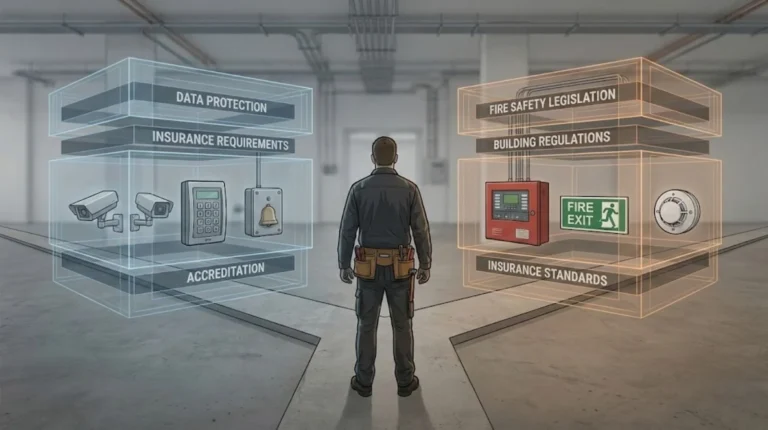
Illustration showing engineer choosing between data protection rules and fire safety legislation.

Qualified electricians increasingly consider diversifying into low-voltage security work—intruder alarms, CCTV, access control, and fire detection systems—attracted by recurring maintenance revenue and perceived similarity to electrical installation. The technical transition appears straightforward at surface level: extra-low voltage circuits operating at 12V or 24V present minimal electric shock risk compared to 230V mains work, and cable installation skills transfer directly. However, the apparent simplicity masks substantial differences in regulatory frameworks, liability exposure, and competence requirements. Extra-low voltage doesn't mean low risk. The liability shifts from preventing electric shock to ensuring system functionality when life safety or property protection depends on correct operation.
Is Level 1 Electrical Installation Worth It? (UK) 

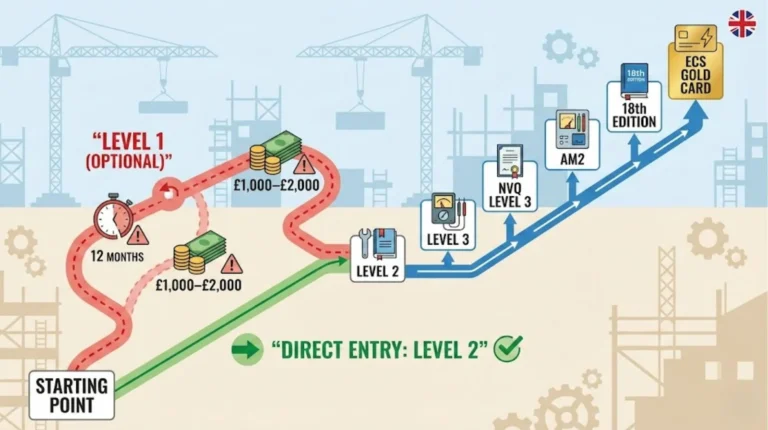
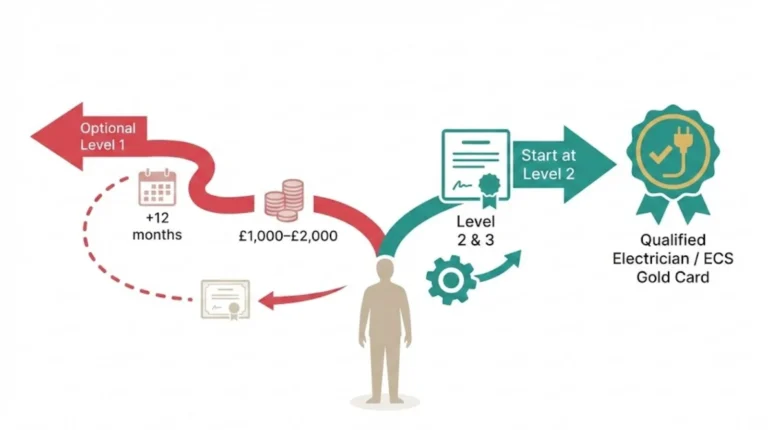
Diagram showing optional Level 1 electrical course versus direct entry to Level 2 and ECS Gold Card.

Level 1 Electrical Installation is an introductory pre-vocational qualification providing basic knowledge of electrical principles, hand tool familiarization, and fundamental health and safety awareness. It holds no legal recognition for electrical competence, grants no ECS card eligibility, and creates no direct employability advantage for most electrical roles. For the approximately 90% of adult career changers who could start directly at Level 2, it represents a costly time detour adding 12 months and £1,000-£2,000 to qualification timelines without reducing subsequent Level 2, Level 3, or NVQ requirements. Level 1 serves legitimate purpose for three specific groups: 16-18 learners lacking GCSE grades (particularly maths and English) required for Level 2 college entry, adults who genuinely struggle with basic numeracy or have never used hand tools and need confidence-building foundation, and individuals wanting low-commitment exploration of electrical trades before committing to full training pathways.

Electrical Fault-Finding Courses: What You Should Know Before Training 

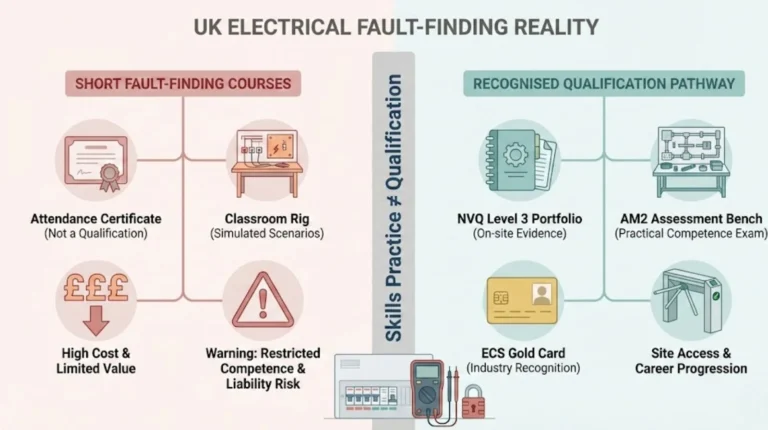
Diagram comparing short fault-finding courses with the recognised UK electrical qualification pathway and real workplace competence.

The electrical training market sells "fault-finding courses" as if they're qualifications. They're not. This is where people get tripped up most often, spending £200-£950 on courses expecting employability credentials but receiving attendance certificates with no industry recognition for site access or insurance purposes. Fault-finding is a diagnostic skill embedded within NVQ Level 3 portfolios and assessed formally in the AM2 end-point test. It's not a standalone qualification you can acquire through short courses, regardless of marketing claims suggesting otherwise. Understanding this distinction before paying for training prevents wasted investment and dangerous overconfidence in safety-critical work.

Daily vs Hourly vs Price-Work Electrician Rates: What UK Electricians Actually Earn 

Diagram showing optional Level 1 versus direct entry at Level 2 in the UK electrical qualification pathway, with time and cost comparisons.

Ask an electrician how much do electricians make and you'll get three completely different answers depending on whether they're paid hourly under a JIB agreement, working CIS day rates through an agency, or doing price-work on new build housing. A £20.25 per hour JIB rate sounds modest compared to a £300 day rate, which in turn sounds pedestrian compared to a domestic installer claiming £55 per socket and completing ten points per day.

Learners are Studying level 2 Electrician Course

Guaranteed Work Placement for Your NVQ

No experience needed. Get started Now.

Prefer to call? Tap here

Learners are Studying level 2 Electrician Course

Guaranteed Work Placement for Your NVQ

No experience needed. Get started Now.

Prefer to call? Tap here

Learners are Studying level 2 Electrician Course

Guaranteed Work Placement for Your NVQ

No experience needed. Get started Now.

Prefer to call? Tap here

Learners are Studying level 2 Electrician Course

Guaranteed Work Placement for Your NVQ

No experience needed. Get started Now.

Prefer to call? Tap here

Enquire Now for Course Information