Day December 31, 2025

ECS vs CSCS Card: What’s the Difference and Which One Do Electricians Need?
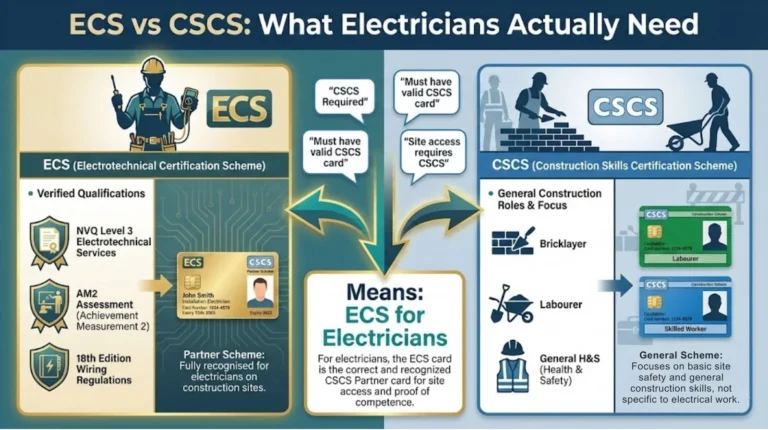
Infographic comparing ECS and CSCS cards, explaining that electricians need an ECS card while CSCS is for general construction roles.

UK electricians encounter persistent confusion distinguishing between ECS (Electrotechnical Certification Scheme) and CSCS (Construction Skills Certification Scheme) cards, often resulting from contradictory information in job advertisements, inconsistent site access policies, and recruitment agents using terminology interchangeably despite fundamental differences between schemes.
What Employers Really Look for When Hiring Mates & Improvers (UK)

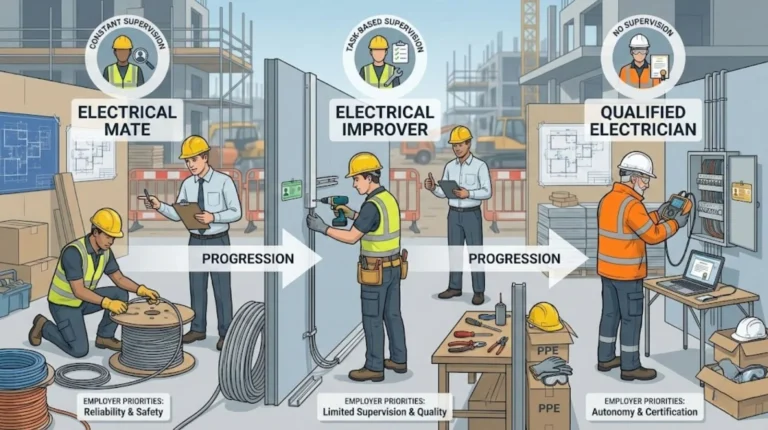
Illustration showing progression from electrical mate to electrical improver to qualified electrician, highlighting supervision levels and responsibilities.

Electrical contractors hiring mates and improvers operate under different decision framework than training providers issuing qualifications. Understanding this distinction prevents costly misunderstandings about employability versus certification. Employers minimize two primary risks: safety liability under Health and Safety Executive Electricity at Work Regulations requiring workers possess adequate competence or supervision, and productivity drain where supervision burden exceeds worker contribution. Candidates reducing these risks get hired. Candidates increasing these risks get rejected regardless of qualification level. 

Commercial vs Domestic vs Industrial Electrician Pay Differences: Which Sector Actually Pays More in 2025?

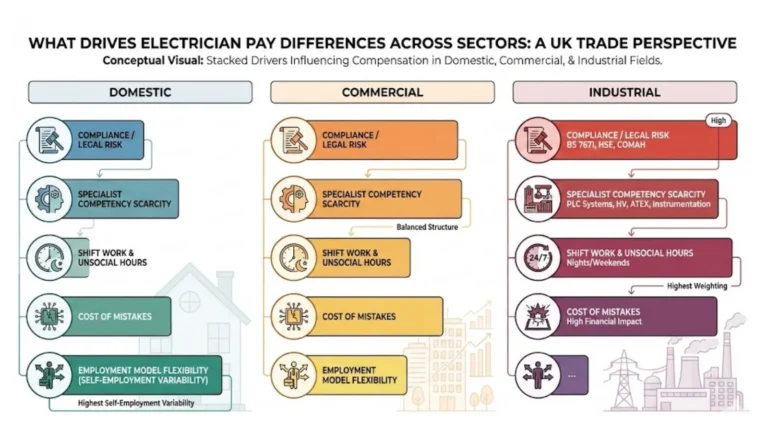
Factors that drive electrician pay differences across domestic, commercial, and industrial sectors in the UK.

Electrician salary varies more by sector than many electricians realise when starting their careers. Domestic electricians working in residential properties, commercial electricians in offices and retail spaces, and industrial electricians in factories and manufacturing plants face fundamentally different working patterns, compliance requirements, technical demands, and pay structures. The assumption that "industrial always pays most" holds true for PAYE medians but obscures substantial variation within each sector driven by employment model, qualifications, and regional positioning.

Self-Employed Electrician Earnings vs Employed Earnings: What You Actually Take Home 

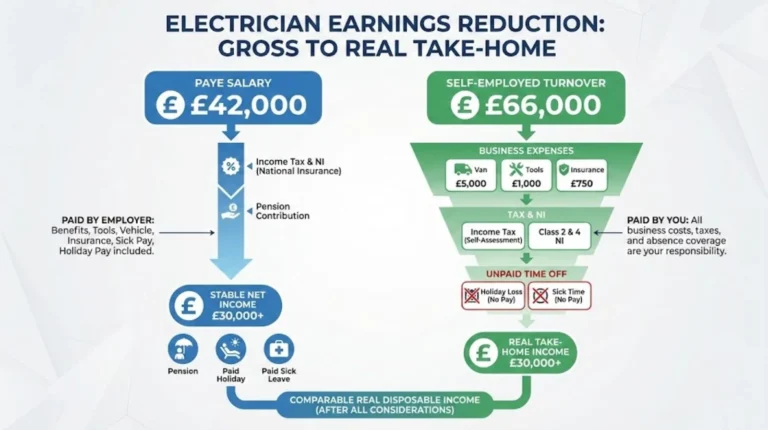
Infographic comparing electrician earnings from gross pay to real take-home income for employed versus self-employed roles.

The conversation about electrician salary in the UK splits into two camps almost immediately. PAYE electricians quote annual salaries of £35,000-£45,000 and talk about stability, paid holidays, and employer pensions. Self-employed electricians mention day rates of £250-£350 and calculate annual earnings north of £60,000. On paper, self-employment appears to offer substantially higher income. In practice, once you account for the cost stack that employed electricians never see (van, fuel, tools, insurance, unpaid holidays, sick time, business admin, tax compliance), the gap between the two models narrows considerably, and in some scenarios disappears entirely.

Electrician Pay vs Plumber vs Gas Engineer vs Carpenter: Which UK Trade Actually Pays More? 

Comparison of tools and certifications for UK electricians, plumbers, gas engineers, and carpenters showing regulatory and competency differences

Questions like "how much do electricians make compared to plumbers?" or "do gas engineers earn more than carpenters?" assume simple answers. They don't exist. ONS data for 2025 shows median full-time earnings of approximately £38,760 for electricians, £35,000-£38,000 for plumbers, £40,000-£45,000 for gas engineers (often bundled with plumbers in official statistics), and £32,000-£35,000 for carpenters. At first glance, gas engineers appear to earn most, carpenters least, with electricians and plumbers in between.

Electrician Pay by Years of Experience: What 1, 5, and 10+ Years Actually Earns You 

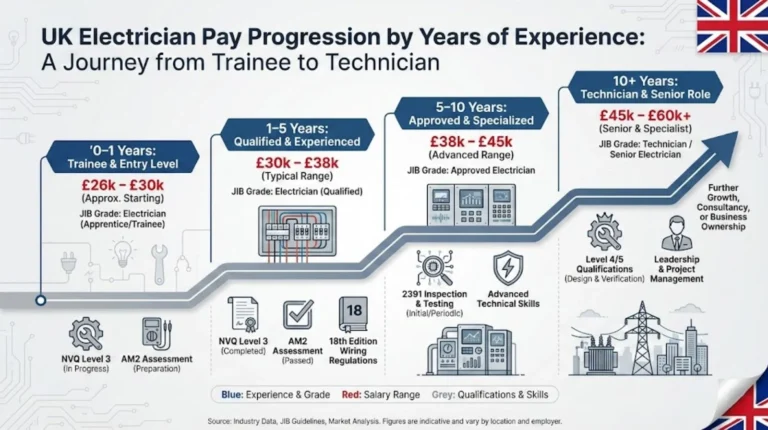
UK electrician pay progression by years of experience, from trainee to senior technician, with salary ranges and qualification milestones.

When researching electrician salary uk data, you'll find broad ranges that seem unhelpful: £26,000 to £60,000+ depending on "experience." What these ranges don't explain is how pay actually progresses from year one to year ten, why two electricians with identical years of experience can earn £10,000-£20,000 apart, or when experience stops driving pay increases without additional qualifications or sector changes.

Learners are Studying level 2 Electrician Course

Guaranteed Work Placement for Your NVQ

No experience needed. Get started Now.

Prefer to call? Tap here

Learners are Studying level 2 Electrician Course

Guaranteed Work Placement for Your NVQ

No experience needed. Get started Now.

Prefer to call? Tap here

Learners are Studying level 2 Electrician Course

Guaranteed Work Placement for Your NVQ

No experience needed. Get started Now.

Prefer to call? Tap here

Learners are Studying level 2 Electrician Course

Guaranteed Work Placement for Your NVQ

No experience needed. Get started Now.

Prefer to call? Tap here

Enquire Now for Course Information