Day January 5, 2026

Common NVQ Portfolio Mistakes (and How to Avoid Them) 
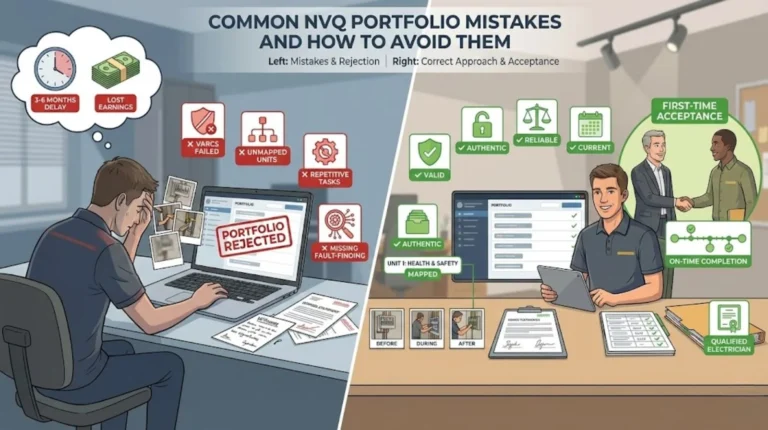
Split graphic showing common NVQ portfolio mistakes causing rejection on the left, and correct evidence, mapping, and verification leading to first-time acceptance on the right.

You've worked 15 months on electrical sites documenting installations across domestic rewires, commercial fit-outs, and industrial maintenance. Your portfolio contains 150 photos showing consumer unit installations, containment work, testing procedures, and circuit commissioning. Witness statements from qualified supervisors confirm you completed documented work. Testing certificates prove installations met BS 7671 requirements. Then your assessor reviews the portfolio and sends everything back requesting major corrections. What went wrong? The brutal reality is that volume doesn't equal quality in NVQ portfolios. Having 150 photos means nothing if they don't prove your personal competence through clear attribution, proper context, and systematic mapping to unit performance criteria.

Why Fast Track Appeals to Adults (Motivation, Time, Money Pressures) 

illustration comparing a 4-year electrical apprenticeship classroom with a 12–16 week fast-track retraining classroom, highlighting different timelines and learner profiles.

If you're researching electrical training in your 30s, 40s, or 50s, you've probably noticed fast-track courses dominate the search results whilst apprenticeships seem aimed at teenagers. That's not an accident. Fast-track providers specifically target adult career changers because they understand something traditional colleges don't: adults face completely different pressures than 18-year-olds. 

The Impact of Self-Employment on Electrician Income: Gross Earnings vs Net Reality 

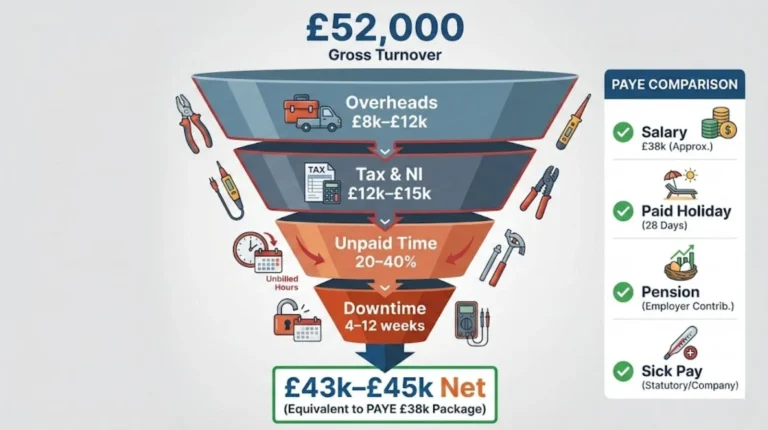
Infographic funnel showing £52,000 gross self-employed electrician turnover reduced by overheads, tax, unpaid time, and downtime to £43k–£45k net, compared with a £38k PAYE salary.

Self-employment's impact on electrician income requires examining the comprehensive analysis of electrician earnings across employment models distinguishing between gross turnover (total invoiced), business profit (after overheads), and net take-home pay (after tax/NI), because the common perception that "self-employed electricians earn significantly more" conflates gross day rates or hourly charges with actual disposable income. A PAYE electrician earning £38,000 annual salary takes home approximately £29,500 after tax and National Insurance with zero overhead costs, 28 days paid holiday (£4,200 value), 3-5% employer pension contribution (£1,140-£1,900 value), sick pay protection, and employer-funded training. A self-employed electrician charging £300/day achieving £60,000 gross turnover appears vastly superior until accounting for £7,000-£12,000 annual overheads (van, insurance, tools, compliance), £12,000-£15,000 tax/NI, self-funded holidays and training, resulting in £33,000-£41,000 net take-home—only 12-39% higher than PAYE despite 58% higher gross.

Short Electrical Courses (1–5 Days) – What They’re Actually Worth 

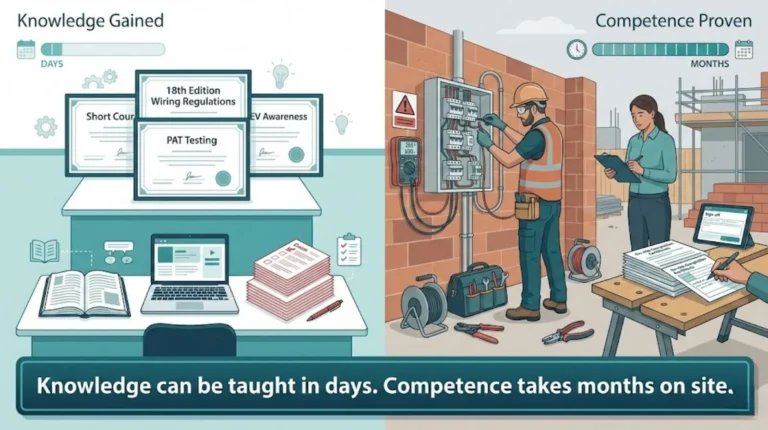
Split illustration comparing classroom certificates and short courses with on-site electrical work, showing knowledge gained in days versus competence proven over months.

Short electrical courses lasting one to five days dominate online training advertising, aggressive social media marketing, and career change promotional content targeting working adults seeking rapid entry into electrical trades without abandoning current employment or investing years in qualification pathways, with providers marketing intensive weekend workshops, evening intensive blocks, and compressed delivery promising substantial skill development and career advancement in days rather than months or years required for traditional electrical qualifications.

JIB Apprentice Rates Explained: Electrical Apprentice Pay in 2026 

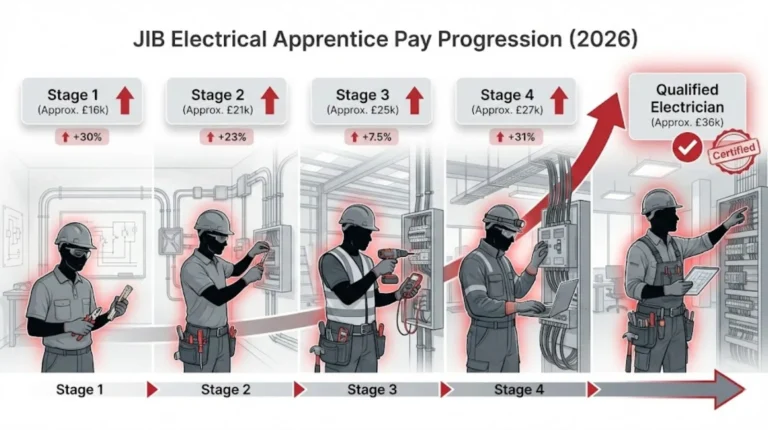
JIB electrical apprentice pay progression in 2026, from Stage 1 through Stage 4, leading to a qualified electrician role with increasing responsibilities and earnings.

The jib apprentice rates for 2026 establish four-stage progression structure defining minimum wages for electrical apprentices employed by Joint Industry Board member firms across England, Wales, and Northern Ireland, with rates ranging from Stage 1 at £8.16/hour (£15,912 annually at standard 37.5-hour weeks, entry-level first year apprentices beginning electrical training with basic installation competence development) through Stage 2 at £10.60/hour (£20,670 annually, +30% increase reflecting intermediate circuit work and NVQ progression), Stage 3 at £13.05/hour (£25,448 annually, +23% for advanced systems installation and Level 3 completion), to Stage 4 at £14.03/hour (£27,359 annually, +7.5% for final year apprentices approaching AM2 practical assessment and qualification completion ready for Electrician grading).

Electrician Training in Wolverhampton for Adults and Career Changers 

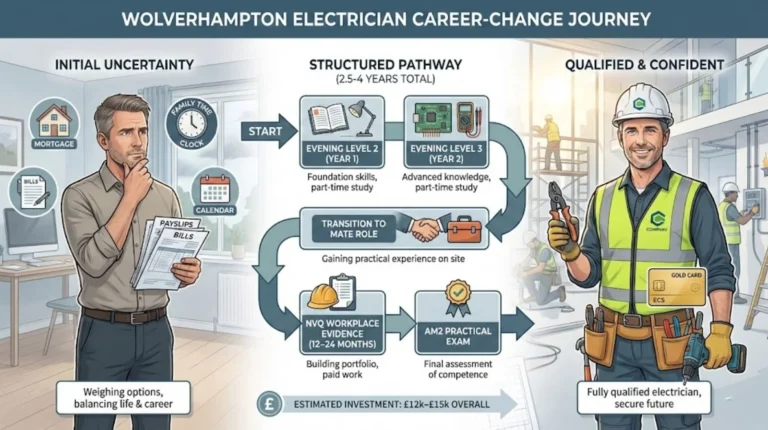
Illustrated roadmap titled “Wolverhampton Electrician Career-Change Journey,” showing progression from initial uncertainty through evening Level 2 and Level 3 study, transition to a mate role, NVQ workplace evidence, AM2 assessment, and finally a confident, fully qualified electrician holding an ECS Gold Card.

If you're 28, 35, 42, or older and you're looking at retraining as an electrician in Wolverhampton, you're probably asking yourself whether it's realistic. You've got a mortgage, maybe kids, definitely bills. You can't just quit your job and hope for the best. You need a pathway that actually works for adults with responsibilities. Here's what matters: Wolverhampton has legitimate routes for career changers, but the journey from zero electrical experience to qualified electrician isn't a single course you can knock out over a few weekends.

JIB Electrician Rates Explained What Each Rate Means in Practice

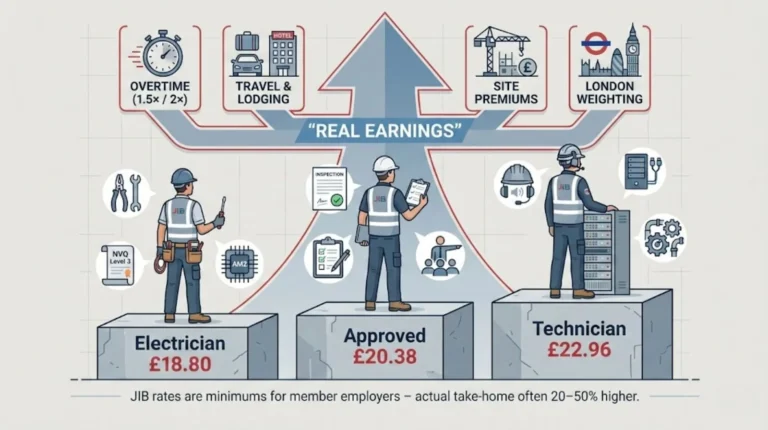
Electrician pay progression from Electrician to Approved and Technician, with overtime, travel, site premiums, and London weighting increasing real earnings.

JIB electrician rates represent the minimum hourly wages for qualified electrical operatives working under Joint Industry Board collective agreements in England, Wales, and Northern Ireland, but understanding what these rates actually mean requires distinguishing between the headline hourly figure (the "floor" that participating employers cannot legally pay below), the employment framework creating those minimums (collective bargaining between Electrical Contractors' Association employers and Unite the Union members applicable only to JIB member firms), and the real-world take-home earnings electricians experience after accounting for overtime premiums at time-and-a-half or double-time, travel allowances compensating distance beyond 15 miles from employer base, lodging payments for working away from home, shift premiums for night work, and regional uplifts like London weighting adding £2-3/hour to base rates.

Electrical Courses in Birmingham: Level 2, Level 3 and NVQ Explained 

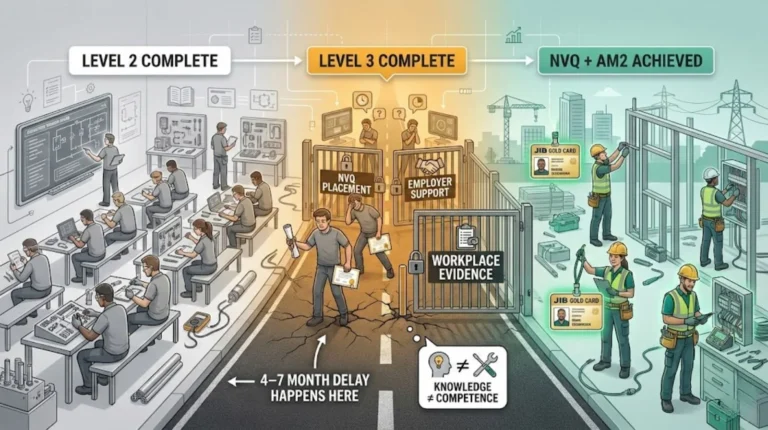
Electrician pathway showing Level 2 and Level 3 classroom training, a delay at NVQ placement and workplace evidence, and progression to NVQ + AM2 with ECS Gold Card.

You've just paid £3,800 for what Birmingham training centre advertisements called a "Level 3 Professional Electrician Course." The certificate arrives. City & Guilds 2365-03 Diploma in Electrical Installations. You apply for electrician positions on Indeed and Reed. Every rejection email says the same thing: "We require NVQ Level 3 and AM2 assessment." Here's what the training centre didn't explain upfront: Level 3 diplomas prove you understand electrical theory. NVQ Level 3 proves you can safely perform electrical work on real sites under real conditions.

Learners are Studying level 2 Electrician Course

Guaranteed Work Placement for Your NVQ

No experience needed. Get started Now.

Prefer to call? Tap here

Learners are Studying level 2 Electrician Course

Guaranteed Work Placement for Your NVQ

No experience needed. Get started Now.

Prefer to call? Tap here

Learners are Studying level 2 Electrician Course

Guaranteed Work Placement for Your NVQ

No experience needed. Get started Now.

Prefer to call? Tap here

Learners are Studying level 2 Electrician Course

Guaranteed Work Placement for Your NVQ

No experience needed. Get started Now.

Prefer to call? Tap here

Enquire Now for Course Information