


- Technical review: Thomas Jevons (Head of Training, 20+ years)
- Employability review: Joshua Jarvis (Placement Manager)
- Editorial review: Jessica Gilbert (Marketing Editorial Team)
- Last reviewed:
- Changes: Initial publication using JIB Industrial Determination 2025-2027, CPI forecasts November 2025, SJIB Scotland rates, NAECI Grade 5/6 comparisons, and ONS median earnings data
Introduction
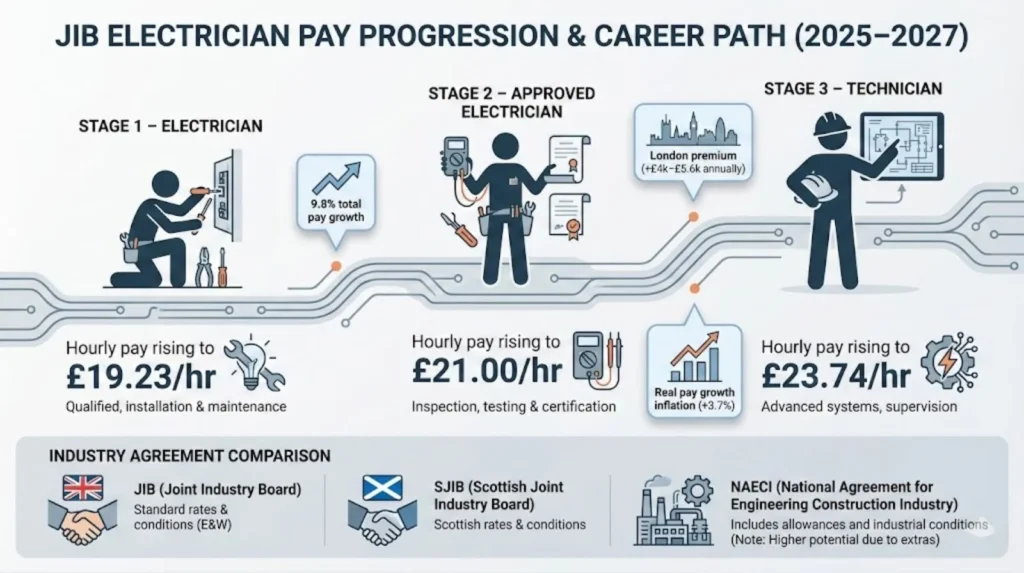
JIB pay bands are the most widely used wage framework for PAYE electricians working in England, Wales, and Northern Ireland, but headline hourly rates tell only part of the story. The difference between an Electrician earning £19.23 per hour and a Technician earning £23.74 per hour in 2027 represents not just a 23.4% pay gap but distinct levels of qualification, competence, and responsibility. Add regional variations (National versus London Zone), transport arrangements (Transport Provided versus Own Transport), and the impact of inflation on purchasing power, and the apparently simple question of “What do electricians actually earn?” becomes significantly more complex.
The 2025 to 2027 period offers unusual clarity because the JIB agreement confirmed multi-year increases rather than single-year settlements: 5.0% in January 2025, 3.95% in January 2026, and 4.6% in January 2027, with January 2028 already agreed at 4.85%. This allows genuine comparison of how pay progresses across grades and years, factoring in inflation forecasts to determine whether electricians experience real-terms wage growth or simply nominal cash increases that fail to match rising living costs. For anyone planning electrical qualifications, assessing career progression, or comparing job offers, understanding these pay bands and how they interact with grade status, location, and market conditions is essential.
This article breaks down what JIB pay bands actually mean across the three core grades (Electrician, Approved Electrician, Technician), how confirmed 2025-2027 rates translate into weekly and annual earnings, how much purchasing power these increases deliver once inflation is factored in, where London Zone premiums sit relative to higher living costs, and how JIB rates compare to SJIB Scotland and NAECI industrial frameworks plus UK median earnings. The goal is to move beyond headline figures to show what these numbers mean for career planning, job comparison, and long-term earning potential. For comprehensive background on how JIB pay structures integrate with qualification pathways, NVQ Level 3 requirements, and the complete route from training to Approved Electrician status, we’ve covered the full electrical training framework and employment support structure.
What JIB Pay Bands Actually Mean
Understanding JIB pay requires distinguishing between grades, regional variants, and transport arrangements, each of which affects the final hourly rate and total annual earnings.
The Three Core Grades
Electrician: Qualified operative holding JIB Gold Card (Electrician grade). Has completed NVQ Level 3 Diploma in Installing Electrotechnical Systems and Equipment (2357), passed AM2/AM2E practical assessment, and holds 18th Edition BS 7671 certification. Competent in installation and maintenance work but not necessarily inspection, testing, and certification to full industry standards.
Approved Electrician: Fully qualified operative holding JIB Gold Card (Approved Electrician grade). Has completed all Electrician requirements plus demonstrated inspection and testing capability (typically via AM2E assessment with inspection/testing components). Authorized to inspect, test, and certify electrical installations. This is the grade most electricians aim for as it enables independent work and full site responsibility.
Technician: High-level technical operative, often in supervisory or specialist roles. Holds Approved Electrician qualifications plus additional competencies such as HNC/HND, advanced fault-finding, complex system design, or site supervision. Some Technicians progress from Approved status after 5-10 years; others enter via engineering routes. This grade represents the top tier of JIB operative pay before moving into management or engineering positions.
Regional Variants: National vs London
National Standard: The baseline rate for England, Wales, and Northern Ireland excluding the M25 London Zone. Applies to work in Birmingham, Manchester, Leeds, Newcastle, Cardiff, Belfast, and all other regions outside defined London boundaries.
London Zone: Enhanced rate for work within the M25 and defined Inner London areas. Reflects higher living costs, transport expenses, and housing costs specific to London. The premium varies by grade but typically adds £1-2 per hour, translating to £2,000-£4,000 annually.
Transport Arrangements: Transport Provided vs Own Transport
Transport Provided (TP): The employer provides transport to site, either via company vehicle, organized minibus, or specific transport arrangements. The hourly rate reflects base pay for work performed. This is the standard comparison rate used in most wage discussions.
Own Transport (OT): The operative provides their own vehicle and handles travel logistics. The hourly rate is grossed up to compensate for fuel, vehicle maintenance, insurance, wear-and-tear, and travel provision responsibility. Own Transport rates appear approximately £1-1.20 higher per hour than Transport Provided rates, but this reflects expense reimbursement incorporated into the gross rate, not additional discretionary income.
Thomas Jevons, Head of Training at Elec Training, explains the critical distinction:
"Own Transport rates look higher on paper - £22.16 versus £21.00 for Approved Electrician National in 2027 - but that's because the rate is grossed up to reflect travel provision responsibility. The additional £1.16 per hour compensates for fuel, vehicle maintenance, insurance, and wear-and-tear. It's not 'extra money' in the sense of discretionary income. Transport Provided means the employer handles logistics, which many electricians prefer despite the lower headline rate."
Thomas Jevons, Head of Training
How Pay Bands Combine
The combination of grade + region + transport creates 12 distinct pay bands:
Electrician National TP
Electrician National OT
Electrician London TP
Electrician London OT
Approved Electrician National TP
Approved Electrician National OT
Approved Electrician London TP
Approved Electrician London OT
Technician National TP
Technician National OT
Technician London TP
Technician London OT
Each band has different hourly rates, and each increases at the same percentage year-on-year, maintaining relative gaps between grades while providing consistent growth across the framework.
Critical context: JIB rates are PAYE framework rates negotiated between the Electrical Contractors’ Association (ECA) and Unite the Union. They apply to electricians employed directly by electrical contractors on standard employment contracts. They do not apply to agency workers (who may earn more or less depending on market conditions), CIS self-employed electricians (who invoice at different rates and handle their own tax), or electricians working for non-JIB employers (who may use JIB rates as a benchmark but aren’t legally bound to them).
The Confirmed JIB Pay Deal: 2025-2027
The JIB wage agreement for this period represents a multi-year settlement providing certainty rather than annual renegotiation:
January 2025: 5.0% increase across all grades and bands. This was the final year of the previous multi-year deal, bringing rates from 2024 baseline to 2025 confirmed levels.
January 2026: 3.95% increase across all grades and bands. First year of the new three-year agreement running through 2028.
January 2027: 4.6% increase across all grades and bands. Second year of the current agreement.
January 2028: 4.85% increase (already confirmed but outside this article’s analytical scope).
Cumulative impact 2025-2027: Compounding these increases produces approximately 9.8% total growth over the two-year period from 2025 to 2027. This is calculated as: (1.05 × 1.0395 × 1.046) – 1 = 0.0983 or 9.83%.
Why Multi-Year Agreements Matter
Single-year settlements create annual uncertainty for both electricians and employers. Multi-year agreements provide:
Planning certainty: Electricians can project future earnings for mortgage applications, family budgets, and career decisions. Employers can forecast wage costs for multi-year contracts and project bids.
Reduced negotiation disruption: Annual negotiations consume union and employer resources and create potential for industrial action. Multi-year deals reduce this frequency.
Inflation tracking: The structure allows comparison against inflation forecasts to determine whether real-terms wage growth is being delivered, not just nominal cash increases.
Structured progression: Knowing 2026 and 2027 rates in advance allows electricians to calculate earning potential at different career stages and compare qualification investment against future returns.
The 2025-2027 settlement was negotiated in late 2024 when inflation forecasts showed CPI declining from 3.5% (2025) to 2.5% (2026) to 2.0% (2027), creating conditions where wage increases could outpace inflation and deliver real purchasing power growth.
JIB Pay Bands by Grade: 2025 vs 2026 vs 2027
These tables show how each grade progresses across the three-year period, translating hourly rates into weekly gross (37.5 hours) and annual gross earnings.
Electrician Grade Progression
National Standard (Transport Provided):
| Year | Hourly Rate | Weekly Gross (37.5h) | Annual Gross |
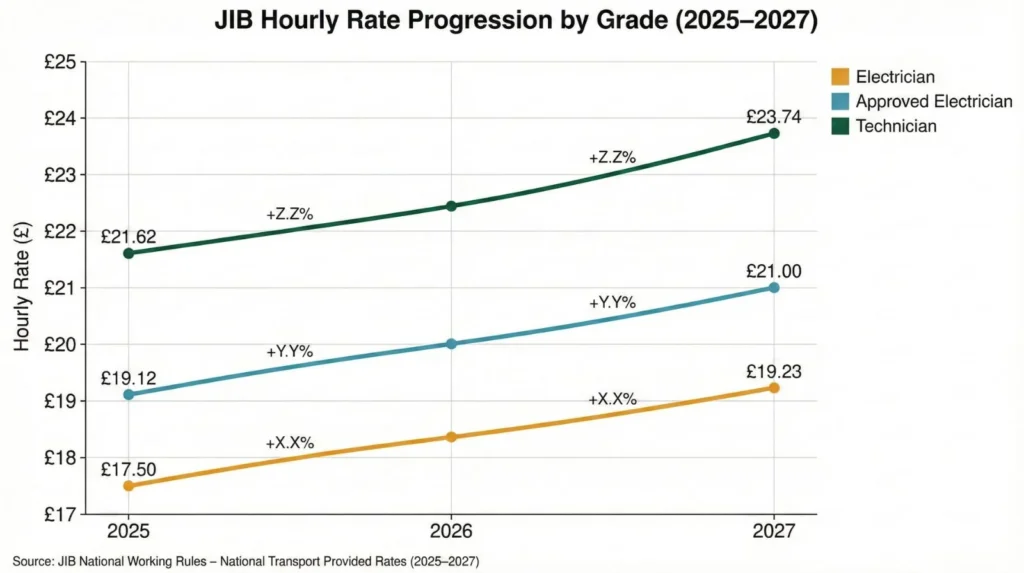
| 2025 | £17.50 | £656.25 | £34,125 |
| 2026 | £18.38 | £689.25 | £35,841 |
| 2027 | £19.23 | £721.12 | £37,498 |
Change 2025-2027: +£1.73/hour, +£64.87 weekly, +£3,373 annually (+9.89%)
London Zone (Transport Provided):
| Year | Hourly Rate | Weekly Gross (37.5h) | Annual Gross |
| 2025 | £19.60 | £735.00 | £38,220 |
| 2026 | £20.58 | £771.75 | £40,131 |
| 2027 | £21.53 | £807.37 | £41,983 |
Change 2025-2027: +£1.93/hour, +£72.37 weekly, +£3,763 annually (+9.85%)
London Premium (2027): £2.30 per hour, £86.25 weekly, £4,485 annually over National rate
Approved Electrician Grade Progression
National Standard (Transport Provided):
| Year | Hourly Rate | Weekly Gross (37.5h) | Annual Gross |
| 2025 | £19.12 | £717.00 | £37,284 |
| 2026 | £20.08 | £753.00 | £39,156 |
| 2027 | £21.00 | £787.50 | £40,950 |
Change 2025-2027: +£1.88/hour, +£70.50 weekly, +£3,666 annually (+9.83%)
National Standard (Own Transport):
| Year | Hourly Rate | Weekly Gross (37.5h) | Annual Gross |
| 2025 | £20.18 | £756.75 | £39,351 |
| 2026 | £21.19 | £794.62 | £41,320 |
| 2027 | £22.16 | £831.00 | £43,212 |
Change 2025-2027: +£1.98/hour, +£74.25 weekly, +£3,861 annually (+9.81%)
Own Transport Premium (2027): £1.16 per hour, £43.50 weekly, £2,262 annually over Transport Provided
London Zone (Transport Provided):
| Year | Hourly Rate | Weekly Gross (37.5h) | Annual Gross |
| 2025 | £21.41 | £802.87 | £41,749 |
| 2026 | £22.48 | £843.00 | £43,836 |
| 2027 | £23.51 | £881.62 | £45,844 |
Change 2025-2027: +£2.10/hour, +£78.75 weekly, +£4,095 annually (+9.81%)
London Premium (2027): £2.51 per hour, £94.12 weekly, £4,894 annually over National rate
Key observation: Approved Electrician is the most common target grade for fully qualified electricians. The 2027 National Transport Provided rate of £21.00 per hour (£40,950 annually) represents the baseline earning potential for most Gold Card electricians working outside London. The Own Transport variant (£22.16/hour, £43,212 annually) reflects expense-compensated travel provision rather than additional discretionary income.
Technician Grade Progression
National Standard (Transport Provided):
| Year | Hourly Rate | Weekly Gross (37.5h) | Annual Gross |
| 2025 | £21.62 | £810.75 | £42,159 |
| 2026 | £22.70 | £851.25 | £44,265 |
| 2027 | £23.74 | £890.25 | £46,293 |
Change 2025-2027: +£2.12/hour, +£79.50 weekly, +£4,134 annually (+9.81%)
London Zone (Transport Provided):
| Year | Hourly Rate | Weekly Gross (37.5h) | Annual Gross |
| 2025 | £24.26 | £909.75 | £47,307 |
| 2026 | £25.47 | £955.12 | £49,666 |
| 2027 | £26.64 | £999.00 | £51,948 |
Change 2025-2027: +£2.38/hour, +£89.25 weekly, +£4,641 annually (+9.81%)
London Premium (2027): £2.90 per hour, £108.75 weekly, £5,655 annually over National rate
Grade gap analysis (2027 National TP):
Approved Electrician to Technician: +£2.74/hour, +£102.75 weekly, +£5,343 annually (+13.0% earnings increase)
Electrician to Approved Electrician: +£1.77/hour, +£66.38 weekly, +£3,452 annually (+9.2% earnings increase)
Interpretation: The percentage gap between Electrician and Approved Electrician (9.2%) is smaller than the gap between Approved and Technician (13.0%), reflecting that Technician status typically requires additional qualifications (HNC/HND) or significant supervisory responsibility beyond standard electrical work. Many electricians remain at Approved status throughout their careers; progression to Technician is selective rather than automatic.
Nominal vs Real Pay: What These Rises Are Worth
Cash increases mean little if inflation erodes purchasing power faster than wages rise. Understanding real-terms growth requires comparing nominal pay increases against inflation rates.
Nominal Pay Growth Explained
Nominal pay growth is the percentage increase in cash wages year-on-year, regardless of inflation. When JIB rates increase 5.0% from 2025 to 2026, an Approved Electrician moves from £19.12 to £20.08 per hour – a nominal £0.96 increase or 5.02%.
Real Pay Growth Explained
Real pay growth adjusts nominal increases for inflation to show changes in actual purchasing power. The formula is:
Real Growth (%) ≈ Nominal Growth (%) – Inflation Rate (%)
More precisely: Real Growth = [(1 + Nominal) ÷ (1 + Inflation)] – 1
If nominal wages rise 5.0% but inflation runs at 3.5%, real growth is approximately 1.5% – wages increased faster than prices, meaning electricians can afford more goods and services. If nominal wages rise 3.0% but inflation runs at 4.0%, real growth is approximately -1.0% – wages increased but purchasing power declined because prices rose faster.
Inflation Context: 2025-2027 Forecasts
Using CPI (Consumer Prices Index) as proxy for CPIH (including housing costs):
2025: CPI forecast 3.5% (OBR November 2025 projection) 2026: CPI forecast 2.5% (OBR November 2025 projection) 2027: CPI forecast 2.0% (Bank of England target/OBR forecast)
Cumulative 2025-2027: Approximately 6.09% total inflation over the two-year period.
Real Pay Change Analysis by Year
2025 to 2026:
Nominal increase: 5.0% (confirmed JIB agreement)
Inflation forecast: 3.5% CPI
Real pay growth: +1.5%
2026 to 2027:
Nominal increase: 4.6% (confirmed JIB agreement)
Inflation forecast: 2.5% CPI
Real pay growth: +2.1%
Cumulative 2025 to 2027:
Nominal increase: 9.8%
Inflation forecast: 6.09%
Real pay growth: +3.7%
What This Means for Electricians
2025-2026: Real purchasing power increases modestly. An Approved Electrician earning £19.12 in 2025 moves to £20.08 in 2026 – enough to slightly outpace rising food, energy, and transport costs.
2026-2027: Stronger real growth as inflation moderates to 2.5% while wages rise 4.6%. Electricians gain meaningful purchasing power, not just nominal cash.
Overall 2025-2027: The 9.8% nominal increase delivers 3.7% real-terms growth after inflation, meaning electricians experience genuine living standard improvements over the period. This contrasts with 2022-2023 when inflation exceeded 10% and wage increases typically lagged, creating real-terms pay cuts despite nominal raises.
Critical insight: The multi-year JIB deal was structured assuming inflation would moderate from high 2024 levels toward the Bank of England’s 2% target. If inflation remains higher than forecast (for example, if 2026 CPI averages 3.5% instead of 2.5%), real pay growth would be lower than projected. Conversely, if inflation falls faster (averaging 2.0% in 2026), real gains would exceed projections.
National vs London: How Big Is the Gap?
London Zone rates compensate for higher living costs within the M25, but the premium rarely translates into superior net financial positions once housing, transport, and general living expenses are considered.
The London Premium by Grade (2027)
Hourly rate gaps (London TP minus National TP):
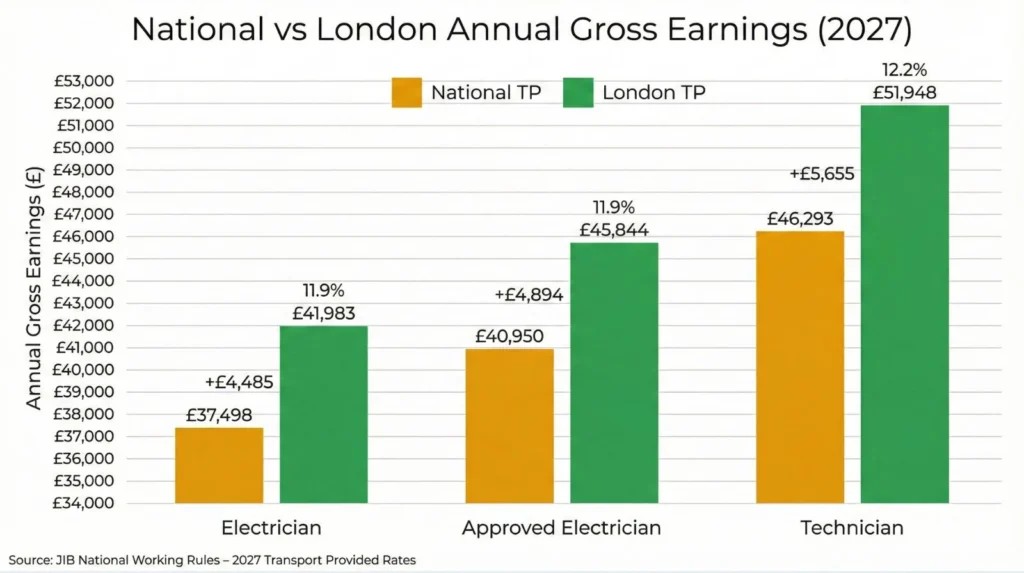
Electrician: £21.53 – £19.23 = £2.30 per hour
Approved Electrician: £23.51 – £21.00 = £2.51 per hour
Technician: £26.64 – £23.74 = £2.90 per hour
Annual gross gaps (37.5 hours weekly):
Electrician: £41,983 – £37,498 = £4,485 annually (11.9% premium)
Approved Electrician: £45,844 – £40,950 = £4,894 annually (11.9% premium)
Technician: £51,948 – £46,293 = £5,655 annually (12.2% premium)
Cost-of-Living Context
The London premium is not discretionary income but compensation for structural cost differences:
Housing: Average monthly rent for one-bedroom flat in London: £1,800-£2,500 (Zone 2-4). Outside London (Birmingham, Manchester, Leeds): £700-£1,100. Annual difference: £13,200-£16,800.
Transport: London Zone 1-4 annual Travelcard: £2,500-£3,000. Outside London car ownership + fuel: £2,000-£3,000 annually (comparable, but London workers often forgo vehicle ownership).
General living costs: Food, utilities, and council tax run approximately 15-20% higher in London versus UK average.
Net effect: The £4,485-£5,655 London premium roughly offsets higher housing costs (covering 27-43% of typical rent differential) but does not fully compensate for total cost-of-living gap. Electricians working London projects are not necessarily financially better off in terms of disposable income or savings capacity than those working Midlands or Northern regions.
Why Electricians Choose London Work
Despite limited net financial advantage, London work remains attractive for:
Career development: Large-scale commercial projects, data centres, rail infrastructure, and high-profile builds concentrated in London provide exposure to complex installations and advanced systems.
Higher qualification pipeline: London contractors more likely to support progression to Technician status due to project complexity requiring supervisory capability.
Networking: Larger electrical contracting community, greater employer choice, stronger union presence.
Project diversity: Mix of commercial, residential, industrial, and infrastructure work within compact geographic area.
The decision to work London versus regional markets depends on career stage, housing situation (living with family versus renting independently), and whether the complexity premium justifies higher living costs.
JIB vs SJIB vs NAECI: Context, Not Confusion
JIB is the primary wage framework for electrical contractors in England, Wales, and Northern Ireland, but understanding how it compares to Scotland’s SJIB and the industrial NAECI framework provides valuable context for electricians considering work across different sectors or regions.
SJIB (Scottish Joint Industry Board)
SJIB operates Scotland’s equivalent electrical framework with key structural differences:
Shop Rate vs Travel Rate:
Shop Rate: Base rate for work at or near employer’s premises
Travel Rate: Enhanced rate for work at external sites (standard for most project work)
SJIB Travel Rates are the appropriate comparison to JIB National rates, as both reflect typical site work rather than base workshop rates.
2027 SJIB Travel Rates:
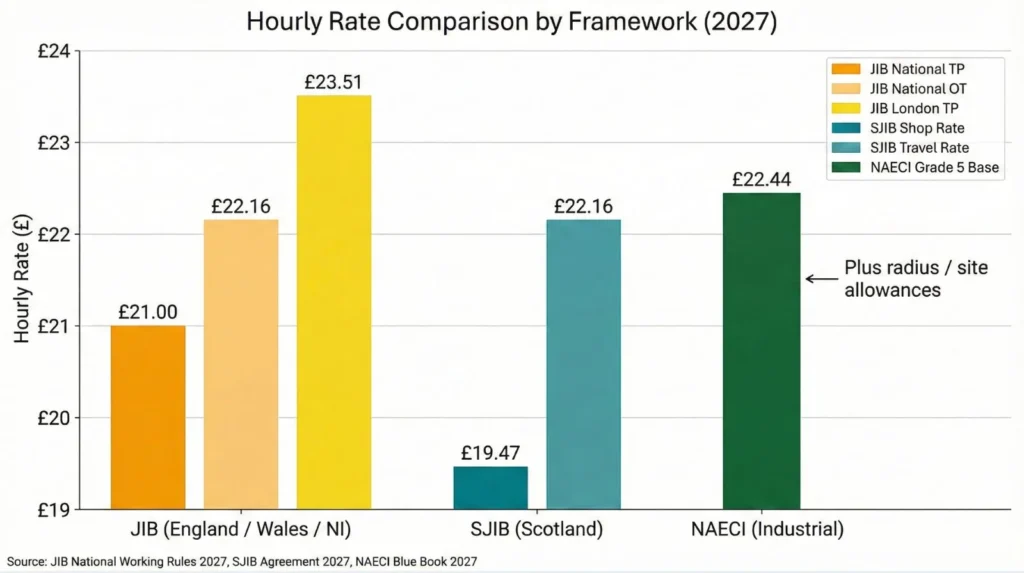
Electrician: £20.44 per hour (vs JIB National £19.23 – SJIB 6.3% higher)
Approved Electrician: £22.16 per hour (vs JIB National £21.00 – SJIB 5.5% higher)
Technician: £24.97 per hour (vs JIB National £23.74 – SJIB 5.2% higher)
Key observations:
SJIB Travel rates consistently exceed JIB National Transport Provided rates by 5-6% across all grades. However, SJIB Own Transport rates (£22.16 for Approved Electrician in 2027) precisely match JIB National Own Transport rates (also £22.16), suggesting both frameworks use similar methodologies for grossing up rates to compensate vehicle provision.
Scotland has no equivalent to London Zone premiums; SJIB rates are uniform across Scotland whether working Glasgow, Edinburgh, Aberdeen, or rural areas. The 5-6% SJIB premium over JIB National partly reflects Scotland’s distinct industrial relations framework and cost-of-living patterns rather than being directly comparable “better pay.”
NAECI (National Agreement for the Engineering Construction Industry)
NAECI governs major industrial projects including oil refineries, gas processing plants, power stations, petrochemical facilities, and large-scale process engineering. The framework differs fundamentally from JIB:
Grades: NAECI uses Grade 1-8 structure rather than Electrician/Approved/Technician Scope: Industrial electrical work, often requiring additional certifications (scaffolding awareness, confined spaces, CCNSG, etc.) Allowances: Comprehensive radius allowances, site allowances, and accommodation provisions integrated into pay structure
2025 NAECI Base Rates (latest confirmed):
Grade 5 (Advanced Craft, comparable to Approved Electrician): £22.44 per hour base
Grade 6 (Mechanical/Electrical Supervisor, comparable to Technician): £23.38 per hour base
JIB 2025 Comparison:
JIB Approved Electrician National: £19.12 per hour (NAECI Grade 5 17.4% higher)
JIB Technician National: £21.62 per hour (NAECI Grade 6 8.1% higher)
Critical context: NAECI base rates sit above JIB rates but reflect industrial working conditions (shift patterns, site accommodation, extended hours, shutdown work, hazardous environments). NAECI roles also include extensive allowances for radius (distance from home), subsistence, and site-specific conditions that add substantially to base rates. Total NAECI packages can reach £30-35 per hour effective rate on major shutdowns or remote industrial sites, but this reflects compressed working periods and challenging conditions rather than standard ongoing employment.
When NAECI applies: Electricians working Hinkley Point C nuclear, Drax power station upgrades, North Sea offshore, petrochemical refineries, or large process plants typically fall under NAECI rather than JIB. Most commercial and residential electrical contractors use JIB.
Framework Selection: What Matters for Electricians
JIB: Standard for commercial electrical contractors, M&E firms, maintenance companies, facility management, and general electrical installation work. Covers vast majority of UK electrical employment.
SJIB: Standard for Scottish electrical contractors. Rates slightly higher than JIB but Scotland-specific.
NAECI: Industrial/process engineering electrical work. Higher rates but limited to specific project types and often requires additional certifications and willingness to work shutdowns/shifts.
Electricians don’t typically “choose” between frameworks; rather, the employer’s business sector determines which agreement applies. A JIB electrician can transition to NAECI work by gaining industrial certifications and applying for shutdown projects, but this represents a career shift rather than simply seeking higher pay.
How JIB Pay Compares to UK Median Earnings
Placing JIB rates within broader UK wage distribution shows where electricians sit relative to national earnings.
UK Median Hourly Earnings (2025)
ONS Annual Survey of Hours and Earnings (ASHE) data:
UK median hourly wage (all full-time workers): £19.67 per hour
Electricians and electrical fitters median (SOC 5241): £18.04 per hour
JIB Comparison (2025 Rates)
JIB Electrician National TP: £17.50 per hour
Below UK median (all workers): -£2.17 per hour (-11.0%)
Below electrician median: -£0.54 per hour (-3.0%)
JIB Approved Electrician National TP: £19.12 per hour
Below UK median (all workers): -£0.55 per hour (-2.8%)
Above electrician median: +£1.08 per hour (+6.0%)
JIB Technician National TP: £21.62 per hour
Above UK median (all workers): +£1.95 per hour (+9.9%)
Above electrician median: +£3.58 per hour (+19.8%)
Key Observations
Electrician grade slightly below ONS median: The entry-level JIB Gold Card grade (£17.50 in 2025, £19.23 in 2027) sits marginally below the UK-wide median for all full-time workers and below the electrician occupation median. This reflects that “Electrician” grade requires Gold Card but not necessarily inspection/testing capability or extensive experience.
Approved Electrician crosses UK median: The £19.12 rate (2025) sits very close to UK median (£19.67) and exceeds the electrician occupation median by 6.0%. By 2027 (£21.00), Approved Electrician will sit clearly above both benchmarks. This is the grade most Gold Card electricians achieve after 2-3 years post-qualification.
Technician well above median: At £21.62 (2025) rising to £23.74 (2027), Technician grade places electricians in the upper earnings tier for skilled trades. The 19.8% premium over electrician median reflects supervisory responsibility and advanced technical capability.
Interpretation for Career Planning
JIB pay progression from Electrician (£19.23/hr 2027) to Approved (£21.00/hr) to Technician (£23.74/hr) moves electricians from slightly below UK median to clearly above it. For context on how qualification pathways support progression from initial training through Approved Electrician status and potential Technician advancement, we’ve covered the complete NVQ Level 3 framework, AM2 preparation, and structured career development strategies.
The ONS electrician median (£18.04) likely blends JIB, non-JIB, agency, CIS, and maintenance electricians across all experience levels, explaining why it sits below JIB Approved Electrician rates. Electricians following structured JIB progression typically exceed median earnings within 3-5 years post-qualification.
Common Misunderstandings About JIB Pay Bands
Several persistent misconceptions about JIB pay structure create confusion when comparing job offers or planning career moves.
Misunderstanding 1: “JIB rates are low compared to agency work”
Why this seems true: Agency adverts often quote £22-28 per hour for electricians, appearing to exceed JIB Approved Electrician rates (£21.00 National, £23.51 London in 2027).
Why it’s misleading: Agency rates are gross figures with zero employment security, no sick pay, no holiday entitlement, no pension contributions, and no guaranteed progression. Joshua Jarvis, Elec Training’s Placement Manager, explains:
"We see job adverts offering £22 to £28 per hour for electricians, sometimes above JIB rates, sometimes below. But JIB provides structure: guaranteed annual increases, sick pay, holiday entitlement, pension contributions, standardized progression. Agency or CIS roles might offer £25 per hour but with zero security and no benefits. When comparing opportunities, electricians need to calculate total package value - base rate plus benefits plus job security - not just headline hourly figures."
Joshua Jarvis, Placement Manager
Total package comparison (Approved Electrician, 2027)
JIB National TP: £21.00/hour base, plus:
5.6 weeks holiday (22 days + 8 bank holidays): equivalent to ~£2,350 annually
Employer pension (3% minimum): ~£1,200 annually
Sick pay (up to 13 weeks full pay): insurance value ~£500 annually
Guaranteed 4.85% increase in 2028
Total package value: ~£44,000-45,000
Agency £25/hour: £48,750 gross (assuming 37.5 hours weekly), minus:
Zero holiday pay: must set aside ~£2,600 for unpaid leave
Zero employer pension: must fund retirement separately
Zero sick pay: no income protection
No guaranteed future increases
Effective take-home after self-funded benefits: ~£42,000-43,000
The headline £4/hour agency premium (£25 vs £21 JIB) largely disappears once total package is calculated. Agency work suits electricians seeking flexibility or higher short-term cash flow, but JIB provides superior long-term financial security.
Misunderstanding 2: “London rates always mean you’re better off”
Why this seems true: London rates are 11-12% higher than National rates (£23.51 vs £21.00 for Approved Electrician in 2027).
Reality: The £2.51/hour premium (£4,894 annually) compensates for structural London costs:
Rent differential: £13,000-17,000 annually higher
Transport: £2,500-3,000 Travelcard vs £2,000-3,000 car ownership (comparable)
General living: 15-20% higher food, utilities, council tax
Net financial position: London electricians often have lower disposable income and savings capacity than regional electricians earning National rates but living in lower-cost areas. The London premium prevents London workers from being significantly worse off, but doesn’t make them better off in net financial terms.
When London work makes sense: Career development (complex projects, networking), temporary assignments (living with family to maximize premium), or targeting positions requiring London experience for future progression.
Misunderstanding 3: “Own Transport means more money in your pocket”
Why this seems true: Own Transport rates appear £1-1.20 higher per hour (£22.16 vs £21.00 for Approved Electrician National in 2027).
Reality: The £1.16/hour premium represents expense compensation, not additional income:
Fuel: 15,000 annual work miles at 15p/mile real cost = £2,250
Insurance, MOT, maintenance: £800-1,200 annually
Vehicle depreciation: £1,000-2,000 annually
Total annual vehicle costs: £4,000-5,500
Own Transport premium: £2,262 annually (£1.16/hr × 37.5hrs × 52 weeks)
Net position: Own Transport electricians subsidize £1,700-3,200 annually from the premium, meaning actual take-home purchasing power may be lower than Transport Provided despite higher gross rate. Own Transport works financially only if:
Vehicle already owned for personal use (no additional capital cost)
Commute short enough to minimize fuel/maintenance
Vehicle costs managed efficiently (used vehicle, low insurance, DIY maintenance)
Misunderstanding 4: “JIB rates don’t keep up with inflation”
Why this seems true: 2022-2023 high inflation (10%+) exceeded wage increases, creating real-terms pay cuts.
Reality for 2025-2027: JIB increases (5.0%, 4.6%) outpace forecast inflation (3.5%, 2.5%), delivering 1.5% and 2.1% real growth. Cumulative 9.8% nominal growth exceeds 6.1% cumulative inflation by 3.7% real-terms gain.
The criticism was valid during peak inflation years but doesn’t apply to the current agreement, which restores real purchasing power growth.
Misunderstanding 5: “Grade doesn’t matter if you’re experienced”
Why this seems true: Experienced electricians without Approved status may perform inspection/testing work on some sites.
Reality: Grade determines pay band regardless of capability. An electrician with 10 years experience but only Electrician grade status earns £19.23/hour (2027 National), while a newly graded Approved Electrician with 3 years experience earns £21.00/hour – a £3,452 annual difference.
Major contractors, public sector projects, and insurance-sensitive work require appropriate grade status for liability reasons. Experience matters for capability and employment, but grade determines JIB pay structure.

What the 2025-2027 Data Actually Shows
Moving beyond individual rates and percentages to synthesis reveals several clear patterns about JIB pay structure and its evolution over this three-year period.
Consistent upward progression across all grades: Every grade and every regional/transport variant increases at virtually identical percentage rates (9.8-9.9% cumulative 2025-2027), maintaining relative wage hierarchies while lifting absolute earnings. This structure ensures Electricians, Approved Electricians, and Technicians all experience parallel wage growth rather than grade compression or divergence.
Real-terms recovery after high-inflation period: The 2025-2027 agreement delivers approximately 3.7% real wage growth after inflation, marking the first sustained period of purchasing power improvement since 2021. The structure of higher increases in years when inflation is forecast to moderate (4.6% in 2027 against 2.5% inflation) demonstrates deliberate calibration to restore living standards eroded during 2022-2023 peak inflation.
Grade differentiation matters significantly: The £2.74/hour gap between Approved Electrician and Technician (2027 National TP) translates to £5,343 annually – more than most electricians appreciate when considering whether to pursue Technician status. Similarly, the £1.77/hour Electrician-to-Approved gap represents £3,452 annually, justifying the investment in completing AM2E inspection/testing qualifications.
Regional premiums compensate rather than enrich: London Zone premiums (11-12% across grades) roughly offset higher M25 living costs rather than providing net financial advantage. The premium prevents London workers from being worse off relative to national colleagues but doesn’t create superior net financial positions. Decision-making about London work should prioritize career development and project complexity over headline pay differentials.
Own Transport rates reflect expense compensation: The consistent £1-1.20/hour Own Transport premium across all grades represents grossed-up expense reimbursement for vehicle provision rather than additional discretionary income. Electricians choosing Own Transport arrangements should calculate actual vehicle costs against the premium to determine net financial impact rather than assuming higher gross rates equal higher take-home purchasing power.
Framework structures provide value beyond headline rates: Comparing JIB £21.00/hour to agency £25/hour misses the total package value of guaranteed increases, sick pay, holiday entitlement, pension contributions, and employment security. The effective financial difference narrows substantially (often to £2,000-3,000 annually) once self-funded benefits are factored into agency/CIS earnings, while employment security and career progression structure remain absent from non-JIB arrangements.
Multi-year certainty enables planning: Knowing 2026 and 2027 rates in advance allows electricians to project mortgage affordability, plan family budgets, and assess qualification investment payback periods with unusual confidence. Employers benefit from cost forecasting certainty for multi-year contracts. This planning advantage has independent value beyond the percentage increases themselves.
JIB rates track above electrician median but require progression: While JIB Electrician grade (£19.23 in 2027) sits marginally below UK median and electrician occupation median, progression to Approved (£21.00) and potentially Technician (£23.74) moves electricians clearly above median earnings within 3-5 years post-qualification. The framework rewards qualification completion and grade progression rather than tenure alone.
The 2025-2027 pay data demonstrates that JIB remains a robust framework for structured electrical employment, providing real wage growth, clear progression pathways, and financial stability that agency or CIS arrangements struggle to match despite sometimes higher headline rates. Understanding these patterns helps electricians make informed decisions about training investment, job selection, and career progression rather than chasing headline hourly rates without considering total package value or long-term earning potential.
JIB pay bands represent a structured progression system where grades (Electrician, Approved Electrician, Technician), regional variants (National versus London), and transport arrangements (Transport Provided versus Own Transport) combine to create distinct earning trajectories across a career spanning 30-40 years. The confirmed 2025-2027 increases deliver 9.8% nominal growth and approximately 3.7% real purchasing power gains after inflation, restoring wage growth following high-inflation years and providing financial planning certainty through multi-year settlement. Understanding these pay bands, how they interact with qualification requirements and grade progression, and how they compare to agency rates or alternative frameworks is essential for electricians assessing training investment payback, evaluating job offers, or planning long-term career moves.
The distinction between headline hourly rates and total package value, between nominal cash increases and real purchasing power growth, and between Regional and London premiums versus net financial position becomes critical when making decisions that affect lifetime earnings and career trajectory. Whether you’re considering electrical training pathways from NVQ Level 3 through AM2 assessment and Approved Electrician qualification, evaluating whether Own Transport or Transport Provided arrangements suit your circumstances, or assessing whether progression to Technician status justifies the additional qualification investment, call us on 0330 822 5337 to discuss how JIB pay structures integrate with career planning, what realistic progression timelines look like, and how Elec Training’s qualification support and in-house recruitment team help electricians navigate the pathway from training through graded employment to long-term career development.
References
- JIB (Joint Industry Board) – Industrial Determination 2025-2027 (Pay Bands & Wage Rates) – https://www.jib.org.uk/wp-content/uploads/2025/06/JIB-Industrial-Determination-062025.pdf
- JIB – National Working Rules Handbook 2024-2025 – https://www.jib-pmes.org/wp-content/uploads/2023/10/JIB-PMES-NWRs-2024-25-Final-secure-V2.pdf
- NAECI (National Agreement for the Engineering Construction Industry) – Grade Rates & Allowances 2025 – https://www.njceci.org.uk/national-agreement/
- ONS – Annual Survey of Hours and Earnings (ASHE) 2025, Electricians Median Wages (SOC 5241) – https://www.ons.gov.uk/employmentandlabourmarket/peopleinwork/earningsandworkinghours
- ONS – UK Median Hourly Earnings, All Full-Time Workers 2025 – https://www.ons.gov.uk/employmentandlabourmarket/peopleinwork/earningsandworkinghours
Last reviewed: 19 December 2025. This page is maintained; we correct errors and refresh sources as JIB Industrial Determinations, SJIB Scotland rates, NAECI agreements, and inflation forecasts are updated. Pay rates based on confirmed JIB Industrial Determination 2025-2027. SJIB rates from official SJIB publications 2025-2027. NAECI rates from NJC communiques 2025 (2026-2027 not yet confirmed). Inflation data from OBR Economic Outlook November 2025 and Bank of England Monetary Policy Report November 2025. ONS median earnings from ASHE 2025 release. Real wage calculations use CPI as proxy for CPIH where full housing cost data unavailable. Framework comparisons use Transport Provided rates (JIB), Travel Rates (SJIB), and base rates excluding allowances (NAECI) for consistency. Next review scheduled following release of 2028 JIB rates (expected late 2027) and updated inflation outturn data.
