


- Technical review: Thomas Jevons (Head of Training, 20+ years)
- Employability review: Joshua Jarvis (Placement Manager)
- Editorial review: Jessica Gilbert (Marketing Editorial Team)
- Last reviewed:
- Changes: New comprehensive article addressing age concerns for adult electrician career changers, legal age limits, financial planning, physical demands, and realistic qualification timelines across all age groups
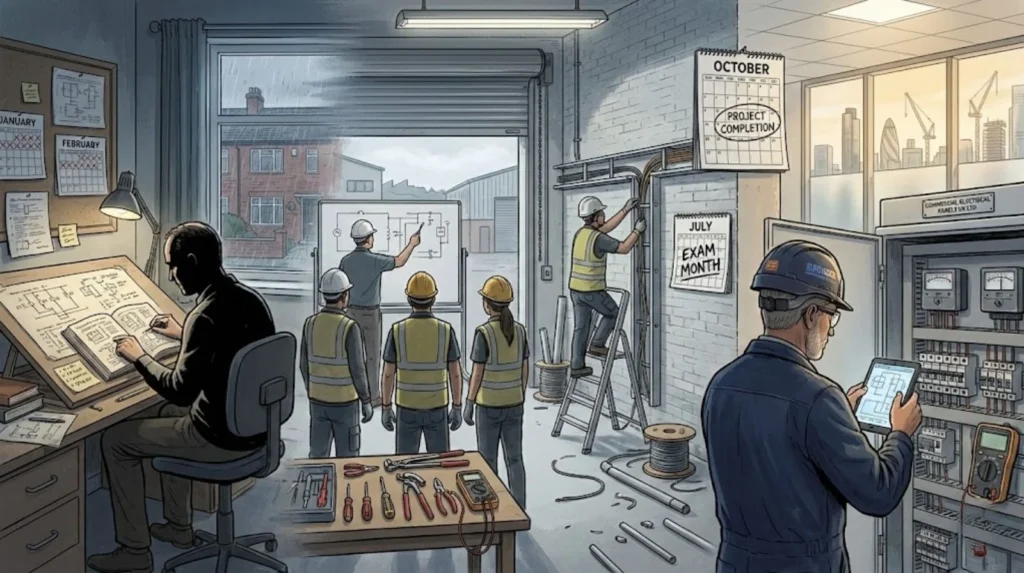
The question appears in search boxes thousands of times monthly from people in their 30s, 40s, and 50s: “Is it too late to become an electrician?” Behind the question sits fear that electrician training has an invisible age ceiling, that employers won’t hire older trainees, that physical demands exclude anyone past their 20s, or that qualification pathways close after certain birthdays.
The factual answer is straightforward. There is no legal or regulatory upper age limit for becoming an electrician in the UK. GOV.UK apprenticeship guidance confirms eligibility starts at 16 with no upper restriction. City & Guilds accepts NVQ Level 3 enrolments regardless of age. National Electrotechnical Training (NET) operates AM2 assessments based on prior qualifications, not date of birth. The Electrotechnical Certification Scheme (ECS) issues Gold Cards to anyone meeting qualification standards. Age discrimination in apprenticeships is unlawful under Equality Act 2010.
However, legal permission differs from practical reality. The real barriers adults face are financial (significant income reduction during training periods), physical (manual labour demands that don’t accommodate age), and temporal (2 to 4 years minimum to reach qualified status). These constraints exist regardless of motivation or capability. They require planning, not just permission.
Adults over 25 now represent 48% of apprenticeship starts according to industry data. Career changers entering electrical training at 30, 40, or 50 succeed regularly. But success requires understanding what actually changes with age, which routes suit different circumstances, and what “qualified electrician” means in employer and regulatory terms versus marketing claims from fast-track courses.
This article explains legal age policies, compares training routes available to adults, presents realistic timelines and costs, addresses physical demands honestly, and clarifies why some pathways lead to full qualification whilst others create permanent restrictions. For comprehensive information on the complete electrician qualification framework, see Elec Training’s detailed electrician qualification guide.

What "Qualified Electrician" Actually Means (And Why This Matters for Adults)
Understanding qualification terminology prevents expensive mistakes where adults train for restricted scopes thinking they’ve achieved full recognition.
The Industry Standard: NVQ Level 3 + AM2 + ECS Gold Card
A qualified electrician in employer, site access, and regulatory terms means someone who has achieved:
NVQ Level 3 (e.g., City & Guilds 2357 or 5357): Workplace competence qualification. Requires building evidence portfolio from real electrical jobs covering installations, testing, fault-finding, and safe isolation. Cannot be completed purely in classroom. Needs employment or placement providing supervised electrical work. Typical duration: 12 to 18 months once working in qualifying roles.
AM2 / AM2S / AM2E Assessment: Independent practical exam taken at NET centres. Tests installation skills, fault diagnosis, inspection procedures, and safe isolation under timed conditions. Duration: 2 to 3 days. Pass is mandatory for full qualification. Cost: £800 to £1,000 per attempt. No automatic retakes.
18th Edition (BS 7671:2018+A2:2022): Current UK wiring regulations. 3 to 5 day course plus exam. Required component but insufficient alone. Proves regulatory knowledge, not practical competence.
ECS Gold Card: Industry recognition enabling site access and commercial work. Requires NVQ Level 3, AM2 pass, and 18th Edition. Issued by Electrotechnical Certification Scheme. Most agencies and main contractors filter candidates by card status.
This combination demonstrates competence under Electricity at Work Regulations 1989, which requires persons to possess sufficient technical knowledge and experience to prevent danger. Courts and employers default to NVQ Level 3 plus AM2 as the competence standard.
Domestic Installer (Restricted Scope, Not Full Qualification)
Domestic installer status allows self-certification of residential electrical work under Building Regulations Part P through Competent Person Scheme (CPS) registration with NICEIC, NAPIT, or similar bodies. Training typically 4 to 12 weeks covering Level 2, Level 3 theory, and 18th Edition. Cost: £2,500 to £4,000.
However, domestic installer scope is permanently restricted to houses and flats. Cannot work on commercial sites, industrial installations, or three-phase systems. Cannot hold ECS Gold Card. Cannot access most construction site work. Average earnings: £30,000 to £40,000 annually self-employed versus £38,000 to £50,000+ for Gold Card electricians with full scope.
Many adults choose domestic routes thinking they’re faster pathways to full electrician status. They’re not. Domestic-only training creates permanent scope limitation unless you later complete full NVQ and AM2 pathway anyway, essentially retraining from scratch. For career changers planning potentially 15 to 30 year electrical careers, this restriction affects decades of earning potential and job flexibility.
Installation / Maintenance Electrician (Full Scope)
Covers domestic, commercial, and industrial environments. Capable of working on three-phase supplies, complex distribution systems, motor control circuits, and industrial equipment. Requires workplace competence demonstrated through NVQ portfolio, not just theory diplomas. Enables supervision of others, testing and inspection work, and access to highest-paying roles.
This is the qualification employers mean when job adverts say “qualified electrician.” Understanding this distinction upfront prevents adults from spending thousands on courses that never lead to full industry recognition.
Is There an Upper Age Limit? (Legal and Policy Reality)
Evidence from government sources, awarding bodies, and assessment centres confirms no legal age restrictions exist at any qualification stage.
Apprenticeships (All Ages)
GOV.UK apprenticeship guidance states eligibility begins at age 16 with no upper limit. The Installation and Maintenance Electrician standard (ST0152) operated by the Institute for Apprenticeships and Technical Education accepts applicants regardless of age. Funding rules differentiate by age for payment rates but don’t prohibit participation.
Adults over 25 represent 48% of current apprenticeship starts across all sectors. In construction trades specifically, mature entrants are increasingly common. Employers legally cannot discriminate based on age when hiring apprentices under Equality Act 2010 protected characteristics.
However, wage rules create practical considerations. Apprentices under 19 or in Year 1 receive Apprentice National Minimum Wage: £7.55/hour from April 2025. From Year 2 onwards, apprentices aged 21+ must receive National Living Wage: £12.21/hour. This makes adult apprentices approximately 60% more expensive than younger starters after Year 1, affecting employer willingness to hire despite legal permission.
NVQ Level 3 and Diploma Enrolment
City & Guilds, EAL, and other awarding bodies accept NVQ Level 3 enrolments based on prerequisite qualifications (typically Level 2 or equivalent), not age. Training providers offering Level 2 and Level 3 diplomas (C&G 2365 series) market specifically to adult learners and career changers. Part-time, evening, and weekend study options accommodate working adults.
Age doesn’t prevent enrolment. Workplace access for portfolio evidence gathering creates the constraint. Adults need employment or placements providing supervised electrical work to complete NVQ requirements. Securing these positions at 30, 40, or 50 requires employer willingness, which varies by company size, region, and individual circumstances.
AM2, AM2S, AM2E Assessments
National Electrotechnical Training operates assessment centres accepting candidates based on prior NVQ completion, not age. The practical exam standards remain identical regardless of candidate age. Physical capability to complete timed installation, testing, and fault-finding tasks matters. Age itself doesn’t determine eligibility.
ECS Gold Card Applications
Electrotechnical Certification Scheme bases card applications on qualification verification (NVQ Level 3, AM2, 18th Edition, health and safety training), not applicant age. Cards renew every five years subject to maintaining qualifications and continuing professional development. No age-based restrictions or renewal refusals.
The legal answer is clear: no upper age limit exists anywhere in the qualification pathway. The practical answer depends on financial capacity to sustain reduced income during training, physical capability for manual work, and employer willingness to hire or support mature trainees. These barriers require planning and honest assessment, not legal permission.
Training Routes for Adult Career Changers (Compared Honestly)
Four pathways exist with different trade-offs for adults at various life stages and financial positions.
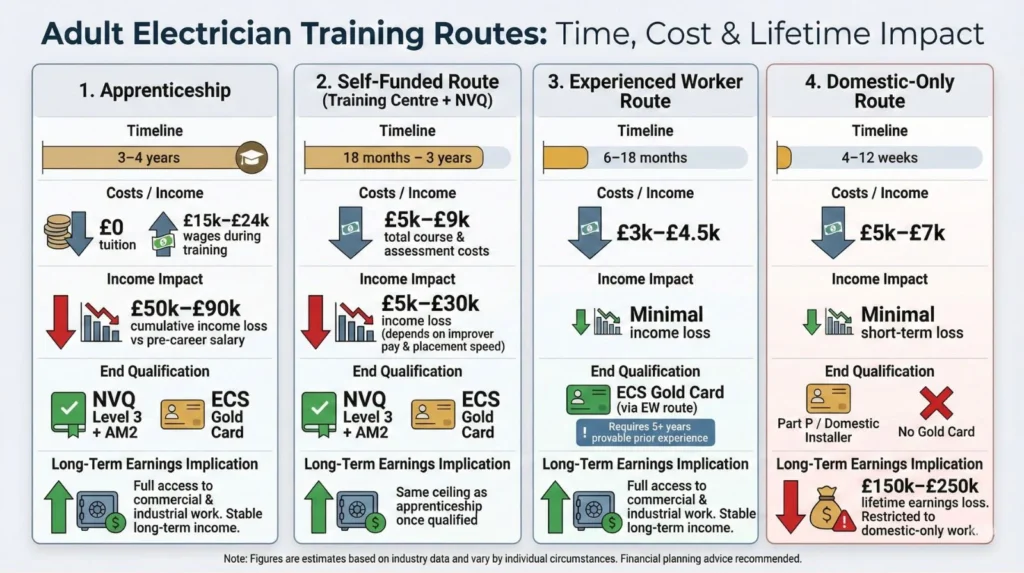
Route A: Adult Apprenticeship (Government-Funded, Employer-Dependent)
Structure: Installation and Maintenance Electrician standard (ST0152). Combines 80% workplace training with 20% college study. Typically four days per week on site, one day at college. Duration: 3 to 4 years from start to completion.
Costs: Training largely government-funded through apprenticeship levy (large employers) or co-investment (small employers). Apprentice pays for tools (approximately £300 to £500 starting kit) and personal PPE. No upfront course fees.
Income: Year 1: £7.55/hour (Apprentice Minimum Wage), approximately £15,000 annually. Year 2+: £12.21/hour (National Living Wage for 21+), approximately £24,000 annually. Some employers pay above minimums to attract mature candidates.
Who It Suits: Adults who can accept significant income reduction for 3 to 4 years. Those with savings, working partners, or low fixed expenses. People wanting structured learning with guaranteed employment throughout.
Main Constraint for Adults: Finding employers willing to sponsor. Small contractors calculating costs per apprentice often prefer younger candidates who remain at lower apprentice rates throughout training. Year 2 wage jump makes adults 60% more expensive, affecting hiring decisions despite no legal age discrimination.
End Status: Full NVQ Level 3, AM2S assessment, 18th Edition. Eligible for ECS Gold Card. Complete qualification with workplace competence proven.
Route B: Self-Funded Diploma + NVQ + AM2 (Most Common Adult Route)
Phase 1 – Theory Diplomas: Complete Level 2 and Level 3 diplomas (C&G 2365) at FE college or private training provider. Study modes: full-time intensive (3 to 6 months), part-time evenings/weekends (12 to 24 months). Costs: Level 2 approximately £1,500 to £2,500, Level 3 approximately £2,000 to £4,000.
Phase 2 – Employment Gap: Secure work as Electrical Mate or Improver. This transition is the highest failure point for adults. Employers prefer apprentices they’ve trained or younger improvers. Competition is significant. Mate wages: £12.00 to £15.00/hour. Improver wages: £15.00 to £18.00/hour.
Phase 3 – NVQ Portfolio: Once employed, enrol in NVQ Level 3 (C&G 2357). Build evidence portfolio over 12 to 18 months covering installations, testing, fault-finding across various job types. Assessor visits verify work. Cost: £1,500 to £3,000 for assessment and portfolio support.
Phase 4 – AM2 Assessment: Complete 2 to 3 day practical exam at NET centre. Cost: £800 to £1,000. Must pass for qualification completion.
Total Timeline: 18 months to 3 years from starting Level 2 to ECS Gold Card application.
Total Cost: £5,000 to £9,000 excluding tools (£500+), testing equipment (eventually £500 to £800 for multifunctional tester), and income reduction during improver phase.
Who It Suits: Career changers maintaining current employment whilst studying theory part-time. Those with financial flexibility to self-fund. People who can’t commit to full apprenticeship timescales but want full qualification outcome.
Why This Is Most Common for Adults: Flexibility to study whilst working. No immediate income drop. Can assess physical capability during theory phase before committing to full career change. Faster initial progress than apprenticeships (theory completion in 12 to 24 months).
Risk: Many adults complete Level 2 and Level 3, spend £4,000 to £6,000, then cannot secure improver employment providing NVQ-qualifying evidence. Without diverse workplace access, portfolios stall. This is the primary adult dropout point.
Route C: Experienced Worker Assessment (EWA / AM2E Route)
Eligibility: Minimum 3 to 5 years verifiable electrical work experience. Must demonstrate through job logs, photos with dates, witness statements from qualified electricians, installation certificates, and risk assessments. Evidence must cover breadth: installations, testing, fault-finding, three-phase work, containment systems.
What Counts: Supervised electrical work as mate under qualified electrician. Facilities maintenance including electrical tasks. Industrial maintenance with electrical components. Self-employed electrical work (though technically illegal without competence, can be recognised retrospectively through EWA).
What Often Fails: General construction labouring without electrical tasks. Trade-adjacent work (plumbing, kitchen fitting) where “electrics” meant only connecting appliances. Historical work from decades ago without recent evidence. Repetitive single-task work lacking portfolio breadth.
Process: Background verification proving experience duration. Technical theory assessment (some centres). Build NVQ portfolio from current employment (must be fresh evidence post-enrolment, cannot use historical work alone). Complete AM2E assessment including additional containment tasks beyond standard AM2.
Timeline: 6 to 18 months from EWA enrolment to Gold Card if evidence gathering proceeds smoothly and AM2E passes first attempt.
Cost: Assessment and portfolio support £1,500 to £2,500. AM2E £935. 18th Edition £400 to £600 if not current. Total approximately £3,000 to £4,000.
Who It Suits: Long-term mates, facilities maintenance workers, or those who’ve worked electrical roles without formal qualifications. Not suitable for complete beginners or those with limited electrical exposure.
Why It’s Fastest (If Eligible): Recognises prior learning. Shorter timeline than apprenticeships or full college routes. Lower costs than self-funded diploma pathway. Respects existing site knowledge and experience.
Route D: Domestic Installer (Fast Entry, Permanent Restrictions)
Structure: Level 2, Level 3 theory, 18th Edition, and 2391 Inspection & Testing. Register with Competent Person Scheme (NICEIC, NAPIT, ELECSA). Begin self-certifying domestic installations under Building Regulations Part P.
Timeline: 4 to 12 weeks intensive training depending on provider. Some offer weekend or modular formats extending to 3 to 6 months.
Cost: Training £2,500 to £4,000. CPS registration £500 to £700 annually. Public liability insurance £300 to £600 annually. Tools and testing equipment £1,500+. Total startup: £5,000 to £7,000.
What It Enables: Rewiring houses. Consumer unit replacements. Kitchen and bathroom electrical work. Garden circuits. Socket and lighting installations in residential properties. Self-certification of notifiable work.
What It Permanently Blocks: Commercial sites. Industrial installations. Multi-occupancy buildings beyond single dwellings. Three-phase systems. Construction site agencies. Main contractor employment. ECS Gold Card eligibility. Supervision of others. Higher-paying roles requiring full scope.
Average Earnings: Self-employed domestic installers: £30,000 to £40,000 gross annually. After overheads (tools, insurance, vehicle, unpaid admin, materials risks), net approximately £22,000 to £32,000.
Why It Appeals to Adults: Fastest time to earning. Lower training investment. Immediate self-employment possible. Flexible work schedule. No employer hunting. No workplace evidence complications.
Why It Limits Long-Term Prospects: Restricts scope permanently. Over 15 to 30 year career, domestic-only caps earnings at £30,000 to £40,000 versus £38,000 to £50,000+ for Gold Card electricians. Difference of approximately £120,000 to £300,000 in lifetime earnings. Moving to commercial work later requires completing full NVQ and AM2 anyway, making domestic route a detour rather than shortcut.
Why It’s Often Mis-Sold: Marketing presents domestic courses as “become a qualified electrician in weeks.” Technically true for domestic scope under Part P. Deliberately misleading for full industry recognition. Adults at 30, 40, or 50 planning long careers need honest assessment of this scope limitation before choosing fastest route.
For comparative context on how age-specific considerations differ across life stages, our article on becoming an electrician at 40 uk explores unique challenges and advantages at that particular milestone.
Realistic Timelines for Adults (What Happens After 6, 12, 24 Months)
Progression varies by route but follows predictable patterns based on qualification structure.
Months 0 to 6: Theory Learning or Initial Employment
Apprenticeship route: Working as trainee on site four days weekly, college one day. Performing supervised basic tasks: cable pulling, fixing containment, assisting qualified electricians. Earning £15,000 annually (Year 1 rate). Learning safe isolation, hand tool use, circuit identification. Not recognised as competent for independent work.
Self-funded route: Completing Level 2 diploma (if full-time) or partway through evening/weekend study (if part-time). Learning electrical science, health and safety basics, basic installation theory. No site access yet. No income change if maintaining current employment. Not qualified in any capacity.
Experienced Worker route: Gathering historical evidence, preparing portfolio documentation, potentially beginning technical assessments. Still working in existing role. Not yet enrolled in formal NVQ.
Status After 6 Months: Theory student or supervised trainee. Cannot work independently. Not recognised as qualified, improver, or mate in formal employment terms. Insurance, liability, and competence under Electricity at Work Regulations require supervision.
Months 6 to 12: Building Foundations
Apprenticeship route: Expanded responsibilities. Installing basic circuits under supervision. Terminating cables in consumer units. Using testing equipment for continuity and earth loop impedance. Beginning portfolio evidence gathering. Approaching Year 2 wage increase to £24,000 annually. Still supervised, not independent.
Self-funded route: Completed Level 2 (if full-time) or nearing completion (if part-time). May have started Level 3. If part-time, still in current employment. If full-time, hunting for mate or improver roles to start earning whilst continuing NVQ pathway. Certificates held but no workplace competence proven.
Experienced Worker route: Enrolled in NVQ, beginning structured evidence gathering from current employment. Assessor visits starting. Documenting installations, testing results, fault-finding work. Still working at existing job and wage level.
Status After 12 Months: Apprentices are competent for basic supervised tasks. Self-funded students have theory knowledge but typically no site experience. EWA candidates are gathering formal evidence from existing work. None are qualified or can work independently yet.
Months 12 to 24: Competence Evidence and NVQ Progress
Apprenticeship route: Midway through training. Handling three-phase installations, complex testing procedures, fault diagnosis. Portfolio covering multiple NVQ units. Earning £24,000+ annually. Working more independently but still technically supervised. Approaching AM2S eligibility subject to portfolio completion.
Self-funded route: Completed Level 2 and Level 3 theory. Secured improver role (if successful). Building NVQ portfolio from site work. Earning £30,000 to £36,000 annually as improver. Assessor visits every 8 to 12 weeks verifying evidence. Diverse job access critical, repetitive work stalls portfolios. Approximately halfway to qualification.
Experienced Worker route: Well into NVQ portfolio, potentially nearing completion if workplace provides good evidence variety. AM2E booking approaching or scheduled. Still in existing employment. Ready to test competence through independent assessment.
Status After 24 Months: Apprentices likely completing portfolios soon, AM2S within 6 to 12 months. Self-funded students halfway through NVQ if employed in qualifying roles. EWA candidates potentially ready for AM2E. Still not qualified without AM2 pass, but competence developing toward that threshold.
Months 24 to 48: Qualification Completion
Apprenticeship route: Completing final portfolio units. Sitting AM2S assessment. Passing (typically 85% pass rate first attempt for well-prepared apprentices). Applying for ECS Gold Card. Transitioning to qualified electrician wages: £36,000 to £40,000 starting.
Self-funded route: Completing NVQ portfolio (if no delays from employment issues). Sitting AM2 assessment. Passing and applying for Gold Card. Timeline extends to 36+ months if improver role took long to secure or evidence gathering faced setbacks. Reaching qualified status at £36,000 to £48,000 depending on region and experience level.
Experienced Worker route: AM2E completed (potentially by Month 18 to 24 if smooth). Gold Card issued. Continuing in existing employment now at qualified electrician recognition, or transitioning to higher-paying electrical roles with official status.
The consistent factor: qualification only occurs after AM2/AM2S/AM2E passes and Gold Card issues. Theory diplomas, partial NVQ portfolios, or years of experience don’t constitute “qualified” status until independent assessment verifies competence.
Costs, Income Dip, and Financial Reality
Financial pressure is the single biggest adult barrier, not age or capability.
Training Costs by Route
Apprenticeship: £0 to £500. Government-funded training. Apprentice pays only for tools and PPE. Lowest cost pathway.
Self-funded (Diplomas + NVQ + AM2): £5,000 to £9,000 broken down as:
Level 2 diploma: £1,500 to £2,500
Level 3 diploma: £2,000 to £4,000
NVQ assessment: £1,500 to £3,000
AM2 exam: £800 to £1,000
18th Edition: £400 to £600
Tools/PPE: £500 to £800
Experienced Worker: £3,000 to £4,500 broken down as:
EWA assessment: £1,500 to £2,500
AM2E: £935
18th Edition: £400 to £600 (if not current)
Tools: £500+ (often already owned)
Domestic Installer: £5,000 to £7,000 broken down as:
Training package: £2,500 to £4,000
CPS registration: £500 to £700 annually
Insurance: £300 to £600 annually
Tools/testing: £1,500+
Additional costs all routes:
Testing equipment (multifunctional tester): £500 to £800 (needed professionally, not during training)
Books and guides: £100 to £200
Travel to assessment centres: Variable
ECS card application: £50 to £100
Income Changes During Training
The financial pressure comes not from training costs but from wage reduction for adults transitioning from established careers.
Career changer scenario (currently earning £35,000 to £45,000):
Apprenticeship Year 1: Drop to £15,000 (loss of £20,000 to £30,000 annually)
Apprenticeship Year 2+: Rise to £24,000 (still loss of £11,000 to £21,000 annually)
Duration: 3 to 4 years at reduced income
Total income loss: £50,000 to £90,000 over apprenticeship period
Self-funded improver scenario: Part-time study: Maintain current £35,000 to £45,000 during theory phase (12 to 24 months)
Improver phase: Drop to £30,000 to £36,000 (loss of £5,000 to £15,000 annually)
Duration: 12 to 24 months at reduced income
Total income loss: £5,000 to £30,000 during improver period
Experienced Worker scenario: Maintain existing wage throughout if staying with current employer (£25,000 to £35,000 typical for long-term mates)
Minimal income disruption
Total income loss: £0 to £5,000 (only assessment time off work)
This income pressure explains why many adults drop out midway through NVQ portfolios. Planning starts with calculating whether you can sustain £20,000 to £30,000 income reduction for 2 to 4 years with existing mortgage, family, and financial commitments.
Long-Term Return on Investment
Despite short-term losses, qualified electrician earnings justify training investment:
Qualified electrician median: £38,760 annually (ONS 2024)
Experienced electricians: £40,000 to £50,000+ with overtime
Approved electricians: £44,000 to £56,000 with testing responsibilities
Career length at qualified rates matters more than training costs:
Qualify at 32: Approximately 35 years at qualified wages (to age 67)
Qualify at 42: Approximately 25 years at qualified wages
Qualify at 52: Approximately 15 years at qualified wages
Even qualifying at 52 provides 15 years earning £40,000+, total approximately £600,000 career earnings. Training investment of £5,000 to £9,000 plus 2 to 3 years reduced income represents recoverable cost over career span.
However, domestic-only scope limits this return. At £30,000 to £40,000 capped earnings versus £40,000 to £50,000 with Gold Card, the difference is £10,000 annually. Over 15 years: £150,000 foregone. Over 25 years: £250,000 foregone. Domestic route “saves” 18 to 24 months training time but costs significantly more across career span.
Joshua Jarvis, our Placement Manager, explains:
"Adults changing careers at 30, 40, or 50 aren't just training for immediate qualification. You're planning potentially 15 to 30 year second careers. That timeline justifies the 2 to 4 year training investment despite short-term income drops. Route selection matters more for adults than younger entrants because domestic-only restrictions or incomplete qualifications affect decades of earnings, not just initial employment."
Joshua Jarvis, Placement Manager
Employer Expectations and Market Reality
What employers actually filter for when hiring electricians, mates, or improvers.
Qualification Requirements Dominate Age Considerations
Analysis of job adverts across Indeed, Reed, and Totaljobs for electrician and improver roles shows consistent patterns:
ECS Gold Card: Required in 80%+ of electrician roles. Implied in additional 10% through “fully qualified” or “JIB registered” language. Improver roles: 30% to 40% require ECS card (typically Green Labourer card for site access).
NVQ Level 3: Specified explicitly in 60% to 70% of electrician adverts. Assumed in remainder through qualification requirements or “competent person” language.
18th Edition: Required in 90%+ of electrician roles, 40% to 50% of improver roles. Current edition essential, older editions not accepted.
Driving licence: Required in 70% to 80% of both electrician and improver roles. Critical for mobile maintenance work, customer site visits, transporting tools and materials.
Testing qualification (2391): Specified in 50% to 60% of electrician roles paying £40,000+ annually. Rare in entry-level positions. Enables inspection and testing work, periodic inspections, commercial testing contracts.
IPAF/PASMA certification: Required in 20% to 30% of roles involving construction sites, industrial maintenance, or commercial installations. Demonstrates capability for height work using mobile platforms and scaffolds.
Age never appears as requirement or filter. However, combined demands (physical capability, driving, shift availability, site mobility) indirectly affect candidates with age-related health conditions or family constraints.
Maturity as Asset, Wage Cost as Barrier
Employers value transferable professional skills adults bring:
Reliability and punctuality: Site managers consistently cite mature workers as more dependable for scheduled attendance and time management.
Client communication: Adults from customer-facing roles adapt quickly to residential work involving homeowner interaction, explanations, and professionalism.
Health and safety awareness: Previous workplace experience with risk assessments, PPE, and safety protocols transfers well to electrical site work.
Problem-solving: Career experience provides systematic approaches to fault diagnosis and installation challenges beyond rote learning.
However, employer costs create hiring barriers:
Small contractors (under 10 employees): Represent majority of electrical firms. Calculate costs per apprentice carefully. Year 2 wage jump to National Living Wage makes adults 60% more expensive than younger apprentices. Tight margins affect willingness despite valuing maturity.
Large firms and agencies: More willing to hire adult apprentices and improvers. Benefit from apprenticeship levy funding. Value reliability for commercial contracts. Better positioned to absorb higher wage costs.
Industry Demand Helps Adults
Construction sector needs 104,000 additional electricians by 2032 according to industry forecasts. Current workforce approximately 230,000 qualified electricians. Demand significantly exceeds supply, particularly in commercial and industrial sectors.
Skills shortages mean employers increasingly accept adult entrants who demonstrate commitment, capability, and proper qualification pathways. Competition exists but opportunities are available for adults willing to complete full training rather than shortcuts.
Physical Demands: The Uncomfortable Truth
Electrical work involves sustained manual labour that doesn’t accommodate age or prior career background.
Daily Physical Requirements
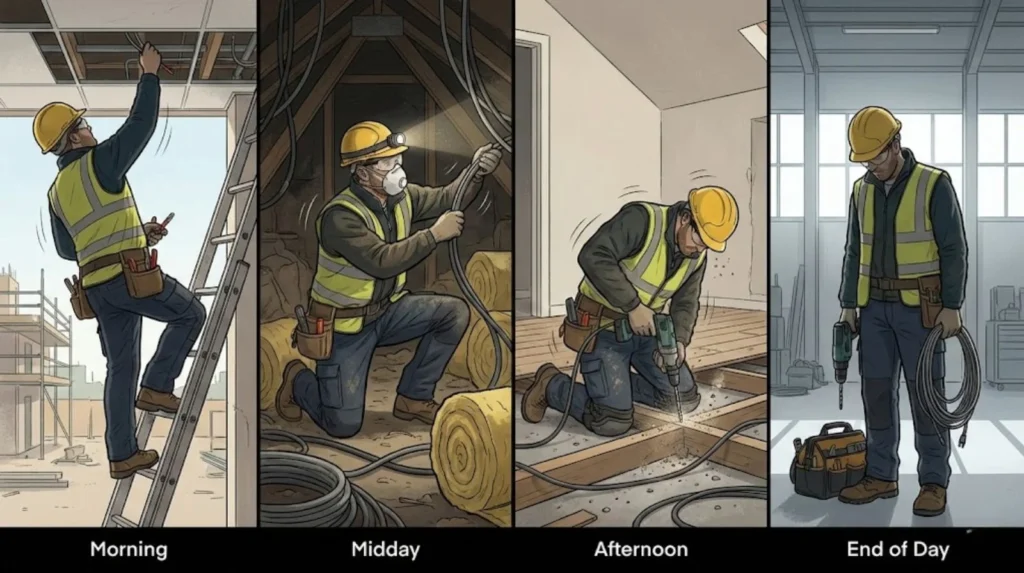
Working at height: Ladders, scaffolds, mobile elevated work platforms (scissor lifts, cherry pickers). Frequent ladder climbing with tools. Installation work in ceiling voids. Height work accounts for 30% to 40% of typical installation time.
Loft and confined space work: Crawling through insulation in temperatures exceeding 40°C in summer. Installing cables in roof spaces with limited headroom. Repetitive stooping, kneeling, and awkward postures. Loft work particularly demanding for those with back, knee, or heat tolerance issues.
Manual handling: Lifting cable drums up to 25kg. Carrying toolboxes, equipment, and materials. Pulling heavy cables through containment. Repetitive lifting throughout workday. HSE guidance emphasises manual handling risks increase with age but sets no restrictions.
Floor access work: Lifting floorboards, crawling under floors, working in underfloor voids. Reaching beneath kitchen units. Accessing service ducting. Physical flexibility and joint health matter significantly.
Repetitive tasks: Drilling, fixing, terminating cables. Requires sustained hand grip strength and fine motor control. Cumulative strain on wrists, hands, and shoulders over career duration.
Age-Related Physical Considerations
Presbyopia (age-related vision loss): Typically begins age 40 to 45. Affects close-up termination work. AM2 assessment requires identifying tiny faults in consumer units under timed conditions. Corrective eyewear addresses this but represents additional consideration.
Joint health: Back pain affects 60% to 80% of electricians according to industry health surveys. Knee problems from prolonged kneeling. Shoulder issues from overhead work. Pre-existing conditions at 35, 45, or 55 may worsen under daily electrical work strain.
Recovery time: Physical recovery from manual labour days extends with age. Weekend recovery insufficient for sustained five-day weeks performing heavy physical work. Fatigue accumulation affects capability over career duration, not just initial qualification.
Heat tolerance: Loft work in summer heat. Industrial environments with high ambient temperatures. Age affects thermoregulation, potentially impacting capacity for sustained work in hot conditions.
No Safety Exemptions Exist
Health and Safety Executive regulations require risk assessments for all workers but don’t provide age-based accommodations. Manual handling limits, height work requirements, and PPE standards apply uniformly. Employers cannot reduce physical demands based on age without changing role scope entirely.
Thomas Jevons, our Head of Training with 20 years experience, states:
"Electrical work involves crawling through lofts in summer heat, pulling cables under floors, and working from ladders for hours. These demands don't reduce with age. Before investing £5,000 to £8,000 and 2 to 3 years in training, adults need honest assessment of physical capability for sustained manual work, not just initial qualification."
Thomas Jevons, Head of Training
Honest Self-Assessment Required
Before committing to electrical training, adults should:
Test physical capacity: Spend days performing similar physical work. Volunteer for construction projects. Help friends with home renovations. Assess whether you can sustain ladder work, loft access, and manual handling repeatedly.
Consult medical professionals: Discuss existing back, knee, shoulder, or vision conditions with GP. Obtain honest assessment of impact from sustained manual labour.
Consider workplace modifications: Some electrical work is less physically demanding (testing and inspection, industrial control panels, design work). However, these roles typically require several years of installation experience first. Cannot avoid physical work during qualification phase.
The physical reality matters more than legal permissions. You can qualify legally at any age. Sustaining electrical work physically for 10 to 30 years requires honest capability assessment before training investment.
For context on how other physical considerations intersect with electrical work, including vision-related factors beyond presbyopia, see our guide on can you be a electrician if you are colorblind and practical accommodations available.
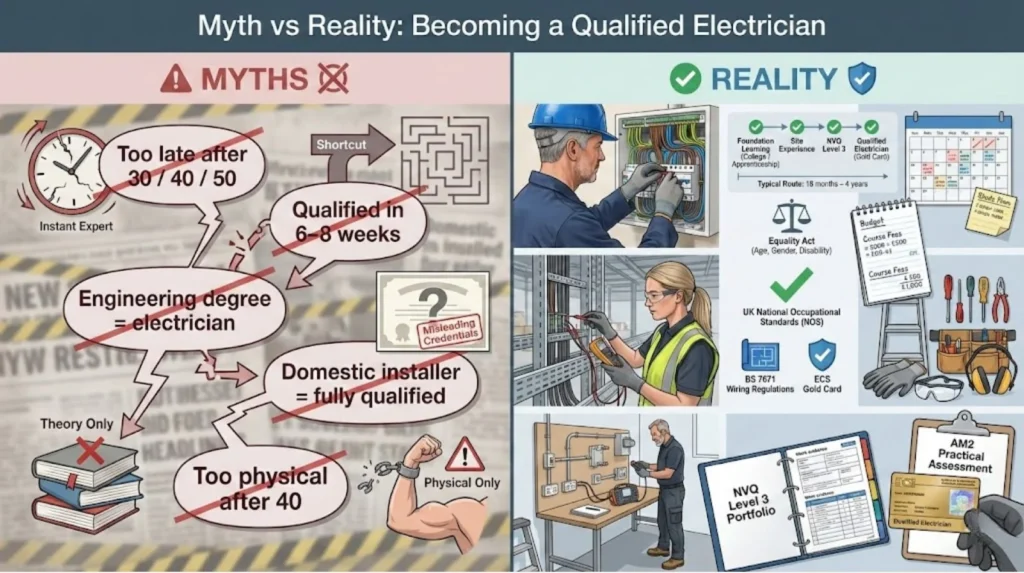
Myth vs Reality: Evidence-Tested Claims
Common beliefs about age and electrician training require factual evaluation.
Myth: “It’s too late after age 30/40/50”
Reality: No legal upper age limit exists for apprenticeships (GOV.UK guidance), NVQ enrolment (City & Guilds policy), AM2 assessments (NET eligibility criteria), or ECS cards (application requirements). Adults over 25 represent 48% of apprenticeship starts across all sectors. Age discrimination in apprenticeships is unlawful under Equality Act 2010.
Verdict: False. Legal barriers don’t exist. Practical challenges (wage costs for employers, physical demands, financial pressure during training) require planning but don’t constitute age limits.
Myth: “You can become a qualified electrician in 6 to 8 weeks”
Reality: Short courses typically offer domestic installer training covering theory diplomas and 18th Edition compressed into intensive blocks. You can register with Competent Person Schemes for residential self-certification. You cannot obtain ECS Gold Card (requires NVQ Level 3 workplace competence plus AM2 practical assessment). Commercial and industrial employers require Gold Card, not domestic-only registration. Full qualification requires 18 months to 4 years depending on route.
Verdict: False for full electrician status. True only for domestic-only scope, which is permanent restriction not pathway to full qualification.
Myth: “My degree in Electrical Engineering makes me a qualified electrician”
Reality: Engineering degrees are academic qualifications covering theory, mathematics, and design principles. Electrician qualifications are vocational, assessing practical workplace competence. Degree holders may receive Recognition of Prior Learning (RPL) exempting some Level 2 or Level 3 theory units. However, RPL doesn’t replace NVQ Level 3 portfolio (requires real electrical installations documented and assessed) or AM2 practical exam (hands-on installation, testing, fault-finding). Degree knowledge helps understanding but doesn’t substitute for demonstrable installation competence.
Verdict: False. Engineering background accelerates theory learning but doesn’t replace vocational competence requirements.
Myth: “Domestic installer qualification equals fully qualified electrician”
Reality: Domestic installer scope limited to residential properties under Building Regulations Part P. Registration with NICEIC/NAPIT enables self-certification. Does not qualify for ECS Gold Card. Cannot work on commercial sites, industrial installations, three-phase systems, or construction projects requiring site cards. Job adverts specifying “qualified electrician” mean NVQ Level 3 plus AM2 plus Gold Card, not domestic-only registration. Courts interpreting Electricity at Work Regulations default to NVQ Level 3 plus AM2 as competence standard.
Verdict: False. Different scope and recognition level entirely. Domestic-only is not pathway to full qualification without completing full NVQ and AM2 afterwards.
Myth: “Physical demands prevent electrician work past age 40”
Reality: No age-based physical restrictions exist in health and safety regulations. Many electricians work successfully into their 50s, 60s, and beyond. However, electrical work is physically demanding: loft access, ladder work, manual handling, confined spaces. Pre-existing back, knee, or shoulder conditions may worsen under sustained strain. Physical capability varies individually more than chronologically. Honest assessment of capacity for sustained manual work over 10 to 30 year careers matters more than age itself.
Verdict: Mostly false. Age doesn’t automatically prevent electrical work. Physical capability (which correlates with but doesn’t equal age) determines sustainability.
Planning Career Change at Any Age
Age isn’t the barrier adults fear. Planning is the difference between successful qualification and expensive failure.
No legal restrictions prevent becoming an electrician at 30, 40, 50, or beyond. Government policy, awarding body requirements, assessment centre eligibility, and ECS card applications operate without age limits. Discrimination based on age in apprenticeships or employment is unlawful. The question “is it too late?” has clear legal answer: no.
However, three real barriers require honest assessment and careful planning before starting training:
Financial capacity to sustain significant income reduction for 2 to 4 years during training and improver phases. Adults transitioning from £35,000 to £45,000 careers to apprentice wages of £15,000 (Year 1) or £24,000 (Year 2+), or improver wages of £30,000 to £36,000, experience substantial short-term losses. Planning must accommodate mortgages, family commitments, and living costs during this period. Those unable to sustain this reduction either need savings, working partners, or should maintain current employment whilst studying part-time.
Physical capability for sustained manual labour over 10 to 30 year careers, not just initial qualification. Electrical work demands don’t reduce with age: loft access in 40°C+ heat, manual handling up to 25kg, prolonged ladder work, confined spaces, repetitive tasks. Pre-existing back, knee, or shoulder conditions may worsen. Testing physical capacity through similar work before committing £5,000 to £9,000 and 18 months to 4 years prevents discovering limitations midway through training.
Route selection based on circumstances, not marketing promises. Domestic-only training provides fastest entry (4 to 12 weeks, £2,500 to £4,000) but permanently restricts scope to residential work, capping earnings at £30,000 to £40,000 versus £38,000 to £50,000+ for Gold Card electricians. Over 15 to 30 year careers, scope restriction costs £120,000 to £300,000 in foregone earnings. Full qualification routes take longer (18 months to 4 years, £5,000 to £9,000 if self-funded) but provide complete commercial and industrial access.
The qualification standard doesn’t change with age. NVQ Level 3 portfolio requirements, AM2 assessment criteria, and ECS Gold Card eligibility apply identically to 25-year-old apprentices and 55-year-old career changers. Competence under Electricity at Work Regulations requires demonstrated ability to prevent danger through safe isolation, correct installation, and accurate testing. Age affects route selection and financial planning. Competence requirements stay constant.
Adults over 25 representing 48% of apprenticeship starts demonstrates career change into electrical work is common, accepted, and increasingly normal. Employers value maturity, reliability, and professional skills adults bring. Industry skills shortages (104,000 additional electricians needed by 2032) create genuine opportunities. However, success requires completing proper qualification pathways (NVQ Level 3 plus AM2 plus ECS Gold Card), not shortcuts through domestic-only courses that never lead to full recognition.
Time to qualified status (2 to 4 years) coupled with projected career length (15 to 30 years depending on starting age) justifies training investment despite short-term financial pressure. The calculation is straightforward: training costs £5,000 to £9,000, income reduction lasts 2 to 4 years, but qualified earnings of £38,000 to £50,000 annually over 15 to 30 years total £570,000 to £1,500,000 career earnings. Return on investment is clear for those who can sustain initial financial pressure.
If you’re considering electrician training at any age, focus on honest assessment of financial capacity, physical capability, and route selection leading to full qualification. Avoid courses promising qualification in weeks without workplace competence components. Plan financially for sustained income reduction. Test physical tolerance for manual work before committing. Choose routes providing NVQ Level 3 plus AM2 pathways, not domestic-only restrictions. And understand that age itself doesn’t prevent qualification, proper planning enables it.
Call 0330 822 5337 to discuss electrician training routes for adult career changers at any age. We’ll assess your current circumstances, explain which pathways match your financial position and physical capability, clarify NVQ evidence requirements and workplace access needs, outline realistic timelines and costs, and discuss how our network of 120+ contractor partners supports adults securing improver placements for portfolio completion. No false promises about fast qualification. No claims that age is irrelevant. Just evidence-based guidance on recognised routes, real barriers requiring planning, and what full qualification actually demands for 15 to 30 year electrical careers.
References
- GOV.UK – Become an Apprentice (Age and Eligibility) – https://www.gov.uk/become-apprentice
- GOV.UK – National Minimum Wage and Living Wage Rates April 2025 – https://www.gov.uk/national-minimum-wage-rates
- Equality Act 2010 – Age Discrimination in Employment – https://www.gov.uk/guidance/equality-act-2010-guidance
- National Careers Service – Electrician Job Profile and Entry Requirements – https://nationalcareers.service.gov.uk/job-profiles/electrician
- City & Guilds – 2365 Level 2/3 Electrical Installation Diplomas – https://www.cityandguilds.com/
- City & Guilds – 2357/5357 NVQ Diploma in Installing Electrotechnical Systems – https://www.cityandguilds.com/
- Electrotechnical Certification Scheme (ECS) – Card Types and Application Requirements – https://www.ecscard.org.uk/
- National Electrotechnical Training (NET) – AM2, AM2S, AM2E Assessment Information – https://www.netservices.org.uk/am2/
- Office for National Statistics (ONS) – Annual Survey of Hours and Earnings (ASHE) 2024 – https://www.ons.gov.uk/
- Health and Safety Executive (HSE) – Electricity at Work Regulations 1989 – https://www.hse.gov.uk/pubns/books/hsr25.htm
- NICEIC – Domestic Installer Scheme and Part P Registration – https://niceic.com/
- GOV.UK – Building Regulations Part P (Electrical Safety) – https://www.gov.uk/government/publications/electrical-safety-approved-document-p
Note on Accuracy and Updates
Last reviewed: 22 December 2025. This page is maintained; we correct errors and refresh sources as apprenticeship funding rules, ECS requirements, wage rates, and NVQ regulations change. Pay data reflects ONS ASHE 2024 and National Minimum Wage rates effective April 2025. Apprenticeship start statistics from construction industry reports 2024/25. Training costs reflect current market pricing from FE colleges and private providers. Physical demand data based on HSE construction health guidance. Job advert analysis reflects December 2025 sample. Next review scheduled following apprenticeship funding rule changes (April 2026), National Minimum Wage updates (April 2026), or significant changes to ECS card requirements.
