


- Technical review: Thomas Jevons (Head of Training, 20+ years)
- Employability review: Joshua Jarvis (Placement Manager)
- Editorial review: Jessica Gilbert (Marketing Editorial Team)
- Last reviewed:
- Changes: Initial publication calculating exact monetary increases from 2026 JIB Industrial Determination using confirmed rates across grades (Electrician, Approved Electrician, Technician), bands (National/London, Transport Provided/Own Transport), and working patterns including overtime multipliers and real-terms purchasing power adjustments

The 2026 JIB pay rise, effective Monday 5 January 2026, delivers a 3.95% increase to hourly rates for graded electrical operatives across England, Wales, and Northern Ireland as the first year of a three-year wage agreement negotiated between the Electrical Contractors’ Association and Unite the Union. Industry coverage of this pay determination frequently focuses on the percentage figure alone, leaving electricians uncertain about the practical monetary impact: how many additional pounds per hour, how much more per week, what this means for annual gross pay, and how overtime patterns amplify or diminish these gains depending on working hours and grade progression.
Understanding the 2026 JIB pay rise requires distinguishing between percentage headlines and actual sterling increases that vary substantially by grade (Electrician earning £18.38/hour versus Technician at £22.70/hour in 2026), band selection (National versus London, Transport Provided versus Own Transport), and working patterns (standard 37.5-hour week versus electricians regularly working 45-50 hours with overtime premiums). A 3.95% increase translates to £0.70/hour for an Electrician on National Transport Provided rates but £0.86/hour for a Technician, creating £26.25 versus £32.25 weekly differences at standard hours, £1,365 versus £1,677 annual gross increases, and substantially larger gains when overtime multipliers (time-and-a-half, double-time) apply to extended working weeks common in commercial and industrial electrical contracting.
This article presents a transparent calculator methodology showing exactly how much more electricians will earn in 2026 using confirmed JIB Industrial Determination rates, worked examples across all grade and band combinations, overtime multiplier effects for electricians working beyond 37.5 hours weekly, real-terms purchasing power adjustments accounting for projected 2-3% inflation, and explicit limitations including why apprentices are excluded (no 2026 increase), why gross figures don’t reflect take-home pay after tax and National Insurance, and why JIB minimum rates represent earning floors rather than ceilings that many employers exceed through site premiums and allowances. For electricians planning qualification pathways from initial training through NVQ Level 3 and AM2 assessment to JIB graded employment, understanding how grade progression from Electrician to Approved Electrician to Technician creates larger income gains than annual pay rises affects career development priorities and qualification investment decisions far more than single-year percentage increases.
Who the JIB Pay Rise Applies To (And Who It Doesn't)
The 2026 JIB pay determination covers specific categories of electrical workers employed under Joint Industry Board National Working Rules, with explicit exclusions that affect calculator applicability.
Who Receives the 3.95% Increase
Graded operatives:
Electrician: NVQ Level 3 qualified, capable of installation work, typically working under supervision or alongside Approved Electricians on commercial and industrial projects
Approved Electrician: NVQ Level 3 plus inspection and testing competency (AM2/AM2E qualification), authorized for independent work, testing, certification, and supervision of Electrician-grade workers
Technician: Advanced qualifications (HNC/HND) or supervisory/design responsibilities, typically handling technical planning, fault diagnosis, system commissioning, and project coordination beyond standard installation
Geographic coverage: England, Wales, Northern Ireland only (Scotland operates under separate SJIB agreement with aligned but distinct rates)
Employment basis: PAYE employees of JIB signatory electrical contractors working under JIB National Working Rules with standard 37.5-hour working week, paid holidays, sick pay entitlements, and employer pension contributions
Who Does NOT Receive the Increase
Apprentices (all stages): JIB apprentice rates remain unchanged in 2026 at £8.16/hour (Stage 1) through £14.03/hour (Stage 4) for national Transport Provided, creating real-terms erosion when projected 2-3% inflation is factored in. The apprentice wage structure operates independently from graded operative determinations, with apprentice increases negotiated separately and often back-loaded to later years of multi-year agreements.
Scotland: Scottish Joint Industry Board (SJIB) negotiates separate wage determinations for electrical operatives in Scotland, typically following similar percentage structures but with distinct rates and effective dates.
Non-JIB employers: Electrical contractors not signatory to JIB agreements (estimated 30-40% of UK electrical employers) set wages independently without obligation to follow JIB rates, though many reference JIB minimums for market positioning.
Self-employed electricians: NICEIC/NAPIT registered sole traders operating as self-employed businesses determine their own charge-out rates and net income independent of JIB wage structures.
Agency workers: Electricians engaged through recruitment agencies or umbrella companies typically negotiate day rates or hourly rates separate from JIB minimums, though some agency roles explicitly reference JIB rates as baseline.
Why Apprentices Are Excluded from Calculator
Apprentice wages serve different economic purposes than qualified operative rates: they balance training cost recovery for employers, household income adequacy for learners, and completion incentives encouraging qualification progression. Including apprentice rates (unchanged in 2026) alongside graded operative increases (3.95%) in a single calculator creates misleading comparisons suggesting apprentices receive equivalent treatment when they factually do not. Apprentice earnings analysis requires separate context addressing Stage progression timing, National Living Wage compliance for adult apprentices aged 21+, and the substantial wage jump upon NVQ/AM2 completion from Stage 4 (£14.03/hour) to Electrician grade (£18.38/hour) representing £8,494 annual increase that dwarfs single-year pay rise percentages.
How JIB Pay Is Structured: Grades, Bands, and Transport
Understanding why calculator inputs require grade, band, and transport selection necessitates explaining JIB’s multi-dimensional pay structure reflecting skill levels, geographic cost differentials, and vehicle responsibility allocation.
Grades: Skill and Qualification Hierarchy
JIB grading system creates three qualification-based pay tiers for electrical operatives:
Electrician (Base Grade):
Qualification: NVQ Level 3 Electrical Installation
Capability: Installation work under supervision, circuit terminations, basic fault-finding
Limitation: Cannot independently certify installations or supervise other electricians
2026 National TP rate: £18.38/hour (£35,841 annual at 37.5h/52w)
Approved Electrician (Intermediate Grade):
Qualification: NVQ Level 3 plus 18th Edition plus AM2/AM2E (inspection and testing practical assessment)
Capability: Independent work, installation testing and certification, EICRs, supervision of Electrician-grade workers
Authorized: Sign-off on installation certificates and periodic inspection reports
2026 National TP rate: £20.08/hour (£39,156 annual)
Premium over Electrician: £1.70/hour (£3,315 annually)
Technician (Advanced Grade):
Qualification: Typically HNC/HND Electrical Engineering, or equivalent supervisory/design experience
Capability: Technical planning, system design, complex fault diagnosis, project supervision, commissioning
Responsibility: Often acting as site supervisor, coordinating multiple electricians, interfacing with clients and engineers
2026 National TP rate: £22.70/hour (£44,265 annual)
Premium over Approved: £2.62/hour (£5,109 annually)
Grade differentiation reflects qualification investment, responsibility level, and independent decision-making capability. Electricians cannot legally perform work reserved for Approved status (testing and certification) without appropriate qualifications regardless of experience years, making grade progression dependent on formal qualification completion rather than time-served alone.
For the full explanation of grade-by-grade rates, see the JIB rates 2026 breakdown.
Bands: National vs London Geographic Differential
National rates: Apply to work in England (outside M25), Wales, and Northern Ireland, reflecting typical living costs and housing expenses in non-London regions.
London rates: Apply to work within M25 boundary or London-based shop operatives working outside London for up to 12 weeks, providing approximately 12% premium over National rates to offset London housing costs (£12,000-18,000 additional annually for rent/mortgage versus equivalent accommodation in most UK regions).
London premium by grade (2026 Transport Provided):
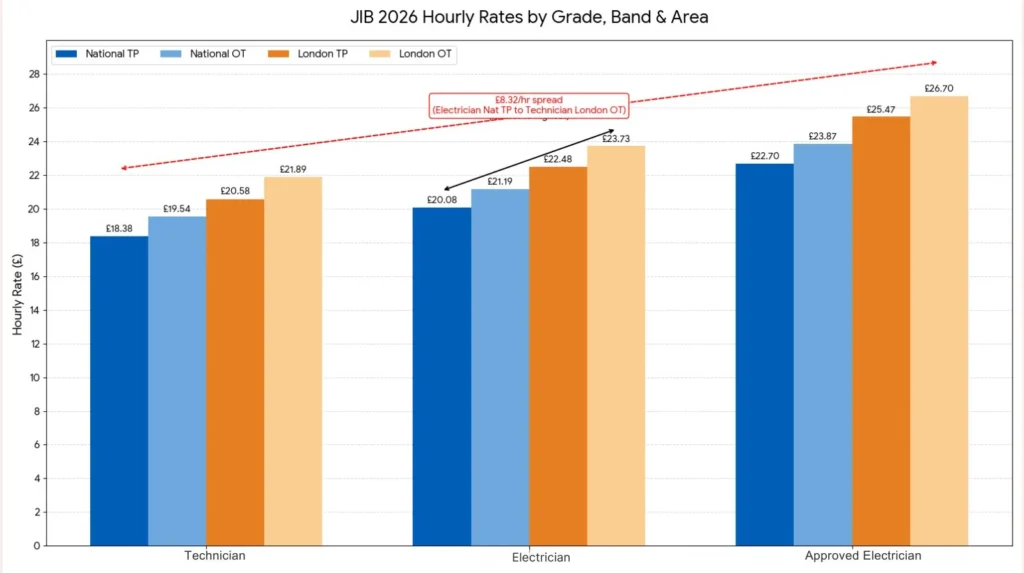
Electrician: £20.58/hour London vs £18.38 National = £2.20/hour (£4,290 annual)
Approved Electrician: £22.48 London vs £20.08 National = £2.40/hour (£4,680 annual)
Technician: £25.47 London vs £22.70 National = £2.77/hour (£5,402 annual)
The London premium compensates for higher regional costs but does not create net financial advantage: a £4,680 annual gross increase for London Approved Electricians yields approximately £2,800-3,200 additional take-home after tax, insufficient to offset typical £12,000+ housing cost differential compared to Midlands, North, or Wales equivalents.
Transport: Provided vs Own Transport
Transport Provided (TP): Employer provides company vehicle for site travel or arranges transportation, electrician uses only for work purposes, employer bears all vehicle costs (fuel, insurance, maintenance, depreciation, road tax).
If you are comparing this with providing your own transport, review buying or leasing a work van.
Own Transport (OT): Electrician uses personal vehicle for site travel, receives higher hourly rate compensating vehicle running costs, electrician bears all ownership and operating expenses.
Own Transport premium by grade (2026 National):
Electrician: £19.54 OT vs £18.38 TP = £1.16/hour (£2,262 annual)
Approved Electrician: £21.19 OT vs £20.08 TP = £1.11/hour (£2,166 annual)
Technician: £23.87 OT vs £22.70 TP = £1.17/hour (£2,283 annual)
The OT premium represents partial cost recovery, not additional income: electricians using personal vehicles for site work typically face £3,000-5,000 annually in fuel (assuming 10,000-15,000 business miles at 15-20p/mile after fuel efficiency), insurance (commercial use endorsement), maintenance (servicing, tyres, repairs), and depreciation (accelerated wear from higher mileage). The £2,166-2,283 OT premium subsidizes but does not fully cover actual vehicle costs, making TP arrangements financially preferable when available unless electricians already own appropriate vehicles for personal use.
Standard Working Week: 37.5 Hours
JIB National Working Rules establish 37.5 hours weekly as standard working time (typically Monday-Friday, 8:00am-4:30pm with 30-minute unpaid lunch break, or similar patterns totaling 7.5 hours daily across five days). All calculator wage calculations default to 37.5 hours unless users specify custom working patterns.
Hours beyond 37.5 weekly trigger overtime premium rates (examined in detail below) typically paid at time-and-a-half (1.5× base rate) for initial overtime hours and double-time (2× base rate) for weekend work or extended hours beyond time-and-a-half thresholds.
Why Calculator Requires Multiple Selections
A single “JIB electrician wage” does not exist: the 2026 pay rise creates 24 distinct hourly rates across three grades, two areas (National/London), and two transport arrangements (TP/OT). An Electrician on National TP (£18.38/hour) earns £3.09/hour less than an Approved Electrician on London OT (£23.73/hour) – a £6,023 annual gross difference at standard hours. Calculator inputs capture these structural variations to show precise increases relevant to individual circumstances.
The 2025 to 2026 Rate Changes: What's Actually Increasing
The 3.95% uplift applies consistently across all grades and bands, but translates to different absolute monetary increases depending on starting hourly rates.
Hourly Rate Increases by Grade (National Transport Provided)
Electrician:
2025 rate: £17.68/hour
2026 rate: £18.38/hour
Increase: £0.70/hour
Percentage: 3.96%
Approved Electrician:
2025 rate: £19.32/hour
2026 rate: £20.08/hour
Increase: £0.76/hour
Percentage: 3.93%
Technician:
2025 rate: £21.84/hour
2026 rate: £22.70/hour
Increase: £0.86/hour
Percentage: 3.94%
Higher base rates produce larger absolute hourly increases: a Technician gains £0.16/hour more than an Electrician from the same 3.95% percentage uplift. This compounds significantly over annual calculations.
Weekly Increases at Standard 37.5 Hours
Electrician: £0.70/hour × 37.5 hours = £26.25/week additional gross
Approved Electrician: £0.76/hour × 37.5 hours = £28.50/week additional gross
Technician: £0.86/hour × 37.5 hours = £32.25/week additional gross
Weekly increases represent pre-tax, pre-National Insurance additional income. Actual take-home increases are approximately 60-65% of gross figures after standard rate tax (20%) and National Insurance (12%) deductions for most electricians, examined in detail below.
Annual Increases at 52 Paid Weeks
JIB minimum rates assume 52 weeks annually including paid holiday entitlements (typically 30+ days comprising 22 days annual leave plus 8 bank holidays). Calculation uses 52 weeks rather than 46.4 “worked weeks” because holiday pay is included in JIB employment contracts, making 52-week calculation reflect actual annual gross pay.
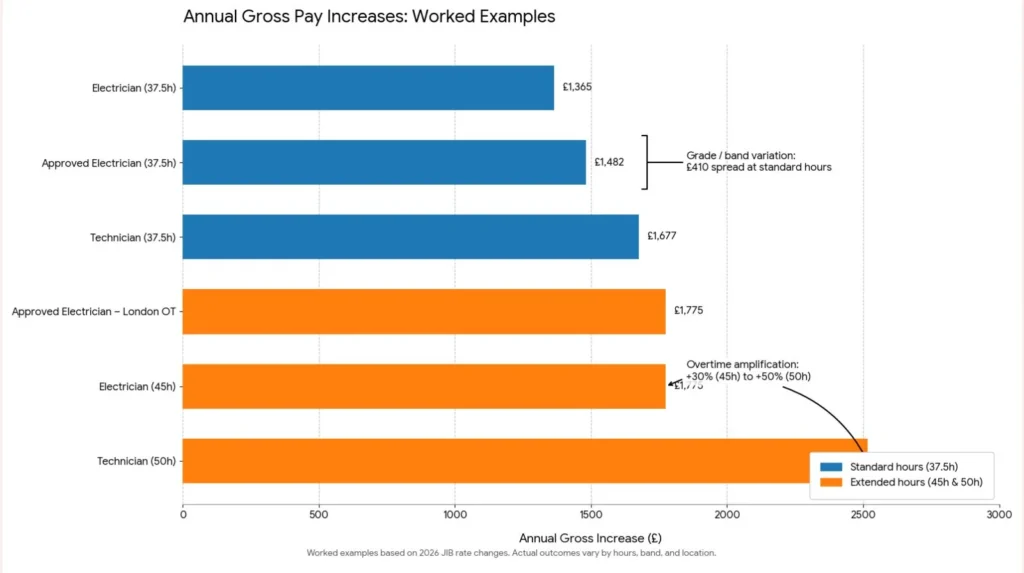
Electrician: £26.25/week × 52 weeks = £1,365 annual gross increase
Approved Electrician: £28.50/week × 52 weeks = £1,482 annual gross increase
Technician: £32.25/week × 52 weeks = £1,677 annual gross increase
Annual increases range from £1,365 to £1,677 across grades at National TP rates before accounting for band variations (National vs London, TP vs OT) that create additional spread.
Complete Rate Comparison: All Grades and Bands
| Grade | Band | 2025 Rate | 2026 Rate | Hourly Increase | Weekly Increase | Annual Increase |
| Electrician | National TP | £17.68 | £18.38 | £0.70 | £26.25 | £1,365 |
| Electrician | National OT | £18.80 | £19.54 | £0.74 | £27.75 | £1,443 |
| Electrician | London TP | £19.79 | £20.58 | £0.79 | £29.63 | £1,541 |
| Electrician | London OT | £21.05 | £21.89 | £0.84 | £31.50 | £1,638 |
| Approved | National TP | £19.32 | £20.08 | £0.76 | £28.50 | £1,482 |
| Approved | National OT | £20.38 | £21.19 | £0.81 | £30.38 | £1,580 |
| Approved | London TP | £21.62 | £22.48 | £0.86 | £32.25 | £1,677 |
| Approved | London OT | £22.82 | £23.73 | £0.91 | £34.13 | £1,775 |
| Technician | National TP | £21.84 | £22.70 | £0.86 | £32.25 | £1,677 |
| Technician | National OT | £22.96 | £23.87 | £0.91 | £34.13 | £1,775 |
| Technician | London TP | £24.50 | £25.47 | £0.97 | £36.38 | £1,892 |
| Technician | London OT | £25.68 | £26.70 | £1.02 | £38.25 | £1,989 |
Annual increases span £1,365 to £1,989 (£624 spread) depending on grade and band selection. A Technician on London OT earns £1.02/hour more from the 2026 rise than an Electrician on National TP (£0.70/hour), compounding to £624 additional annual increase – nearly half the value of the lowest increase itself.
How the Pay Rise Calculator Works
The calculator converts grade, band, and working pattern selections into precise monetary increases using transparent formulas derived from confirmed JIB rates.
Calculator Inputs
Grade selection (dropdown):
Electrician
Approved Electrician
Technician
Area selection (toggle):
National (England outside M25, Wales, Northern Ireland)
London (M25 and Inner Zone)
Transport selection (toggle):
Transport Provided (TP) – employer vehicle
Own Transport (OT) – personal vehicle use
Weekly hours (adjustable, default 37.5):
Standard 37.5 hours (JIB default)
Custom hours (e.g., 35, 40, 45, 50)
Calculator applies hourly increase to user-specified weekly hours
Worked weeks per year (adjustable, default 52):
52 weeks (includes paid holidays in JIB contracts)
46.4 weeks (alternative calculation showing “worked weeks” excluding holidays)
Custom weeks (e.g., accounting for unpaid leave, part-year employment)
Optional overtime module:
Overtime hours per week (user input)
Overtime type (time-and-a-half 1.5× or double-time 2×)
Calculator shows additional weekly and annual uplift from overtime premium
Calculator Outputs
Hourly increase: 2026 rate minus 2025 rate (e.g., £20.08 – £19.32 = £0.76)
Weekly increase: Hourly increase × weekly hours (e.g., £0.76 × 37.5 = £28.50)
Annual gross increase: Weekly increase × worked weeks (e.g., £28.50 × 52 = £1,482)
Percentage change: (Hourly increase ÷ 2025 rate) × 100 (e.g., 0.76 ÷ 19.32 × 100 = 3.93%)
Optional overtime weekly uplift: Overtime hours × 2026 rate × (multiplier – 1) – showing additional premium from pay rise applied to overtime work
Optional overtime annual uplift: Overtime weekly uplift × worked weeks – total additional annual income from pay rise on overtime hours
Optional real-terms change: Percentage change minus CPIH inflation forecast – showing purchasing power gain or loss (examined separately below)
Why 52 Weeks Default
JIB employment contracts include paid holiday entitlements (typically 22 days annual leave plus 8 bank holidays = 30 days total) where electricians receive normal wage during holiday periods. Calculating annual pay using 52 weeks reflects actual annual gross income received including holiday pay.
Alternative 46.4-week calculation (52 weeks minus 30 days ÷ 5 days/week = 46 worked weeks) shows income from worked time only, useful for comparing JIB rates with self-employed or agency earnings where holidays are self-funded. However, JIB employed electricians factually receive 52 weeks of pay annually, making 52-week default most accurate for JIB context.
Calculator Limitations and Assumptions
Gross pay only: Calculator shows increases before income tax (20-45%), National Insurance (12% employee contribution), pension contributions (typically 5% employee minimum), and student loan repayments where applicable. Actual take-home increases are 55-70% of gross figures depending on personal tax circumstances.
Minimum rates: JIB rates are contractual minimums. Many employers pay above JIB minimums through site premiums (+£1-3/hour), specialist allowances (solar, EV, data centres), or negotiated individual rates. Calculator shows guaranteed increases; actual increases may exceed these where employers maintain percentage or fixed-value premiums above JIB minimums.
Standard patterns: Calculator assumes consistent weekly hours and annual weeks. Real electrical work involves variable hours (project peaks 50+ hours, quiet periods 30-35 hours), seasonal patterns (construction slower November-January), and contract variations affecting actual annual income beyond simple multiplication.
Excludes allowances: Travel allowances (mileage reimbursement, lodging £51.29/night), shift premiums (night work +33⅓%), and tool allowances are separate from hourly rates and not included in pay rise calculations as 2026 allowance changes were not confirmed at Industrial Determination publication.
Thomas Jevons, Head of Training at Elec Training, explains calculator output interpretation:
"Pay rise calculators showing gross annual increases don't reflect take-home pay after tax, National Insurance, pension contributions, and student loan repayments where applicable. A £1,482 annual gross increase for an Approved Electrician translates to approximately £900-1,000 additional take-home after deductions. That's still meaningful - equivalent to an extra £17-19 per week in spending power - but electricians planning household budgets need to work from net figures, not gross calculator outputs."
Thomas Jevons, Head of Training
Worked Examples: What This Looks Like in Real Life
Translating calculator methodology into concrete scenarios shows how the 2026 pay rise affects electricians in different grades and working patterns.
Example 1: Electrician, National TP, 37.5 Hours Weekly
Starting position:
Grade: Electrician
Band: National Transport Provided
Weekly hours: 37.5
Annual weeks: 52
Calculator outputs:
2025 rate: £17.68/hour
2026 rate: £18.38/hour
Hourly increase: £0.70
Weekly increase: £26.25 (£0.70 × 37.5)
Annual gross increase: £1,365 (£26.25 × 52)
Percentage: 3.96%
Take-home estimate: £1,365 gross increase yields approximately £840-880 additional take-home after 20% tax and 12% NI (£16-17 per week spending power increase).
Example 2: Approved Electrician, National TP, 37.5 Hours Weekly
Starting position:
Grade: Approved Electrician
Band: National Transport Provided
Weekly hours: 37.5
Annual weeks: 52
Calculator outputs:
2025 rate: £19.32/hour
2026 rate: £20.08/hour
Hourly increase: £0.76
Weekly increase: £28.50 (£0.76 × 37.5)
Annual gross increase: £1,482 (£28.50 × 52)
Percentage: 3.93%
Take-home estimate: £1,482 gross increase yields approximately £910-970 additional take-home after deductions (£17.50-18.65 per week).
Example 3: Technician, National TP, 37.5 Hours Weekly
Starting position:
Grade: Technician
Band: National Transport Provided
Weekly hours: 37.5
Annual weeks: 52
Calculator outputs:
2025 rate: £21.84/hour
2026 rate: £22.70/hour
Hourly increase: £0.86
Weekly increase: £32.25 (£0.86 × 37.5)
Annual gross increase: £1,677 (£32.25 × 52)
Percentage: 3.94%
Take-home estimate: £1,677 gross increase yields approximately £1,030-1,090 additional take-home after deductions (£19.80-21 per week).
Example 4: Approved Electrician, London OT, 37.5 Hours Weekly
Starting position:
Grade: Approved Electrician
Band: London Own Transport
Weekly hours: 37.5
Annual weeks: 52
Calculator outputs:
2025 rate: £22.82/hour
2026 rate: £23.73/hour
Hourly increase: £0.91
Weekly increase: £34.13 (£0.91 × 37.5)
Annual gross increase: £1,775 (£34.13 × 52)
Percentage: 3.99%
Take-home estimate: £1,775 gross increase yields approximately £1,090-1,155 additional take-home after deductions (£21-22.20 per week).
Context: This represents the highest standard-hours increase available under 2026 JIB rates, though Technician London OT (£1,989 annual increase) exceeds it.
Example 5: Electrician, National TP, 45 Hours Weekly (Including Overtime)
Starting position:
Grade: Electrician
Band: National Transport Provided
Weekly hours: 45 (37.5 standard + 7.5 overtime at time-and-a-half)
Annual weeks: 52
Calculator approach: Standard hours increase: £0.70 × 37.5 = £26.25/week Overtime hours increase: £0.70 × 7.5 × 1.5 = £7.88/week Total weekly increase: £34.13 (£26.25 + £7.88) Annual gross increase: £1,775 (£34.13 × 52)
Comparison: An Electrician working 45 hours weekly gains £410 more annually from the 2026 pay rise than an Electrician working standard 37.5 hours (£1,775 vs £1,365), demonstrating how overtime patterns amplify percentage increases.
Example 6: Technician, National TP, 50 Hours Weekly (Extended Overtime)
Starting position:
Grade: Technician
Band: National Transport Provided
Weekly hours: 50 (37.5 standard + 12.5 overtime at time-and-a-half)
Annual weeks: 52
Calculator approach: Standard hours increase: £0.86 × 37.5 = £32.25/week Overtime hours increase: £0.86 × 12.5 × 1.5 = £16.13/week Total weekly increase: £48.38 (£32.25 + £16.13) Annual gross increase: £2,516 (£48.38 × 52)
Comparison: A Technician working 50 hours weekly gains £839 more annually from the 2026 pay rise than a Technician working standard hours (£2,516 vs £1,677), showing substantial overtime amplification effects.
Overtime: How the 2026 Rise Scales Beyond 37.5 Hours
Overtime work amplifies the 2026 pay rise through premium multipliers, creating proportionally larger annual increases for electricians regularly working extended hours common in commercial and industrial electrical contracting.
JIB Overtime Rules (Unchanged in 2026)
Time-and-a-half (1.5× base rate):
Applies to first overtime hours after 37.5-hour weekly threshold
Typical pattern: Monday-Friday work beyond 7.5 daily hours
Saturday morning work (before 1:00pm in some agreements)
Calculation: Base rate × 1.5 = overtime rate
Double-time (2× base rate):
Saturday work from 1:00pm onwards (varies by agreement)
All Sunday work
Bank holidays
Night shift work (after 8:00pm weekdays in some patterns)
Calculation: Base rate × 2 = overtime rate
Critical note: Overtime multipliers have not changed in 2026. The pay rise applies to base rates; multipliers then apply to increased base rates, creating compound effect.
How Overtime Amplifies Pay Rise Impact
Example calculation (Approved Electrician, National TP):
Base rate increase: £0.76/hour (£19.32 to £20.08)
Time-and-a-half overtime:
2025 overtime rate: £19.32 × 1.5 = £28.98/hour
2026 overtime rate: £20.08 × 1.5 = £30.12/hour
Overtime rate increase: £1.14/hour (50% larger than base increase)
Double-time overtime:
2025 overtime rate: £19.32 × 2 = £38.64/hour
2026 overtime rate: £20.08 × 2 = £40.16/hour
Overtime rate increase: £1.52/hour (100% larger than base increase)
Annual impact (regular overtime patterns):
45-hour weeks (7.5 hours time-and-a-half):
Base hours increase: £0.76 × 37.5 × 52 = £1,482
Overtime hours increase: £0.76 × 7.5 × 1.5 × 52 = £444
Total annual increase: £1,926 (+30% over standard hours)
50-hour weeks (12.5 hours time-and-a-half):
Base hours increase: £0.76 × 37.5 × 52 = £1,482
Overtime hours increase: £0.76 × 12.5 × 1.5 × 52 = £741
Total annual increase: £2,223 (+50% over standard hours)
Overtime Frequency and Patterns
Electrical work overtime patterns vary substantially by sector, employer, and project phase:
Commercial construction: 45-50 hour weeks common during project installation phases (8-10 week periods), reverting to 37.5 hours during commissioning or between contracts
Industrial maintenance: Regular overtime for shutdown coverage, emergency callouts, and scheduled preventive maintenance often pushing average hours to 42-45 weekly year-round
Data centres and critical infrastructure: Shift patterns and 24/7 coverage requirements create consistent overtime opportunities at premium rates
Domestic and light commercial: More likely to maintain 37.5-40 hour patterns with occasional overtime during project peaks rather than sustained extended hours
Seasonal variation: Construction sector overtime typically higher March-October (longer daylight, better weather, project scheduling) than November-February
Electricians should not assume consistent overtime availability when projecting annual income: a pay rise calculator showing 50-hour weekly increases provides ceiling estimate, not guaranteed outcome. Actual annual income depends on employer project pipeline, sector patterns, and individual willingness to accept overtime offers.
Real-Terms Pay: Is This a Genuine Increase?
Understanding whether the 2026 JIB pay rise delivers actual purchasing power improvement requires comparing the 3.95% wage increase against projected inflation rates measuring cost-of-living changes.
What “Real Terms” Means
Nominal increase: The percentage or monetary wage rise announced (3.95%, £0.70-1.02/hour depending on grade/band)
Inflation: The rate at which prices for goods and services increase, measured by Consumer Prices Index including owner occupiers’ housing costs (CPIH) capturing rent, mortgage interest, energy, food, transport, and other household expenses
Real-terms increase: Nominal wage increase minus inflation rate, showing purchasing power change
Formula: Real increase = Nominal increase – Inflation rate
Example: 3.95% wage increase – 3.0% inflation = 0.95% real purchasing power gain
Inflation Context for January 2026
CPIH inflation for January 2026 will not be published until February 2026, requiring reliance on forecasts from Office for Budget Responsibility and Bank of England projections:
OBR forecast (November 2025): CPIH approximately 2.5% for Q1 2026 year-on-year
Bank of England forecast (December 2025): CPI (closely aligned with CPIH) approximately 2.0-2.5% for early 2026
Consensus forecast: 2.5-3.0% CPIH for January 2026 year-on-year comparison
These forecasts assume energy prices remain stable, wage growth moderates to 4-5%, and no external shocks (geopolitical disruption, supply chain crises) create inflation spikes similar to 2022-2023 period when CPIH exceeded 9%.
Real-Terms Scenarios for 2026 Pay Rise
| Inflation Scenario | Nominal Increase | Inflation Rate | Real Increase | Meaning |
| Optimistic | 3.95% | 2.0% | +1.95% | Purchasing power increases substantially; wage growth clearly exceeds cost increases |
| Base Case | 3.95% | 2.5% | +1.45% | Modest purchasing power gain; electricians slightly better off after accounting for costs |
| Moderate | 3.95% | 3.0% | +0.95% | Small purchasing power improvement; marginal gains above inflation |
| Challenging | 3.95% | 4.0% | -0.05% | Purchasing power approximately stagnant; wage barely keeps pace with costs |
Most likely outcome: Base case scenario (2.5% inflation) delivering approximately 1.45% real purchasing power gain, sufficient for electricians to feel modestly better off rather than merely maintaining existing living standards against rising costs.
Historical Context: 2024-2026 Cumulative Recovery
The 2026 pay rise continues three-year pattern of real-terms recovery following 2022-2023 erosion:
2024: 7% nominal increase vs ~4% inflation = ~3% real gain
2025: 5% nominal increase vs ~3% inflation = ~2% real gain
2026: 3.95% nominal increase vs ~2.5% inflation = ~1.45% real gain
Cumulative 2024-2026: ~6.5% real purchasing power recovery
This pattern restores electrician purchasing power approximately to 2021 levels but does not deliver sustained real wage growth beyond inflation compensation. The 2026 increase represents consolidation phase after correction years (2024-2025) following erosion phase (2022-2023).
Why Real Terms Matters More Than Nominal Percentages
An electrician hearing “3.95% pay rise” might reasonably expect their household budget to improve by 3.95%, enabling 3.95% additional spending on groceries, utilities, mortgage or rent, vehicle costs, and discretionary expenses. However, if those same goods and services increase in price by 2.5%, the actual household budget improvement is only 1.45% – sufficient for modest gains (perhaps an additional £15-20 weekly spending power after rent/mortgage and bills) rather than transformational income increase enabling major lifestyle changes.
Real-terms analysis prevents electricians from overestimating pay rise impact when budgeting for household expenses, mortgage applications, or major purchases where lenders and personal financial planning require realistic income projections accounting for cost-of-living changes.
Apprentices: Why the Calculator Looks Different
JIB apprentice rates remain unchanged in 2026, creating distinct calculator requirements and interpretation contexts compared to graded operative increases.
Apprentice Rates (No 2026 Change)
Stage | 2025 National TP | 2026 National TP | Change |
Stage 1 (Year 1) | £8.16/hour | £8.16/hour | £0.00 |
Stage 2 (Year 2) | £10.60/hour | £10.60/hour | £0.00 |
Stage 3 (Year 3) | £13.05/hour | £13.05/hour | £0.00 |
Stage 4 (Year 4) | £14.03/hour | £14.03/hour | £0.00 |
London apprentice rates similarly unchanged (£9.14, £11.88, £14.62, £15.72 respectively).
Real-Terms Impact for Apprentices
With apprentice rates static and inflation projected at 2.5%, apprentices experience -2.5% real purchasing power erosion in 2026, making household budgets tighter during training years:
Stage 1 apprentice:
Annual gross (37.5h, 52w): £15,912
Real-terms loss at 2.5% inflation: -£398 purchasing power annually
Weekly impact: Approximately £7.65/week reduced spending power against rising costs
Stage 4 apprentice:
Annual gross: £27,359
Real-terms loss at 2.5% inflation: -£684 purchasing power annually
Weekly impact: Approximately £13.15/week reduced spending power
This real-terms erosion makes adult apprentice recruitment challenging (examined extensively in prior article on 2026 pay rise recruitment/apprenticeship impact) where household income requirements and National Living Wage obligations for 21+ apprentices create affordability barriers.
The Completion Incentive: Why Pay Rise Percentages Matter Less for Apprentices
Joshua Jarvis, Elec Training’s Placement Manager, explains the apprentice wage structure logic:
"Apprentices seeing no pay increase in 2026 while qualified electricians receive 3.95% can feel discouraged, but the completion wage jump is the real incentive. A Stage 4 apprentice earning £14.03/hour completing their NVQ and AM2 immediately moves to Electrician grade at £18.38/hour - a £4.35/hour increase or £8,494 annually. That's equivalent to six years of 3.95% annual increases compressed into qualification completion. The message for apprentices: completion speed matters more than annual pay rise percentages during training."
Joshua Jarvis, Placement Manager
Completion wage jump calculation:
Stage 4 apprentice: £14.03/hour (£27,359 annual at 37.5h/52w)
Qualified Electrician: £18.38/hour (£35,841 annual)
Immediate increase: £4.35/hour (£8,482 annually)
Percentage jump: 31.0%
This 31% wage increase upon qualification dwarfs annual percentage rises and provides strong financial incentive for apprenticeship completion. An apprentice completing 12 months faster (e.g., 30 months versus 42 months total) gains an additional £8,482 in qualified wages that year, far exceeding any annual pay rise value during training.
Compare how long it takes to train as an electrician before turning future pay rates into a personal earnings forecast.
Why Apprentices Are Excluded from Main Calculator
Including apprentice rates (£0.00 increase) alongside graded operative rates (3.95% increase) in unified calculator creates misleading interface suggesting apprentices receive equivalent treatment or that calculator applies to all electrical workers. Separating apprentice wage analysis maintains clarity about distinct wage structures and real-terms impacts affecting training demographics.
Electricians planning qualification progression from apprenticeship through NVQ Level 3 completion, AM2 assessment, and entry to JIB graded employment understand that completion timing affects lifetime earnings far more than annual percentage increases during training years, prioritizing efficient portfolio completion and first-time AM2 passes over waiting for apprentice wage improvements that lag behind inflation and qualified rate increases.
Important Limits and Caveats
Calculator outputs require contextual interpretation accounting for JIB rate structure, tax implications, and individual circumstance variations.
JIB Rates Are Minimums, Not Ceilings
JIB Industrial Determination establishes minimum hourly rates that signatory contractors cannot legally pay below. Many electrical contractors exceed JIB minimums through:
Site premiums: £1-3/hour additional for specific projects (data centres, industrial facilities, renewable energy installations)
Specialist allowances: Additional rates for certified specialisms (solar PV, EV charging, fire alarm, SCADA systems)
Employer competitive positioning: Firms in high-demand regions (London, South-East, Scotland) often pay £2-4/hour above JIB minimums to attract and retain experienced electricians
The wider shortage of skilled electricians helps explain why demand affects pay.
Negotiated individual rates: Electricians with strong track records, niche skills, or supervisory capabilities may negotiate personal rates exceeding JIB minimums by £3-5/hour
Calculator shows guaranteed minimum increases; actual increases may exceed calculator outputs where employers maintain fixed premiums (+£X/hour) or percentage premiums (+Y% above JIB) that compound with 2026 base rate increases.
Gross Pay Before Tax and Deductions
All calculator figures represent gross pay before mandatory deductions:
Income tax: 20% on income between £12,571-£50,270 (basic rate), 40% on £50,271-£125,140 (higher rate)
Employee National Insurance: 12% on income between £12,570-£50,270 (reduced to 10% above £50,270)
Employer pension contributions: Minimum 3% employee contribution (often 5% in JIB schemes)
Student loan repayments: Plan 1 (9% above £24,990), Plan 2 (9% above £27,295), Plan 4 Scotland (9% above £31,395), Postgraduate Loan (6% above £21,000)
Approximate take-home conversion:
Gross annual increase £1,365-1,677 → Net increase £840-1,090 (60-65% retention)
Weekly gross increase £26.25-32.25 → Weekly net £16-21
Electricians budgeting household expenses should use net figures accounting for personal tax circumstances, not gross calculator outputs.
Geographic Coverage: England, Wales, Northern Ireland Only
Calculator reflects JIB rates for England (outside M25), Wales, and Northern Ireland National rates, plus London/Inner Zone variants. Scotland operates under Scottish Joint Industry Board (SJIB) with separate negotiations producing aligned but distinct rates typically 4-6% higher than JIB equivalents.
Scottish electricians should reference SJIB Industrial Determination rather than JIB calculator outputs.
Allowances Not Included
Calculator focuses on hourly wage increases only. Separate allowances affecting actual earnings but not included:
Travel allowances:
Mileage reimbursement: 22p/mile for journeys exceeding 15 miles each way
Daily travel allowance: Fixed sum for distant sites (varies by distance bands)
No confirmed 2026 changes published at Industrial Determination release
Lodging allowance:
Maximum £51.29/night for overnight stays on distant projects
No confirmed 2026 change
Shift premiums:
Night shift: Additional 33⅓% base rate
Weekend shift: Double-time or time-and-a-half depending on pattern
Unchanged in 2026
Electricians regularly receiving these allowances experience additional income gains if allowances increase proportionally to base rates, but calculator cannot reflect unconfirmed allowance changes.
Inflation Figures Are Forecasts Only
Real-terms calculator output uses projected 2.5-3.0% CPIH inflation for January 2026. Actual CPIH published February 2026 may differ if:
Energy prices spike: Gas/electricity cost increases raise household inflation significantly
Wage growth accelerates: Broad economy wage settlements above forecasts create demand-pull inflation
Supply shocks occur: Geopolitical disruption, extreme weather, pandemic resurgence affecting supply chains
Policy changes: Interest rate adjustments, government spending patterns, tax policy shifts
Real-terms purchasing power gains shown as 0.95-1.95% represent forecasts, not guarantees. Actual purchasing power changes determined by final January 2026 CPIH publication.
Working Pattern Variability
Calculator assumes consistent weekly hours and annual weeks for simplification. Real electrical work involves:
Project cycles: Intensive 50-hour weeks during installation phases followed by 32-hour weeks between contracts
Seasonal patterns: Construction typically slower November-February affecting overtime availability
Economic sensitivity: Recession or construction slowdowns reduce hours offered regardless of hourly rates
Personal choices: Health issues, family obligations, voluntary reduced hours create individual variation
Annual income projections from calculator represent idealized scenarios assuming consistent work availability and personal capacity for specified hours. Actual income requires factoring in employer project pipeline reliability and individual circumstances.
The 2026 JIB pay determination effective 5 January 2026 delivers a 3.95% increase to hourly rates for graded electrical operatives (Electrician, Approved Electrician, Technician) across England, Wales, and Northern Ireland, translating to £0.70-1.02/hour increases depending on grade and band selection, £26.25-38.25 weekly additional gross at standard 37.5-hour working patterns, and £1,365-1,989 annual gross increases before tax and National Insurance deductions. The practical monetary impact varies substantially across structural dimensions: an Electrician on National Transport Provided rates (£18.38/hour in 2026) receives £26.25 weekly additional gross compared to a Technician on London Own Transport (£26.70/hour) receiving £38.25 weekly – a £624 annual differential from the same 3.95% percentage increase applied to different baseline rates reflecting qualification levels, geographic cost compensation, and vehicle responsibility allocation.
Overtime patterns amplify pay rise impact through premium multipliers where electricians working 45-50 hour weeks common in commercial construction and industrial maintenance experience 30-50% larger annual increases than standard-hours calculations suggest: an Approved Electrician gaining £1,482 annually at 37.5 hours receives £1,926 at 45 hours (+30%) or £2,223 at 50 hours (+50%) as the £0.76 hourly base increase compounds through time-and-a-half overtime premiums. However, overtime availability varies by sector, employer project pipeline, and seasonal construction patterns, making extended-hours projections ceiling estimates rather than guaranteed outcomes requiring consistent work availability throughout the year.
Real-terms purchasing power analysis comparing the 3.95% nominal increase against projected 2.5% CPIH inflation for January 2026 suggests modest but genuine improvement delivering approximately 1.45% real purchasing power gain – sufficient for electricians to feel slightly better off (equivalent to £15-20 additional weekly spending power after rent/mortgage and utility costs) rather than merely maintaining existing living standards against rising costs, continuing three-year recovery pattern (2024-2026 cumulative ~6.5% real gain) restoring purchasing power to approximately 2021 levels following substantial 2022-2023 erosion when inflation spiked to 9%+ while JIB increases lagged at 4-5%.
Calculator methodology presented shows transparent conversion from grade/band/hours selections to precise monetary increases, but requires interpretation accounting for critical limitations: gross figures don’t reflect take-home pay after 20-40% tax/NI deductions reducing £1,365-1,989 gross annual increases to approximately £840-1,300 net depending on personal tax circumstances, JIB rates are contractual minimums that many employers exceed by £1-5/hour through site premiums and specialist allowances creating actual increases beyond calculator outputs, and working pattern consistency assumptions don’t capture real electrical work volatility where project cycles create 50-hour installation phases alternating with 32-hour quiet periods between contracts affecting actual annual income beyond simple hourly × weekly × annual multiplication.
Apprentices experience fundamentally different wage trajectory with zero 2026 rate increases creating -2.5% real purchasing power erosion against projected inflation, but the completion wage structure compensates through substantial qualification jump from Stage 4 apprentice (£14.03/hour, £27,359 annual) to qualified Electrician (£18.38/hour, £35,841 annual) representing £4.35/hour or £8,482 annual increase (31% jump) upon NVQ/AM2 completion that exceeds six years of 3.95% annual increases compressed into qualification achievement. This back-loaded incentive structure prioritizes completion speed over annual percentage rises during training years, making efficient portfolio development and first-time AM2 passes far more valuable for lifetime earnings than waiting for apprentice wage improvements that consistently lag behind qualified operative increases and inflation rates.
Grade progression delivers larger income gains than annual pay rises: the differential between Electrician and Approved Electrician rates (£1.70/hour, £3,315 annually at National TP) or Approved Electrician and Technician (£2.62/hour, £5,109 annually) represents permanent step-changes exceeding multiple years of 3.95% increases, suggesting electricians focusing solely on annual JIB percentage headlines miss bigger earning opportunities through completing inspection and testing qualifications (AM2/AM2E, 2391 Testing & Inspection) enabling Approved status or pursuing advanced qualifications (HNC/HND) supporting Technician progression. Electricians planning career development through qualification pathways from initial NVQ Level 3 completion through AM2 assessment and advanced testing qualifications enabling grade progression from Electrician to Approved to Technician status should prioritize qualification investment and skills development over waiting for annual wage determinations that deliver modest 1-2% real purchasing power gains compared to 15-25% permanent income increases from grade advancement.
Pay is only one consideration; these reasons to become an electrician cover progression, variety and long-term demand.
Call us on 0330 822 5337 to discuss how qualification pathways integrate with JIB grading structures, what realistic timelines look like for progressing from Electrician to Approved status through inspection and testing qualifications, how our in-house recruitment team helps NVQ learners secure JIB employment with contractors offering above-minimum rates and consistent overtime opportunities, and what actual take-home income looks like across grades accounting for tax, National Insurance, and benefit package value rather than gross calculator headlines alone.
References
- JIB (Joint Industry Board for the Electrical Contracting Industry) – Industrial Determination 2026-2028 – https://www.jib.org.uk/wp-content/uploads/2025/06/JIB-Industrial-Determination-062025.pdf
- JIB – Handbook 2025 (2025 rates baseline for comparison) – https://www.jib.org.uk/wp-content/uploads/2025/01/JIB-Handbook-2025.pdf
- JIB – New Wage Agreement from 2026 to 2028 (announcement) – https://www.jib.org.uk/news/new-wage-agreement-from-2026-to-2028/
- Office for Budget Responsibility – Economic and Fiscal Outlook November 2025 (CPIH forecast) – https://obr.uk/efo/economic-and-fiscal-outlook-november-2025/
- ONS (Office for National Statistics) – Consumer Price Inflation (CPIH data series) – https://www.ons.gov.uk/economy/inflationandpriceindices
Note on Accuracy and Updates
Last reviewed: 23 December 2025. This page is maintained; we correct errors and refresh sources as JIB Industrial Determinations, inflation data, and tax threshold changes are published. 2026 rates sourced from confirmed JIB Industrial Determination 062025 effective 5 January 2026. 2025 baseline rates from JIB Handbook 2025 effective 6 January 2025. CPIH inflation projections use Office for Budget Responsibility November 2025 forecast (~2.5%) and Bank of England December 2025 guidance (2.0-2.5% CPI), acknowledging actual January 2026 CPIH will be published February 2026 and may vary from forecasts based on energy prices, wage growth, and economic conditions. Take-home calculations assume basic rate tax (20%), standard National Insurance (12%), and typical pension contribution (5%) without accounting for higher rate tax, student loans, or Scotland/Wales tax variations affecting individual net income. Overtime calculations use confirmed JIB multipliers (time-and-a-half 1.5×, double-time 2×) unchanged in 2026. Calculator methodology assumes consistent weekly hours and annual weeks; actual electrical work involves variable hours by project cycle, seasonal construction patterns, and employer pipeline reliability. JIB rates are contractual minimums; many employers exceed through site premiums (£1-3/hour), specialist allowances, or negotiated individual rates creating actual increases beyond calculator baseline projections. Apprentice completion wage jump calculation (Stage 4 £14.03/hour to Electrician £18.38/hour = £4.35/hour or £8,482 annually) uses National Transport Provided rates; London and Own Transport variants produce proportionally similar percentage jumps. Next review scheduled following January 2026 CPIH publication (expected February 2026) for real-terms calculation validation and any mid-year JIB bulletins addressing allowance adjustments or clarifications.
