


- Technical review: Thomas Jevons (Head of Training, 20+ years)
- Employability review: Joshua Jarvis (Placement Manager)
- Editorial review: Jessica Gilbert (Marketing Editorial Team)
- Last reviewed:
- Changes: Updated 2025 salary data and BCIA Q2 market intelligence figures
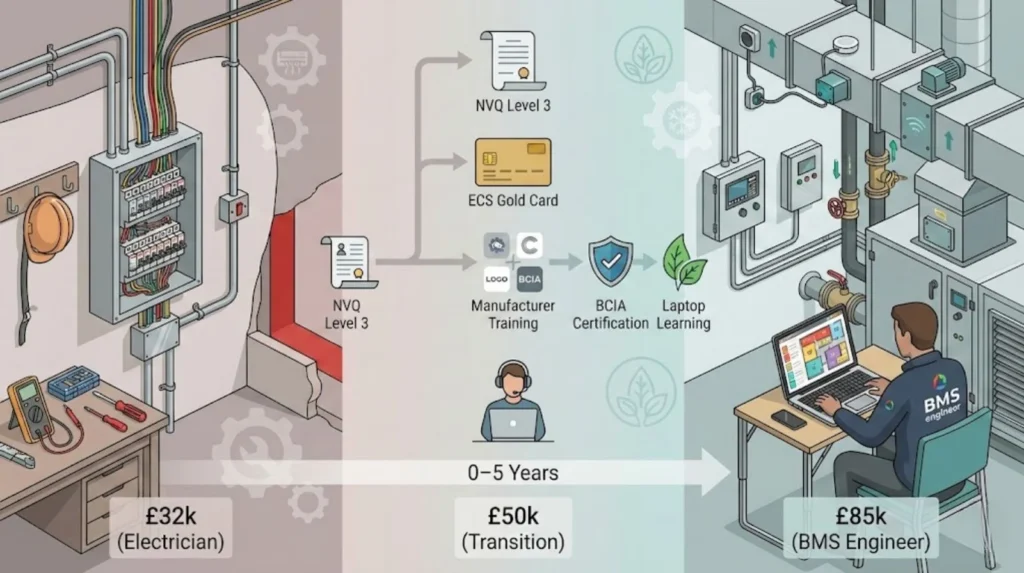
Building Management Systems represent one of the strongest career progression routes for qualified electricians in the UK, driven by government decarbonisation targets requiring almost every commercial building to upgrade energy management capabilities by 2030. The BEMS market grew 11.9% in Q2 2025 according to Building Controls Industry Association data, creating sustained demand for electricians who can bridge traditional installation skills with control systems expertise.
Understanding what BMS actually involves prevents expensive training detours and unrealistic expectations. This isn’t advanced electrical wiring with higher pay. It’s a fundamental shift from power circuits to control logic, from physical fault-finding to software diagnostics, and from team-based installation work to solo plant room troubleshooting. The electrical foundation matters, but success in BMS careers depends equally on software confidence, HVAC system understanding, and comfort working independently in operational buildings.
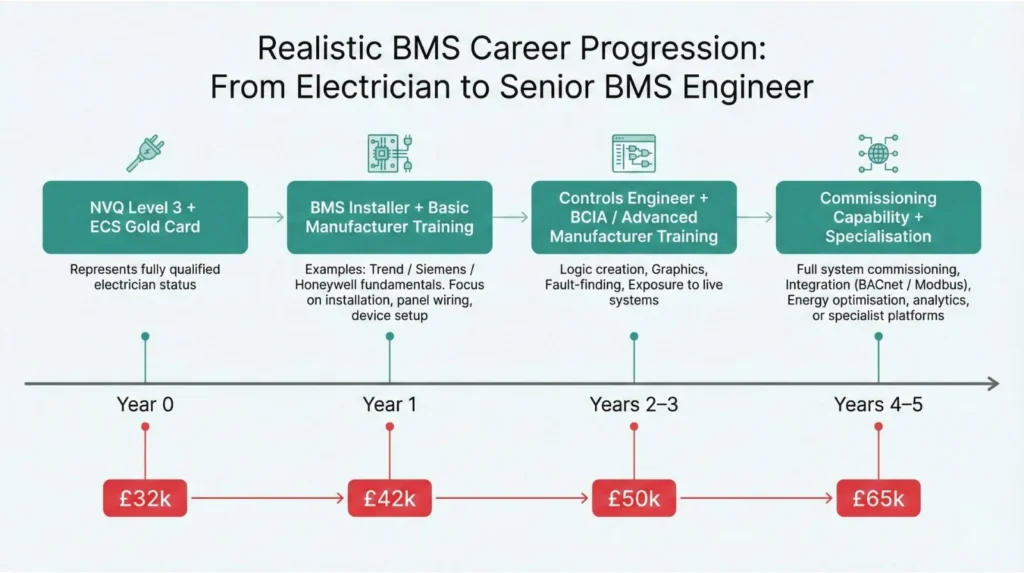
The transition pathway exists and pays well for electricians willing to develop new skillsets, but it’s not a quick course-and-certificate route. Progression from installation electrician to BMS commissioning engineer typically takes 2-4 years of manufacturer training, site experience, and demonstrated competence in unfamiliar technical areas. Entry roles start around £32,000-£40,000 similar to electrical installation rates, but specialist commissioning positions in the South East command £50,000-£65,000, with senior London roles reaching £75,000-£85,000.
This article explains what BMS means in UK building services contexts, how the work differs from traditional electrical contracting, realistic transition pathways for recognised UK electrician courses graduates, and what determines whether electricians succeed or struggle in controls engineering careers. No hype about easy transitions. Just evidence-based guidance about a legitimate but demanding career option.
Definitions Panel: BMS vs BEMS vs BAS vs HVAC Controls
UK building services terminology overlaps significantly, creating confusion about what BMS actually means and how related systems differ. The Chartered Institution of Building Services Engineers (CIBSE) provides industry standard definitions clarifying distinctions.
BMS (Building Management System) describes computer-based centralized systems monitoring and controlling mechanical and electrical equipment in buildings. The “management” component emphasizes oversight across multiple building services: heating, ventilation, air conditioning (HVAC), lighting, energy usage, plant equipment, alarms, and scheduling. Modern BMS platforms integrate these functions through software providing real-time monitoring, trend logging, automated control sequences, and remote access capabilities.
BEMS (Building Energy Management System) refers to BMS implementations specifically focused on energy efficiency and optimization. The terms are often used interchangeably in UK contexts, though BEMS emphasizes data analytics, energy consumption tracking, and optimization algorithms aligning with government Net Zero requirements. Practically, most contemporary BMS installations include energy management capabilities making the BEMS designation largely marketing terminology rather than technical distinction.
BAS (Building Automation System) represents American terminology more common in US building services literature than UK practice. Where BAS appears in UK contexts, it typically refers to automation of specific systems like lighting control or access systems rather than comprehensive building-wide integration. CIBSE guidance and UK training materials predominantly use BMS terminology.
HVAC Controls constitute a subset of BMS functionality managing heating, ventilation, and air conditioning systems. This includes boilers, chillers, air handling units, pumps, dampers, and associated sensors and actuators. HVAC controls often represent the most complex component of BMS implementation given the mechanical system integration, energy consumption implications, and occupant comfort requirements. Understanding HVAC principles—not just electrical connections—becomes essential for BMS engineers.
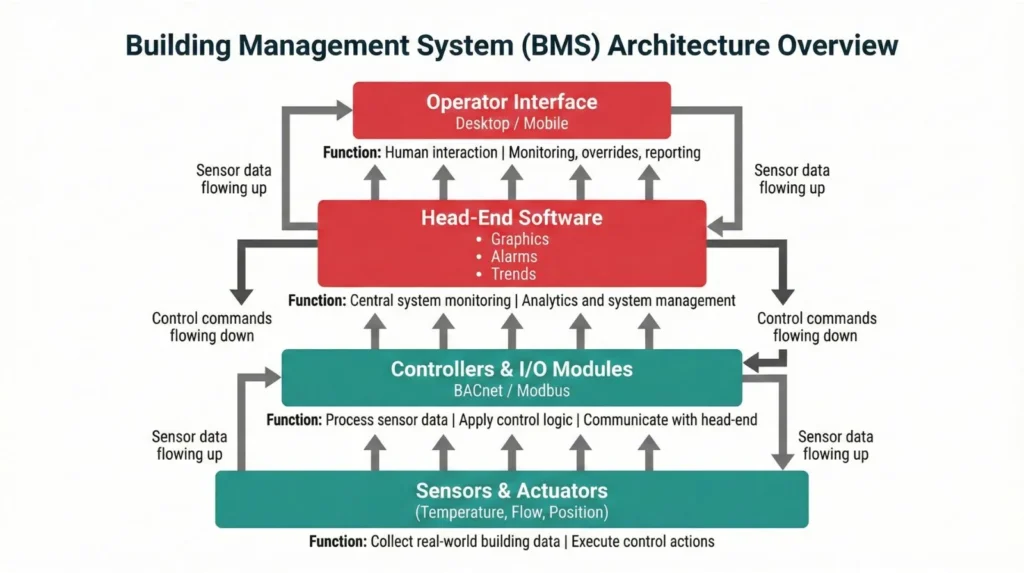
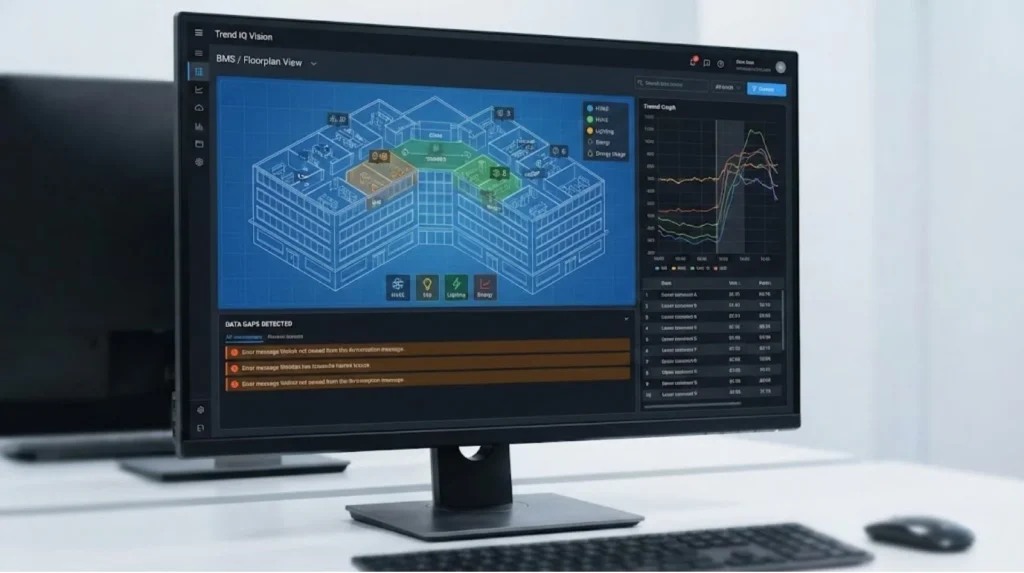
The “Head-End” describes the central supervisory computer or server running BMS software where building graphics, alarm management, trend data, and user interfaces reside. Field controllers throughout the building communicate back to this head-end system via network protocols. Electricians transitioning to BMS roles work extensively with head-end software for system configuration, troubleshooting, and optimization.
Common UK job titles reflect functional specialization rather than distinct qualifications. BMS Installer focuses on physical installation including containment, panel wiring, and sensor mounting. BMS Controls Engineer handles system integration, I/O configuration, and software programming. Commissioning Engineer tests installed systems against design specifications before handover. Service or Maintenance Engineer provides ongoing fault diagnosis and optimization in operational buildings. These roles represent progression pathways rather than entry positions.
The practical implication for electricians: BMS isn’t a single system or role. It’s a diverse sector where electrical competence provides entry credibility, but career progression depends on developing controls logic, software capabilities, and mechanical systems knowledge extending well beyond traditional electrical scope.
What Electricians Actually Do in BMS Roles
Understanding real work functions rather than job titles clarifies what BMS careers actually involve day-to-day and which electrical skills transfer directly versus requiring new development.
Installation-focused roles remain closest to traditional electrical work. BMS installers pull cables, install containment systems, mount sensors and controllers, wire control panels, and terminate field devices. The containment and panel wiring use familiar electrical skills. The difference appears in what’s being connected: temperature sensors, actuators controlling damper positions, flow meters, and network communication cables rather than power circuits serving outlets and lighting. BS 7671 requirements still apply to fixed wiring, but the focus shifts to separation between power and control circuits preventing electromagnetic interference.
Installation work requires ECS Gold Card for site access proving electrical competence, but minimal software interaction. Installers work from detailed drawings showing sensor locations and controller mounting positions. The role suits electricians wanting to leverage existing skills without immediately developing software capabilities, but progression potential remains limited without controls training. Installation positions typically offer £32,000-£40,000 in most UK regions.
Controls engineering roles represent the first significant departure from traditional electrical work. Controls engineers configure controllers, map input/output points, write control sequences determining how equipment operates, and integrate different manufacturer systems using protocols like BACnet and Modbus. The work involves laptop-based configuration using proprietary software rather than multimeters and hand tools. Understanding circuit diagrams remains important, but reading mechanical schematics showing airflow paths and water pipe layouts becomes equally essential.
Electrical competence provides credibility and safety awareness, but success depends on logical thinking, software confidence, and willingness to learn HVAC operational principles. Why does this boiler fire when outdoor temperature drops below 12°C but valve position is only 65%? Controls engineers need to understand mechanical behavior, not just electrical connectivity. Salary ranges typically reach £42,000-£52,000 reflecting the additional complexity beyond installation work.
Commissioning engineer positions test completed BMS installations against design specifications, verify control sequences operate correctly, calibrate sensors, document system performance, and train facilities staff. The work requires understanding both electrical and mechanical sides thoroughly enough to diagnose whether problems stem from wiring faults, sensor calibration issues, control logic errors, or mechanical equipment failures. Commissioning happens during building handover when pressure to complete is intense and problems require rapid diagnosis.
This role demands highest competence levels among BMS positions. Commissioning engineers work largely independently, make critical decisions affecting building operation, and bear responsibility for system functionality after contractors leave. Gold Card status is standard requirement proving electrical safety competence. Salaries reflect the responsibility level: £50,000-£65,000 nationally, with London and South East positions reaching £75,000-£85,000 for experienced engineers.
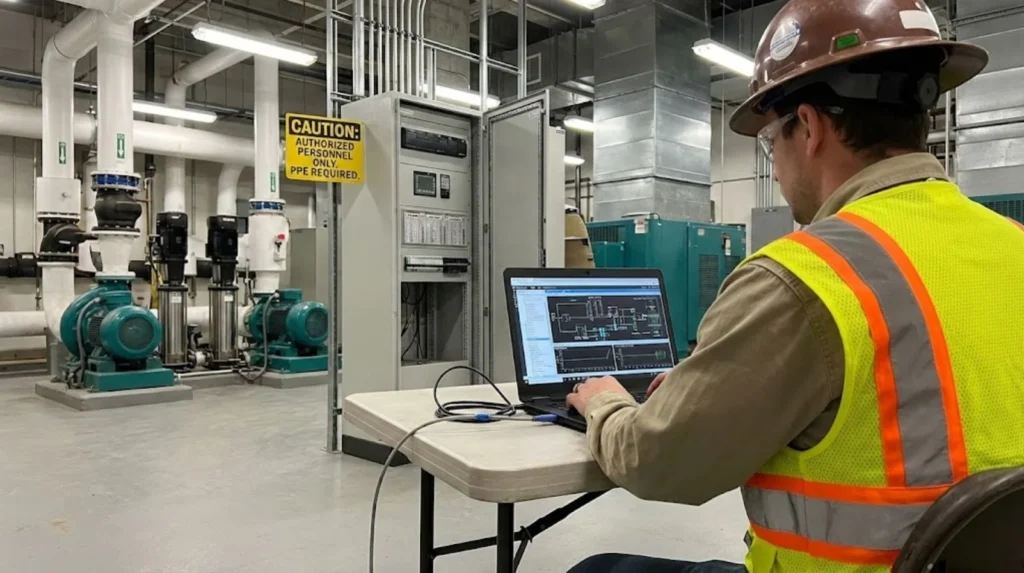
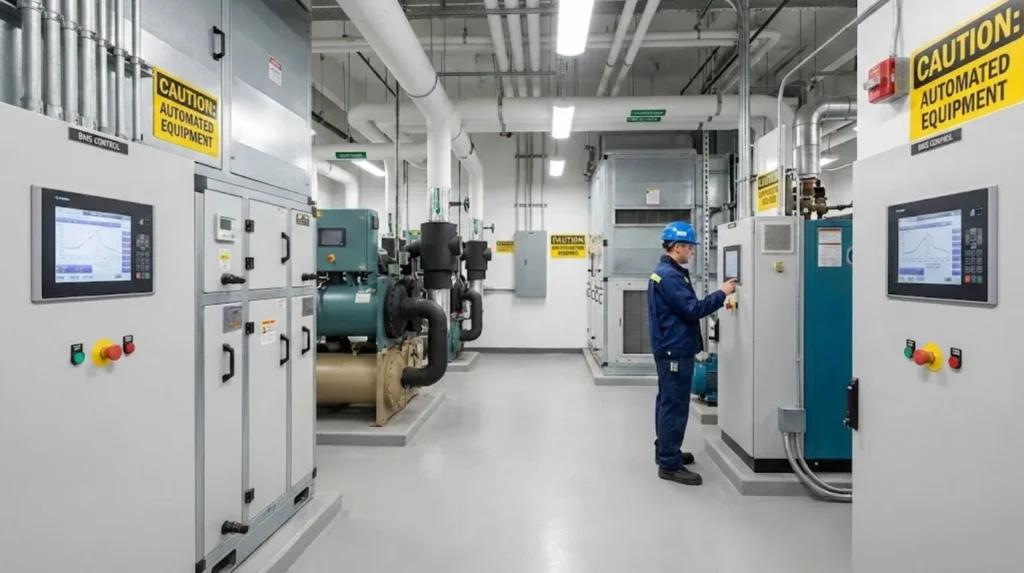
Service and maintenance engineer roles provide ongoing support in operational buildings. Work includes responding to fault callouts, performing planned preventive maintenance, optimizing system performance based on usage patterns, and implementing control sequence modifications requested by facilities managers. Engineers work alone in plant rooms diagnosing problems affecting entire buildings, often during occupied hours when shutdowns aren’t feasible.
Joshua Jarvis, Placement Manager:
"BMS service and commissioning work involves different environments than typical electrical contracting. You're often alone in plant rooms diagnosing problems affecting entire buildings, coordinating with facilities managers who aren't electrically trained, and working during occupied hours when shutdowns aren't possible. There's frequent on-call work for heating failures or control system faults outside normal hours. The electrical work is safer—mostly ELV—but the pressure and isolation differ significantly from installation teams working together on new builds."
Joshua Jarvis, Placement Manager
Service roles typically include on-call responsibilities for emergency heating failures during winter or cooling system problems in summer. The work suits electricians comfortable with solo troubleshooting and able to communicate technical issues to non-technical building managers. Salary ranges sit at £42,000-£52,000 depending on on-call requirements and building complexity.
| Role | Electrical Focus | Software/Controls Focus | Typical Salary | ECS Card Expected | Career Entry Point |
| BMS Installer | 90% | 10% | £32k-£40k | Gold Card | Yes – Common |
| Controls Engineer | 30% | 70% | £42k-£52k | Gold/Related | Possible with training |
| Commissioning Engineer | 50% | 50% | £50k-£65k (£75k-£85k London) | Gold Card | Rare without experience |
| Service/Maintenance | 40% | 60% | £42k-£52k | Gold/Maintenance | Possible with experience |
The role map reveals BMS isn’t a single career but a spectrum. Electricians can enter via installation roles leveraging existing skills, but progression requires deliberate development of software and mechanical competencies extending beyond electrical training foundations.
Legal and Competency Boundaries (UK)
BMS work operates under the same legal framework as traditional electrical work, though the application differs given predominant use of extra-low voltage control circuits.
Electricity at Work Regulations 1989 remain primary legislation governing electrical safety in UK workplaces. Regulation 16 requires persons working on electrical systems to be competent, with competence defined as possessing adequate knowledge, skills, and experience for the specific work undertaken. For BMS roles, competence encompasses electrical safety for panel work and power circuit connections, understanding of control circuit operation preventing unintended equipment activation, and ability to work safely in mechanical plant environments with rotating equipment and high-temperature surfaces.
The regulations don’t specify qualifications, but employers typically require NVQ Level 3 and ECS Gold Card as minimum evidence of electrical competence. This proves capability for safe electrical work without supervision, which underpins all BMS roles even when actual daily work focuses primarily on software and controls.
Thomas Jevons, Head of Training:
"Even though BMS controllers typically operate on 24-volt circuits, safe isolation procedures still apply to the primary power sources feeding control panels. HSE guidance GS38 requires proving dead before working on any electrical equipment, regardless of voltage levels in the control circuits themselves. Electricians transitioning to BMS sometimes underestimate risks because they're working with extra-low voltage, but the panel contains 230V or 400V supplies that must be isolated correctly."
Thomas Jevons, Head of Training
BS 7671:2018+A2:2022 (IET Wiring Regulations) applies to all fixed electrical installations in buildings up to 1,000V AC, including BMS containment, panel wiring, and sensor cable installations where integrated with building electrical systems. Chapter 41 covering protection against electric shock is particularly relevant for SELV (Safety Extra-Low Voltage) and PELV (Protective Extra-Low Voltage) circuits powering most BMS controllers.
SELV systems operate unearthed at maximum 50V AC with proper separation from higher voltages. PELV systems use earthing for additional fault protection whilst maintaining voltage limits. BMS controllers typically operate on 24V DC supplies meeting SELV requirements, but the 230V primary power feeding those supplies requires full BS 7671 compliance including proper circuit protection, earthing, and isolation provisions.
The practical implication: electricians transitioning to BMS don’t leave BS 7671 behind. Panel wiring, containment installation, and circuit protection design follow the same regulatory framework as traditional electrical work. The difference is scale and application—BMS panels serve control functions rather than power distribution, but electrical safety principles remain identical.
HSE Guidance GS38 specifies requirements for electrical test equipment and safe working procedures. The guidance recommends proving dead using approved voltage indicators or test lamps before work commences on any circuit. This applies equally to BMS work despite predominant use of extra-low voltage in control circuits. Safe isolation sequences include identifying the circuit, isolating at the appropriate point, securing isolation with lock-off devices, proving the test equipment functions correctly, testing the isolated circuit, and re-proving the test equipment afterwards.
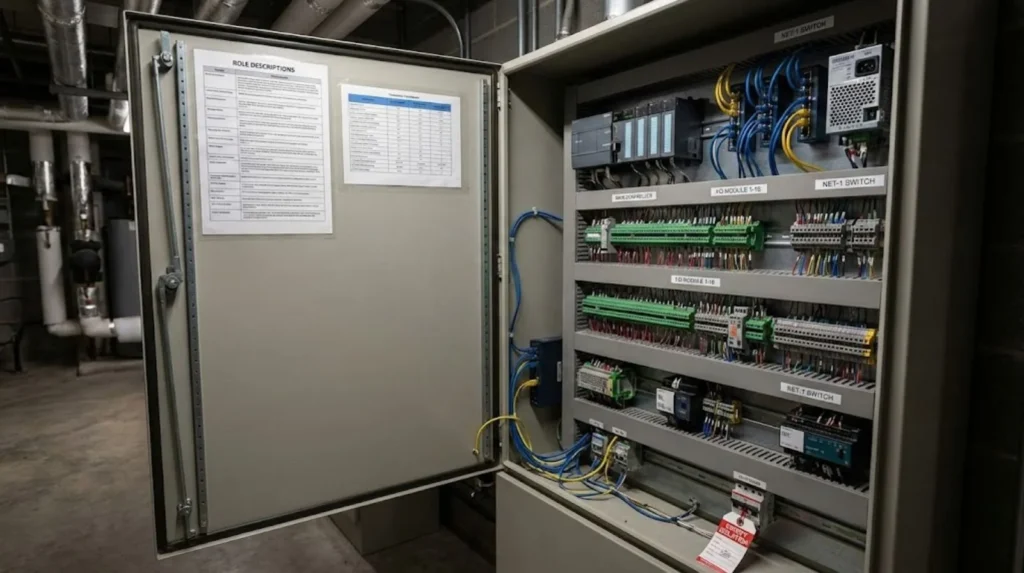
BMS engineers must isolate primary power sources before working inside control panels even when accessing 24V circuits. Panel internals contain mixed voltage levels where 230V supplies for actuators, relays, and circuit protection devices exist alongside 24V control circuits. Safe working requires treating the panel as a hazardous environment until proper isolation and testing confirms it’s dead.
IET Guidance Note 1 addresses separation requirements between power and data cables preventing electromagnetic interference. Control circuits carrying low-voltage signals can experience interference from parallel power cables if separation distances aren’t maintained or segregated containment isn’t used. BMS installations must consider EMI prevention during cable routing design—a consideration less critical in traditional power-only installations but essential for reliable control system operation.
These legal and technical frameworks emphasize a key reality: BMS work doesn’t reduce electrical safety requirements despite working primarily with extra-low voltage control circuits. Electricians bring essential electrical safety competence to BMS roles, which is why electrician course completion leading to NVQ Level 3 and Gold Card status remains the standard entry requirement regardless of role type.
The Real Transition Pathway: Electrician to BMS
The realistic progression from qualified electrician to established BMS engineer typically spans 2-5 years depending on starting competencies, employer support, and pace of skills development. Understanding this timeline prevents disappointment from expecting immediate commissioning roles.
Start with the wider route in our guide to how long it takes to train as an electrician.
Starting Point: Qualified Electrician Status
The foundation remains non-negotiable: NVQ Level 3 in Electrotechnical Services, successful AM2 assessment, 18th Edition certification, and ECS Gold Card. These credentials prove electrical competence sufficient for independent site-based work and satisfy employer requirements for safe working without supervision. Short BMS courses without this electrical foundation don’t create employability regardless of marketing claims about “specialist” status.
Electricians holding these qualifications can realistically pursue BMS installer positions immediately. The work leverages existing installation skills with minimal software demands, providing income whilst observing BMS system architecture and control principles in practical contexts. This observation period proves crucial for understanding what controls engineers actually do daily and whether the software-focused work suits individual preferences.
Year 1-2: Entry via Installation or Trainee Controls Roles
Most electricians enter BMS through installation positions with contractors, facilities management companies, or building services firms. Initial work involves containment installation, panel wiring, sensor mounting, and field device connections. Employers value electrical competence for quality installation and safety awareness, whilst the electrician gains exposure to BMS system design, controller architecture, and mechanical equipment integration.
Progression to trainee controls engineer positions typically occurs within 12-18 months for electricians demonstrating interest in system operation beyond physical installation. Manufacturers offer entry-level training courses (Trend Essentials, basic Siemens or Honeywell programmes) teaching proprietary software navigation, controller configuration basics, and network communication principles. Employers often sponsor these courses for employees showing aptitude and commitment.
Our training-to-employment journey explains the support available while learners seek suitable workplace experience.
The critical development during this phase: building software confidence. Controls work requires comfort using laptops as primary tools, navigating unfamiliar software interfaces without documentation, and troubleshooting problems through software menus rather than test meters. Electricians who approach computers as necessary evils rather than tools struggle with this transition regardless of electrical capability.
Year 2-4: Controls Engineering and Manufacturer Accreditation
With 1-2 years BMS installation or trainee experience, electricians typically pursue formal manufacturer training leading to accredited engineer status. Trend, Siemens, Schneider, and Honeywell offer multi-level training pathways from basic configuration through advanced programming and system design. Completion of manufacturer training programmes provides credentials employers recognize for independent controls engineering work.
Simultaneously, understanding HVAC principles becomes essential. Controls engineers must grasp why boilers cycle, how cooling coils affect air temperature and humidity, what PID (Proportional-Integral-Derivative) control loops accomplish, and how different sensor types respond to environmental conditions. This mechanical knowledge doesn’t come from electrical training; it requires dedicated study and site-based observation of plant equipment operation.
The Building Controls Industry Association (BCIA) offers vendor-neutral training courses (BCM01-BCM06) teaching control principles applicable across manufacturer platforms. These courses complement manufacturer-specific training by developing transferable understanding rather than software-specific skills. Employers increasingly value BCIA credentials alongside manufacturer qualifications.
Salary progression during this phase typically sees rises from £40,000 installation/trainee levels toward £45,000-£50,000 as controls engineering competence develops. However, progression isn’t automatic—it requires demonstrated ability to configure systems independently, diagnose complex faults, and work without constant supervision.
Year 3-5: Commissioning Capability and Specialist Development
Commissioning represents highest complexity BMS work combining electrical, mechanical, and software competencies applied under time pressure during building handovers. Reaching commissioning capability typically requires 3-5 years combined experience in installation and controls engineering roles, advanced manufacturer training, and successful completion of supervised commissioning projects building confidence in independent system testing and handover procedures.
Commissioning engineers command higher salaries (£50,000-£65,000 nationally, £75,000-£85,000 London) reflecting the responsibility and competence required. Career progression at this level often involves specialization in particular building types (data centers, hospitals, laboratories) or system types (air handling optimization, critical environment controls, energy management) where deep expertise commands premium rates.
Alternative routes exist: the Level 4 BEMS Controls Engineer apprenticeship (Standard ST0629) provides formal qualification pathway spanning 36 months. This structured approach suits younger electricians or those with employer backing for formal training time. However, most practising BMS engineers progressed through the experience-then-training route described above rather than formal apprenticeships.
Critical Success Factor: Software Confidence
Every BMS professional interviewed emphasizes the same barrier: software confidence determines progression speed more than electrical competence. Electricians comfortable spending entire days configuring controllers via laptop screens, troubleshooting through software menus, and learning new platforms independently progress rapidly. Those viewing computers with skepticism or frustration plateau at installation levels regardless of electrical capability.
This doesn’t require computer science degrees or programming backgrounds. It demands curiosity about how systems work, patience to navigate unfamiliar interfaces, and comfort admitting ignorance whilst learning. Electricians who approach BMS as “just fancy electrics” rather than distinct discipline involving substantial software skills typically return to traditional electrical contracting within 2-3 years.
Training Landscape: What Actually Matters
The UK BMS training market divides between vendor-neutral programmes teaching transferable principles and manufacturer-specific courses focused on proprietary software platforms. Understanding which training provides value at different career stages prevents wasted investment in inappropriate courses.
Building Controls Industry Association (BCIA) Training
BCIA represents UK building controls industry standards body offering vendor-neutral training courses (BCM01-BCM06) covering control theory, HVAC fundamentals, network protocols, and system design principles applicable across manufacturer platforms. The courses assume participants hold electrical qualifications but lack controls-specific knowledge.
BCM01 (Foundation) introduces control system concepts, sensor types, and basic HVAC theory. BCM02-04 progress through intermediate topics including PID control, network communication, and system commissioning. BCM05-06 cover advanced design and project management for senior engineers. Course costs typically range £400-£800 per module with duration of 2-5 days depending on level.
BCIA training delivers genuine value for electricians serious about BMS careers. The vendor-neutral approach means knowledge transfers across different manufacturer platforms encountered in varied employment. However, BCIA courses don’t teach specific software operation—they develop conceptual understanding that makes learning manufacturer platforms easier.
Manufacturer-Specific Training
Trend Controls (owned by Honeywell) represents the most prevalent BMS platform in UK buildings. Trend offers tiered training from Essentials (basic navigation and configuration) through IQ Vision (advanced graphics and integration). Training typically requires employer sponsorship or existing employment with Trend-approved partners. Costs vary significantly but often range £600-£1,200 per course level. Completion provides credentials recognized across the substantial UK Trend installed base.
Tridium Niagara serves as integration platform connecting different manufacturer systems. Niagara training focuses on system integration rather than standalone BMS implementation. Advanced Niagara skills command premium rates given the platform’s use in complex multi-vendor environments, particularly data centers and industrial facilities. Training costs similar to Trend but requires controls engineering foundation before attempting.
Siemens, Schneider Electric, and Honeywell offer comprehensive training programmes for their respective platforms. Access typically requires employment with authorized partners or direct employment by the manufacturer. Training quality is generally excellent given manufacturers’ investment in installer competency, but the knowledge remains platform-specific requiring adaptation when encountering different systems.
Level 4 BEMS Controls Engineer Apprenticeship (ST0629)
This formal qualification pathway provides structured route from electrical foundations through advanced BMS competency over 36 months. The apprenticeship combines on-job learning with formal training modules covering control theory, HVAC systems, electrical installation, project management, and health and safety. Successful completion provides Level 4 qualification recognized by employers and supports chartered engineer progression.
Apprenticeships suit younger electricians or those with employer backing providing training time. The structured approach ensures comprehensive coverage but requires significant employer commitment. Many current BMS engineers lack formal apprenticeship credentials, having progressed through manufacturer training and experience instead. The apprenticeship creates more standardized pathway but isn’t essential for career success.
What Training Doesn’t Replace
No training programme—vendor-neutral, manufacturer, or apprenticeship—substitutes for site-based experience working with operating BMS systems. Understanding why boilers cycle, how chillers respond to load changes, what causes actuators to stick, and how occupancy patterns affect system performance requires observing real buildings over months and years. Training provides theoretical frameworks; experience develops the intuition distinguishing competent engineers from course attendees.
Learners building evidence from real installations can use this guide to building an NVQ Level 3 electrical portfolio.
Similarly, software confidence develops through repeated exposure to unfamiliar platforms rather than formal training. Engineers encountering new manufacturer systems learn through exploration and experimentation, applying principles learned on familiar platforms to unfamiliar interfaces. Training courses introduce concepts, but software capability develops through practice.
Red Flags: Misleading Training Claims
Avoid courses claiming “BMS mastery in weekends” or “complete BMS engineer training in 5 days.” Control theory, HVAC fundamentals, electrical safety, and software competency don’t compress into short intensive formats regardless of instructor quality. Legitimate training occurs over months or years combining formal education with practical application.
Unrecognized “diplomas” or “certificates” without assessment components provide minimal value. Employers recognize BCIA credentials, manufacturer accreditations, and formal apprenticeships. Attendance certificates from unaffiliated training providers carry little weight in hiring decisions. Always verify whether courses are mapped to recognized frameworks before paying.
Claims that BMS courses qualify electricians for independent work without NVQ Level 3 and Gold Card foundations are demonstrably false. Employers require electrical qualifications as baseline regardless of controls training completed. Marketing suggesting otherwise targets inexperienced learners unfamiliar with industry employment requirements.
Pay, Demand and Progression (Evidence-Led)
Understanding realistic earnings and demand drivers prevents both pessimism about BMS viability and unrealistic expectations about rapid high earnings.
Market Demand Drivers
UK government Net Zero 2050 commitments require almost all commercial buildings to implement or upgrade energy management systems demonstrating efficiency improvements. Building Regulations increasingly mandate BMS installation in new commercial construction. Existing building stock requires retrofitting with modern controls enabling energy monitoring and optimization. The Building Controls Industry Association reports 11.9% market growth in Q2 2025 reflecting this sustained demand.
Skills shortages compound demand pressure. The Institution of Engineering and Technology’s 2025 skills survey found 36% of organizations lack personnel with skills needed for decarbonisation projects. BMS engineering sits directly in this gap—combining building services knowledge with digital systems expertise. Employers struggle finding qualified candidates particularly for commissioning and service roles requiring both electrical and software competencies.
However, “demand” doesn’t mean automatic employment for electricians taking short courses. Employers seek candidates with solid electrical foundations (NVQ Level 3 minimum), demonstrated software confidence, and realistic understanding of BMS work scope. Demand for competent engineers is high; demand for course certificate holders without practical experience remains minimal.
This specialist demand sits within the wider shortage of skilled electricians in the UK.
Realistic Salary Ranges (2025 Data)
Glassdoor and Totaljobs data from December 2025 provides current salary benchmarks, though regional variation and individual capability significantly affect actual earnings.
Junior/Trainee BMS Engineer or Installer: £30,000-£35,000 nationally, with London reaching £32,000-£38,000. This entry level suits electricians transitioning into BMS installation roles or trainee controls positions. Salaries comparable to qualified electrician installation rates but with progression potential traditional electrical roles often lack.
BMS Controls Engineer (Mid-Level): £35,000-£45,000 nationally, £38,000-£48,000 in London. This range reflects 2-4 years BMS experience with manufacturer training and independent configuration capability. Employers expect system design understanding, troubleshooting competence, and minimal supervision requirements.
Commissioning Engineer: £50,000-£65,000 nationally, with London and South East positions reaching £60,000-£70,000. Senior commissioning engineers with specialist expertise (data centers, critical environments, complex HVAC) can command £75,000-£85,000 in London market. These rates require 4-6 years combined experience, advanced manufacturer accreditations, and proven independent commissioning capability.
Service/Maintenance Engineer: £35,000-£45,000 nationally, £40,000-£50,000 in London. Service roles typically include on-call responsibilities affecting base salary calculations. Engineers covering multiple sites or specialized facilities earn toward higher ranges. Work-life balance considerations matter given on-call requirements—higher earnings come with availability expectations outside normal hours.
Progression Speed Variables
Software confidence affects earnings progression more than any other factor. Engineers comfortable with multiple manufacturer platforms and able to learn new systems quickly advance faster and command higher rates than those proficient only in single platforms. Versatility creates value employers reward.
HVAC system understanding similarly accelerates progression. Engineers who grasp mechanical principles troubleshoot more effectively than those focusing solely on electrical and software aspects. Understanding why systems behave certain ways rather than just how to configure them distinguishes senior engineers from junior staff.
Specialization in high-value building types (data centers, hospitals, laboratories, clean rooms) or complex systems (BMS integration with fire, security, and access control) supports premium rates. However, specialization requires broad foundation first—attempting to specialize before building general competence typically fails.
Geographic location significantly affects earnings. London and South East positions pay 15-20% more than equivalent roles in North East, Wales, or Southwest regions. However, living costs partially offset salary advantages. Career decisions should weigh total compensation and life quality rather than raw salary figures alone.
The Honest Career Trajectory
Realistic expectations: electricians entering BMS through installation roles at £32,000-£38,000 can reasonably expect reaching £45,000-£50,000 within 3-4 years through controls engineering progression with manufacturer training. Reaching commissioning capability and £60,000+ levels requires additional 2-3 years developing specialist expertise, advanced qualifications, and independent working capability under pressure.
The ceiling is genuinely higher than traditional electrical installation careers. Senior BMS engineers in London market regularly achieve £75,000-£85,000, which represents significant premium over electrician installation rates typically capping around £45,000-£55,000. However, reaching that ceiling demands consistent skills development, software mastery, and comfort with responsibility levels exceeding typical electrical work.
For electricians content with installation work and traditional electrical scopes, BMS may not justify the retraining effort. For those seeking higher earnings potential and willing to develop substantial new capabilities, the pathway delivers on promises—but over years, not months.
For a broader view of career progression and variety, see these reasons to become an electrician.
Common Myths Electricians Hear About BMS
Industry myths create unrealistic expectations or unnecessary barriers discouraging qualified electricians from legitimate career opportunities. Addressing common misconceptions provides realistic perspective.
Myth: “It’s just 24V wiring—easy money for less risk”
Reality: The wiring is easier; the work is harder. BMS complexity lies in understanding system operation, control logic, HVAC behavior, and software configuration. Physical installation represents perhaps 20% of total project scope. Commissioning, programming, and troubleshooting consume majority of time and require competencies completely outside traditional electrical scope. The 24V circuits pose less electrical danger, but the intellectual demands exceed most electrical installation work.
Additionally, responsibility levels differ significantly. BMS faults affect entire building operation, occupant comfort, and energy consumption. Pressure to diagnose and resolve problems quickly exceeds typical electrical fault-finding urgency. Working alone in plant rooms without team support amplifies this pressure. “Easier” physically doesn’t mean easier professionally.
Myth: “You need a computer science degree”
Reality: Computer science knowledge is unnecessary for BMS careers. Software confidence differs fundamentally from programming ability. BMS engineers use manufacturer-provided software rather than writing code from scratch. The requirement is comfort navigating unfamiliar interfaces, troubleshooting through software menus, and understanding system logic rather than creating algorithms.
However, complete computer illiteracy creates genuine barriers. Engineers spending entire days configuring systems via laptops must view computers as tools rather than threats. Electricians who’ve never used spreadsheets, struggled with smartphone applications, or avoided computers throughout their careers face steep learning curves. Basic digital literacy is essential; advanced computing skills are not.
Myth: “A BMS course makes you an engineer”
Reality: Courses teach concepts; experience creates engineers. Manufacturer training programmes provide essential software operation knowledge and control theory foundations. They don’t develop the judgment distinguishing appropriate solutions from technically-possible-but-inappropriate ones, or create the troubleshooting intuition recognizing unusual system behavior immediately.
This mirrors electrical training reality: Level 3 diplomas teach theory; NVQ portfolios require demonstrating competence through actual work. BMS progression follows identical patterns. Training provides tools; site experience teaches application. Marketing suggesting course completion equals engineering competence misleads prospective learners about development timelines.
Myth: “BMS engineers don’t do physical work anymore”
Reality: Particularly in installation and service roles, physical work remains substantial. Mounting sensors requires working at height using access equipment. Panel wiring demands familiar containment installation and termination skills. Fault diagnosis often involves checking physical connections before investigating software issues. Plant rooms involve working around hot boilers, cold chillers, and equipment with exposed rotating components.
Senior commissioning engineers spend more time with laptops than tools, but reaching that level requires years working in plant rooms getting hands dirty. The career doesn’t eliminate physical work; it adds intellectual components alongside practical tasks. Electricians expecting office-based careers face disappointment; those viewing BMS as evolving electrical skills into broader capabilities find realistic expectations.
Readiness Check: Is BMS a Good Fit for You?
Before pursuing BMS transition seriously, honest self-assessment prevents wasting training investment and discovering incompatibility after changing careers. These questions aren’t pass/fail tests; they’re reflection prompts clarifying whether BMS work aligns with individual preferences and capabilities.
Are you comfortable with logic and documentation?
BMS work involves understanding why systems respond certain ways to particular inputs. If temperature sensor reads 18°C but setpoint is 21°C, why is the valve only opening to 40% instead of fully open? Understanding requires grasping PID control loops, system response curves, and intentional logic preventing overcorrection. This logical thinking differs from electrical fault-finding where problems often reduce to “circuit is open” or “circuit is shorted.”
Documentation demands also exceed typical electrical work. Commissioning requires detailed recording of every control point tested, all setpoints verified, and complete system performance documentation before handover. Service engineers maintain logs of all fault callouts, actions taken, and system modifications. Electricians who view paperwork as bureaucratic annoyance rather than professional responsibility struggle with BMS documentation culture.
Are you willing to use laptops and software daily as primary tools?
For controls, commissioning, and service roles—essentially anything beyond installation—laptops become more important than multimeters. Comfortable spending entire days navigating software interfaces, learning new platforms independently through exploration, and troubleshooting problems through menu structures rather than physical testing? BMS fits well. Viewing computer time as necessary evil rather than core work? Traditional electrical roles may suit better.
This doesn’t require existing advanced computer skills. It demands openness to developing digital capabilities through practice and accepting that software understanding is equally important as electrical knowledge in modern building services.
Do you have appetite for learning HVAC concepts extending beyond electrical scope?
Understanding how boilers modulate based on return water temperature, why cooling coils affect both temperature and humidity, how air handling units balance fresh air intake against recirculation, and what determines chiller efficiency under varying loads—none of this is electrical knowledge. It’s mechanical and thermodynamic understanding BMS engineers require for effective system operation.
Curiosity about how buildings “breathe” and mechanical systems interact supports BMS success. Viewing HVAC equipment as boxes requiring electrical connections misses the conceptual understanding distinguishing capable engineers from skilled installers. Willingness to study mechanical principles indicates good BMS fit; resistance to learning beyond electrical scope suggests reconsidering transition.
Are you comfortable working alone under pressure in operational buildings?
Service and commissioning roles involve substantial solo work. You’re the only technical person in the building during fault callouts. Building occupants are uncomfortable because heating or cooling has failed. Facilities managers are stressed because systems aren’t performing as expected. Finding solutions quickly whilst working independently without team support requires both technical competence and emotional resilience.
Electricians who thrive in team environments where colleagues provide backup and shared problem-solving may find BMS isolation challenging. Those comfortable with independent working and able to manage pressure without external support typically adjust successfully.
Can you accept on-call responsibilities affecting personal time?
Service roles typically include on-call rotas covering evenings, weekends, and holidays. Heating failures during winter cold snaps require emergency response. Critical environment control faults in data centers or hospitals demand immediate attendance regardless of time. The additional pay compensates inconvenience, but work-life balance considerations matter significantly.
Electricians with young families or strong commitments outside work should weigh on-call demands carefully. The earnings premium may not justify lifestyle disruption. Others view occasional callouts as acceptable trade-off for generally interesting work and good pay. Understanding your priorities before committing prevents later regret.
What the Data Still Doesn’t Tell Us
Despite BMS sector growth and increasing recognition of building controls importance, significant data gaps limit precise outcome predictions for electricians considering transitions.
Course completion rates remain untracked. No UK-wide data exists on what percentage of electricians starting manufacturer training programmes or BCIA courses complete qualifications. Without completion data, assessing realistic success rates proves difficult. Anecdotal evidence suggests substantial dropout particularly among older electricians struggling with software demands, but quantifying actual figures remains impossible.
Age-related transition outcomes lack systematic study. Whether electricians transitioning in their 20s succeed at different rates than those attempting changes in 40s or 50s hasn’t been researched systematically. Industry sentiment suggests younger electricians adapt to software demands more readily, but this may reflect selection bias rather than age-related capability differences. Older electricians bring valuable troubleshooting experience but may need more support developing digital skills. Data would inform better guidance for different demographic groups.
Regional demand variations beyond London/South East remain poorly documented. Salary data concentrates heavily on London and South East markets. BMS opportunity levels in North East, Wales, Southwest, and Scotland are less clear. Whether sufficient demand exists in these regions for viable BMS careers, or whether relocation to high-demand areas becomes necessary, affects career planning significantly.
Employer training investment by region and company size lacks transparency. Which employers genuinely support electrical-to-BMS transitions through paid training time, manufacturer course sponsorship, and mentorship versus expecting employees to fund their own transitions remains unclear. Without this information, electricians struggle assessing which employment opportunities provide genuine development support versus exploiting qualified electricians as cheap BMS labor.
Return-to-electrical-work rates aren’t captured. Some electricians attempt BMS transitions but return to traditional electrical work after 1-2 years. Understanding what percentage this represents and what factors drive decisions would help prospective career changers assess risks realistically. Current data gaps mean relying on anecdotal impressions rather than systematic evidence.
These gaps don’t invalidate BMS as legitimate career option. They simply mean evidence-based guidance remains incomplete. Future research addressing these questions would support better-informed career decisions for the substantial electrician population considering building controls transitions.
Where Building Controls Take Electricians Who Commit
BMS represents genuine career progression opportunity for qualified electricians willing to develop capabilities extending substantially beyond traditional electrical scope. The pathway exists, demand is real, and earnings potential exceeds installation electrician ceilings. However, success depends on factors often underestimated by electricians evaluating the transition.
Software confidence determines progression speed more than electrical competence. Courses teach concepts; site experience creates capability. The development timeline typically spans 2-5 years from qualified electrician to established commissioning engineer. Expecting rapid transformation through short courses leads to disappointment and wasted investment.
The work itself differs fundamentally from installation electrical roles. Solo plant room troubleshooting replaces team-based construction sites. Laptop-based configuration becomes as important as hand tools. HVAC mechanical understanding matters as much as electrical knowledge. On-call responsibilities affect work-life balance. These realities suit some electricians extremely well whilst others discover incompatibility after investing training time.
For electricians seeking intellectual challenge, higher earnings potential, and future-proof specialization in growing sector, BMS delivers on promises. For those preferring hands-on installation work, team environments, and clear separation between work and personal time, traditional electrical careers may provide better satisfaction despite lower earnings ceilings.
The decision shouldn’t be “Can I become a BMS engineer?” but rather “Do I want to become one?” The capability exists for any qualified electrician willing to commit development time. Whether the destination suits individual preferences and lifestyle requirements demands honest self-assessment beyond purely financial considerations.
For those confirming BMS alignment with career goals, the starting point remains securing NVQ Level 3, AM2 success, and Gold Card status through complete electrical course journey providing essential electrical foundation. BMS training builds on this base; it doesn’t replace it. Electricians attempting controls careers without proper electrical credentials discover employers won’t consider them regardless of BMS course certificates held.
The building services sector needs qualified electricians willing to develop controls expertise. Decarbonisation requirements ensure sustained demand through 2030 and beyond. For electricians choosing this path thoughtfully, understanding both opportunities and demands realistically, BMS offers rewarding careers combining familiar electrical foundations with substantial new intellectual challenges. Contact Elec Training on 0330 822 5337 to discuss proper qualification pathways establishing electrical competence foundations enabling successful BMS transitions. No hype about weekend certifications or guaranteed outcomes. Just honest guidance about what actually works based on industry requirements and employer expectations.
References
- Building Controls Industry Association (BCIA) – Q2 2025 Market Intelligence Report: https://www.bcia.co.uk
- Chartered Institution of Building Services Engineers (CIBSE) – Building Control Systems: https://www.cibse.org
- Skills England – Level 4 BEMS Controls Engineer Apprenticeship Standard (ST0629): https://skillsengland.education.gov.uk
- HSE – Electricity at Work Regulations 1989 (Memorandum HSR25): https://www.hse.gov.uk
- HSE Guidance GS38 – Electrical Test Equipment for Use by Electricians: https://www.hse.gov.uk/pubns/books/gs38.htm
- IET – BS 7671:2018+A2:2022 Wiring Regulations: https://electrical.theiet.org
- ECS Card Scheme – Building Controls Engineer Requirements: https://www.ecscard.org.uk
- Institution of Engineering and Technology (IET) – UK Engineering Skills Statistics 2025: https://www.theiet.org
- Schneider Electric – BMS Training Programmes: https://learnd.co.uk
- BCIA – ECS Cards and Building Controls Qualifications: https://www.bcia.co.uk/training
- Electrical Safety First – SELV, PELV and Voltage Classification: https://www.electricalsafetyfirst.org.uk
Note on Accuracy and Updates
Last reviewed: 24 December 2025. This article reflects current UK building services industry practices, BMS technology standards, and electrical qualification requirements as of December 2025. Salary data represents December 2025 market rates from Glassdoor and Totaljobs surveys and may vary by region, employer size, and individual capability. Market demand projections are based on BCIA Q2 2025 market intelligence and IET 2025 skills surveys. We update content as industry standards, training pathways, and employment requirements evolve. This is educational guidance only and does not constitute career advice or employment guarantees.
