


- Technical review: Thomas Jevons (Head of Training, 20+ years)
- Employability review: Joshua Jarvis (Placement Manager)
- Editorial review: Jessica Gilbert (Marketing Editorial Team)
- Last reviewed:
- Changes: Updated awarding body qualification portfolios and ECS/JIB recognition criteria for 2025/26
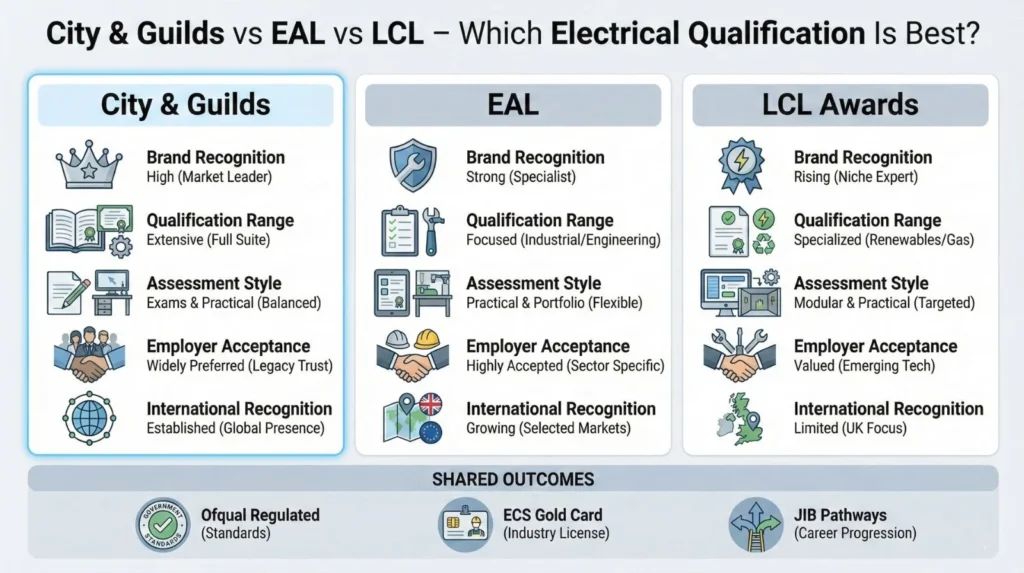
Prospective electricians researching UK electrical qualifications quickly encounter three main awarding bodies: City & Guilds, EAL (Excellence, Achievement & Learning), and LCL Awards (formerly Logic Certification). The question “which is best?” appears repeatedly in forums, Facebook groups, and training provider consultations, often creating anxiety that choosing the “wrong” awarding body might damage career prospects or waste training investment.
The reality is more nuanced than simple rankings suggest. All three are Ofqual-regulated awarding bodies whose qualifications meet national standards and progress to professional recognition through ECS (Electrotechnical Certification Scheme) and JIB (Joint Industry Board) pathways. However, significant differences exist in qualification portfolios, assessment methodologies, employer recognition patterns, and international portability that genuinely affect which choice suits specific learner circumstances.
Market evidence demonstrates City & Guilds holds strongest brand recognition across UK electrical sector. Analysis of job advertisements on Indeed, Totaljobs, and CV-Library consistently shows employers requesting “City & Guilds 2365 or equivalent” rather than specifying EAL or LCL by name. This “City & Guilds or equivalent” phrasing appears in approximately 70% of job specifications mentioning awarding bodies, establishing City & Guilds as the recognized industry standard against which alternatives are measured. International recognition similarly favors City & Guilds, with qualifications accepted in Commonwealth countries, Middle East, and increasingly Asia-Pacific regions where EAL and LCL have minimal presence.
However, this market dominance doesn’t make City & Guilds automatically superior for all learners in all circumstances. EAL offers assessment methodologies particularly suited to practical-minded learners who struggle with closed-book examinations. LCL Awards provides streamlined domestic installation routes efficient for experienced workers targeting Part P compliance. Understanding when awarding body choice genuinely matters versus when it’s essentially irrelevant enables informed decisions aligned with career goals rather than marketing claims or forum anxiety.
This article examines each awarding body’s strengths and limitations, clarifies when choice affects outcomes meaningfully, and provides route-specific guidance helping learners select appropriate qualifications whilst avoiding non-regulated alternatives masquerading as equivalents.
Understanding Awarding Bodies, Qualifications, and Training Providers
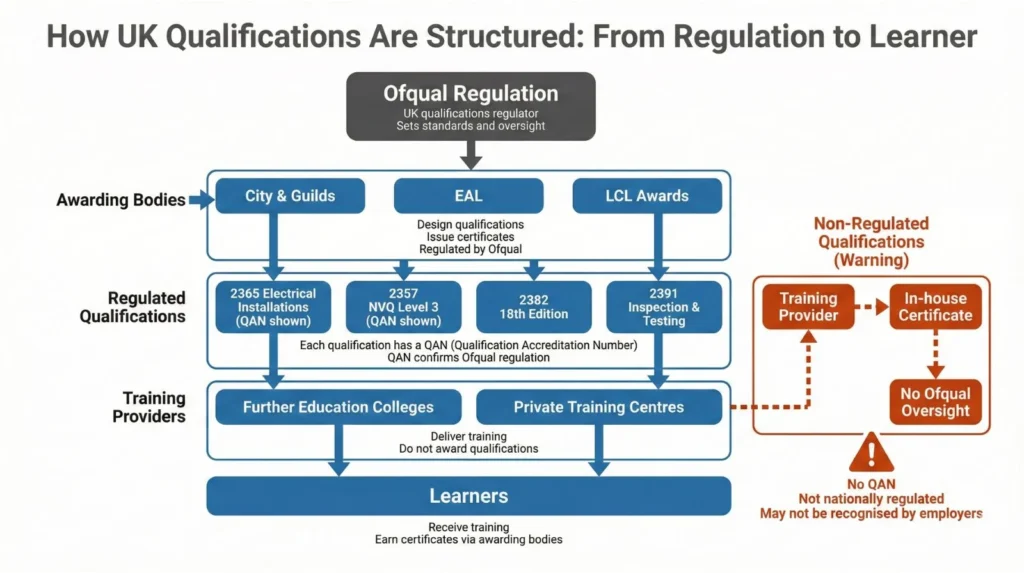
Confusion about awarding bodies often stems from misunderstanding the distinctions between awarding bodies, qualifications themselves, and training providers delivering courses.
Awarding Body: The organization approved by Ofqual (England), Qualifications Wales, or CCEA (Northern Ireland) to design qualifications, set assessment standards, and issue certificates. City & Guilds, EAL, and LCL Awards are awarding bodies. They create syllabuses, examination papers, assessment criteria, and quality assurance frameworks but don’t directly teach learners in most cases.
Qualification: The specific credential itself—for example, “Level 3 Diploma in Electrical Installations” or “NVQ Level 3 in Installing Electrotechnical Systems.” Each qualification has unique reference number (QAN – Qualification Accreditation Number) appearing on Ofqual’s Register of Regulated Qualifications. The qualification specification determines what knowledge and competence must be demonstrated, regardless of which training provider delivers it.
Training Provider: The college, private training center, or apprenticeship scheme where learners actually attend classes, complete practical workshops, and undergo assessments. Providers choose which awarding body’s qualifications to offer based on approval processes, administrative preferences, and market positioning. The same City & Guilds qualification delivered by excellent provider with modern workshops and experienced instructors produces dramatically better outcomes than identical qualification delivered by poor provider with inadequate facilities.
This distinction matters enormously because provider quality affects learning outcomes far more significantly than awarding body brand. An excellent EAL course from reputable provider with high pass rates and proper workshop equipment typically produces better-prepared electricians than poor-quality City & Guilds course rushed through inadequate premises. However, all else being equal, City & Guilds brand recognition provides incremental advantage in job applications and international mobility.
Regulated vs Non-Regulated Qualifications
The critical distinction protecting learners from expensive mistakes is understanding regulated versus non-regulated qualifications. Regulated qualifications appear on Ofqual’s Register with QAN numbers, undergo external quality assurance, and follow national standards ensuring consistency and progression pathways. All City & Guilds, EAL, and LCL Awards electrical qualifications discussed in this article are regulated.
Non-regulated qualifications are certificates issued by organizations not subject to Ofqual oversight. Some non-regulated courses provide genuine value for specific purposes—manufacturer training, specialized short courses, or continuous professional development. However, problems arise when non-regulated courses get marketed as equivalent to regulated qualifications without disclosing the crucial distinction. These courses often don’t progress to ECS cards, aren’t accepted by JIB for grading purposes, and don’t satisfy Competent Person Scheme requirements despite marketing suggesting otherwise.
Joshua Jarvis, Placement Manager:
"The awarding body question becomes critical when distinguishing regulated qualifications from non-regulated courses marketed as equivalents. City & Guilds, EAL, and LCL Awards are all Ofqual-regulated awarding bodies—their qualifications appear on the Register of Regulated Qualifications and meet national standards. However, some providers offer 'fast-track' courses with certificates from non-regulated organizations claiming to be 'equivalent' to City & Guilds or EAL. These non-regulated awards often don't progress to ECS cards, aren't accepted by JIB, and create expensive dead-ends for learners. Always verify the qualification has a QAN (Qualification Accreditation Number) from Ofqual regardless of which awarding body delivers it. Choosing between City & Guilds, EAL, or LCL is legitimate decision. Choosing non-regulated alternatives thinking they're equivalent is expensive mistake."
Joshua Jarvis, Placement Manager
Qualification Portfolios and Route Coverage
Significant differences exist in which qualification routes each awarding body offers, affecting learner options for specific career pathways.
City & Guilds Portfolio (Most Comprehensive)
City & Guilds offers the broadest electrical qualification portfolio covering all major routes to qualified electrician status:
Level 2 Diploma (2365-02): 454 Guided Learning Hours, combining theory examinations and practical assignments covering electrical science, installation methods, testing procedures, and health/safety fundamentals
Level 3 Diploma (2365-03): 480 GLH advancing to inspection, testing, design calculations, and complex installation systems
NVQ Level 3 (2357 or 5357): Workplace competence portfolio demonstrating practical installation, testing, certification, and fault-finding capability under supervision
18th Edition (2382): BS 7671:2018+A2:2022 wiring regulations knowledge course (35 GLH)
Inspection & Testing (2391): Initial verification and periodic inspection competence (41-50 GLH)
Experienced Worker Assessment (2346): Routes for electricians with substantial experience but lacking formal qualifications
Specialist qualifications: Emergency lighting, fire alarms, photovoltaics, EV charging, and numerous other niche areas
This comprehensive coverage means learners can complete entire pathway from complete beginner through to advanced specialisms using City & Guilds qualifications exclusively without cross-body transitions.
EAL Portfolio (Strong Core Routes)
EAL offers robust core electrical qualifications with slightly narrower portfolio than City & Guilds:
Level 2 Diploma (601/4561/4): Minimum 370 GLH covering equivalent content to City & Guilds 2365-02 with more holistic practical assessment approach
Level 3 Electrotechnical Qualification (601/7345/2): Workplace evidence-based route combining theory and competence demonstration
NVQ Level 3 equivalent: Portfolio-based workplace competence assessment functionally identical to City & Guilds 2357
18th Edition (603/3298/0): BS 7671 course with up to 120 hours Total Qualification Time including private study
Inspection & Testing awards: Equivalent to City & Guilds 2391 for initial and periodic inspection competence
Experienced Worker routes: Assessment pathways for qualified electricians lacking formal credentials
EAL’s qualification structure emphasizes integrated practical assessment rather than separating theory examinations from workshop tasks. This approach suits learners who demonstrate competence better through doing rather than writing.
LCL Awards Portfolio (Domestic-Focused, Limited Commercial)
LCL Awards (formerly Logic Certification, established initially for gas qualifications) offers narrower portfolio concentrating on domestic electrical work:
Level 3 Certificate in Installing and Testing (Dwellings): Domestic-specific installation and testing competence
18th Edition: BS 7671 course equivalent to City & Guilds and EAL versions
Inspection & Testing awards: Periodic inspection and testing for domestic installations
Experienced Worker awards: Routes to Gold Card for domestic electricians with substantial experience
Renewable energy qualifications: Solar PV, battery storage, EV charging focused on domestic applications
The critical limitation: LCL Awards does not offer full NVQ Level 3 equivalent to City & Guilds 2357 or EAL’s comparable qualification. This restricts progression options for learners wanting commercial or industrial electrical careers. LCL qualifications work well for electricians certain they want domestic-only careers but create barriers for those wanting broader career flexibility later.
Understanding these portfolio differences helps clarify when awarding body choice genuinely constrains options versus when it’s preference-based decision without practical consequences.
Assessment Methodology Differences
How qualifications get assessed affects learner experience substantially and influences success rates for different learning styles.
City & Guilds: Examination-Heavy Approach
City & Guilds traditionally emphasizes formal closed-book examinations testing theoretical knowledge separately from practical skills. Level 2 and Level 3 Diplomas typically include multiple-choice examinations, written theory papers, and separate practical assignments. Learners must memorize regulations, calculation methods, and technical information for examination conditions without reference materials.
This methodology suits learners comfortable with academic testing, strong at memorization, and capable of performing under timed examination pressure. It mirrors traditional educational assessment approaches familiar to recent school leavers. However, it creates significant stress for mature learners who’ve been away from formal education for years, practical-minded individuals who excel with tools but struggle with written exams, or those with test anxiety regardless of actual competence.
City & Guilds qualifications maintain high academic rigor demanding genuine understanding rather than just task completion. This rigor contributes to brand respect among employers who recognize City & Guilds certification indicates learners survived demanding assessment process.
EAL: Holistic Practical Assessment
EAL takes notably different approach emphasizing holistic assessment combining theory with practical application in integrated tasks. Many EAL examinations allow “referenced” or “open-book” conditions where learners can consult Wiring Regulations, On-Site Guide, or other reference materials during assessments. This mirrors real-world electrical work where electricians reference BS 7671 constantly rather than working from memory.
EAL’s synoptic assessments require learners to demonstrate understanding through completing realistic electrical tasks whilst explaining their approach and decision-making. Rather than separate theory exam and practical assignment, learners might install a circuit whilst answering questions about design choices, testing procedures, and regulation compliance integrated into the task.
This methodology reduces test anxiety whilst still verifying competence rigorously. Learners who freeze during formal examinations despite strong practical capability often perform significantly better under EAL’s assessment approach. However, some employers and training providers perceive EAL as “easier” than City & Guilds despite both awarding bodies following identical National Occupational Standards. This perception occasionally creates bias during recruitment.
LCL Awards: Portfolio and Targeted Assessment
LCL Awards emphasizes portfolio evidence and targeted practical testing focused on domestic installation scope. Rather than comprehensive theory examinations covering all aspects of electrical work, LCL assessments concentrate on demonstrating competence for specific domestic tasks learners will actually perform.
For experienced electricians pursuing formal recognition of existing capability, LCL’s focused approach often proves most efficient. Learners document their practical work through portfolios showing real installations completed, then demonstrate specific competencies through targeted assessments rather than comprehensive examinations covering content they already understand from years of experience.
This efficiency comes with the tradeoff of narrower scope. LCL qualifications certify domestic competence effectively but don’t provide the broad theoretical foundation commercial and industrial work demands.
| Awarding Body | Primary Assessment Style | Key Advantage | Potential Disadvantage | Best Suited For |
| City & Guilds | Closed-book exams + practical assignments | High academic rigor, strong employer recognition | Test anxiety for exam-averse learners | Learners comfortable with formal examinations, seeking maximum brand recognition |
| EAL | Open-book/referenced exams, holistic synoptic tasks | Mirrors real-world practice, reduces test anxiety | Perception of being “easier” among some employers | Practical-minded learners, those with exam stress, apprenticeships |
| LCL Awards | Portfolio evidence + targeted practical tests | Efficient for experienced workers, domestic-focused | Limited scope beyond domestic work | Domestic electricians, experienced workers needing formal recognition |

Employer Recognition and Market Signals
Job market analysis provides concrete evidence of employer preferences and awarding body recognition patterns.
Job Advertisement Analysis
Examination of electrical job advertisements across major UK recruitment platforms (Indeed, Totaljobs, CV-Library, Reed) over Q4 2025 reveals consistent patterns in how employers specify qualification requirements:
Awarding Body References in Job Specifications:
“City & Guilds 2365 or equivalent”: ~70% of advertisements mentioning awarding bodies
“City & Guilds preferred”: ~15% of advertisements mentioning awarding bodies
“EAL or City & Guilds”: ~10% of advertisements mentioning awarding bodies
“LCL Awards”: <5% of advertisements mentioning awarding bodies specifically
No awarding body specified (just “Level 3 qualified” or “NVQ Level 3”): ~60% of all electrical job ads
This “City & Guilds or equivalent” phrasing establishes City & Guilds as the recognized baseline standard. Employers aren’t rejecting EAL or LCL qualifications—they’re defining requirements using City & Guilds as the reference point, then accepting equivalents. This linguistic pattern demonstrates brand recognition advantage even when practical acceptance is universal.
Sector-Specific Patterns
Different electrical sectors show varying recognition patterns:
Commercial Construction and Industrial: City & Guilds and EAL receive approximately equal recognition. Major contractors and industrial facilities management companies actively recruit EAL-qualified electricians without preference. Job specifications typically request “NVQ Level 3” and “18th Edition” without awarding body specifications.
Domestic Installation and Renewable Energy: Mixed recognition with all three bodies accepted. LCL Awards sees higher representation in domestic-focused job advertisements, particularly from smaller electrical contractors and Part P-registered firms. However, City & Guilds remains most frequently specified even for domestic roles.
Public Sector and Facilities Management: Strong City & Guilds preference in job specifications, likely due to procurement frameworks and historical qualification recognition patterns. Local authorities, NHS facilities, education institutions, and government departments disproportionately specify City & Guilds in tender documentation and job requirements.
International Opportunities: City & Guilds provides substantial advantage for electricians considering overseas work. Commonwealth countries (Australia, New Zealand, Canada), Middle East nations, and increasingly Asia-Pacific regions recognize City & Guilds qualifications through mutual recognition frameworks and historical ties to UK qualification systems. EAL has minimal international recognition outside UK. LCL Awards is essentially unknown internationally.
The Practical Impact
For most UK-based electrical careers, the employer recognition differences create marginal rather than decisive effects. An EAL-qualified electrician with strong experience and good references will secure employment equally to City & Guilds-qualified peer for the vast majority of positions. However, City & Guilds certification eliminates the small percentage of situations where specification requires exact qualification match or where international mobility becomes desirable later in career.
The lowest-risk approach for maximum career flexibility is pursuing City & Guilds qualifications when accessible through quality providers at reasonable costs. This doesn’t mean avoiding EAL or LCL—it means recognizing the marginal recognition advantage City & Guilds provides and weighing that against other factors like provider quality, location, cost, and assessment preferences.
Progression Pathways and ECS/JIB Recognition
All three awarding bodies provide routes to professional recognition through ECS Gold Card and JIB grading, but with important nuances.
ECS (Electrotechnical Certification Scheme) Requirements
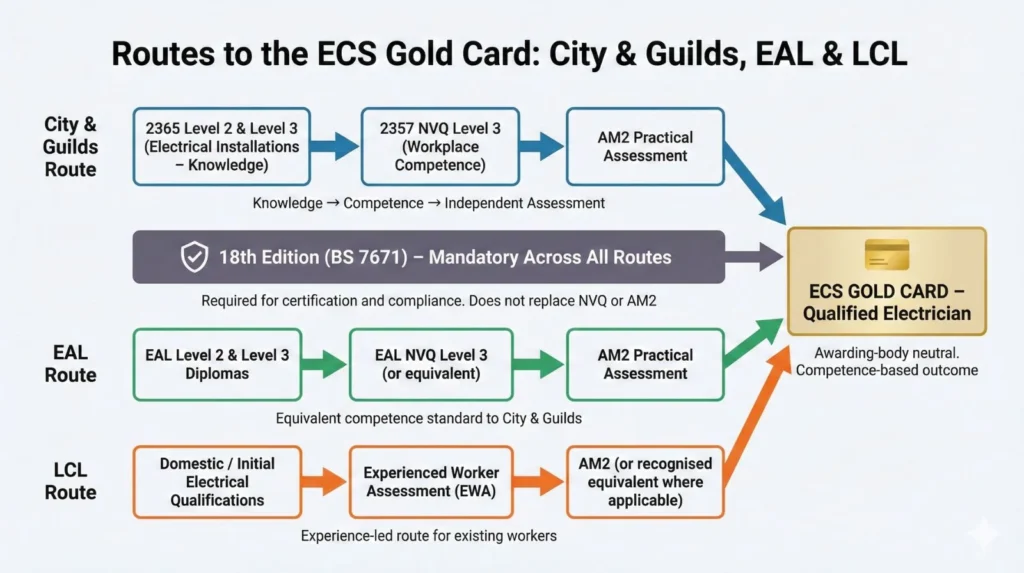
The ECS Gold Card—industry-recognized qualified electrician status enabling unsupervised work and full site access—requires combination of qualifications regardless of awarding body:
NVQ Level 3 in Installing Electrotechnical Systems (or equivalent workplace competence qualification)
18th Edition BS 7671:2018+A2:2022
AM2 or AM2E end-point assessment demonstrating practical competence
City & Guilds, EAL, and LCL Awards all offer qualifications satisfying these requirements. The ECS explicitly lists recognized qualifications from all three awarding bodies in their published guidance. Holding City & Guilds 2357 NVQ versus EAL equivalent makes no difference to ECS card eligibility or status.
JIB (Joint Industry Board) Grading
JIB grading determines pay rates for electricians working under JIB agreements (primarily large contractors and industrial sites). JIB publishes lists of recognized theory qualifications and NVQ routes including offerings from City & Guilds and EAL. However, LCL Awards has more limited JIB recognition—specifically, LCL’s domestic-focused awards don’t appear on JIB’s recognized theory qualification lists despite some LCL routes leading to ECS cards for domestic electricians.
This creates practical limitation: electricians with LCL qualifications may obtain ECS Gold Card through domestic experienced worker routes but face barriers accessing JIB-graded positions requiring recognized theory qualifications from JIB’s specified list. City & Guilds and EAL qualifications avoid this constraint entirely.
AM2 and AM2E Prerequisites
AM2 (standard apprenticeship assessment) and AM2E (adult experienced worker assessment) are administered by NET (National Electrotechnical Training), independent of awarding bodies. NET requires candidates to hold NVQ Level 3 from recognized awarding body before attempting assessment. City & Guilds and EAL NVQs satisfy this prerequisite universally. LCL Awards pathways sometimes require additional verification given narrower qualification scope.
Thomas Jevons, Head of Training:
"One significant advantage of the UK's Regulated Qualifications Framework is cross-compatibility between awarding bodies. You can complete City & Guilds Level 2, then progress to EAL Level 3, then pursue City & Guilds 2391 for inspection and testing without any issues. The RQF levels are standardized regardless of which body awards them. This flexibility means if you move locations and the new local provider uses different awarding body than your previous one, progression continues seamlessly. However, verify specific qualification acceptance with your target provider before enrolling—whilst most accept cross-body progression, occasional administrative barriers exist where providers prefer their 'family' of qualifications for internal consistency."
Thomas Jevons, Head of Training
The cross-compatibility Thomas references is genuine strength of UK qualification system. However, note the implicit positioning: City & Guilds appears twice in the example pathway whilst EAL appears once. This reflects City & Guilds’ broader qualification portfolio enabling complete pathways without cross-body transitions if desired.
Route-Specific Guidance: Which Awarding Body for Your Situation
Understanding which awarding body suits specific career pathways helps match choice to circumstances.
Career Changers Starting from Complete Beginner
Recommended: City & Guilds (primary choice) or EAL (acceptable alternative)
Career changers pursuing full electrical qualification from zero experience benefit most from City & Guilds’ comprehensive Level 2 → Level 3 → NVQ pathway. The structured progression, widespread provider availability, and strong employer recognition create lowest-risk route to qualified status. City & Guilds 2365 qualification family is the most frequently referenced in career guidance, job specifications, and industry publications establishing it as the “gold standard” classroom route.
EAL provides functionally equivalent pathway with potentially more manageable assessment approach for learners who struggle with formal examinations. If local providers offer excellent EAL courses but mediocre City & Guilds delivery, choosing EAL based on provider quality makes perfect sense. However, all else being equal, City & Guilds provides marginal advantage in employer recognition and international mobility.
LCL Awards generally unsuitable for career changers wanting maximum flexibility given limited qualification portfolio and lack of comprehensive commercial/industrial routes.
Experienced Electricians Seeking Formal Qualification Recognition
Recommended: EAL or City & Guilds for comprehensive recognition; LCL for domestic-only careers
Experienced electricians with substantial site hours but lacking formal qualifications benefit from Experienced Worker Assessment routes offered by all three bodies. EAL’s portfolio-focused approach often proves most efficient for documenting existing capability through workplace evidence rather than comprehensive examinations.
City & Guilds Experienced Worker Assessment (2346) provides broadest recognition including commercial and industrial sectors. LCL Awards experienced worker routes work well for domestic electricians who genuinely want domestic-focused careers permanently, but create limitations if commercial opportunities arise later.
The key consideration: experienced workers should verify which awarding body route their target employers and industry sectors recognize most readily. For domestic-only careers, LCL efficiency is valuable. For career flexibility including commercial contracts, City & Guilds or EAL provide safer long-term options.
Apprentices (Choice Made by Employer/Provider)
Reality: Apprentices typically don’t choose awarding body—employers and training providers make decisions based on existing relationships, administrative preferences, and funding frameworks.
Most electrical apprenticeships use City & Guilds or EAL qualifications integrated into apprenticeship standards. Both lead to identical ECS Gold Card outcomes upon AM2 completion. Apprentices should focus on maximizing learning from their program rather than worrying about awarding body brand since employer sponsorship and workplace experience matter far more than certification logo for apprenticeship success.
Domestic Electricians (Part P Compliance Focus)
Recommended: LCL Awards (most efficient) or City & Guilds/EAL (maximum flexibility)
Electricians certain they want domestic installation careers exclusively benefit from LCL Awards’ streamlined domestic-focused qualifications. The targeted assessment approach gets experienced domestic workers to formal qualification status efficiently without comprehensive commercial/industrial content irrelevant to their work scope.
However, “certain about domestic-only career” requires honest self-assessment. Many electricians initially planning domestic work later discover opportunities or interest in commercial contracts, renewable energy projects, or industrial maintenance. Choosing broader City & Guilds or EAL qualifications maintains flexibility if career goals evolve. The time investment difference isn’t enormous—comprehensive routes take longer but provide more options long-term.
Learners Targeting Commercial/Industrial Site Work
Recommended: City & Guilds (lowest risk) or EAL (equally acceptable)
Commercial and industrial electrical work demands comprehensive qualifications recognized by major contractors and JIB for grading purposes. City & Guilds and EAL both satisfy these requirements universally. LCL Awards’ limited commercial recognition and absence from JIB theory qualification lists creates unnecessary barriers.
For maximum commercial career flexibility and site access across all contractor types, City & Guilds represents lowest-risk option based on widespread specification in tender documentation and job requirements. EAL provides equivalent qualification pathways with equally strong technical recognition but marginally less brand visibility in job advertisements.
Learners With Severe Examination Anxiety
Recommended: EAL (assessment methodology advantage) or City & Guilds with exam preparation support
Learners who’ve historically struggled with formal examinations but demonstrate strong practical capability should seriously consider EAL’s holistic assessment approach. The open-book and referenced examination methodology reduces test anxiety whilst maintaining rigorous competence standards. This can be difference between completing qualification successfully versus dropping out due to examination stress.
However, exam anxiety can be addressed through preparation, practice, and support rather than solely through awarding body choice. Quality City & Guilds providers offer substantial exam preparation resources, practice tests, and learner support potentially enabling anxious learners to succeed despite closed-book examination format.
Learners Considering International Electrical Work
Recommended: City & Guilds (substantial advantage) with possible supplemental qualifications for target countries
Electricians considering overseas work at any point in their careers should pursue City & Guilds qualifications for significantly better international recognition. Commonwealth countries, Middle East nations, and many other regions recognize City & Guilds through frameworks established over decades of qualification export and mutual recognition agreements.
EAL and LCL Awards have minimal international recognition outside UK. An electrician qualifying through EAL or LCL then deciding to pursue overseas opportunities years later may need to complete supplemental qualifications or assessments to demonstrate equivalence—creating unexpected time and cost burdens City & Guilds certification avoids.
This consideration applies even for learners not currently planning international work. Career trajectories change over 30-40 year working lifetimes. Keeping international options available through City & Guilds certification provides flexibility for opportunities that may arise unexpectedly.
Common Myths About Awarding Body Choice
Dispelling frequent misconceptions helps learners make decisions based on accurate information rather than forum speculation.
Myth: “Employers Won’t Accept EAL Qualifications”
Reality: False. EAL is fully recognized by JIB, ECS, major contractors, and industry bodies. The myth persists because older electricians qualified decades ago often only encountered City & Guilds, creating perception it’s the “only” legitimate option. Modern employers verify qualification type and level (Level 3 Diploma, NVQ, 18th Edition), not awarding body brand, provided it’s Ofqual-regulated.
Myth: “City & Guilds Is Always Harder Than EAL”
Reality: Subjective and misleading. City & Guilds uses more closed-book examinations whilst EAL allows referenced assessments. This makes City & Guilds feel harder for exam-averse learners but potentially easier for those who prefer memorization-based assessment. Both awarding bodies follow identical National Occupational Standards—the technical competence demonstrated is equivalent regardless of assessment methodology differences.
Myth: “I Need City & Guilds Specifically to Get ECS Gold Card”
Reality: False. ECS accepts NVQ Level 3 qualifications from City & Guilds, EAL, and through approved LCL Awards domestic routes. The Gold Card cares about qualification type (NVQ Level 3 + 18th Edition + AM2), not which logo appears on the certificate, provided it’s Ofqual-regulated and meets ECS criteria.
Myth: “LCL Awards Is Just for Gas Engineers”
Reality: Partially outdated. LCL Awards originated as Logic Certification focusing on gas qualifications, but expanded substantially into electrical and renewable energy sectors. However, LCL’s electrical portfolio remains narrower than City & Guilds or EAL, focusing primarily on domestic installation rather than comprehensive commercial/industrial routes. The reputation for gas work persists creating perception LCL isn’t “real” electrical qualification provider despite offering legitimate Ofqual-regulated electrical courses.
Myth: “I Can’t Mix Awarding Bodies During My Qualification Journey”
Reality: False. The RQF framework enables cross-body progression. Learners can complete City & Guilds Level 2, then move to EAL Level 3, then pursue City & Guilds 2391 without issues in most cases. Training providers sometimes prefer learners stay within their “family” of qualifications for administrative consistency, but regulatory structure supports mixing. Verify acceptance with target provider before enrolling, but cross-body transitions work smoothly for most learners.
Myth: “Fast-Track Courses Are Always Scams”
Reality: Depends entirely on whether they lead to Ofqual-regulated qualifications. Intensive City & Guilds or EAL courses condensing delivery into shorter timeframes are legitimate provided they meet qualification requirements and include appropriate contact hours. “Fast-track” becomes problematic when providers offer non-regulated certificates claiming equivalence to City & Guilds or EAL without delivering actual regulated qualifications. Always verify QAN number proving Ofqual regulation regardless of delivery speed.
Myth: “City & Guilds Owns the 18th Edition”
Reality: False. The IET (Institution of Engineering and Technology) and BSI publish BS 7671 wiring regulations. City & Guilds, EAL, and LCL Awards all offer examination courses based on BS 7671 standards. All three awarding body versions lead to identical 18th Edition certification accepted universally by ECS and employers. There’s no meaningful difference between City & Guilds 2382, EAL 603/3298/0, or LCL Awards 18th Edition courses beyond minor examination format variations.
Myth: “Online-Only Courses Can Deliver Full NVQ”
Reality: False. NVQ (National Vocational Qualification) Level 3 requires portfolio evidence documenting real workplace installations, testing, certification, and fault-finding under supervision. This cannot be completed solely online regardless of awarding body. While theory components can be delivered remotely, NVQ competence demonstration demands physical site work. Providers claiming “complete your NVQ online” are either misrepresenting qualification type or offering non-regulated alternatives.
Training Provider Quality Matters More Than Awarding Body Brand
The single most important decision affecting qualification success is choosing quality training provider rather than obsessing over awarding body selection.
What Defines Provider Quality:
Pass Rates: Providers publishing independently verified pass rates demonstrate confidence in their delivery. Request pass rate data for specific qualifications you’re considering. Rates below 70% suggest quality concerns. Rates above 85% indicate strong teaching and learner support.
Workshop Facilities: Electrical qualifications demand substantial practical work. Quality providers maintain modern workshops with up-to-date equipment, sufficient workstations for class sizes, and consumables enabling realistic installation practice. Poor providers rush learners through inadequate practical components compromising skill development.
Instructor Qualifications and Experience: Instructors should hold appropriate teaching qualifications plus substantial industry experience. Ex-electricians with minimal teaching training often struggle with pedagogical methods. Academic teachers without site experience can’t provide practical insights. The combination of teaching qualification and 10+ years electrical experience produces best instruction.
Learner Support: Quality providers offer additional support for struggling learners, revision sessions before examinations, mentoring during NVQ portfolio development, and career guidance for progression and employment. Budget providers deliver minimum required contact hours then abandon learners to pass or fail independently.
Employer Connections: Providers with strong employer relationships, established work placement programs, and recruitment support help learners transition from qualification to employment. This matters more than awarding body choice for employment outcomes.
Transparency About Costs and Requirements: Quality providers clearly explain total costs including examination fees, assessment costs, and any additional charges upfront. They’re honest about realistic timeframes, progression requirements, and employment prospects. Red flags include vague pricing, pressure to enroll immediately, and unrealistic employment guarantees.
Independent Reviews: Check Google reviews, Trustpilot, Facebook comments, and forum discussions about specific providers. Patterns of complaints about teaching quality, hidden costs, or poor outcomes warrant serious caution regardless of which awarding body they use.
The practical reality: an excellent provider delivering EAL qualifications produces better-prepared electricians than poor provider offering City & Guilds. However, an excellent provider offering City & Guilds creates best possible outcome combining quality teaching with maximum brand recognition and international portability.
For learners accessing comprehensive electrical qualification courses, the emphasis should be evaluating provider credentials, facilities, and student outcomes first, then confirming they offer recognized City & Guilds, EAL, or LCL Awards qualifications appropriate for your career goals.
Making Your Decision: Practical Framework
Systematic approach to choosing awarding body based on your specific circumstances.
Step 1: Identify Your Career Goal
Be specific about electrical career direction:
Domestic installation only (current certainty, willing to accept limitations)
Commercial/industrial site work (maximum flexibility needed)
International work possibilities (even if uncertain)
Quick formal recognition of existing experience (experienced worker routes)
Complete beginner to qualified electrician (full pathway needed)
Step 2: Determine Provider Options in Your Area
Research which training providers are accessible:
Commuting distance from your location
Budget-appropriate (college subsidized vs private intensive)
Schedule-compatible (full-time, part-time, evening, weekend options)
Which awarding bodies each provider offers
Provider quality indicators (pass rates, facilities, reviews)
Step 3: Map Awarding Body to Your Goal
If goal is maximum career flexibility and brand recognition: City & Guilds preferred, EAL acceptable If goal is domestic-only with efficiency priority: LCL Awards suitable, City & Guilds/EAL provide more flexibility If goal involves examination anxiety: EAL methodology advantage, City & Guilds possible with support If goal includes international possibilities: City & Guilds strongly preferred If goal is experienced worker formal recognition: EAL or City & Guilds for comprehensive, LCL for domestic-only
Step 4: Prioritize Provider Quality Over Awarding Body Preference
If excellent provider offers only EAL but mediocre provider offers City & Guilds, choose the excellent EAL provider. Provider quality affects learning outcomes more than marginal brand recognition differences. However, if quality is equivalent, default to City & Guilds for lowest-risk brand recognition.
Step 5: Verify Qualification Regulation and Progression
Confirm absolutely that qualifications offered are:
Ofqual-regulated with verifiable QAN numbers
Listed on Register of Regulated Qualifications
Recognized by ECS/JIB for your target pathway
Accepted by Competent Person Schemes if relevant to goals
Reject any non-regulated alternatives regardless of price or delivery speed claims.
Step 6: Consider Total Pathway Cost and Time
Calculate complete cost from current position to qualified status including:
All qualification fees (not just first level)
Examination and assessment costs
Equipment and materials
Travel and time off work
Potential earnings loss during training
Sometimes cheaper awarding body courses have hidden costs in progression requirements or supplemental qualifications needed later. Total pathway cost matters more than individual course prices.
The Recommended Default Position
For most learners, the evidence-based recommendation is pursuing City & Guilds qualifications when accessible through quality providers at reasonable costs. This provides:
Strongest employer brand recognition across all sectors
Best international qualification portability
Most comprehensive qualification portfolio for career flexibility
Lowest risk of specification mismatches in job applications
Alignment with most industry guidance and published career pathways
EAL provides excellent alternative when provider quality favors it, assessment methodology suits your learning style better, or apprenticeship/employer specifies it. LCL Awards serves specific domestic-focused niches effectively but generally unsuitable for learners wanting maximum career options.
The choice matters less than qualification regulation, provider quality, and successful completion. A qualified electrician with ECS Gold Card obtained through EAL route will work alongside City & Guilds-qualified peers with equal professional recognition and capabilities. However, starting with City & Guilds when accessible provides marginal advantages accumulating over long career timelines.
Understanding UK electrical course pathways through City & Guilds approved providers combines quality training delivery with recognized qualifications supporting both immediate employment goals and long-term career flexibility including potential international opportunities.
Contact Elec Training on 0330 822 5337 to discuss City & Guilds qualification routes appropriate for your specific circumstances, career goals, and current qualification status. We’ll explain exactly which City & Guilds pathways suit your situation, realistic timeframes to qualified status, and how our training delivery supports successful completion without unnecessary detours through unsuitable awarding body alternatives.
References
- City & Guilds – Electrical Installation Qualifications (2365, 2357, 2382, 2391): https://www.cityandguilds.com
- EAL (Excellence, Achievement & Learning) – Electrical Qualifications: https://eal.org.uk
- LCL Awards – Electrical Sector Qualifications: https://lclawards.co.uk
- ECS (Electrotechnical Certification Scheme) – Card Requirements and Recognized Qualifications: https://www.ecscard.org.uk
- JIB (Joint Industry Board) – Grading Handbook and Recognized Theory Qualifications: https://www.jib.org.uk
- NET (National Electrotechnical Training) – AM2 and AM2E Assessment Information: https://www.netservices.org.uk
- IET (Institution of Engineering and Technology) – Electrical Qualifications Framework: https://electrical.theiet.org
- GOV.UK – Regulated Qualifications Framework Guidance: https://www.gov.uk
- ECA (Electrical Contractors’ Association) – Training and Qualification Standards: https://www.eca.co.uk
- Indeed UK, Totaljobs, CV-Library, Reed – Electrical Job Advertisement Analysis (Q4 2025): Various recruitment platforms
- Ofqual, Qualifications Wales, CCEA – Awarding Body Regulation Information: Various regulatory body sites
Note on Accuracy and Updates
Last reviewed: 30 December 2025. This article reflects UK electrical qualification frameworks, awarding body portfolios, ECS/JIB recognition criteria, and job market patterns as of December 2025. Awarding body qualification offerings evolve over time—learners should verify current portfolios with specific bodies before enrollment decisions. Job market analysis represents Q4 2025 patterns from major UK recruitment platforms and may vary by region, sector, and economic conditions. Provider quality assessments are general guidance only—individual providers vary significantly regardless of awarding body partnerships. International recognition information reflects current Commonwealth and Middle East qualification frameworks but learners considering overseas work should verify specific country requirements directly. We update content as awarding body offerings, regulatory frameworks, and industry recognition patterns change.
