


- Technical review: Thomas Jevons (Head of Training, 20+ years)
- Employability review: Joshua Jarvis (Placement Manager)
- Editorial review: Jessica Gilbert (Marketing Editorial Team)
- Last reviewed:
- Changes: Initial publication explaining Approved Electrician status under 2026 JIB rates effective 5 January 2026, including National rate (£20.08/hour, £39,156 annual), London rate (£22.48/hour, £43,836 annual), £1.70/hour premium over Electrician grade (£3,315 annually) reflecting legal certification responsibility, qualification requirements (minimum 2 years experience plus City & Guilds 2391 Inspection and Testing), sector earnings variation (domestic £150-220 day rates, commercial £20-25/hour, industrial £24-30/hour, specialist facilities £28-35/hour), and real-world earnings including overtime and allowances adding 20-40% to base calculations
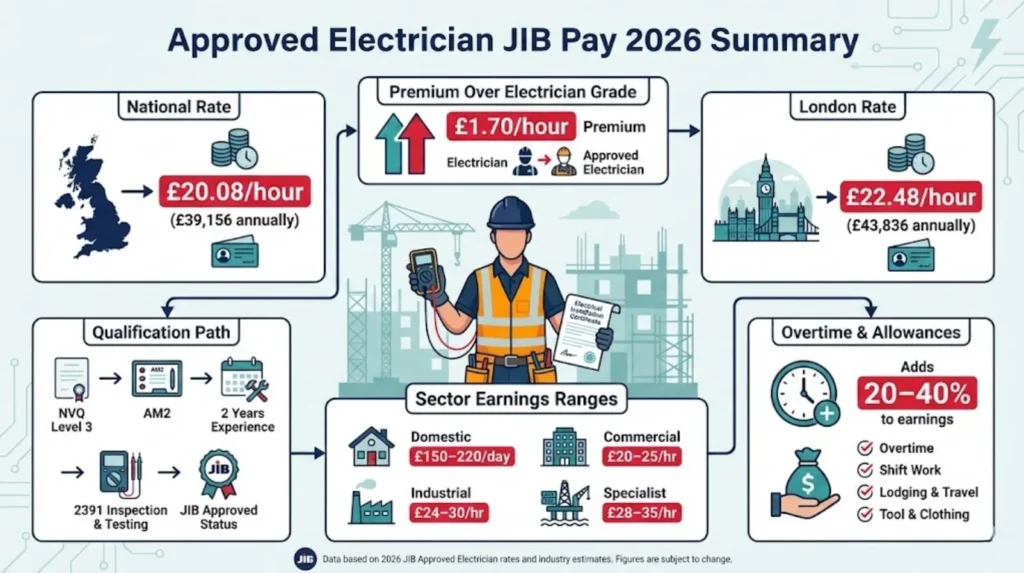
Approved Electrician status under the jib 2026 rates establishes minimum hourly wage of £20.08 for National Transport Provided employment (£39,156 annually at standard 37.5-hour weeks) representing £1.70/hour premium over baseline Electrician grade (£3,315 annually, roughly 9.3% increase) and positioning Approved operatives as mid-career professionals competent in inspection, testing, and independent certification of electrical installations meeting BS 7671:2018+A2:2022 Wiring Regulations compliance requirements without constant supervision from senior staff. This certification authority distinguishes Approved status from general Electrician capability creating legal responsibility that employers pay premium to secure, reducing their supervision costs, compliance risks, and rework potential when installations can be verified and signed off by operatives working autonomously on commercial, industrial, and infrastructure projects where regulatory oversight demands documented competence.
See the current position on Amendment 4 and the 19th Edition.
The 2026 Approved rate reflects 3.95% increase from 2025 figure (£19.32 to £20.08) as first year of three-year industrial determination covering 2026-2028, with London premium adding £2.40/hour (£22.48 total, £43,836 annual) for M25-area work and Own Transport category providing additional £1.17/hour (£21.25 National OT, £23.85 London OT) compensating personal vehicle use for site travel. Understanding what Approved status actually means requires distinguishing between the qualification requirements enabling this grade (minimum two years’ post-qualification experience as Electrician plus inspection and testing certification like City & Guilds 2391 demonstrating competence in periodic inspection procedures, test instrument operation, defect coding, and completing Electrical Installation Condition Reports), the legal responsibilities that justify the pay premium (independent verification authority putting your name on certification documentation potentially examined by building control, HSE inspectors, or courts if installations fail causing injury or property damage), and the real-world market earnings substantially exceeding JIB minimums across different sectors where Approved competence commands £22-35/hour depending on specialization and demand intensity.
This article explains what qualification pathways from Electrician grade completion through two years’ documented site experience, inspection and testing qualifications enabling independent certification authority, and formal JIB grading application deliver in terms of 2026 earnings potential, why the £1.70/hour base premium represents only partial picture when total compensation including overtime at time-and-a-half or double-time rates, travel and lodging allowances for working away from home, shift premiums for unsocial hours, and market uplifts in high-demand sectors multiply baseline calculations by 20-50%, how Approved status changes employability positioning from general installation operative competing in crowded labour market to specialist verification professional eligible for lead electrician roles, quality assurance positions, and small team supervision where employers need autonomous competence, and what sector-specific earnings patterns reveal about where Approved qualification investment delivers highest returns (domestic installation versus commercial construction versus industrial maintenance versus specialist facilities like data centres and transport infrastructure commanding premium rates for complex systems verification capability).
2026 Approved Electrician Rate Structure
National Rates (Most Common)
Approved Electrician (Transport Provided): £20.08/hour
Weekly pay (37.5 hours): £753.00
Annual gross (52 weeks): £39,156
Monthly gross (÷12): £3,263
Take-home estimate: Approximately £29,500-30,500 annually after tax, National Insurance, and standard pension contributions
Comparison to other grades:
Below Electrician: £18.38/hour (£35,841 annual) = -£1.70/hour less than Approved
Above Approved: Technician £22.70/hour (£44,265 annual) = +£2.62/hour more than Approved
London Rates (M25 Work)
Approved Electrician (Transport Provided, London): £22.48/hour (+£2.40 premium)
Weekly pay (37.5 hours): £843.00
Annual gross (52 weeks): £43,836
London premium annual value: £4,680 over National rate
London cost context: Premium compensates approximately 35-40% of actual London living cost differential (housing, transport, general expenses typically £10,000-13,000 higher annually than regional equivalents)
Own Transport Variants
Electricians using personal vehicles receive additional compensation:
National Own Transport: £21.25/hour (+£1.17 over TP)
London Own Transport: £23.85/hour (+£1.37 over London TP)
Annual Own Transport premium value: £2,282-2,672 (partial recovery of vehicle costs averaging £4,400-7,200 annually for insurance, fuel, maintenance, depreciation on business use patterns)
What Makes Approved Status Worth £1.70/Hour More
Legal Certification Responsibility
Thomas Jevons, Head of Training at Elec Training, explains the premium:
"The £1.70/hour premium between Electrician (£18.38) and Approved (£20.08) - that's £3,315 annually - reflects legal responsibility for signing off electrical installations as BS 7671 compliant. When you verify and certify work, you're putting your name on documentation that could be examined by building control, HSE inspectors, or courts if something goes wrong. That responsibility carries genuine legal and professional liability, hence the pay premium."
Thomas Jevons, Head of Training
Independent Verification Authority
Approved Electricians can:
Complete Electrical Installation Certificates (EICs) – Certify new installations as compliant with BS 7671, confirming proper design, safe isolation procedures, circuit protection, earthing and bonding, and test results within acceptable limits
Conduct Periodic Inspections – Perform thorough inspection of existing installations, identifying code 1 (immediate danger), code 2 (potentially dangerous), and code 3 (improvement recommended) defects on Electrical Installation Condition Reports
Sign off verification results – Take legal responsibility for certification that installations meet regulatory requirements, with your signature binding you to accuracy of documentation
Supervise installation teams – Provide technical oversight ensuring work meets standards, checking junior operatives’ installations, and correcting issues before final verification
What Electrician Grade Cannot Do
Standard Electrician grade (£18.38/hour) can install, maintain, and repair electrical systems competently but cannot legally certify their own work without supervision from Approved or Technician operative verifying compliance and signing installation certificates. This limitation reduces their autonomous value to employers on projects requiring documentation sign-off, hence lower base rate despite similar hands-on installation capability.
Reduced Supervision Costs
Employers pay Approved premium because:
Less management overhead – Approved operatives work independently without constant supervision, reducing site management staffing requirements
Lower rework risk – Competence in testing and verification catches problems before handover, avoiding expensive remedial work after client occupation
Faster project delivery – Autonomous operation enables parallel work streams without bottlenecks waiting for senior staff verification
Compliance confidence – Proper certification reduces risk of building control rejections, HSE enforcement notices, or insurance claims from faulty installations
Qualification Requirements for Approved Status
Minimum Experience
Two years post-qualification – Must demonstrate minimum 24 months working as graded Electrician after completing NVQ Level 3 and AM2 assessment (apprenticeship time does not count toward this requirement)
Documented site experience – Employers want evidence of diverse installation types (domestic, commercial, industrial), complex circuit work beyond basic installation, fault-finding and problem-solving, and increasing autonomy in work completion
See how to build an NVQ Level 3 electrical portfolio before reaching the assessment and progression stage.
Essential Qualifications
City & Guilds 2391 Inspection and Testing (or recognized equivalent) proving competence in:
Periodic inspection procedures and safe isolation protocols
Test instrument operation (insulation resistance, continuity, earth loop impedance, RCD testing, polarity verification)
BS 7671 regulation interpretation and application
Defect identification and coding (C1/C2/C3 classification)
Completing Electrical Installation Condition Reports (EICRs) to industry standards
Course details:
Duration: 1-2 weeks classroom + practical assessment
Cost: £1,200-1,800 typically
Pass requirement: Theory examination + practical testing assessment + EICR completion
Formal JIB Grading Application
Approved status is not automatic after two years:
Evidence submission required:
Copies of qualifications (NVQ Level 3, AM2, 18th Edition, 2391)
Employment references confirming experience duration and capability
Portfolio evidence of inspection and testing work (typically 10-15 completed test certificates)
Demonstration of independent verification competence
Application process:
Submit to JIB/ECS for formal grading assessment
Pay grading fee (typically £50-100)
Await approval confirmation (4-8 weeks processing)
Receive upgraded ECS Gold Card showing Approved status
Only after formal approval can you legitimately claim Approved grade and the £20.08/hour minimum that accompanies it.
Real-World Earnings: Base Rate Plus Overtime and Allowances
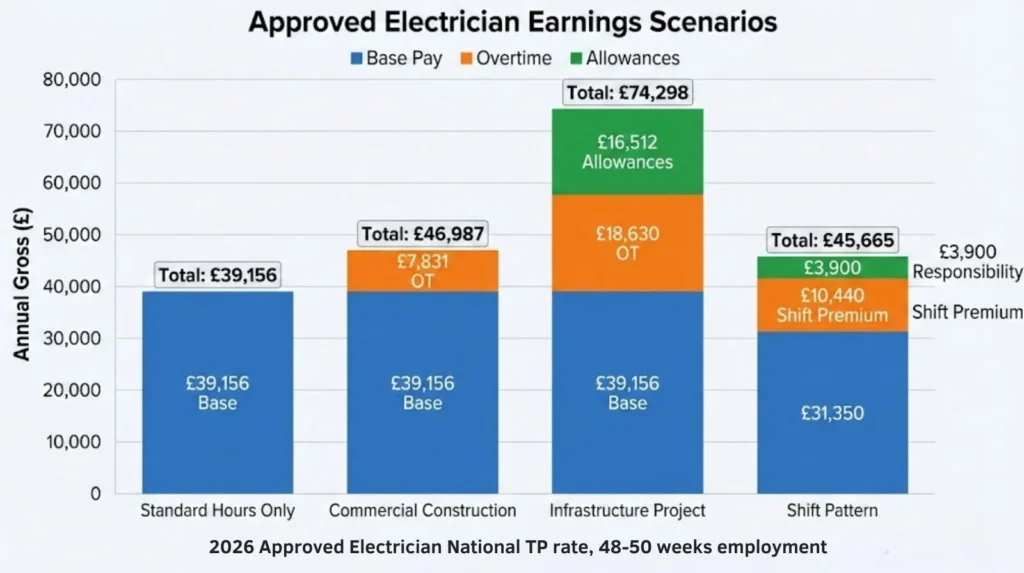
Standard Hours Only (Minimum Scenario)
Approved Electrician earning exactly £20.08/hour:
Weekly: £753.00 (37.5 hours standard)
Annual: £39,156 gross
Take-home: £29,500-30,500 after tax/NI/pension
This represents entry-level Approved or roles with minimal overtime opportunity (some domestic work, light commercial maintenance, public sector positions with strict hour controls).
Typical Commercial Construction Pattern
Approved Electrician with moderate overtime:
Base hours: 37.5 at £20.08 = £753.00
Overtime: 7.5 hours at time-and-a-half (£30.12) = £225.90
Weekly total: £978.90
Annual (48 weeks allowing holidays): £46,987 gross
Take-home: Approximately £35,000-36,000 after deductions
This represents commercial construction during active installation phases with consistent but not excessive overtime patterns.
Industrial Maintenance/Infrastructure (High Overtime)
Approved Electrician on major project:
Base hours: 37.5 at £20.08 = £753.00
Overtime: 12.5 hours at £30.12 = £376.50
Travel allowance: £100/week (455 miles at 22p/mile)
Lodging: £256.45/week (5 nights at £51.29)
Weekly total: £1,485.95
Annual (50 weeks): £74,298 gross
Take-home: Approximately £52,000-55,000 after deductions
This represents infrastructure projects (transport, utilities, major industrial facilities) with substantial travel, overnight stays, and extended hours common during commissioning phases.
Shift Premium Roles (24/7 Operations)
Approved Electrician in industrial plant maintenance:
Day shifts: 30 hours at £20.08 = £602.40
Night shifts: 7.5 hours at time-and-a-third (£26.77) = £200.78
Responsibility money: +£2/hour site premium × 37.5 = £75.00
Weekly total: £878.18
Annual (52 weeks): £45,665 gross
Take-home: Approximately £34,000-35,000
This represents manufacturing, hospitals, utilities with rotating shift patterns and site premiums for critical facility maintenance.
Sector-Specific Earnings Patterns
Joshua Jarvis, Elec Training’s Placement Manager, explains market variation:
"Approved Electrician roles vary enormously by sector. Domestic installers rarely pay JIB rates - it's typically price-per-point or day rates £150-220. Commercial construction offers JIB or above (£20-25/hour). Industrial maintenance and infrastructure typically exceed JIB substantially (£24-30/hour plus shift premiums). Data centres and specialist facilities can reach £28-35/hour PAYE for Approved status because finding electricians competent in complex systems verification is difficult."
Joshua Jarvis, Placement Manager
Domestic Installation (Below JIB)
Typical payment structure: Price-per-point (£25-40 per socket/light), day rates (£150-220), or project quotes rather than hourly rates
Annual earnings estimate: £28,000-38,000 depending on volume, efficiency, and regional pricing
Why below JIB: Domestic work rarely involves JIB member firms, smaller jobs don’t require formal certification processes large commercial projects demand, and market competition from sole traders keeps rates lower than industrial sectors
Approved status value: Limited in pure domestic work unless pursuing NICEIC/NAPIT Qualified Supervisor status enabling company certification scope expansion
The latest competent person scheme changes are relevant for electricians planning that progression.
Commercial Construction (At or Above JIB)
Typical hourly rates: £20-25/hour PAYE, £140-180 day rates CIS
Annual earnings estimate: £42,000-52,000 with moderate overtime
Common projects: Office fit-outs, retail developments, schools, leisure facilities, mixed-use buildings
Approved status value: Lead electrician roles, first-fix supervision, verification responsibility for installation teams, career progression to site management
Industrial Maintenance (Substantially Above JIB)
Typical hourly rates: £24-30/hour PAYE base, plus shift premiums (time-and-a-third for nights = £32-40/hour effective)
Annual earnings estimate: £50,000-65,000 with shift patterns and overtime
Common sectors: Manufacturing plants, food processing, pharmaceuticals, automotive, warehousing, logistics facilities
Approved status value: Autonomous maintenance capability, fault diagnosis without supervision, certification of remedial work, ability to specify replacement equipment meeting compliance requirements
Infrastructure and Utilities (Premium Rates)
Typical hourly rates: £26-32/hour PAYE base, plus extensive overtime and allowances
Annual earnings estimate: £55,000-75,000 with typical project patterns
Common projects: Railways, airports, motorways, power stations, water treatment, telecommunications, major public sector works
Approved status value: Verification of complex distributed systems, coordination with multiple engineering disciplines, high-stakes compliance documentation where errors risk project delays costing millions
Specialist Facilities (Highest Rates)
Typical hourly rates: £28-35/hour PAYE for Approved, £32-42/hour for specialized skills (SCADA, building management systems, fire alarms, access control integration)
Annual earnings estimate: £58,000-75,000 standard patterns, £80,000+ with extensive overtime
Common sectors: Data centres, hospitals, research laboratories, defence facilities, mission-critical installations where downtime costs thousands per minute
Approved status value: Competence in complex integrated systems, verification authority for installations where compliance failures risk catastrophic operational consequences, ability to work autonomously in high-security environments requiring clearance and discretion
When Approved Status Makes Financial Sense
Investment Return Calculation
Costs to achieve Approved status:
City & Guilds 2391 course: £1,200-1,800
Time investment: 1-2 weeks classroom (potential earnings loss £750-1,500 if not employer-funded)
Application fees: £50-100
Total upfront investment: £2,000-3,400 (if self-funded and taking unpaid leave)
Annual return at JIB minimum: £3,315 (£1.70/hour × 37.5 × 52)
Annual return with moderate overtime: £4,200-4,800
Annual return in market roles: £5,000-8,000 (£22-25/hour common for Approved vs £18-20 for Electrician in commercial sectors)
Payback period:
JIB minimum: 7-12 months
Market rates: 4-6 months
After payback: Permanent £3,000-8,000 annual benefit for entire career
Career Opportunity Expansion
Beyond immediate pay increase, Approved status unlocks:
Lead electrician positions – Supervising installation teams (2-4 Electricians plus apprentices), coordinating with other trades, liaising with main contractors on technical matters
Quality assurance roles – Verifying installations meet specifications, conducting interim inspections, signing off stages before handover
Project verification specialist – Dedicated testing and certification operative on large projects where volume of installation work requires full-time verification resource
Training and assessment – Mentor roles developing junior electricians, demonstrating proper testing procedures, building competence in next generation
Career progression to Technician – Approved status is mandatory prerequisite for Technician grade (minimum 5 years Approved experience required), which delivers additional £2.62/hour (£5,109 annual) over Approved base
Comparison to Alternative Investments
Approved qualification (£1,200-1,800, 1-2 weeks) vs University degree (£27,000+ debt, 3-4 years):
Approved payback: 4-12 months
University payback: 5-15 years (if employment secured in degree field)
Approved opportunity cost: 1-2 weeks earnings (~£750-1,500)
University opportunity cost: 3-4 years potential earnings (~£60,000-100,000)
Approved qualification represents one of highest-ROI educational investments available to trade workers when comparing cost, time, guaranteed income increase, and career option expansion.
Career Timeline to Approved Status
Apprenticeship Route (Most Common)
Years 1-4: Apprenticeship
Start: Apprentice Stage 1 (£8.16/hour)
Progress through Stages 2-4 completing NVQ units
Complete AM2 assessment and NVQ Level 3
Exit: Electrician grade (£18.38/hour)
Years 5-6: Building Experience
Work as Electrician accumulating diverse site experience
Document competence through portfolio evidence
Prepare for inspection and testing qualification
Year 7: 2391 Qualification
Complete City & Guilds 2391 course (1-2 weeks)
Pass theory and practical assessments
Demonstrate EICR completion competence
Year 7+: Approved Grading
Apply to JIB/ECS with evidence
Receive Approved status confirmation
Start: Approved Electrician (£20.08/hour, +£3,315 annual)
Total timeline: 7-8 years from apprenticeship start to Approved status
Adult Learner Route (Fast-Track)
Months 1-18: NVQ Completion
Intensive training and placement support
Complete NVQ Level 3 units
Pass AM2 assessment
Exit: Electrician grade (£18.38/hour)
Months 19-42: Experience Building
Work as Electrician (24 months minimum)
Accumulate portfolio evidence
Develop testing and verification competence
Months 43-44: 2391 Qualification
Complete inspection and testing course
Pass assessments
Month 45+: Approved Grading
Apply for formal JIB grading
Start: Approved Electrician (£20.08/hour)
Total timeline: 3.5-4 years from starting electrical training to Approved status (faster than apprenticeship but more intensive study/practice requirements during initial phase)
For the qualification sequence before this stage, see how long it takes to train as an electrician.
Approved vs Staying Electrician: The Decision
Reasons to Pursue Approved Status
If you want:
Higher baseline income (£3,315+ annually guaranteed increase)
Autonomous work capability without constant supervision
Lead electrician and supervisory role eligibility
Career progression pathway to Technician grade (requires Approved prerequisite)
Competitive advantage in commercial/industrial job market
Certification authority enabling company Qualified Supervisor roles (NICEIC/NAPIT schemes)
Check the current Qualified Supervisor routes separately from JIB grading requirements.
Financial motivation: 4-12 month payback on qualification investment, then permanent £3,000-8,000 annual benefit
Reasons to Remain Electrician
If you prefer:
Hands-on installation work without documentation responsibility
Avoiding legal liability from certification signatures
Domestic installation focus where Approved status offers limited value
Simpler work patterns without portfolio evidence requirements
Not investing time/money in additional qualifications
Note: Remaining Electrician grade is perfectly viable long-term career path, particularly in domestic sector or for electricians preferring installation work to verification responsibilities, but limits access to higher-paying commercial, industrial, and infrastructure roles where employers specifically require Approved competence for project compliance needs.
Common Questions About Approved Rates
Only if working standard 37.5-hour weeks (£39,156 base). With moderate overtime common in commercial construction and industrial sectors, £42,000-52,000 more typical. Infrastructure projects with travel/lodging can reach £65,000-75,000. Specialist facilities £58,000-80,000+.
No. You need:
- Minimum 2 years as Electrician AFTER completing NVQ Level 3 and AM2
- Completed 2391 qualification
- Portfolio evidence of inspection/testing competence
- Formal JIB/ECS grading approval
Simply passing 2391 doesn’t automatically grant Approved status or entitlement to £20.08/hour minimum.
No. JIB rates only bind JIB member firms. Many employers (particularly small domestic firms) aren’t JIB members and pay whatever negotiated, sometimes above JIB (commercial/industrial), sometimes below (domestic installation). JIB rate provides benchmark and protection floor for member firm employment.
Limited value: Domestic work rarely requires formal certification processes large commercial projects demand, payment structures use price-per-point or day rates rather than hourly grades, and market competition from sole traders doesn’t reward Approved status substantially.
Better value: Commercial construction, industrial maintenance, infrastructure, specialist facilities where verification authority directly impacts employability and compensation.
£2.40/hour additional (£4,680 annually) for M25-area work. However, London living costs typically £10,000-13,000 higher annually (housing, transport, general expenses), so premium covers only 35-40% of actual differential. Geographic premium helps offset costs but doesn’t fully close gap.
Gross rates yes (£28-35/hour common CIS quotes), but after 20% CIS deduction, zero holiday pay (5.8 weeks worth £5,600+ annually), no employer pension (£2,800-4,000 value), and no sick pay, effective parity requires £28-30/hour CIS minimum to match £20.08 PAYE total compensation package.
Approved Electrician status under 2026 JIB rates establishes £20.08/hour National minimum (£39,156 annually at standard 37.5-hour weeks) representing £1.70/hour premium over Electrician grade (£3,315 annually, 9.3% increase) justified by legal responsibility for independently verifying and certifying electrical installations meet BS 7671 compliance with signatures on documentation potentially examined by building control, HSE inspectors, or courts if installations fail, creating professional liability that employers pay premium to secure while reducing their supervision costs, rework risks, and compliance concerns. Real-world earnings substantially exceed minimums through overtime at time-and-a-half or double-time rates adding 20-40% to base calculations, travel and lodging allowances for infrastructure projects working away from home contributing £10,000-20,000 annually, shift premiums in 24/7 operations paying time-and-a-third for unsocial hours, and market uplifts in high-demand sectors where Approved competence commands £22-35/hour across commercial construction (£20-25), industrial maintenance (£24-30), infrastructure (£26-32), and specialist facilities like data centres (£28-35) due to supply constraints for electricians competent in complex systems verification.
Qualification requirements demand minimum two years’ post-qualification experience as Electrician plus City & Guilds 2391 Inspection and Testing certification (£1,200-1,800 cost, 1-2 weeks duration) proving competence in periodic inspection procedures, test instrument operation, defect coding, and EICR completion, followed by formal JIB grading application with portfolio evidence demonstrating independent verification capability before Approved status confirmed and £20.08/hour minimum applies, creating total timeline of 7-8 years from apprenticeship start or 3.5-4 years for adult learners through intensive fast-track training pathways. Investment return analysis shows £1,200-1,800 qualification cost delivers £3,315+ permanent annual increase with 4-12 month payback period making Approved progression one of highest-ROI educational investments available to trade workers when compared to university degrees (£27,000+ debt, 3-4 years, uncertain employment outcomes) or remaining Electrician grade where annual pay rises average £600-800 taking 4-5 years to match single year’s Approved premium.
Sector earnings variation reveals substantial differences in Approved status value, with domestic installation offering limited financial benefit (price-per-point or day rates £150-220 where JIB grades rarely apply), commercial construction providing JIB or above rates (£20-25/hour, £42,000-52,000 annual with overtime), industrial maintenance exceeding minimums substantially (£24-30/hour, £50,000-65,000 with shift patterns), infrastructure commanding premium rates (£26-32/hour, £55,000-75,000 with project allowances), and specialist facilities reaching highest compensation (£28-35/hour, £58,000-80,000+ for complex integrated systems verification) where supply of electricians competent in autonomous certification authority remains insufficient for employer demand, particularly in mission-critical installations where compliance failures risk catastrophic operational consequences making Approved verification competence essential rather than optional capability.
Call us on 0330 822 5337 to discuss qualification pathways from Electrician status through two years’ documented site experience building portfolio evidence of diverse installation work, City & Guilds 2391 Inspection and Testing certification proving competence in autonomous verification and EICR completion, and formal JIB grading application delivering Approved status worth permanent £3,315+ annual income increase with 4-12 month investment payback, what realistic timelines look like for moving from newly qualified Electrician to Approved grade while accumulating experience and completing testing qualifications alongside full-time employment, and how our in-house recruitment team helps learners secure commercial construction, industrial maintenance, and infrastructure placements where Approved competence commands £22-30/hour market rates substantially exceeding JIB minimums through sector demand for autonomous verification capability reducing employer supervision burden and compliance risks.
References
- JIB (Joint Industry Board) – Industrial Determination 2026-2028 with Approved Electrician rates – https://www.jib.org.uk/wp-content/uploads/2025/06/JIB-Industrial-Determination-062025.pdf
- JIB – JIB Handbook 2025 Section 4 (Approved Electrician grading requirements and competence definitions) – https://www.jib.org.uk/wp-content/uploads/2024/01/JIB_Handbook_2024_Section_4.pdf
- JIB – National Working Rules Agreement 2025 (overtime, allowances, sick pay provisions) – https://www.jib.org.uk/wp-content/uploads/2024/01/JIB_Handbook_2024_Section_2.pdf
- Electrical Contractors’ Association (ECA) – JIB pay rates guidance and member briefings – https://www.eca.co.uk/member-support/employee-relations/national-collective-agreements/jib-pay-rates
- Electrotechnical Certification Scheme (ECS) – Approved Electrician grading application process – https://www.ecscard.org.uk/content/JIB-Grading
- City & Guilds – 2391-52 Inspection and Testing qualification specification – https://www.cityandguilds.com/
- IET (Institution of Engineering and Technology) – BS 7671:2018+A2:2022 Wiring Regulations – https://electrical.theiet.org/
Note on Accuracy and Updates
Last reviewed: 1 January 2026. This page is maintained; we correct errors and refresh sources as JIB Industrial Determinations, National Working Rules, and grading criteria change. 2026 Approved Electrician rate (£20.08/hour National Transport Provided, £22.48 London) sourced from JIB Industrial Determination 062025 effective 5 January 2026 showing 3.95% increase from 2025 figure (£19.32→£20.08). Premium calculations (£1.70/hour over Electrician £18.38, £3,315 annual standard hours) use 37.5 × 52 weeks standard employment. London premium (£2.40/hour, £4,680 annual) and Own Transport allowance (+£1.17/hour, £2,282 annual) confirmed from official rate tables. Grading requirements (minimum 2 years post-qualification experience, City & Guilds 2391 or equivalent, formal JIB application with portfolio evidence) sourced from JIB Handbook Section 4 updated 2024. Overtime calculations use JIB National Working Rules time-and-a-half (1.5×) after 37.5 hours weekdays, double-time (2×) weekends/bank holidays. Take-home estimates use UK tax rates 2025-2026 (basic 20%, higher 40%) and National Insurance (12% up to upper limit, 2% above); actual net pay varies by individual circumstances including tax codes, pension contributions, student loan repayments. Market rate ranges (domestic £150-220 day rates, commercial £20-25/hour, industrial £24-30/hour, specialist facilities £28-35/hour) based on job advertisement analysis and recruitment market patterns 2024-2025 across multiple UK regions and sectors; significant variation exists within each category. Qualification costs (2391 course £1,200-1,800) represent typical commercial training provider pricing 2025; actual costs vary by location and provider. Next review scheduled following 2027 JIB determination publication (typically July-August) for second-year rates under 2026-2028 industrial agreement and any grading criteria updates.
