

NVQ Level 3 Electrical Installation & Maintenance (City & Guilds 2357)
- Guaranteed Work Placement For Your NVQ
- Fast Track option Available
- Open to LCL, EAL and C&G Students
- 0% Finance Option available
- No Prior Experience Required
NVQ Level 3 Electrical Course
- Guaranteed Work Placement For Your NVQ
- Fast Track option Available
- Open to LCL, EAL and C&G Students
- 0% Finance Option available
- No Prior Experience Required
NVQ Level 3 Electrical Installation & Maintenance (City & Guilds 2357)
- Guaranteed Work Placement For Your NVQ
- Fast Track option Available
- Open to LCL, EAL and C&G Students
- 0% Finance Option available
- Paid Work Placements Available All Over the UK
Become an approved electrician through our NVQ Level 3 Electrical Training Course.
Guaranteed Work Placement for your NVQ Placement
The electrical NVQ has been designed to make the process as straightforward as possible. The City and Guilds 2357 NVQ Level 3 in Electrical Installation or Maintenance can be completed remotely through our user friendly online system. This allows you to upload different types of evidence and complete multiple assessments as you go, rather than relying on the usual two or three site visits that many traditional providers require.
You can enrol now and start working toward a comprehensive NVQ Level 3 qualification that will support a successful career as an electrician. This course is available to l earners in Wolverhampton and across the UK.


Sir Laethian & Steve
Laethian is brilliant tutor and taught me so much durring the 4 weeks and feel confident to go out and carry out domestic electrical installs. He also is down to earth easily approachable if you don't understand something. Also you can have banter,..
Lee Lavender, 04 April 2025
Just finished my level 2
Just finished my level 2, the support and teaching was second to none! The tutors were more the helpful more so leathian went the extra mile for the students and myself, malcom to and josh is already finding me job opportunities. Highly recommend! And grateful for everything!
Ed wilkes, 05 April 2025
I signed up for the NVQ with Elec…
I run a company that helps people develop a new route for work, from the Performing Arts to Military or Professional Sports. I referred a candidate to Elect Training, who were brilliant. The training was excellent and the aftercare, particularly from Josh...
Carole davies, 01 April 2025
I signed up for the NVQ with Elec…
I signed up for the NVQ with Elec Training based on their promise to help me find employment to complete my qualification—and they delivered exactly as they said they would! Not only have I secured a new job after my hours were reduced with my previous company, but I’m now working with...
Scott, 27 March 2025
Looking for a new career
Having left the military and looking for a new career, I wanted to build on the skills I gained during my service. I always enjoyed the electrical aspects of my job, which led me to choose the Level 2 2365 course with Elec Training. Laethian was an amazing
Joshua, 25 March 2025
I’ve been in construction since I was a…
I’ve been in construction since I was a teenager, working as both a machine driver and groundworker over the years, but I’ve always had an interest in electrics. Without qualifications, it was difficult to find a way into the electrical industry—until I came across Elec Training.
Cochior Radu, 20 March 2024
Amazing trainer
Just finished my level 2 with elec training,I was a bit nervous to begin with as I didn’t no anything about being an electrician and also my age as I knew I would of been one of the oldest in the class but my trainer laethian was amazing with me and the rest of the lads, the way he delivered the therory...
Abdul Kalam, 18 March 2025
Best training company by far..
After gaining valuable qualifications (level 2 and 3, 18th and 2391) I was finding it quite difficult to get employment/placement to start my NVQ.. After reading all the excellent reviews about this company I thought I'd join them as it stated they find you...
Leon, 10 December 2025
Thank you Elec training
Thank you Elec training, because of you im now in work and working towards my NVQ. Big thanks to josh for sorting me a job in London, couldnt of done it without the help. Really apreciate everything you guys done for me. Kind regards, Muzamel
Muzamel, 26 November 2025
Thank you
Despite being based in Stockport, I was placed with a local company and can now start working towards my NVQ. A big thank you to all the trainers who supported me in achieving my Level 2, Level 3, and 18th Edition qualifications. And a special thanks to Laethian,...
neild, 25 November 2025
Was a pleasent experience with elec…
Was a pleasent experience with elec training, the people were nice and friendly and working with Liam to secure me a role was great, I would recommend them for anyone looking to get qualified
Mitch Aspinall, 25 November 2025
Was a pleasent experience with elec…
Liam was brilliant in finding me a placement. Found me a placement to walk straight into once I finished, and was in constant conversation with me through the whole process. Couldn’t have been better!
Oliver MacDonald, 17 November 2025
Excellent Experience and Career Start
A huge thank you to Elec Training! You’ve not only helped me launch my career in electrics, but I’m now Level 2 qualified and have my 18th Edition certification. Josh found me a great placement with a London company that suited my work situation perfectly....
raval manoj, 7 November 2025
Call Us Today Or Enquire Now For More Course Information

What is the C&G 2357 NVQ Level 3?
The City and Guilds 2357 NVQ Level 3 is the ideal next step for those who have less than five years of experience and are working towards or have recently completed their Level 2 2365-02 and Level 3 2365-03 Diplomas in Electrical Installation.
This qualification is designed to assess the practical skills and knowledge you have developed both during your training and while working on site. It focuses on your real-world ability to carry out electrical work safely and to a high standard.
Once you complete the NVQ and pass the AM2 assessment, you will be eligible to apply for a ECS JIB Gold Card, a key industry credential that confirms your professional status and opens the door to better job opportunities.
What Will I Learn On This Course?
Why Take the C&G 2357 NVQ Level 3?
The City and Guilds 2357 NVQ Level 3 is the ideal next step for those who have less than five years of experience and are working towards or have recently completed their Level 2 and Level 3 Diplomas in Electrical Installation.
This qualification is designed to assess the practical skills and knowledge you have developed both during your training and while working on site. It focuses on your real-world ability to carry out electrical work safely and to a high standard.
Once you complete the NVQ and pass the AM2 assessment, you will be officially recognised as a qualified electrician. This also makes you eligible to apply for a JIB Gold Card, a key industry credential that confirms your professional status and opens the door to better job opportunities.
Who is this course for?
TO BE ELIGIBLE FOR THIS NVQ YOU MUST
- Be working full-time in the electrical installation industry / we will help you find work
- Have achieved, or be working towards Diploma Level 3 (C&G 2365, 8202, or other awarding organisation equivalent)
- Hold or be working towards an 18th Edition Wiring Regulations qualification.
How long does it take?
COMPLETE IN 6-18 MONTHSThe length of time that the NVQ takes will depend on how quickly you can cover the different types of work required to complete all the units. As a rough guide, we find most people will complete it in 6-18 months.
If you have been working in the industry for some time, existing jobs can be used as evidence to speed the process up.
If you have a large variety of work, you can complete it quicker; if you are doing the same thing day in and day out, then you will find it harder to provide the full range of evidence required.
| Date | Name |
| 06/05/2025 09:00 | NVQ Level 3 Electrical Installation/Maintenance – C&G 2357 |
| 19/05/2025 09:00 | NVQ Level 3 Electrical Installation/Maintenance – C&G 2357 |
| 02/06/2025 09:00 | NVQ Level 3 Electrical Installation/Maintenance – C&G 2357 |
| 16/06/2025 09:00 | NVQ Level 3 Electrical Installation/Maintenance – C&G 2357 |
| 30/06/2025 09:00 | NVQ Level 3 Electrical Installation/Maintenance – C&G 2357 |
| 14/07/2025 09:00 | NVQ Level 3 Electrical Installation/Maintenance – C&G 2357 |
| 28/07/2025 09:00 | NVQ Level 3 Electrical Installation/Maintenance – C&G 2357 |
| 11/08/2025 9:00 | NVQ Level 3 Electrical Installation/Maintenance – C&G 2357 |
| 25/08/2025 09:00 | NVQ Level 3 Electrical Installation/Maintenance – C&G 2357 |
| 08/09/2025 9:00 | NVQ Level 3 Electrical Installation/Maintenance – C&G 2357 |
| 22/09/2025 09:00 | NVQ Level 3 Electrical Installation/Maintenance – C&G 2357 |
| 06/10/2025 9:00 | NVQ Level 3 Electrical Installation/Maintenance – C&G 2357 |
| 20/10/2025 09:00 | NVQ Level 3 Electrical Installation/Maintenance – C&G 2357 |
| 03/11/2025 9:00 | NVQ Level 3 Electrical Installation/Maintenance – C&G 2357 |
| 17/11/2025 09:00 | NVQ Level 3 Electrical Installation/Maintenance – C&G 2357 |
| 01/12/2025 9:00 | NVQ Level 3 Electrical Installation/Maintenance – C&G 2357 |
| 15/12/2025 09:00 | NVQ Level 3 Electrical Installation/Maintenance – C&G 2357 |
NVQ Level 3 Electrical Fast Track: Speed Up Your Qualification
The NVQ Level 3 Electrical Fast Track offers an accelerated path for those eager to become fully qualified electricians. The fast track option is only available to learners that are all ready in full time employment within in the electrical industry.
Why Choose the Fast Track Route?
Choosing the fast track program comes with distinct advantages:
- Faster Completion: Achieve your q ualification in less time, allowing you to become fully qualified quicker.
- Career Boost: Gain the credentials needed for better job opportunities or promotions more quickly.

Course Assessments
Rather than 3 fixed day-long assessments, we can assess you online to determine your progress and competence against the national standards. This flexibility will allow you to book your NVQ assessments at a time and place which suits you.
The following assessments will be used during your NVQ:
- Witness testimony
- Reflective accounts
- Photographic evidence
- Direct observation
On completion, you will receive a formal Level 3 NVQ certificate from C&G, the UK’s leading provider of vocational qualifications.
AM2 Assessment
The cost of this NVQ does not include the cost of the AM2 assessment, which is required as your end-point a ssessment. You can book this when you are ready directly with numerous AM2 test centres throughout the UK
Please note that you must bring photographic ID such as a passport or driving license with you in order to sit the assessments on this course. Exams for remote learning can be booked in via student services once you are ready. On in centre elements exams take place at the end of each week.
Learner Feedback
“Just finished my level 2 diploma and it’s been an enjoyment and very educational journey. I was commuting from Preston to Wolverhampton everyday which is over 100 miles however I can fully say it was well worth it . From the reception lady vee being super helpful on admin side to Malcom and mark delivering outstanding lessons , going over and beyond to help students understand crucial topics and help with practical lessons. Overall top centre to start your electrician career and can’t recommend enough .”
“Thank you Elec Training! Richard, you were amazing — the advice and support you gave me really helped build my confidence when joining the NVQ. A big thank you to Josh as well. From the moment I enrolled, we were in constant communication, and he has now found me a job with an electrical contractor. I’m excited to get started and can’t wait to earn my Gold Card. Highly recommended! Kind regards, Peter”
“Great experience with ELEC Training. The training itself was clear and hands-on, and Liam was really helpful and professional throughout. The free recruitment support afterwards was a massive bonus. Highly recommend!”
NVQ Level 3 Electrical Installation & Maintenance (City & Guilds 2357)

- Technical review: Thomas Jevons (Head of Training, 20+ years)
- Employability review: Joshua Jarvis (Placement Manager)
- Editorial review: Jessica Gilbert (Marketing Editorial Team)
- Last reviewed:
- Changes: Comprehensive NVQ guide updated with 2025 pricing, guaranteed work placement details, portfolio requirements, and employment barrier solutions
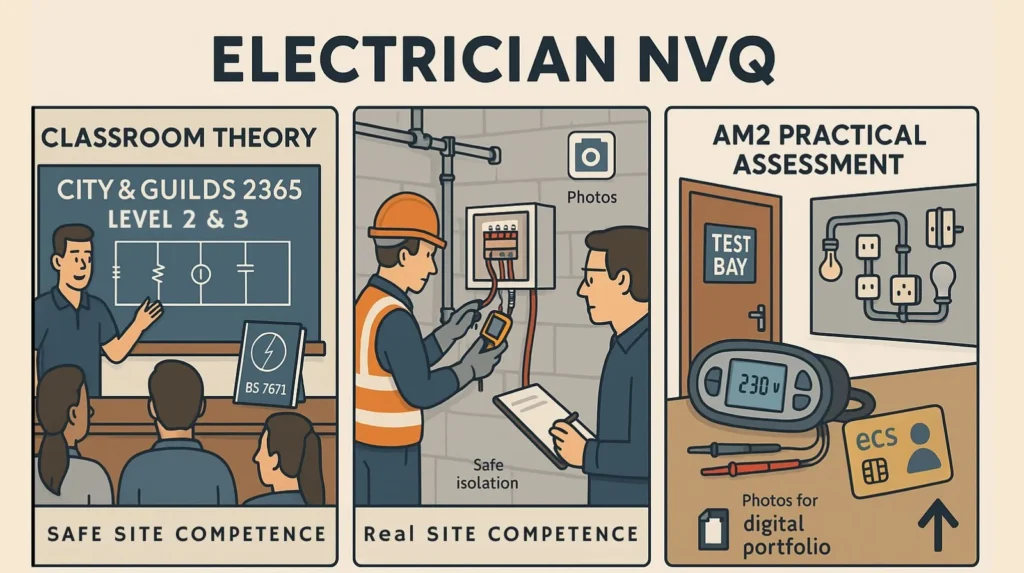
The NVQ Level 3 Electrical Installation (City & Guilds 2357) is the work-based qualification that proves occupational competence on real construction sites. It’s what makes you a qualified electrician capable of working unsupervised, signing off installations, and earning the ECS Gold Card that unlocks JIB Electrician pay rates of £38,000-£48,000 annually compared to £24,000-£32,000 for improvers.
Completing the NVQ requires 12-18 months of varied site work across domestic, commercial, and industrial installations, assessed through a portfolio of photographic evidence, witness testimonies, and direct assessor observations. The qualification concludes with the AM2 practical exam, a three-day assessment covering installation, testing, fault-finding, and certification that 25-30% of candidates fail on their first attempt.
The most critical barrier is securing employment that provides the work variety required for NVQ evidence. Most training providers sell the NVQ to learners without placements, leaving them unable to progress. Forum posts across Reddit, ElectriciansForums, and social media reveal the scale of the problem:
"I spent £10k on Level 2 and Level 3, now I'm stuck because I can't find work that gives me the evidence I need for the NVQ"
(Reddit r/ukelectricians, 2024)
Elec Training operates an in-house recruitment team that makes over 100 calls per learner to our network of 120+ UK contractors, securing placements that provide the domestic, commercial, and industrial work variety essential for NVQ portfolio completion. This guaranteed work placement support is what differentiates us from providers who deliver registration and assessor contact details but leave learners to solve the employment problem alone.
This guide explains what the NVQ Level 3 Electrical actually assesses, who it’s suitable for, the portfolio evidence requirements that cause most failures, realistic completion timescales versus marketing claims, true costs including hidden fees, legal and professional importance under EAWR 1989, pay differences before and after qualification, and how to avoid the common scams that trap learners in incomplete qualifications.
What the NVQ Level 3 Electrical Actually Is (City & Guilds 2357 Explained)
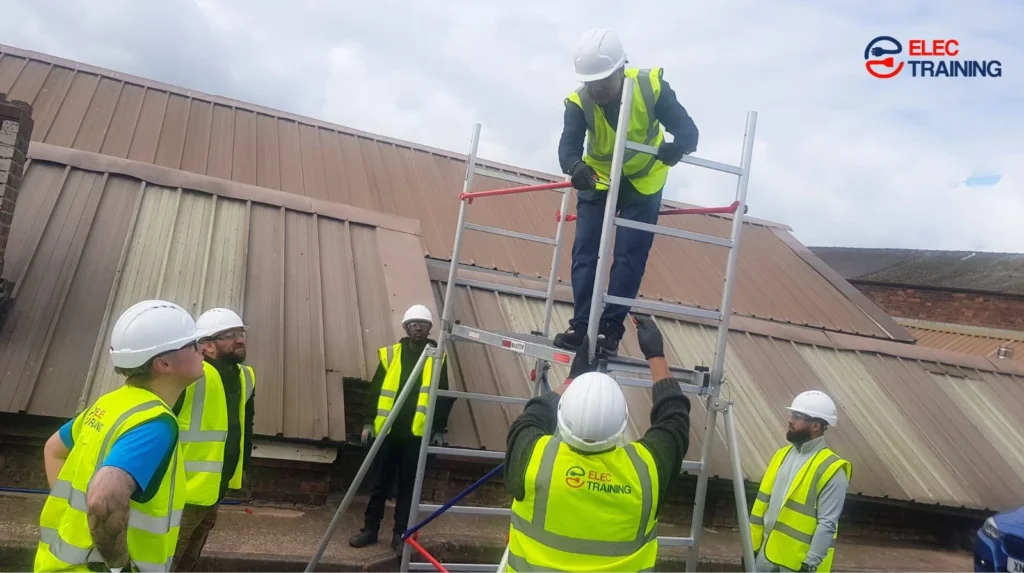
The full official title is the City & Guilds Level 3 NVQ Diploma in Installing Electrotechnical Systems and Equipment (Buildings, Structures and the Environment), qualification code 2357-13 for the Installation pathway. It is a competence-based qualification regulated by Ofqual that must be completed in real working environments, not classrooms or training workshops.
The Critical Distinction: Technical Knowledge vs Occupational Competence
The Level 2 Diploma (C&G 2365-02) and Level 3 Diploma (C&G 2365-03) teach electrical theory, circuit design, regulations, and workshop practice. They prove you understand how electrical systems work and can perform tasks in controlled training environments. They do not prove you can work safely and competently on real construction sites under time pressure, meeting BS 7671 standards, and producing correct certification.
The NVQ Level 3 proves occupational competence. It assesses your ability to install wiring systems, terminate equipment, test circuits, diagnose faults, complete risk assessments, and produce electrical certificates, all in real-world conditions on revenue-generating sites. This is why the Electricity at Work Regulations 1989 (EAWR) and insurance companies recognize the NVQ as proof of competence, while diplomas alone are not sufficient.
NVQ Routes: 2357 vs 2346 vs 5357
There are three routes to achieving NVQ Level 3 Electrical qualification, each designed for different candidate profiles:
C&G 2357 (Standard New Entrant Route)
Target candidates: New entrants, adult trainees, career changers, improvers with less than 5 years’ experience as a practicing electrician. This is the route for learners who have completed Level 2 and Level 3 Diplomas (C&G 2365 or predecessor 2330) and now need to prove work-based competence.
Experience requirement: Less than 5 years working as an electrician.
Final assessment: AM2 (Achievement Measurement 2), a three-day practical exam covering installation, testing, fault-finding, and certification.
Purpose: Completes the training pathway to ECS Gold Card eligibility and JIB Electrician grading.
C&G 2346 (Experienced Worker Assessment, EWA)
Target candidates: Experienced electricians with minimum 5 years as a practicing electrician but no formal Level 3 qualification. This route recognizes prior work experience and provides a pathway to formalize competence.
Experience requirement: Minimum 5 years documented electrical work (excluding training time).
Final assessment: AM2E (Achievement Measurement 2 for Experienced Workers), similar to AM2 but with additional focus on installation of metallic containment (conduit, trunking) to ensure core installation skills are proven.
Purpose: Provides equivalent qualification for experienced, unqualified electricians to gain ECS Gold Card and formal industry recognition.
C&G 5357 (Electrotechnical Qualification, Apprenticeship Standard)
Target candidates: Apprentices completing the Level 3 Electrotechnical Apprenticeship Standard (replaced older frameworks in 2016/17).
Experience requirement: Completed through structured apprenticeship, typically 3-4 years.
Final assessment: AM2S (Achievement Measurement 2 for Apprenticeship Standard), incorporates NVQ performance elements within the apprenticeship end-point assessment.
Purpose: The current primary standard for electrotechnical apprenticeships in England.
This article focuses on the C&G 2357 route, which is the standard pathway for adult trainees and new entrants who have completed technical diplomas and need work-based competence assessment.
What the NVQ Leads To: Industry Credentials and Professional Status
ECS Gold Card (Installation Electrician)
The ECS (Electrotechnical Certification Scheme) Gold Card is the industry-recognized proof of full qualification. Major construction sites, insurance companies, and Competent Person Schemes require it. To obtain a Gold Card, you must complete:
NVQ Level 3 (C&G 2357) including all performance units
AM2 practical exam (pass)
Current 18th Edition Wiring Regulations certificate (BS 7671:2018+A2:2022)
ECS Registered Electrician status (mandatory since January 2019)
The Gold Card is valid for five years and must be renewed with proof of current 18th Edition certification and ongoing CPD (Continuing Professional Development).
JIB Grading (Electrician vs Approved Electrician)
The Joint Industry Board (JIB) grading system defines pay rates, responsibilities, and professional status for electricians working on JIB-compliant contracts:
JIB Electrician (Core Grade):
Requires: NVQ Level 3 + AM2 + 18th Edition
Hourly rate (2025): £18.38/hour base (£34,216-£35,828 annually for 37.5-hour week)
Status: Qualified electrician, can work unsupervised
JIB Approved Electrician:
Requires: NVQ Level 3 + AM2 + 18th Edition + minimum 2 years as qualified Electrician + C&G 2391 Inspection & Testing qualification
Hourly rate (2025): £20.08/hour base (£37,076-£39,156 annually for 37.5-hour week)
Status: Senior electrician with inspection/testing competence, can supervise teams
The total package value (including holiday pay, sick pay, pension) for JIB Approved Electrician is typically £5,000-£8,000 more than base salary, bringing total compensation to £42,000-£47,000 annually.
Competent Person Scheme Membership (NICEIC, NAPIT, ELECSA)
To join a Competent Person Scheme (CPS), which allows you to self-certify Part P notifiable domestic electrical work without involving Building Control, you must hold:
NVQ Level 3 Electrical Installation (C&G 2357 or equivalent)
Current 18th Edition Wiring Regulations
C&G 2391 Inspection & Testing qualification (for domestic installer membership)
Minimum 24 months’ experience in the industry (requirements vary by scheme)
Public liability insurance (£2,000,000 minimum, typically £5,000,000)
CPS membership costs £400-£600 annually but eliminates the need to pay Building Control notification fees (£300-£500 per job) for every notifiable domestic installation. For self-employed electricians and small contractors, CPS membership is essential for commercial viability.
Legacy Qualifications and Equivalents
Electricians who trained before 2010 may hold different qualification codes that map to the same industry standard:
C&G 2330 Level 2 & 3: Predecessor to the 2365 technical certificates. Many electricians completing their NVQ today started with 2330.
C&G 2356: Older version of the NVQ, now superseded by 2357.
C&G 2360: Legacy qualification for traditional apprenticeship route.
Learners who hold these older qualifications can still complete the 2357 NVQ, but may require a Bridging Unit/Assessment (written exam and professional discussion) to cover knowledge gaps between old and new structures, particularly if the Level 3 Diploma was completed before September 2017.
Who the NVQ Level 3 Electrical Is Suitable For
The NVQ Level 3 serves multiple learner profiles, all sharing one common requirement: they must be employed or have access to real construction sites to gather portfolio evidence.
Adult Trainees Who Completed Level 2 and Level 3 Diplomas
Profile: Career changers aged 25-45 who completed C&G 2365 Level 2 and Level 3 technical certificates, now seeking to prove occupational competence and obtain ECS Gold Card.
Why the NVQ matters: Diplomas prove technical knowledge but not work-based competence. Employers require Gold Cards for unsupervised work. Insurance companies require NVQ Level 3 for public liability coverage. The NVQ is what makes you a qualified electrician, not the diplomas.
Critical requirement: Must secure employment as electrician’s mate or improver that provides varied work across domestic, commercial, and industrial installations. Without this, NVQ cannot be completed.
Typical pathway: Level 2 (8 weeks) → 18th Edition (3-5 days) → CSCS Labourer Card → Employment as mate → Level 3 (3-6 weeks, before or during mate work) → Continued employment for NVQ evidence → NVQ portfolio (12-18 months) → AM2 (3 days) → ECS Gold Card.
Improvers Already Working on the Tools
Profile: Electricians currently employed as improvers, mates, or trainees who hold Level 2 and Level 3 Diplomas and are ready to formalize their competence through NVQ assessment.
Why the NVQ matters: Improver status limits earning potential (£24,000-£32,000) and restricts access to higher-responsibility roles and major construction sites. The NVQ unlocks qualified electrician status, higher pay (£38,000-£48,000+), and career progression.
Critical requirement: Current employer must provide work variety (domestic, commercial, industrial), cooperate with assessor site visits, complete witness testimonies, and allow time for evidence documentation. If the employer only provides domestic work or refuses to engage with the NVQ process, completion becomes extremely difficult.
Typical pathway: Already employed → Register for NVQ → Gather portfolio evidence over 12-18 months → AM2 → ECS Gold Card.
Electricians Aiming for ECS Gold Card
Profile: Electricians who have been working in the trade for several years but never completed formal NVQ qualification, now requiring Gold Card for site access or employment requirements.
Why the NVQ matters: Major construction sites require ECS Gold Cards for access. Employers increasingly mandate Gold Card status even for smaller projects due to insurance and compliance requirements. Without the Gold Card, employment opportunities are severely limited.
Critical requirement: If the electrician has 5+ years’ experience, the C&G 2346 Experienced Worker Route (EWA) may be more appropriate than the 2357. However, if experience is less than 5 years or lacks formal structure, the 2357 route is required.
Typical pathway: Confirm eligibility (2357 vs 2346) → Register for appropriate route → Portfolio evidence → AM2 or AM2E → ECS Gold Card.
Domestic Installers Wanting to Expand Into Commercial/Industrial Work
Profile: Electricians who have primarily worked in domestic installations (house rewires, consumer unit changes, additions and alterations) and want to expand into commercial or industrial work to increase earning potential and job variety.
Why the NVQ matters: Domestic-only work creates evidence gaps for NVQ completion (three-phase systems, metallic containment, motor control, industrial fault-finding). Completing the NVQ requires access to commercial or industrial installations, which also opens higher-paying work opportunities.
Critical requirement: Must transition into mixed-sector work or supplement domestic work with commercial/industrial placements. Pure domestic work rarely provides sufficient evidence range for NVQ completion.
Typical pathway: Secure commercial/industrial work or supplement existing domestic work → NVQ portfolio gathering evidence across all sectors → AM2 → ECS Gold Card → Access to commercial/industrial contracts.
Apprentices Who Have Switched Providers or Left Apprenticeships
Profile: Learners who started electrotechnical apprenticeships but left due to employer redundancy, workplace closures, or personal circumstances, now needing to complete qualification through alternative route.
Why the NVQ matters: Incomplete apprenticeships leave learners with technical certificates but no final qualification or Gold Card. The 2357 NVQ provides the pathway to complete qualification independently of apprenticeship frameworks.
Critical requirement: Must hold Level 2 and Level 3 Diplomas (or be working towards Level 3). Must secure new employment that supports NVQ portfolio work.
Typical pathway: Complete any outstanding diploma units → Secure employment → Register for 2357 NVQ → Portfolio evidence → AM2 → ECS Gold Card.
Career Changers With Technical Diplomas But No Trade Background
Profile: People who completed electrical training courses (Level 2, Level 3) as career change but have no prior construction or trade experience, now entering the industry for the first time.
Why the NVQ matters: Career changers often underestimate the employment barrier. Holding diplomas does not guarantee employment, and without employment, the NVQ cannot be started or completed. The NVQ is what employers require for unsupervised work and what determines pay progression.
Critical requirement: Must secure electrician’s mate position that provides training and support for NVQ evidence gathering. This is the hardest stage for career changers without construction industry contacts.
Typical pathway: Complete Level 2, 18th Edition, CSCS → [CRITICAL BARRIER: Find employment] → Complete Level 3 (if not already done) → [CRITICAL BARRIER: Secure NVQ-supporting placement] → NVQ portfolio → AM2 → ECS Gold Card.
Joshua Jarvis, Placement Manager at Elec Training, explains the career progression reality:
"The NVQ and AM2 are what unlock the ECS Gold Card and JIB Electrician grading. That's the difference between earning £24,000-£32,000 as an improver and £38,000-£48,000 as a qualified electrician. It's also what allows you to work unsupervised on major construction sites, join Competent Person Schemes, and obtain insurance for self-employment. Every pathway beyond improver status requires completing the NVQ. It's not optional if you want career progression in this industry."
Joshua Jarvis, Placement Manager
What the NVQ Level 3 Electrical Assesses: The Performance Units Explained
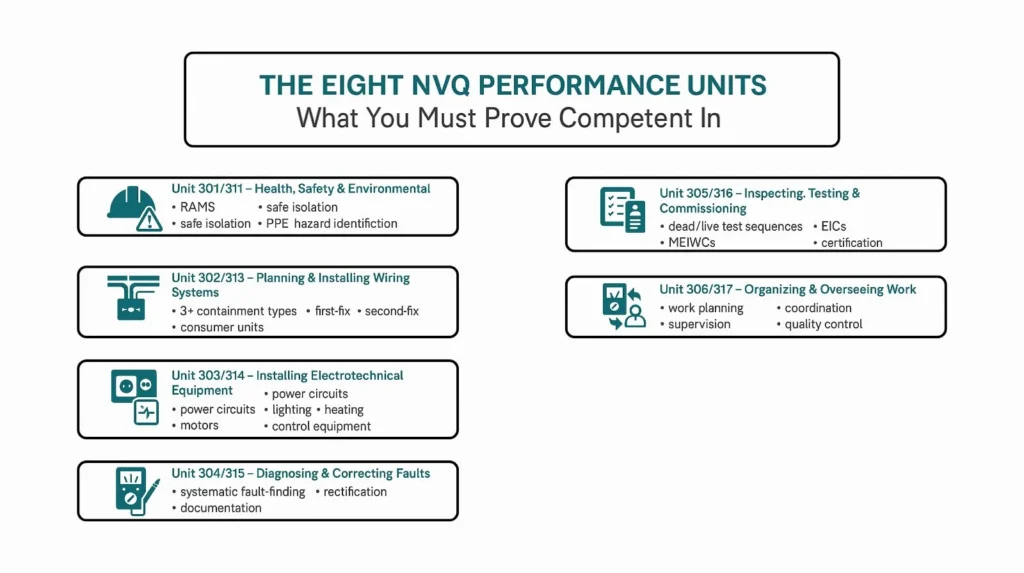
The C&G 2357-13 Installation pathway assesses competence across eight mandatory performance units. Each unit requires auditable evidence from real work sites proving the learner can perform specific tasks to industry standards.
Unit 301/311: Health, Safety and Environmental Considerations
What it assesses: Application of health and safety legislation, procedures, and environmental practices on construction sites.
Evidence required:
Risk assessments (RAMS) for electrical work activities
Method statements detailing safe working procedures
Demonstration of correct PPE use (hard hat, safety boots, high-visibility clothing, gloves, eye protection)
Safe isolation procedures (prove-test-prove using voltage testers)
Identification and mitigation of site hazards (working at height, confined spaces, asbestos, live equipment)
Environmental considerations (waste disposal, energy efficiency, material recycling)
Typical evidence: Completed risk assessment forms, method statements, photos showing PPE and safe working practices, witness testimonies confirming adherence to site safety protocols.
Common gaps: Learners often lack formal RAMS documentation if working for small domestic contractors who don’t complete written assessments. This creates evidence gaps that must be addressed.
Unit 302/313: Planning, Preparing and Installing Wiring Systems and Enclosures
What it assesses: Ability to plan, prepare, and install electrical wiring systems, containment (conduit, trunking, tray), and equipment enclosures (consumer units, distribution boards, junction boxes).
Evidence required:
Installation of minimum three different types of containment (e.g., PVC conduit, steel conduit, trunking, cable tray, basket tray)
First-fix wiring (cables run through containment before plastering/finishing)
Second-fix wiring (terminations, faceplate fitting, testing)
Consumer unit and distribution board installation
Equipment mounting (correct heights, spacing, accessibility)
Cable routing (logical, neat, compliant with BS 7671)
Typical evidence: Before/during/after photo sequences showing containment installation, cable routing, and equipment fixing. Photos must clearly show the learner performing the work, not just finished installations.
Common gaps: Domestic-only learners struggle with heavy-duty metallic containment (steel conduit, cable tray) which is primarily used in commercial and industrial installations. Without evidence of installing at least three different containment types, this unit cannot be signed off.
Unit 303/314: Installing Electrotechnical Equipment
What it assesses: Competence in installing and terminating electrical equipment including switches, sockets, lighting, heating controls, motors, and control gear.
Evidence required:
Installation and termination of power circuits (ring finals, radials)
Installation and termination of lighting circuits (one-way, two-way, intermediate switching)
Installation of heating controls (programmers, thermostats, zone valves)
Installation of motors and control equipment (starters, contactors, overload protection)
Correct termination techniques (torque settings, strain relief, cable identification)
Equipment commissioning (functional testing, proving correct operation)
Typical evidence: Photo sequences showing equipment installation process, termination close-ups proving correct technique, witness testimonies from supervisors confirming work quality, completed installation certificates.
Common gaps: Motor installation and control equipment evidence is rare in domestic work. Learners working solely on houses typically lack this evidence, creating a significant gap.
Unit 304/315: Diagnosing and Correcting Electrical Faults
What it assesses: Systematic fault diagnosis using test equipment, identifying root causes, and rectifying faults safely and effectively.
Evidence required:
Fault-finding on power circuits (loss of supply, blown fuses, tripped MCBs/RCDs)
Fault-finding on lighting circuits (non-functioning lights, flickering, incorrect switching operation)
Fault-finding on motors and control equipment (failure to start, overload trips, phase loss)
Systematic diagnostic approach (visual inspection, dead testing, live testing, logical elimination)
Correct rectification procedures (replacing faulty components, repairing damaged cables, correcting incorrect terminations)
Documentation of faults found and rectification carried out
Typical evidence: Photos showing fault conditions, diagnostic process, test results, and rectified installations. Written reflective accounts describing the fault-finding process and reasoning. Witness testimonies confirming correct diagnosis and rectification.
Common gaps: Learners in new-build or installation-only roles lack fault-finding opportunities. This unit requires encountering genuine faults in existing installations, which may not occur regularly during new installation work.
Unit 305/316: Inspecting, Testing and Commissioning Electrotechnical Systems
What it assesses: Competence in performing the full sequence of inspection and testing procedures according to BS 7671 and Guidance Note 3, and completing electrical certificates correctly.
Evidence required:
Visual inspection (correct identification, equipment suitability, correct connections, mechanical protection, isolation provision)
Dead testing sequence (continuity of protective conductors, continuity of ring final circuit conductors, insulation resistance, polarity)
Live testing sequence (earth fault loop impedance, RCD operation, voltage, phase sequence)
Correct use of multifunction testers (calibration checks, correct test settings, accurate readings)
Completion of Electrical Installation Certificates (EICs) with no errors
Completion of Minor Electrical Installation Works Certificates (MEIWCs) with no errors
Correct documentation of test results and compliance verification
Typical evidence: Photo sequences showing full testing process, screenshots or photos of completed test results, copies of EICs and MEIWCs signed by the learner, witness testimonies from supervising electricians confirming testing competence.
Common gaps: This is the most common evidence gap. Learners often assist with testing but don’t personally conduct the full sequence or complete the certification. Assessors require proof that the learner independently performed all tests and correctly completed certificates, which requires significant trust and responsibility from employers.
Thomas Jevons, Head of Training at Elec Training, explains the evidence quality requirement:
"Assessors reject more evidence for poor quality than for insufficient quantity. A portfolio with 50 photos of socket installations doesn't prove competence if there's no variety in circuit types, containment methods, or testing procedures. The NVQ requires breadth and depth. You need to demonstrate competence across domestic, commercial, and industrial installations, covering single-phase and three-phase systems, multiple containment types, and the full testing sequence. That's what separates a competent electrician from someone who's only learned one narrow type of work."
Thomas Jevons, Head of Training
Unit 306/317: Organizing and Overseeing the Work Environment
What it assesses: Ability to plan, organize, and oversee electrical work activities, demonstrating responsibility, coordination with other trades, and supervision capabilities.
Evidence required:
Work planning (scheduling, material ordering, tool preparation)
Coordination with other trades (liaising with plumbers, plasterers, builders, site managers)
Progress monitoring (ensuring work stays on schedule, identifying and resolving delays)
Quality control (checking work meets standards, identifying and correcting deficiencies)
Site organization (maintaining clean and safe work areas, proper storage of materials and tools)
Supervision or mentoring (guiding junior electricians or trainees, checking their work)
Typical evidence: Written reflective accounts describing work planning and coordination, witness testimonies from site managers or supervisors confirming organizational competence, photos showing work progression and site organization.
Common gaps: Learners working solely as mates under close supervision may lack opportunities to demonstrate planning and coordination responsibilities. This unit requires some degree of autonomy and responsibility, which not all employers provide to trainees.
Minimum Range Requirements Across All Units
The NVQ requires demonstrating competence across a minimum range of:
Installation types:
Domestic (houses, flats, small residential)
Commercial (offices, retail, hospitality)
Industrial (factories, warehouses, process plants)
Voltage levels:
Single-phase 230V (standard domestic supply)
Three-phase 400V (commercial and industrial supplies)
Containment types (minimum three different):
PVC conduit
Steel conduit
Plastic trunking
Metallic trunking
Cable tray
Basket tray
Circuit types:
Radial power circuits
Ring final circuits
Lighting circuits (one-way, two-way, intermediate switching)
Heating control circuits
Motor circuits
Emergency lighting circuits (if applicable to work environment)
Testing procedures:
Full dead testing sequence (continuity, insulation resistance, polarity)
Full live testing sequence (earth fault loop impedance, RCD operation, voltage)
Correct completion of EICs and MEIWCs
Learners who only work in one sector (e.g., domestic-only) or on limited circuit types (e.g., power and lighting only, no motor control) will lack the evidence range required for NVQ completion. This is the primary reason for delayed or incomplete NVQs.
Portfolio Requirements: How the NVQ Is Actually Assessed
The NVQ portfolio is a structured collection of evidence mapped directly against the performance criteria of each unit. It proves the learner has applied technical knowledge in real working environments and can perform electrical work competently and safely.
What an NVQ Portfolio Looks Like
Digital portfolios are the industry standard. Platforms like OneFile, Learning Assistant, and Ecordia allow learners to upload evidence from smartphones or computers, with assessors reviewing remotely and providing feedback digitally. This significantly speeds up the administrative process compared to paper portfolios.
Portfolio structure:
Organized by unit (301-317)
Each unit contains multiple pieces of evidence mapped to specific performance criteria
Evidence types include: photos, videos, written reflective accounts, risk assessments, method statements, witness testimonies, completed electrical certificates, site drawings
Evidence sequencing: Assessors expect photo evidence to show the full process, not just finished work. For example, containment installation evidence should include:
Photo showing area before work begins (measuring, marking out)
Photos showing containment fixing process (brackets, supports, intermediate stages)
Photo showing cable installation through containment
Photo showing completed installation (neat, secure, compliant with BS 7671)
Close-up photos showing specific details (correct torque on fixings, appropriate support spacing, proper bending techniques for conduit)
Video evidence: Increasingly accepted, particularly for demonstrating process-based tasks like safe isolation (prove-test-prove sequence) or testing procedures. Video can show competence more clearly than still photos for dynamic tasks.
Evidence Types and Quality Standards
Direct Observations (Highest Quality Evidence)
The assessor physically visits the learner on a work site and directly observes them performing a specific task from start to finish. This is considered the gold standard of NVQ evidence because the assessor can verify competence in real-time, ask questions, and confirm the learner is working to the required standard without supervision.
Typical observation tasks:
Installing containment (conduit, trunking, tray)
First-fix or second-fix wiring
Testing sequence (dead and live tests)
Fault-finding and rectification
Safe isolation procedures
How many observations: Typically 2-5 site visits depending on the quality of remote evidence. Learners with high-quality photo/video evidence and strong witness testimonies may require fewer observations. Learners with weak remote evidence require more direct observations to verify competence.
Logistical challenges: Coordinating assessor site visits with suitable work being performed is difficult. If the learner is scheduled to install cable tray on Tuesday but the assessor isn’t available until Friday (by which time the task is complete), the observation opportunity is lost. This is a common cause of NVQ delays.
Photographic Evidence (Most Common Evidence Type)
Photos must clearly show:
The learner performing the work (not just the finished installation)
Sequential stages (before, during, after)
Sufficient detail to verify quality and compliance (close-ups of terminations, support spacing, cable routing)
Date and location metadata (most digital portfolios capture this automatically from smartphone uploads)
What assessors reject:
Photos that don’t show the learner in frame (could be anyone’s work)
Photos showing only finished installations (doesn’t prove the learner did the work)
Photos lacking detail (too far away, poor lighting, blurred)
Photos showing non-compliant work (incorrect terminations, unsafe practices, non-BS 7671 compliant installations)
Photos from training centres or simulated work (must be real, revenue-generating sites)
Video Evidence
Accepted for process-based tasks where still photos cannot adequately demonstrate competence. Particularly useful for:
Safe isolation procedures (prove-test-prove sequence)
Testing procedures (showing full test sequence and meter readings)
Fault-finding (systematic diagnostic approach)
Complex termination techniques
Video requirements: Clear audio and video, unedited, showing the full process from start to finish. The learner should narrate what they’re doing as they work (e.g., “I’m now checking the voltage tester is functioning by testing against a known live source, confirming the tester shows 230V…”).
Witness Testimonies (Supporting Evidence)
Statements completed by qualified electricians, site supervisors, or employers confirming the learner performed specific tasks competently. Witness testimonies must be:
On company letterhead or official email
Signed by a qualified electrician (Gold Card holder or equivalent)
Specific about the task performed, date, location, and standard achieved
Detailed enough to map against performance criteria
What assessors reject:
Generic testimonies (“John is a good worker”) without specific task details
Testimonies from unqualified persons (labourers, trainees, non-electricians)
Testimonies for work done years ago without supporting contemporary evidence
Testimonies that contradict photographic evidence or describe work that doesn’t match portfolio content
Reflective Accounts (Written Evidence)
The learner writes a detailed account describing a task they performed, including:
The work required (circuit type, installation location, client requirements)
Planning and preparation (risk assessment, method statement, material selection)
The installation process (step-by-step description of what was done)
Testing and commissioning (what tests were performed, results, any issues encountered)
Relevant regulations (which sections of BS 7671 applied, how compliance was achieved)
Problems encountered and how they were solved
Reflective account quality: Must demonstrate deep understanding, not just describe surface-level tasks. Assessors look for evidence of thinking, decision-making, and application of regulations, not just “I installed a socket circuit.”
Work Products (Documents)
Completed documentation produced during real electrical work:
Electrical Installation Certificates (EICs) signed by the learner
Minor Electrical Installation Works Certificates (MEIWCs) signed by the learner
Risk assessments (RAMS)
Method statements
Site drawings marked up with cable routes or equipment locations
Handover documentation
Test result sheets
Document authenticity: Must be genuine documents from real jobs, not training centre exercises. Assessors check dates, addresses, client names, and cross-reference with photo evidence to verify authenticity.
Why Domestic-Only Work Fails to Meet NVQ Requirements
Learners working solely on domestic installations face systematic evidence gaps:
Missing containment types: Domestic work primarily uses PVC conduit and plastic trunking. Heavy-duty metallic containment (steel conduit, cable tray, basket tray) is almost exclusively commercial and industrial. Without evidence of installing at least three different containment types, Unit 302/313 cannot be signed off.
Missing three-phase evidence: Domestic installations are single-phase 230V. Three-phase 400V supplies are used in commercial and industrial settings for larger loads, motors, and distribution. Without three-phase evidence, several performance criteria across multiple units remain unmet.
Missing motor and control equipment: Domestic installations rarely include motors or control equipment beyond basic heating controls. Industrial installations require motor starters, contactors, overload protection, and control panels. Without this evidence, Unit 303/314 has significant gaps.
Limited fault-finding opportunities: New-build domestic work involves installing new circuits, not diagnosing faults in existing installations. Maintenance and fault-finding evidence (Unit 304/315) is difficult to gather without access to reactive maintenance or remedial work on existing installations.
Testing limitations: Domestic electricians may conduct dead and live testing, but often don’t complete EICs or MEIWCs themselves (the supervising electrician or company owner signs off). Without personally completing certificates, Unit 305/316 evidence is incomplete.
Real forum experience illustrates the domestic-only problem:
"I've been working domestic for 18 months, done about 30 rewires, hundreds of socket additions, loads of consumer unit changes. My assessor says I still can't complete the NVQ because I have no industrial evidence. I need cable tray, three-phase, and motor control. But I can't find an industrial job because I don't have the Gold Card yet. Stuck." (ElectriciansForums, 2024)
(Reddit r/ukelectricians, 2024)
What Assessors Reject: The Reality of Portfolio Failures
Simulated work: Any work done purely for assessment purposes in training centres, workshops, or the learner’s own home (unless part of a legitimate, paid contract with third-party verification) is rejected. The EAWR 1989 requires competence to be demonstrated in real working conditions, not simulated environments.
Insufficient variety: 50 photos of socket installations don’t prove competence if every installation is identical (same circuit type, same containment, same voltage level). Assessors require breadth across installation types, circuit types, containment methods, and sectors.
Self-employment without supervision: Learners working solely for themselves without qualified electrician supervision face rejection because the NVQ requires proof of working under supervision until competence is proven. Witness testimonies must come from qualified third parties, not the learner themselves or family members.
Work done for family/friends without formal contracts: Installing a socket for your uncle or rewiring your friend’s garage doesn’t count unless there’s a formal contract, appropriate insurance, and qualified third-party verification. Assessors are extremely strict on this because of widespread evidence fabrication in the past.
Old evidence without contemporary context: Photos from jobs completed years ago can be used if accompanied by strong reflective accounts and witness testimonies, but assessors are skeptical of portfolios consisting entirely of old work with no recent evidence. The NVQ assesses current competence, not historical work.
Poor-quality photos: Blurred, poorly lit, or distant photos that don’t clearly show the work being performed or the learner in frame are rejected. If the assessor cannot verify what’s shown in the photo, it has no evidential value.
Entry Requirements: What You MUST Have Before Starting the NVQ Level 3
The NVQ Level 3 is a competence qualification that builds on prior technical knowledge. You cannot start the NVQ without completing prerequisite qualifications and, critically, securing employment or site access.
Required Technical Qualifications
Level 2 Diploma (C&G 2365-02 or equivalent)
The Level 2 Diploma in Electrical Installations establishes foundation knowledge of electrical theory, circuit types, installation methods, health and safety, and basic testing. You must hold this qualification (or its predecessor, C&G 2330 Level 2) before starting the NVQ.
Equivalent qualifications accepted:
C&G 2330 Level 2
BTEC Level 2 Electrical Installation
SQA Level 2 Electrical Installation (Scotland)
EAL Level 2 Diploma in Electrical Installation
Level 3 Diploma (C&G 2365-03 or equivalent)
The Level 3 Diploma advances into three-phase systems, motor control, advanced fault-finding, design calculations, and inspection/testing theory. This is the most critical prerequisite because it covers the technical knowledge assessed in the NVQ performance units.
Equivalent qualifications accepted:
C&G 2330 Level 3
BTEC Level 3 Electrical Installation
SQA Level 3 Electrical Installation (Scotland)
EAL Level 3 Diploma in Electrical Installation
Bridging assessments: If you completed Level 2 and Level 3 Diplomas before September 2017 under older qualification structures, you may require a Bridging Unit/Assessment. This is a written exam and professional discussion covering knowledge gaps between old and new NVQ structures. Your NVQ training provider will assess whether bridging is required during initial registration.
18th Edition Wiring Regulations (C&G 2382-22)
Current knowledge of BS 7671:2018+A2:2022 is mandatory. The 18th Edition certificate must be held before or early in the NVQ process because all portfolio evidence must demonstrate compliance with current regulations. The 18th Edition is also required for ECS Gold Card eligibility and AM2 entry.
When to complete 18th Edition: Ideally completed immediately after Level 2 Diploma, before seeking employment. Employers require 18th Edition certification for electrician’s mate positions due to insurance and site safety requirements.
The Critical Requirement: Employment or Site Access
You cannot start the NVQ Level 3 without employment or access to real construction sites. This is non-negotiable. The NVQ is entirely work-based and requires gathering evidence from real, revenue-generating electrical work.
What counts as suitable employment:
Electrician’s mate working for electrical contractor
Improver working under supervision of qualified electrician
Trainee employed by construction company with electrical division
Subcontractor working under supervision of main contractor
Self-employed electrician with verifiable contracts and qualified third-party supervision
What does NOT count:
Classroom-only learner with no job
Labourer who occasionally helps with electrical tasks but isn’t employed specifically as electrical trainee
Person doing electrical work casually for friends/family without formal contracts
Training centre workshop practice
Employment characteristics required for NVQ completion:
Work variety: The employer must provide access to different installation types (domestic, commercial, industrial), different circuit types (power, lighting, heating, motors), and different containment types (conduit, trunking, tray). Employers who only provide one type of work (e.g., domestic-only, commercial fit-outs only) create evidence gaps.
Assessor access: The employer must allow assessor site visits for direct observations. Some employers refuse to have external assessors on site due to insurance, client confidentiality, or logistical constraints. This blocks NVQ completion.
Witness testimony cooperation: The employer (or supervising electrician) must be willing to complete witness testimonies on company letterhead confirming the learner performed specific tasks. Employers who are too busy or unwilling to complete paperwork create significant delays.
Time allowance for evidence documentation: The learner needs time during work hours to photograph evidence, write reflective accounts, and maintain the portfolio. Employers who expect 100% productivity without allowing portfolio time make NVQ completion extremely difficult.
The “Catch-22” Problem: Can’t Get a Job Without Qualification, Can’t Get Qualification Without a Job
This is the most common complaint across electrical training forums:
"I spent £10,000 on Level 2, Level 3, and 18th Edition. Now I'm trying to get my NVQ but I can't find a job. Employers want Gold Card holders, but I can't get the Gold Card without completing the NVQ, and I can't complete the NVQ without a job. I'm stuck in limbo. The training provider that sold me the diplomas offers no help finding work."
(Reddit r/ukelectricians, 2024)
"Did my Level 2 and Level 3 two years ago. Been applying for mate positions ever since. Nobody will take me on without experience, but I can't get experience without someone taking me on. Meanwhile, I'm working in a warehouse because I can't afford to be unemployed while I wait for my 'big break' into electrical. Feels like I wasted £8,000 on training."
(ElectriciansForums, 2024)
This Catch-22 exists because most training providers deliver classroom qualifications but provide no employment support. They register learners onto the NVQ, provide assessor contact details, and expect learners to solve the employment problem themselves.
How Elec Training solves this: We operate an in-house recruitment team that makes over 100 calls per learner to our network of 120+ UK contractors. We actively place learners into electrician’s mate and improver positions that provide the work variety required for NVQ completion. This guaranteed work placement support is the key differentiator between completing the NVQ successfully and getting stuck in incomplete qualification limbo.
Common Mis-Selling and Scams to Avoid
“Complete your NVQ in 4 weeks”
This is the most common misleading claim. It is physically impossible to gather the required range and volume of auditable evidence, coordinate assessor site visits, and pass the AM2 in four weeks. What providers actually mean is “registration takes 4 weeks,” not completion.
Reality: NVQ completion takes 6-18 months minimum, depending on work variety and assessor availability.
“We provide full NVQ support” (but no placement assistance)
Many providers claim to offer “full support” which consists of:
Providing access to online portfolio platform
Providing assessor contact details
Answering questions by email
This is not full support. Without guaranteed work placement assistance, most learners cannot progress.
Reality: Completion depends on securing employment that provides work variety. Without placement support, learners get stuck.
“You can complete the NVQ working for yourself”
While technically possible, self-employed learners face extreme difficulties:
No qualified third-party supervision (required for evidence verification)
Difficulty obtaining witness testimonies (self-employed learners can’t witness their own work)
Limited work variety (self-employed beginners typically work domestically, lacking commercial/industrial evidence)
Assessment bodies are extremely skeptical of self-employment evidence due to past fraud
Reality: Self-employment is possible but significantly harder. Most successful NVQs are completed through traditional employment.
Real Work Requirements: What Counts as "Real Site Experience"
The NVQ requires all evidence to come from real working environments where electrical work is subject to commercial or industrial standards, client deadlines, health and safety protocols, and final certification. This cannot be simulated or created purely for assessment.
Industry Definition of “Real Work Environment”
A real work environment is a site where:
The installation or maintenance work is part of a commercial contract
The work is subject to client requirements and deadlines
Health and safety protocols are enforced (RAMS, site inductions, PPE requirements)
The work will be inspected, tested, and certified upon completion
The work generates revenue for the employer/contractor
The work will be used by the client for its intended purpose (occupied homes, functioning businesses, operational industrial facilities)
What counts:
New-build housing estates (first-fix and second-fix electrical work)
Commercial fit-outs (offices, retail units, restaurants, hotels)
Industrial installations (factories, warehouses, process plants, distribution centres)
Maintenance and remedial work on existing installations
Refurbishment projects (upgrading consumer units, rewiring, fault-finding)
Subcontracted work for main contractors on large projects
What does NOT count:
Training centre workshops (simulated installations for learning purposes)
Work in learner’s own home (unless part of legitimate contract with third-party verification)
Work for family/friends without formal contracts and insurance
“Practice” installations created solely for assessment
College projects or assessment tasks
Voluntary work where no contract or payment exists
Jobs That Commonly Cause Evidence Gaps
Purely domestic-only installation
Problem: Lacks commercial/industrial evidence, three-phase systems, heavy-duty containment, motor control, and complex fault-finding.
Evidence gaps: Units 302/313 (containment variety), 303/314 (motor installation), 304/315 (industrial fault-finding).
Solution required: Supplement domestic work with commercial or industrial placements, or transition to mixed-sector employment.
Roles focused on one specific system
Examples: CCTV installers, fire alarm engineers, data cabling specialists, renewable energy installers who only work on solar PV or battery storage.
Problem: Lacks traditional power and lighting installation evidence, testing competence across varied circuit types, and broad containment experience.
Evidence gaps: Multiple units lack breadth, particularly 302/313, 303/314, 305/316.
Solution required: Transition to general electrical installation role or supplement specialist work with broader electrical placements.
Purely remedial or fault-finding work
Problem: Provides strong Unit 304/315 evidence (fault diagnosis and rectification) but lacks new installation evidence for Units 302/313 (wiring systems and containment) and 303/314 (equipment installation).
Evidence gaps: Installation units incomplete, limiting NVQ progression.
Solution required: Balance maintenance/remedial work with new installation projects.
Commercial retail fit-outs (identical repetitive work)
Problem: If every job is identical (e.g., 50 retail unit fit-outs with same layout, same circuits, same containment), there’s no evidence variety. The NVQ requires breadth, not just repetition.
Evidence gaps: Insufficient variety to satisfy performance criteria requiring different circuit types, installation methods, and system types.
Solution required: Seek varied commercial work or supplement with domestic/industrial placements.
Industrial Experience: The Evidence Gap Filler
To satisfy the full range of NVQ performance criteria, most learners need some industrial experience covering:
Heavy-duty containment:
Cable tray systems (ladder tray, solid-bottom tray, perforated tray)
Steel conduit (heavy-gauge, rigid)
Industrial trunking (large-capacity, metallic)
Basket tray and cable management in plant rooms
Three-phase systems:
400V three-phase supplies
Three-phase distribution boards
Phase rotation and balancing
Three-phase equipment (motors, heaters, large power loads)
Motors and control equipment:
Electric motor installation (single-phase and three-phase)
Motor starters (direct-on-line, star-delta)
Contactors and overload protection
Control panels and PLC wiring (basic)
Emergency stop systems
Industrial testing:
Testing three-phase installations
Earth fault loop impedance on industrial supplies
Insulation resistance on motors and control circuits
Commissioning of industrial equipment
Learners who never access industrial work struggle to complete these aspects. Some assessment centres accept “borrowed” industrial evidence (spending a few days on an industrial placement to gather specific evidence), but this is not guaranteed and depends on the employer’s willingness to provide access.
Subcontracting, Part P, and Working with Relatives
Subcontracting work
Counts as real work provided:
The subcontractor is working under legitimate contract for main contractor or client
The work is subject to main contractor supervision and quality control
Appropriate insurance is in place
Witness testimonies can be obtained from main contractor or qualified supervisors
Subcontracting is common in the electrical industry and is fully accepted for NVQ evidence provided the above conditions are met.
Part P domestic installers
Domestic installers registered under Part P (Competent Person Scheme members) who hold 2391 Inspection & Testing but not NVQ Level 3 can complete the NVQ through the 2357 route if they have less than 5 years’ experience, or through the 2346 Experienced Worker Route (EWA) if they have 5+ years’ experience.
However, domestic-only work creates the evidence gaps described earlier. Part P installers often need to supplement domestic work with commercial or industrial placements to gather the full evidence range.
Working with a relative
Qualifies provided:
The relative is a fully qualified electrician (Gold Card holder)
Formal employment contract exists (not just “helping out”)
Appropriate insurance is in place
The relative provides witness testimonies and supervision
The assessment centre/Awarding Body (City & Guilds) verifies authenticity through strict auditing
Assessment centres impose extremely strict verification requirements when the supervisor is a relative to prevent evidence fabrication. Expect thorough questioning, verification of contracts and insurance, and potentially additional direct observations to confirm competence.
Legal Reasons Why Simulation Is Not Accepted
The Electricity at Work Regulations 1989 (EAWR) require that persons working on electrical systems possess sufficient technical knowledge or experience to prevent danger (Regulation 16). Competence can only be reliably demonstrated in real working environments where consequences of errors are genuine (safety risks, client dissatisfaction, financial losses, legal liability).
Simulated work in training centres does not expose learners to:
Time pressure and client deadlines
Real-world problem-solving (unexpected site conditions, material shortages, coordination with other trades)
Consequences of poor workmanship (callbacks, client complaints, safety incidents)
Professional responsibility (signing off work, accepting liability, meeting regulatory standards)
The NVQ is designed to prove competence under real-world conditions, which simulation cannot replicate. This is why Ofqual (the qualifications regulator) and City & Guilds mandate that all NVQ evidence must come from real work environments.
What You Should Realistically Expect from a Fast-Track Course
So, if you’re considering a fast-track course, here’s what you should actually expect.
What a fast-track course DOES give you:
Classroom knowledge of electrical science, regulations (BS 7671), and installation principles
Basic practical skills in a controlled training bay environment
Level 2 and/or Level 3 diplomas (e.g., City & Guilds 2365)
18th Edition Wiring Regulations certificate
Possibly Inspection and Testing (2391) qualification
A foundation of understanding that you can build on
What it DOESN’T give you:
Full competence to work independently as an electrician
NVQ Level 3 (2357) portfolio (unless it’s part of an extended programme with guaranteed placement)
AM2 or AM2S assessment
ECS Gold Card
Guaranteed employment or even guaranteed interviews
The experience needed to deal with real-world installations, faults, and site challenges
What you’ll still need to do after the course:
Secure employment or a work placement (this is often the hardest part)
Build your NVQ Level 3 portfolio over 12 to 24+ months of supervised site work
Pass your AM2 assessment (a practical exam that costs around £800 to £1,000)
Apply for your ECS Gold Card
Potentially complete additional qualifications like 2391 (if not already done)
Who fast-track courses are suitable for:
Career-changers who understand they’re at the beginning of a longer pathway
Adults who can’t access traditional apprenticeships but have a plan for securing work afterwards
People with existing site experience (e.g., in other trades) who need formal qualifications to progress
Learners who’ve researched realistic timelines and costs, and have savings or finance to cover the extended journey
Who fast-track courses are NOT suitable for:
Anyone expecting to be a qualified electrician within weeks or months
Learners without a clear plan for how they’ll access site work and supervision after the course
People who can’t afford the upfront cost plus the potential months or years of lower wages whilst completing NVQ
Anyone who assumes “fast-track” means they can skip the standard requirements
A fast-track course can be a good starting point, but only if you treat it as exactly that: a starting point. It’s not a shortcut, and it’s not a guarantee. It’s an entry ticket to a much longer journey.
If you go in with realistic expectations, a financial plan, and a clear idea of how you’ll secure the work experience you need afterwards, fast-track can work. If you go in thinking you’ll be qualified and earning decent money in a few months, you’re setting yourself up for disappointment.
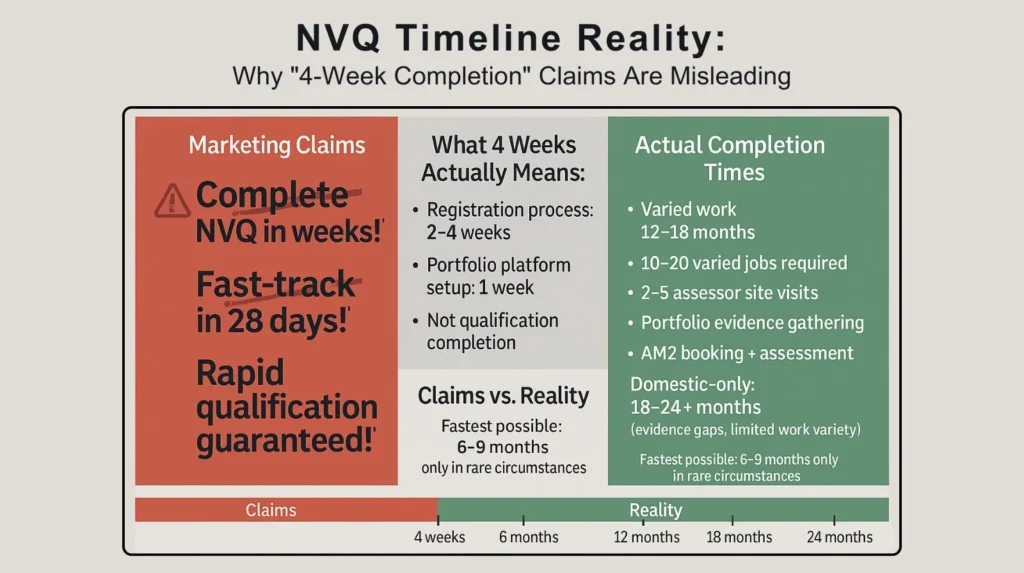
How Long the NVQ Level 3 Electrical Takes: Realistic vs Marketing Claims
NVQ completion time varies dramatically based on work environment, assessor availability, and learner circumstances. Marketing claims of “4-week completion” are misleading and create false expectations.
True Average Completion Times
Apprentices (C&G 5357 Electrotechnical Apprenticeship Standard)
Work environment: Structured apprenticeship with planned progression through domestic, commercial, and industrial placements.
Realistic average: 3.5 to 4 years for entire apprenticeship, with NVQ portfolio work concentrated in Years 3-4.
Why this timeline: Apprenticeships include classroom delivery of Level 2 and Level 3 Diplomas in Years 1-2, followed by on-site portfolio work in Years 3-4. The apprenticeship standard requires 80% on-the-job training, ensuring work variety and assessor access.
Adult Trainees (C&G 2357) in Varied Mixed-Sector Work
Work environment: Employment with contractor providing access to domestic, commercial, and industrial installations. Employer cooperates with assessor visits and provides witness testimonies.
Realistic average: 9 to 18 months after completing Level 2 and Level 3 Diplomas.
Why this timeline: Learners in varied roles encounter the full range of installation types, circuit types, and containment methods within 9-12 months. Assessor observations can be scheduled efficiently. Portfolio documentation proceeds steadily. AM2 booking and completion adds final 2-6 months.
Adult Trainees (C&G 2357) in Domestic-Only Work
Work environment: Employment with domestic installer or small contractor working exclusively on houses. Limited access to commercial or industrial work.
Realistic average: 18 to 24+ months, often extending beyond the 24-month maximum registration period.
Why this timeline: Domestic-only work creates evidence gaps for industrial containment, three-phase systems, motor control, and complex fault-finding. Learners must either transition to mixed-sector work or negotiate supplementary commercial/industrial placements. This extends completion significantly.
Experienced Workers (C&G 2346 EWA) with Evidence Ready
Work environment: Electrician with 5+ years’ documented experience, retrospectively gathering evidence from recent jobs.
Realistic average: 6 to 12 months.
Why this timeline: Experienced workers already possess competence and have extensive work history. Portfolio work involves documenting existing competence rather than developing new skills. However, if evidence variety is lacking (e.g., purely domestic career), completion still takes 12-18 months.
Fastest Possible Completion: The 3-Month Myth
Some providers advertise “3-month fast-track NVQ” completion. This is achievable only under extremely specific circumstances:
Prerequisites for 3-month completion:
Learner is currently employed in highly varied role (domestic, commercial, industrial)
Learner has been working in this role for 6-12 months before starting NVQ (evidence already exists retrospectively)
Learner has maintained detailed photo documentation of all work (hundreds of photos covering all performance criteria)
Employer fully cooperates with immediate assessor scheduling
Assessor is available for multiple site visits within 8-12 weeks
AM2 can be booked immediately with no waiting list
Reality: These conditions are extremely rare. Most learners do not retrospectively document work before starting the NVQ. Most employers cannot accommodate rapid assessor scheduling. AM2 booking typically involves 4-8 week waits. The “3-month NVQ” is theoretically possible but practically unrealistic for 95%+ of learners.
Number of Jobs Typically Required
Minimum significant jobs: 5-10 varied jobs covering different installation types, circuit types, containment methods, and testing scenarios.
Why this number: Each performance unit requires evidence across multiple performance criteria. A single job rarely covers all criteria for even one unit. For example:
Unit 302/313 (wiring systems and containment): Requires evidence of installing minimum three different containment types. If Job 1 uses PVC conduit, Job 2 uses trunking, Job 3 uses cable tray, that satisfies containment variety. But you also need evidence of first-fix wiring, second-fix wiring, consumer unit installation, and equipment mounting, which may require Jobs 4-7.
Unit 305/316 (testing): Requires full testing sequence on multiple circuit types (power, lighting, heating, motors). If each job only allows testing one circuit type, you need 4-5 jobs to cover the range.
Total jobs across all units: 10-20 jobs covering different sectors, installation types, circuit types, and containment methods provides sufficient evidence variety for most learners.
Differences in Duration by Work Type
Domestic-only work: Significantly longer (18-24+ months) due to evidence gaps requiring transition to mixed-sector work or supplementary placements.
Mixed commercial/industrial work: Faster (9-15 months) due to higher likelihood of encountering three-phase systems, heavy-duty containment, motor control, and varied testing opportunities.
Maintenance-focused work: Can be slower (15-20 months) if employer provides repetitive maintenance tasks without new installation variety. However, if maintenance includes varied fault-finding, testing, and remedial installation, duration is similar to mixed installation work.
Pitfalls and Common Delays
Employers not assigning varied tasks
Problem: Employer keeps learner on simple, repetitive work (e.g., pulling cables, installing sockets) without progressing to more complex tasks (containment installation, consumer unit fitting, testing, fault-finding).
Impact: Learner cannot gather evidence for multiple performance units, blocking NVQ progression.
Solution: Communicate with employer about NVQ requirements. If employer cannot or will not provide varied work, transition to different employer or negotiate supplementary placements.
Learners stuck on testing evidence
Problem: Employer does not allow learner to conduct full testing sequences or complete EICs/MEIWCs. Testing and certification are performed by senior electrician or company owner, leaving learner with no Unit 305/316 evidence.
Impact: Cannot complete critical testing unit, blocking NVQ completion despite having strong installation evidence.
Solution: Negotiate with employer to allow supervised testing with learner completing certificates under supervision. If employer refuses, seek alternative employment that provides testing responsibility.
Assessor delaying visits
Problem: Assessor has large caseload and cannot accommodate site visit scheduling within reasonable timeframes. Learner completes suitable work but assessor isn’t available until weeks later, by which time the work is complete and observation opportunity is lost.
Impact: Delays unit sign-off by months, extending overall completion time.
Solution: Choose training provider with guaranteed assessor availability. Elec Training provides dedicated assessor support with rapid scheduling to minimize delays.
AM2 booking delays
Problem: AM2 assessment centres have limited capacity. During peak seasons (typically spring and autumn when apprentices complete), booking waits extend to 8-12 weeks.
Impact: Even with completed portfolio, learner must wait months for AM2, delaying Gold Card application and career progression.
Solution: Book AM2 early once portfolio is nearing completion. Training providers should coordinate AM2 booking to minimize wait times.
AM2 / AM2E / AM2S: How the Final Practical Exam Connects to the NVQ
The Achievement Measurement 2 (AM2) is the industry-standard practical assessment that forms the final unit of the NVQ Level 3. It is a three-day exam conducted at independent NET (National Electrotechnical Training) assessment centres that tests installation, testing, fault-finding, and certification skills under exam conditions.
Which AM2 Each Route Requires
C&G 2357 (Standard New Entrant Route) → AM2
The standard AM2 is taken by adult trainees, new entrants, career changers, and improvers completing the 2357 NVQ. It assesses installation, testing, fault-finding, safe isolation, and certification competence.
C&G 5357 (Apprenticeship Standard) → AM2S
The AM2S is taken by apprentices completing the Electrotechnical Apprenticeship Standard. It incorporates NVQ performance elements within the apprenticeship end-point assessment and is similar to AM2 but integrated into the apprenticeship framework.
C&G 2346 (Experienced Worker Assessment) → AM2E
The AM2E is taken by experienced electricians completing the EWA route. It is similar to AM2 but includes additional focus on installation of metallic containment (conduit bending, trunking fabrication) to ensure experienced workers possess core installation skills, not just maintenance or testing competence.
What the AM2 Assesses
The AM2 is conducted over approximately 2.5 to 3 days (16.5 hours of practical assessment plus short online theory component) and covers:
Installation Tasks (Day 1-2)
Install steel conduit and trunking (measuring, cutting, bending, fixing, ensuring correct support spacing and mechanical protection)
Install consumer unit or distribution board (correct positioning, fixing, labeling)
Install SWA (Steel Wire Armoured) sub-main cable (gland termination, earth continuity, mechanical protection)
Wire lighting circuits (one-way, two-way switching, emergency lighting if applicable)
Wire power circuits (ring final, radials)
Wire central heating control circuit (programmer, thermostat, zone valves, pump, boiler interlock)
Install accessories (sockets, switches, light fittings)
Inspection & Testing (Day 2-3)
Perform full dead testing sequence (continuity of protective conductors, continuity of ring final circuit conductors, insulation resistance, polarity)
Perform full live testing sequence (earth fault loop impedance, RCD operation, voltage, phase sequence for three-phase)
Complete Electrical Installation Certificate (EIC) with no errors
Complete Minor Electrical Installation Works Certificate (MEIWC) with no errors
Verify all test results are within acceptable limits per BS 7671 and Guidance Note 3
Fault Finding (Day 3)
Diagnose and rectify electrical faults in a pre-wired installation
Faults typically include: blown fuses, tripped MCBs/RCDs, incorrect polarity, earth faults, open circuits, short circuits, loss of neutral, phase loss (three-phase), control circuit faults
Systematic diagnostic approach required (visual inspection, dead testing, live testing, logical elimination)
Faults must be identified correctly and rectified within time limit
Safe Isolation (Throughout)
Demonstrate correct safe isolation procedure (identify circuit, isolate at appropriate point, secure isolation with lock-off device, prove dead with voltage tester before and after proving the tester works, retest after work)
Marks deducted for unsafe isolation practices
Risk Assessment & Method Statement
Complete RAMS for the installation work
Identify hazards, assess risks, specify control measures
Demonstrate understanding of health and safety requirements
Pass Rates and Common Fail Points
Official pass rates for AM2 are not publicly published by NET, but industry sources and forum discussions indicate pass rates of approximately 70-75%, meaning 25-30% of candidates fail on their first attempt.
Common reasons for AM2 failure:
Conduit work (Installation section)
Problem: Incorrect bending techniques, poor support spacing, inadequate mechanical protection, conduit not properly secured.
Impact: Mechanical damage to cables, non-compliance with BS 7671, unsafe installation. Immediate fail if critical defects identified.
Testing accuracy (Inspection & Testing section)
Problem: Incorrect test procedures, wrong test settings on multifunction tester, inaccurate readings, failure to identify out-of-limit results.
Impact: Test results don’t match assessor’s verification tests, indicating poor testing competence. Fail if discrepancies exceed acceptable tolerances.
Certification errors (Inspection & Testing section)
Problem: Incorrect entries on EICs or MEIWCs, missing information, wrong circuit details, calculation errors, missing signatures.
Impact: Electrical certificates are legal documents. Errors indicate lack of competence in completing correct documentation. Multiple errors result in fail.
Fault diagnosis (Fault Finding section)
Problem: Unable to identify faults within time limit, incorrect diagnostic approach, misidentifying fault location, unsafe working during fault-finding.
Impact: Fault-finding competence is critical for qualified electricians. Inability to diagnose faults systematically indicates insufficient experience or training. Fail if faults not identified/rectified within time.
Time management
Problem: Not finishing installation tasks within allocated time, rushing testing and making errors, poor planning and organization.
Impact: Real-world electrical work operates under time constraints. Inability to complete work to standard within time indicates lack of site readiness. Fail if critical tasks incomplete.
Retake Fees and Process
Retake costs: £200-£500 per failed section, depending on the assessment centre and which sections require reattempt. Full retakes (failing multiple sections) can cost £600-£800.
Retake process: Candidates receive detailed feedback identifying which sections failed and why. They can book retake for failed sections only (not entire AM2) once weaknesses are addressed. Retake booking waits are similar to initial booking (4-8 weeks).
Financial impact: Multiple AM2 retakes significantly increase total qualification cost. Combined with lost time (delays in obtaining Gold Card, progression to qualified electrician pay), AM2 failure can cost £2,000-£5,000+ in fees and lost earnings.
Can You Sit AM2 Before Portfolio Completion?
No. The AM2 is the final unit of the NVQ and can only be taken once the entire portfolio is complete and all performance units are signed off and verified by the Awarding Body (City & Guilds).
Booking sequence:
Complete all NVQ performance units (301-317)
Submit portfolio to City & Guilds for verification
City & Guilds confirms all units signed off (typically 2-4 weeks)
Training provider releases candidate for AM2 booking
Book AM2 at NET centre (4-8 week wait)
Attend AM2 assessment (3 days)
Results issued (typically within 2 weeks)
Apply for ECS Gold Card
Why this sequence exists: The AM2 is the culmination of the NVQ. It assesses whether the learner can apply all competences developed during portfolio work under exam conditions. Taking AM2 before portfolio completion defeats the purpose of work-based assessment.
AM2 Waits and Booking in 2025-2026
Current booking waits: 4-8 weeks is typical, but waits extend to 10-12 weeks during peak seasons (April-June and September-November when apprentices complete).
Assessment centres: NET centres are located across the UK (London, Birmingham, Manchester, Leeds, Glasgow, Cardiff, Bristol, others). Candidates typically travel to nearest centre, though some training providers have partnerships with specific centres and coordinate group bookings.
Booking strategy: Book AM2 as early as possible once portfolio nears completion (80-90% complete). Training providers should coordinate booking to ensure minimal delay between portfolio completion and AM2 attendance.
What the NVQ Level 3 Electrical Actually Costs in the UK (Complete Breakdown)
NVQ Level 3 costs vary significantly based on provider type (college, private training centre, portfolio-only assessor), route (2357 vs 2346), and what’s included in the quoted price. Hidden fees and additional costs catch many learners by surprise.
Elec Training NVQ Pricing
Base NVQ cost: £2,500.00
What’s included:
NVQ registration with City & Guilds
Access to digital portfolio platform (OneFile or equivalent)
Dedicated assessor support throughout portfolio process
Portfolio guidance and feedback
Professional discussions and written assessments
Guaranteed work placement support through our in-house recruitment team (key differentiator)
Additional cost: Site assessment visits charged separately based on location and frequency. Typical site assessment costs: £150-£300 per visit depending on travel distance. Most learners require 2-5 site visits.
AM2 exam fee: Not included in base NVQ cost. AM2 costs £700-£900 + VAT (total £840-£1,080) paid directly to NET assessment centre.
Total typical cost at Elec Training: £2,500 (NVQ) + £300-£900 (site assessments) + £840-£1,080 (AM2) = £3,640-£4,480 total for complete NVQ Level 3 qualification from registration to Gold Card eligibility.
Market Price Comparison (UK-Wide)
Private Training Centres
Anything from £2000 to £4000 depending on which one you speak to.
Colleges and FE Providers
Some Colleges: Free if eligible for government funding (19+ apprenticeships, unemployment support schemes)
Additional Fees That Almost Nobody Mentions (Hidden Costs)
AM2/AM2E Exam Fee: £700-£900 + VAT = £840-£1,080 total. This is almost always an additional cost on top of quoted NVQ price. Many learners don’t realize AM2 is separate until late in the process.
Site Assessment Travel Fees: If you’re outside the training provider’s service radius (typically 50-100 mile limit), expect to pay additional travel/mileage fees for assessor site visits. Common charges: £0.45-£0.75 per mile beyond service radius, or flat fee of £100-£200 per distant visit.
City & Guilds Registration Fee: Some providers include this in their quoted price, others charge separately. If charged separately: £150-£300 for initial registration and certification.
Resit Fees (AM2 Failure): £200-£500 per failed section. If you fail multiple sections: £600-£800+ for full retake. This is a significant risk given 25-30% first-time failure rate.
Re-enrolment Fee (Exceeding 24-Month Registration): If you don’t complete the NVQ within the standard 18-24 month registration period, you may face re-enrolment fees of £300-£800 to extend registration. This is common for learners who get stuck on evidence gaps.
Portfolio Platform Access Fee: Some providers charge annual fees for continued access to digital portfolio platforms (OneFile, Learning Assistant) if course extends beyond 12 months. Typical charge: £50-£150 per additional year.
Bridging Assessment Fee: If you hold older qualifications (C&G 2330 completed before 2017), you may require Bridging Unit/Assessment to update knowledge. Cost: £150-£400 depending on provider.
18th Edition Update (If Required): If your 18th Edition certificate is outdated (e.g., you hold 17th Edition or 18th Edition Amendment 1 but need current Amendment 2), you must update before NVQ completion. Cost: £300-£500 for 18th Edition update course and exam.
Payment Plan Options
Most private training providers offer payment plans to spread NVQ costs:
Typical payment structures:
3-month plan: 3 equal installments, no interest (pay in full over 3 months)
6-month plan: 6 equal installments, small admin fee (£50-£100)
12-month plan: 12 equal installments, larger admin fee or interest (5-10% APR)
Payment plan availability varies by provider. Elec Training offers flexible payment options, contact 0330 822 5337 to discuss installment plans that suit your circumstances.
VAT Differences and Total Cost Transparency
VAT treatment: Most training centres charge 20% VAT on top of advertised prices. Always confirm whether quoted prices are inclusive or exclusive of VAT.
Example:
Advertised price: £1,500
If VAT-exclusive: Total cost = £1,500 + 20% VAT = £1,800
If VAT-inclusive: Total cost = £1,500 (no additional charge)
Elec Training pricing: Our £2,500 NVQ cost is VAT-inclusive where applicable, providing transparent pricing with no hidden VAT surprises.
Legal Guarantees: Why No Provider Can Promise Completion Timeframes
Misleading advertising: Providers that guarantee “Complete your NVQ in 4 weeks” or “Finish in 12 weeks guaranteed” are making false claims.
Why guarantees are impossible: The NVQ is competence-based and relies entirely on:
The learner securing suitable employment with work variety
The employer providing access to varied tasks
The employer cooperating with assessor visits
Assessor availability for site observations
The learner gathering sufficient high-quality evidence
The learner passing AM2 (25-30% fail first attempt)
No training provider can control these variables. Completion time depends on learner circumstances, not provider promises.
What providers CAN guarantee:
Duration of support/registration period (e.g., “We provide 24 months of assessor support”)
Assessor availability within reasonable timeframes (e.g., “Site visits scheduled within 2-4 weeks of request”)
Portfolio platform access for specified period
Quality of teaching and support
What providers CANNOT guarantee:
Completion timeframes (depends on work access)
Employment placement (unless they operate recruitment services like Elec Training)
First-time AM2 pass (depends on learner competence)
Specific job offers or salary outcomes
Elec Training’s honest approach: We provide guaranteed work placement support through our in-house recruitment team (120+ contractor network, 100+ calls per learner), which solves the most critical barrier to NVQ completion. We cannot guarantee completion timeframes because competence development takes time, but we guarantee to solve the employment barrier that blocks most learners.
Why the NVQ Level 3 Electrical Matters Legally and Professionally
The NVQ Level 3 is not just a credential, it’s the legal and professional proof of competence that determines whether you can work as a qualified electrician or remain restricted to supervised trainee roles.
Electricity at Work Regulations 1989 (EAWR): The Legal Competence Requirement
Regulation 16 of the EAWR states:
"No person shall be engaged in any work activity where technical knowledge or experience is necessary to prevent danger, unless he possesses such knowledge or experience, or is under such a degree of supervision as may be appropriate having regard to the nature of the work."
What this means in practice:
Electrical work poses significant risk of death (electric shock), serious injury (burns, falls from height due to shock), and fire (faulty installations causing property damage and potential loss of life). The law requires that only “competent persons” carry out electrical work.
How competence is proven:
The EAWR does not specify exact qualifications, but enforcement authorities (HSE, local authority building control) and insurance companies universally recognize the following as proof of competence:
NVQ Level 3 Electrical Installation (C&G 2357 or equivalent)
AM2 practical assessment (passed)
Current 18th Edition Wiring Regulations (BS 7671:2018+A2:2022)
ECS Gold Card (proof of qualification)
Diplomas alone are NOT sufficient. Level 2 and Level 3 Diplomas prove technical knowledge but not occupational competence. Under EAWR interpretation, diploma holders without NVQ must work under supervision of competent persons (Gold Card holders).
Consequences of non-compliance:
Prosecution: Employers who allow unqualified persons to work unsupervised can be prosecuted under EAWR. Fines are unlimited. In cases involving serious injury or death, imprisonment is possible.
Personal liability: Unqualified electricians working unsupervised who cause injury, death, or fire can be personally prosecuted and sued for damages.
Prohibition notices: HSE can issue prohibition notices preventing work from continuing if unqualified persons are found working unsupervised.
BS 7671:2018+A2:2022 (IET Wiring Regulations): The Compliance Standard
BS 7671 is the UK national standard for design, installation, inspection, and testing of electrical installations up to 1000V AC. While it is non-statutory (not a law), it is recognized in courts as the accepted standard of electrical safety.
Legal status of BS 7671:
The EAWR requires electrical work to be “safe.” BS 7671 defines what “safe” means in practical terms. If electrical work causes injury, fire, or death, investigations compare the installation to BS 7671 requirements. Installations that don’t comply with BS 7671 are considered unsafe, and those responsible (installers, employers, building owners) can be prosecuted or sued.
Why the NVQ matters for BS 7671 compliance:
The NVQ assesses ability to design, install, and test electrical systems in compliance with BS 7671. Every performance unit requires demonstrating understanding and application of relevant BS 7671 regulations. The AM2 tests ability to produce installations that meet BS 7671 standards under exam conditions.
Diploma holders have theoretical knowledge of BS 7671 but haven’t proven they can apply it correctly on real sites. The NVQ provides that proof.
Part P of the Building Regulations: Domestic Electrical Work Certification
Part P applies to electrical work in dwellings (houses, flats, HMOs) in England and Wales. It classifies certain work as “notifiable,” meaning it must either be:
Self-certified by a Competent Person Scheme (CPS) member who self-certifies compliance and notifies Building Control on the client’s behalf, or
Notified to Local Authority Building Control before work starts, inspected by Building Control, and certified by Building Control upon completion (client pays £300-£500 notification fee per job)
Notifiable work includes:
New circuits added to consumer unit
Consumer unit replacements
Work in bathrooms or shower rooms
Work outdoors (garden lighting, outbuildings, EV chargers)
Swimming pools, saunas, hot tubs
How to self-certify Part P work:
To join a Competent Person Scheme (NICEIC, NAPIT, ELECSA, STROMA, NICEIC Certification), you must hold:
NVQ Level 3 Electrical Installation (C&G 2357 or equivalent)
AM2 (passed)
Current 18th Edition Wiring Regulations
C&G 2391 Inspection & Testing qualification (for domestic installer schemes)
Public liability insurance (minimum £2,000,000, typically £5,000,000)
Minimum 24 months’ industry experience (varies by scheme)
Why this matters financially:
Self-employed electricians and small contractors cannot operate profitably without CPS membership. Notifying Building Control for every notifiable job costs £300-£500 per notification. For an electrician doing 50-100 domestic jobs annually, that’s £15,000-£50,000 in Building Control fees.
CPS membership costs £400-£600 annually but eliminates notification fees entirely. The NVQ is what unlocks CPS eligibility, making self-employment financially viable.
ECS Gold Card: The Industry Passport
The ECS Gold Card is the industry-recognized proof of qualification. It’s issued by the Electrotechnical Certification Scheme (ECS) and required by:
Major construction sites (hospitals, schools, infrastructure projects)
Principal contractors and main contractors
Insurance companies
Many employers (even for smaller projects)
What the Gold Card proves:
The holder has completed NVQ Level 3, passed AM2, holds current 18th Edition, and is a qualified electrician capable of working unsupervised.
Why sites require Gold Cards:
Construction sites operate strict access control. Only qualified workers with appropriate cards (ECS, CSCS) are permitted on site. This is driven by:
Insurance requirements: Site insurance policies require all workers to hold cards proving competence
Principal contractor responsibilities: Main contractors are legally responsible for ensuring all workers are competent
Industry standards: ECS cards are the universal credibility system across UK construction
Without a Gold Card:
Cannot access major construction sites
Limited to small domestic or commercial projects where site access control isn’t enforced
Earning potential limited to improver rates (£24,000-£32,000) rather than qualified rates (£38,000-£48,000+)
Insurance and Professional Indemnity
Public Liability Insurance (Essential for Self-Employment)
Public liability insurance covers claims if your work causes injury or property damage to clients or third parties. It’s mandatory for self-employed electricians and contractors.
Insurers require proof of:
NVQ Level 3 (C&G 2357 or equivalent)
AM2 (passed)
Current 18th Edition
Competent Person Scheme membership (NICEIC, NAPIT, etc.)
Without NVQ: Insurers will not provide coverage to unqualified electricians working unsupervised. If you work without insurance and cause injury or damage, you’re personally liable for all costs (medical expenses, legal fees, compensation). Claims can exceed £100,000-£1,000,000 for serious incidents.
Insurance costs: £300-£800 annually for £5,000,000-£10,000,000 coverage (typical requirement for electrical work).
Employment Restrictions Without NVQ
Legal restriction: Unqualified persons (those without NVQ + AM2 + Gold Card) must work under supervision of qualified electricians at all times (EAWR Regulation 16).
Practical restriction:
Cannot work unsupervised on any site
Cannot sign off electrical work (complete EICs, MEIWCs, EICRs)
Cannot certify Part P notifiable work
Cannot join Competent Person Schemes
Cannot obtain insurance for self-employment
Limited to trainee, mate, or improver roles
Career progression: Every pathway beyond improver status (JIB Electrician grading, Approved Electrician status, self-employment, supervisory roles, testing specialist roles) requires completing the NVQ. It’s not optional if you want career advancement in the electrical industry.
What You Earn Before and After Completing the NVQ Level 3 (Pay Breakdown)
The NVQ Level 3 directly determines earning potential. Qualified electricians with Gold Cards earn significantly more than improvers without formal competence qualifications.
Pay Rates by Qualification Status
Trainees and Improvers (No NVQ, No Gold Card)
Status: Holding Level 2 and Level 3 Diplomas but no NVQ or AM2. Working as electrician’s mate or improver under supervision.
PAYE rates:
Entry-level trainee: £18,000-£24,000 annually (£9.23-£12.31/hour)
Experienced improver (2-3 years on tools): £24,000-£32,000 annually (£12.31-£16.41/hour)
JIB Adult Trainee rates (Stage 3, 2025): £18.57/hour base (£36,192 annually for 37.5-hour week)
Why pay is lower: Trainees and improvers require constant supervision. They cannot work independently, cannot sign off work, and are less productive than qualified electricians. Employers factor supervision costs into pay rates.
Domestic Installers Without NVQ (Working Independently but Unqualified)
Status: Electricians working for themselves or small contractors, completing domestic installations, but lacking NVQ and Gold Card. Often hold 18th Edition and 2391 Inspection & Testing but not formal competence qualification.
Self-employed/CIS rates:
£26,000-£32,000 annually for pure domestic work
£14.00-£18.00/hour PAYE equivalent
Why pay is limited: Cannot join Competent Person Schemes, so must involve Building Control for all notifiable work (£300-£500 per job). Cannot access larger contracts or major sites. Work restricted to non-notifiable domestic installations or jobs where clients pay Building Control fees.
JIB Electrician (Core Grade) – NVQ Level 3 + AM2 + Gold Card
Status: Qualified electrician holding NVQ Level 3, passed AM2, current 18th Edition, and ECS Gold Card. Can work unsupervised, sign off work, and access major construction sites.
JIB PAYE rates (2025):
£18.38/hour base (£34,216-£35,828 annually for 37.5-hour week)
Total package value (including holiday pay, sick pay, pension): £39,000-£43,000 annually
Non-JIB qualified electricians:
PAYE: £32,000-£42,000 annually depending on region and sector
CIS day rates: £24.00-£28.00/hour (£46,800-£54,600 gross equivalent annually)
Why pay is higher: Qualified electricians work unsupervised, sign off installations, produce certificates, and carry professional responsibility. Employers can deploy them independently, increasing productivity and reducing supervision costs.
JIB Approved Electrician – NVQ Level 3 + AM2 + 2391 Testing + 2+ Years Experience
Status: Senior electrician with NVQ Level 3, AM2, C&G 2391 Inspection & Testing qualification, and minimum 2 years working as qualified Electrician. Can supervise teams and conduct EICRs.
JIB PAYE rates (2025):
£20.08/hour base (£37,076-£39,156 annually for 37.5-hour week)
Total package value: £42,000-£47,000 annually
Non-JIB approved electricians with testing:
PAYE: £38,000-£50,000 annually
CIS day rates: £26.00-£32.00/hour (£50,700-£62,400 gross equivalent annually)
EICR work: £200-£400 per inspection, 2-3 inspections per day = £400-£900 daily income
Why pay is significantly higher: Approved Electricians perform inspection, testing, and EICR work, which commands premium rates. They often supervise teams, increasing their value to employers.
Specialist Electricians (EV Installation, Industrial, Data Centres, HV Work)
Status: Qualified electricians with NVQ + AM2 + Gold Card plus specialist qualifications (C&G 2921 EV Charging, HV Authorised Person, industrial controls experience).
Specialist rates:
PAYE: £40,000-£55,000 annually
CIS day rates: £28.00-£40.00/hour (£54,600-£78,000 gross equivalent annually)
EV installation specialists: £300-£600 per domestic installation, 2-3 installations per day
Data centre electricians: £35.00-£45.00/hour contract rates
Why specialist pay is highest: Specialists possess skills in high demand but short supply. EV charging infrastructure rollout, data centre expansion, and renewable energy installations all require qualified electricians with additional specialist training. Employers pay premiums to secure these skills.
Regional Pay Differences
Electrician pay varies significantly by UK region:
London and M25 Ring (Highest Paying Region)
JIB London weighting: +£1.50-£2.50/hour on top of national JIB rates
Qualified electricians (PAYE): £40,000-£55,000 annually
CIS day rates: £28.00-£35.00/hour
Self-employed domestic: £35,000-£50,000 annually
Why London pays more: Higher cost of living, higher property values (larger domestic projects), more commercial and industrial work, contractor shortages.
South East (Excluding London)
Qualified electricians (PAYE): £35,000-£48,000 annually
CIS day rates: £24.00-£30.00/hour
Self-employed domestic: £32,000-£45,000 annually
Midlands (Birmingham, Coventry, Leicester, Nottingham, Derby)
Qualified electricians (PAYE): £32,000-£42,000 annually
CIS day rates: £22.00-£26.00/hour
Self-employed domestic: £28,000-£38,000 annually
North (Manchester, Liverpool, Leeds, Sheffield, Newcastle)
Qualified electricians (PAYE): £30,000-£40,000 annually
CIS day rates: £20.00-£25.00/hour
Self-employed domestic: £26,000-£35,000 annually
Scotland (SJIB Rates)
SJIB Electrician: £18.54/hour (slightly higher than JIB England/Wales)
SJIB Approved Electrician: £20.38/hour
Qualified electricians (PAYE): £32,000-£44,000 annually
Wales
Qualified electricians (PAYE): £30,000-£40,000 annually
CIS day rates: £20.00-£26.00/hour
The Financial Impact of NVQ Completion
Immediate pay increase upon Gold Card:
Transitioning from improver (£24,000-£32,000) to qualified electrician (£38,000-£48,000) represents a £6,000-£16,000 annual pay increase.
Example earnings progression:
Year 1-2 (Trainee/Improver, no NVQ): £24,000 annually
Year 3 (NVQ in progress, improved responsibility): £28,000-£32,000 annually
Year 4+ (Qualified, Gold Card obtained): £38,000-£42,000 annually
Year 6+ (Approved Electrician with 2391): £42,000-£50,000 annually
Year 8+ (Specialist or self-employed): £50,000-£70,000+ annually
Return on investment:
NVQ total cost at Elec Training: £3,640-£4,480
Annual earnings increase after qualification: £10,000-£16,000
Payback period: Less than 6 months of qualified work.
After 6 months, the increased earnings exceed the total NVQ investment. Over a 30-year career, the NVQ generates £300,000-£500,000+ in additional lifetime earnings compared to remaining unqualified.
Skills Demand, Shortages & Why the NVQ Is Becoming More Important
The UK faces a critical electrician shortage driven by infrastructure investment, Net Zero targets, housing demand, and an ageing workforce. Demand for qualified electricians significantly outstrips supply, creating sustained career opportunities and wage growth.
Government Forecasts and Industry Skills Gap
Construction Skills Network (CSN) reports indicate the UK construction industry needs tens of thousands of new electricians by 2030. The electrotechnical sector consistently appears in shortage occupation lists due to insufficient training completions and high retirement rates.
Key statistics:
37% of electrical businesses report recruitment difficulties (Construction Industry Training Board, 2024)
Need for 725,000 new energy sector workers by 2050 to achieve Net Zero targets (Energy UK, 2023)
Workforce projected to shrink 30% by 2038 due to retirement of Baby Boomer generation without sufficient new entrants to replace them (SERT Work, 2024)
Why the shortage exists:
Ageing workforce: Median age of UK electricians is 47 years. Large proportion of qualified electricians will retire within next 10-15 years. Insufficient apprentice completions and adult trainee qualifications to replace retirees.
NVQ completion barriers: While thousands complete Level 2 and Level 3 Diplomas annually, many fail to progress to NVQ due to employment barriers. This creates a “leaky pipeline” where technical training doesn’t translate into qualified electricians.
Apprenticeship decline: Traditional apprenticeship routes have declined due to Apprenticeship Levy complexities and employer reluctance to commit to 3-4 year training programmes. Smaller contractors especially struggle to support apprentices.
Net Zero Policy Impact and Demand Drivers
EV Charging Infrastructure Rollout
The UK government’s 2030 ban on new petrol and diesel car sales requires massive expansion of charging infrastructure:
300,000 public charge points by 2030 (current: ~50,000)
Millions of domestic and workplace chargers required as EV ownership grows from ~1 million vehicles currently to 10-15 million by 2030
Electrician demand: Every charge point requires design, installation, testing, and commissioning by qualified electricians. EV installation specialists (with C&G 2921 EV Charging qualification) command 20-30% premium rates due to high demand and limited supply.
Heat Pump Rollout for Decarbonizing Heat
Government targets replacing 23 million gas boilers with low-carbon heating (primarily heat pumps) by 2050:
600,000 heat pump installations annually by 2028 (current: ~60,000 annually)
Each heat pump installation requires electrical upgrades (larger consumer units, higher-capacity supplies, new circuits)
Electrician demand: Heat pump installations require qualified electricians to assess electrical capacity, upgrade consumer units, install dedicated circuits, and certify work. This creates sustained long-term demand.
Solar PV and Battery Storage Expansion
Government incentives (Smart Export Guarantee, ECO4 scheme) and rising energy costs are driving solar PV and home battery installations:
Residential solar PV installations growing 25-30% annually
Battery storage systems increasingly installed alongside solar
Electrician demand: Solar and battery installations require AC-side electrical work (inverter installation, consumer unit integration, grid connection, G99 applications). Qualified electricians are essential for compliance and safety.
Grid Infrastructure Investment
National Grid is investing billions in substations, distribution networks, and smart grid technology to support electrification:
£54 billion investment in electricity networks by 2030 (National Grid ESO)
Requires thousands of electricians for substation work, HV installations, and grid connections
Housing New-Build Electrical Demand
Government housing targets (300,000 new homes annually) create consistent demand for electrical first-fix and second-fix work on new developments.
Private Rented Sector (PRS) EICR Requirements
Regulations requiring landlords to obtain Electrical Installation Condition Reports (EICRs) every 5 years for all rental properties drive sustained demand for Approved Electricians with C&G 2391 Inspection & Testing qualification:
4.4 million privately rented properties in England require EICRs every 5 years
880,000+ EICRs needed annually in England alone
Wales and Scotland have similar regulations, adding further demand
Electrician demand: EICR work pays £200-£400 per inspection. Testing specialists complete 2-3 inspections per day, generating £50,000-£60,000+ annual income. This creates strong financial incentive for electricians to complete NVQ Level 3 and progress to Approved Electrician status with 2391 qualification.
Predictions for 2030-2035: Sustained Demand and Career Security
Workforce growth required: Energy UK estimates 725,000 workers needed in clean energy sector by 2050, with electricians identified as priority occupation. To meet this target, UK must train and qualify 15,000-20,000 new electricians annually.
Current completion rates: Approximately 8,000-10,000 apprentices complete electrotechnical apprenticeships annually. Adult trainee completions add another 3,000-5,000 annually. Total: 11,000-15,000 new qualified electricians per year.
Gap: Even optimistic estimates show shortfall of 5,000-10,000 qualified electricians annually. This gap will widen as retirement rates accelerate.
Career security: Electricians completing NVQ Level 3 in 2025-2030 will enter a market with sustained long-term demand, strong wage growth, and diverse opportunities across residential, commercial, industrial, and renewable energy sectors. The qualification provides recession-resistant career security because electrical infrastructure is essential regardless of economic conditions.
Common Problems, Complaints & Scams in the NVQ Market: What to Avoid
Real-world experience and forum discussions reveal recurring problems with NVQ providers that trap learners in incomplete qualifications or misleading programmes.
Problem 1: Providers Selling NVQ Without Work Placement
The complaint: Training centres enrol learners onto C&G 2357 NVQ without securing employment or providing placement support. Learners pay £1,500-£3,000 expecting to complete the NVQ, only to discover they cannot progress without site access.
Real forum experience:
"Signed up for NVQ Level 3 with [provider name removed]. Paid £2,200 upfront. They gave me access to OneFile and an assessor's phone number. That's it. No help finding work, no placement support. I've been registered for 14 months and haven't gathered any evidence because I can't find a job that lets me do varied work. Asked for refund, they said no refunds once registered. Feels like a scam."
(Reddit r/electricians, 2024)
"They told me 'just get a job and we'll assess you.' Sounds easy until you realize employers don't want to hire someone doing an NVQ because it means assessor visits, paperwork, and giving you time for portfolio. Been trying for 8 months, sent 50+ applications, nobody will take me on."
(ElectriciansForums, 2024)
Why this happens: Providers make money from registration fees and portfolio platform subscriptions. They have no financial incentive to ensure learners actually complete, especially if they operate on volume model (register hundreds of learners, provide minimal support, collect fees).
How to avoid: Only enrol with providers who offer guaranteed work placement support. Ask specific questions before registration:
Do you have partnerships with employers who provide NVQ placements?
How many learners did you place into NVQ-supporting roles in the past 12 months?
What happens if I cannot find work after 3-6 months?
Elec Training operates in-house recruitment team making 100+ calls per learner to our network of 120+ contractors. We do not register learners without clear pathway to employment.
Problem 2: Fake “Complete NVQ in 4 Weeks” Claims
The complaint: Providers advertise “Fast-track NVQ in 4 weeks” or “Rapid completion guaranteed,” creating false expectations about qualification timescales.
Real forum experience:
"Saw advert saying 'Complete your NVQ in 28 days.' Sounded too good to be true but I was desperate for Gold Card. Paid £1,800. Four weeks later, I'm nowhere near complete. Assessor said I need 6-8 site visits over 12-18 months minimum. When I complained to the provider, they said '28 days refers to registration process, not completion.' That's deliberately misleading."
(Trustpilot review, 2024)
Why this happens: Misleading advertising attracts desperate learners who want rapid qualification. Providers know completion takes 12-18 months but advertise “4 weeks” to generate registrations.
The reality: NVQ completion requires:
10-20 varied jobs across domestic, commercial, industrial sectors
Evidence gathering over 12-18 months
2-5 assessor site visits coordinated with suitable work
AM2 booking (4-8 week wait) and 3-day assessment
Results processing and Gold Card application
Minimum realistic completion: 9-12 months for learners in ideal circumstances (varied work, retrospective evidence ready, immediate assessor availability). Typical completion: 12-18 months. Struggling learners: 18-24+ months.
How to avoid: Ignore any provider claiming completion in less than 6 months. Ask for realistic timescales based on learner circumstances and work access.
Problem 3: Misleading 2357 vs 2346 Route Advertising
The complaint: Providers confuse the new entrant route (C&G 2357, for learners with less than 5 years’ experience) with the Experienced Worker Assessment (C&G 2346 EWA, for electricians with 5+ years’ experience), enrolling learners onto inappropriate routes.
Real forum experience:
"Provider enrolled me on 2346 EWA even though I only have 3 years' experience. I thought it meant 'experienced' as in 'I'm not brand new.' Now I'm stuck because the assessment requirements are different and I don't meet eligibility criteria. City & Guilds rejected my registration. Provider won't refund because 'you signed the paperwork.'"
(ElectriciansForums, 2024)
Why this happens: Providers either lack understanding of route differences or deliberately mis-sell EWA to experienced learners who should be on 2357 route because EWA fees are higher.
The distinction:
C&G 2357: For learners with less than 5 years as practicing electrician. Requires Level 2, Level 3 Diplomas, and 18th Edition as prerequisites. AM2 assessment.
C&G 2346 EWA: For electricians with minimum 5 years documented experience. May not hold formal diplomas but has extensive work history. AM2E assessment (additional focus on installation skills).
How to avoid: Confirm your eligibility before registration. If you have less than 5 years working as electrician, you need 2357 route. If you have 5+ years but never completed diplomas, you need 2346 EWA route.
Problem 4: Assessors Disappearing or Delaying Site Visits
The complaint: Assessors become unresponsive, cancel scheduled observations, or have caseloads so large that learners wait months for site visits.
Real forum experience:
"My assessor scheduled a site visit for containment installation. I arranged everything with my employer, planned the job around the assessor's availability. Assessor cancelled 2 days before with no explanation. Took 6 weeks to reschedule. Meanwhile, I completed the job and lost the observation opportunity. This happened three times. Been trying to finish this NVQ for 20 months."
(ElectriciansForums, 2024)
Why this happens: Providers employ assessors on freelance/casual basis with large caseloads (50-100 learners per assessor). Assessors prioritize easier observations or higher-paying work, leaving some learners waiting indefinitely.
How to avoid: Choose providers with dedicated assessor teams and guaranteed visit scheduling within 2-4 weeks of request. Elec Training provides dedicated assessor support to minimize delays.
Problem 5: Lack of Industrial Experience Blocking Progression
The complaint: Learners working domestic-only roles cannot gather industrial evidence (three-phase, heavy-duty containment, motor control), blocking NVQ completion.
Real forum experience:
"18 months into NVQ, done 30+ domestic rewires, hundreds of socket circuits, loads of testing. Assessor says I still can't complete because I need industrial evidence: cable tray, three-phase, motors. But I can't get industrial work without Gold Card. Providers offers no help transitioning to industrial role. Stuck."
(Reddit r/ukelectricians, 2024)
Why this happens: Providers register learners without assessing whether their current employment provides sufficient work variety. Once registered and paying, providers have limited incentive to solve work variety problems.
How to avoid: Before registration, confirm your current or planned employment provides access to domestic, commercial, AND industrial work. If you’re domestic-only, confirm the provider will help you access industrial placements.
Elec Training’s recruitment team specifically places learners with contractors providing mixed-sector work, ensuring evidence variety from the start.
Problem 6: Portfolio Platforms Inaccessible or Poorly Supported
The complaint: Digital portfolio platforms (OneFile, Learning Assistant, Ecordia) experience technical issues, poor user interfaces, or inadequate support, making evidence submission frustrating.
Real forum experience:
"OneFile keeps crashing when I try to upload photos. Lost evidence multiple times. Customer support takes days to respond. Assessor can't review my work because the platform won't load properly. This is delaying my NVQ completion through no fault of mine."
(ElectriciansForums, 2024)
Why this happens: Portfolio platforms are third-party systems. Training providers have limited control over platform functionality or support quality.
How to avoid: Ask about portfolio platform reliability before registration. Check whether provider offers alternative evidence submission methods if platform fails.
How to Verify a Provider Is Legitimate (Practical Steps)
Check City & Guilds approval:
Visit City & Guilds centre directory: https://www.cityandguilds.com/
Search for provider name
Confirm they are approved City & Guilds centre with NVQ 2357 approval
Check Ofsted rating (if provider is FE college or training provider):
Search for provider name
Check overall effectiveness rating (Good or Outstanding preferred)
Request completion statistics:
Ask: How many learners registered for NVQ in past 2 years?
Ask: How many successfully completed and obtained Gold Cards?
Ask: What’s your average completion time?
Legitimate providers provide transparent statistics. Evasive answers indicate problems.
Read reviews and forum feedback:
Search provider name + “review” on Google
Check Trustpilot, Google Reviews, Facebook reviews
Search provider name on ElectriciansForums, Reddit r/electricians, Reddit r/ukelectricians
Look for patterns: multiple complaints about same issue indicate systemic problems
Verify work placement claims:
Ask for specific examples of recent placements
Ask for testimonials from employers who have taken NVQ learners
Ask how many learners are currently waiting for placements (zero waiting list indicates strong placement support)
Get everything in writing:
Written confirmation of total costs including all fees
Written confirmation of work placement support (what exactly they provide)
Written confirmation of refund policy
Written confirmation of realistic completion timescales
Avoid providers who refuse to provide written confirmation or pressure you to register immediately without time to review documentation.
How to Choose the Right NVQ Provider: Critical Checkpoints
Choosing an NVQ provider determines whether you complete the qualification successfully or get stuck in incomplete limbo. These checkpoints help evaluate provider quality before committing.
Checkpoint 1: Work Placement Guarantee or Support
Why this matters: The most common NVQ failure is inability to secure employment that provides work variety required for portfolio completion.
Questions to ask:
- Do you provide work placement support? If yes, what specifically does this include?
- How many employers do you have partnerships with?
- How many learners did you place into NVQ-supporting roles in the past 12 months?
- What happens if I cannot find suitable work after 3-6 months?
Red flags:
- “We can’t guarantee placement but we’ll help you with your CV”
- “You need to find work yourself, we just assess you”
- Vague answers without specific numbers or processes
What to look for:
- Specific placement support processes (recruitment team, employer partnerships, guaranteed call volumes)
- Recent placement statistics showing high success rates
- Clear action plan if employment isn’t secured within reasonable timeframe
Elec Training’s approach: In-house recruitment team making 100+ calls per learner to our network of 120+ UK contractors. We don’t register learners without clear pathway to employment securing placements that provide domestic, commercial, and industrial work variety.
Checkpoint 2: Transparent Pricing with No Hidden Fees
Why this matters: Hidden fees significantly increase total qualification cost, catching learners financially unprepared.
Questions to ask:
- What is the total cost including all fees (registration, site visits, AM2)?
- Are site assessment visits included or charged separately? If separate, how much per visit?
- What happens if I need more site visits than typical (e.g., 6-8 instead of 2-3)?
- Are there any circumstances where additional fees would be charged?
Red flags:
- “We’ll discuss fees later”
- Advertised price that seems too good compared to market (likely excludes major costs)
- Refusal to provide written breakdown of all costs
What to look for:
- Complete written breakdown of all costs
- Transparent AM2 fee (should be stated upfront, not hidden)
- Clear policy on site visit charges
- Written confirmation of what’s included in base price
Elec Training’s approach: £2,500 base NVQ cost (VAT-inclusive) with site assessments charged separately at transparent rates. AM2 fee (£840-£1,080 paid to NET centre) clearly stated as additional. No hidden re-registration or platform access fees.
Checkpoint 3: Dedicated Assessor Availability
Why this matters: Assessor delays are the second most common cause of NVQ timeline extensions. Learners completing suitable work cannot progress if assessors are unavailable for site observations.
Questions to ask:
- How many assessors do you employ?
- What’s the typical wait time for scheduling site visits after requesting?
- What’s your assessor-to-learner ratio?
- What happens if my assessor becomes unavailable (illness, leaves company)?
Red flags:
- “Assessors are freelance and availability varies”
- “Wait times depend on assessor schedules, we can’t guarantee timeframes”
- Very high assessor-to-learner ratios (e.g., one assessor supporting 80+ learners)
What to look for:
- Dedicated assessor teams (not freelance/casual)
- Guaranteed site visit scheduling within 2-4 weeks
- Reasonable assessor-to-learner ratios (ideally 1:20-40)
- Backup assessor arrangements if primary assessor unavailable
Checkpoint 4: Realistic Completion Timeframes
Why this matters: Providers advertising unrealistic completion times create false expectations and operate on misleading business models.
Questions to ask:
- What’s your average completion time for learners in varied work?
- What’s your average completion time for domestic-only learners?
- What percentage of learners complete within 12 months? Within 18 months? Within 24 months?
- How many learners exceed 24-month registration period?
Red flags:
- “Most learners complete in 3-6 months”
- “Complete your NVQ in 4 weeks guaranteed”
- Refusal to provide completion statistics
What to look for:
- Honest average completion times (12-18 months for varied work)
- Acknowledgment that domestic-only work takes longer (18-24+ months)
- Completion statistics showing majority of learners finish within 18-24 months
- Clear explanation of factors affecting completion time
Realistic expectations:
- Varied work: 9-18 months typical
- Domestic-only: 18-24+ months typical
- Fastest possible: 6-9 months if evidence ready and assessor immediately available
- Struggling learners: 24+ months if employment problems or evidence gaps
Checkpoint 5: Portfolio Platform Quality and Support
Why this matters: Poor portfolio platforms create frustration, evidence loss, and delays in assessor review.
Questions to ask:
- Which portfolio platform do you use (OneFile, Learning Assistant, Ecordia, proprietary)?
- What support is available if I have technical issues with the platform?
- Can I submit evidence via alternative methods if platform fails?
- Is platform access time-limited or do I retain access after completion?
Red flags:
- Proprietary platforms with no external reputation
- Limited technical support (email-only, slow response times)
- No alternative evidence submission methods
What to look for:
- Recognized portfolio platforms (OneFile is industry standard)
- Responsive technical support (phone + email, rapid response)
- Alternative evidence submission if platform unavailable
- Continued platform access after completion (useful for future employment references)
Checkpoint 6: Complaint Handling and Refund Policy
Why this matters: Problems inevitably arise during NVQ process. Provider’s willingness to resolve issues fairly indicates quality.
Questions to ask:
- What’s your complaints procedure?
- Under what circumstances would refunds be provided?
- Can I see examples of how you’ve resolved learner complaints in the past?
- What protection do I have if the provider goes out of business mid-registration?
Red flags:
- “No refunds under any circumstances”
- “All sales final once registered”
- No clear complaints procedure
What to look for:
- Written complaints procedure
- Fair refund policy (e.g., partial refunds if provider fails to deliver services)
- Membership in industry bodies (provides recourse if provider fails)
- Insurance or financial protection for learner fees
Checkpoint 7: Evidence of Success (Testimonials, Case Studies, Completion Stats)
Why this matters: Providers making big claims should back them with evidence of actual success.
Questions to ask:
- Can you provide testimonials from recent NVQ completions?
- Can you share case studies showing learner progression from registration to Gold Card?
- What percentage of registered learners successfully complete?
- Can I speak to a current learner or recent graduate?
Red flags:
- Generic testimonials without specifics
- Refusal to provide completion statistics
- No willingness to connect you with current/past learners
What to look for:
- Specific testimonials with learner names, timelines, and outcomes
- Case studies showing realistic progression (12-18 months, challenges encountered, how resolved)
- High completion rates (60%+ of registered learners successfully completing indicates quality support)
- Opportunity to speak with current learners about their experience
The Elec Training Solution: Guaranteed Work Placement for NVQ Success
The biggest barrier to NVQ completion is securing employment that provides the work variety required for portfolio evidence. Elec Training solves this critical barrier through our in-house recruitment team and 120+ contractor partnerships.
How Our Guaranteed Work Placement Support Works
In-House Recruitment Team (Not Just Job Board Access)
We operate a dedicated recruitment team that actively places learners into electrician’s mate and improver positions with our network of UK contractors. This is not passive job board access or generic CV advice. Our team makes over 100 calls per learner to contractors we’ve built relationships with over years, advocating for learners and negotiating placements that provide the work variety essential for NVQ completion.
120+ Contractor Network Across Domestic, Commercial, and Industrial Sectors
Our contractor partnerships span:
Domestic installers (house rewires, consumer unit changes, additions and alterations)
Commercial contractors (office fit-outs, retail installations, hospitality projects)
Industrial contractors (factories, warehouses, distribution centres, process plants)
Maintenance companies (reactive and planned preventative maintenance across all sectors)
Specialist contractors (EV charging, solar PV, data centres, healthcare facilities)
This breadth ensures we can place learners into roles providing the domestic, commercial, AND industrial evidence required for NVQ completion. We don’t place learners into domestic-only roles that create evidence gaps.
Comprehensive Employability Support
Our recruitment support includes more than just making calls:
CV writing workshops tailored to electrical industry expectations. We teach learners how to present classroom qualifications (Level 2, Level 3, 18th Edition) alongside any prior work experience or transferable skills to maximize employer interest.
Interview preparation sessions covering common employer questions, how to explain the NVQ process to employers unfamiliar with it, and how to position yourself as a valuable trainee worth investing in.
Mock interviews with detailed feedback from industry professionals who understand what contractors look for. We identify weaknesses in interview performance and provide specific improvement strategies.
Ongoing coaching throughout job search process including follow-up support after initial placements. If a placement doesn’t work out (employer goes out of business, cultural fit problems, evidence variety insufficient), we re-engage to secure alternative placement.
Realistic Timeline for Securing Placement
Typical placement timeframe: 1-12 weeks after completing Level 2, 18th Edition, and CSCS Labourer Card (for electrician’s mate positions), or after completing Level 3 (for more senior improver positions).
Factors affecting speed:
Geographic location: Placements in major cities and construction hubs (London, Birmingham, Manchester, Leeds, Bristol) typically faster (2-6 weeks) than rural or remote areas (6-12 weeks).
Learner availability: Flexible learners available for full-time work place faster than those with restricted hours or location constraints.
Market conditions: Placement speed varies with construction industry activity (faster during busy periods, slower during downturns).
Learner attitude and presentation: Learners who interview well, demonstrate enthusiasm, and show willingness to learn place faster than those presenting poorly or showing limited commitment.
Our commitment: We continue recruitment efforts until placement is secured. We don’t abandon learners after initial unsuccessful applications. If 100 calls don’t result in placement, we make another 100 calls.
What Makes Our NVQ Package Different
£2,500 Base NVQ Cost + Site Assessment Fees
Included in base cost:
NVQ registration with City & Guilds
Access to digital portfolio platform (OneFile)
Dedicated assessor support throughout portfolio process
Portfolio guidance and feedback (what evidence to gather, how to photograph it, how to write reflective accounts)
Professional discussions and written assessments
Guaranteed work placement support through our in-house recruitment team
Site assessment fees: Charged separately based on location and frequency. Typical: £150-£300 per visit. Most learners require 2-5 visits.
AM2 exam fee: £840-£1,080 (paid to NET assessment centre).
Total typical cost: £3,640-£4,480 for complete NVQ qualification from registration to Gold Card eligibility.
Why This Pricing Structure Is Fair
We charge separately for site assessments because visit frequency depends on work variety and evidence quality, which varies by learner. Learners in highly varied roles with excellent photo documentation may only need 2 site visits. Learners in limited roles or with weaker evidence may need 5+ visits.
Transparent separate charging ensures learners only pay for assessments they actually need, rather than inflating base price to cover maximum possible visits.
Our Success Rate and Learner Outcomes
Completion rate: We prioritize completion over volume. Our focus is ensuring every registered learner successfully completes and obtains Gold Card, not maximizing registrations.
Average completion time:
Learners in varied roles: 12-18 months
Learners requiring transition from domestic-only to mixed-sector work: 15-20 months
Post-qualification outcomes:
Average starting pay for Gold Card holders we’ve placed: £32,000-£38,000 PAYE or £24-£26/hour CIS
Learners progressing to Approved Electrician (with 2391) within 2-3 years: 40%+
Learners transitioning to self-employment within 5 years: 25%+
Why Choose Elec Training for NVQ Level 3
We solve the employment barrier that blocks most NVQ completions. Other providers deliver registration and assessor contact details but leave learners to solve employment problems alone. We provide guaranteed work placement support that makes NVQ completion achievable.
We prioritize quality over volume. We don’t register hundreds of learners and provide minimal support. We work closely with smaller cohorts, ensuring every learner receives dedicated attention and active placement assistance.
We maintain honest, realistic timescales. We don’t advertise “4-week completion” or make false promises. We explain that NVQ completion takes 12-18 months minimum and depends on work variety, not just registration status.
We provide transparent pricing. All costs are clearly stated upfront. No hidden fees, no surprises, no pressure tactics.
We offer flexible payment plans to spread costs over manageable monthly installments, making NVQ accessible to career changers and self-funding learners.
Call us on 0330 822 5337 to discuss your NVQ Level 3 pathway. We’ll assess your current situation, confirm your eligibility, explain exactly what the qualification involves, provide realistic completion timescales based on your circumstances, and outline how our guaranteed work placement support will help you progress from registration through portfolio completion to Gold Card and qualified electrician status.
If you’ve completed Level 2, Level 3, and 18th Edition but are struggling to find work that provides the evidence variety required for NVQ completion, or if you’re currently employed but stuck on domestic-only work without access to commercial or industrial installations, Elec Training’s in-house recruitment team can place you into roles that provide the breadth of experience essential for NVQ success.
The NVQ Level 3 is what makes you a qualified electrician capable of working unsupervised, signing off installations, joining Competent Person Schemes, obtaining insurance, and earning £38,000-£48,000+ annually rather than remaining stuck on improver rates of £24,000-£32,000. It’s the qualification that unlocks every career pathway beyond trainee status, from JIB Electrician grading to Approved Electrician with testing specialization to self-employment as contractor.
Completing the NVQ requires 12-18 months of varied site work, systematic portfolio evidence gathering, dedicated assessor support, and passing the AM2 practical exam. The most critical factor determining success is securing employment that provides domestic, commercial, and industrial work variety. Without this, the NVQ cannot be completed regardless of technical competence or classroom qualifications.
Elec Training provides guaranteed work placement support through our in-house recruitment team making over 100 calls per learner to our network of 120+ UK contractors. We don’t abandon learners after registration. We actively place you into roles that provide the evidence variety required for completion, support you through portfolio development with dedicated assessor guidance, and coordinate AM2 booking to minimize delays between portfolio completion and final assessment.
Call 0330 822 5337 to discuss your NVQ pathway and how our guaranteed placement support can help you progress from classroom qualifications to qualified electrician status with ECS Gold Card, JIB Electrician grading, and access to the £38,000-£48,000+ earning potential that full qualification provides.
FAQs: NVQ Level 3 Electrical Installation
What is the NVQ Level 3 Electrical Installation qualification (C&G 2357)?
The City & Guilds 2357 NVQ Level 3 in Electrical Installation is a vocational qualification that certifies competence in installing, inspecting, testing, and commissioning electrical systems in buildings and structures, serving as the industry-recognized pathway to becoming a qualified electrician in the UK.
Key Points to Understand:
- It focuses on practical skills aligned with real-world electrical work, including wiring systems, fault diagnosis, and safety protocols.
- This qualification replaces the older C&G 2330 and is essential for apprenticeship completion or experienced worker routes.
- It combines theory with on-site evidence to ensure comprehensive competency.
- Successful completion leads to eligibility for professional registrations like the ECS Gold Card.
This qualification adheres to City & Guilds standards and BS 7671 Wiring Regulations for electrical safety and competence.
Who is the NVQ Level 3 Electrical course designed for, and do I need industry experience?
The NVQ Level 3 Electrical Installation course is designed for aspiring electricians, apprentices, or experienced workers seeking formal qualification; prior industry experience is beneficial but not always mandatory, as it can be pursued through apprenticeships or experienced worker assessments.
Key Points to Understand:
- Ideal for those with Level 2 qualifications or equivalent, transitioning from training to professional practice.
- Apprentices without experience can enroll via employer-sponsored programs, gaining skills on the job.
- Experienced candidates use it to validate existing competencies through portfolio evidence.
- No formal prerequisites beyond basic literacy and numeracy, but practical exposure accelerates completion.
Aligned with Electrotechnical Certification Scheme (ECS) requirements and City & Guilds guidelines for accessible career progression in electrotechnics.
How does the NVQ Level 3 Electrical Installation assessment process work?
The assessment involves building a portfolio of on-site evidence, observed practical tasks, professional discussions, and end-point assessments like the AM2/AM2E, evaluated by qualified assessors to demonstrate competency in electrical installation practices.
Key Points to Understand:
- Portfolio includes photos, witness testimonies, and job records from real work environments.
- On-site observations ensure skills like installation and testing are performed safely and correctly.
- Knowledge is tested via assignments, exams, or discussions covering regulations and theory.
- The AM2/AM2E is a rigorous practical exam simulating workplace scenarios for final certification.
This process complies with City & Guilds and ECS standards to uphold high levels of electrical professionalism and safety under BS 7671.
How much does the NVQ Level 3 Electrical Installation (C&G 2357) course cost in the UK?
The cost of the City & Guilds 2357 NVQ Level 3 Electrical Installation course in the UK typically ranges from £1,400 to £2,100, depending on the training provider, delivery mode (e.g., online or in-person), and inclusions like assessment fees.
Points to Understand:
- Prices vary by provider; for example, some offer packages around £2,445 for mature candidates, while others charge up to £3,100 for comprehensive support.
- Additional costs may include AM2 exams (around £800–£1,000) and materials like textbooks or tools.
- Employer sponsorship or apprenticeships can reduce or cover fees entirely.
- Online options tend to be cheaper but require self-motivation for portfolio building.
Costs are guided by City & Guilds frameworks to ensure value in meeting UK electrical qualification standards.
How long does it take to complete the NVQ Level 3 Electrical?
Completion of the NVQ Level 3 Electrical Installation typically takes 2–3 years for apprentices, or 6–12 months for experienced workers via accelerated routes, depending on prior experience, work opportunities, and assessment scheduling.
Key Points to Understand:
- Apprentices combine it with on-the-job training, extending duration for comprehensive learning.
- Experienced candidates fast-track by submitting existing evidence, shortening to under a year.
- Factors like employer support and portfolio gathering influence timelines.
- Includes time for AM2 preparation and any resits.
Timelines align with City & Guilds and ECS protocols to foster thorough competence in line with BS 7671.
What are differences between the NVQ Level 3 Electrical Installation (2357) providers?
Here is a comprehensive guide to NVQ Level 3 Electrical Installation (2357) providers – https://elec.training/courses/nvq-level-3-electrical/providers/
What evidence do I need to complete the NVQ Level 3 Electrical Installation portfolio?
The portfolio requires workplace evidence such as photographs of installations, method statements, risk assessments, witness testimonies from supervisors, job sheets, and records of inspections, testing, and fault-finding to prove practical competency.
Key Points to Understand:
- Evidence must cover all units, including health and safety, installation techniques, and system commissioning.
- Diversity in job types (e.g., domestic, commercial) strengthens the portfolio.
- Professional discussions and assessor observations supplement written records.
- Digital tools can organize submissions for efficiency.
Portfolio requirements are set by City & Guilds to ensure compliance with BS 7671 and ECS certification criteria.
Can I complete the NVQ Level 3 Electrical Installation (2357) without an employer?
Yes, you can complete the NVQ Level 3 Electrical Installation without a traditional employer by using the experienced worker route, self-employment evidence, or training center simulations, though on-site experience is still required for portfolio building.
Key Points to Understand:
- Self-employed individuals gather evidence from their own projects or subcontract work.
- Training providers offer support for those without employers, including job placement assistance.
- Simulations cover some aspects, but real-world evidence is mandatory for full competency.
- It may take longer without steady work access.
This flexibility is supported by City & Guilds and ECS to broaden access while maintaining BS 7671 standards.
What job roles can I access after completing the NVQ Level 3 Electrical?
Upon completion, you can access roles such as qualified electrician, electrical installer, site supervisor, inspector, or maintenance technician in domestic, commercial, or industrial settings, with opportunities for self-employment or specialization.
Key Points to Understand:
- It qualifies you for JIB grading as an approved electrician.
- Opens doors to advanced roles like design or renewable energy installations.
- Enhances employability with recognized competency.
- Further progression to Level 4 or management positions is possible.
These roles are endorsed by the Electrotechnical Certification Scheme (ECS) and align with City & Guilds professional pathways under BS 7671.
Is the NVQ Level 3 Electrical Installation required to apply for the ECS Gold Card?
Yes, the NVQ Level 3 Electrical Installation (or equivalent) is a core requirement for the ECS Gold Card, which signifies advanced competence and allows unsupervised work on electrical installations in the UK.
Key Points to Understand:
- Must include AM2/AM2E endorsement and current BS 7671 knowledge.
- Gold Card holders demonstrate leadership-level skills.
- It’s essential for compliance in regulated environments.
- Renewal requires ongoing CPD.
Eligibility is governed by the Electrotechnical Certification Scheme (ECS) to uphold industry standards per BS 7671.
What is the difference between the NVQ Level 3 Electrical Installation (2357) and the NVQ Level 3 Electrical Maintenance route?
The 2357 Installation route focuses on new electrical system setups, wiring, and commissioning, while the Maintenance route emphasizes fault diagnosis, repairs, and upkeep of existing systems, though both lead to similar qualifications with overlapping skills.
Key Points to Understand:
- Installation suits new builds and projects; maintenance targets ongoing operations.
- Both require portfolios but differ in evidence types (e.g., installs vs. repairs).
- Maintenance may involve more industrial focus.
- Choice depends on career goals.
Distinctions are outlined by City & Guilds to meet diverse needs under BS 7671 and ECS frameworks.
If you have any other questions, please don’t hesitate to contact us—we’re here to help!
References
- City & Guilds 2357 Level 3 NVQ Diploma in Installing Electrotechnical Systems and Equipment: https://www.cityandguilds.com
- City & Guilds 2346 Experienced Worker Assessment (EWA): https://www.cityandguilds.com
- City & Guilds 5357 Electrotechnical Qualification (Apprenticeship Standard): https://www.cityandguilds.com
- Electricity at Work Regulations 1989: https://www.hse.gov.uk
- BS 7671:2018+A2:2022 (IET Wiring Regulations): https://www.theiet.org
- IET Guidance Note 3 (Inspection & Testing): https://www.theiet.org
- Part P Building Regulations (Domestic Electrical Work): https://www.gov.uk
- ECS (Electrotechnical Certification Scheme): https://www.electricalcompetentperson.co.uk
- JIB (Joint Industry Board for the Electrical Contracting Industry): https://www.jib.org.uk
- NET (National Electrotechnical Training) Assessment Centres: https://www.netservices.org.uk
- NICEIC Competent Person Scheme: https://www.niceic.com
- NAPIT Competent Person Scheme: https://www.napit.org.uk
- Ofqual (Qualifications Regulator): https://www.gov.uk/ofqual
- Construction Skills Network (CSN) Skills Forecasts: https://www.citb.co.uk
- Energy UK Clean Energy Workforce Report: https://www.energy-uk.org.uk
- ONS Annual Survey of Hours and Earnings (ASHE) 2024: https://www.ons.gov.uk
- Private Rented Sector (England) Regulations 2020 EICR Requirements: https://www.gov.uk
Note on Accuracy and Updates
Last reviewed: 7 December 2025. This page is maintained and updated regularly to reflect current NVQ pricing, assessment requirements, AM2 procedures, pay data, and employment market conditions. City & Guilds qualifications are subject to updates and revisions. BS 7671 is amended every 3-4 years. JIB pay rates are revised annually. Always confirm current requirements with Elec Training by calling 0330 822 5337 before enrolling in the NVQ Level 3 programme.
State Of The Art Facility













Get In Touch
Feel free to contact us at any time. We would love to hear from you.
- 033 0822 5337
- Elec Training, Thomas Street, Wolverhampton, West Midlands, WV2 4BY
- The Faraday Campus, 1b Ward St, Wolverhampton WV1 3LT
