
18th edition Amendment 4 (2026): What Just Changed and What You Need to Do Before October

- Technical review: Thomas Jevons (Head of Training, 20+ years)
- Employability review: Joshua Jarvis (Placement Manager)
- Editorial review: Jessica Gilbert (Marketing Editorial Team)
- Last reviewed:
- Article published on announcement day covering Amendment 4 content, timeline, new chapters, practical implications, and compliance requirements
BREAKING: The IET and BSI announced Amendment 4 to BS 7671:2018 this morning (15 January 2026). Here’s what working electricians need to know immediately.
Amendment 4 is not the 19th Edition. It’s not live today. And you don’t need to panic about immediate compliance. But you do need to understand what’s changed and what you must do before 15 October 2026 when the current regulations get withdrawn and A4 becomes mandatory for all new work.
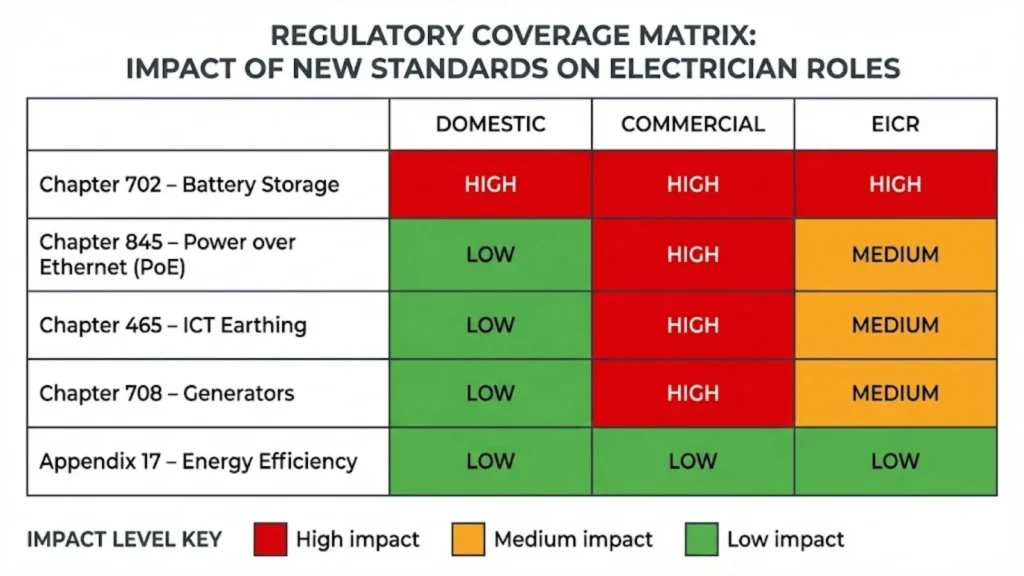
Here’s what you need to know right now: Amendment 4 introduces five major new chapters and sections covering battery storage systems, Power over Ethernet installations, functional earthing for ICT systems, low-voltage generators, and energy efficiency design frameworks. These changes affect domestic solar installers, commercial electricians working in smart buildings, EICR testers inspecting renewable installations, and anyone working on backup power systems.
The biggest practical impact is Chapter 702 on stationary secondary batteries. If you install solar-plus-storage systems, home battery units, or commercial energy storage, you now have dedicated BS 7671 regulations rather than relying on manufacturer instructions. This formalizes requirements for protection, ventilation, fire segregation, and testing that previously existed only in best practice guides.
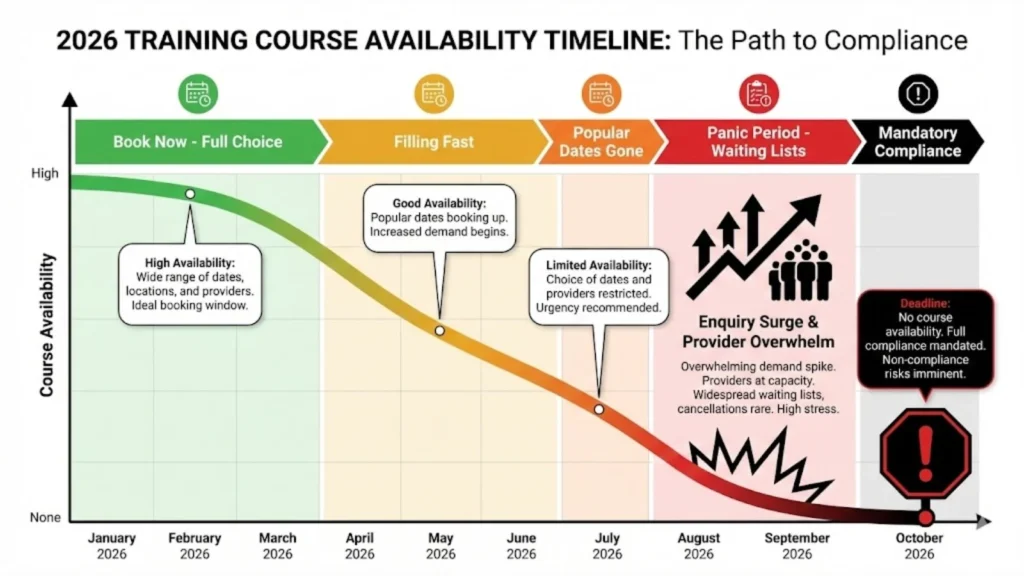
Your immediate action: Book an 18th Edition Amendment 4 update course now before the summer rush. Training providers will be overwhelmed by August-September as electricians realize the October deadline is approaching. Courses booked in January-March give you choice of dates and locations. Wait until August and you’ll struggle to find availability.
This article covers the exact timeline for compliance and when you can start using A4, which chapters affect domestic vs commercial vs EICR electricians, what Chapter 702 means for battery storage installations in practical terms, the myth-busting on energy efficiency (it’s NOT mandatory), how PoE and ICT functional earthing change commercial installations, what EICR testers need to check from October onwards, and why booking training now rather than waiting matters for your career and compliance.
Let’s start with what A4 actually is and kill the myths spreading online already.
What Amendment 4 Actually Is (And What It Isn't)
Within hours of this morning’s announcement, confusion spread online about what Amendment 4 represents. Here’s the reality based on official IET and BSI statements:
What A4 IS:
An amendment to the 18th Edition (BS 7671:2018)
A consolidated “Orange Book” incorporating Amendments 2, 3, and all previous corrigenda into one publication
Five new chapters and sections addressing battery storage, PoE, ICT earthing, generators, and energy efficiency
Published 15 April 2026, implementable immediately for new jobs
Mandatory for all new work from 15 October 2026 when previous versions withdraw
What A4 is NOT:
The 19th Edition (that’s not expected until at least 2028-2030)
Live today (you cannot comply with A4 until it publishes in April)
A bolt-on PDF like Amendment 3 (it’s a full consolidated reprint replacing previous versions)
Immediately invalidating existing installations (only new work from October must comply)
Making energy efficiency mandatory for domestic installations (Appendix 17 remains informative)
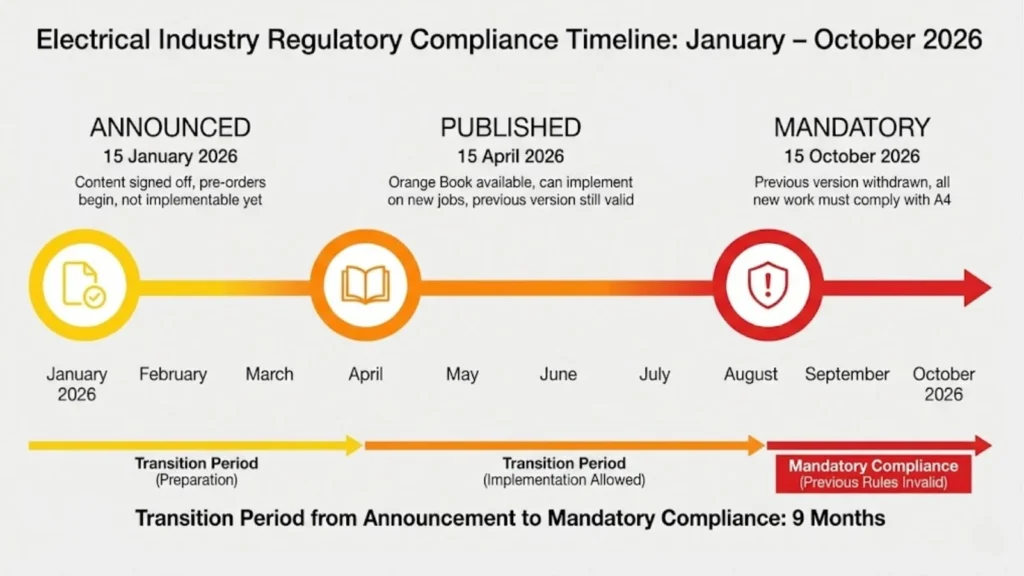
The timeline explained:
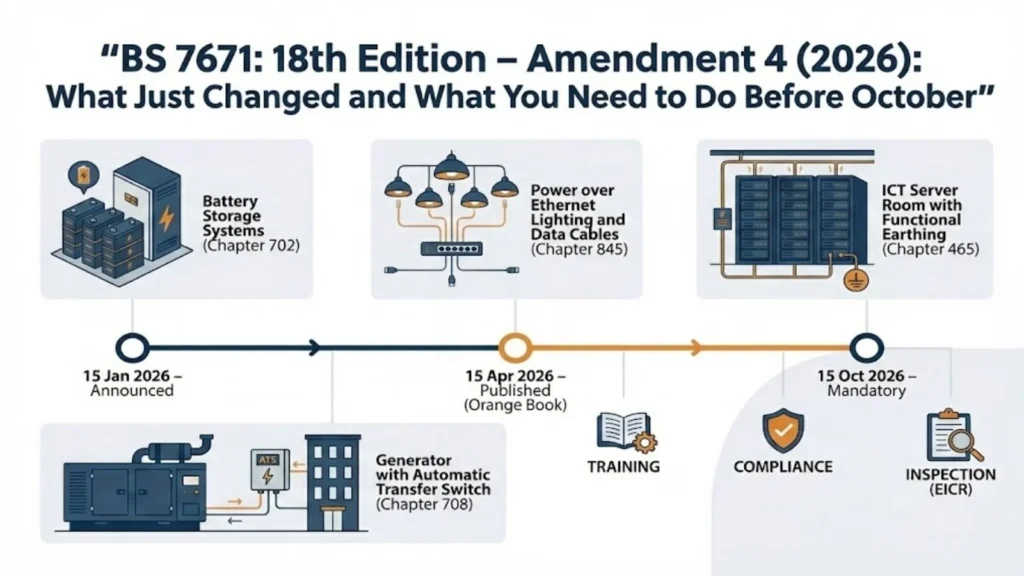
15 January 2026 (today): Content signed off, technical details announced, pre-orders begin. You cannot implement A4 yet because the full regulations aren’t published.
15 April 2026: Publication date. The Orange Book becomes available for purchase. You can start using A4 on new designs and installations immediately. The previous version (BS 7671:2018+A2:2022+A3:2024) remains valid in parallel.
15 October 2026: Withdrawal date for previous version. From this date, all new work and alterations must comply with A4. The six-month parallel period ends. Existing installations compliant with previous versions remain valid unless altered.
What this means practically: You have nine months from today to get trained, update your documentation, understand the new chapters, and prepare for mandatory compliance. Jobs starting before 15 October can still use the current regulations, but anything starting after that date must use A4.
Why the confusion about the 19th Edition? Major amendments historically preceded new editions (e.g., Amendment 3 to the 17th Edition before the 18th launched in 2018). Social media speculation assumed A4 would be the “19th Edition,” but the IET explicitly confirmed this remains the 18th Edition framework. The 19th Edition will be a complete rewrite, not an amendment.
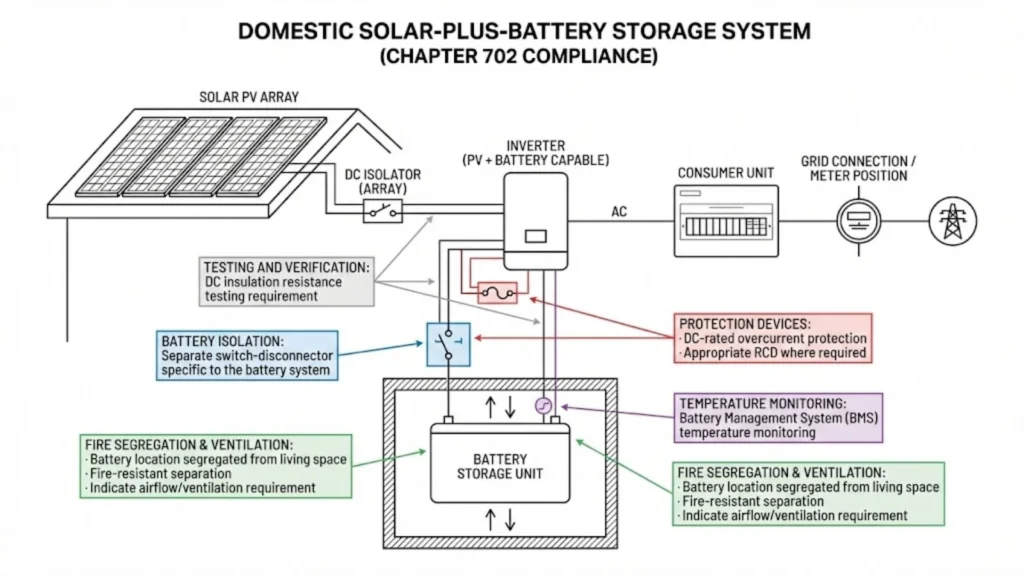
Chapter 702: Battery Storage Systems (The Biggest Change for Most Electricians)
Chapter 702 is titled “Stationary Secondary Batteries” and covers electrical energy storage systems (ESS) used in domestic, commercial, and industrial installations. This affects anyone installing solar-plus-storage, standalone home batteries, EV chargers with backup storage, or commercial battery systems.
What existed before A4: No dedicated BS 7671 chapter. Electricians relied on manufacturer installation guides, MCS standards for solar installations, and best practice recommendations from scheme providers. The lack of formal regulations created inconsistency in how battery systems were protected, ventilated, and tested.
What Chapter 702 provides: Specific requirements for selection and erection of battery installations including protection against electric shock, protection against thermal effects and fire, isolation and switching, and verification requirements for testing and inspection.
Practical implications for domestic installers:
Solar-plus-storage installations: When you install a solar PV system with battery storage (increasingly common as battery costs drop), Chapter 702 now regulates the battery component. Requirements include:
Proper isolation of the battery from both the solar array and the consumer unit
Adequate ventilation to prevent hydrogen gas buildup (lithium batteries produce minimal hydrogen but regulation applies to all chemistries)
Fire segregation between battery units and occupied spaces
Protection against overcharge and over-discharge using appropriate battery management systems
Temperature monitoring and thermal cutoff devices
Example scenario: Homeowner wants 10kWh lithium battery added to existing 4kW solar system. Under previous regulations, you’d follow manufacturer guidelines. Under A4, you must verify the installation meets Chapter 702 requirements for isolation (separate switch-disconnector for battery), protection (appropriate overcurrent and RCD protection considering DC fault currents), ventilation (even for lithium units, segregation from living spaces), and testing (specific verification procedures for battery connections and BMS functionality).
What you need to do differently: Read Chapter 702 thoroughly when the Orange Book publishes in April. Update your risk assessments and method statements for battery installations. Ensure your test equipment can verify DC isolation and insulation resistance for battery circuits. Factor additional installation time for meeting ventilation and segregation requirements that manufacturer instructions might not explicitly state.
Commercial and industrial applications: Larger battery systems for load shifting, backup power, or grid services fall under Chapter 702. Commercial installations require more sophisticated protection against fire risks given higher energy storage capacity. Expect requirements for:
Dedicated battery enclosures with fire-rated separation
Automatic fire suppression systems for installations above certain capacity thresholds
Integration with building management systems for temperature monitoring
Coordination of protective devices considering bidirectional power flow (batteries charging and discharging)
Example scenario: Commercial property installing 100kWh battery storage for peak shaving. Chapter 702 will specify protection requirements that exceed domestic installations, including proper fault current calculations for the larger DC system, appropriate sizing of isolation devices, and verification that the battery enclosure meets fire segregation standards.
EICR implications: From October 2026, periodic inspections of properties with battery storage must verify Chapter 702 compliance. This means checking:
Isolation devices are accessible and correctly rated
Protection devices coordinate properly with battery management systems
Ventilation provisions are adequate and unobstructed
Battery connections show no signs of overheating or degradation
Test certificates confirm proper installation according to A4 requirements
Action step: If you install battery storage systems, prioritize Chapter 702 in your A4 training. This isn’t a minor update, it’s the formalization of an entire technology category that’s growing 40% year-on-year in the domestic market and expanding rapidly in commercial applications.
Chapter 845: Power over Ethernet (Commercial and Smart Building Focus)
Chapter 845 addresses Power over Ethernet (PoE) installations, a technology increasingly common in commercial buildings, offices, schools, and smart homes where DC power and data travel over the same cabling infrastructure.
What PoE actually is: PoE delivers low-voltage DC power (typically 48V or less) over Ethernet data cables (Cat5e, Cat6, Cat6A) to devices like LED lighting, Wi-Fi access points, IP cameras, VoIP phones, and building sensors. This eliminates the need for separate power cables and allows centralized power management through network switches.
Why it needed regulation: Traditional electrical regulations focused on mains voltage AC distribution. PoE operates at ELV DC but can present risks when improperly installed, heat buildup in cable bundles with insufficient current-carrying capacity, connector failures creating arc faults, and mixing incompatible PoE standards causing equipment damage.
What Chapter 845 covers:
Selection of cables with adequate current-carrying capacity for PoE power levels
Cable derating factors when multiple PoE cables bundle together
Protection requirements for PoE distribution points
Earthing and bonding considerations for PoE systems
Verification procedures for PoE installations
Practical implications for commercial electricians:
Smart lighting installations: Commercial buildings increasingly use PoE for LED lighting where each luminaire receives power and control data over a single Cat6 cable. Chapter 845 regulates how these systems integrate with building electrical infrastructure.
Example scenario: Office refurbishment installing PoE lighting system with 200 LED panels across three floors. Each panel draws 30W via PoE. Under A4, you must verify:
Cable bundles containing multiple PoE feeds are derated appropriately (heat buildup affects current-carrying capacity)
PoE switches supplying power are properly protected and earthed
Total PoE load is accounted for in building electrical load calculations
Installer understands different PoE standards (802.3af, 802.3at, 802.3bt) and their power limits
What changes in practice: You can no longer treat PoE as purely an IT concern. Chapter 845 brings it under BS 7671 scope, meaning electricians installing PoE systems need to understand both electrical protection requirements and network infrastructure basics. This creates opportunities for electricians willing to cross-train in ICT systems.
Smart building integration: Modern commercial buildings integrate PoE for building management systems, access control, environmental sensors, and security cameras. All these systems now fall under Chapter 845.
Example scenario: New-build warehouse installing comprehensive smart building system with 50 PoE cameras, 100 PoE sensors, and PoE-powered access control at 20 entry points. Chapter 845 requires proper electrical design accounting for total PoE load, appropriate circuit protection, and integration with emergency systems where applicable.
Who this affects most: Commercial electricians, industrial maintenance specialists, and anyone working on smart building projects. Domestic electricians encounter PoE less frequently (mainly in smart home systems), so Chapter 845 has limited residential application.
Action step: If you work in commercial or industrial settings, ensure your A4 training covers Chapter 845 in detail. Consider cross-training in network infrastructure if PoE installations are common in your market. The convergence of electrical and data systems creates opportunities for electricians with both skill sets.
Chapter 465: Functional Earthing and Bonding for ICT Systems
Chapter 465 introduces specific requirements for functional earthing in information and communication technology (ICT) installations, separating it explicitly from protective earthing which serves safety functions.
The distinction that matters: Protective earthing prevents electric shock and provides fault current paths. Functional earthing prevents electromagnetic interference, reduces signal noise, and maintains equipment performance. Previous BS 7671 versions didn’t clearly separate these concepts, leading to confusion about bonding requirements in data centers and server rooms.
What Chapter 465 clarifies:
Functional earthing is for equipment performance and signal integrity, not safety
Functional bonding conductors must be separate from protective conductors
ICT equipment requires functional earthing networks (often called “technical earth” or “clean earth”)
Bonding ring conductors and earth reference grids in data-heavy environments
Practical implications for commercial electricians:
Server rooms and data centers: These environments require extremely low electrical noise for sensitive equipment. Chapter 465 formalizes requirements that previously existed only in industry best practice guides.
Example scenario: New data center installation with 50 server racks. Under A4, you must provide:
Separate functional earth network independent of the protective earth system
Bonding ring conductor connecting all server racks to maintain equal potential
Segregation of functional and protective earthing at the distribution board
Clear labeling distinguishing functional earth from protective earth
What changes in practice: You cannot simply bond ICT equipment to the nearest protective conductor and call it compliant. Functional earthing requires dedicated infrastructure often involving copper mesh earth grids under raised floors or bonding bars connecting equipment racks.
Office environments with heavy IT loads: Even smaller-scale installations with multiple network switches, telecoms equipment, and audio-visual systems benefit from proper functional earthing.
Example scenario: Office fit-out installing comms room with 10 network switches, VOIP system, and CCTV recording equipment. Chapter 465 requires functional earthing infrastructure to prevent signal interference and equipment malfunctions caused by ground loops or EMI.
Thomas Jevons, Head of Training at Elec Training with 20+ years of experience, explains the timeline:
"Amendment 4 was announced today, 15 January 2026, but it's not live yet and it's definitely not the 19th Edition. The Orange Book publishes on 15 April, that's when you can start using it on new jobs. But the critical date is 15 October when the current version gets withdrawn and A4 becomes mandatory for all new work. That gives you nine months to get trained up, update your documentation, and understand what's changed. Don't panic about immediate compliance, but don't leave it until September either."
Thomas Jevons, Head of Training
EICR implications: Inspecting installations with ICT systems now requires verifying functional earthing provisions meet Chapter 465. This includes:
Confirming functional earth conductors are correctly sized and segregated
Checking bonding ring connections at ICT equipment racks
Verifying clear labeling distinguishes functional from protective systems
Testing bonding resistance meets specified values for signal integrity
Who this affects most: Electricians specializing in commercial and industrial installations, particularly those working on data centers, telecoms facilities, broadcast studios, and IT-heavy office environments. Minimal domestic application.
Joshua Jarvis, Placement Manager at Elec Training, explains the commercial career advantage:
"Electricians working in commercial and industrial settings benefit most from understanding the full scope of A4 changes. Chapter 465 functional earthing for ICT, Chapter 845 PoE installations, Chapter 708 generator integration, these are all commercial-focused additions that domestic-only sparks won't encounter regularly. If you're looking to move into higher-value commercial work, having A4 competence across all the new chapters demonstrates professional capability beyond residential installations. Employers hiring for commercial contracts will prioritize electricians with up-to-date BS 7671 knowledge."
Joshua Jarvis, Placement Manager
Action step: If commercial work is part of your career plan, Chapter 465 is essential knowledge. The convergence of electrical and ICT systems creates opportunities for electricians who understand both protective and functional earthing requirements. Consider this part of building specialist knowledge that commands premium rates.
Chapter 708: Low-Voltage Generating Sets (Backup Power and Integration)
Chapter 708 covers low-voltage generating sets used for backup power, portable generators integrated into fixed installations, and small-scale generation systems that interact with the main electrical supply.
What existed before A4: Generator installations were covered under various sections of BS 7671 but lacked dedicated comprehensive guidance. Integration of generators with battery systems, solar arrays, and grid-tied systems created grey areas in regulation.
What Chapter 708 provides:
Requirements for generator selection and installation
Protection and switching for generator circuits
Integration of generators with other sources (solar, grid, batteries)
Automatic transfer switch requirements
Verification procedures for generator installations
Practical applications:
Commercial backup power: Businesses requiring uninterrupted power (healthcare facilities, data centers, critical infrastructure) use generator backup. Chapter 708 formalizes installation requirements.
Example scenario: Care home installing 50kVA diesel generator for emergency backup. Chapter 708 specifies:
Proper isolation between generator supply and grid supply
Automatic transfer switch meeting specific performance requirements
Protection coordination ensuring generator circuits don’t backfeed into the grid
Load management preventing generator overload during transfer
Verification testing confirming automatic transfer operates correctly
Portable generator integration: Construction sites and temporary installations using portable generators that feed into distribution boards now have specific regulation under Chapter 708.
Example scenario: Construction site using portable generator to supply temporary distribution board. Under A4, you must verify:
Generator output protection is appropriate for the installation
Earth fault protection operates correctly with generator supply
Switching prevents simultaneous connection of generator and grid supplies
Generator capacity matches connected load
Hybrid systems (solar + generator + battery): The growing complexity of renewable installations combining multiple sources requires clear regulation of how they integrate. Chapter 708 addresses generator interaction with these systems.
Example scenario: Remote commercial property with solar array, battery storage, and diesel generator for resilience. Chapter 708 regulates how the generator integrates with the battery and solar systems, including protection coordination when multiple sources operate simultaneously and automatic control systems managing which source supplies load at any given time.
Who this affects: Commercial electricians installing backup power systems, industrial maintenance specialists, construction site electricians using generator supplies, and renewable energy installers working on hybrid systems.
Action step: If you work on commercial projects or construction sites, understanding Chapter 708 is essential for legal compliance with generator installations. The integration requirements affect how you design and verify systems with multiple power sources.
Energy Efficiency Updates (Appendix 17): What's Mandatory and What Isn't
Appendix 17 receives updates related to energy efficiency in electrical installations, but there’s significant confusion about whether these create new mandatory requirements. Here’s the reality:
What changed: Appendix 17 now includes refined guidance on designing installations to minimize energy losses, references to energy-efficient equipment selection, and frameworks for calculating electrical system efficiency in commercial and industrial settings.
What did NOT change: The informative nature of Appendix 17. These are guidelines and recommendations, not mandatory pass/fail criteria for compliance.
The myth spreading online: “Amendment 4 makes energy efficiency mandatory for all installations.” This is false. EICR testers will not fail domestic installations for lacking energy-efficient design.
The reality: Appendix 17 energy efficiency provisions primarily target large commercial and industrial installations where electrical system design significantly impacts building energy consumption. They provide frameworks for designers to optimize efficiency but don’t create enforceable requirements for small-scale domestic work.
What this means practically:
Domestic installations: Energy efficiency considerations remain good practice (LED lighting, efficient consumer units, appropriate cable sizing to minimize losses) but are not mandatory A4 requirements. Your EICR won’t be coded for lacking energy optimization.
Commercial installations: Larger projects may need to demonstrate consideration of energy efficiency in design. This means documenting equipment selection rationale, cable sizing calculations including efficiency factors, and load management strategies in design submissions.
Example scenario: Office building electrical design incorporating lighting controls, efficient transformers, and optimized distribution to minimize energy losses. Appendix 17 provides guidance on calculating and documenting efficiency measures, but non-compliance doesn’t invalidate the installation if safety requirements are met.
Action step: Don’t panic about energy efficiency requirements. Read Appendix 17 when the Orange Book publishes to understand the guidance, but recognize these are design considerations rather than mandatory compliance points. Focus your training time on the chapters that create actual new requirements (702, 845, 465, 708).
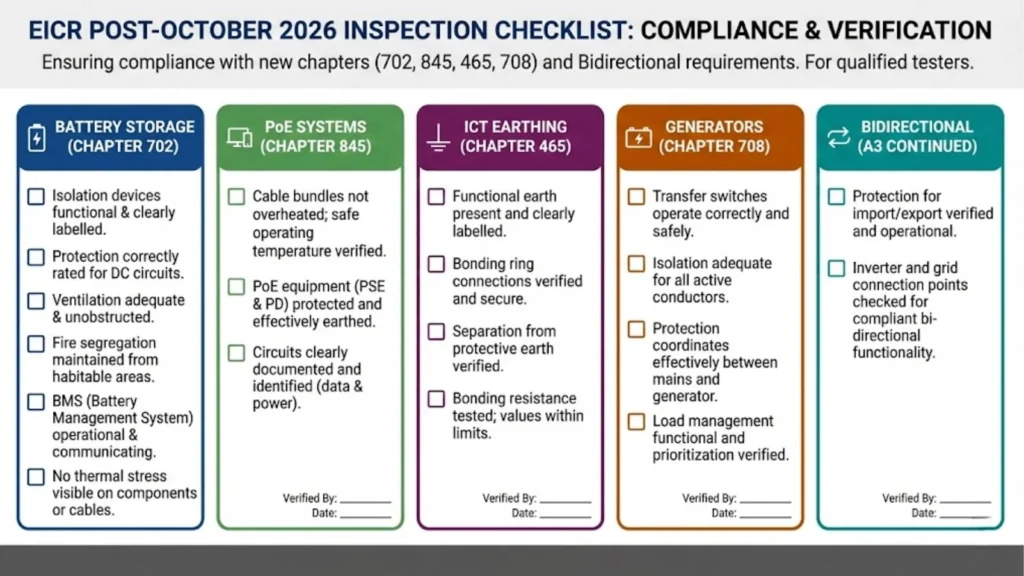
EICR Implications: What Testers Need to Check from October 2026
Periodic inspection and testing receives major updates from A4, not through changes to Chapter 65 (Inspection & Testing) itself, but through the need to verify compliance with all the new chapters introduced.
New inspection requirements from October 2026:
Battery storage systems (Chapter 702): When inspecting a property with solar-plus-storage or standalone battery systems, you must verify:
Proper isolation devices are installed and functional
Protection devices are correctly rated for DC circuits
Ventilation provisions meet requirements (not obstructed, adequate airflow)
Fire segregation between battery and occupied spaces is maintained
Battery management system operates correctly
No visual signs of thermal stress, corrosion, or damage to battery connections
Installation certificate confirms Chapter 702 compliance
Code implications: Battery installations not meeting Chapter 702 may receive C2 codes (potentially dangerous) if protection or isolation is inadequate. FI codes (further investigation) where battery management systems require specialist verification.
PoE installations (Chapter 845): In commercial inspections, verify:
PoE cable bundles are not overheated or incorrectly derated
PoE distribution equipment is properly protected and earthed
Clear distinction between PoE circuits and mains circuits in documentation
ICT functional earthing (Chapter 465): In data centers, server rooms, and IT-heavy commercial spaces, verify:
Functional earthing infrastructure is present and correctly labeled
Bonding ring conductors connect ICT equipment racks
Separation between functional and protective earthing systems
Bonding resistance meets specified values for signal integrity
Generator installations (Chapter 708): Verify:
Automatic transfer switches operate correctly
Isolation between generator and grid supplies is adequate
Protection coordination prevents backfeed
Generator load management systems function properly
Bidirectional devices (continued from A3): Verify systems with bidirectional power flow (solar export, battery discharge to grid, V2G EV chargers) have appropriate protection for both import and export.
Documentation updates: EICR software and forms need updating to reference A4 from October 2026. Ensure your inspection checklist includes verification points for all new chapters.
Training requirements: EICR testers must understand what constitutes compliant installation under A4 across all new technology categories. You cannot code installations correctly if you don’t know the requirements they should meet.
Action step: If you conduct EICRs, your A4 training must cover all new chapters even if you don’t install these systems yourself. You need to recognize compliant vs non-compliant installations when inspecting. Book training that specifically addresses EICR implications, not just installation requirements.
For electricians working toward professional qualifications, understanding how ECS Gold Card requirements integrate with keeping current BS 7671 knowledge demonstrates commitment to maintaining competence rather than letting qualifications stagnate with outdated regulations.
Why You Need to Book Training Now (Not in August)
The pattern from previous amendments is predictable and painful for electricians who wait too long to update their knowledge:
January-March: Announcement creates awareness. Some electricians book training immediately. Most assume they have plenty of time and delay.
April-June: Orange Book publishes. Early adopters read the new chapters and start implementing on new jobs. Training providers run regular courses with availability.
July: Electricians realize October deadline is approaching. Training enquiries increase. Popular dates and locations start filling.
August-September: Panic. Everyone realizes simultaneously that mandatory compliance is weeks away. Training providers are overwhelmed. Courses fully booked. Waiting lists develop. Electricians struggle to find availability before the deadline.
October: Compliance becomes mandatory. Electricians without current training face issues at scheme audits, cannot legally work on new installations, and risk non-compliance penalties.
How to avoid this pattern:
Book your 18th Edition Amendment 4 update course in January, February, or March. You get choice of dates, locations, and training providers. You have time to read the Orange Book after it publishes in April and consolidate knowledge before the October deadline.
Why training matters beyond compliance: A4 introduces genuine new knowledge across battery storage, PoE, ICT earthing, and generator integration. This isn’t just regulatory box-ticking, it’s professional development that expands the types of installations you can confidently work on. Electricians with A4 competence can tender for renewable energy work, smart building projects, and backup power installations that electricians stuck on 2018 regulations cannot.
Scheme provider expectations: NICEIC, NAPIT, ECA, and other competent person schemes will expect evidence of A4 training at audits after October 2026. The Electrotechnical Assessment Specification (EAS) requires electricians to maintain current BS 7671 knowledge. Failure to demonstrate A4 training could result in scope restrictions or suspension from schemes.
Career advantages: Electricians who update knowledge early differentiate themselves from competitors. Clients commissioning battery storage, solar installations, or commercial projects want electricians who understand current regulations. Being ahead of the curve wins work.
For EV charging specialists: Chapter 702 directly impacts installations combining EV chargers with battery storage systems. Vehicle-to-home (V2H) and vehicle-to-grid (V2G) technologies rely on battery storage integration. Understanding A4 requirements for both the EV charging component and the battery storage component positions you for emerging technologies in the EV sector.
Action step: Don’t read this article, acknowledge you should book training, then do nothing for three months. Book your course today. Training providers accepting bookings now will have far better availability than providers in August when everyone panics simultaneously.
Nine Months to Update Your Knowledge
Amendment 4 to BS 7671:2018 was announced this morning, 15 January 2026. It publishes 15 April 2026. It becomes mandatory 15 October 2026. That timeline gives you nine months to get trained, update your documentation, and understand what changed.
The key changes affecting working electricians:
Chapter 702: Stationary secondary batteries now have dedicated regulations covering protection, ventilation, fire segregation, and testing. This affects anyone installing solar-plus-storage, home battery systems, or commercial energy storage. You can no longer rely solely on manufacturer instructions.
Chapter 845: Power over Ethernet installations require compliance with cable derating, protection, and earthing requirements. This mainly affects commercial electricians working on smart buildings and PoE lighting systems.
Chapter 465: Functional earthing for ICT systems separates performance earthing from protective earthing. Commercial specialists working on data centers, server rooms, and IT-heavy environments need to understand bonding ring requirements and earth reference grids.
Chapter 708: Low-voltage generating sets have specific requirements for integration with grid supplies, battery systems, and solar arrays. This affects commercial backup power installations and construction site generator supplies.
Energy efficiency (Appendix 17): Updated guidance remains informative, not mandatory. Don’t panic about energy efficiency compliance for domestic installations.
What you must do before October 2026:
Book training now: Don’t wait for the summer rush. Courses will fill. You need current knowledge for legal compliance and career advantage.
Read the Orange Book in April: When it publishes on 15 April, read the new chapters relevant to your work. Battery storage specialists prioritize Chapter 702. Commercial electricians focus on Chapters 845, 465, and 708.
Update your documentation: Certificates, risk assessments, method statements, and EICR checklists need updating to reference A4 and verify compliance with new chapters.
Review your scope: Can you competently work on battery storage, PoE systems, or generator installations? If not, can you gain that competence through training and mentoring before October? Expanding your scope creates opportunities.
Talk to your scheme provider: Confirm what they expect regarding A4 training evidence at audits. Ensure your professional development records show you’re maintaining current knowledge.
The career opportunity: A4 formalizes regulations for technologies that are growing rapidly, battery storage, smart buildings, backup power, renewable integration. Electricians with A4 competence can access premium work in expanding markets. Those without current knowledge face scope restrictions and lost opportunities.
The compliance reality: From 15 October 2026, all new electrical work must comply with A4. Ignorance isn’t a defense. Scheme audits will verify your knowledge is current. Clients will expect installations meet the latest standards.
Nine months sounds like plenty of time. It isn’t. Book your training in January-March, read the regulations in April-June, and implement on jobs in July-September. That schedule puts you ahead of competitors scrambling in August and positions you for professional success in a changing industry.
The announcement happened this morning. The countdown started today. Don’t be the electrician panicking in September because training courses are fully booked and you don’t understand what’s changed. Be the professional who updated knowledge early, understood the implications, and moved forward confidently with current competence.
References
IET/BSI Official Sources
- IET Press Release: Amendment 4 Announcement (15 January 2026) – https://www.theiet.org/media/press-releases/press-releases-2026/press-releases-2026-january-march/15-january-2026-iet-and-bsi-publish-amendment-4-2026-to-bs-76712018-iet-wiring-regulations
- IET Electrical: BS 7671 18th Edition Updates – https://electrical.theiet.org/bs-7671-18th-edition-wiring-regulations/updates-to-18th-edition
- IET Wiring Matters: The Impact of Amendment 4 (September 2024) – https://electrical.theiet.org/wiring-matters/years/2024/102-september-2024/the-impact-of-amendment-42026-on-the-18th-edition-of-the-iet-wiring-regulations
- IET Electrical: About BS 7671 – https://electrical.theiet.org/bs-7671-18th-edition-wiring-regulations/about-bs-7671
Trade Bodies and Scheme Operators
- ECA: Amendment 4 Announcement – https://www.eca.co.uk/news/2026/jan/iet-bsi-publish-amendment-4-2026-to-bs-7671-2018-iet-wiring-regulations
- NICEIC: Amendment Four Information – https://niceic.com/amendment-four
- Electrical Safety First: Amendment 4 Press Release – https://www.electricalsafetyfirst.org.uk/media-centre/press-releases/2026/01/iet-bsi-publish-amendment-4-2026-to-bs-7671-2018-iet-wiring-regulations
Note on Accuracy and Updates
Last reviewed: 16 January 2026 (article published on A4 announcement day). This page reflects official IET and BSI announcements regarding BS 7671:2018+A4:2026 timeline, content, and practical implications. Information is accurate as of the announcement date. When the Orange Book publishes on 15 April 2026, we will review this content against the full published regulations and update any details that require clarification based on the complete text. All dates, chapter numbers, and requirements stated here are based on official primary sources listed in the references section.
FAQs
What is BS 7671 Amendment 4 (2026), and why is it not the 19th Edition?
BS 7671 Amendment 4 (2026) is the latest update to the 18th Edition of the IET Wiring Regulations (BS 7671:2018). It introduces new requirements to address evolving technologies such as stationary secondary batteries, Power over Ethernet (PoE), functional earthing for ICT systems, low-voltage generating sets, and updates to medical locations and energy efficiency guidance. It was announced on 15 January 2026 following a public consultation in 2024.
It is not the 19th Edition because it builds on the existing 18th Edition framework rather than replacing it entirely. Full editions usually occur every 8–10 years, whereas amendments introduce targeted updates to harmonised standards the UK must adopt.
What this means in practice:
Electricians can continue using familiar 18th Edition processes but must update training and practices for new technologies by October 2026.
What are the key dates for Amendment 4, and when does it become mandatory for new work?
Amendment 4 was officially announced on 15 January 2026. It will be published on 15 April 2026, allowing voluntary use from that date. The existing version, BS 7671:2018+A3:2024, remains valid until the transition period ends.
A six-month parallel period runs from 15 April to 15 October 2026. From 15 October 2026, Amendment 4 becomes mandatory for all new electrical work.
Key dates:
- Announcement: 15 January 2026
- Publication: 15 April 2026
- Mandatory use: 15 October 2026
What this means in practice:
Plan training around April 2026 and ensure contracts after October specify Amendment 4.
Can electricians start using Amendment 4 from April 2026, and what does the parallel period mean in practice?
Yes, electricians can start using Amendment 4 from 15 April 2026. During the parallel period, either Amendment 3 (2024) or Amendment 4 may be used, provided the installation complies fully with the chosen version.
This allows existing projects to complete under older rules while new designs adopt Amendment 4. After 15 October 2026, Amendment 3 is withdrawn.
Good practice during the overlap:
- Use Amendment 4 early for batteries or PoE
- Clearly document which version applies
What this means in practice:
Switch fully by October 2026 to avoid certification or compliance disputes.
What does Chapter 702 cover, and how does it change requirements for stationary battery storage systems?
Chapter 702 introduces dedicated requirements for stationary secondary battery systems used for energy storage. It addresses risks such as thermal runaway, overcurrent, and electric shock. Batteries are now treated as generating sets rather than loads.
Requirements include isolation, earthing, ventilation, identification, and location restrictions. Installation in high-risk areas such as escape routes or lofts is prohibited. Industry speculation suggests possible renumbering to Chapter 57, but this is not confirmed.
What this means in practice:
Battery installations after October 2026 must include proper isolation and fire mitigation to remain compliant.
If you install solar plus storage, what are the biggest compliance risks under Chapter 702 from October 2026?
Solar-plus-storage systems fall under both Section 712 (PV) and Chapter 702 (batteries). Key risks include incorrect isolation of bidirectional energy flow, inadequate ventilation, unsuitable locations such as lofts, and poor earthing arrangements.
Batteries must be installed on the supply side of protective devices and treated as generators. Fire-resistant enclosures and emergency shutdown provisions are commonly overlooked.
What this means in practice:
Verify isolation, earthing, and fire protection carefully. Errors could invalidate EICRs or insurance cover.
What is Chapter 845 (Power over Ethernet), and which installations will it affect most?
Chapter 845 introduces requirements for Power over Ethernet systems distributing extra-low-voltage DC power via data cabling. It ensures cabling can safely carry power without overheating or compromising data performance.
It mainly affects commercial environments such as offices, schools, retail spaces, and smart buildings using IP cameras, wireless access points, VoIP phones, and smart lighting. Industry speculation suggests possible renumbering to Section 716, but this is not confirmed.
What this means in practice:
Existing cabling must be assessed for suitability. New installations must use compliant materials after October 2026.
What is functional earthing in Chapter 465, and how does it differ from protective earthing and bonding?
Functional earthing in Chapter 465 supports correct operation of ICT systems by reducing interference and maintaining signal integrity. It differs from protective earthing, which exists solely for electrical safety.
Functional earthing must not compromise protective measures. Combined conductors are permitted if they meet both functional and protective requirements. A main functional earthing terminal may be required.
What this means in practice:
In smart buildings, functional earthing may need to be separate, but safety earthing always takes priority.
What does Chapter 708 change for low-voltage generating sets and changeover arrangements?
Chapter 708 updates requirements for low-voltage generating sets, including standby and parallel-running systems. Generators must be installed on the supply side of protective devices, with improved rules for changeover arrangements.
The focus is on preventing back-feeding, overloads, and unsafe parallel operation. Enhanced requirements apply to isolation, earthing, labelling, and testing.
What this means in practice:
Generator installations must include compliant changeover switches to avoid safety risks after October 2026.
Does Amendment 4 make energy efficiency mandatory, and what does Appendix 17 actually require?
Energy efficiency remains guidance rather than a mandatory requirement. Appendix 17 provides updated recommendations on load profiling, efficient equipment selection, sub-metering, and renewable integration.
These measures are advisory unless required by contracts or building regulations. There are no penalties for non-adoption.
What this means in practice:
Appendix 17 can support client advice and energy ratings, but ignoring it does not breach BS 7671.
What do EICR testers need to check differently from October 2026?
From October 2026, EICR testers must assess compliance with new chapters covering batteries, PoE, ICT functional earthing, and generators.
Checks include battery isolation, ventilation, and fire risk, PoE cable loading and separation, functional earthing identification, and generator changeover safety.
Key focus areas:
- Batteries: thermal and isolation risks
- PoE: cable rating and overload
- ICT: correct functional bonding
- Generators: safe changeover and earthing
What this means in practice:
EICR checklists must be updated. Missing these areas could create liability if faults are later discovered.
