

What UK Electricians Really Charged in 2018 (And How COVID, Green Energy, and Digital Tools Changed Everything)

- Technical review: Thomas Jevons (Head of Training, 20+ years)
- Employability review: Joshua Jarvis (Placement Manager)
- Editorial review: Jessica Gilbert (Marketing Editorial Team)
- Last reviewed:
- Changes: Complete rewrite covering 2018-2025 day rate evolution, COVID impact analysis, green energy premium work emergence, and digital tool efficiency gains
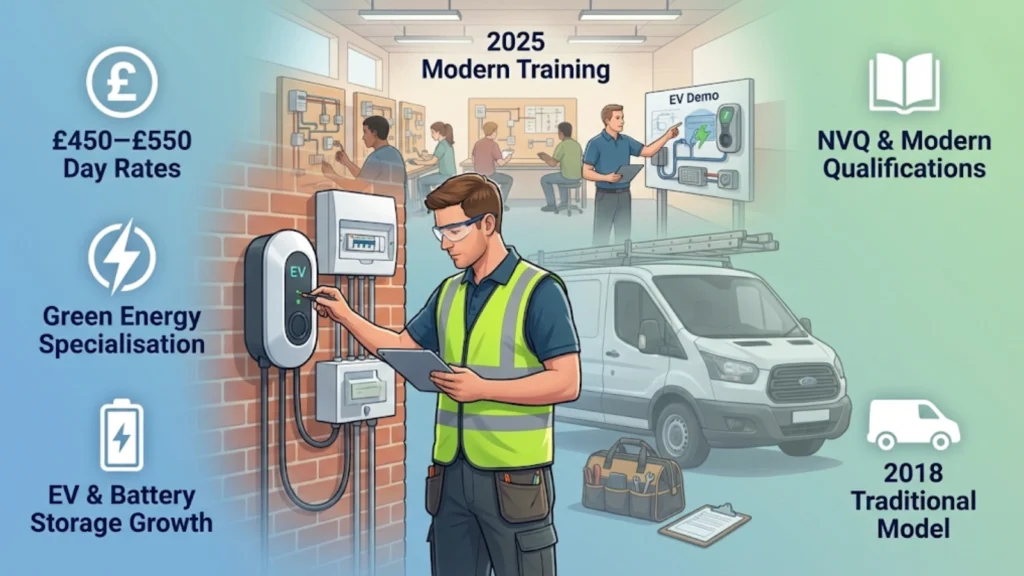
In 2018, a typical UK domestic electrician charged £180-£250 per day for standard installations, testing, and repair work. By early 2025, that same work commands £300-£450 per day, representing a 50-80% increase over seven years.
This isn’t a simple inflation story. Between 2018 and 2025, the UK electrical trade experienced three major disruptions: COVID-19’s impact on work patterns and demand, the rapid emergence of green energy installation as premium-rate work, and digital tools improving business efficiency while adding new cost burdens.
The headline rate increase from £220 average in 2018 to £375 average in 2025 represents approximately 71% growth. UK Consumer Price Index inflation over the same period totalled approximately 28%. The gap between general inflation and trade rate increases stems from sector-specific cost pressures that residential consumers don’t directly experience.
Understanding what changed between 2018 and 2025 matters for three audiences: homeowners wondering why quotes doubled, people considering retraining after redundancy and evaluating earning potential, and working electricians contextualizing their own rate evolution.
This article breaks down the year-by-year progression, examines how COVID reshaped demand patterns, evaluates green energy’s impact on premium work opportunities, and assesses whether digital tools genuinely improved take-home earnings or just added another overhead category.
The 2018 Baseline: What Sparkies Actually Charged
In 2018, UK domestic electrical work pricing reflected a period of relative stability following the 2008 financial crisis recovery but preceding Brexit uncertainty and COVID disruption.
Typical sole trader day rates in 2018:
- Standard domestic work: £180-£250
- London and South East: £220-£300 (20-25% premium)
- Rural areas: £160-£220 (lower due to reduced competition and travel distances)
- Small firms (1-3 employees): £230-£280
These rates covered straightforward installations (socket circuits, lighting, consumer unit changes), testing and inspection (EICRs), and minor fault-finding. Specialist work like fire alarm systems or three-phase installations commanded 10-20% premiums.
What £220 per day meant in practice:
The 2018 median day rate of approximately £220 didn’t translate to £220 take-home. Sole traders typically achieved 180-200 billable days annually, creating gross turnover of £39,600-£44,000. After overheads (discussed in detail later), tax, and National Insurance, net take-home ranged from £24,000-£32,000 for sole traders.
Employed electricians in 2018 earned £28,000-£34,000 gross according to ONS data, with better job security and benefits (holiday pay, sick pay, employer pension contributions) but lower peak earning potential compared to successful self-employed sparkies.
Market context in 2018:
Fuel costs averaged £1.20-£1.25 per litre. A typical Transit van or smaller commercial vehicle cost £8,000-£15,000 for a decent used example with 60,000-80,000 miles. Public liability and tools insurance ran approximately £800-£1,200 annually for sole traders with clean records.
Compliance costs remained manageable. Part P registration fees sat at approximately £400-£600 annually depending on scheme provider. The 18th Edition of BS 7671 had just been published (July 2018) but Amendment 2 wouldn’t arrive until 2022, meaning testing and inspection requirements were less burdensome than they’d become.
Material costs were stable. A standard 17th Edition consumer unit cost £60-£100 for decent quality. Twin and earth cable prices reflected stable copper markets. A typical kitchen rewire requiring 50 metres of 2.5mm² T&E, 30 metres of 1.5mm² T&E, consumer unit, and accessories cost approximately £200-£300 in materials.
Competition was intense. The pre-Brexit period saw steady EU worker availability, keeping labour supply high. Trade forums from 2018 show electricians regularly undercutting each other by £20-£50 per day to secure work, particularly in areas with multiple approved contractors chasing the same domestic renovation market.
How electricians actually worked in 2018:
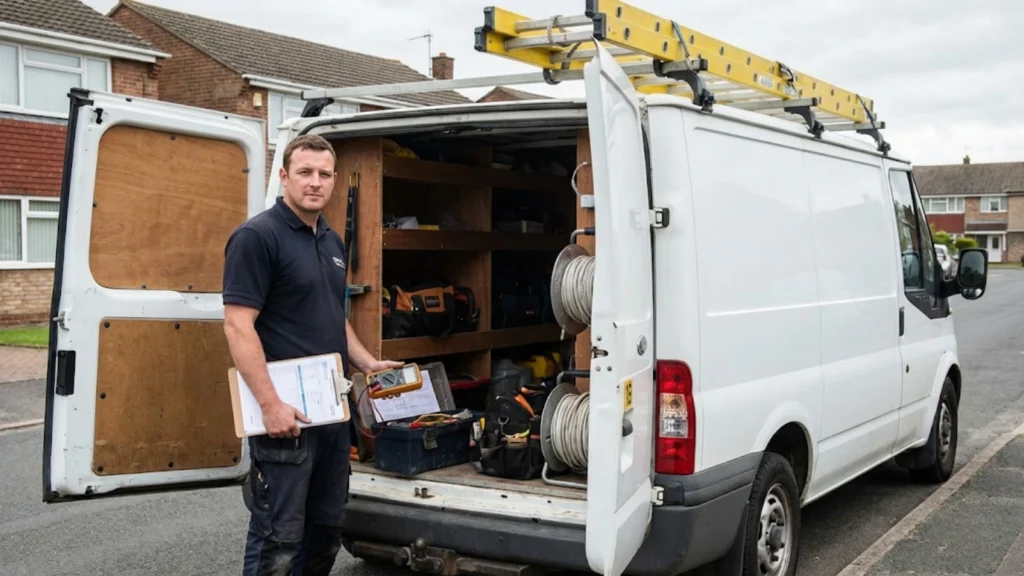
Most quotes were provided via phone estimates or brief site visits. Digital quoting systems existed but weren’t widespread among sole traders. Many electricians still used paper-based certification with manual calculations for testing results, though electronic testers were standard.
Marketing primarily relied on word-of-mouth recommendations, Checkatrade/Rated People profiles, and local advertising. Social media marketing wasn’t yet dominant. Website presence was optional rather than expected.
The typical working week involved 3-4 billable days on domestic jobs, with remaining time spent on quotes, materials collection, admin, and travel between jobs. Non-billable time consumed 30-40% of working hours, limiting annual billable days to 180-200 even for busy sole traders.
Year-by-Year Evolution: 2019-2025
2019: Pre-COVID Stability with Brexit Uncertainty
Average day rates: £190-£260
The 2019 market showed modest increases of 3-5% over 2018 levels, primarily reflecting general inflation and slight fuel cost increases. Brexit uncertainty hadn’t yet significantly impacted labour supply, though some EU electricians began returning home ahead of the formal exit.
Materials remained stable. Overhead costs increased marginally. The market remained competitive with similar dynamics to 2018.
Key development: Growing awareness of electric vehicle charging installation as potential new work, though residential EV adoption remained low (approximately 1.6% of new car sales). Few electricians had invested in EV charging training or equipment.
2020-2021: COVID Disruption and Demand Transformation
2020 day rates: £180-£280 (initial dip, then recovery) 2021 day rates: £250-£320
COVID-19 created the most significant market disruption since 2008. Initial lockdowns in March-June 2020 halted most domestic electrical work, with rates temporarily dropping or remaining static as electricians competed for limited available work.
However, by Q3 2020, domestic demand exploded. Households stuck at home during lockdowns wanted home office electrical installations, garden office power supplies, upgraded WiFi and network wiring, kitchen and bathroom renovations, and outdoor lighting for gardens being used as primary recreation spaces.
This demand surge continued through 2021 and into 2022. Simultaneously, electrician availability decreased due to COVID illness, self-isolation requirements, and Brexit-related EU worker departures. By late 2020, electricians could be selective about work, pushing rates up 15-25% compared to pre-COVID levels.
Supply chain disruptions began affecting materials availability. Lead times for consumer units, specific cable sizes, and specialist components extended from days to weeks. Some electricians added supply risk premiums to quotes.
COVID also accelerated digital adoption. Video quoting via WhatsApp became standard. Digital certification systems gained traction as paper-based processes became impractical during social distancing. Cloud-based job management software adoption increased significantly.
2022: The Inflation Shock
Day rates: £280-£400
2022 saw the most dramatic single-year rate increases since the 1970s. Multiple factors converged simultaneously:
Energy crisis impact: Russia’s invasion of Ukraine in February 2022 triggered energy market chaos. UK fuel prices peaked at £1.80-£2.00 per litre in June-July 2022 before settling around £1.50-£1.65. Electricians driving 20,000-30,000 miles annually saw fuel costs increase from approximately £2,500-£3,000 in 2018-2019 to £4,500-£6,000 in 2022.
Materials inflation: Copper prices increased approximately 35% between 2020 and 2022 peak. Twin and earth cable costs rose proportionally. Consumer units increased 40-60% as manufacturers passed through component shortages and energy costs. A kitchen rewire materials package costing £250 in 2018 reached £400-£450 by late 2022.
Labour shortage intensification: Brexit-related EU worker departures combined with COVID-disrupted apprenticeship programmes created severe skilled electrician shortages. Apprenticeship starts dropped 15-20% in 2020-2021, creating a gap in newly qualified electricians entering the market in 2022-2024.
BS 7671 Amendment 2: Published in March 2022, Amendment 2 introduced new requirements including mandatory AFDD (Arc Fault Detection Device) consideration and updated testing procedures. Consumer units requiring AFDDs cost £200-£400 versus £80-£120 for standard units, adding significant material costs that electricians had to pass through to customers.
Insurance premium increases: Trade insurance premiums increased 20-30% in 2022 as insurers responded to increased claims and general market volatility.
The combination pushed many electricians to increase rates by £50-£80 per day between January and December 2022. Those who didn’t raise rates found margins eroded to unsustainable levels.
2023-2024: The New Normal Stabilizes
2023 day rates: £300-£420 2024 day rates: £300-£450
Rates stabilized at new higher levels but continued gradual increases reflecting ongoing cost pressures. Fuel prices eased slightly to £1.40-£1.50 per litre. Material costs remained elevated but stopped accelerating.
The critical development: labour shortages persisted. The 2020-2021 apprenticeship drop created a sustained gap in newly qualified electricians entering the market. Experienced electricians found themselves in high demand, sustaining premium rates.
Green energy installation work began representing significant income for electricians who invested in training. EV charging installation, solar panel systems, and battery storage became mainstream residential work commanding premium rates (discussed in detail in later section).
Digital tools matured. AI-powered quoting software, automated scheduling systems, and customer relationship management platforms became standard for successful sole traders. However, these tools added £500-£1,500 annually to overhead costs.
2025: Current Landscape
Day rates: £300-£450+
By early 2025, the market has established new pricing norms. Standard domestic day rates sit at £300-£380 for most of England and Wales, £400-£450 in London and South East, and £280-£350 in rural areas.
Specialist work commands significant premiums:
- EV charging installation: £450-£550 per day
- Solar and battery storage: £400-£500 per day
- Emergency fault-finding: £350-£500 per day plus call-out fees
- Testing and inspection (EICR): £300-£400 per day
The 2025 electrician operates in a fundamentally different market than 2018. Labour shortages persist, demand remains strong, and green energy work provides premium income streams that didn’t exist seven years ago.
"COVID created a domestic work boom that sustained through 2021-2023. People stuck at home wanted office setups, garden power, home gyms. That demand spike, combined with fewer available electricians due to Brexit and COVID disruption, pushed rates up faster than any other period since the 1970s trades boom."
Joshua Jarvis, Placement Manager
COVID's Lasting Impact on Electrical Work and Earnings
COVID-19 created three distinct phases of impact on electrical trade work and earnings that persisted well beyond the pandemic’s acute phase.
Phase 1: Initial disruption (March-August 2020)
The first lockdown halted most domestic electrical work. Many homeowners were reluctant to allow tradespeople into occupied homes. Non-urgent work was postponed. Emergency repairs and essential maintenance continued, but discretionary installations stopped.
Electricians working commercial or industrial sectors faced complete site closures. Those dependent on new-build residential work saw projects pause indefinitely.
Day rates either remained static or decreased slightly as electricians competed for limited available work. Many sole traders applied for government support schemes (SEISS – Self-Employment Income Support Scheme) providing 80% of average profits for March-May 2020.
Phase 2: The domestic boom (September 2020-December 2022)
As initial lockdowns eased and people adapted to pandemic conditions, domestic demand exploded beyond pre-COVID levels. Multiple factors converged:
Working from home became standard rather than exceptional. Households needed proper home office electrical installations including dedicated circuits for equipment, upgraded lighting for video calls, and network infrastructure improvements.
Gardens transformed into primary living spaces. Demand for garden office power supplies, outdoor socket installations, lighting for extended outdoor use, and hot tub/pool electrical work surged.
Home improvements accelerated as people spent more time in their houses and redirected holiday spending toward renovations. Kitchen and bathroom refits, home gym installations, and garage conversions all required electrical work.
This demand surge occurred simultaneously with reduced electrician availability due to COVID illnesses, self-isolation requirements, Brexit-related worker shortages, and older electricians taking early retirement to avoid COVID exposure risks.
The supply-demand imbalance allowed electricians to be selective about work, increase rates significantly, and often book 4-6 weeks ahead versus the typical 1-2 week lead times of 2018-2019.
Phase 3: Persistent structural changes (2023-present)
Even as COVID-19 became endemic and pandemic restrictions ended, several structural changes persisted:
Remote work normalization: Many people continue working from home 2-3 days per week, sustaining demand for home office electrical infrastructure beyond initial pandemic installations.
Apprenticeship gap: The 15-20% drop in apprenticeship starts during 2020-2021 created a persistent shortage of newly qualified electricians entering the market in 2023-2025. This gap won’t fully close until 2026-2028.
Changed customer expectations: Video quoting, digital payments, and electronic certification became standard during COVID and remain expected practice. Electricians had to invest in digital tools or lose work to competitors who embraced these changes.
Risk premiums: Insurance costs increased and didn’t return to pre-COVID levels. Public liability policies now routinely include pandemic-related exclusions and higher base premiums reflecting increased insurer risk assessment.
The net effect: COVID transformed what appeared to be temporary disruption into permanent market restructuring. For electricians who adapted successfully, the 2020-2025 period offered exceptional earning growth. For those who struggled with digital adoption or lost momentum during lockdowns, recovery proved more challenging.
Green Energy: The Premium Work That Didn't Exist in 2018
In 2018, green energy installation represented negligible income for typical domestic electricians. EV charging, solar panels, and battery storage existed but comprised less than 2% of domestic electrical work.
By 2025, green energy installation represents 15-25% of work volume for electricians who invested in training and equipment, commanding premium rates 25-40% higher than standard domestic work.
Electric vehicle charging installation
UK EV adoption accelerated dramatically between 2018 and 2025:
- 2018: 1.6% of new car sales were EVs
- 2021: 11.6% of new car sales were EVs
- 2024: 16.5% of new car sales were EVs
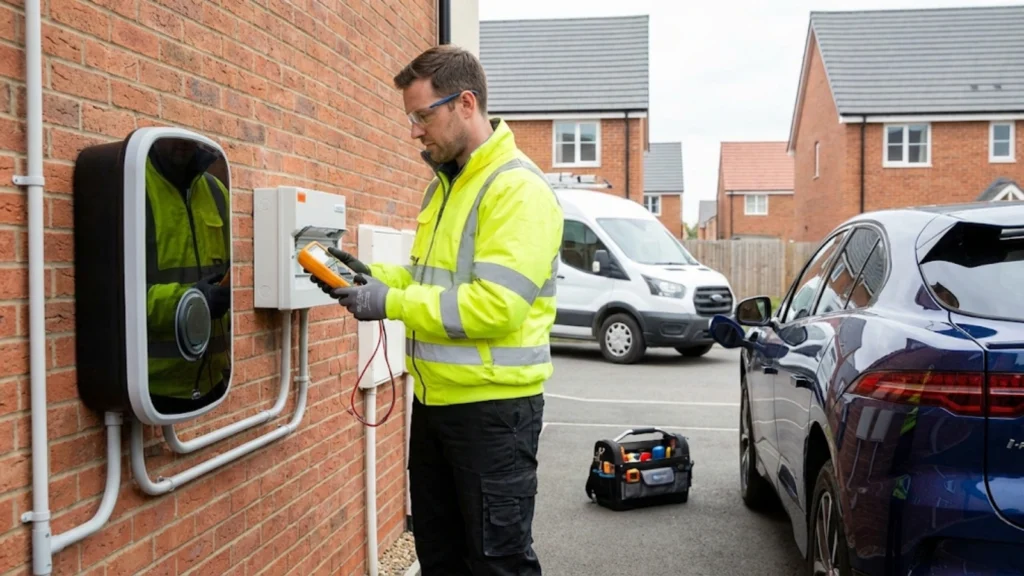
Each EV requires home charging infrastructure. A typical home EV charger installation involves:
- Electrical capacity assessment and potential consumer unit upgrade
- Dedicated 32A or 40A circuit installation
- Cable run from distribution board to charging point location (often external wall)
- Charge point mounting and commissioning
- Testing and certification specific to EV supply equipment
Standard installation takes 4-6 hours and commands £450-£750 total fees (£450-£550 day rate plus materials markup). Compare this to a similar-complexity job like a shower circuit installation charging £320-£400 day rate.
The premium reflects:
- Specialist training requirements (City & Guilds 2919 or equivalent)
- Higher insurance costs for EV work
- More expensive testing equipment
- Grant scheme administration (government EV charger grants require approved installer status)
- Liability concerns around high-power installations in outdoor locations
Electricians who qualified in EV charging installation during 2020-2022 positioned themselves for sustained premium work. By 2025, home EV charging represents routine work commanding excellent rates without requiring unusual skills beyond the specialist course.
Solar panel and battery storage systems
Solar PV installation involves electrical connections but the physical panel mounting typically falls to specialist solar installers. However, battery storage systems connected to existing solar installations or installed independently represent significant electrical work.
A typical battery storage installation involves:
- Three-phase or high-current single-phase connections
- Integration with existing consumer units or dedicated battery distribution boards
- Inverter installation and programming
- Complex testing procedures
- G99 grid connection applications (for larger systems)
Installation times range from 6-10 hours for straightforward systems to multiple days for complex three-phase installations with multiple battery units.
Day rates for battery storage work range from £400-£500, with total job values reaching £800-£1,500 depending on system complexity.
Solar and battery work requires:
- Understanding of DC systems (solar panels)
- AC-DC integration knowledge (inverters)
- Grid connection regulations and procedures
- Specialist testing equipment for DC systems
- Higher insurance coverage
Heat pump electrical work
Heat pumps represent another growing category, though less dominant than EV and solar. Air source and ground source heat pumps require:
- High-current dedicated circuits (often 32A or higher)
- Outdoor electrical connections
- Integration with home heating systems
- Compliance with MCS (Microgeneration Certification Scheme) requirements for grant eligibility
Heat pump electrical work commands similar premiums to EV charging (£400-£500 per day) due to specialist requirements and MCS certification costs.
Green energy’s impact on overall earnings
For electricians who invested in green energy training and equipment during 2020-2023, these premium work categories transformed income potential. A typical breakdown for a green-qualified electrician in 2025:
- 50-60% standard domestic work: £320-£380 per day
- 20-30% EV/solar/battery work: £450-£550 per day
- 10-20% testing and inspection: £300-£350 per day
- 5-10% emergency/specialist work: £400-£500 per day
Compare this to a 2018 electrician with no specialist qualifications:
- 70-80% standard domestic work: £200-£240 per day
- 10-20% testing and inspection: £180-£220 per day
- 5-10% emergency work: £250-£300 per day
The weighted average day rate increased from approximately £210-£230 in 2018 to £360-£400 in 2025 for electricians with green qualifications. Those without green qualifications average £320-£360, still substantially higher than 2018 but missing the premium work opportunities.
For people considering entry to the electrical trade, understanding green energy qualifications as income multipliers matters significantly. Someone entering through electrical courses while working full-time should plan to add EV charging certification within 12-18 months of qualifying to maximize earning potential.
Digital Tools and AI: Efficiency Gains or Just Another Overhead?
Between 2018 and 2025, digital transformation fundamentally changed how electricians operate businesses, though the impact on actual take-home earnings remains nuanced.
2018 digital baseline
In 2018, typical domestic electricians operated with:
- Basic mobile phone for customer communication
- Paper-based certification completed on-site and manually filed
- Manual testing with results recorded by hand
- Spreadsheet-based job tracking (if any tracking at all)
- Word processor for quotes (or handwritten quotes)
- Bank statements and receipts for accounting
- Annual accountant visit for tax return
Software costs: approximately £0-£200 annually for most sole traders.
2025 digital reality
By 2025, competitive electricians require:
Mandatory digital tools:
- Smartphone with 4G/5G data for video calls, WhatsApp business, photo documentation
- Electronic test equipment with cloud storage for certification records
- Digital certification software (e.g., Pirform, NICEIC Cert Saver): £400-£800 annually
- Accounting software with HMRC integration (Making Tax Digital compliance): £150-£300 annually
- Basic website or professional social media presence: £100-£500 annually
Optional but competitive:
- Customer relationship management (CRM) software: £200-£600 annually
- AI-powered quoting systems: £300-£800 annually
- Job scheduling and optimization software: £150-£400 annually
- Cloud storage for job photos and documentation: £60-£120 annually
- Email marketing platforms: £100-£300 annually
Total annual digital overhead in 2025: £1,200-£3,000 for competitive sole traders, compared to near-zero in 2018.
Efficiency gains achieved
Digital tools genuinely improved business efficiency in measurable ways:
Reduced quote time: AI-powered quoting tools reduce quote preparation from 30-45 minutes to 10-15 minutes per quote. For electricians producing 5-10 quotes weekly, this saves approximately 100-150 hours annually, equivalent to 12-18 additional billable days worth of time.
Improved quote conversion: Professional digital quotes with photo integration, clear breakdowns, and instant delivery improve acceptance rates by approximately 15-25% according to trade software providers. Higher conversion means fewer quotes required per job secured.
Faster certification: Electronic test certificates prepared on-site with automatic calculations eliminate transcription errors and reduce certification time by 30-40 minutes per EICR or installation certificate. For electricians completing 80-120 certificates annually, this saves 40-80 hours.
Better scheduling: Digital calendars and automated booking systems reduce double-booking errors, optimize travel routes, and improve utilization of available time. Estimated benefit: 5-10% increase in billable time utilization.
Improved collections: Automated payment reminders and digital payment options (card readers, bank transfers) reduce outstanding invoices and improve cash flow. Less time spent chasing payments translates to more time on billable work.
Net efficiency impact:
The combination of time savings and improved conversion theoretically adds 15-25 billable days per year (worth £4,500-£9,000 at 2025 rates) while costing £1,200-£3,000 in software subscriptions and equipment.
However, these gains come with caveats:
Learning curve costs: Adopting new software requires time investment. Electricians report spending 20-40 hours initially learning new systems, though this is one-time cost.
Reduced human connection: Some electricians report that automated systems reduce personal interaction with customers, potentially affecting relationship-building that drove repeat business in the pre-digital era.
Software dependency risks: System outages, software bugs, or compatibility issues can halt work. In 2018, paper-based systems were immune to technology failures.
Data security costs: Digital systems require backup procedures, security measures, and occasional tech support, adding hidden time costs beyond subscription fees.
Real-world assessment from electricians:
Electrician forums and surveys suggest mixed but generally positive views:
- 65-70% report digital tools improved overall efficiency
- 25-30% report neutral impact (efficiency gains offset by digital overhead)
- 5-10% report negative impact (struggled with technology, preferred traditional methods)
The most successful digital adopters tend to be electricians who invested time in proper system setup during 2020-2021 (when COVID disrupted normal work patterns) and now operate efficiently with established workflows.
Those who adopted tools haphazardly or felt forced into digital systems by customer expectations report less benefit and higher frustration.
The Overhead Reality: What Changed Behind the Day Rate
Day rate increases from £220 average (2018) to £375 average (2025) don’t translate to proportional take-home increases. Understanding overhead evolution explains why.
"A 2018 electrician running a Transit van spent maybe £8,000-£10,000 annually on overheads. By 2025, that's £15,000-£20,000 minimum - insurance doubled, fuel up 25%, tool calibration costs increased, and mandatory software for digital certification adds £500-£1,000. Higher day rates barely cover these increases after tax."
Thomas Jevons, Head of Training
Detailed overhead comparison: 2018 vs 2025
Vehicle costs:
- 2018: Van purchase/finance £2,000-£3,000 annually, fuel £2,500-£3,000, insurance £800-£1,200, maintenance £500-£800 = £5,800-£8,000 total
- 2025: Van purchase/finance £2,500-£4,000, fuel £3,500-£4,500, insurance £1,200-£1,800, maintenance £600-£1,000, ULEZ/congestion charges £500-£1,500 (if applicable) = £8,300-£12,800 total
- Increase: 43-60%
Insurance and liability:
- 2018: Public liability £600-£900, tools insurance £200-£300 = £800-£1,200 total
- 2025: Public liability £1,200-£1,800, tools insurance £400-£600, cyber liability £150-£300 (increasingly required) = £1,750-£2,700 total
- Increase: 119-125%
Tools and equipment:
- 2018: Multifunction tester £800-£1,500 (3-5 year lifespan), calibration £150-£250 annually, hand tools replacement £300-£500 annually = £450-£750 annually
- 2025: Multifunction tester £1,200-£2,000, calibration £250-£400 annually, hand tools replacement £400-£700 annually, specialist equipment (EV testing, battery storage tools) £500-£1,000 one-time = £650-£1,100 annually plus occasional specialist purchases
- Increase: 44-47% ongoing, plus new categories
Certification and compliance:
- 2018: Part P scheme £400-£600 annually, minor updates to BS 7671 = £400-£600 total
- 2025: Competent person scheme £500-£800 annually, mandatory CPD courses £200-£500, digital certification software £400-£800 = £1,100-£2,100 total
- Increase: 175-250%
Business administration:
- 2018: Accountant £400-£700 annually, minimal software costs = £400-£700 total
- 2025: Accountant £500-£900, digital tools £1,200-£3,000, website/marketing £300-£800 = £2,000-£4,700 total
- Increase: 400-571%
Materials markup and storage:
Not a direct overhead but worth noting: In 2018, electricians typically marked up materials 15-25%. By 2025, material markups increased to 25-40% to cover increased storage costs, price volatility, and risk of materials price increases between quote and job completion.
Total annual overhead comparison:
2018: £8,000-£11,000 typical 2025: £15,000-£23,000 typical Increase: 88-109%
Compare overhead increase (88-109%) to day rate increase (71% from £220 to £375 average). Overhead costs grew faster than income, compressing margins.
Take-home reality check:
A 2018 sole trader working 190 billable days at £220 average:
- Gross: £41,800
- Overheads: £9,500
- Gross profit: £32,300
- Tax and NI (20-28%): £6,460-£9,044
- Net take-home: £23,256-£25,840
A 2025 sole trader working 200 billable days at £375 average:
- Gross: £75,000
- Overheads: £19,000
- Gross profit: £56,000
- Tax and NI (28-35%): £15,680-£19,600
- Net take-home: £36,400-£40,320
The £375 day rate looks 71% higher than the 2018 £220 rate. But actual take-home increased only 40-56% after accounting for overhead increases and higher tax brackets. Real earnings growth substantially lags headline rate growth.
Regional Variations and Job-Type Differences
Day rate averages mask significant regional and job-type variation that persisted from 2018 through 2025, though the patterns shifted.
Regional day rate comparison:
London and South East:
- 2018: £220-£300
- 2025: £400-£550
- Increase: 82-83%
- Drivers: ULEZ charges adding £12.50 per day for non-compliant vans, congestion charges, extreme competition for parking during jobs, higher insurance premiums, wealthier client base willing to pay premium rates
Midlands (Birmingham, Nottingham, Leicester):
- 2018: £190-£250
- 2025: £320-£400
- Increase: 68-60%
- More aligned with national average, benefited from strong residential construction activity
North England (Manchester, Liverpool, Leeds, Newcastle):
- 2018: £180-£240
- 2025: £300-£380
- Increase: 67-58%
- Slightly below national average but substantial growth driven by same factors affecting entire UK
Scotland (Edinburgh, Glasgow):
- 2018: £190-£260
- 2025: £310-£400
- Increase: 63-54%
- Scottish market followed similar patterns to England with slightly compressed range
Wales and rural areas:
- 2018: £160-£220
- 2025: £280-£350
- Increase: 75-59%
- Rural areas saw highest percentage increases as fuel costs hit harder (longer distances between jobs) and labour shortages affected rural areas more severely than urban areas with larger electrician populations
Job-type rate variations in 2025:
Standard installations (sockets, lighting, consumer units): £300-£380 per day – this is the baseline rate most electricians quote for straightforward domestic work
Testing and inspection (EICRs, periodic testing): £250-£350 per day – often lower day rate but predictable work with clear scope, favoured by electricians building volume business with landlords
Fault-finding and diagnostics: £350-£500 per day (or £50-£75 per hour) – premium rates reflect unpredictability, potential for difficult/time-consuming faults, and customer urgency
Emergency call-outs: £400-£600 per day plus call-out fees (£80-£150) – emergency work commands highest rates due to inconvenience, urgency premium, and risk of evening/weekend work
New-build second fix: £280-£350 per day – often lower rates due to volume, predictability, and less customer interaction hassle, but reliable workflow
Commercial work (small commercial): £320-£420 per day – slightly higher than domestic due to increased regulation, three-phase work, and commercial client expectations
Specialist work (EV, solar, data/network): £400-£550 per day – premium rates justified by specialist training, equipment costs, and limited competition
The 2025 job-type spread shows wider variation than 2018 (when most domestic work clustered around £200-£240). Specialization became more valuable, with specialist electricians earning 40-50% premiums over general domestic electricians.
What This Means for People Entering the Trade Now
Understanding 2018-2025 rate evolution matters for people considering electrical work as a career, whether through Level 1 electrical training as a first step or direct entry to NVQ programmes.
Earning potential trajectory:
Someone qualifying in 2025 enters a market where:
- Starting employed rates: £28,000-£35,000 gross (compared to £24,000-£30,000 in 2018)
- Progression to £40,000-£45,000: achievable within 3-5 years with solid experience
- Self-employed potential: £35,000-£50,000 net within 5-7 years after building client base and reputation
The 2018 qualifier experienced slower progression, typically reaching equivalent inflation-adjusted earnings in 7-10 years rather than 5-7 years.
The green energy opportunity:
2025 entrants have immediate access to premium work categories that 2018 entrants had to discover and invest in later. Someone planning their training pathway should:
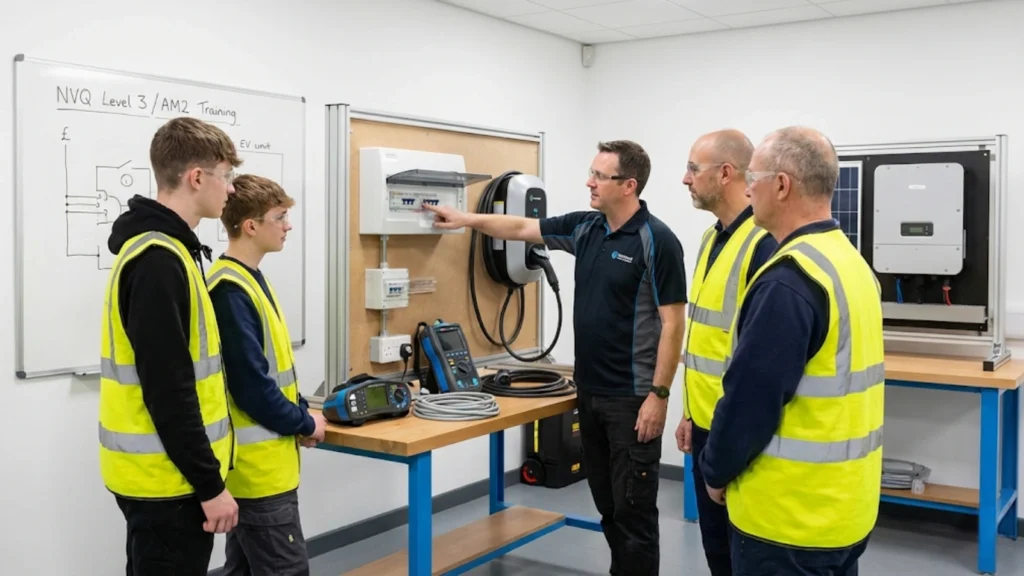
- Complete core electrical qualifications (NVQ Level 3, 18th Edition)
- Gain 12-18 months experience in general domestic work
- Add EV charging qualification (City & Guilds 2919 or equivalent)
- Consider solar/battery storage qualifications depending on local market demand
- Build reputation in green energy installations while maintaining general domestic work for steady income
This pathway creates potential for £45,000-£60,000 net self-employed earnings within 5-7 years of qualifying, significantly higher than the £30,000-£40,000 trajectory typical for 2018 entrants.
The overhead reality for new entrants:
People entering now face higher barriers to self-employment than 2018 entrants:
Setup costs increased:
- 2018: Van £10,000-£15,000, tools £3,000-£5,000, insurance deposit £600-£1,000, initial stock £500-£1,000 = £14,100-£22,000 total
- 2025: Van £15,000-£25,000, tools £4,000-£7,000, insurance deposit £1,000-£2,000, initial stock £800-£1,500, digital setup £500-£1,000 = £21,300-£36,500 total
The higher barrier means newly qualified electricians typically spend longer as employed electricians (3-5 years) building capital before going self-employed, compared to 2-3 years typical for 2018 qualifiers.
Market saturation concerns:
Some trade forums discuss market saturation concerns, questioning whether high rates will attract excessive new entrants and compress rates. The evidence suggests this isn’t happening:
- Apprenticeship completions remain below pre-COVID levels
- Retirement rate among older electricians (55-65 age group) remains high
- Green energy work creates additional demand beyond traditional domestic electrical
- Brexit permanently reduced EU worker availability
The labour shortage persists and likely continues through 2026-2028, sustaining strong earning potential for qualified electricians.
Realistic expectations:
2025 entrants should understand:
Years 1-2 (qualifying period): Apprentice wages £15,000-£20,000 or self-funded training costs £8,000-£12,000 while working other jobs
Years 3-4 (newly qualified): Employed at £28,000-£35,000 gross or struggling sole trader at £25,000-£35,000 net while building client base
Years 5-7 (experienced): Employed at £35,000-£45,000 gross or established sole trader at £40,000-£55,000 net
Years 8-10 (specialist): Senior employed roles £45,000-£55,000 gross or successful sole trader with green specialization £50,000-£70,000 net
This trajectory represents realistic expectations based on current market conditions. The exceptional 2020-2024 growth period was anomalous, driven by unique circumstances unlikely to repeat.
The UK electrical trade experienced more change between 2018 and 2025 than the previous two decades combined. Day rates increased 50-80% depending on region and specialization, but this wasn’t simple inflation or opportunistic price gouging.
Key drivers of change:
COVID-19: Created demand surge in domestic work while reducing electrician availability, allowing 20-30% rate increases during 2020-2022 that largely persisted afterward
Brexit: Reduced EU worker availability permanently, creating labour shortages that prevented rates from falling back to pre-pandemic levels
Green energy: Generated entirely new categories of premium work (EV charging, solar, battery storage) commanding 25-40% higher rates than traditional domestic work
Materials inflation: Copper, components, and consumer units increased 30-60% between 2018 and 2022 peak, forcing electricians to raise rates to maintain margins
Overhead explosion: Total business running costs increased 88-109%, driven by doubled insurance, increased fuel costs, mandatory digital tools, and expanded compliance requirements
Digital transformation: Required £1,200-£3,000 annual investment in software and systems but improved efficiency by 15-25% for electricians who adapted successfully
What stayed the same:
Despite massive changes, some fundamentals persisted:
- Regional variation patterns (London premium, rural discount)
- Job-type variation (emergency/specialist commanding premiums)
- Take-home reality (day rate ≠ personal income after overheads and tax)
- Competitive pressures (electricians still compete primarily on reputation and word-of-mouth referrals rather than pure price)
The 2026 outlook:
Rates are unlikely to increase substantially from 2025 levels unless another external shock occurs. The market has stabilized at new higher pricing that reflects genuine cost increases rather than temporary pandemic disruption.
Labour shortages will persist through 2026-2028, sustaining demand and preventing rate compression. Green energy work will continue expanding, offering premium income for qualified electricians.
The most successful electricians in the 2025-2030 period will be those who:
- Embrace digital tools while maintaining personal customer relationships
- Invest in green energy qualifications to access premium work
- Manage overheads efficiently to preserve margins
- Build specialization rather than competing purely on price for general domestic work
For homeowners, understanding that 2018 rates are permanently obsolete helps set realistic expectations. The £350-£450 range represents new normal pricing reflecting genuine cost increases, not temporary price gouging that will reverse.
For career changers, the electrical trade offers stronger earning potential in 2025 than 2018 despite higher barriers to entry, with clear pathways to £45,000-£60,000 net earnings for successful sole traders within 5-10 years of qualifying.
The 2018-2025 period was exceptional. The 2025-2030 period will likely show more modest change, but the transformed market creates better opportunities for qualified electricians than existed in the pre-COVID era.
FAQs
What did UK domestic electricians typically charge per day in 2018, and what work did that usually cover?
In 2018, UK domestic electricians typically charged between £200 and £300 per day, equivalent to roughly £25–£35 per hour for a full working day. These rates usually covered straightforward domestic tasks such as adding or replacing sockets, fitting lighting circuits, minor consumer unit work, and basic fault-finding. Partial rewires or more time-intensive jobs often sat at the higher end of this range. These figures were gross rates, meaning take-home pay was reduced by costs such as tools, vehicle expenses, insurance, and travel time. Regional differences existed, but demand was relatively stable before COVID, and pricing expectations were broadly consistent among homeowners.
Why were 2018 rates higher in London and the South East than in the Midlands or North?
Rates differed by as much as 30 percent between regions due to variations in living costs, travel time, and demand density. In 2018, London and South East electricians commonly charged £250–£350 per day, compared with £180–£250 in the Midlands and North. Higher southern prices reflected increased rents, congestion-related travel costs, and greater competition for skilled labour. In contrast, lower overheads and softer demand in northern regions kept rates down. Annual earnings data reflected the same pattern, with London electricians earning noticeably more in gross terms, though higher costs often reduced the real advantage.
What changed in 2019 that began pushing electrician day rates up before COVID?
In 2019, early upward pressure came from skills shortages and reduced labour mobility linked to Brexit. Fewer new entrants into the trade tightened supply, while steady demand for domestic upgrades continued. Day rates began edging up to around £220–£320, and average salaries rose by roughly 5 percent. At the same time, compliance and certification costs increased, narrowing margins. These changes did not dramatically boost take-home pay but marked the start of a shift away from pre-2018 pricing norms.
How did COVID change electricians’ workload and pricing, and why did the home improvement boom matter?
From 2020 onwards, COVID lockdowns redirected demand toward domestic work. With people working from home, demand for electrical upgrades rose sharply, and domestic workloads increased significantly. Day rates moved into the £250–£350 range, reflecting higher demand, reduced labour availability, and additional operating costs such as sanitisation and disrupted supply chains. The home improvement boom mattered because it replaced lost commercial work and sustained elevated demand through 2021. While gross earnings rose, payment delays and material shortages limited the benefit for some electricians.
Between 2021 and 2023, what cost pressures pushed quotes up faster than inflation?
Between 2021 and 2023, electrician quotes rose 20–25 percent, exceeding general inflation. Key drivers included fuel costs more than doubling, copper and electrical components rising 30–40 percent, higher van maintenance costs, and insurance premiums increasing around 15 percent. Compliance costs also grew, with updated regulations adding ongoing certification expenses. Many electricians raised day rates to £300–£400 simply to maintain viability, yet net income often stagnated once overheads were deducted.
How did green energy work change what electricians could charge compared to standard domestic jobs?
Green energy work introduced significant pricing premiums. From 2020 onwards, EV charger installations, solar PV connections, battery storage, and heat pump electrical work often attracted 20–50 percent higher rates than standard domestic jobs. Day rates for EV charging or solar-related work frequently reached £500–£800, reflecting specialist knowledge, compliance requirements, and certification such as MCS. These jobs often delivered higher total job values and more predictable workloads, though training and certification costs increased accordingly.
Did digital tools genuinely increase electricians’ take-home pay, or mainly add overheads?
Digital tools generally improved take-home pay by reducing administrative time. Quoting software, scheduling tools, and digital certification systems saved many electricians 20–30 percent of non-billable time, allowing more chargeable work. Subscription costs were modest compared with the efficiency gains, and faster invoicing improved cash flow. While some electricians were slow to adopt these tools, particularly older sole traders, overall the financial benefit outweighed the added overheads.
Which overhead costs rose most between 2018 and 2025, and how did this affect net income?
The largest increases came from fuel, vehicle costs, insurance, and compliance. Fuel costs rose by over 100 percent, van costs by 40–50 percent, insurance by around 25 percent, and certification fees roughly doubled. As a result, electricians’ net take-home fell from around 60–70 percent of gross earnings in 2018 to closer to 50–60 percent by 2025. Many electricians increased rates to compensate, but not all could recover these losses fully, particularly in lower-demand regions.
Why can two electricians in 2025 quote very different prices for the same job?
Price differences often reflect legitimate variations in overheads, efficiency, business models, and local demand. An electrician in London may need to charge £300–£350 for a job that costs £200–£220 in the Midlands due to fuel, insurance, and travel costs. Experience, use of digital tools, VAT status, and workload strategy also affect pricing. Some electricians prioritise volume and lower margins, while others price higher to limit workload or include extended warranties and certification support.
Why are homeowner expectations about “normal” electrician prices now out of date?
Many homeowners still reference £200–£250 day rates from 2018, but by 2025 typical rates have risen to £350–£450 due to inflation, fuel costs, compliance requirements, and competition from higher-value green energy work. Although gross prices increased, real take-home pay has often remained flat once costs are deducted. Expecting pre-COVID pricing no longer reflects the realities of operating a compliant electrical business and can result in unrealistic comparisons or poor-quality work from overstretched providers.
References
- Elec Training – Electrician Salary Snapshot 2018 – https://elec.training/news/electrician-salary-snapshot-2018-trades-salary-survey-shows-sparkies-still-lead-the-pack/
- Checkatrade – Electrician Hourly Rate Guide – https://www.checkatrade.com/blog/cost-guides/electrician-hourly-rate
- Office for National Statistics – Construction Output – https://www.ons.gov.uk/businessindustryandtrade/constructionindustry/bulletins/constructionoutputingreatbritain/october2025
- ONS – Construction Output Price Indices – https://www.ons.gov.uk/businessindustryandtrade/constructionindustry/datasets/interimconstructionoutputpriceindices/current
- BCIS Construction Industry Forecast – https://www.bcis.co.uk/news/bcis-construction-industry-forecast
- Gov.uk – Building Materials Statistics – https://www.gov.uk/government/statistics/building-materials-and-components-statistics-december-2025/construction-building-materials-commentary-december-2025
- HMRC – Self-Employment Income Data – https://www.gov.uk/government/statistics/income-of-individuals-with-self-employment-sources-2010-to-2011
- Elec Training – Self-Employment Impact on Electrician Income – https://elec.training/news/the-impact-of-self-employment-on-electrician-income-gross-earnings-vs-net-reality/
- Elec Training – 2022 UK Trades Salary Survey – https://elec.training/news/2022-uk-trades-salary-survey-electricians-still-lead-the-pack-and-how-to-maximise-your-earnings/
- Elec Training – Regional Electrician Wages – https://elec.training/news/regional-electrician-wages-north-vs-south-vs-midlands/
- MyJobQuote – How Much Do Electricians Make – https://www.myjobquote.co.uk/tradesadvice/how-much-do-electricians-make
- ONS – Consumer Price Inflation – https://www.ons.gov.uk/economy/inflationandpriceindices/bulletins/consumerpriceinflation/december2025
- Bank of England – Monetary Policy Report February 2025 – https://www.bankofengland.co.uk/monetary-policy-report/2025/february-2025
- Elec Training – How Much Can You Make as an Electrician 2026 – https://elec.training/news/how-much-can-you-make-as-an-electrician-a-2026-pay-guide/
Note on Accuracy and Updates
Last reviewed: 11 February 2026. This page is maintained; we correct errors and refresh sources as market rates and overhead costs evolve. Historical rates (2018-2021) based on trade surveys, ONS data, and industry reports current at time of publication. Recent rates (2022-2025) reflect current market conditions and may vary by region, specialization, and individual business circumstances. Overhead cost estimates based on sole trader data from trade associations and electrician surveys. Green energy premium rates apply only to electricians with relevant qualifications and established client base in these categories. Next review scheduled for Q1 2027 following accumulation of additional market data and potential policy changes affecting trade rates.
