
18th Edition BS 7671 Training and Compliance Guide 2026

- Technical review: Thomas Jevons (Head of Training, 20+ years)
- Employability review: Joshua Jarvis (Placement Manager)
- Editorial review: Jessica Gilbert (Marketing Editorial Team)
- Last reviewed:
- Changes: Complete rewrite incorporating Amendment 2 (2022) and Amendment 3 (2024) updates, current training pathway, and 2026 employer requirements
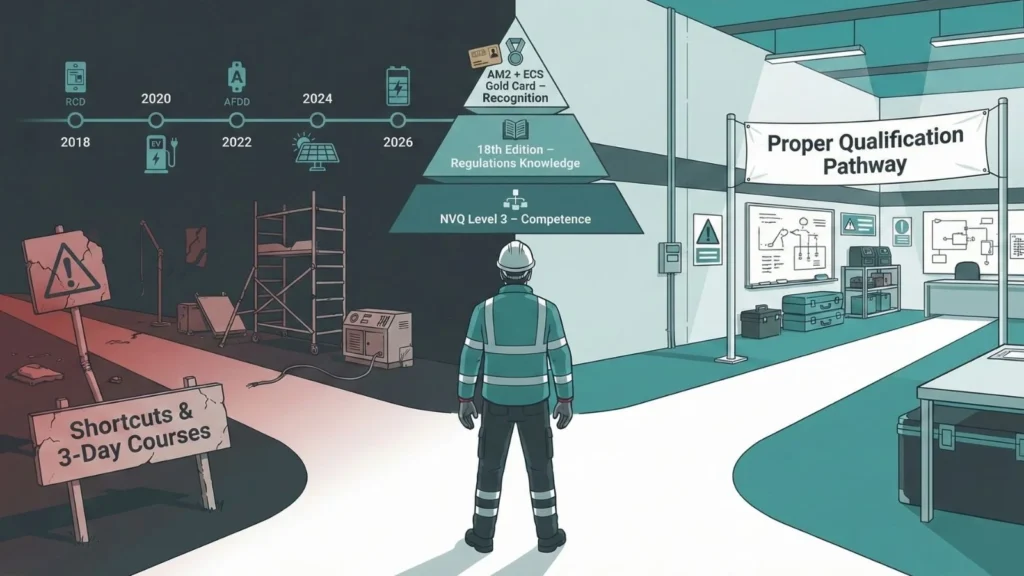
The 18th Edition of the Wiring Regulations isn’t a qualification that makes you an electrician. It’s not a licence to touch electrical installations. And it’s definitely not something you complete in three days and walk onto site calling yourself a spark.
Yet training providers market it that way. Job adverts list it as though it’s the only requirement. And trainees waste money thinking they’re buying a shortcut into the trade.
Here’s what the 18th Edition actually is: BS 7671:2018, the UK’s national standard for electrical installations. It’s the rulebook. Not the trade qualification. Not the practical competence. The rulebook.
If you’re training to become an electrician in the UK, you need to understand where the 18th Edition fits in your pathway, what Amendments 1, 2, and 3 changed, and why employers keep asking for it alongside NVQ Level 3 and AM2.
This isn’t another “everything you need to know” article that skims the surface. This covers what changed, why it matters, who actually needs it, and how to avoid wasting money on courses that promise more than they deliver.
What BS 7671:2018 Actually Is (And Isn't)
BS 7671:2018 – the 18th Edition of the Wiring Regulations – is the British Standard for electrical installations. It’s published jointly by the Institution of Engineering and Technology (IET) and the British Standards Institution (BSI).
It’s not law. It’s a standard.
The law is the Electricity at Work Regulations 1989 (EAWR), which requires electrical systems to be constructed and maintained to prevent danger. BS 7671 is the recognised way to demonstrate compliance with that legal requirement.
If you don’t follow BS 7671 and something goes wrong, you’d struggle to defend yourself against a charge of breaching the Electricity at Work Regulations. So while it’s technically not mandatory, practically speaking, it is.
What it covers:
Design and installation requirements for electrical systems
Protection against electric shock and fire
Earthing and bonding arrangements
Inspection and testing procedures
Special installations (swimming pools, medical locations, marinas, solar PV, EV charging)
What it doesn’t do:
Qualify you as an electrician
Prove you’re competent to carry out electrical work
Replace the need for NVQ Level 3, AM2, or site experience
Act as a licence (the UK doesn’t have electrical licensing)
The 18th Edition certificate proves you’ve passed an exam on the regulations. That’s it. Employers want it because it demonstrates current knowledge of the standards, but they also want NVQ Level 3, AM2, and an ECS Gold Card. Just having the 18th Edition gets you nowhere.
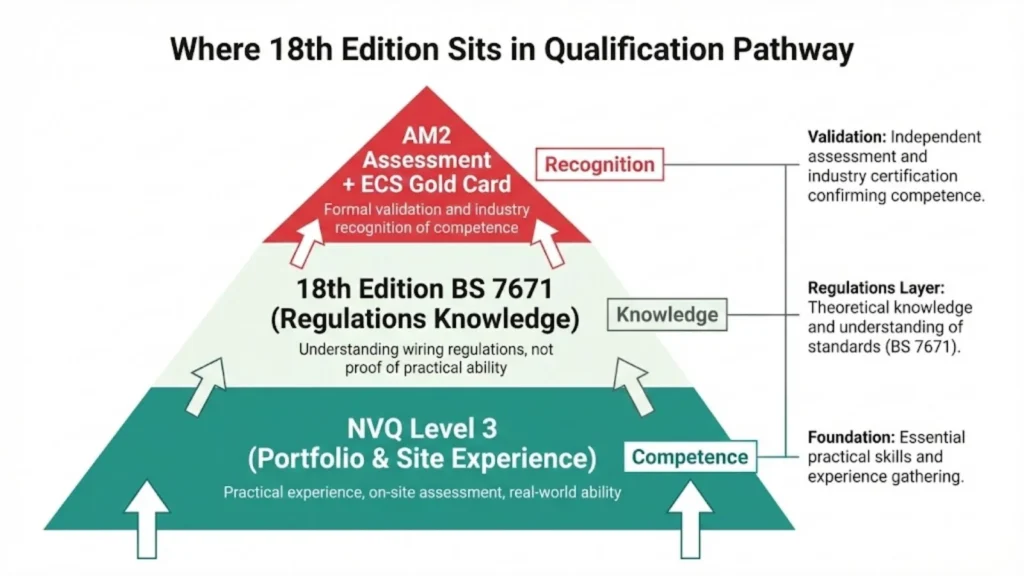
Timeline: 18th Edition Launch and Amendments
The 18th Edition was published on 2 July 2018, replacing the 17th Edition Amendment 3. The transition period ran until 1 January 2019, when the 18th Edition became the only acceptable standard for new electrical work.
Key dates:
2 July 2018: BS 7671:2018 published
July-December 2018: Transition period (both 17th and 18th Edition accepted)
1 January 2019: 18th Edition mandatory for all new work
1 July 2019: Full enforcement begins
Work designed and started before 1 January 2019 could be completed under the 17th Edition, provided it fully complied with that standard. After that date, everything had to meet 18th Edition requirements.
Amendment 1 (2020):
Minor updates, primarily clarifications. Key change: refined requirements for EV charging installations, addressing PME earthing concerns. Most electricians barely noticed Amendment 1 because it didn’t fundamentally change working practices.
Amendment 2 (March 2022):
Significant update focusing on:
Type B RCD requirements for EV charging (Section 722)
Prosumer installations (buildings generating and consuming power) – new Chapter 82
Energy efficiency requirements (Part 8)
AFDD (Arc Fault Detection Device) mandates for higher-risk residential premises
Surge Protection Device (SPD) requirements tightened
Amendment 2 is the current standard electricians must work to. Courses or books that don’t mention “BS 7671:2018+A2:2022” are outdated.
Amendment 3 (2024):
Further updates addressing smart home integration, battery storage systems, and enhanced fire safety requirements for escape routes. Amendment 3 refined rather than revolutionised, but electricians working to Amendment 1 or the base 18th Edition are now two updates behind.
The pattern is clear: BS 7671 updates roughly every 6-7 years, with amendments every 1-3 years. The 19th Edition is expected around 2025-2026, at which point the cycle repeats.
What Changed: Key Technical Updates
The 18th Edition introduced substantial safety improvements over the 17th Edition. Amendments 1, 2, and 3 built on those foundations, addressing emerging technologies and tightening requirements based on real-world incidents.
Expanded RCD Protection:
The 18th Edition removed exemptions that allowed “skilled persons” to install socket circuits without RCD protection. Now, all socket outlets rated 32A or less in domestic and similar installations require 30mA RCD protection.
The logic: electric shock doesn’t care if you’re qualified. The regulation applies universally.
Surge Protection Devices (SPDs):
SPDs are now required unless a risk assessment justifies their omission. This addresses overvoltage damage to sensitive equipment and fire risks from surge-related failures.
Practically, most domestic and commercial installations now include SPDs as standard. The risk assessment paperwork for not fitting one often takes longer than just installing it.
Arc Fault Detection Devices (AFDDs):
Amendment 2 made AFDDs mandatory in certain higher-risk residential premises:
Houses in Multiple Occupation (HMOs)
Purpose-built student accommodation
Care homes
Other premises where vulnerable occupants or sleeping risks increase fire danger
AFDDs detect dangerous arcing (series or parallel arcs) that standard overcurrent devices miss. They’re expensive – £150-£200 per circuit versus £30-£40 for a standard RCBO – but they address a real problem.
Thomas Jevons, Head of Training (20+ years), Elec Training
"AFDDs are mandatory in higher-risk premises like HMOs and student accommodation under Amendment 2, but the debate isn't settled. They cost £150-£200 per circuit versus £30 for a standard RCBO. Landlords complain about costs, but arc faults cause 20,000+ electrical fires annually in the UK."
Thomas Jevons, Head of Training
Section 722: Electric Vehicle Charging:
The 18th Edition introduced Section 722 specifically for EV charging installations. Amendment 2 refined these requirements, mandating Type B RCD protection to handle DC fault currents from vehicle chargers.
Standard Type A RCDs (protecting most UK circuits) can’t detect DC faults. DC current saturates the RCD’s magnetic core, preventing it from tripping during a fault. Type B RCDs detect both AC and DC faults, making them essential for EV installations.
Section 722 also addresses:
PME earthing concerns (risk of lost neutral affecting vehicle chassis)
Load management (preventing simultaneous charging from overloading local networks)
Cable sizing for sustained 7kW+ loads
Smart charging integration requirements
Electricians installing EV chargers without Amendment 2 knowledge are working to outdated standards. The technical requirements changed significantly between 2018 and 2022.
Part 8: Energy Efficiency:
Amendment 2 introduced Part 8, focusing on energy-efficient electrical design. Requirements include:
Load balancing to minimise distribution losses
Specification of energy-efficient equipment (LED lighting, efficient motors)
Integration of smart controls (timers, sensors, demand response)
Support for renewable energy sources (solar PV, battery storage)
Part 8 isn’t about box-ticking. Properly balanced circuits save clients 5-10% on energy costs. Smart controls reduce consumption by 10-20% in commercial installations. Electricians who understand Part 8 add measurable value beyond basic compliance.
Chapter 82: Prosumer Installations:
New in Amendment 2, Chapter 82 addresses “prosumer” installations – buildings that both consume and generate electricity (solar PV, wind, battery storage).
This reflects the reality of UK electrical work in 2026. Solar installations are common. Battery storage is growing. Grid export arrangements require specific protection and isolation. Chapter 82 provides the framework electricians need to install these systems safely and compliantly.
Who Actually Needs the 18th Edition (Role-Based Reality)
Not everyone needs the 18th Edition immediately. Beginners shouldn’t waste money on it. Experienced electricians can’t work without it.
Beginners/Trainees:
No. Don’t start with the 18th Edition.
The exam assumes you already understand electrical principles, circuit design, testing procedures, and installation methods. Without that foundation (typically Level 2 and Level 3 diplomas), you’re memorising regulations without context.
Trainees who jump straight to the 18th Edition fail the exam or pass but can’t apply the knowledge. There’s no shortcut. Build the foundation first.
Electrician’s Mates/Improvers:
Not essential, but increasingly expected.
Most UK construction sites require the 18th Edition for ECS card eligibility beyond basic labourer grade. Mates supporting qualified sparks benefit from understanding current regulations, but it’s not mandatory for supervised work.
The sensible approach: complete Level 2, gain site experience, then take the 18th Edition alongside Level 3 training.
Trainee Electricians (Apprentices/NVQ Learners):
Yes, as part of progression.
Apprentices and NVQ learners need 18th Edition certification to demonstrate current regulatory knowledge. It’s typically completed during Level 3 training, once learners have sufficient practical context to understand what they’re reading.
Timing matters. Too early, and it’s abstract theory. Too late, and you’re working to outdated standards on site.
Qualified Electricians (Installation):
Yes. Non-negotiable.
You cannot maintain an ECS Gold Card without current 18th Edition certification. Competent Person Schemes (NICEIC, NAPIT, STROMA) require members to hold valid 18th Edition qualifications.
Electricians working to the 17th Edition or outdated amendments are non-compliant. Employers won’t hire you. Insurance won’t cover you. It’s career-limiting.
Maintenance Electricians:
Yes.
Safe isolation, fault diagnosis, and repair work must comply with current regulations. Maintenance electricians need 18th Edition knowledge to assess existing installations against current standards and carry out work safely.
Inspection and Testing (2391) builds on 18th Edition knowledge. You can’t accurately complete an EICR without understanding current BS 7671 requirements.
Supervisors/Designers:
Yes. Absolutely essential.
Anyone overseeing electrical work, signing off installations, or designing systems must understand current regulations. You’re responsible for everything your team installs. Ignorance of Amendment 2 or 3 isn’t a defence.
Advanced qualifications like 2393 (Design) assume current 18th Edition knowledge as a baseline.
Where 18th Edition Fits in the Qualification Pathway
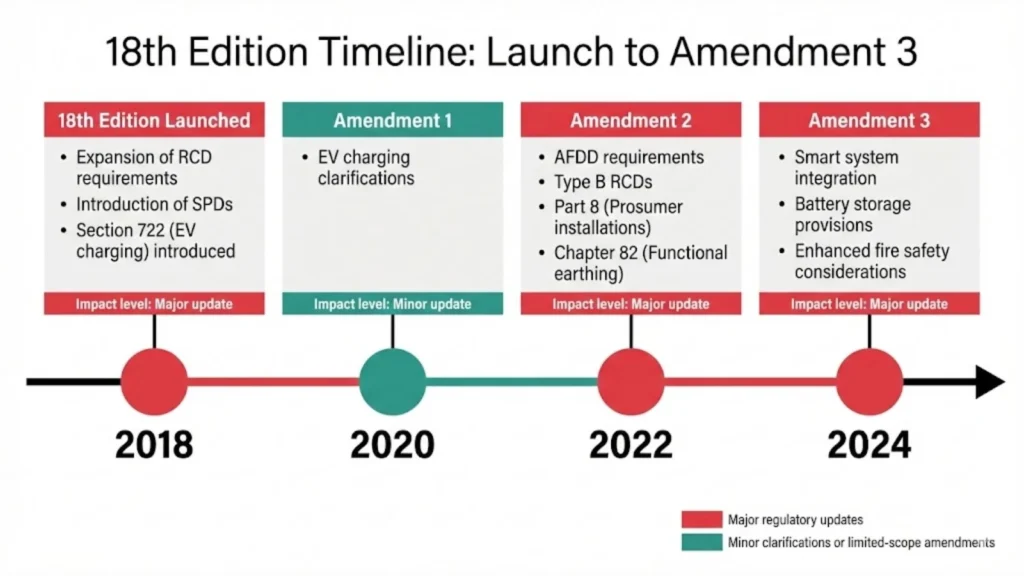
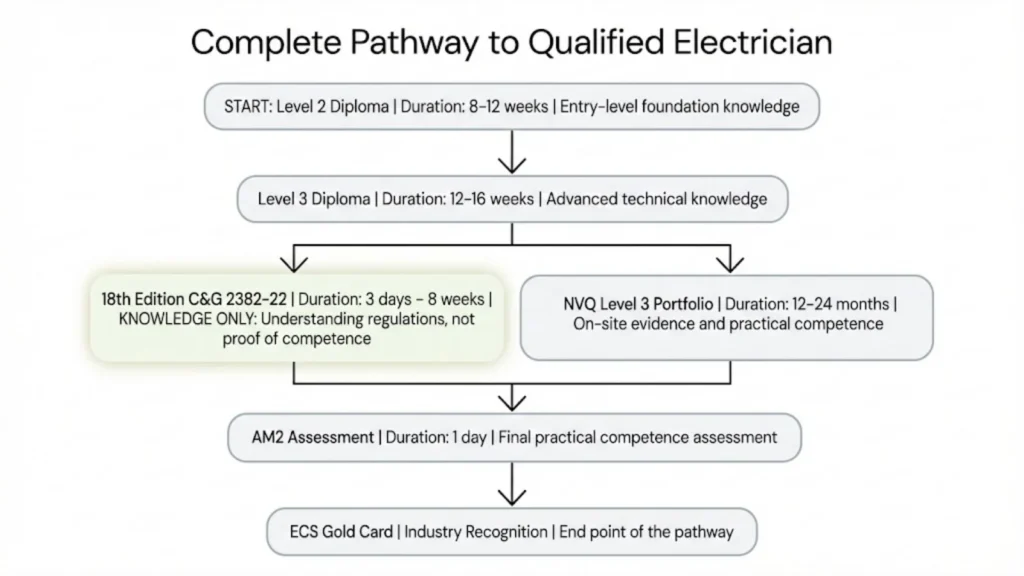
The 18th Edition is one component of becoming a qualified electrician. It’s not the start, the middle, or the end. It’s a knowledge update that sits alongside practical training.
Foundation (Level 2 Diploma):
Entry-level electrical theory and basic practical skills. Covers fundamental concepts: circuits, protection, earthing, testing, safe isolation. Duration: typically 8-12 weeks full-time.
Without Level 2, you lack the context to understand what BS 7671 regulations actually mean in practice.
Technical Knowledge (Level 3 Diploma):
Advanced electrical theory covering design calculations, motor control, three-phase systems, special locations. Duration: 12-16 weeks full-time.
Level 3 provides the technical depth needed to apply 18th Edition regulations intelligently, not just memorise them.
Regulations (18th Edition – C&G 2382-22):
Current regulatory knowledge. The “rulebook” for electrical installations. Duration: 3 days intensive or 6-8 weeks evening course. Assessment: 2-hour, 60-question open-book exam.
The 18th Edition makes sense once you have Level 2 and Level 3 foundation. Before that, it’s abstract.
Competence (NVQ Level 3):
Workplace portfolio demonstrating practical competence across installation, testing, fault diagnosis, and certification. Duration: 12-24 months alongside employment.
NVQ Level 3 proves you can actually do the work, not just pass exams about the work.
Assessment (AM2/AM2E):
Independent practical and theory test. Duration: 1 day assessment. Covers installation work, testing, fault diagnosis, and safe working practices in a controlled environment.
AM2 is the final hurdle proving you’re ready for unsupervised work.
Recognition (ECS Gold Card):
Industry recognition requiring NVQ Level 3, AM2 pass, and current 18th Edition certification. The Gold Card proves you’re a qualified, competent electrician.
Without all three components, you don’t get the Gold Card. The 18th Edition alone gets you nowhere.
Amendment 2 and Green Skills: The Employer Premium
Amendment 2’s focus on energy efficiency, prosumer installations, and EV charging infrastructure aligns directly with employer demand for green skills.
Section 722 (EV charging) is no longer niche work. It’s standard domestic and commercial installation. Employers need electricians who understand Type B RCD requirements, load management, and PME earthing concerns.
Part 8 (energy efficiency) matters to commercial clients focused on net-zero targets. Electricians who can design efficient systems, integrate renewable energy, and implement smart controls add measurable value.
Chapter 82 (prosumer installations) addresses the solar PV, battery storage, and grid export work that’s becoming routine in 2026. Electricians without this knowledge can’t competently install modern renewable systems.
Joshua Jarvis, Placement Manager, Elec Training
"Amendment 2's focus on prosumer installations and energy efficiency aligns perfectly with the green skills employers want. Electricians who understand Section 722 EV charging, Part 8 efficiency, and renewable integration command £2-5k salary premiums over those working to older standards."
Joshua Jarvis, Placement Manager
The premium isn’t theoretical. Job adverts for commercial electricians with solar PV and EV installation competence offer £35k-£45k versus £30k-£38k for domestic-only roles. Self-employed sparks charging £600-£1,200 for domestic EV installations versus £200-£300 for standard socket circuits.
Green skills matter because clients are legally required to meet energy efficiency targets, install EV infrastructure, and reduce carbon emissions. Electricians who can deliver those requirements have competitive advantage.
But you need the foundation first. Amendment 2 knowledge without NVQ Level 3 and AM2 doesn’t get you the work. Employers want competent electricians who happen to understand green technology, not green technology specialists who can’t wire a consumer unit properly.
Employer Expectations: What "18th Edition Required" Actually Means
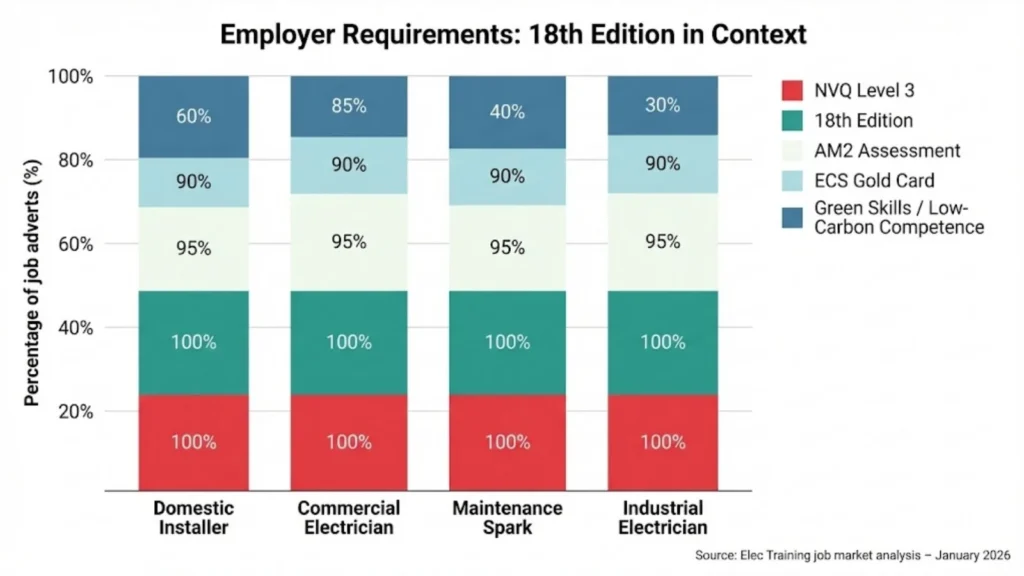
Job adverts list “18th Edition required” alongside “NVQ Level 3” and “ECS Gold Card.” They’re not saying the 18th Edition alone qualifies you. They’re using it as shorthand for “current, qualified electrician.”
What employers actually want:
NVQ Level 3 or equivalent (proving competence)
AM2 pass (proving practical assessment)
Current 18th Edition (proving regulatory knowledge)
ECS Gold Card (proving industry recognition)
Site experience (proving you can actually do the job)
“18th Edition required” is a keyword filter. HR departments use it to eliminate CVs from people working to outdated standards or lacking proper qualifications.
Red flags in job adverts:
Lists only 18th Edition, no mention of NVQ or AM2
“Become an electrician – 3-day course”
“Start earning immediately after qualification”
Vague about what actual work involves
These adverts target mates, not qualified sparks. The pay reflects that. Employers looking for qualified electricians list the full qualification package, not just the 18th Edition.
What “Amendment 2 knowledge essential” means:
Employers working on EV installations, solar PV, or commercial energy efficiency projects need electricians who understand Section 722, Part 8, and Chapter 82. They’re not training you from scratch. They expect current, applicable knowledge.
If the advert specifies Amendment 2, they’re serious about compliance. If it just says “18th Edition,” check whether they actually mean Amendment 2 or whether they’re working to outdated standards themselves.
Choosing the Right 18th Edition Course (Avoiding Scams)
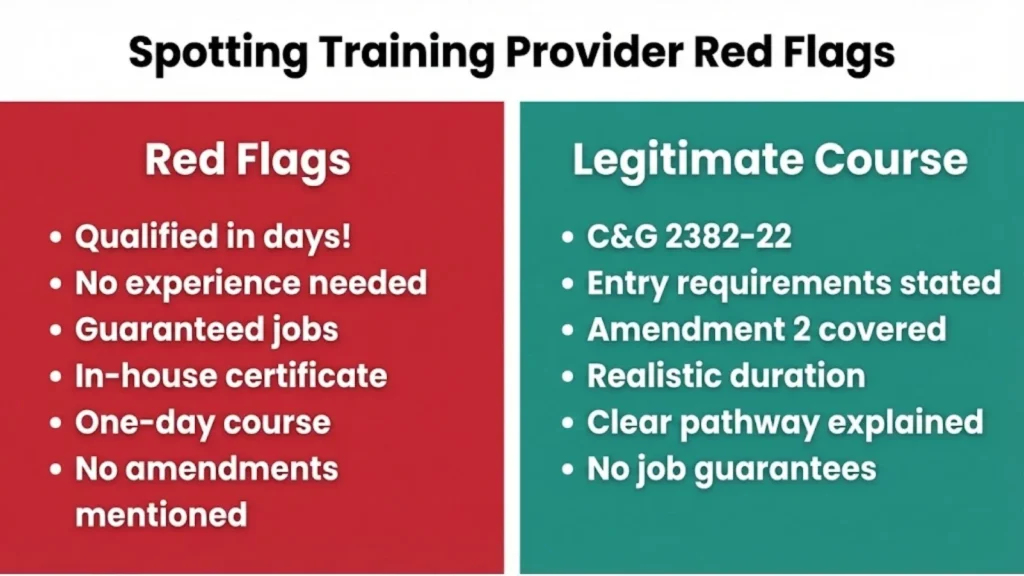
Not all 18th Edition courses are equal. Some providers market outdated content. Others promise qualifications they can’t deliver. Here’s how to avoid wasting money.
Check the version:
The course must cover BS 7671:2018+A2:2022 (Amendment 2). Ideally, it should also reference Amendment 3 (2024) changes.
If the course materials say “BS 7671:2018” without mentioning amendments, it’s outdated. If they reference Amendment 1 only, it’s two updates behind.
Don’t pay for old content.
Verify the awarding body:
City & Guilds 2382-22 and EAL equivalent qualifications are industry-recognised. These certificates are accepted by ECS, NICEIC, NAPIT, and employers nationwide.
“In-house” certificates, “approved by us” claims, or vague references to “industry standards” without naming City & Guilds or EAL are red flags.
Check course entry requirements:
Legitimate 18th Edition courses state entry requirements: Level 3 qualification or equivalent experience. They don’t promise “no experience needed.”
If the provider markets the course to absolute beginners, they’re either misinformed or deliberately misleading. The 18th Edition assumes existing electrical knowledge.
Look for realistic duration:
3-day intensive courses exist and work for experienced electricians updating knowledge. Evening courses running 6-8 weeks suit employed learners.
“Qualified in one day” or “fast-track in two days” courses compress too much content. You’ll pass the exam through memorisation without understanding the material.
Red flags:
“Become a qualified electrician in 3 days”
No mention of amendments
Vague about which awarding body
Promises guaranteed job placement
High-pressure sales tactics
No clear course content breakdown
Legitimate training providers explain exactly what the 18th Edition is, where it fits in qualification pathways, and what you need beyond it. They don’t sell shortcuts because shortcuts don’t exist.
The 18th Edition (BS 7671:2018+A2:2022) is essential for working electricians. It’s not optional. It’s not a shortcut. It’s one component of proper qualification.
For beginners:
Don’t start with the 18th Edition. Complete Level 2, gain practical experience, then take it alongside Level 3 training once you understand what you’re actually learning.
For qualified electricians:
Update to Amendment 2 if you haven’t already. Amendment 3 clarifications are important but Amendment 2 introduced the substantial changes (AFDDs, Section 722, Part 8, Chapter 82).
Your ECS Gold Card renewal depends on current certification. Employers expect Amendment 2 knowledge for EV installations, solar PV, and commercial energy efficiency work.
For everyone:
The 18th Edition proves you know the regulations. NVQ Level 3 proves you can do the work. AM2 proves you can do it under assessment conditions. You need all three.
There’s no shortcut. Training providers selling “qualified in three days” courses are lying. Employers listing “18th Edition only” are looking for cheap labour, not qualified sparks.
The proper pathway takes 18 months to 3 years: Level 2 foundation, Level 3 technical knowledge, NVQ portfolio, 18th Edition regulations, and AM2 assessment. That’s how you become a qualified electrician.
Anything faster isn’t real qualification. Anything cheaper comes with hidden costs (usually discovering your certificate isn’t recognised or you can’t actually do the work).
Call us on 0330 822 5337 to discuss 18th Edition training, NVQ pathways, and how our in-house recruitment team supports electricians into placements requiring current BS 7671 knowledge. We’ll explain realistic timelines, what qualifications you actually need, and what Amendment 2 changes mean for your career. No shortcuts. No false promises. Just honest guidance from people training electricians every day.
References
- BS 7671:2018+A2:2022 (18th Edition Wiring Regulations, Amendment 2) https://electrical.theiet.org/bs-7671/
- Approved Document P: Electrical Safety in Dwellings (England & Wales) https://www.gov.uk/government/publications/electrical-safety-approved-document-p
- IET 18th Edition Amendment 2 Technical Guidance https://electrical.theiet.org/bs-7671/18th-edition-resources/
- ECS Gold Card Requirements https://www.ecscard.org.uk/card-types/electrotechnical/installation-electrician
- NICEIC BS 7671 Compliance Guidance https://www.niceic.com/help-advice/bs-7671-wiring-regulations
Note on Accuracy and Updates
Last reviewed: 16 January 2026. This page reflects BS 7671:2018 as amended by Amendment 1 (2020), Amendment 2 (2022), and Amendment 3 (2024). Technical requirements reference current IET/BSI standards. Course codes and qualification pathways based on 2026 City & Guilds and ECS requirements.
FAQs
What is the 18th Edition (BS 7671) and what does it actually govern in UK electrical work?
The 18th Edition of BS 7671, published in 2018 by the Institution of Engineering and Technology (IET), is the UK’s national standard for electrical installations. It sets out requirements for the design, installation, inspection, testing, and certification of electrical systems in buildings and other fixed installations up to 1,000V AC or 1,500V DC. This includes wiring systems, protection devices, earthing, and isolation to reduce risks such as fire and electric shock.
It does not cover high-voltage transmission systems, portable appliances regulated under the Electricity at Work Regulations 1989, or non-electrical building work. It is also not a training manual and assumes the user already has appropriate competence, such as NVQ Level 3–level qualifications.
BS 7671 is updated regularly to reflect new technology. Amendment 2 (2022) and Amendment 3 (2024) introduced changes linked to renewables, EV charging, and prosumer installations.
What this means in practice:
Employers expect electricians to apply BS 7671 to deliver safe, compliant work that passes inspection under schemes such as NICEIC or ECS card requirements.
Is BS 7671 law, and how does it relate to the Electricity at Work Regulations 1989 and Building Regulations Part P?
BS 7671 is not statutory law. It is a non-statutory British Standard that represents accepted good practice for electrical safety. Failure to follow it does not automatically result in legal penalties.
However, it closely supports compliance with the Electricity at Work Regulations 1989 (EAWR), which are statutory. EAWR requires employers and the self-employed to prevent danger from electricity and ensure work is carried out by competent persons. Following BS 7671 is widely accepted by the Health and Safety Executive as evidence of meeting EAWR duties.
For domestic work in England and Wales, Building Regulations Part P requires electrical installations to be carried out safely. Compliance with BS 7671 is the recognised way of demonstrating this. Competent person schemes allow electricians to self-certify work against Part P using BS 7671.
Scotland and Northern Ireland use different building regulations but still reference BS 7671 as the technical benchmark.
What this means in practice:
Treat BS 7671 as the working standard. Ignoring it risks breaches of EAWR or Part P, which can lead to fines, insurance issues, or prohibition from carrying out work.
Who genuinely needs an 18th Edition certificate in 2026?
In 2026, the 18th Edition certificate (such as City & Guilds 2382-22 or equivalent) is essential for anyone who designs, installs, inspects, tests, or certifies electrical installations under BS 7671.
- Qualified electricians: Required to remain competent and eligible for ECS Gold Cards and competent person schemes.
- Trainees: Recommended as part of progression, especially when working towards NVQ Level 3 or AM2, but not mandatory for basic labouring roles.
- Electrician’s mates: Not always required immediately, unless undertaking regulated electrical tasks.
- Supervisors and maintenance staff: Required if they oversee or carry out electrical work, due to EAWR competence duties.
Employers commonly require it for site access, particularly in commercial and industrial environments. Holders of older editions must update to include Amendments 2 and 3.
What this means in practice:
Without the certificate, job opportunities and scheme access are restricted. It is a core employability requirement for safety-critical roles.
What changed in Amendment 2 (2022) that electricians encounter most often on site?
Amendment 2 to BS 7671:2018, effective from March 2022, introduced several practical changes:
- Mandatory use of AFDDs for socket-outlet circuits in higher-risk residential buildings such as HMOs and care homes
- Surge protection devices (SPDs) required in most installations unless risk assessment justifies omission
- New requirements for prosumer installations with bidirectional power flow (solar PV, EV charging)
- Definition of protected escape routes and requirements for non-combustible cable supports
- Extended RCD protection for socket-outlets up to 32A
- Introduction of foundation earthing for new builds
These apply to new designs from September 2022 onward.
What this means in practice:
Electricians must actively check for AFDD and SPD requirements and update designs for renewable and mixed-generation systems to avoid non-compliance.
What changed in Amendment 3 (2024), and what work does it affect most?
Amendment 3, effective from July 2024, focuses on protection in prosumer installations. It introduces Regulation 530.3.201, requiring correct selection of protective devices for unidirectional and bidirectional circuits.
This ensures overcurrent and fault protection devices are suitable for installations where electricity can flow both to and from the grid, such as:
- Solar PV systems
- Battery storage
- EV charging installations
Minor updates also clarify labelling and isolation requirements.
What this means in practice:
Electricians must confirm that protective devices are compatible with bidirectional current flow to avoid safety issues and rework, particularly on renewable-linked projects.
Where does the 18th Edition sit in the electrician qualification pathway?
The typical electrician pathway is:
- Level 2 Diploma: Basic electrical knowledge
- Level 3 Diploma: Advanced theory and practical skills
- NVQ 2357: On-site competence assessed through a portfolio
- 18th Edition (BS 7671): Regulatory and compliance knowledge
- AM2 / AM2E: Final practical competence assessment
The 18th Edition is not a standalone qualification and does not replace NVQ or AM2. It complements them by proving regulatory understanding.
What this means in practice:
Take the 18th Edition after core technical qualifications to unlock site work, certification, and card eligibility.
What does “18th Edition required” really mean on job adverts?
When job adverts state “18th Edition required,” they mean a current BS 7671 certificate covering Amendments 2 and 3. Employers use this to screen for up-to-date regulatory knowledge and competence under EAWR and Part P.
It also aligns with ECS card and site access requirements. For qualified electrician roles, it is non-negotiable alongside NVQ Level 3 and AM2. For trainees, it may indicate progression expectations rather than immediate responsibility.
What this means in practice:
Holding the certificate is essential to pass initial screening and reduces employer liability on domestic and commercial projects.
What common misunderstandings cause people to waste money on 18th Edition training?
Common misconceptions include:
- Believing the 18th Edition alone qualifies someone as an electrician
- Taking the course before completing Level 2 or Level 3, leading to exam failure
- Assuming it is mandatory for all electrical roles, including basic mate work
- Thinking BS 7671 applies retroactively to all existing installations
- Confusing a British Standard with statutory law
What this means in practice:
Map your qualification pathway before enrolling. Completing technical qualifications first avoids wasted fees and improves employability.
How can you tell if an 18th Edition course is legitimate and up to date?
Legitimate courses are accredited by recognised awarding bodies such as City & Guilds (2382-22) or EAL and cover BS 7671:2018 up to Amendment 3 (2024).
Checks to make:
- Provider listed on the awarding body’s website
- Explicit inclusion of Amendments 2 and 3
- Reference to current BS 7671 materials
- Sensible entry guidance (basic electrical knowledge assumed)
- Ofqual recognition and credible reviews
What this means in practice:
Choose accredited providers only; this ensures the certificate is accepted by employers, ECS, and competent person schemes.
How often does BS 7671 update, and how should electricians stay compliant?
Major editions of BS 7671 are released every 5–10 years. The 18th Edition was published in 2018, with the 19th Edition expected around 2028. Amendments are issued as needed, with recent updates in 2020, 2022, and 2024.
To stay compliant, electricians should:
- Monitor IET updates and publications
- Attend CPD sessions via NICEIC, SELECT, or similar bodies
- Complete short update courses when amendments are released
- Maintain ECS card CPD records
- Apply new rules from the correct transition dates
What this means in practice:
Regular updates and CPD keep you employable and prevent gaps in compliance that could exclude you from inspections, sites, or contracts.
