

Apprenticeship Standards Explained: 5393 Domestic vs 5357 Installation/Maintenance

- Technical review: Thomas Jevons (Head of Training, 20+ years)
- Employability review: Joshua Jarvis (Placement Manager)
- Editorial review: Jessica Gilbert (Marketing Editorial Team)
- Last reviewed:
- Changes: Initial publication
Introduction
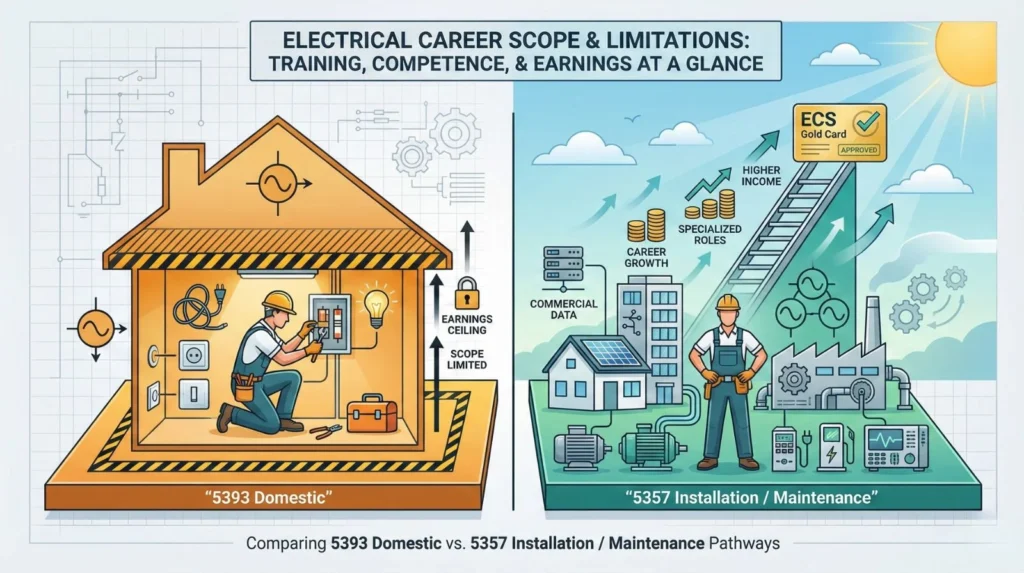
The UK electrical industry now operates with two distinct apprenticeship standards: ST0539 (Level 3 Domestic Electrician) and ST0152 (Level 3 Installation/Maintenance Electrician). On paper, both are Level 3 qualifications. Both take 3-4 years. Both are government-funded. But here’s what the marketing materials don’t emphasise: choosing the wrong one can lock you out of 70% of the electrical industry for your entire career.
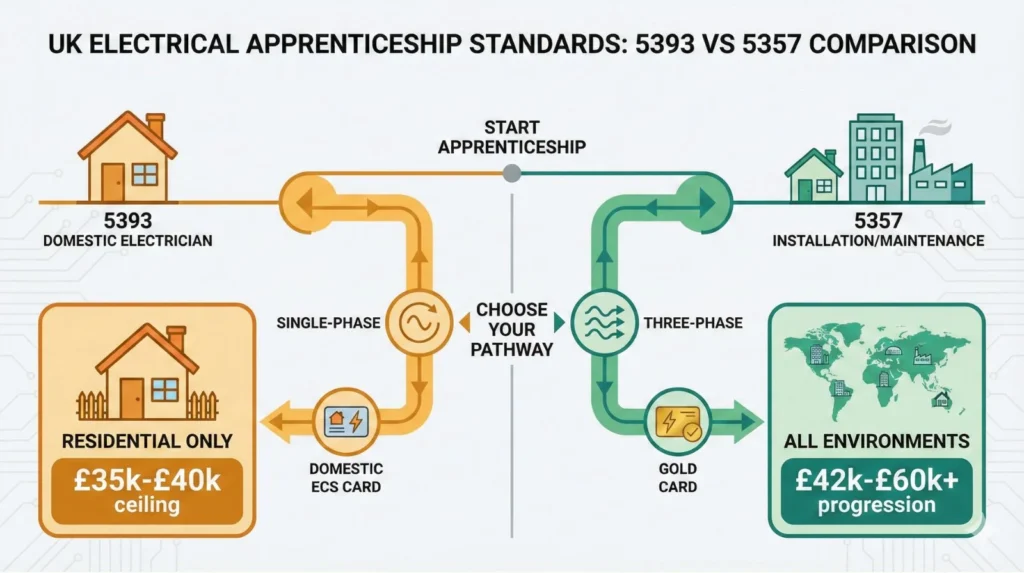
The 5393 Domestic Electrician standard was introduced in 2018 to create a streamlined pathway specifically for residential electrical work. The 5357 Installation/Maintenance standard has been the industry’s full-scope qualification since 2016. The difference isn’t just about breadth of training. It’s about legal competence under the Electricity at Work Regulations 1989, insurance coverage, site access through the ECS card system, earning potential, and whether you’ll hit a career ceiling at £40,000 or progress to £60,000+ with specialist roles.
If you’re considering UK electrical apprenticeship pathways and trying to understand which standard leads where, this guide breaks down the regulatory framework, training content, permitted scope of work, evidence requirements, pay differences, and long-term career implications using data from government apprenticeship standards, JIB wage agreements, ECS card requirements, and HSE competence guidance.
The Regulatory Framework: What the Law Actually Requires
Understanding why these two standards exist requires starting with the legal definition of electrical competence in the UK.
Electricity at Work Regulations 1989 (EAWR)
Regulation 16 states: “No person shall be engaged in any work activity where technical knowledge or experience is necessary to prevent danger or, where appropriate, injury, unless he possesses such knowledge or experience, or is under such degree of supervision as may be appropriate having regard to the nature of the work.”
The critical phrase is “technical knowledge or experience necessary to prevent danger.” This isn’t a blanket qualification. Competence must match the specific work and environment.
5357 holders meet the Regulation 16 competence threshold for complex multi-phase systems, commercial distribution boards, industrial control panels, and hazardous environments because their training includes “Electrical Scientific Principles” covering three-phase theory, fault current calculations, and commercial containment methods.
5393 holders do not meet the competence threshold for commercial or industrial environments under EAWR. Their training is explicitly limited to “dwellings.” Working unsupervised on three-phase systems, commercial distribution, or industrial motor circuits would constitute a breach of EAWR if their training consisted only of the domestic standard. Legally, they would require close supervision in those environments, equivalent to an apprentice, which negates their value as a qualified tradesperson outside residential work.
This isn’t theoretical. HSE investigations following electrical incidents examine whether the person who carried out the work possessed the technical knowledge required under Regulation 16. A 5393 holder working on a commercial system cannot prove competence if their qualification explicitly excludes that scope.
Building Regulations Part P
Part P of the Building Regulations applies only to electrical installations in dwellings (houses, flats, and associated gardens/outbuildings). It defines “notifiable work” (new circuits, consumer unit replacements, work in bathrooms and kitchens) and requires it to be carried out by a “competent person” or notified to Building Control.
The 5393 Domestic Electrician standard was specifically designed to meet the Qualified Supervisor (QS) requirements for Competent Person Schemes like NICEIC Domestic Installer and NAPIT. This allows self-certification of Part P notifiable work in homes.
The limitation: Part P competence does not extend to communal areas in blocks of flats, landlord supplies, or intake rooms serving multiple dwellings if they involve complex distribution or three-phase supplies. These are often classified as commercial installations despite being in residential buildings, creating a grey area where a Domestic Electrician may be legally unable to work on the electrical intake serving the very flats they’re wiring.
BS 7671 Wiring Regulations (18th Edition)
Both standards require knowledge of BS 7671:2018+A2:2022 (the IET Wiring Regulations). Both require the 18th Edition qualification (City & Guilds 2382). The difference is in assessment scope.
5357 Installation/Maintenance is assessed against the full scope of BS 7671 Parts 1-7, including:
Three-phase distribution and load balancing
Commercial and industrial containment systems (steel conduit, cable tray, cable ladder, trunking)
Motors, starters, and control circuits
Special installations (Section 7): agricultural, marinas, caravans, heating cables, photovoltaic systems
Advanced testing sequences for polyphase systems
5393 Domestic Electrician is assessed only on single-phase residential applications of BS 7671. The standard explicitly excludes:
Commercial and industrial trunking and conduit installation
Three-phase polyphase distribution boards
Agricultural and special locations (Section 705 often excluded from domestic curriculum)
Complex fault diagnosis on control wiring and motor circuits
Electrotechnical Assessment Specification (EAS) 2024
The EAS 2024 formally categorises electrical workers for JIB grading and ECS card purposes:
Installation Electrician (A1.1): Meets full Qualified Supervisor requirements for all electrical work. Requires NVQ Level 3 Installation or Maintenance (5357) plus AM2/AM2S practical assessment.
Domestic Electrician (A1.2): Separate category strictly limited to dwellings. Requires Level 3 Electrotechnical Services (Electrical Installation – Dwellings) (5393) plus AM2D practical assessment.
The EAS upgrade requirements state that to move from Domestic to Installation Electrician, a candidate must provide performance evidence of commercial work including steel containment and three-phase systems. A 5393 holder working exclusively in homes cannot generate this evidence in their normal job role, creating a significant barrier to progression.
ECS Card System and Site Access
5357 Installation/Maintenance:
Eligible for ECS Registered Electrician Gold Card (Installation Electrician)
Full site access to domestic, commercial, industrial, and infrastructure projects
Meets insurance and client competence requirements for Tier 1 contractors
5393 Domestic Electrician:
Eligible for Domestic Electrician Gold Card (introduced 2023)
Restricted to residential housing sites only
Many large commercial construction sites operate “100% CSCS/ECS Installation Card” policies that reject Domestic cards entirely
The practical impact: Major contractors like Balfour Beatty, Mace, and NG Bailey require Installation Electrician Gold Cards. A 5393 graduate turning up at a commercial site gate with a Domestic card will be refused access, regardless of their technical ability. This isn’t arbitrary; it’s driven by client contracts, insurance requirements, and CDM Regulations competence verification.
Qualification Structure: What You Actually Learn
The structural differences between these standards explain why the career outcomes diverge so dramatically.
ST0539 – Level 3 Domestic Electrician (5393)
Duration: 36 months typical (government minimum 12 months, but most providers deliver 3-year programmes)
Core training content:
Electrical Scientific Principles in Dwellings (excludes complex polyphase theory)
Design and Installation Practices for Dwellings (single-phase circuit design only)
Termination and Connection in Dwellings (domestic cable types, excludes SWA glanding except simple runs)
Inspection, Testing and Commissioning in Dwellings (single-phase EIC and basic EICR)
Fault Diagnosis in Dwellings (excludes control wiring faults, motor faults, panel diagnostics)
What’s explicitly excluded:
Three-phase power systems and motor installations
Steel conduit, cable tray, cable ladder systems
SWA (Steel Wire Armoured) cable installation to commercial standards
MICC and FP200 fire-rated cable systems
Industrial fault diagnosis and maintenance
Building Management Systems (BMS) and HVAC controls
Complex load calculations for commercial distribution
Assessment method:
On-site portfolio of domestic installations
AM2D (Achievement Measurement 2 – Domestic) practical exam
Knowledge test covering residential scenarios only
Off-the-job training: Minimum 20% of working hours (6 hours per 30-hour week)
End Point Assessment: Portfolio review, practical assessment in controlled domestic environment, professional discussion
ST0152 – Level 3 Installation/Maintenance Electrician (5357)
Duration: 48-54 months typical (4-year programmes standard for comprehensive coverage)
Core training content:
Electrical Scientific Principles (full scope including three-phase theory, transformer principles, motor operation)
Design and Installation Practices (domestic, commercial, and industrial environments)
Termination and Connection (all cable types: T&E, SWA, MICC, FP200, singles in containment)
Understand and Apply Inspection, Testing and Commissioning (single and three-phase, commercial EICRs)
Fault Diagnosis and Rectification (control circuits, motor faults, panel diagnostics, complex systems)
Industrial Containment Methods (steel conduit bending, tray and ladder installation, trunking systems)
Additional scope covered:
Motors, motor starters, and control gear
Three-phase distribution boards and busbar chambers
Emergency lighting systems (central battery and self-contained)
Fire alarm systems (basic installation)
Photovoltaic (PV) systems integration
EV charging infrastructure (commercial installations)
Heat pump electrical integration
Building Management Systems (BMS) awareness
Assessment method:
Comprehensive portfolio across domestic, commercial, and industrial environments
AM2/AM2S (Achievement Measurement 2 – Standard) practical exam including three-phase scenarios
Knowledge test covering all environments
Off-the-job training: Minimum 20% of working hours
End Point Assessment: Portfolio review, practical assessment covering multi-environment scenarios, professional discussion on complex installations
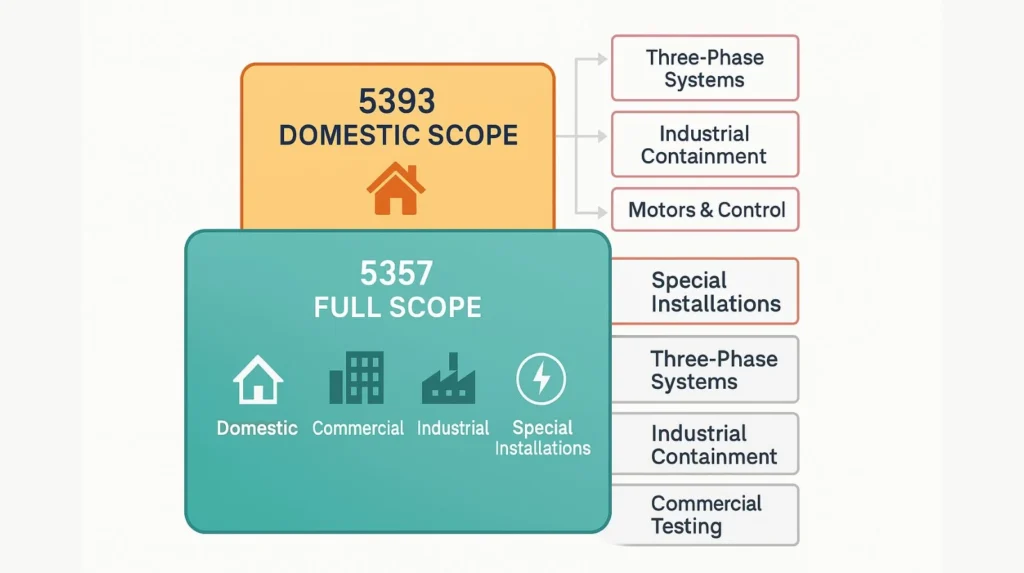
The comprehensive comparison across electrical training programmes:
| Feature | 5393 Domestic Electrician | 5357 Installation/Maintenance |
| Duration | 36 months (3 years) | 48-54 months (4-4.5 years) |
| Assessment | Portfolio + AM2D | Portfolio + AM2/AM2S |
| Scope | Dwellings only | All environments |
| Three-Phase | Not covered | Full coverage |
| Industrial Containment | Excluded | Steel conduit, tray, ladder |
| Motors & Control | Excluded | Full installation & fault-finding |
| Testing Authority | Domestic EIC/EICR only | Commercial & industrial EICRs |
| End Card | Domestic Electrician Gold | Installation Electrician Gold |
| JIB Grading | Not applicable (domestic only) | Electrician / Approved Electrician |
Permitted Scope of Work: What You Can Actually Do
The scope limitations aren’t just about training depth. They’re defined by legal competence, insurance coverage, and industry certification requirements.
5393 Domestic Electrician – Permitted Work
Residential installations:
House rewires (single-phase only)
Consumer unit installation and replacement
Lighting, socket, and cooker circuits
Immersion heaters and electric showers
Domestic EV chargers (7kW single-phase with additional short course)
Smoke and heat detector systems (domestic grade)
Testing and certification:
Initial Verification (EIC) of own new domestic work
Minor Works Certificates for domestic alterations
Basic Electrical Installation Condition Reports (EICRs) for single-phase dwellings
Qualified Supervisor status:
Can act as QS for Domestic Installer schemes (NICEIC/NAPIT Domestic)
Limited to Part P self-certification in homes
5393 Domestic Electrician – Prohibited Work
Commercial installations:
Office fit-outs, retail premises, restaurants
Schools, nurseries, medical facilities
Warehouses, workshops, light industrial units
Commercial landlord supplies and communal areas
Industrial environments:
Factory installations and maintenance
Data centres and server rooms
Agricultural installations
Processing plants and heavy industrial sites
Specific systems:
Three-phase distribution boards and busbar chambers
Motor installations, starters, and variable speed drives
Industrial control panels and relay logic
Commercial emergency lighting (central battery systems)
Commercial fire alarm installation (addressable systems)
Industrial SWA distribution and panel feeding
High-bay lighting and industrial containment
Insurance implications: Public Liability and Professional Indemnity insurance for domestic electricians typically contains explicit exclusions for “work on commercial, industrial, or agricultural premises.” Claims arising from prohibited work would be rejected, leaving the individual personally liable.
5357 Installation/Maintenance Electrician – Full Scope
Domestic work: All work permitted to 5393 holders plus:
Whole-house smart home integration
Complex lighting control systems
Integrated renewable energy systems (PV with battery storage)
Commercial work:
Complete office and retail fit-outs
Commercial distribution boards (single and three-phase)
Small power and lighting in all commercial premises
Till and point-of-sale electrical infrastructure
Commercial kitchen installations
Shop frontage and signage electrical work
Industrial work:
Factory maintenance and installation
Motor installations up to specified ratings
Industrial control systems and starter panels
Production line electrical distribution
Warehouse and logistics centre installations
Process control wiring and sensor integration
Specialist systems (with additional training):
Commercial EV rapid charging hubs (50kW+ DC)
Solar farms and large-scale PV installations
Industrial heat pump systems and HVAC integration
Building Management Systems (BMS) integration
Emergency lighting (all types)
Fire alarm systems (with FIA certification)
Testing and certification:
Commercial EICRs (with C&G 2391-52 qualification)
Periodic Inspection and Testing across all sectors
Industrial installation commissioning
Three-phase system verification
Qualified Supervisor status:
Can act as QS for full NICEIC/NAPIT Approved Contractor schemes
Covers domestic, commercial, and industrial work
Required for supervisory and management positions
The Evidence Barrier: Why Upgrading Is Nearly Impossible
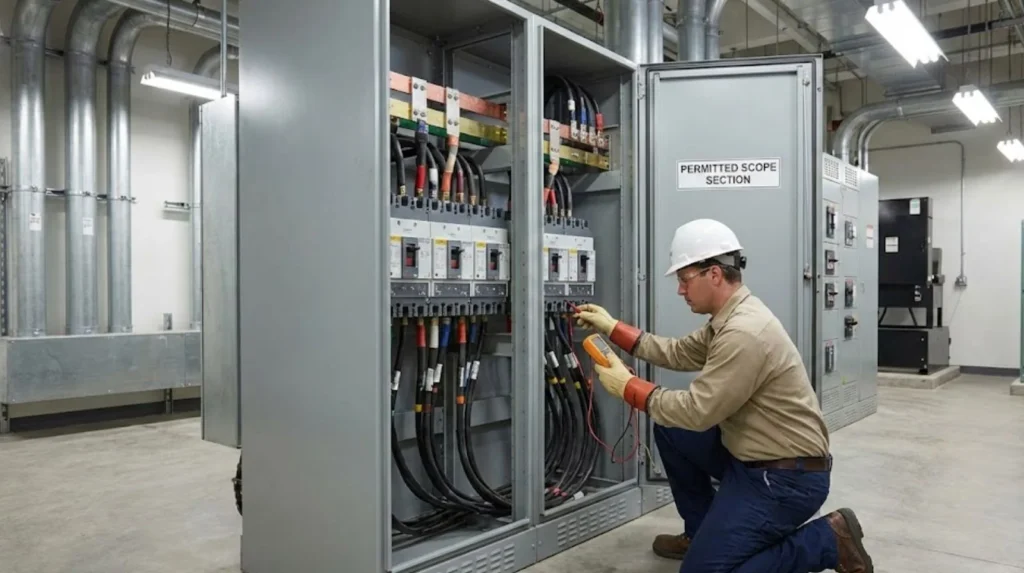
This is where the career trap becomes apparent. The NVQ evidence requirements create a structural barrier that prevents domestic apprentices from easily upgrading to full Installation Electrician status later.
5357 Portfolio Evidence Requirements
To achieve the Level 3 NVQ in Installation or Maintenance (5357), apprentices must provide documented photographic and written evidence of:
Installation work:
Steel conduit installation and bending (90° bends, sets, saddles)
Cable tray and cable ladder installation
Three-phase distribution board termination and testing
SWA cable installation, glanding, and earthing
Motor installation and starter wiring
Control panel wiring and relay logic
Testing and commissioning:
Three-phase system testing (insulation resistance, continuity, RCD testing)
Earth fault loop impedance on polyphase circuits
Prospective fault current calculations and verification
Functional testing of motor control circuits
Diverse environments:
Documented work in domestic settings
Documented work in commercial premises
Documented work in industrial or agricultural settings
Thomas Jevons, our Head of Training with 20+ years of experience, explains the problem:
"The NVQ evidence barrier is real. To complete a 5357 portfolio, you need documented proof of steel conduit installation, three-phase panel terminations, and SWA cable work. A domestic apprentice legally can't obtain this evidence because they're not competent to work on those systems unsupervised. It creates a genuine career trap."
Thomas Jevons, Head of Training
The Catch-22 for 5393 Holders
The upgrade problem:
Need evidence from commercial/industrial work to complete 5357 portfolio
Can’t legally work unsupervised on commercial/industrial systems without 5357 competence
Employers won’t hire without Gold Card (which requires completed 5357)
Insurance won’t cover non-competent work on commercial systems
Must find willing employer to provide supervised commercial experience while building portfolio
Most employers prefer hiring qualified 5357 graduates rather than supervising 5393 upgraders
The bridging assessment route: Some providers offer “Experienced Worker Assessment” routes allowing 5393 holders to pursue 5357 later. This requires:
Finding employment in a commercial or industrial environment
Working under close supervision while building portfolio evidence
Paying for additional assessment (often £2,000-£3,000)
Taking AM2E (Experienced) or AM2S practical exam
Typically 12-18 months to complete while working full-time
The practical reality: Many 5393 holders who attempt to upgrade later report being unable to secure the necessary commercial experience. Employers hiring for commercial roles specifically request “NVQ Level 3 Installation (2357/5357)” and reject domestic-only applicants. This forces a restart of the full apprenticeship with a different employer, effectively wasting 3 years.
5393 Portfolio – Limitations
The 5393 portfolio requires evidence of domestic work only:
Single-phase consumer units
Domestic lighting and socket circuits
Twin and earth cable installation
PVC trunking and capping
Basic testing and initial verification
What’s missing: Three-phase experience, industrial containment methods, motor installations, commercial distribution, SWA cable work, complex fault diagnosis. These gaps make the 5393 portfolio insufficient for upgrading to 5357 without essentially starting fresh.
Earnings and Labour Market Demand
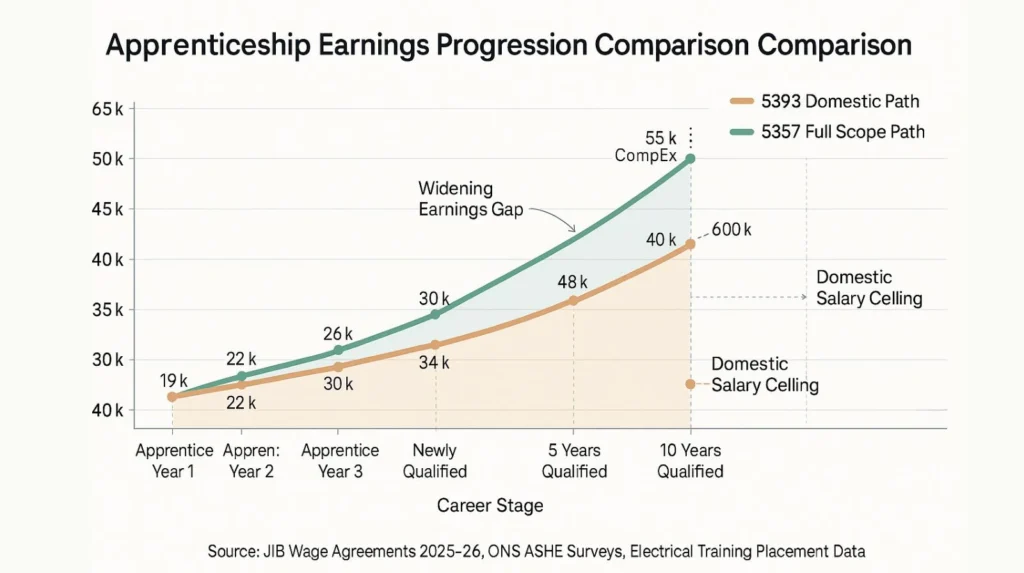
The pay gap between domestic-only and full-scope electricians is substantial and well-documented across multiple data sources.
Apprentice Rates
| Apprentice Year | 5393 Domestic | 5357 Installation/Maintenance |
| Year 1 | £6.40 – £9.00/hour | £7.00 – £10.50/hour (JIB rates apply) |
| Year 2 | £8.00 – £11.00/hour | £9.50 – £12.50/hour |
| Year 3 | £10.00 – £13.00/hour | £12.00 – £15.00/hour |
| Year 4 | N/A (complete at 3 years) | £14.00 – £16.50/hour |
JIB apprentice rates 2025: First-year apprentices on 5357 programmes with JIB-registered employers earn structured rates starting at £7.83/hour, rising to £15.34/hour by Year 4. 5393 apprentices rarely benefit from JIB rates as most employers are small domestic contractors outside the JIB structure.
Newly Qualified Earnings (PAYE)
5393 Domestic Electrician:
Entry salary: £28,000 – £32,000 annually
Regional variation: North £26,000-£30,000, Midlands £28,000-£32,000, South £30,000-£34,000, London £32,000-£36,000
5357 Installation Electrician:
Entry salary: £32,000 – £38,000 annually
Regional variation: North £30,000-£36,000, Midlands £32,000-£38,000, South £36,000-£42,000, London £38,000-£45,000
JIB Electrician grade: £38,742 base (2025 rates, £18.80/hour standard 40-hour week, London +£3-£5/hour)
Experienced Electrician Earnings
5393 Domestic Route:
5-10 years experience: £32,000 – £38,000
Ceiling: £35,000 – £40,000 (rarely exceeds £42,000)
Self-employed domestic: £180-£220 per day (regional variation)
5357 Installation Route:
5-10 years experience: £42,000 – £52,000
With C&G 2391 testing qualification: £45,000 – £55,000
With specialist skills (CompEx, EV, PV, controls): £50,000 – £65,000+
JIB Approved Electrician: £42,952 base (2025 rates, £20.84/hour)
Self-employed commercial: £250-£350 per day
Contract roles (data centres, industrial maintenance): £280-£400 per day
Joshua Jarvis, our Placement Manager, regularly sees this gap:
"Domestic-only electricians hit a hard earnings ceiling around £35,000-£40,000 because homeowners only pay so much. The commercial and industrial sectors pay significantly more - £42,000-£55,000+ for experienced electricians - but those opportunities require the full 5357 qualification and Gold Card."
Joshua Jarvis, Placement Manager
Regional Earnings Breakdown
| Region | 5393 Domestic (Experienced) | 5357 Installation (Experienced) | Gap |
| North | £32,000 – £38,000 | £38,000 – £48,000 | £6,000 – £10,000 |
| Midlands | £34,000 – £40,000 | £42,000 – £52,000 | £8,000 – £12,000 |
| South | £36,000 – £42,000 | £45,000 – £55,000 | £9,000 – £13,000 |
| London | £38,000 – £45,000 | £48,000 – £65,000 | £10,000 – £20,000 |
Why the gap exists:
Commercial and industrial contracts pay higher rates due to complexity and risk
Gold Card requirement restricts domestic-only electricians from accessing these contracts
Testing qualification (C&G 2391) typically adds £5,000-£10,000 to earning potential
Domestic market is highly competitive and price-sensitive
Commercial roles often include premium rates for overtime, shift work, and specialist skills
Employer Perception and Hiring Preferences
The labour market reality shows a clear preference for 5357-qualified electricians across the commercial and industrial sectors.
Major M&E Contractor Requirements
Tier 1 and Tier 2 mechanical and electrical contractors (firms like NG Bailey, T-Clarke, Crown House Technologies, Briggs & Forrester) almost exclusively hire 5357 graduates. Job advertisements explicitly state:
Typical requirements:
“NVQ Level 3 Electrical Installation (2357/5357) essential”
“ECS Gold Card (Installation Electrician) required”
“AM2/AM2S qualified – no domestic-only applicants”
“Experience across commercial and industrial environments”
“Ability to work on three-phase distribution systems”
5393 applicants: Routinely rejected from commercial roles. HR systems filter out Domestic Electrician cards during pre-screening. Even where technical ability might suffice, insurance and client contract requirements mandate Installation Electrician Gold Cards.
Housing Association and Domestic Contractors
5393 holders find employment primarily with:
Housing associations (Clarion, Peabody, L&Q) for social housing maintenance
Small domestic electrical contractors (1-5 employees)
Regional house-building firms (new-build domestic installations)
Domestic maintenance and repair companies
Market size: The domestic-only sector represents approximately 30% of total UK electrical work by value. The remaining 70% (commercial, industrial, infrastructure, specialist installations) requires 5357 competence.
Industry Sentiment
Employer feedback (paraphrased from industry forums and recruitment discussions):
"We won't take the risk on domestic-only electricians for site work. Our insurance requires Gold Card installation electricians, and our clients audit competence. A Domestic card doesn't meet the standard."
Regional M&E contractor, Midlands
"Domestic apprentices often struggle with the site discipline required in commercial environments. They haven't been trained on permit-to-work systems, isolation procedures for complex panels, or coordination with other trades."
Industrial maintenance manager, Manufacturing sector
"The 5357 gives you versatility. We need electricians who can work on a house rewire Monday, a commercial office fit-out Tuesday, and factory maintenance Wednesday. Domestic-only limits our ability to deploy labour flexibly."
Multi-sector electrical contractor, South East
Graduate Outcomes
5357 Installation/Maintenance:
Near 100% employment rate post-qualification
Average 3-5 job offers upon completing AM2
Ability to choose between PAYE stability and higher-earning CIS contract work
Clear progression to testing roles, supervisory positions, specialist sectors
5393 Domestic Electrician:
Good employment in domestic sector (housing associations, small contractors)
Limited mobility between employers due to restricted scope
Difficulty accessing commercial roles without 5357 upgrade
Career progression primarily through self-employment (starting own domestic business)
Career Progression Pathways
The long-term trajectory of each standard differs fundamentally.
5393 Domestic Electrician Progression
Typical career path:
Years 1-3: Apprenticeship with domestic contractor or housing association
Years 4-6: Qualified domestic electrician, building experience
Years 7-10: Senior domestic electrician or team leader (domestic projects only)
Years 10+: Self-employed domestic contractor or QS for Domestic Installer scheme
Barriers to advancement:
Cannot progress to commercial or industrial supervisory roles
Cannot become QS on Approved Contractor schemes (requires full scope competence)
Cannot access testing and inspection roles in commercial sector (C&G 2391 requires diverse experience)
Cannot move into specialist sectors: EV infrastructure, solar farms, data centres, industrial maintenance, CompEx hazardous areas
Earning ceiling around £40,000-£50,000 even with 20+ years experience
The self-employment route: Many 5393 holders progress by starting their own domestic electrical businesses. This provides more earning potential (£45,000-£60,000+ possible with high workload and efficiency) but still restricts work to residential markets. Commercial tenders require Installation Electrician QS status, excluding domestic-only contractors.
5357 Installation/Maintenance Progression
Typical career path:
Years 1-4: Apprenticeship across diverse environments
Years 4-6: Qualified electrician, working across domestic, commercial, industrial
Years 6-10: Pursuing specialist qualifications (C&G 2391, CompEx, EV, PV, HV awareness)
Years 10-15: Approved Electrician, Supervisor, or moving into specialist sectors
Years 15+: Project Manager, Contracts Manager, QS on Approved Contractor scheme, or specialist roles (£60,000-£85,000+)
Advancement opportunities:
JIB Approved Electrician status (with C&G 2391 + 2 years experience)
Electrical Supervisor / Foreman roles
Testing and Inspection Specialist (commercial landlord EICRs, periodic inspection contracts)
EV Charging Infrastructure Specialist (commercial rapid charging hubs, fleet installations)
Solar PV and Battery Storage Specialist (farms, commercial rooftops, grid-connected systems)
CompEx certification for hazardous areas (oil & gas, chemical processing, pharmaceutical) – £60,000-£90,000+ roles
High Voltage Authorised Person (with HV switching training) – £55,000-£75,000
Building Management Systems (BMS) and controls engineering – £50,000-£70,000
Data centre electrical maintenance – £50,000-£80,000
Electrical Project Manager – £55,000-£85,000
Electrical Contractor (self-employed with full scope capability) – £70,000-£120,000+ possible
The key difference: The 5357 aligns with the entire JIB grading structure (Electrician → Approved Electrician → Technician → Design Technician), providing formal career progression with wage increases at each level. The 5393 exists outside this structure, creating a distinct lower-tier pathway.
Future Industry Trends and Net Zero Implications
The electrical industry is undergoing rapid transformation driven by decarbonisation targets, and this significantly affects the value of each apprenticeship standard.
Green Energy Infrastructure Demands
Electric Vehicle (EV) charging:
Domestic 7kW chargers: 5393 sufficient (with additional EV course)
Commercial rapid charging hubs (50kW-350kW DC): Requires three-phase competence and commercial certification (5357 essential)
Fleet charging installations: Three-phase distribution, load management systems (5357 essential)
Heat pumps:
Domestic air-source heat pumps: 5393 can install electrical side (single-phase)
Commercial ground-source and air-source installations: Require integration with BMS, three-phase supplies, complex controls (5357 essential)
Industrial heat recovery systems: Exclusively 5357 scope
Solar PV and battery storage:
Domestic rooftop PV (<4kW): 5393 can install with additional training
Commercial rooftop and ground-mounted arrays: Three-phase grid connection, G99 compliance (5357 essential)
Solar farms and community energy projects: Industrial-scale installations (5357 essential)
The growth sectors: Government targets include 600,000 heat pump installations annually by 2028, 300,000 public EV charge points by 2030, and massive expansion of grid-connected renewable generation. The majority of this work falls outside 5393 scope.
Building Safety Act and Competence Tightening
Following the Grenfell Tower fire, the Building Safety Act 2022 has dramatically increased scrutiny on competence verification. The Electrotechnical Assessment Specification (EAS) is being tightened in 2025/26 consultations.
Likely changes:
Stricter evidence requirements for Domestic Electrician status
Formal separation of Domestic QS from full Approved Contractor QS
Increased emphasis on demonstrated competence across environments for Installation Electricians
Potential restrictions on domestic-only electricians working in multi-occupancy buildings
Industry direction: The electrical trade is formally bifurcating. “Domestic Electrician” is becoming a distinct, narrower specialisation (similar to a gas installer who only does domestic boilers versus a heating engineer who works across all sectors). The 5357 Installation/Maintenance Electrician remains the industry’s “full electrician” standard.
What This Means for Apprenticeship Choices
If you’re deciding between these two standards, the choice depends entirely on your long-term goals and career expectations.
Choose 5393 Domestic Electrician if:
You’re certain you only want to work in residential properties
You’re happy with an earning ceiling around £35,000-£40,000 (potentially £50,000-£60,000 self-employed with high volume domestic work)
You want a shorter apprenticeship (3 years vs 4+ years)
You plan to work for a housing association or small domestic contractor long-term
You understand the limitations and accept you won’t access commercial, industrial, or specialist electrical sectors
You’re willing to potentially restart training later if your goals change
Critical consideration: Most 16-18 year olds choosing apprenticeships don’t yet know their full career preferences. The 5393 route closes doors that are extremely difficult to reopen later.
Choose 5357 Installation/Maintenance if:
You want the full scope of electrical work available to you
You want access to commercial, industrial, and infrastructure projects
You want earning potential of £45,000-£65,000+ including specialist roles
You value career flexibility and the ability to move between sectors
You want the industry-standard Gold Card and JIB recognition
You want access to growth sectors (EV infrastructure, solar, industrial automation, data centres)
You want progression opportunities to supervisory, testing, and management roles
You want to keep all options open while you decide which electrical sector you prefer
The versatility argument: Even if you primarily enjoy domestic work after qualifying, the 5357 gives you that option while also keeping commercial and industrial routes available. The reverse (5393 upgrading to 5357) is structurally difficult and expensive.
The Reality vs The Marketing
Training providers, employers, and government guidance don’t always emphasise the long-term implications of choosing 5393 versus 5357.
Common misconceptions
Misconception: “Both are Level 3, so they’re equivalent.” Reality: Level refers to complexity of learning, not scope of competence. A Level 3 in Dwellings is fundamentally different from Level 3 across all environments.
Misconception: “You can easily upgrade from Domestic to Installation Electrician later.” Reality: The NVQ evidence barrier makes upgrading extremely difficult. You need commercial experience to qualify, but you can’t get commercial experience without qualifying.
Misconception: “Domestic apprentices are employable everywhere.” Reality: Domestic apprentices are employable in the residential sector only. Commercial and industrial employers require 5357 + Gold Card as standard.
Misconception: “The domestic route is faster, so you start earning sooner.” Reality: You start earning qualified rates one year earlier, but hit a permanent ceiling £10,000-£20,000 below 5357 holders within 5 years.
Misconception: “All electrical work is the same once you’re qualified.” Reality: Competence, insurance, legal liability, and site access differ dramatically between the two standards.
At Elec Training, we’re transparent about these differences. The 5393 route serves a genuine purpose for apprentices who are certain about residential-only careers. But for most people entering the electrical trade, the 5357 Installation/Maintenance standard provides the comprehensive training, legal competence, and career flexibility that leads to sustainable long-term employment across the full industry.
We offer both pathways but recommend the 5357 route for apprentices who want maximum career options. Our placement network of 120+ UK contractors provides diverse work experience across domestic, commercial, and industrial environments, ensuring apprentices build comprehensive NVQ portfolios that lead to Installation Electrician Gold Cards and JIB grading.
Looking for an electrician course uk?
Call Us on 0330 822 5337 to discuss which apprenticeship standard matches your goals. We’ll explain exactly what each involves, the evidence requirements, progression pathways, earning potential at each stage, and what our placement team can do to ensure you build the portfolio needed for your chosen route. No misleading marketing. No hidden limitations. Just honest guidance on the two distinct electrical apprenticeship standards and what they actually lead to in the UK industry.
References
- Building Regulations Part P (Electrical Safety – Dwellings) – https://www.gov.uk/government/publications/electrical-safety-approved-document-p
- IET Wiring Regulations BS 7671:2018+A2:2022 – https://www.theiet.org/
- Electrotechnical Assessment Specification (EAS) 2024 – https://electrical.theiet.org/
- ST0539 Domestic Electrician Apprenticeship Standard – https://www.instituteforapprenticeships.org/apprenticeship-standards/domestic-electrician-v1-0
- ST0152 Installation Electrician / Maintenance Electrician Apprenticeship Standard – https://www.instituteforapprenticeships.org/apprenticeship-standards/installation-electrician-maintenance-electrician-v1-2
- ECS Card Scheme Requirements – https://www.ecs.co.uk/
- JIB (Joint Industry Board) Grading and Wage Rates 2025-2026 – https://www.jib.org.uk/
- City & Guilds NVQ Level 3 Electrical Installation (2357/5357) – https://www.cityandguilds.com/
- City & Guilds Level 3 Electrotechnical Services (5393) – https://www.cityandguilds.com/
- Net-JATES AM2/AM2S/AM2E Assessment Information – https://www.netservices.org.uk/
- HSE Guidance on Electrical Competence – https://www.hse.gov.uk/electricity/
- ONS Annual Survey of Hours and Earnings (ASHE) – Electrical Trades – https://www.ons.gov.uk/
Note on Accuracy and Updates
Last reviewed: 13 December 2025. This page is maintained; we correct errors and refresh sources as apprenticeship standards, EAS requirements, JIB wage agreements, and electrical regulations change. All apprenticeship details cited reflect current Institute for Apprenticeships standards as of December 2025. Salary data reflects 2025 JIB wage agreements and ONS Annual Survey of Hours and Earnings for electrical trades. Next review scheduled following EAS 2026 updates and any revisions to ST0539/ST0152 standards.
