

Are Electricians Paid Well in the UK? 2025-2030 Outlook

- Technical review: Thomas Jevons (Head of Training, 20+ years)
- Employability review: Joshua Jarvis (Placement Manager)
- Editorial review: Jessica Gilbert (Marketing Editorial Team)
- Last reviewed:
- Changes: Initial publication covering ONS ASHE 2024 data, JIB 2026-2028 pay deal analysis, and CITB demand forecasts to 2030
Introduction
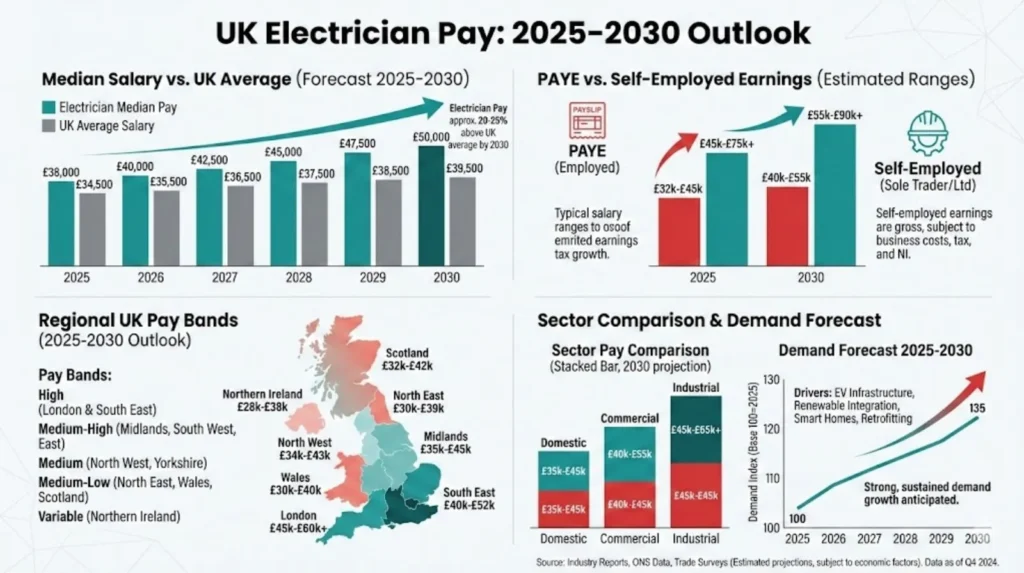
Ask whether electricians are well paid in the UK and you’ll get wildly different answers depending on who you’re talking to. A self-employed spark billing £400 per day in the South East will tell you it’s one of the best trades going. A PAYE electrician in London earning £42,000 and spending half of it on rent will tell you the numbers look better than they feel. An industrial electrician pulling 55-hour weeks with structured overtime might say the money’s there but the work-life balance isn’t.
“Good pay” doesn’t exist in a vacuum. It depends on employment type (PAYE versus self-employed versus agency), sector (domestic versus commercial versus industrial), region (London premium versus Wales baseline), and critically, whether you have access to overtime and specialist work that pushes base rates into genuinely comfortable territory.
This isn’t a soft-focus careers article. We’re using ONS Annual Survey of Hours and Earnings (ASHE) data, JIB and SJIB framework pay determinations, NAECI industrial rates, salary aggregator figures from Indeed and Reed, CITB workforce forecasts, and actual practitioner evidence from forums where electricians discuss what they really earn. The question isn’t just “are electricians paid well today?” It’s “will they remain well paid through 2030, and what does the evidence say about real-terms earnings once inflation, cost of living, and demand shifts are factored in?”
If you’re considering electrician training, this matters more than headline salary figures. The complete electrician pay breakdown for 2025-2030 shows base rates and overtime structures, but understanding whether the trade is genuinely well-compensated requires looking at wage growth, inflation, regional purchasing power, and long-term demand.

What Actually Counts as an Electrician (Definitions Matter)
Before we compare pay, we need to be clear about who we’re talking about. “Electrician” covers a wide range of roles, qualifications, and working arrangements, and earnings vary significantly across these categories.
Domestic electricians handle residential work: rewires, consumer unit changes, socket additions, EICRs. They’re often self-employed or working for small firms, registered with Competent Person Schemes like NICEIC, NAPIT, or ELECSA to self-certify Building Regulations compliance. Commercial electricians work on non-residential buildings like offices, schools, retail spaces, and general construction sites, dealing with power distribution, data cabling, lighting systems, and fire alarms. Industrial electricians operate in factories, utilities, data centres, and process plants, often working with high-voltage systems, automation, PLCs, and complex machinery installations.
Within these sectors, grading matters for pay. JIB (England, Wales, Northern Ireland) defines Electrician, Approved Electrician, and Technician grades, with Approved Electricians supervising work and Technicians handling more complex design and fault-finding. SJIB (Scotland) uses similar grading. NAECI or “Blue Book” agreements apply to industrial engineering construction on major projects. The ECS Gold Card (requiring NVQ Level 3 and AM2) is the benchmark for experienced, fully qualified electricians, while Domestic Installer cards cover entry-level residential-only work.
Employment type fundamentally shapes earnings. PAYE employed electricians receive salaries through employers with benefits like paid holidays (28 days statutory minimum), sick pay, pension contributions, and job security, often under JIB or SJIB collective agreements. Self-employed, CIS (Construction Industry Scheme), or sole traders bill clients directly or work as subcontractors, handling their own taxes. Gross earnings look higher, but you’re responsible for van costs, tools, insurance, fuel, unpaid admin time, quoting, and you have no paid leave. Agency or umbrella workers are contracted temporarily through agencies for specific projects, paid hourly via CIS, offering flexibility but little stability and often reduced take-home after umbrella company deductions.
These distinctions aren’t academic. A £40,000 PAYE salary with 28 days holiday, pension, and sick pay is worth significantly more than £40,000 CIS with none of those benefits. Understanding what type of electrician we’re comparing is essential before we can say whether the pay is “good.”
Current Pay: What Electricians Actually Earn (2024-2026)
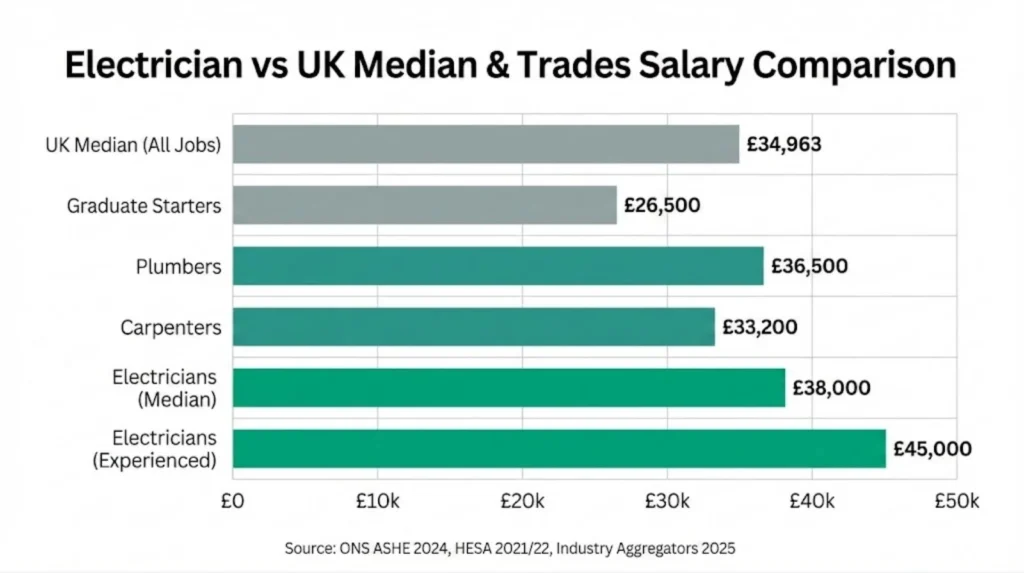
The most reliable baseline comes from the Office for National Statistics. ONS Annual Survey of Hours and Earnings (ASHE) 2024 data for SOC code 5241 (electricians and electrical fitters) shows median annual gross earnings of £38,760 for full-time employees. The mean is slightly higher at £39,249. For context, the UK median full-time salary across all occupations in April 2025 was £38,100. Electricians are slightly above the national median, not dramatically so, but consistently above.
Salary aggregators paint a similar but slightly higher picture, likely reflecting market competition and London weighting. Indeed reports an average of £22.39 per hour across the UK based on 15,100 salaries as of November 2025. Annualised at 37.5 hours per week across 48 working weeks, that’s roughly £40,400. For commercial electricians specifically, Indeed shows similar rates. Industrial electricians average £23.58 per hour, closer to £42,500 annually. Reed’s November 2025 data shows advertised salaries ranging from £39,672 to £49,689, with experienced roles toward the top end.
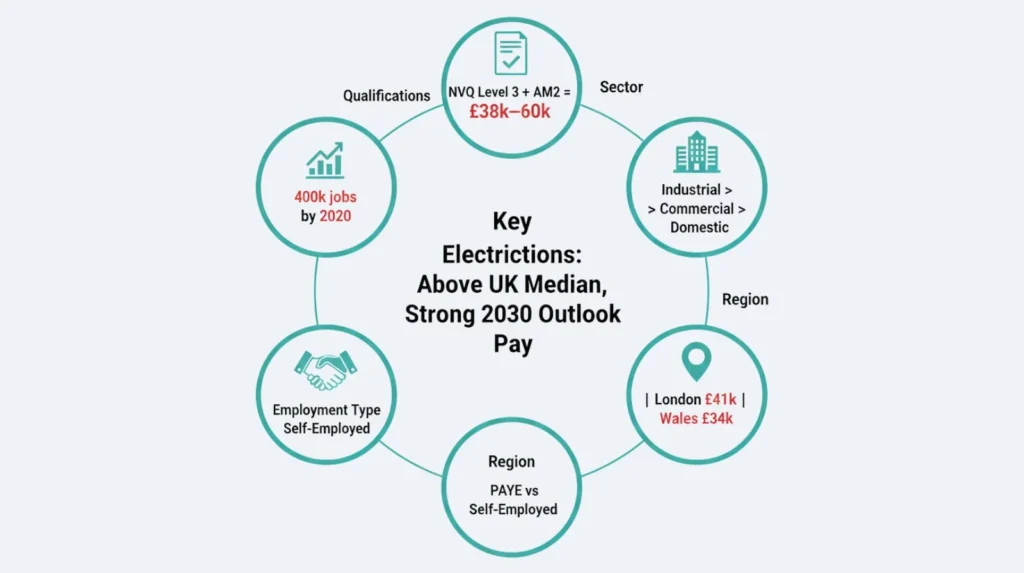
New starters typically earn £26,000 to £29,000 depending on region and whether they’ve completed their NVQ Level 3 and AM2 or are still working as improvers. Experienced electricians with Gold Cards, several years on the tools, and access to commercial or industrial work earn £40,000 to £60,000 PAYE depending on overtime availability and sector.
The UK Government’s Skilled Worker visa “going rate” for electricians is set at £38,800, a figure derived from ASHE data and used as the baseline for immigration purposes. This is a useful proxy for what the government considers a fair, skilled-trade wage in this occupation.
So in raw numbers: electricians earn slightly above the UK median, well above typical graduate starting salaries (£27,000-£30,000 according to HESA 2021/22 data), and consistently in the upper tier of traditional skilled trades. But does “above median” mean “well paid” once you factor in cost of living, inflation, and what electricians are expected to do for that money?
Framework Rates: The Pay Floor That Actually Matters
If you work under a JIB, SJIB, or NAECI agreement, your pay isn’t subject to individual negotiation or market volatility in the same way self-employed rates are. These frameworks set a guaranteed floor, and for 2026-2028, that floor is rising significantly.
The JIB agreement covering England, Wales, and Northern Ireland locked in a three-year pay deal in 2025. From January 2026, an Approved Electrician on the national rate earns £21.06 per hour. At a standard 37.5-hour week across 48 working weeks, that’s approximately £41,067 annually before overtime or allowances. JIB Technicians start at £22.45 per hour or roughly £43,777 annually. These rates increase by 4% in January 2027 and another 4% in January 2028, producing a cumulative rise of approximately 13.8% over the three-year period.
London and South East rates are higher. A JIB Technician in London will approach £26-£27 per hour by 2027, pushing annual base pay toward £50,000-£52,000 before overtime. The deal also includes increases to sick pay (£10 per week additional) and enhanced allowances for travel and lodging when working away from base.
SJIB rates in Scotland for January 2026 show Approved Electricians at £18.61 per hour (approximately £36,289 annually at 37.5 hours) and Technicians at £20.43 per hour. A 3.95% increase is scheduled for 2026, with further rises likely in 2027-2028 negotiations.
NAECI, governing industrial engineering construction, shows provisional 2025 increases of 5.5% with base rates around £18-£20 per hour depending on grade, plus London premiums of approximately £1 per hour. Annualised, this yields £35,000-£42,000 for standard grades before shift premiums, travel radius allowances, and lodging payments, which can add substantial amounts on major projects.
These framework rates are crucial because they’re guaranteed and collectively bargained. An Approved Electrician who completed their qualifications in 2024 knows their hourly rate will compound upward by nearly 14% through 2028 regardless of what happens in the wider economy. That’s the value of working under a recognised agreement rather than relying on market rates or individual negotiation.
Thomas Jevons, Head of Training with 20+ years on the tools, explains:
"The JIB framework isn't just about today's hourly rate. It's about locked-in pay progression over years. An Approved Electrician who completed their NVQ Level 3 and AM2 in 2024 knows their rate increases by roughly 13.8% through 2028, regardless of what happens elsewhere in the economy. That's the value of proper qualifications."
Thomas Jevons, Head of Training
Self-Employed Earnings: Higher Gross, More Volatile
Self-employed electricians operate in a different financial reality. Day rates and hourly charges look impressive compared to PAYE salaries, but the gross-to-net journey is complicated by overheads and unpaid time.
Typical domestic day rates range from £300 to £500 depending on region and job complexity, with an average around £335-£400 in the South East and London. Hourly rates for smaller jobs run £20-£50 per hour, averaging around £44 per hour according to trade platform data. Emergency call-outs start at £65-£80 for the first hour, rising to £120-£180 for out-of-hours or weekend emergencies.
CIS and agency rates for commercial and industrial work sit at £22-£30 per hour typically, though specialist roles or London sites can command higher. An agency electrician working 50 hours per week at £26 per hour grosses £62,400 annually across 48 weeks, but this is CIS income with no holiday pay, sick pay, or pension contributions.
Annual gross turnover for a busy self-employed electrician working 180-200 chargeable days at £335-£400 per day ranges from £63,000 to £87,000+. That looks substantially better than PAYE salaries until you deduct business expenses. Van costs (purchase or lease, fuel, insurance, maintenance), tools and test equipment, public liability insurance, professional indemnity, accounting fees, and most significantly, unpaid time spent quoting, invoicing, chasing payments, and sourcing materials typically reduce net profit to £42,000-£52,000 before personal income tax.
Forum evidence from practitioner discussions shows self-employed electricians reporting £75,000 gross with take-home after expenses closer to £50,000-£55,000. The headline figure is real, but so are the costs and risks. One bad month, a major van repair, or a client who doesn’t pay can wipe out several weeks of profit.
The gap between PAYE and self-employed net earnings is real but not as dramatic as the gross figures suggest. A top-tier PAYE electrician on £45,000 with pension, holiday pay, and sick leave is financially comparable to a self-employed spark netting £50,000-£52,000 after expenses, especially once you factor in the stability and predictability of employment.
How Electricians Compare to Other Trades and Workers
Electricians sit near the top of the traditional skilled trades pay scale. ONS and aggregator data consistently show electricians outearning most comparable trades.
Plumbers and heating engineers average £33,836 annually according to 2024 aggregator data, roughly £5,000 below the electrician median. Experienced plumbers can reach £45,000-£50,000, making them competitive at the top end, but the median electrician salary remains higher. Carpenters and joiners (no direct 2024 ONS median available in the research) generally sit in the £30,000-£35,000 range for PAYE roles, below electricians. General construction workers and labourers earn significantly less, typically £25,000-£32,000 depending on region and experience.
Compared to graduate starting salaries, electricians are well ahead. HESA data for 2021/22 shows the most common graduate salary band is £27,000-£29,999, with the median for all graduates around £30,000-£33,000 depending on subject and region. A fully qualified electrician at 25 with five years’ experience is typically earning £38,000-£42,000 PAYE with no student debt, while a graduate at 25 is often still at £27,000-£32,000 with £40,000+ in student loans.
Against the UK median full-time salary of £38,100, electricians at £38,760 are marginally above but not dramatically so. This matters because it shows electricians are paid competitively and fairly within the wider economy, not grossly underpaid, but also not in a separate high-earning tier like finance, tech, or senior management.
The verdict: electricians are among the best-paid traditional trades, ahead of most non-graduate occupations, and competitive with many graduate careers in the first decade of work.
Regional and Sector Variation: Location and Specialism Shape Earnings
Where you work and what type of electrical work you do significantly affects your earning potential. Regional variation is substantial, and sector choice determines both your base rate and your access to higher-paying specialist roles.
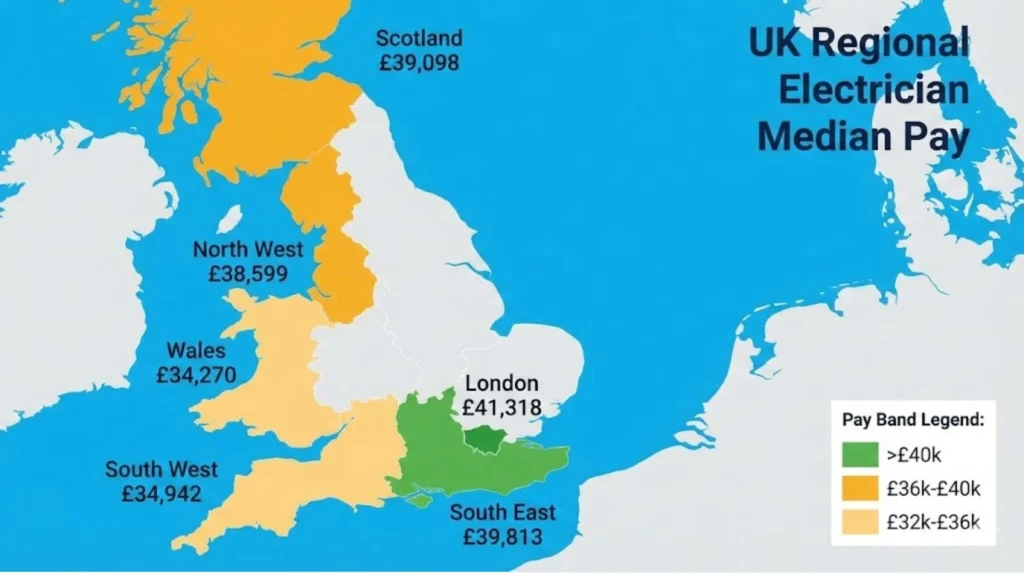
London electricians earned a median of £41,318 in 2024, the highest in the UK. The South East follows at £39,813. Scotland shows £39,098, and the North West £38,599, both above the national median. The South West drops to £34,942, and Wales sits lowest at £34,270. That’s a £7,000+ spread between the highest and lowest regions.
But headline salary doesn’t tell the full story. London’s £41,318 median looks attractive until you account for housing costs. The average London rent in 2025 is over £2,000 per month for a one-bedroom flat in many boroughs. An electrician earning £41,000 in London may have less disposable income than an electrician earning £36,000 in the North West where rent is £800-£1,000 monthly. Regional pay differences partially reflect cost-of-living differences, not pure advantage.
Sector variation is even more pronounced. Domestic PAYE electricians working for small local firms typically earn £35,000-£45,000 depending on region and experience, with limited overtime opportunities. Commercial electricians on construction sites and fit-outs earn £38,000-£50,000 PAYE with more structured overtime available during project-intensive periods. Industrial electricians in factories, data centres, utilities, and HV environments command £45,000-£60,000+ base salaries with access to shift premiums, weekend work at double time, and specialist allowances that can push total earnings significantly higher.
Industrial work offers the highest ceiling. Electricians on NAECI agreements working rotating shifts with regular weekends and night work report annual earnings of £60,000-£75,000 when overtime and shift allowances are included. Data centre electricians in the M4 corridor and around London are currently seeing particularly strong demand, with some CIS roles advertising £300+ per day flat rates.
The UK electrician salary analysis and regional comparisons breaks down exactly how location, sector, and qualifications combine to determine earning potential across different pathways.
Inflation, Cost of Living, and Real Wages (2021-2030)
Nominal pay increases don’t mean much if inflation erodes purchasing power faster than wages rise. The 2021-2024 period was brutal for real-terms pay across most occupations, and electricians weren’t immune.
Between 2021 and 2024, UK inflation spiked dramatically. CPI peaked above 10% in late 2022, driven by energy price shocks, food costs, and supply chain disruptions. Wage growth in construction and electrical trades averaged 4-6% annually during this period, well behind inflation. In real terms (adjusted for purchasing power), electrician wages fell. A 6% nominal increase in 2022 was actually a 4% real-terms pay cut when inflation hit 10%.
The JIB pay deal from 2021-2023 included modest increases around 2.5-3.5% annually, which union bodies including Unite publicly criticised as pay cuts in real terms. SJIB and NAECI deals followed similar patterns. Framework electricians maintained employment security but saw their purchasing power squeezed by rapidly rising costs in housing, energy, fuel, and food.
The 2026-2028 JIB deal changes this trajectory. With cumulative pay rises of approximately 13.8% locked in over three years, electricians under JIB agreements are positioned to regain ground. If CPI returns to the Bank of England’s 2% target as OBR forecasts suggest (2.5% in 2025, 2.1% in 2026, then holding around 2%), the 13.8% nominal increase translates to roughly 7-8% real-terms growth over the period. That’s significant recovery.
However, cost-of-living pressures remain uneven. Housing costs, particularly in London and the South East, haven’t moderated. Mortgage interest rates remain elevated compared to the 2010s. Transport costs (fuel, vehicle insurance, public transport) continue rising. Energy bills, while lower than the 2022 peak, remain substantially above 2020 levels.
The outlook to 2030 depends heavily on whether inflation stabilises and whether wage growth under framework agreements continues to outpace it. Current evidence suggests electricians under JIB/SJIB agreements will see genuine real-terms improvement through 2028, but those outside framework agreements (self-employed, non-unionised PAYE) may find cost-of-living pressures harder to overcome without strong market demand driving day rates upward.
Joshua Jarvis, Placement Manager at Elec Training, notes:
"From our placement network, the electricians who feel well-paid aren't necessarily those with the highest base rates. They're the ones with access to structured overtime: industrial shifts, commercial projects with weekend work, JIB double-time Sundays. Base salary tells you the floor. Overtime access tells you the ceiling."
Joshua Jarvis, Placement Manager
Demand, Shortages, and Future Earning Power (to 2030)
Pay doesn’t exist in isolation. It responds to supply and demand, and the evidence strongly suggests demand for electricians will remain high and likely intensify through 2030.
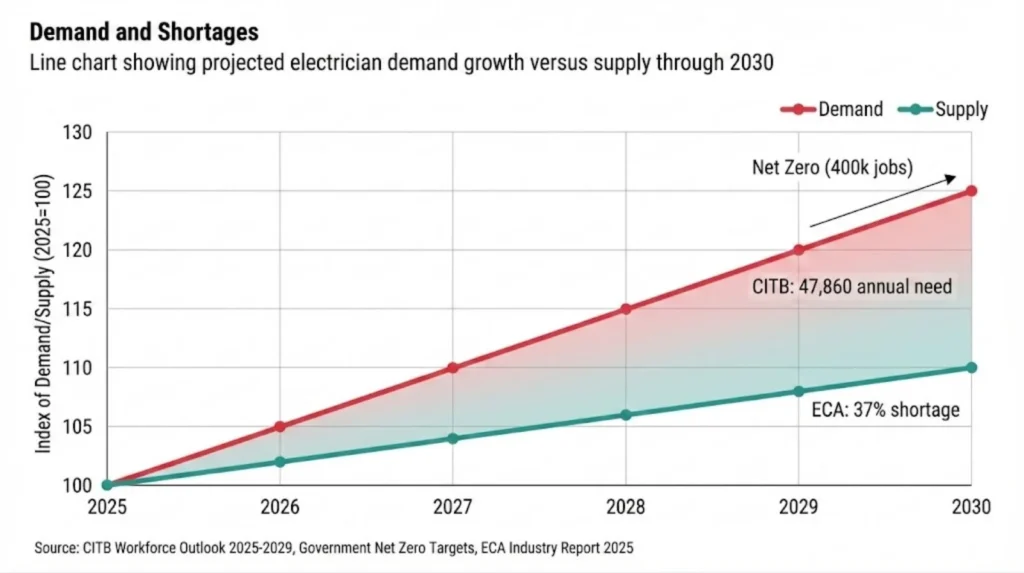
The Construction Industry Training Board (CITB) forecasts construction output to grow by 2.4% annually on average through to 2028, with approximately 47,860 additional workers needed annually across all construction trades. Electricians, carpenters (6,000 additional per year), and labourers (4,900 additional) are identified as key shortage areas.
The UK government’s net-zero commitments create structural, long-term demand specifically for electricians. The target of 400,000 additional clean energy jobs by 2030 prioritises electrical trades for EV charging infrastructure, solar panel installation, heat pump systems, smart home technology, and grid upgrades. These aren’t speculative projections. They’re backed by policy commitments, infrastructure funding, and regulatory changes requiring electrification of heating and transport.
The Electrical Contractors’ Association (ECA) reports that 37% of member firms cite electrician shortages as a primary barrier to business growth in 2025. This isn’t a temporary skills gap. It’s a persistent structural shortage caused by years of underinvestment in apprenticeships, an aging workforce (significant numbers of electricians approaching retirement), and demand growth outpacing supply.
Trade bodies including Unite, ECA, and industry commentators consistently link these shortages to upward wage pressure. When employers can’t find qualified electricians, they compete on pay and conditions. Framework agreements like the JIB deal reflect this. The 13.8% increase wasn’t granted out of goodwill. It was negotiated in a market where employers need electricians more than electricians need any specific employer.
The outlook to 2030 is clear: structural demand from net-zero policies, infrastructure investment, housing targets, and industrial electrification will keep electricians in high demand. Persistent shortages will continue pushing wages upward, particularly for those with NVQ Level 3 qualifications, Gold Cards, and willingness to work in commercial or industrial sectors where demand is strongest.
What Electricians Actually Say About Pay (Lived Experience)
Forum evidence and practitioner discussions provide texture to the statistical data. Satisfaction with electrician pay is highly context-dependent.
High satisfaction clusters around specific circumstances. Self-employed electricians consistently working at £300-£400 day rates report feeling well-compensated, particularly when they can control their schedules. One Reddit user working four days per week reported projecting £75,000 gross annually before tax with strong work-life balance. Industrial electricians with access to structured overtime and shift premiums report similar satisfaction. An automotive factory electrician noted earning £27-£30 per hour with regular 10-12 hour days, taking home £1,800-£2,000 weekly. Improvers with heavy overtime access report £1,100 per week, feeling positive about progression.
Dissatisfaction centres on feeling trapped between modest base pay and high cost of living. PAYE electricians on JIB base rates with limited overtime, particularly in London and the South East, report earning £42,000-£45,000 but feeling financially stretched. One forum user noted “pay may be 2x normal but cost of living is 2.5x normal” when discussing London rates. Another earning £650 weekly (approximately £33,800 annually) on 45 hours described it as “decent but not the best,” considering self-employment to increase earnings.
The trade-offs of self-employment create mixed feelings. High day rates are attractive, but the lack of paid holidays, sick pay, and financial security during quiet periods generates anxiety. Forum discussions frequently mention that “£250 CIS day rate looks good until you factor in no time off being unpaid.” Several practitioners note that consistent self-employed work requires strong business skills, customer management, and financial discipline beyond just technical competence.
The common thread is that electricians feel well-paid when they have either structured overtime access (industrial/commercial PAYE) or consistent, well-paid self-employed work. Those on base PAYE rates without overtime in high-cost regions feel the squeeze most acutely.
Myth vs Reality: Evidence-Based Verdicts
Let’s evaluate common claims about electrician pay using the research evidence.
“Electricians are one of the best-paid trades in the UK.” Supporting evidence: median electrician salary £38,760 exceeds plumbers at £33,836, carpenters around £30,000-£35,000, and general construction workers £25,000-£32,000. Contradicting evidence: some specialist trades (gas engineers, advanced HVAC) can match or exceed electrician earnings at the top end. Verdict: Mostly true. Electricians consistently rank in the top tier of traditional skilled trades.
“Domestic electricians struggle compared with commercial and industrial.” Supporting evidence: domestic PAYE roles typically cap at £35,000-£45,000 while commercial reaches £38,000-£50,000 and industrial exceeds £45,000-£60,000 with structured overtime. Contradicting evidence: successful self-employed domestic electricians can gross £60,000-£80,000 if consistently busy. Verdict: Mostly true for PAYE, context-dependent for self-employed.
“Self-employed sparks always earn more than PAYE.” Supporting evidence: gross annual turnover £63,000-£87,000 substantially exceeds typical PAYE salaries. Contradicting evidence: net earnings after expenses (£42,000-£52,000) are more competitive with top-tier PAYE once benefits are valued. Verdict: Partly true. Higher gross potential but not dramatically higher net, with more risk.
“Electrician wages haven’t kept up with the cost of living.” Supporting evidence: real-terms wage declines 2021-2024 as inflation outpaced nominal increases. Contradicting evidence: 2026-2028 JIB deal projects 13.8% cumulative rise, likely outpacing forecast 2% inflation, restoring real-terms growth. Verdict: True for recent past, improving outlook for framework workers.
“Becoming an electrician beats going to university, financially.” Supporting evidence: electrician median £38,760 exceeds typical graduate starting salary £27,000-£30,000, with no student debt. Contradicting evidence: top-tier graduate careers (finance, tech, law) offer substantially higher lifetime earnings. Verdict: Mostly true for starting pay and debt avoidance, context-dependent for lifetime earnings.
So Are Electricians Well Paid? The Evidence Says Yes (With Caveats)
The research supports a clear conclusion: electricians in the UK are competitively and fairly paid compared to the national median, substantially ahead of most skilled trades, and positioned to maintain or improve their relative position through 2030.
Current median pay of £38,760 sits above the UK full-time median of £38,100. Framework agreements (JIB, SJIB, NAECI) provide a guaranteed pay floor that consistently exceeds market medians, with the 2026-2028 JIB deal locking in 13.8% cumulative increases that will likely produce genuine real-terms wage growth if inflation moderates as forecast. Self-employed electricians can achieve higher gross earnings, but net income after expenses is more competitive with top-tier PAYE roles than headline figures suggest.
Sector, region, and employment type shape outcomes significantly. Industrial electricians with structured overtime and shift premiums can reach £60,000-£75,000 annually. Domestic electricians in PAYE roles without overtime may struggle at £35,000-£40,000, particularly in high-cost regions. London’s premium looks attractive until housing costs are factored in, while lower-paid regions often offer better purchasing power.
The long-term outlook is strong. CITB forecasts sustained demand for 47,860+ construction workers annually through 2029. Government net-zero commitments create 400,000 additional clean energy jobs by 2030, with electricians prioritised for EV, solar, heat pumps, and grid work. ECA reports 37% of firms can’t find enough qualified electricians. This structural shortage will continue applying upward pressure on wages.
If you’re considering electrician training, the evidence suggests it’s a financially sound decision compared to many graduate pathways, most other trades, and the general labour market. The qualifications required (NVQ Level 3, AM2, 18th Edition) aren’t shortcuts, and the training pathway takes 18 months to 3 years depending on route, but the earning potential and job security justify the investment.
Call us on 0330 822 5337 to discuss electrician training routes that lead to JIB-recognised qualifications and access to the commercial and industrial sectors where structured pay progression and overtime opportunities create the strongest long-term earnings. We’ll explain exactly what’s required, how long each stage takes, and what our in-house recruitment team can do to help secure placements with contractors offering framework agreements and genuine career development. Our Elec Training’s comprehensive electrician pay guide provides additional detail on regional variations, sector-specific earnings, and how qualifications unlock higher pay bands.
References
- Office for National Statistics (ONS) – Annual Survey of Hours and Earnings (ASHE) 2024, SOC 5241 – https://www.ons.gov.uk/employmentandlabourmarket/peopleinwork/earningsandworkinghours
- ONS – UK Median Full-Time Earnings April 2025 – https://www.ons.gov.uk/employmentandlabourmarket/peopleinwork/earningsandworkinghours
- ONS – Consumer Prices Index including owner occupiers’ housing costs (CPIH) – https://www.ons.gov.uk/economy/inflationandpriceindices
- JIB National Working Rules and Pay Determination 2026-2028 – https://www.jib.org.uk/
- SJIB Handbook and National Rates 2025-2026 – https://www.sjib.org.uk/
- NAECI Blue Book (Engineering Construction Industry Agreement) – https://www.ecia.co.uk/
- Indeed UK – Electrician Salary Data November 2025 – https://uk.indeed.com/
- Reed – Electrician Salary Listings November 2025 – https://www.reed.co.uk/
- Construction Industry Training Board (CITB) – Construction Workforce Outlook 2025-2029 – https://www.citb.co.uk/
- UK Government – Net Zero Strategy and Clean Energy Jobs Forecasts – https://www.gov.uk/
- Electrical Contractors’ Association (ECA) – Industry Reports and Member Surveys 2025 – https://www.eca.co.uk/
- Higher Education Statistics Agency (HESA) – Graduate Outcomes 2021/22 – https://www.hesa.ac.uk/
- Office for Budget Responsibility (OBR) – Economic and Fiscal Outlook – https://obr.uk/
- Checkatrade – Electrician Rates and Day Rate Data – https://www.checkatrade.com/
- City & Guilds 2357 NVQ Level 3 Electrical Installation – https://www.cityandguilds.com/
- IET Wiring Regulations BS 7671:2018+A2:2022 – https://www.theiet.org/
Note on Accuracy and Updates
Last reviewed: 13 December 2025. This page is maintained; we correct errors and refresh sources as ONS releases new ASHE data, JIB/SJIB framework agreements are updated, and CITB workforce forecasts are revised. Pay figures cited reflect 2024 ONS data and 2026-2028 JIB pay determinations. Next major review scheduled following ONS ASHE 2025 release (expected November 2026) and conclusion of 2026-2028 JIB agreement period.
