
Are Fast-Track Electrician Courses Worth It?

- Technical review: Thomas Jevons (Head of Training, 20+ years)
- Employability review: Joshua Jarvis (Placement Manager)
- Editorial review: Jessica Gilbert (Marketing Editorial Team)
- Last reviewed:
- Changes: Initial publication
Why Fast-Track Electrician Courses Are Everywhere (and Why People Are Confused)
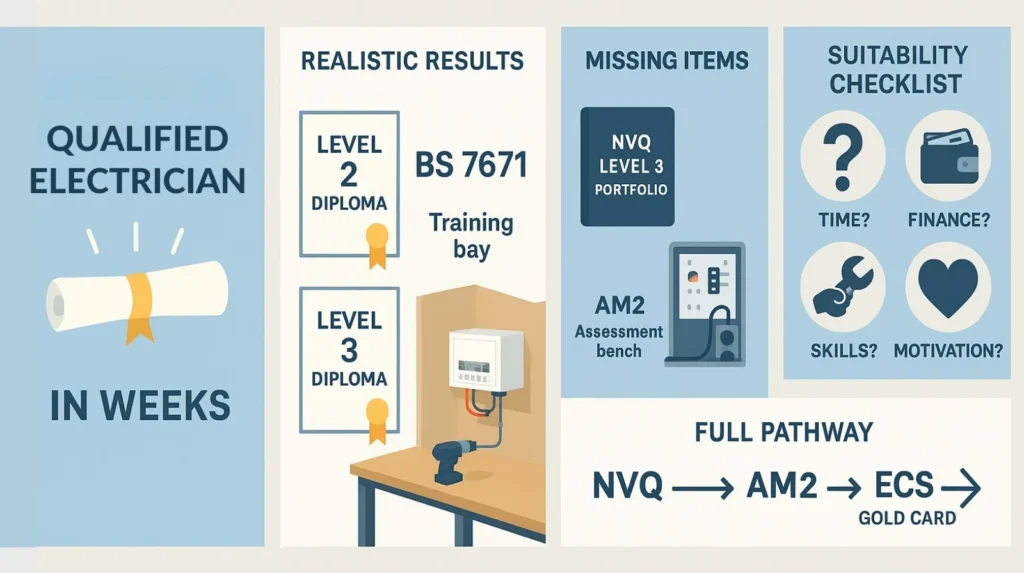
If you’ve been looking at retraining as an electrician, you’ve probably seen the adverts. “Become an electrician in 4 weeks.” “Fast-track to a qualified electrician career.” “Gold Card in 12 weeks.” They’re everywhere, especially on social media and Google search results.
The UK has a massive skills shortage in the electrical sector. The electrical workforce in England has declined by 26.2% since 2018, dropping from 214,200 to just 158,000 workers. The ECA estimates we need around 12,000 new qualified electricians every year just to meet demand, and around 40,000 people are currently working in electrical roles without the appropriate qualifications.
For adults looking to retrain quickly, these fast track electrician course options seem like the perfect answer. You’ve got bills to pay, you can’t afford to spend four years on an apprenticeship earning £15,000 a year, and these courses promise you can be working as an electrician in weeks, not years.
But here’s where it gets confusing. Scroll through any electrician forum, and you’ll find experienced sparks calling fast-track courses “six-week wonders” and warning people away. You’ll see stories of learners who spent thousands, finished their course, and then couldn’t get hired. You’ll also find people defending fast-track routes, saying they used them as a stepping stone and now have decent careers.
So what’s actually going on? Are fast-track electrician courses worth it, or are they a waste of money?
This article breaks down exactly what fast-track courses are, what they can and cannot do for your career, and who they actually suit. No hype, no sales pitch. Just the evidence from training providers, employers, regulators, and electricians themselves.
What "Fast-Track" Really Means (Based on Actual Data)
Let’s start with definitions, because “fast-track” isn’t an official qualification term. It’s a marketing label used by private training providers.
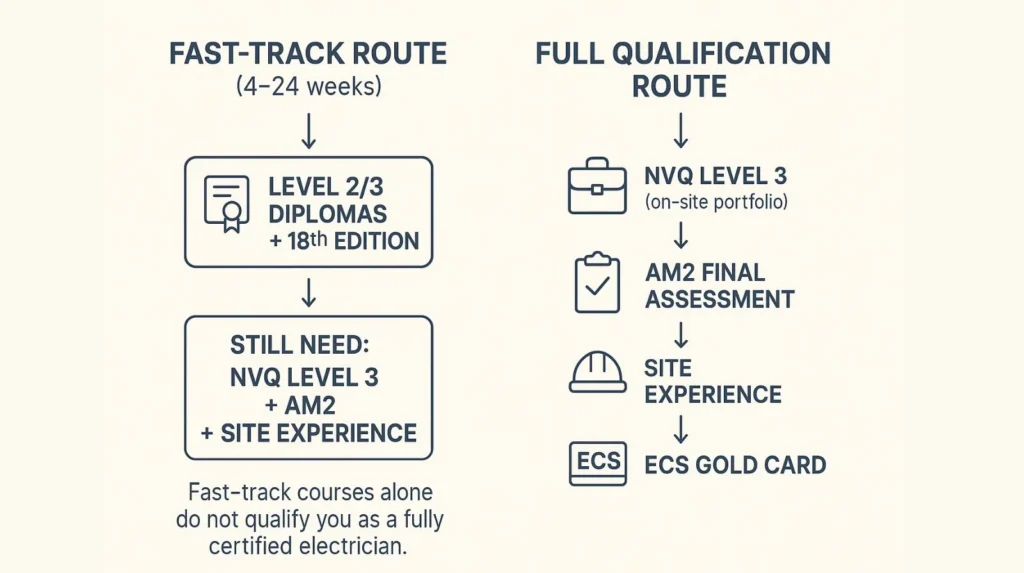
Fast-track electrician courses typically run from 4 to 12 weeks for intensive full-time blocks, or up to 24 weeks for part-time formats. You’ll see them advertised under various names: “intensive electrician course,” “adult career-change electrician training,” “domestic installer fast-track,” or just “short course.”
What’s usually included:
City & Guilds Level 2 and Level 3 diplomas (often the 2365 series)
18th Edition Wiring Regulations (BS 7671)
Inspection and Testing (2391)
Sometimes Part P Domestic Installer registration
Classroom theory covering electrical science, regulations, and calculations
Practical training in simulated bays with consumer units, circuits, and test equipment
Exams leading to diplomas or certificates
What’s typically NOT included:
NVQ Level 3 (2357) portfolio requiring on-site evidence
AM2 or AM2S end-point practical assessment
ECS Gold Card eligibility (which requires the above)
Guaranteed supervised work experience
Actual employment
Some providers offer “fast-track NVQ” options with portfolio building or placement support, but these still require subsequent months or years of site work to complete.
The key point: fast-track courses deliver classroom qualifications and basic practical skills. They’re an entry point into the electrical industry, not a complete route to being a fully qualified electrician. That’s not necessarily a problem, provided you understand what you’re buying. The issue is that the marketing headlines often say one thing, while the small print says something very different.
What "Fully Qualified Electrician" Actually Means (Using Official Sources)
This is where the confusion starts. What does “fully qualified” actually mean in the UK?
According to official sources (IET, National Careers Service, JIB, and ECS), a fully qualified electrician has typically completed:
The Traditional Apprenticeship Route:
3 to 4 year apprenticeship programme
Level 3 Electrotechnical qualification (e.g., City & Guilds 5357 or equivalent)
NVQ Level 3 (2357) portfolio, built over time on actual sites
AM2 or AM2S practical assessment (the final hands-on test)
ECS Gold Card (which confirms the above and allows you to work on JIB-graded sites)
Apprentices work whilst training, earning a wage (albeit lower at the start), and they’re supervised throughout. Most apprenticeships require GCSEs in Maths and English to start.
The Adult or Experienced Worker Route:
Experienced Worker Assessment (EWA) pathway
Evidence of at least 3 to 5 years of verifiable electrical work
Portfolio submission proving competence
AM2E assessment
This route can take 6 to 12 months once you have the experience
The IET states: “An electrician is generally someone who has completed a 3-4 year apprenticeship and holds a Level 3 technical and vocational qualification or Level 3 Diploma.” The National Careers Service confirms that EWA routes require a minimum of 3 to 5 years’ documented experience.
Here’s the critical bit: A Level 2 or Level 3 diploma from a fast-track course alone does not make you a fully qualified electrician. It gives you foundational knowledge and some practical skills, but it’s not the same as the NVQ Level 3 portfolio, which requires on-site evidence of competence across all units.
Thomas Jevons, Head of Training at Elec Training, puts it clearly:
"A Level 2 or Level 3 diploma from a classroom course gives you the theory and some practical skills, but it's not the same as NVQ Level 3. The NVQ requires on-site evidence of competence across all the units, and that can't be replicated in a training bay, no matter how good the facilities are."
Thomas Jevons, Head of Training
What Fast-Track Providers Promise vs What the Small Print Says
Let’s look at the gap between marketing and reality. We’ve reviewed adverts and course descriptions from multiple fast-track providers (we’re not naming them, but you’ll recognise the patterns).
Common headline promises:
“Become a qualified electrician in 4 / 6 / 8 / 12 weeks”
“Fast-track to Gold Card”
“Guaranteed work placement” or “Job guarantee” or “Guaranteed interviews”
“Fully qualified electrician fast”
“Earn up to £50k+” or “High demand, shortage of electricians”
What the small print usually says:
“You’ll need 2 years of supervised work experience before joining competent persons schemes”
“Portfolio of work required for completion after course”
“NVQ Level 3 not included in this package”
“Designed to help you achieve Gold Card with experience”
“This is Step 1 of a longer process”
Job guarantees often turn out to be “guaranteed interview,” not guaranteed employment
There’s a fundamental contradiction here. The headlines make it sound like you’ll be fully qualified and working within weeks. The disclaimers make it clear you won’t. To be fair, some providers are more upfront than others, but the overall advertising approach creates unrealistic expectations for people who don’t know how the UK qualifications system works.
What the Regulators, Schemes, and Trade Bodies Actually Say
So what do the official organisations say about fast-track training?
Gov.uk, HSE, and Building Regulations Part P emphasise that competence is required for notifiable electrical work. Competent persons schemes (like NICEIC, NAPIT, ELECSA) require proper qualifications, work experience, and registration. None of them describe fast-track courses as shortcuts to competence. They all stress duties under BS 7671 and the need for proven skills.
NICEIC and NAPIT both require electricians to demonstrate qualifications, experience, insurance, and compliance with BS 7671 before granting membership. Their assessors audit real work. Neither organisation promotes or endorses fast-track training as a complete route.
JIB and ECS make it clear: JIB grading as an electrician requires an apprenticeship or equivalent experience. The ECS Gold Card requires NVQ Level 3 and AM2. There’s no fast-track version of the Gold Card.
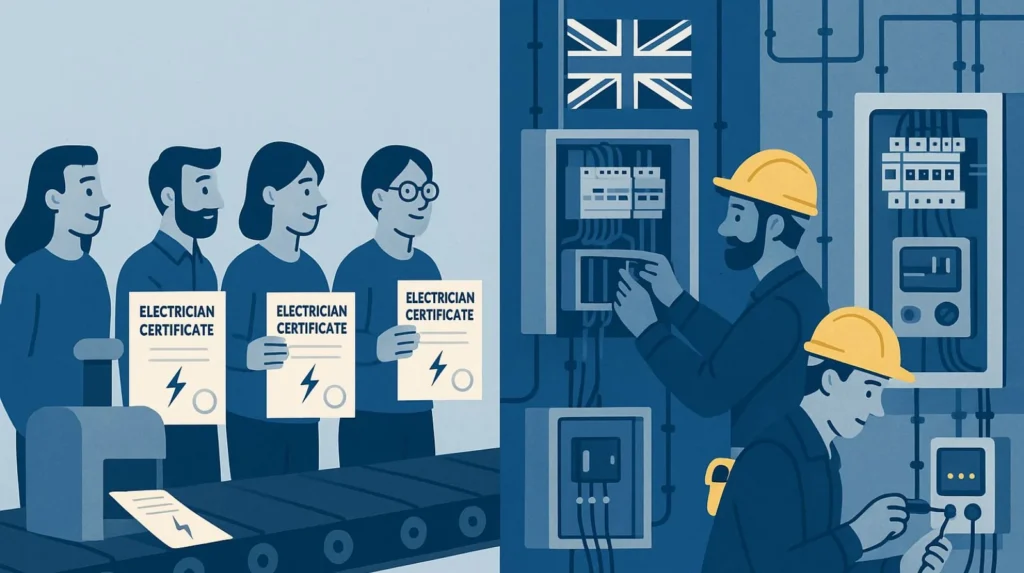
Trade bodies and training organisations have warned about “six-week wonders” lacking real competence. A statement from an electrical trade body head noted: “Short courses and ‘six-week wonders’ are no substitute for proper electrical training.” The emphasis across the board is on structured progression, employer involvement, and supervised experience.
The regulators aren’t saying fast-track courses are illegal or useless. They’re saying they don’t replace the full pathway. That’s an important distinction.
Do Fast-Track Learners Get Jobs? What the Evidence Shows
Right, this is the bit that matters. Do people who complete fast-track courses actually find work?
The evidence is mixed, and there isn’t much hard data. What we do have comes from provider case studies (which should be treated cautiously), forum discussions, and anecdotal reports.
Success stories (less common, but they exist):
Some learners use fast-track as a foundation, secure an improver or mate role, and then complete their NVQ Level 3 and AM2 over the following 2 to 3 years
Positive experiences with structured providers who support learners in finding work placements
Career-changers who went in with realistic expectations and treated the course as Step 1
One Reddit user said: “Did the fast-track, enjoyed it, found employment, but won’t be fully qualified until I finish the NVQ and AM2. It was a good foundation, but anyone thinking they’ll be qualified in weeks is kidding themselves.”
Struggles and disappointments (more frequent in forums):
Learners who completed courses and couldn’t find employers willing to hire them
“Stuck with certificates but no employer” is a recurring theme
Mis-sold expectations: “I thought I’d be fully qualified and earning £30k+ within months, but I can’t even get an interview”
Employers not recognising classroom-only qualifications
One learner on ElectriciansForums wrote: “Spent £5k on a fast-track course. Got my Level 3 diploma and 18th Edition. Can’t get a single employer to take me on because I’ve got no site experience. Wish someone had been honest with me at the start.”
What employers actually say:
Many won’t hire fast-track learners without prior experience
Some will hire as mates or labourers, but not as electricians or improvers
Reliability, attitude, and willingness to learn under supervision matter more than certificates
Joshua Jarvis, Placement Manager at Elec Training, explains:
"Reliability and willingness to learn matter more than certificates at the entry level. Employers dealing with skills shortages still won't compromise on those basics. A fast-track course might get you in the door for an interview, but what secures the placement is showing you understand you're there to gain competence, not just collect hours."
Joshua Jarvis, Placement Manager
The data gap: The ECA found that only 10% of learners who complete classroom-based electrical courses go on to progress to apprenticeships. There’s no published data specifically tracking employment outcomes for private fast-track learners. That absence of data should tell you something.
Pros and Cons (Based on What the Research Actually Shows)
Let’s be balanced. Here’s what the evidence shows about fast-track courses.
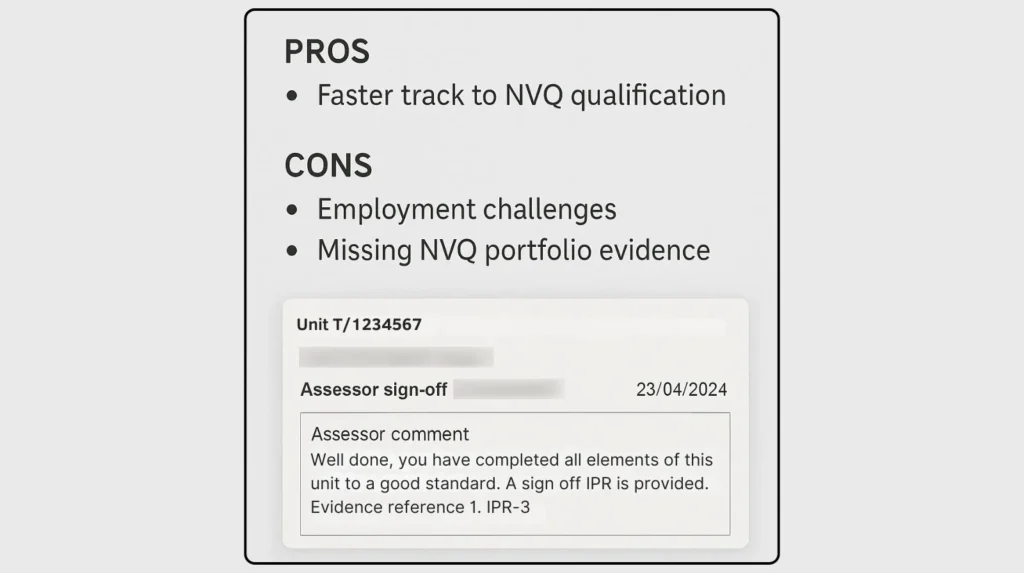
Pros:
Speed: You can complete Level 2 and Level 3 classroom qualifications in weeks or months, compared to 1 to 3 years at college
Suits career-changers: If you can’t do a traditional apprenticeship (because you’re older, have financial commitments, or need flexibility), fast-track gives you an entry point
Structured and focused: Intensive courses keep you engaged, with good workshop facilities at some providers
Can be a stepping stone: If you manage expectations and secure work afterwards, fast-track can be the start of a longer pathway
Cons:
Cost vs value: Fast-track courses cost between £2,500 and £6,000+, and that often doesn’t include NVQ, AM2, or placement support
Not a full qualification: You won’t be a qualified electrician at the end. You’ll have diplomas, but you’ll still need the NVQ, AM2, and site experience
Employment challenges: Many learners struggle to find employers willing to take them on without prior experience
Negative perceptions: A significant number of employers and experienced electricians view fast-track courses as inadequate or even damaging to the industry
Mis-sold expectations: Some learners feel regret and frustration after realising they were sold something they didn’t actually get
The pros don’t cancel out the cons. Whether fast-track is “worth it” depends entirely on whether you understand what you’re buying, and whether you have a realistic plan for what happens after the course finishes.
Cost, Finance, and Value for Money (Real Figures)
Let’s talk money. Fast-track courses aren’t cheap.
Typical fees:
£2,500 to £4,000 for basic Level 2/3 diploma packages
£4,000 to £6,000+ for “full” packages including 18th Edition, Inspection and Testing, and sometimes Part P
Some providers charge £6,090 for bundles with financing options
Finance options:
0% credit or instalment plans (e.g., £200/month)
Commercial loans (some at higher interest rates)
“Pay later” schemes
Some learners are eligible for government-funded options (like Skills Bootcamps or free Level 3 courses if you don’t already have a Level 3 qualification), but these aren’t always advertised as prominently as the paid fast-track packages.
Comparison with alternatives:
College routes: Part-time Level 2/3 courses can be free or heavily subsidised for eligible adults, but they take 1 to 3 years
Apprenticeships: Free to the learner, and you earn whilst you train. But they’re harder to access as an adult
Skills Bootcamps: DfE-funded, usually free for eligible adults, 12 to 16 weeks, and designed to feed into NVQ or EWA routes
Value complaints: Trustpilot and forum reviews show mixed feedback. Positive reviews highlight good teaching and helpful tutors. Negative reviews focus on cost vs outcome: “Spent £5k and I’m no closer to being an electrician than when I started” is a recurring theme.
The value equation depends on what you’re comparing against, and whether you have other options. If you’re paying £5k for a fast-track course that leaves you needing another 2 years of supervised work (unpaid or low-paid), that’s a significant financial commitment with no guaranteed return.
Fast-Track vs Apprenticeships vs College vs Bootcamps
So how do fast-track courses compare to other routes?
Apprenticeships:
Duration: 3 to 4 years
Cost: Free to the learner, paid by employer and government funding
Earnings: You earn a wage throughout (starting low, but increasing)
Outcome: Full NVQ Level 3, AM2, and ECS Gold Card. Immediate employment
Employer preference: Very high, because apprentices gain supervised site experience
Who it suits: School leavers or younger adults who can afford lower starting wages
FE College (Level 2/3 part-time):
Duration: 1 to 3 years
Cost: Often free or subsidised for eligible adults
Outcome: Level 2/3 diplomas, but you’ll still need a job to complete NVQ
Who it suits: Working adults who want to study alongside current employment
Perception: Structured and thorough, but slower
Skills Bootcamps (DfE-funded):
Duration: 12 to 16 weeks
Cost: Free for eligible adults (19+, specific criteria apply)
Outcome: Entry-level training designed to lead into NVQ or EWA pathways
Who it suits: Adults looking to upskill with government support
Employer links: Some bootcamps include placement support
Fast-Track Private Courses:
Duration: 4 to 24 weeks
Cost: £2,500 to £6,000+
Outcome: Level 2/3 diplomas, 18th Edition, possibly Inspection and Testing. Still need job + NVQ + AM2 afterwards
Who it suits: Career-changers with savings who want fast classroom qualifications
Employer preference: Lower than apprenticeships, unless you can demonstrate work experience
Here’s the reality: fast-track is fastest to classroom qualifications, but you’re still facing the same hurdle as everyone else when it comes to securing work and completing your NVQ. Apprenticeships take longer overall, but you’re earning and building competence the entire time. College routes are slower but cheaper. Bootcamps are free but have eligibility criteria.
There’s no shortcut that gets you qualified and employed in weeks. The question is which pathway fits your circumstances, your finances, and your ability to access opportunities afterwards.
Myths and Misunderstandings Everyone Gets Wrong
Let’s clear up the major myths, because these are what trip people up.
Myth 1: “You’ll be a fully qualified electrician in 4/6/8 weeks”
Reality: Fast-track courses provide Level 2/3 diplomas and maybe 18th Edition. Full qualification requires NVQ Level 3, AM2, and verifiable site experience. That takes 18 months to 3+ years depending on your route and how quickly you can secure work. Sources: JIB, ECS, National Careers Service, City & Guilds.
Myth 2: “Part P registration alone makes you a fully qualified electrician”
Reality: Part P is specifically for domestic notifiable work in England and Wales. It’s a subset of electrical work. Full electrician status requires broader qualifications and competence, including NVQ Level 3 and AM2. Sources: NICEIC, NAPIT.
Myth 3: “Once you’ve got 18th Edition, you’re basically an electrician”
Reality: 18th Edition is the regulations update (BS 7671). It’s essential knowledge, but it needs to be combined with Level 3 qualifications, NVQ portfolio, and AM2. Sources: IET, City & Guilds.
Myth 4: “Fast-track courses are approved by City & Guilds, so they must make you fully qualified”
Reality: City & Guilds approves the diplomas (like 2365), but the diplomas are theory and basic practice. They’re part of the pathway, not the whole thing. C&G also administers the NVQ and AM2, which are separate. Just because a course delivers C&G qualifications doesn’t mean it delivers the full package. Sources: City & Guilds, trade body warnings.
Myth 5: “If it’s on the Competent Persons register, that means full electrician status”
Reality: Competent Persons Schemes (NICEIC, NAPIT, etc.) are for specific types of work and require registration, assessment, and ongoing audits. They don’t replace JIB grading or the ECS Gold Card. You can be on a CPS register for domestic work without being a fully qualified electrician. Sources: NICEIC, NAPIT.
Myth 6: “Any Level 2/Level 3 classroom certificate is the same as NVQ Level 3”
Reality: Diplomas are classroom-based and assess theory plus simulated practical tasks. The NVQ requires real on-site evidence of competence across all units, signed off by an assessor who’s observed your work in real installations. They’re fundamentally different. Sources: City & Guilds, National Careers Service.
These myths exist because the terminology is confusing, and because some providers exploit that confusion in their marketing.
What You Should Realistically Expect from a Fast-Track Course
So, if you’re considering a fast-track course, here’s what you should actually expect.
What a fast-track course DOES give you:
Classroom knowledge of electrical science, regulations (BS 7671), and installation principles
Basic practical skills in a controlled training bay environment
Level 2 and/or Level 3 diplomas (e.g., City & Guilds 2365)
18th Edition Wiring Regulations certificate
Possibly Inspection and Testing (2391) qualification
A foundation of understanding that you can build on
What it DOESN’T give you:
Full competence to work independently as an electrician
NVQ Level 3 (2357) portfolio (unless it’s part of an extended programme with guaranteed placement)
AM2 or AM2S assessment
ECS Gold Card
Guaranteed employment or even guaranteed interviews
The experience needed to deal with real-world installations, faults, and site challenges
What you’ll still need to do after the course:
Secure employment or a work placement (this is often the hardest part)
Build your NVQ Level 3 portfolio over 12 to 24+ months of supervised site work
Pass your AM2 assessment (a practical exam that costs around £800 to £1,000)
Apply for your ECS Gold Card
Potentially complete additional qualifications like 2391 (if not already done)
Who fast-track courses are suitable for:
Career-changers who understand they’re at the beginning of a longer pathway
Adults who can’t access traditional apprenticeships but have a plan for securing work afterwards
People with existing site experience (e.g., in other trades) who need formal qualifications to progress
Learners who’ve researched realistic timelines and costs, and have savings or finance to cover the extended journey
Who fast-track courses are NOT suitable for:
Anyone expecting to be a qualified electrician within weeks or months
Learners without a clear plan for how they’ll access site work and supervision after the course
People who can’t afford the upfront cost plus the potential months or years of lower wages whilst completing NVQ
Anyone who assumes “fast-track” means they can skip the standard requirements
A fast-track course can be a good starting point, but only if you treat it as exactly that: a starting point. It’s not a shortcut, and it’s not a guarantee. It’s an entry ticket to a much longer journey.
If you go in with realistic expectations, a financial plan, and a clear idea of how you’ll secure the work experience you need afterwards, fast-track can work. If you go in thinking you’ll be qualified and earning decent money in a few months, you’re setting yourself up for disappointment.
Are fast-track electrician courses worth it? The honest answer is: it depends entirely on your circumstances and your expectations.
They’re worth it if you understand what you’re buying (a foundation, not a full qualification), if you have a plan for securing work experience afterwards, and if you can afford the financial commitment with no guaranteed return.
They’re not worth it if you’re expecting to be a fully qualified electrician quickly, if you’re relying on job guarantees that don’t exist, or if you don’t have the means to support yourself through the additional 18 months to 3 years it’ll take to complete your NVQ and AM2.
The electrical skills shortage is real. The demand for electricians is real. But the pathway to becoming a qualified electrician hasn’t changed. Fast-track courses haven’t found a magic loophole around NVQ Level 3, AM2, and supervised site experience. They’ve just packaged the classroom bit into a shorter timeframe.
If you want to explore your options for electrical training with honest guidance about timelines, costs, and what happens after you finish your classroom qualifications, call us on 0330 822 5337. We’ll explain exactly what you need, how long it actually takes, and what our in-house recruitment team can do to support you in securing placements. No hype. No unrealistic promises. Just practical guidance from people who’ve placed hundreds of learners with UK contractors.
For a realistic overview of all accelerated electrician routes, including what you need to complete after classroom training, have a look at our complete breakdown of fast-track training pathways.
References
- ECA (Electrical Contractors’ Association) – Skills Shortage Data 2023/2024
- National Careers Service (GOV.UK) – Electrician Career Profile and Routes
- IET (Institution of Engineering and Technology) – Wiring Regulations and Electrician Definitions
- JIB (Joint Industry Board) – Grading and Card Requirements
- ECS (Electrotechnical Certification Scheme) – Card Eligibility Criteria
- NICEIC – Competent Person Scheme Requirements
- NAPIT – Registration and Assessment Standards
- City & Guilds – 2365, 2357, 5357 Qualification Specifications
- HSE – Electrical Safety and Competence Guidance
- Building Regulations Part P (England & Wales) – Notifiable Work Requirements
- Reddit (r/ukelectricians, r/uktrades) – User experiences and forum discussions 2023-2025
- ElectriciansForums – Industry professional discussions 2023-2025
- Trustpilot – Training provider reviews (anonymised)
- Various training provider websites – Course descriptions and small print (anonymised, 2024-2025)
Note on Accuracy and Updates
Last reviewed: 06 December. This page is maintained; we correct errors and refresh sources as standards and regulations change. If you spot anything that needs updating, contact us at [email protected].
