There is a version of CPD that exists purely as a compliance exercise. You log 30 hours, you tick the box, you move on. Most people in the electrical sector have encountered it. Most have also encountered the reality that it does not tell you much about whether someone is actually keeping pace with what is changing in their field.
A CPD advisor operates differently. The role exists to push past the hours-logged metric and into the harder question: is this person maintaining genuine competence in a sector that has changed significantly in the last five years? With BS 7671 amendments covering EV charging, battery storage, and smart energy systems landing in close succession, that question matters more now than it has for a long time.
For context on where the financial rewards sit once you have built a proper qualification and CPD foundation, our article on the JIB wage rise 2026 covers the current pay picture in detail.
What a CPD Advisor Actually Does
The role is more specific than the title suggests. A CPD advisor reviews individual development records against the requirements of a professional body, typically the IET or the Engineering Council, and provides structured feedback on whether those records demonstrate actual maintenance of competence.
That means looking at more than a list of courses attended. It means asking whether the activities are relevant to what the individual actually does, whether the reflection recorded shows genuine engagement with the learning, and whether the plan going forward addresses the gaps that regulatory and technical change has opened up.
In practical terms, the work includes four main functions. The first is reviewing submitted CPD logs against UK-SPEC criteria or institutional requirements, checking both the quality of the reflection and the relevance of the activities. The second is gap analysis: identifying where a practitioner’s current knowledge falls short of where the sector has moved, particularly around newer areas like prosumer installations (covered in Chapter 82 of BS 7671) or the High-Risk Residential Buildings framework introduced through the Building Safety Act 2022.
The third function is strategic mapping: helping individuals align their personal development plans with where they want to go professionally, whether that is moving into inspection and testing work, taking on supervisory responsibilities, or progressing toward professional registration. The fourth is resource navigation: pointing people toward credible structured learning rather than product demonstrations dressed up as CPD.
Why the Legal Picture Has Changed
The framing that CPD is optional once you hold a qualification has never been accurate in engineering, but it has become harder to sustain in recent years. The Building Safety Act 2022 shifted the regulatory focus toward individual competence as a provable, documented thing rather than something assumed from a credential. Post-Grenfell changes placed new weight on the ability to demonstrate current knowledge through evidence. In the electrical sector, the specific legal anchor is the Electricity at Work Regulations 1989.
Thomas Jevons, Head of Training at Elec Training, is direct about what that means:
The Difference Between Qualification and Ongoing Competence
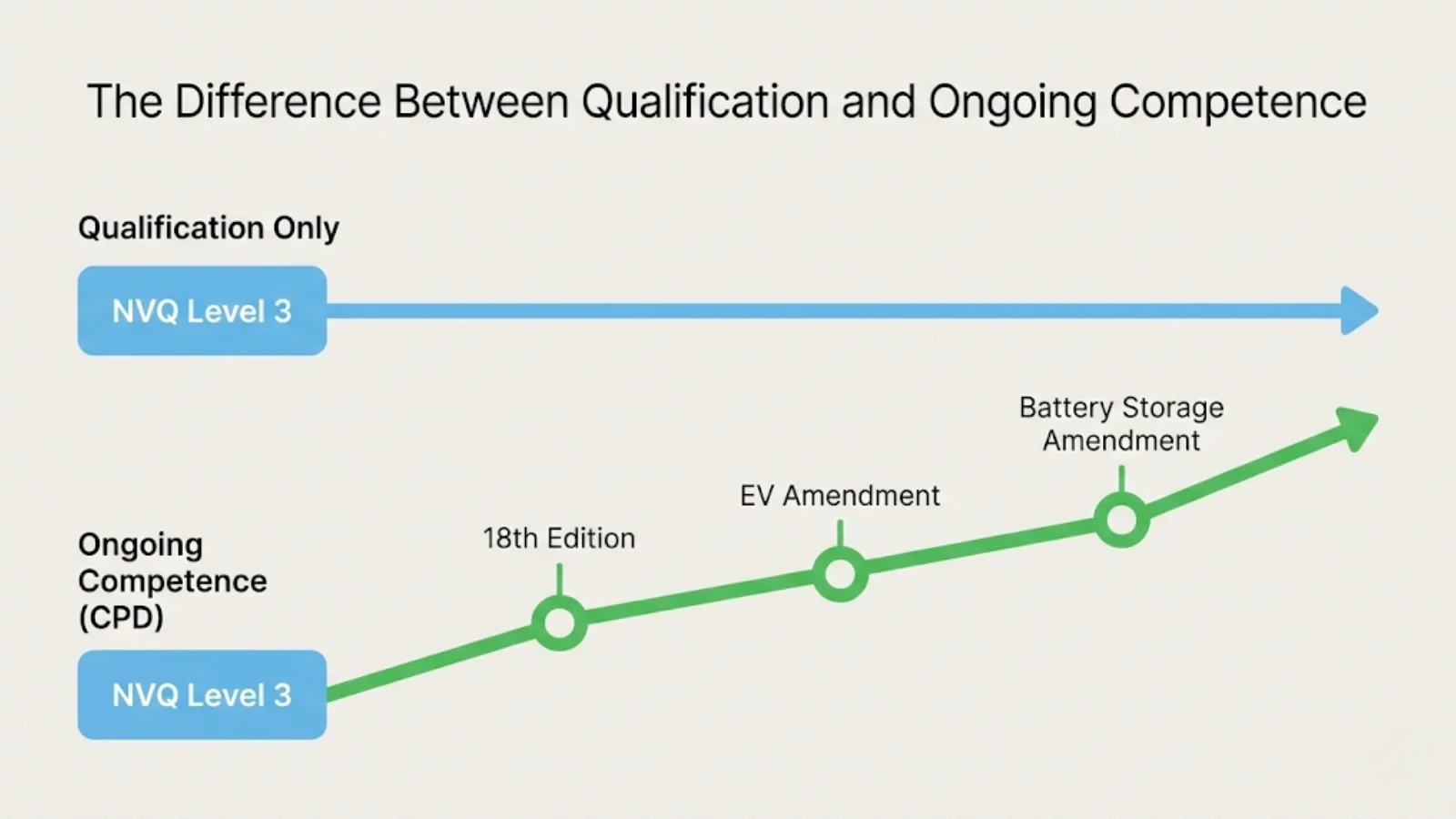
A qualification proves you met a defined standard at the point of assessment. That is its purpose, and it is a meaningful thing. The NVQ Level 3 (2357) is not easy to achieve and requires genuine demonstration of competence across a range of units. The 18th Edition certificate requires engagement with the full scope of BS 7671. These are real thresholds.
The problem is that the sector keeps moving and the qualification does not move with it. Research suggests technical knowledge can become substantially outdated within three to five years in high-growth areas. An electrician who qualified before EV charging infrastructure requirements, before the prosumer installation framework, or before battery storage guidance came into force is working from a knowledge base that has meaningful gaps. That is not a criticism. It is simply the nature of a sector where the regulatory documents are live and subject to amendment.
The Engineering Council’s UK-SPEC framework addresses this directly. Competence E4 requires all registered engineers (EngTech, IEng, CEng) to carry out and record CPD necessary to maintain and enhance competence as an ongoing condition of registration. Not a one-off requirement. A continuous one.
If you are at an earlier stage and thinking about what the foundation qualifications actually are, our electrician qualifications guide covers the full pathway from Level 2 through to Gold Card status.
CPD in the Electrical Sector Specifically
The electrical trades offer a clear example of why generic CPD guidance is not enough and why sector-specific advisory support has real value.
BS 7671 is amended on a rolling basis. The 18th Edition itself arrived in 2018, with Amendment 1 following in 2020 (primarily addressing EV charging) and Amendment 2 in 2022. Amendment 4 is expected to land in 2026, covering battery energy storage systems, Power over Ethernet installations, and updates to medical location protections. Each amendment changes what safe, compliant installation actually looks like in practice.
Then there is the EICR picture. The mandatory inspection requirements introduced in the private rented sector have created significant demand for qualified inspectors. But the competence required to inspect and correctly apply C1, C2, and C3 coding is different from, and goes beyond, the competence required to install. Moving from installer to inspector is a CPD journey in itself. The diagnostic skills, the correct interpretation of what constitutes an immediate danger versus a potential hazard, the documentation expectations: these require structured learning, not just site experience.
Certification schemes (NICEIC, ECA, NAPIT) already require evidence of relevant qualifications and ongoing CPD for supervisors and inspectors. Larger contractors are using tools like ECA’s eCOMS to maintain auditable training matrices. The infrastructure for CPD accountability is being built into the contracting environment whether individual electricians are engaging with it proactively or not.
The Path From Practitioner to CPD Advisor
The transition from practitioner to CPD advisor is a credibility-led progression. Professional bodies require the advisor to be registered themselves, typically at EngTech level as a minimum, and to model the kind of reflective CPD practice they are advising others on. It is not a role you can apply for without demonstrating that you have walked the path.
Joshua Jarvis, Placement Manager at Elec Training, has watched this trajectory play out with employers and more senior learners:
In practical terms, the route generally involves accumulating several years of post-qualification experience, achieving professional registration (EngTech is accessible for experienced electricians without a degree), and developing additional credibility through roles such as internal trainer, assessor via TAQA qualifications, or active involvement with a licensed institution. Some practitioners formalise this further through the Level 3 Award in Education and Training (AET).
The IET runs a CPD Advisor volunteer programme that provides a structured framework for this transition. It requires existing registration, demonstrated commitment to CPD, and the willingness to support others’ development through formal review and feedback. It is the kind of role that gives experienced practitioners a credible professional identity beyond the tools, without requiring a return to full-time education.
Common Myths Worth Addressing
Three things come up repeatedly that are worth clearing up directly. The first is that twenty years of experience substitutes for CPD. It does not. The Engineering Council and BS 7671 are clear that static experience, however substantial, does not satisfy the “skilled person” definition when regulatory standards have evolved significantly beyond the point of original qualification.
The second is that CPD is a degree-level requirement. It is not. The Engineering Council’s CPD policy applies to EngTech registrants in exactly the same way it applies to Chartered Engineers. The scale and nature of the activities may differ, but the obligation does not disappear at technician level.
The third is that a trade show or product demonstration is adequate structured CPD. Informal learning, including industry events and professional networking, contributes to a CPD portfolio. However, the Engineering Council’s position is clear that a portfolio needs to include structured activities with reflection and evaluation against personal objectives. Input measures such as hours attended are secondary to demonstrated outcomes.
What This Means Practically
The CITB Construction Workforce Outlook 2025-2029 projects a need for an average of 47,860 additional construction workers per year, with electrical installation trades projected to grow by around 4,300 roles. The demand is not in question. The question is which electricians are positioned to access the best opportunities as that growth plays out.
Employers are becoming more sophisticated in how they evaluate candidates. Documented CPD, professional registration, and the ability to demonstrate current engagement with regulatory change are differentiators in a market where 76% of engineering employers already report difficulty filling roles. The electricians who invest in their development records now are building an advantage that compounds over time.
At Elec Training, the NVQ pathway is priced at £10,000 and includes AM2, tutor support, and placement through our in-house recruitment team. That team makes contact with 120+ contractors daily. The qualifications are the foundation. The CPD habits you build on top of them determine where you go from there.
For a clear breakdown of what the course codes on your qualification certificates actually mean, our article on understanding electrical course codes is worth a read before you speak to anyone about next steps.
Call us on 0330 822 5337 to discuss where you are in your training and what a structured development pathway looks like from here. We will give you an straight answer about what is needed, how long it takes, and what our team can do to connect qualified people with contractors who are actively hiring.