
Becoming an Electrician at 30: Your Complete Adult Retraining Guide

- Technical review: Thomas Jevons (Head of Training, 20+ years)
- Employability review: Joshua Jarvis (Placement Manager)
- Editorial review: Jessica Gilbert (Marketing Editorial Team)
- Last reviewed:
- Changes: New comprehensive article addressing adult retraining at 30, legitimate qualification routes, realistic timelines, costs, and common pitfalls for career changers
Introduction
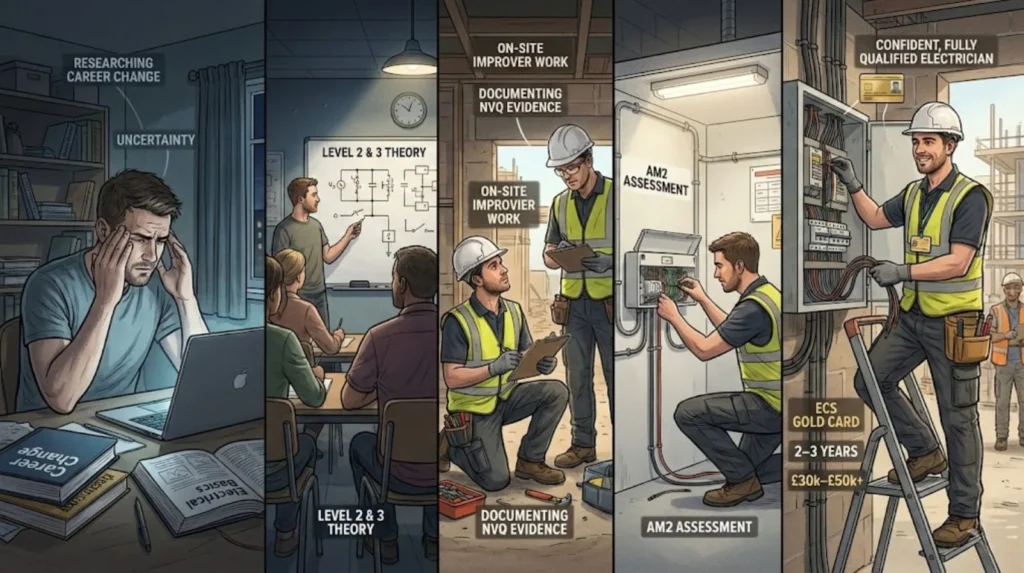
The question lands in search bars thousands of times per month: “Can I become an electrician at 30?” The short answer is yes. The longer answer is that age isn’t the barrier. Misunderstanding what “qualified” actually means, how long different routes take, and what evidence you need to work on commercial sites is the barrier.
Here’s the thing. The electrical training market is full of conflicting claims. You’ll see adverts promising “qualified in 8 weeks” next to forum posts from people saying their NVQ took 18 months. You’ll read that domestic installer courses make you an electrician, then discover most site agencies won’t accept you without an ECS Gold Card. Some providers imply theory diplomas equal job readiness. Others say apprenticeships are the only legitimate route.
For someone at 30, possibly with a mortgage, family commitments, and a stable income they’re considering leaving, this confusion creates real risk. You could spend £9,000 and 18 months on courses that don’t lead to site-recognised qualifications. You could train for domestic work only to discover it limits your earning potential and flexibility. You could start an apprenticeship at lower wages without understanding the timeline or what happens if the employer relationship breaks down.
The UK needs 15,000 new electricians over the next five years. Workforce numbers have fallen 26% since 2018. Clean energy targets will create 400,000 jobs by 2030, many requiring electrical skills. This isn’t theoretical demand. Shortages are real, salaries are rising (median £38,760 annually, with experienced electricians earning £40,000 to £50,000+), and employers increasingly accept adult entrants who understand what proper qualification involves.
This article explains the recognised routes, what each qualification actually does, realistic timelines for working adults, costs and funding options, and the pitfalls that cause people to waste time and money. It uses industry standards from the Electrotechnical Certification Scheme (ECS), Joint Industry Board (JIB), and Health and Safety Executive (HSE) guidance, not marketing claims. For comprehensive information on the complete pathway from entry to full qualification, see Elec Training’s complete guide to becoming an electrician in the UK.
What "Electrician" Actually Means in the UK
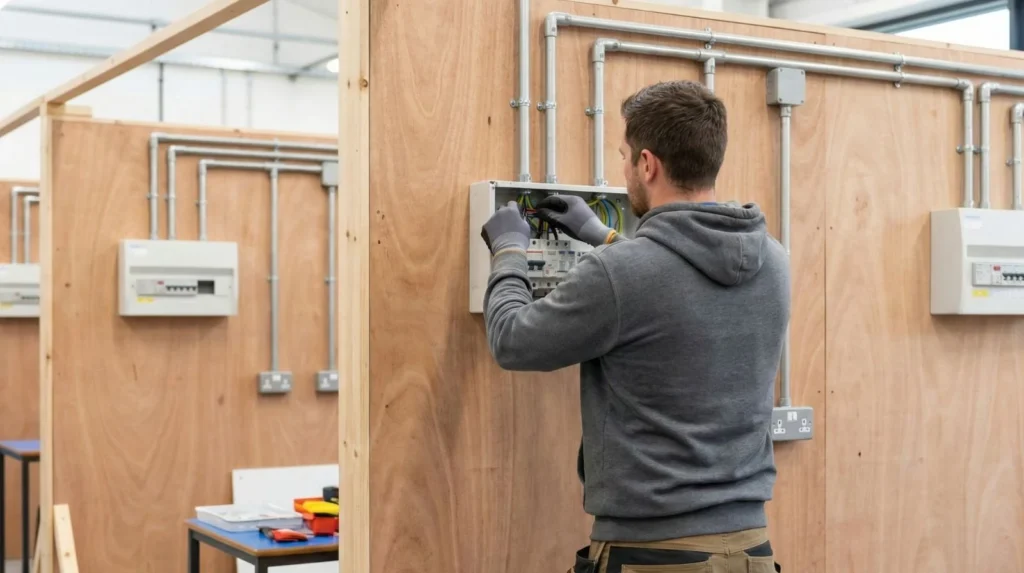
The confusion starts with the word itself. “Electrician” gets used loosely across training adverts, job boards, and qualification names. In practice, the industry recognises distinct roles with different scopes and requirements.
Domestic Installer / Domestic Electrician
Scope limited to residential dwellings (houses, flats). Work includes rewiring, installing sockets and lighting, and replacing consumer units. Can register with a Competent Person Scheme (CPS) like NICEIC or NAPIT to self-certify work under Part P (Building Regulations). Not recognised as a fully qualified electrician on commercial or industrial sites. Cannot typically hold an ECS Gold Card for Installation Electrician status.
Installation Electrician (Gold Card standard)
The industry benchmark. Commercial, industrial, and domestic scope. Capable of working unsupervised on three-phase systems, containment (conduit, trunking), and complex circuits. Eligible for ECS Gold Card (JIB Grade: Electrician). This is the primary requirement for agency work and large construction sites. Requires NVQ Level 3 (competence) plus AM2 (end-point assessment) plus Level 3 technical theory.
Maintenance Electrician
Fault-finding and upkeep in commercial and industrial settings. JIB grading applies. Emphasises competence in ongoing system maintenance rather than new installations. Similar qualification requirements to Installation Electrician but focused on preventive maintenance, diagnostics, and repair.
Approved Electrician / Technician
Higher JIB grade. Requires at least two years holding the Electrician grade plus Inspection and Testing qualification (C&G 2391). Allows supervision of others, electrical foreman roles, and specialist testing responsibilities.
When job adverts say “electrician,” they typically mean Gold Card standard, not domestic-only. Agency recruiters filter by ECS Gold Card status. Site access often requires it. Employers assume it means NVQ Level 3 plus AM2 plus 18th Edition. Understanding this distinction prevents expensive mistakes where people train for domestic work expecting it to open commercial opportunities.
The Building Blocks: What Each Qualification Actually Does
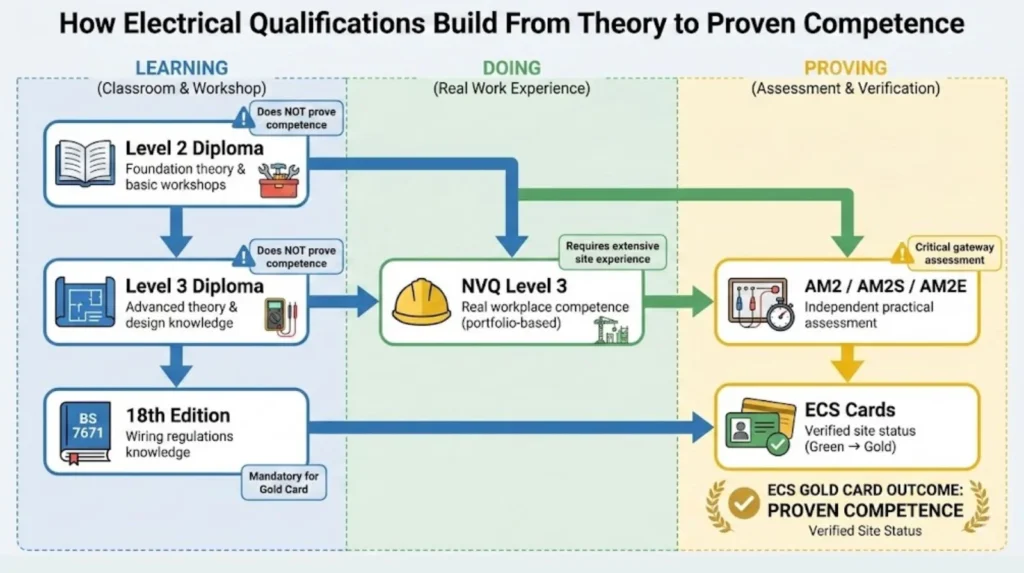
Breaking down qualifications individually prevents confusion about what proves competence versus what teaches theory.
Level 2 Diploma (e.g., C&G 2365-02)
Foundation theory and basic practical workshops. Covers electrical science, health and safety basics, inspection and testing principles. Classroom-based with some workshop practice. Typically 200 to 400 guided learning hours. Does not demonstrate workplace competence. Not sufficient for ECS Gold Card. Enables entry to Level 3 study or supervised work as a trainee.
Level 3 Diploma (e.g., C&G 2365-03)
Advanced theory including design, fault diagnosis, and inspection principles. Typically 300 to 500 guided learning hours. Still classroom-based, not workplace assessment. Provides technical knowledge required for full qualification but does not prove you can wire installations competently. Must be combined with NVQ and AM2 to achieve recognised status.
NVQ Level 3 (e.g., C&G 2357 / 2346)
The competence qualification. You must be working in the industry to complete this. You build a portfolio of evidence (photos, job sheets, witness statements) from real jobs covering installations, testing, fault-finding, and safe isolation. Assessed by a visiting officer who checks your work meets standards. Cannot be simulated in a classroom. Requires employment or placement to gather evidence. Typical duration 12 to 24 months depending on site access and job variety.
AM2 / AM2S / AM2E
The 2.5-day practical exam taken at an independent NET centre. AM2 for adult learners on standard NVQ route. AM2S for apprentices. AM2E for experienced workers (includes extra containment tasks). Simulates real-world installations, testing, fault-finding, and safe isolation under timed conditions. Pass is mandatory for ECS Gold Card. No retakes are automatic; you pay again for each attempt (£860 to £935 per sitting).
18th Edition (BS 7671)
Classroom course on UK wiring regulations. Mandatory component of being an electrician. Typically 3 to 5 days training plus exam. Proves you understand regulatory requirements. Does not prove practical competence. Holding this alone qualifies you for nothing beyond demonstrating you can read the regulations book.
ECS Cards
Proof of verified status. Green card (Labourer) for site access without electrical qualifications. Gold Card (Electrician) requires NVQ Level 3 plus AM2 plus 18th Edition. Card system controlled by JIB and ECS. Site agencies and main contractors filter job applicants by card type. Without Gold Card, you’re typically restricted to mate or labourer roles on commercial sites.
Thomas Jevons, our Head of Training with 20 years experience, explains:
"The NVQ portfolio requires evidence across specific competency units. You can't fake this with classroom simulations. Assessors need photos, job sheets, and witness statements from real installations covering fault-finding, three-phase systems, testing procedures, and containment work. If your improver role only involves pulling cables, your portfolio won't meet the breadth requirement."
Thomas Jevons, Head of Training
What "Fully Qualified" Really Means (Legally and Practically)
Industry standards define “fully qualified” clearly, but training adverts often blur this deliberately.
ECS and JIB Standard:
NVQ Level 3 (Performance / Competence)
Technical Level 3 (Theory / Knowledge)
AM2 Assessment (Independent Verification)
18th Edition (Regulatory Knowledge)
ECS Gold Card (Industry Recognition)
This combination proves you meet Electricity at Work Regulations requirements for competent persons. HSE guidance defines competence as having sufficient training, experience, and knowledge to avoid danger. Theory diplomas alone don’t demonstrate this. NVQ plus AM2 provide the evidence.
Why Domestic CPS Registration Isn’t the Same
Competent Person Schemes allow self-certification of domestic work under Building Regulations Part P. You can register after completing Level 2, Level 3, and 18th Edition without NVQ or AM2. This lets you work independently on houses and flats. However, CPS registration doesn’t qualify you for commercial or industrial sites. It doesn’t get you an ECS Gold Card. Agencies and main contractors typically won’t hire you for site work. Your scope is permanently restricted unless you go back and complete NVQ plus AM2 later.
Some training providers sell domestic installer packages as “becoming a qualified electrician” without clarifying this limitation. For adults at 30 considering this route, understand that domestic work limits earning potential (self-employed domestic installers average £30,000 to £40,000 versus £38,000 to £50,000+ for Gold Card electricians with access to commercial and industrial work), reduces job flexibility, and makes it harder to move into commercial work later because you’ll need additional qualifications.
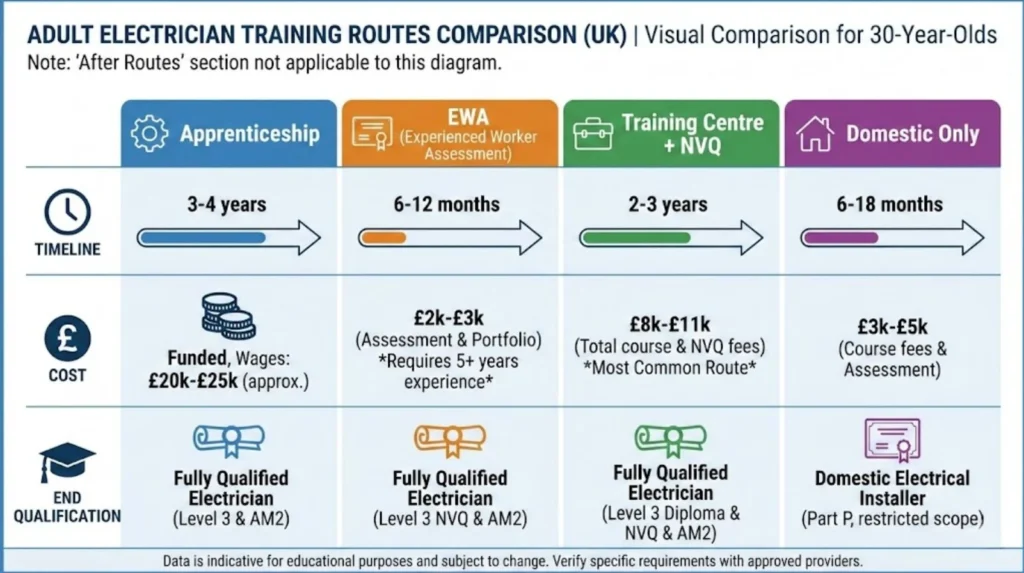
Legitimate Routes for a 30-Year-Old (Compared)
Four recognised pathways exist. Each trades off time, cost, and earning potential differently.
Apprenticeship Route (Adult Entrant)
Structure: Typically 3 to 4 years. Four days on site, one day at college. Combines workplace training with technical education. Leads to NVQ Level 3, AM2, and ECS Gold Card.
Wages: Year 1: Employers can legally pay Apprentice National Minimum Wage (£7.55/hour from April 2025). Year 2+: Must pay National Living Wage for your age (£12.21/hour for 21+ from April 2025). Many employers pay above minimums to attract mature candidates, but not all. Expect £20,000 to £25,000 annually during training.
Funding: Fully funded via apprenticeship levy. No cost to the learner.
Pros for 30-year-old: Guaranteed employment throughout. Structured progression. No upfront costs. Ends with full qualification.
Cons: Long commitment. Significant wage drop if coming from higher-paid role. Dependent on single employer relationship. If employment ends, you may not complete qualification.
Experienced Worker Assessment (EWA)
Eligibility: Those with 5+ years genuine electrical work experience but no formal qualifications. Requires proving this through employment records or detailed work history.
Process: Background check proving 5 years work, technical interview, NVQ portfolio (on current site), AM2E exam.
Timeline: 6 to 12 months from enrolment to Gold Card.
Cost: Approximately £2,000 to £3,000 for assessment and AM2E.
Who it suits: Mates, labourers, or those who worked in electrical roles without formal training. Not suitable for complete beginners or those with limited electrical work history.
Adult Training Centre Route (Self-Funded Theory + Workplace NVQ)
Phase 1 (Theory): Complete C&G 2365 Level 2 and Level 3 at college or private centre. Part-time, evenings, weekends, or intensive blocks. Duration: 6 to 18 months depending on study mode.
Phase 2 (The Gap): Find work as Electrical Improver or Mate. This is the hardest transition point. You need employment to start NVQ evidence gathering.
Phase 3 (Completion): Enrol in NVQ Level 3 (C&G 2357), build portfolio over 12 to 24 months, take AM2.
Total Timeline: 2 to 3 years from starting Level 2 to ECS Gold Card.
Total Cost: £8,000 to £11,000 (Level 2/3: £6,500 to £7,500, NVQ: £1,500 to £1,800, AM2: £860 to £935, 18th Edition: £400 to £500, tools and PPE: £500+).
Who it suits: Career changers keeping current jobs while studying theory. Those who can self-fund. People with flexibility to switch to improver roles once theory completes.
Risk: Many adults finish Level 2 and Level 3 but never complete NVQ because they can’t find improver employment that provides varied evidence. This is the most common failure point.
Domestic-Only Route (CPS Focus)
Structure: Level 2, Level 3, 18th Edition, 2391 (Inspection and Testing). Register with Competent Person Scheme. Start working on domestic installations.
Timeline: 6 to 18 months for theory qualifications.
Cost: £3,000 to £5,000 for theory qualifications plus CPS registration.
Scope: Residential only. No commercial or industrial sites. No ECS Gold Card.
Who it suits: Those targeting self-employed domestic work exclusively. People who want faster entry at lower cost and accept scope limitations.
Limitation: Difficult to move into commercial work later without completing full NVQ and AM2 pathway.
Joshua Jarvis, our Placement Manager, notes:
"Free courses work perfectly for 16-18 year olds who aren't earning £25,000+ anyway. The opportunity cost is negligible. But for career changers at 30 with mortgages and families, the two-year timeline is financially devastating compared to intensive training with immediate placement into improver work. It's not about the tuition cost, it's about speed to qualified status."
Joshua Jarvis, Placement Manager
Timelines: What's Realistic at 30
Timeline claims vary wildly across training adverts. Evidence-based ranges show why.
Level 2 Diploma: 200 to 400 guided learning hours. Full-time: 4 to 8 weeks. Part-time/weekends: 6 to 9 months.
Level 3 Diploma: 300 to 500 guided learning hours. Full-time: 12 to 14 weeks. Part-time: 6 to 9 months.
NVQ Level 3: Highly variable. Requires evidence of specific jobs (fault-finding, three-phase installation, testing, containment systems). Realistic minimum: 6 months if working full-time on varied sites. Typical: 12 to 18 months. Can extend to 24+ months if site access is limited or work is repetitive.
AM2 Booking: Test centres average 4 to 8 weeks wait times after portfolio completion.
Realistic Scenarios for 30-Year-Old
Scenario A: Quit and Switch (Full-Time Study)
Months 1 to 6: Level 2 and Level 3 diplomas (intensive)
Months 7 to 18: Work as improver plus complete NVQ portfolio
Month 19: Pass AM2
Total: 1.5 to 2 years
Financial requirement: Savings to cover reduced income during improver phase (£25,000 to £30,000 annually versus potentially higher previous salary).
Scenario B: Evening Study (Keep Current Job)
Months 1 to 18: Level 2 and Level 3 diplomas (evenings/weekends)
Months 19 to 30: Leave current job, work as improver plus NVQ
Month 31: Pass AM2
Total: 2.5 to 3 years
Financial requirement: Ability to sustain evening study for 18 months whilst working full-time. Then transition to lower wages.
Scenario C: Trade-Adjacent Entry
If currently working in construction or facilities maintenance with some electrical exposure:
Months 1 to 12: Formalise role to include electrical tasks, begin NVQ evidence gathering
Months 13 to 24: Complete NVQ portfolio whilst working
Month 25: Pass AM2
Total: 2 to 2.5 years
Requires employer cooperation to provide varied electrical work and support assessor visits.
Scenario D: Zero Site Access
Most challenging scenario. Complete theory, then hunt for improver roles.
Months 1 to 12: Level 2 and Level 3 (part-time)
Months 13 to 18: Job applications, mate work to gain initial experience
Months 19 to 36: Secure improver role, complete NVQ portfolio
Month 37: Pass AM2
Total: 3+ years
High dropout risk during transition from theory to site work. Many abandon qualification at this stage.
The consistent factor across all scenarios: NVQ portfolio phase depends entirely on workplace access and job variety. You cannot accelerate it by studying harder. You need real jobs providing evidence across required competency units.
Costs and Funding: What Adults Actually Pay
Most government funding targets under-19s or first Level 3 qualifications. Adults typically self-fund at least part of the journey.
Typical Cost Breakdown (2025 estimates)
Level 2 and Level 3 diplomas: £6,500 to £7,500 (combined packages from private providers)
NVQ Level 3 registration: £1,500 to £1,800 (includes assessor visits and portfolio access)
AM2 assessment: £860 to £935 (fee paid to NET, rising periodically)
18th Edition course and exam: £400 to £500
Tools and PPE: £500+ (basic hand tools, drill, testers, boots, hi-vis)
Total: £9,500 to £11,000
This excludes lost earnings during training periods or wage reductions when switching to improver roles.
NVQ Package Note: Comprehensive packages from providers like Elec Training typically cost £10,000 to £12,000, excluding AM2 exam fees and personal PPE, but include tutor support, assessor coordination, and placement assistance.
Funding Options for Adults
Advanced Learner Loan: Available for Level 3 qualifications at approved colleges. Not always available at private fast-track centres. Repayment starts only when earning over £27,295 annually. Useful for Level 3 diploma costs but doesn’t cover NVQ assessment or AM2.
Adult Skills Fund: Government funding for eligible Level 3 qualifications for adults aged 19+ without prior Level 3. Availability depends on residency and provider approval. Check with local FE colleges.
Apprenticeship Levy: Fully funds apprenticeships. Employers pay via levy or government co-investment. Zero cost to the learner. Wage during training is the only financial consideration.
Regional Support: Wales offers ReAct+ for those recently made redundant. Scotland has specific adult training schemes through SECTT. England has regional variations in Adult Education Budget allocation.
JIB Skills Fund: Up to 75% fee coverage for JIB members. Requires membership before starting training. Typically applies to employed electricians seeking additional qualifications rather than initial training.
Employer Sponsorship: Some employers sponsor Level 3 costs or NVQ assessment fees in exchange for commitment agreements. More common in apprenticeships than self-funded routes.
The reality for most 30-year-olds: plan to self-fund theory qualifications (£6,500 to £7,500), then rely on improver wages to fund NVQ and AM2 phases (£2,500 to £3,500 combined). Total personal investment: £9,000 to £11,000 plus foregone earnings if leaving higher-paid employment.
Getting the First Job: The Improver Bottleneck
Adults finishing Level 2 and Level 3 face the “improver bottleneck.” You have theory knowledge but no portfolio evidence. Employers want people who contribute immediately. The transition is difficult.
What Improver and Mate Roles Involve
Electrical Mate: Entry-level site work. Cable pulling, fixing containment, assisting qualified electricians. Little independent work. Pay: £11.44 to £14.00/hour (National Minimum Wage to slightly above).
Electrical Improver: More responsibility. Terminating cables, installing accessories, basic testing under supervision. Building NVQ evidence. Pay: £15.00 to £17.00/hour.
The critical difference: mates perform labouring tasks that don’t generate NVQ evidence. Improvers perform electrical work that does. You need improver roles, not just mate work, to progress toward qualification.
The Danger of Repetitive Work
Some companies hire improvers for repetitive tasks only. Pulling cables on large commercial projects. Installing socket fronts. Clipping containment. These tasks appear in your NVQ portfolio but don’t cover the breadth of competencies required. You need evidence of fault-finding, testing, three-phase work, safe isolation procedures, and varied installation types (lighting circuits, power circuits, containment systems, inspection procedures).
If your role doesn’t provide this variety, your NVQ stalls. Assessors reject portfolios lacking diversity. You remain stuck at improver level, unable to book AM2 or progress to qualification.
How to Secure Good Improver Roles
Target smaller contractors rather than large site agencies. Smaller firms provide more varied work. You’ll install entire systems rather than repeat one task across multiple floors.
Be explicit about NVQ requirements when applying. Explain you need diverse evidence for portfolio completion. Ask what types of jobs you’ll work on. Avoid companies that keep improvers on repetitive tasks indefinitely.
Consider facilities maintenance or industrial settings. These roles often provide equipment variety (motors, controls, distribution boards, testing equipment) that domestic work doesn’t.
Network through training providers. Many colleges and centres maintain employer relationships. Use their placement assistance rather than applying blind through job boards.
Joshua Jarvis adds:
"We work with over 120 contractor partners specifically because varied site experience matters more than any other factor in completing NVQ portfolios. The biggest failure point for adults isn't ability or commitment. It's being stuck in roles that don't generate qualifying evidence. Our placement support focuses on matching learners with employers who understand NVQ requirements and provide the job variety assessors demand."
Joshua Jarvis, Placement Manager
Earnings: What the Progression Actually Looks Like
Pay data from ONS, JIB wage agreements, and job board analysis shows clear stages.
Pay by Career Stage
Trainee / Apprentice: £20,000 to £25,000 annually. Based on National Living Wage minimums plus employer top-ups. Lower end reflects Year 1 apprentice wages. Upper end reflects Year 2+ or employers paying above minimums.
Improver / Mate: £25,000 to £30,000 annually. Hourly rates £15.00 to £17.00. Some variation by region (London and South-East higher). Work typically full-time with occasional overtime.
Newly Qualified (ECS Gold Card): £30,000 to £38,000 annually. JIB base rate £18.80/hour (approximately £37,000 at 40 hours/week). Job boards show newly qualified roles at £32,000 to £40,000 depending on location and sector (industrial higher than domestic).
Experienced (2 to 5 years post-qualification): £38,000 to £50,000+ annually. ONS median for electricians: £38,760. With overtime, many exceed £45,000 to £50,000. Approved Electrician JIB rate: £20.38/hour (approximately £40,000 base before overtime).
Self-Employed / Contractor: Gross £40,000 to £60,000 for established electricians. Day rates £200 to £250 are standard. Domestic private work: chargeable rates £40 to £60/hour, but billable hours lower due to travel, quoting, and admin. Net income after overheads (tools, insurance, vehicle, tax, unpaid admin) significantly lower than gross figures suggest.
Regional and Sector Variations
London and South-East: Typically 10% to 15% higher than national averages. Newly qualified: £35,000 to £42,000. Experienced: £42,000 to £55,000+.
Industrial and Data Centres: Premium rates. Electricians in data centres or industrial maintenance often earn £45,000 to £60,000 due to shift premiums, overtime, and technical complexity.
Domestic-Only: Self-employed domestic installers average £30,000 to £40,000 annually. Lower than Gold Card electricians with commercial access due to work irregularity, lower day rates, and unpaid time.
For 30-year-olds, the key consideration: expect 2 to 4 years of reduced earnings during training and improver phases. If currently earning £35,000+, switching to apprentice or improver wages (£20,000 to £30,000) creates short-term financial pressure. Plan accordingly.
Pitfalls Adults Fall Into
Certain claims and course structures cause preventable failures.
“Qualified in 5 to 8 weeks”
Impossible. These courses stack theory modules back-to-back but provide no NVQ or site competence assessment. You leave with certificates but no ECS card. No employer recognition. No ability to work independently on sites. Some courses deliberately blur this by calling graduates “qualified” based on theory completion alone.
“Guaranteed Placements”
Scrutinise this claim. Is it a one-week unpaid placement for assessment purposes, or actual employment? Most private providers do not find you jobs. They may have employer partnerships for portfolio evidence gathering, but permanent employment is your responsibility. Some colleges offer better placement support than private fast-track centres. Ask for specifics: placement duration, pay, employer commitment.
The Domestic-Only Trap
Training providers sell Domestic Installer packages implying they equal full electrician status. They don’t. You’re restricted to residential work. Cannot access commercial or industrial sites. Cannot hold ECS Gold Card. Moving into commercial work later requires completing full NVQ and AM2, essentially retraining. For 30-year-olds planning long careers, this limitation matters. Domestic work offers lower earning potential and less job security than having full scope.
ECS Card Confusion
CSCS cards (Construction Skills Certification Scheme) are for general site access. ECS cards (Electrotechnical Certification Scheme) are for electrical workers. Some adverts mention CSCS cards implying they equal electrician status. They don’t. Green ECS card (Labourer) allows site access. Gold ECS card (Electrician) requires NVQ Level 3 plus AM2. Only Gold Card proves full qualification to employers and agencies.
Theory-Only Courses Without NVQ Routes
Some providers offer Level 2 and Level 3 diplomas with no clear path to workplace NVQ evidence gathering. They take your money for theory but provide no assessor support, no employer connections, and no guidance on completing portfolios. You finish theory with no route to Gold Card. Always confirm: what happens after Level 3? How do I access NVQ assessment? Who provides assessor visits? What employer partnerships exist?
Hidden Fees and Time Limits
Some contracts include time limits for completing NVQ portfolios (e.g., 18 months from enrolment). If you don’t complete within that window, additional fees apply. Assessor visit fees may be capped (e.g., 3 visits included, then £150 per additional visit). AM2 fees often excluded from package prices. Read contracts carefully. Understand total cost including assessment, exam, and any renewal fees.
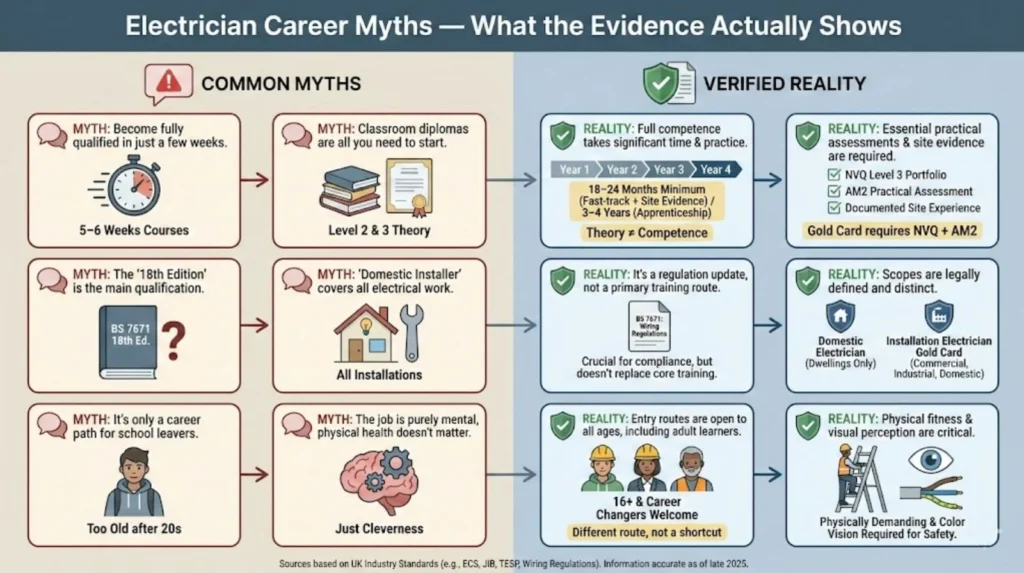
Myth vs Reality
Common claims need evidence-based responses.
“You can be fully qualified in 3 months.”
False. You can finish Level 2 and Level 3 theory in 3 months if studying full-time. You cannot complete NVQ portfolio (requires workplace evidence over 12+ months) in that time. You cannot take AM2 until NVQ completes. Total realistic minimum: 18 to 24 months even on fastest routes.
“18th Edition makes you an electrician.”
False. It’s a regulations update course proving you can read BS 7671. Does not assess practical competence. Does not replace NVQ or AM2. Necessary component but insufficient alone. Many people hold 18th Edition with no ability to wire installations safely.
“You don’t need the NVQ if you’ve done Level 3.”
False. Level 3 diploma is theory. NVQ Level 3 is workplace competence. Without NVQ, you cannot get ECS Gold Card. You’ll be stuck as mate or labourer on commercial sites regardless of theory knowledge. Employers filter by card status, not diplomas.
“Domestic work is an easier shortcut to being fully qualified.”
Partly true, mostly misleading. Domestic installer route is faster (6 to 18 months for CPS registration versus 2 to 3 years for Gold Card). Lower cost (£3,000 to £5,000 versus £9,000 to £11,000). But it’s not “full qualification.” You’re restricted to residential work. Cannot access commercial sites. Earnings capped lower. Not a shortcut to Gold Card status, it’s a different scope entirely.
“At 30, you’re too old to start.”
False. Age is not a barrier. Adults are eligible for apprenticeships, training centre routes, and EWA without upper age limits. Maturity often helps: better time management, higher commitment, clearer career goals. The barrier is financial (accepting lower wages during training) and practical (managing study whilst working or supporting family). Not age itself. Many electricians begin training in their 30s and succeed.
“You can’t become an electrician with certain conditions.”
This varies. Some physical or visual conditions limit certain types of electrical work. For example, colour vision deficiency affects ability to identify wire colours, though workarounds exist for many cases. For detailed information on this specific topic, see our guide on becoming a colour blind electrician. Physical demands (crawling through lofts, lifting equipment, working at heights) are manageable for most but may be challenging for some. Honest assessment matters, but many conditions don’t prevent qualification.
Understanding the Reality
Becoming an electrician at 30 is achievable through recognised qualification routes, but it requires understanding what “qualified” actually means in industry terms, planning the NVQ evidence-gathering phase before spending money on theory courses, and accepting realistic timelines of 2 to 3 years minimum for full Gold Card status.
The distinction between domestic installer scope and full Installation Electrician status matters for long-term career flexibility and earning potential. Domestic routes are faster and cheaper but permanently restrict work scope unless you later complete NVQ and AM2 anyway. For adults planning 20 to 30 year careers, investing in proper qualification (NVQ Level 3 plus AM2 plus ECS Gold Card) provides better returns through access to commercial and industrial work, higher average earnings, and greater job security.
The improver bottleneck causes more failures than any other stage. Adults finish Level 2 and Level 3 theory, then cannot find employment that provides the varied evidence NVQ portfolios require. Solving this before enrolling in theory courses prevents wasted time and money. Confirm how you’ll access workplace NVQ evidence before paying for diplomas.
Financial reality for 30-year-olds differs from 18-year-olds. You likely have higher living costs, possibly family commitments, and may be leaving higher-paid employment. Apprenticeship wages (£20,000 to £25,000) or improver rates (£25,000 to £30,000) represent significant short-term income reductions. Budget for 2 to 4 years of this before reaching qualified electrician earnings (£30,000 to £50,000+). The investment pays off long-term, but short-term financial planning matters.
Age itself is not a barrier. Qualification requirements, workplace evidence demands, and financial realities create barriers. Understanding these upfront and planning accordingly separates successful career changers from those who abandon qualification halfway through. For adults at 30, career longevity matters more than speed. Taking 3 years to complete proper qualification beats taking 18 months for restricted domestic-only status that limits earning potential for the next 20 years.
For specific age-related considerations comparing different life stages, see our guide on becoming an electrician at 40, which addresses how family commitments, financial planning, and physical demands shift across age brackets.
If you’re considering electrician training at 30, focus on finding routes with clear NVQ pathways, confirmed assessor support, and realistic timelines. Avoid courses promising fast qualification without workplace evidence components. Plan financially for reduced earnings during training. Confirm you can access varied site work for portfolio building. And understand the difference between domestic scope and full Gold Card status before choosing a route.
Call 0330 822 5337 to discuss electrician training pathways for 30-year-old career changers. We’ll assess your current situation, explain which route fits your financial position and time availability, clarify NVQ evidence requirements, and discuss how our network of 120+ contractor partners supports portfolio completion through varied site placements. No false promises about 8-week qualifications. Just honest guidance on recognised routes, realistic timelines, and what full qualification actually requires.
References
- Electrotechnical Certification Scheme (ECS) – Card Requirements and Recognition – https://www.ecscard.org.uk/
- Joint Industry Board (JIB) – Grading, Wage Rates, and Standards – https://www.jib.org.uk/
- Office for National Statistics (ONS) – Annual Survey of Hours and Earnings (ASHE) 2024 – https://www.ons.gov.uk/
- City & Guilds – 2365 Level 2/3 Electrical Installation Qualifications – https://www.cityandguilds.com/
- City & Guilds – 2357 NVQ Diploma in Installing Electrotechnical Systems – https://www.cityandguilds.com/
- Health and Safety Executive (HSE) – Electricity at Work Regulations 1989 – https://www.hse.gov.uk/
- National Electrotechnical Training (NET) – AM2 Assessment Information – https://www.netservices.org.uk/
- GOV.UK – Apprenticeships for Adults and Funding – https://www.gov.uk/
- GOV.UK – Advanced Learner Loans – https://www.gov.uk/
- Scottish Joint Industry Board (SJIB) – Standards and Training (Scotland) – https://www.sjib.org.uk/
Last reviewed: 19 December 2025. This page is maintained; we correct errors and refresh sources as ECS requirements, JIB wage agreements, qualification standards, and apprenticeship funding rules change. Pay data reflects ONS ASHE 2024 and JIB rates effective January 2025. Course costs reflect 2024/25 academic year pricing from major training providers. Timeline estimates based on City & Guilds GLH requirements and typical NVQ portfolio completion rates. Next review scheduled following publication of JIB 2026 wage agreement (estimated March 2026) or changes to apprenticeship funding structures.
