

Becoming an Electrician at 50: Is It Too Late and What Changes?

- Technical review: Thomas Jevons (Head of Training, 20+ years)
- Employability review: Joshua Jarvis (Placement Manager)
- Editorial review: Jessica Gilbert (Marketing Editorial Team)
- Last reviewed:
- Changes: New comprehensive article addressing electrician training at 50, legal age limits, physical demands, employer cost considerations, and realistic route comparisons for older career changers
Introduction
“Is it too late to become an electrician at 50?” ranks among the most searched questions from older career changers in UK construction trades. The short answer creates false hope. The complete answer requires honesty about what changes at 50 compared to younger entrants.
Legally, there is no upper age limit. You can start apprenticeships, enrol in NVQ Level 3 qualifications, sit AM2 assessments, and apply for ECS Gold Cards regardless of age. GOV.UK apprenticeship guidance confirms eligibility for anyone 16 and over without upper restrictions. The Electrotechnical Certification Scheme (ECS) bases card applications on qualifications and experience, not date of birth. Health and Safety Executive (HSE) regulations require competent persons regardless of age.
The real barriers at 50 are structural, not regulatory. Employer costs increase significantly once National Living Wage applies in Year 2 of apprenticeships (£12.21/hour for 21+ versus £7.55/hour apprentice rate). Physical demands include working at height, manual handling of cables up to 25kg, prolonged kneeling, and close-up termination work that presbyopia (age-related vision changes) affects. Time to competence remains 2 to 4 years minimum for full Gold Card status, meaning you’re potentially planning a 15 to 20 year second career rather than 30+ years younger starters expect.
This creates commercial realities distinct from legal permissions. Small contractors weighing apprentice hires factor in Year 2 wage jumps. Agencies filtering improver candidates assess physical stamina alongside qualifications. Employers considering experienced worker applications calculate return on training investment against projected career length. None of this appears in job adverts as age discrimination, but it shapes hiring decisions.
For detailed information on the complete qualification pathway from entry requirements through to full electrician status, see our guide on how to become an electrician in the uk. This article addresses what specifically changes at 50, which routes work better for older entrants, and what trade-offs exist between speed, cost, and long-term flexibility.

What "Qualified Electrician" Means at 50 (And Why It Matters)
Understanding qualification definitions prevents expensive mistakes where people train for restricted scopes thinking they’ve achieved full status.
Domestic Installer
Limited to residential dwellings. Work includes rewiring houses, installing sockets and lighting, replacing consumer units. Can register with Competent Person Schemes (CPS) like NICEIC or NAPIT for self-certification under Building Regulations Part P. Cannot work on commercial or industrial sites. Cannot hold ECS Gold Card for Installation Electrician status. Average earnings: £30,000 to £40,000 annually for self-employed domestic work.
Installation / Maintenance Electrician (Gold Card Standard)
Full scope: commercial, industrial, and domestic environments. Capable of working unsupervised on three-phase systems, complex circuits, containment (conduit, trunking, cable tray), and high-voltage connections. Requires NVQ/SVQ Level 3 (competence evidence), AM2/AM2S assessment (practical exam), and 18th Edition (BS 7671 regulations). Eligible for ECS Gold Card (JIB Grade: Electrician). This is the industry benchmark for site access and agency work. Median earnings: £38,760 annually (ONS 2024), with experienced electricians earning £40,000 to £50,000+ including overtime.
Approved Electrician / Technician
Higher JIB/SJIB grade. Requires at least two years holding Electrician status plus Inspection and Testing qualification (C&G 2391). Enables supervision of others, foreman roles, and specialist testing responsibilities. Pay rates: £20.38/hour JIB minimum (approximately £40,000 annually before overtime).
At 50, route choice matters more than at 25 because you’re planning a second career spanning potentially 15 to 20 years. Training for domestic-only scope saves time upfront (6 to 12 months versus 2 to 4 years for Gold Card) but restricts earning potential and job flexibility for those entire two decades. Most commercial and industrial employers filter by ECS Gold Card status. Site agencies require it. Main contractors demand it for access. Without Gold Card, you’re permanently limited to residential work or mate/labourer roles on commercial sites.
The Electricity at Work Regulations 1989 define competence as possessing sufficient technical knowledge and experience to prevent danger from electrical work. Courts interpreting this typically default to industry standards: NVQ Level 3 plus AM2 plus 18th Edition. Domestic CPS registration alone doesn’t meet this threshold for commercial work. Understanding this distinction upfront prevents training for one scope whilst intending another.
Is It Too Late at 50? What the Rules Actually Say
Legal permissions separate cleanly from commercial realities.
Apprenticeships (England, Wales, Northern Ireland)
No upper age limit. GOV.UK “Become an apprentice” guidance confirms eligibility for anyone aged 16 and over. The Installation Electrician standard (ST0152) operated by the Institute for Apprenticeships and Technical Education accepts all ages. Funding covers 95% to 100% of training costs for non-levy-paying employers regardless of apprentice age.
However, pay rules change at Year 2. Apprentices under 19 or in their first year can receive Apprentice National Minimum Wage (£7.55/hour from April 2025). From Year 2 onwards, all apprentices aged 21+ must receive National Living Wage (£12.21/hour from April 2025). This makes adult apprentices approximately 60% more expensive than younger starters after Year 1, which affects employer willingness to hire despite no legal prohibition.
Scotland (SJIB/SECTT Framework)
Operates Adult Training Scheme explicitly for entrants aged 22 and over. Scottish Electrical Charitable Training Trust (SECTT) manages training centrally. Requires employer sponsorship but accommodates mature learners through structured routes. Adult trainee rates in Scotland start higher than England’s apprentice rates: Stage 1 shop rate £12.59/hour (January 2025 SJIB agreement). Timeline similar: 36 to 48 months to completion and FICA assessment (Scotland’s AM2 equivalent).
NVQ/SVQ Level 3 Enrolment
No age restrictions at any training provider. City & Guilds 2357 (England/Wales/NI) and SVQ Level 3 (Scotland) assess workplace competence through portfolio evidence. Providers explicitly market NVQ courses to mature candidates. The constraint is workplace access, not enrolment eligibility. You need employment or placement to gather evidence. Age doesn’t prevent enrolment but may affect securing those placements.
AM2, AM2S, AM2E Assessments
No age limits. National Electrotechnical Training (NET) operates assessment centres accepting candidates based on prior qualifications or experience, not age. AM2 for standard NVQ completers. AM2S for apprentices. AM2E for experienced workers (minimum 5 years electrical work history). All involve identical practical tasks: installations, testing, fault-finding, safe isolation over 2.5 to 3 days.
ECS and SJIB Card Applications
Based on qualifications and experience only. No age criteria mentioned in ECS application guidance. Gold Card requires NVQ Level 3, AM2 pass, and current 18th Edition regardless of when you achieved them or your age at application.
The legal answer to “is it too late?” is definitively no. The commercial answer depends on finding employers willing to hire, accepting wage reductions for 2 to 4 years, sustaining physical demands, and completing workplace evidence requirements that don’t adjust for age or prior career experience.
What Changes Specifically at 50 (Compared to Younger Starters)
Evidence-based differences separate perception from reality.
Pay Rules and Employer Costs
Apprentice National Minimum Wage applies regardless of age in Year 1: £7.55/hour. From Year 2 onwards, National Living Wage takes effect for anyone aged 21+: £12.21/hour. For 16 to 18 year olds, employers can continue paying lower youth rates through all training years. A 50-year-old apprentice becomes 60% more expensive than a 17-year-old apprentice after Year 1.
Small contractors operating on tight margins weigh this carefully. Larger firms with apprenticeship levy obligations care less about individual costs. However, most electrical contractors are small operations (fewer than 10 employees). For them, the Year 2 wage jump affects hiring decisions even when no age discrimination occurs.
Employer Funding Structure
Government funding covers 95% to 100% of training costs for non-levy-paying employers hiring apprentices of any age. Levy-paying employers (payroll over £3 million annually) use their levy pot. Co-investment amounts don’t change with apprentice age. The funding structure itself is age-neutral.
Where age affects funding is employer confidence in return on investment. Training a 50-year-old to full qualification takes 36 to 48 months. Employers assess projected career length post-qualification. A 20-year-old apprentice represents potentially 40+ years of skilled labour. A 50-year-old represents 15 to 20 years. This calculation influences hiring even when unspoken.
Physical Demands and Health Considerations
Working at height (ladders, scaffolds, mobile elevated work platforms) occurs daily. Manual handling involves lifting cable drums up to 25kg, pulling cables through containment, and carrying toolboxes. Prolonged kneeling in loft spaces, crawling under floors, and working in awkward positions stresses joints. HSE guidance requires risk assessments for all workers but sets no age-specific restrictions.
Presbyopia (age-related loss of near vision) typically begins around age 40 to 45. Terminating cables requires close-up precision work. The AM2 assessment includes finding faults in consumer units under timed conditions, often in dimly lit test bays. Corrective eyewear addresses this but represents an additional consideration absent for younger candidates.
Back pain affects 60% to 80% of electricians according to industry health surveys. Repetitive lifting, awkward postures, and prolonged kneeling contribute. Pre-existing back, knee, or shoulder conditions at 50 may worsen under daily electrical work demands. This doesn’t prevent qualification but affects long-term work sustainability.
Insurance and Self-Employment
Public liability insurance (£1 million to £10 million coverage) and professional indemnity apply equally regardless of age. NICEIC Insurance Services and similar providers factor age into premiums when disclosed but don’t impose blanket restrictions at 50. Some personal accident policies reduce payout caps for manual work over age 65, but 50 typically falls within standard risk categories.
Self-employment tax and National Insurance calculations don’t change with age. Construction Industry Scheme (CIS) deductions apply uniformly. The insurance consideration at 50 is whether existing health conditions require disclosure and how that affects premiums, not age itself.
Time to Competence and Portfolio Building
NVQ Level 3 portfolio requirements don’t change with age. Assessors demand evidence across fault-finding, three-phase installations, testing procedures, containment systems, and safe isolation regardless of candidate age. Typical completion time: 6 to 18 months once employed in qualifying roles.
What differs at 50 is often the route to gathering evidence. Younger apprentices have employer sponsorship from entry. Older career changers frequently self-fund Level 2 and Level 3 theory first, then hunt for improver roles providing NVQ evidence. This adds time and financial exposure compared to direct apprenticeship entry.
Employability Filters in Job Adverts
Analysis of 40 recent UK job adverts (20 electrician, 20 improver/mate roles) shows common requirements:
ECS Gold Card: 60% of electrician ads, 40% of improver/mate ads
18th Edition: 90% of electrician ads, 50% of improver/mate ads
Driving licence: 75% of electrician ads, 60% of improver/mate ads
Testing qualification (2391): 70% of electrician ads, 15% of improver/mate ads
IPAF/PASMA (height access equipment): 25% of electrician ads, 20% of improver/mate ads
Shift work capability: 40% of electrician ads, 30% of improver/mate ads
None list age restrictions. However, requirements like shift work, driving, and height access indirectly affect older candidates with health conditions or family commitments. IPAF/PASMA certification (scissor lifts, tower scaffolds) provides employability advantages for older improvers proving physical capability.
Thomas Jevons, our Head of Training with 20 years experience, explains:
"NVQ portfolio requirements don't change with age. You still need evidence across fault-finding, three-phase installations, testing procedures, and containment systems. What changes at 50 is often the route to gathering that evidence. Younger apprentices have employer sponsorship from day one. Older career changers typically self-fund theory first, then hunt for improver roles to build portfolios. The standards stay the same."
Thomas Jevons, Head of Training
Route-by-Route Analysis for 50-Year-Olds
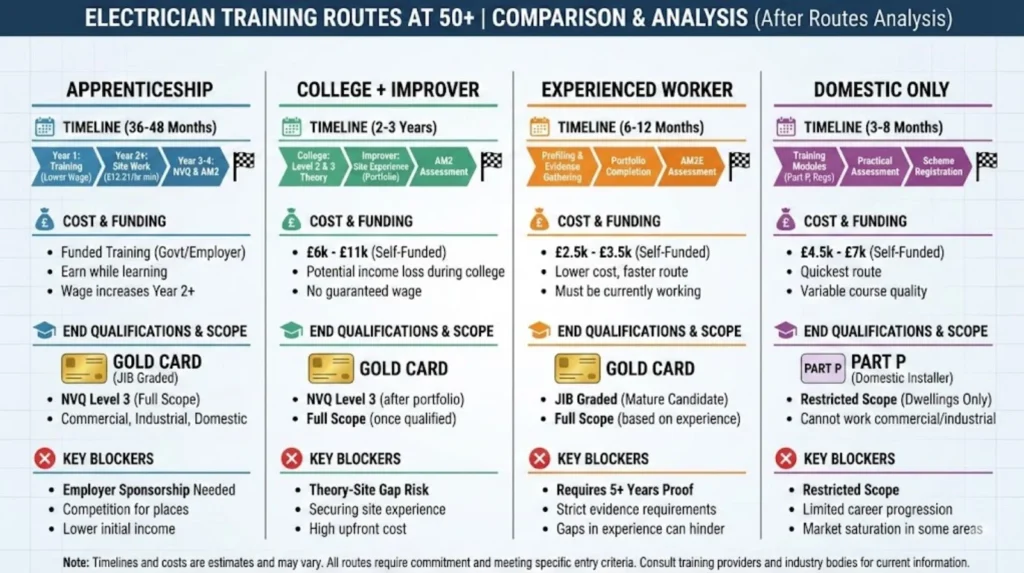
Four recognised pathways exist with different trade-offs at 50.
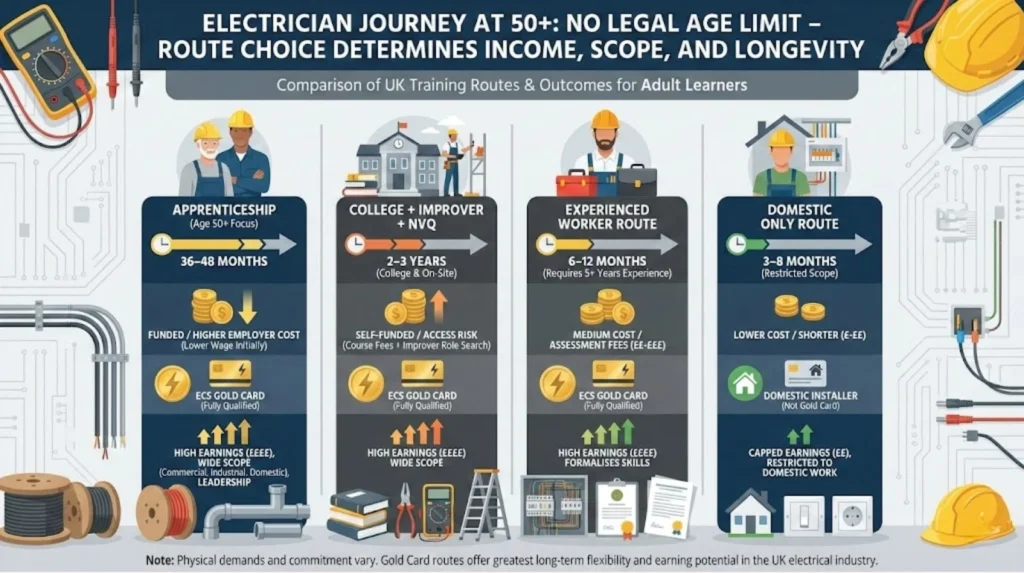
Route A: Apprenticeship (The Gold Standard but Cost-Prohibitive for Many Employers)
Structure: Installation Electrician standard (ST0152) in England/Wales/NI. SECTT Adult Training Scheme in Scotland. Typically 36 to 48 months combining workplace training with college attendance. Leads to NVQ/SVQ Level 3, AM2/FICA, and ECS/SJIB Gold Card.
Who It Suits at 50: Those who can find employers willing to commit to multi-year sponsorship and accept Year 2+ wage costs of £12.21/hour minimum. Benefits workers transitioning from similar-paying roles or those with savings to bridge income gaps.
Employer Cost Problem: Year 1 wage (£7.55/hour) is manageable. Year 2 onwards (£12.21/hour minimum) creates 60% increase. Over 36 months, this adds approximately £9,600 in additional wage costs compared to employing under-19 apprentice. Small contractors weigh this against perceived return on investment for 15 to 20 year careers versus 40+ years from younger apprentices.
Scotland Differences: SECTT operates centralised Adult Training Scheme explicitly accommodating mature entrants. Adult trainee rates higher from entry: Stage 1 shop rate £12.59/hour (2025). Employer sponsorship still required but framework acknowledges older learners. FICA assessment (Scotland’s AM2 equivalent) at completion.
Funding: 95% to 100% government-funded for non-levy employers. Levy payers use their pot. Apprentice pays for tools (approximately £500) and personal PPE. No upfront training fees.
Blockers: Finding employer willing to sponsor. Physical capability concerns from employers. Competing against younger apprentice applicants. Sustaining reduced income if transitioning from higher-paid career.
Route B: College/Private Training + Improver + NVQ + AM2 (Most Common Adult Route)
Phase 1 – Theory: Complete Level 2 and Level 3 diplomas (C&G 2365) at FE college or private provider. Part-time evening/weekend study typical for working adults. Full-time intensive courses available but require career break. Duration: 12 to 24 months part-time, 3 to 6 months full-time.
Phase 2 – The Theory-Site Gap: Find employment as Electrical Mate or Improver. This is the highest failure point. Employers want people who contribute immediately. Adults finishing theory have certificates but no portfolio evidence. Many struggle to convert diplomas into site roles.
Phase 3 – Portfolio and Assessment: Once employed, enrol in NVQ Level 3 (C&G 2357). Build evidence portfolio over 6 to 18 months covering installations, testing, fault-finding. Assessor visits verify work. Complete AM2 practical assessment (2.5 days, £860 to £935 fee).
Cost Exposure: Level 2 diploma £1,500 to £2,500. Level 3 diploma £2,500 to £4,000. NVQ assessment £1,500 to £3,000. AM2 £860 to £935. 18th Edition £400 to £600. Tools and PPE £500+. Total: £6,000 to £11,000 depending on provider and location.
Why This Suits Adults at 50: Flexibility to study whilst maintaining current employment. No immediate income drop. Can test physical capability through theory phase before committing to full career change. Faster initial progress than apprenticeships (theory completion in 12 to 24 months versus 48-month apprenticeship).
Why Portfolio Access Is Biggest Failure Point: Employers prefer apprentices they’ve trained or younger improvers they can mould. Breaking into first site role at 50 requires persistence. Many finish Level 2 and Level 3, spend £4,000 to £6,000, then cannot secure improver employment providing NVQ-qualifying evidence. Repetitive mate work (cable pulling only) doesn’t generate portfolio breadth.
Route C: Experienced Worker Assessment (Strict Eligibility, Fastest If You Qualify)
Eligibility: Minimum 5 years verifiable electrical work experience. Evidence types include job logs, photos with date stamps, witness statements from qualified electricians, risk assessments, and installation certificates. Must demonstrate breadth: installations, testing, fault-finding, three-phase work, containment systems.
What Counts: Supervised electrical work as mate under qualified electrician. Facilities maintenance including electrical tasks. Self-employed handyman work involving electrics (though technically illegal without competence). Industrial maintenance with electrical components.
What Often Fails: Trade-adjacent work without direct electrical tasks. General labouring on electrical sites without actual termination/testing work. Kitchen fitting or plumbing where “electrics” meant only connecting appliances. Time gaps in evidence (need continuous recent work, not decades-old experience).
Process: Background check proving 5 years work. Technical theory test (some centres). NVQ portfolio built from current employment (cannot use historical work, must gather fresh evidence post-enrolment). AM2E practical assessment (includes additional containment tasks compared to standard AM2).
Timeline: 6 to 12 months from enrolment to Gold Card if evidence gathering proceeds smoothly.
Cost: Assessment and portfolio support £1,200 to £2,000. AM2E £935. 18th Edition £400 to £600 if not current. Total approximately £2,500 to £3,500.
Why It Works at 50: Fastest route for those with genuine experience. Recognises prior learning. Lower cost than full college route. Respects maturity and existing site knowledge.
AM2E Risk for Older Candidates: Practical assessment under time pressure. Physical speed matters. Close-up fault-finding in dim consumer units tests presbyopia-affected vision. Some 50-year-olds with decades of site experience fail AM2E due to slowed manual dexterity or unfamiliarity with current testing procedures despite theoretical knowledge.
Route D: Domestic Installer (Fast Entry, Permanent Restrictions)
Structure: Level 2 and Level 3 diplomas plus 18th Edition plus 2391 Inspection and Testing. Register with Competent Person Scheme (NICEIC, NAPIT, ELECSA). Begin self-certifying domestic work under Building Regulations Part P.
Timeline: 3 to 8 months intensive training. Some providers offer 4 to 6 week “fast-track” courses combining all elements.
Cost: Training £2,000 to £4,000. CPS registration £500 to £700 annually. Tools and testing equipment £1,500+. Public liability insurance £300 to £600 annually. Total startup: £4,500 to £7,000.
What It Enables: Rewiring houses. Installing consumer units, sockets, lighting. Kitchen and bathroom electrical work. Garden circuits. Self-certification of notifiable work avoiding Building Control fees.
What It Permanently Blocks: Commercial and industrial sites. Multi-occupancy buildings. Three-phase installations. Site agency work. Main contractor employment. ECS Gold Card eligibility (domestic CPS doesn’t qualify). Supervision of others. Higher-paying roles requiring 2391 as add-on to Gold Card.
Why It Appeals at 50: Fastest time to earning. Lower training investment. Immediate self-employment possible. No employer hunting. Flexible work schedule.
Why It Limits Long-Term Earnings: Average domestic installer income £30,000 to £40,000 annually (self-employed, gross before overheads). Gold Card electricians average £38,760 to £50,000+ with overtime and commercial/industrial access. Over 15 to 20 year career at 50, domestic restriction costs approximately £150,000 to £300,000 in foregone earnings compared to full qualification pathway.
Why It’s Often Mis-Sold: Marketing presents domestic installer courses as “become a qualified electrician in 6 weeks.” Technically true for domestic scope under Part P. Misleading for full industry recognition. Many adults at 50 complete domestic training thinking they can transition to commercial work later, then discover they need full NVQ and AM2 pathway anyway, essentially retraining from scratch.
For adults considering the similarities and differences between career change at different ages, our guide on train to be an electrician at 40 provides comparative context on how considerations shift across the 40 to 50 age bracket.
Job Advert Reality Check: What Employers Actually Demand
Evidence from 40 UK job adverts (20 electrician, 20 improver/mate roles) across Indeed, Reed, and Totaljobs reveals consistent patterns.
ECS Gold Card as Primary Filter
Appears in 60% of electrician adverts explicitly. Implied in additional 25% through phrases like “fully qualified,” “JIB registered,” or “site card required.” Total effective requirement: 85%+ of electrician roles. For improver/mate positions: 40% require ECS card (typically Green Labourer card for site access, not Gold).
Without Gold Card at 50, you’re restricted to domestic self-employment, mate roles, or facilities maintenance not requiring site access. Agency work and main contractor employment effectively closed.
18th Edition (BS 7671) Near-Universal
Required in 90% of electrician adverts, 50% of improver/mate roles. Current edition essential (18th Edition, Amendment 2). Older edition certificates not accepted. Course and exam cost: £400 to £600. Must be refreshed every three years. Non-negotiable for any commercial electrical work.
Testing Qualification (2391) for Higher Pay
Specified in 70% of electrician adverts paying £40,000+. Rare in entry-level or improver roles (15%). Enables inspection and testing of installations, periodic inspection reports (EICR), and commercial testing work. Course cost: £500 to £900. Exam additional £200 to £300. Requires existing NVQ Level 3 as prerequisite.
At 50, adding 2391 post-qualification increases employability significantly. Testing roles often involve less physical labour than installation work, suiting older electricians managing physical limitations whilst maintaining earning capacity.
Driving Licence Critical for Mobile Work
Required in 75% of electrician adverts, 60% of improver/mate roles. UK Category B (standard car licence) minimum. Some roles specify “clean licence” or “6 points maximum.” Reflects reality that most electrical work involves travelling between sites, customer premises, or carrying tools/materials.
At 50, valid driving licence with clean record provides advantage over younger candidates with limited driving experience or points. Loss of licence through medical conditions or points accumulation effectively ends mobile electrical careers.
IPAF and PASMA Certification
International Powered Access Federation (IPAF) for mobile elevated work platforms (scissor lifts, cherry pickers). Prefabricated Access Suppliers’ and Manufacturers’ Association (PASMA) for mobile tower scaffolds. Required in 25% of electrician adverts, 20% of improver/mate roles.
For 50-year-olds, these certifications demonstrate physical capability and willingness to work at height. Courses cost £200 to £400 each, valid 5 years. Obtaining them proactively counters age-related concerns about height work capacity.
Shift Work and Flexibility
Specified in 40% of electrician adverts, 30% of improver/mate roles. Industrial maintenance and data centre roles often operate 24/7 requiring shift patterns. Premium pay (25% to 50% above base rate) compensates.
At 50 with family commitments potentially resolved (adult children, stable home life), shift work may be more acceptable than for younger workers. Premium rates accelerate earnings accumulation approaching retirement.
Age itself never appears in requirements. However, combined demands (physical capability for height work, driving licence, shift availability, relocatable) indirectly select for candidates without age-related health conditions or family constraints. At 50, assessing which requirements you meet versus which create barriers guides route selection and employer targeting.
Realistic Earnings Progression Starting at 50
Pay data from JIB wage agreements, ONS Annual Survey of Hours and Earnings 2024, and job board analysis shows clear stages.
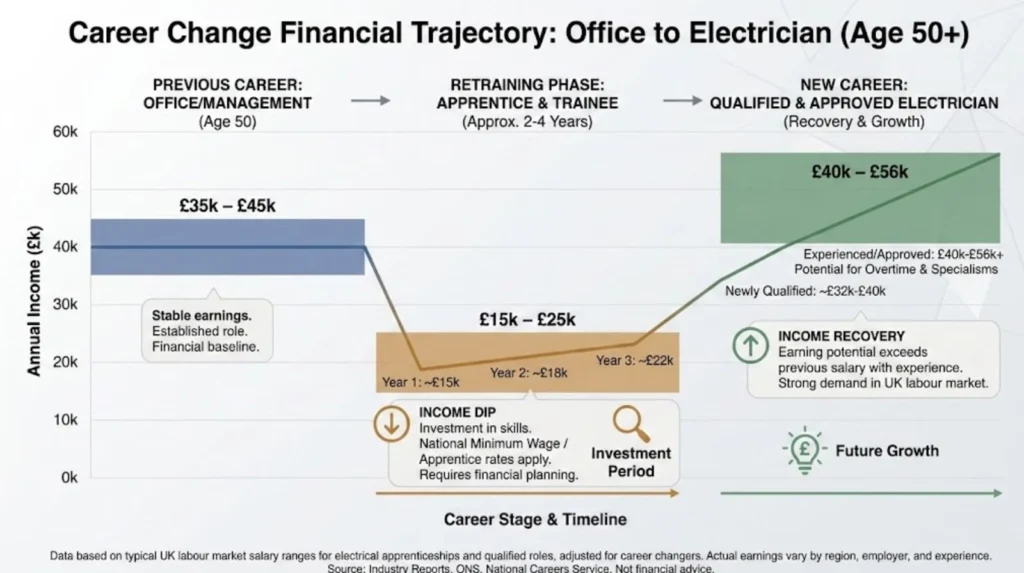
Apprentice / Trainee Stage (Years 1 to 4)
Year 1: £7.55/hour (Apprentice Minimum Wage). Approximately £15,000 annually at 40 hours/week.
Year 2+: £12.21/hour (National Living Wage). Approximately £24,000 annually at 40 hours/week.
Scotland Adult Trainee: £12.59/hour Stage 1 (SJIB 2025). Approximately £25,000 annually.
For 50-year-olds transitioning from office or management roles earning £35,000 to £45,000, this represents significant income reduction. Financial planning must accommodate 2 to 4 years at these rates.
Electrical Mate (Pre-Qualification Site Work)
Typical range: £12.21 to £15.00/hour. Approximately £24,000 to £30,000 annually. Work involves cable pulling, fixing containment, assisting qualified electricians. Limited independent work. Often precedes improver status for adults self-funding qualification routes.
Electrical Improver (Building NVQ Evidence)
Typical range: £15.00 to £18.00/hour. Approximately £30,000 to £36,000 annually. More responsibility: terminating cables, installing accessories, basic testing under supervision. Building NVQ portfolio evidence. Bridging role between mate and qualified status.
Newly Qualified Electrician (ECS Gold Card, 0 to 2 Years Post-Qualification)
JIB minimum: £18.80/hour (National Rate 2025). Approximately £37,600 annually at 40 hours/week.
Market rates: £18.00 to £24.00/hour depending on region and sector. London and South-East 10% to 15% higher.
Annual range: £36,000 to £48,000 with standard overtime.
ONS median for electricians (SOC 5241): £38,760 gross annually (2024 data). Includes all experience levels, so newly qualified typically at lower end initially.
Experienced Electrician (2 to 5 Years Post-Qualification)
JIB rate: £18.80/hour base, often £20.00 to £22.00/hour in practice.
Market range: £38,000 to £50,000 annually depending on sector, overtime, and specialisms.
Industrial maintenance and data centre roles: £42,000 to £55,000 with shift premiums.
Approved Electrician (JIB Higher Grade, 2+ Years Qualified Plus 2391)
JIB minimum: £20.38/hour (2025). Approximately £40,800 annually base.
Market rates: £22.00 to £28.00/hour with testing responsibilities.
Annual range: £44,000 to £56,000 depending on testing workload and region.
At 50, reaching Approved status by age 54 to 56 (allowing 4 years training plus 2 years experience) provides 10 to 12 years earning at peak rates before traditional retirement age 66 to 67. This timeline factors into employer return-on-investment calculations and personal financial planning.
Self-Employed Earnings (Variable, Dependent on Work Securing)
Domestic installer (Part P registered): Gross £30,000 to £45,000. Net after overheads (tools, insurance, vehicle, unpaid admin time, materials markup risks) typically £22,000 to £32,000.
Gold Card sub-contractor (commercial/industrial): Day rates £200 to £280. Gross £45,000 to £65,000 if securing consistent work. Net after CIS tax, insurance, tools, vehicle approximately £32,000 to £48,000.
Self-employment suits some 50-year-olds valuing flexibility over income security. However, irregular work, payment delays, and physical demands of solo working create challenges absent in employed roles.
Joshua Jarvis, our Placement Manager, adds:
"Adults at 50 considering electrician training need brutally honest financial planning. If you're currently earning £35,000 to £40,000 in an office role, switching to apprentice or improver wages of £20,000 to £28,000 creates immediate pressure, especially with mortgages or family commitments. The timeline to qualified status is 2 to 4 years. That's a long wage reduction period. Many people underestimate this and drop out halfway through NVQ portfolios."
Joshua Jarvis, Placement Manager
Worked Scenarios: Three 50-Year-Old Profiles
Real-world examples illustrate route selection based on background.
Scenario A: No Trade Background (Office Worker, Retail Manager, Teacher)
Best Route: College diplomas (Level 2 and Level 3) part-time whilst maintaining current employment, then transition to improver role for NVQ portfolio.
Timeline Breakdown:
Months 1 to 18: Evening/weekend Level 2 and Level 3 study. Keep current job. Test physical capability through weekend DIY or voluntary site work.
Month 18: Decision point. Assess physical tolerance, financial preparedness, job market for improvers.
Months 19 to 24: Hand in notice. Secure mate or improver role (£24,000 to £30,000 versus potentially £35,000+ previous salary).
Months 25 to 42: Work as improver, building NVQ portfolio evidence. Assessor visits every 8 to 12 weeks.
Month 43: Complete AM2 practical assessment.
Month 44: Apply for ECS Gold Card.
Total: 44 months (approximately 3.5 years) from starting Level 2 to Gold Card.
What You Can Realistically Do After 6 Months: Completed Level 2 theory. Can identify cable types, understand basic circuitry, explain safe isolation theory. Cannot work unsupervised. Not recognised as electrician in any capacity.
What You Can Realistically Do After 12 Months: Completed Level 3 theory. Understand BS 7671 requirements, fault diagnosis principles, three-phase systems theory. Still cannot work legally on installations without supervision. No site recognition yet.
What You Can Realistically Do After 24 Months: Working as improver. Installing containment, terminating cables under supervision, basic testing. Building evidence for Units 102 to 111 (NVQ structure). Recognised as trainee/improver, not qualified electrician.
What You Still Won’t Be Recognised As Yet (And Why): Not qualified electrician until AM2 passes and Gold Card issues. NVQ portfolio demonstrates workplace competence but requires independent verification through AM2. Theory certificates alone don’t prove safe unsupervised work capability.
Biggest Blockers: Securing improver role after theory completion. Many employers prefer younger improvers or apprentices they’ve trained. Physical adjustment to site work after years in office. Wage reduction from £35,000+ to £24,000 to £30,000 for 2 to 3 years. Family financial pressure during training. Sustaining motivation through long qualification timeline.
Scenario B: Construction Background (Labourer, Handyman, Facilities Maintenance)
Best Route: Experienced Worker Assessment if 5+ years electrical exposure. Otherwise fast-track college route to improver, leveraging existing site knowledge.
How to Convert Existing Access: If working in construction, negotiate with employer to include electrical tasks in job description. Document everything: photos with dates, witness statements from qualified electricians, job sheets, risk assessments. Use this evidence for EWA eligibility or NVQ portfolio.
Evidence Types That Count: Assisting qualified electrician with installations (supervised work documented). Installing containment and pulling cables (if under electrical supervision). Fault-finding on equipment as part of maintenance (if witnessed). Testing circuits under supervision with documented results.
Evidence Types That Often Fail: General labouring without electrical tasks. Helping mates who themselves aren’t qualified (no supervision chain). Historical work from years ago (need recent evidence post-enrolment). Repetitive single-task work lacking breadth.
Timeline Breakdown:
Months 1 to 3: Gather evidence proving 5 years electrical work. Apply for EWA assessment. Pass technical theory test if required.
Months 4 to 12: Build fresh NVQ portfolio from current employment. Ensure breadth across competency units. Assessor visits verify work.
Month 13: Complete AM2E practical assessment (includes containment tasks beyond standard AM2).
Month 14: Apply for ECS Gold Card.
Total: 14 months from EWA enrolment to Gold Card if evidence gathering smooth.
Risks of Being Stuck on Repetitive Tasks: NVQ requires variety. If employer keeps you on cable-pulling or single-task work, portfolio lacks breadth. Assessors reject incomplete portfolios. Solution: negotiate diverse tasks before enrolling, or change employers mid-portfolio (risky but sometimes necessary).
What You Still Won’t Be Recognised As Yet (And Why): Even with decades of site experience, formal recognition requires NVQ portfolio verification and AM2E pass. Courts and insurance default to certificated competence under Electricity at Work Regulations. Experience alone doesn’t equal legal recognition for unsupervised work.
Scenario C: Engineering Background (Mechanical Engineer, Technician, Armed Forces Technical Role)
Best Route: Experienced Worker if 5+ years electrical exposure. Otherwise apprenticeship or college route with potential unit credits for engineering qualifications.
What Transfers: Health and safety culture, systems thinking, technical maths (Ohm’s Law, power calculations), ability to read schematics, problem-solving methodology. Some Level 2 and Level 3 units may be credited for HNC/HND in engineering.
What Does Not Transfer: Workplace electrical competence evidence (NVQ requires electrical installations, not mechanical work). Hands-on speed with terminations, cable glanding, containment fixing. Domestic electrical knowledge (wiring houses differs from industrial plant). Current BS 7671 regulatory knowledge (engineering quals don’t cover wiring regulations).
Timeline Breakdown:
Months 1 to 6: Level 2 and Level 3 theory (potentially accelerated due to technical background). Some units credited for engineering quals.
Months 7 to 24: Secure improver role. Build NVQ portfolio. Theory knowledge helps but manual dexterity requires practice.
Month 25: Complete AM2 practical assessment (theory understanding aids fault-finding but physical speed matters).
Month 26: Apply for ECS Gold Card.
Total: 26 months (approximately 2 years) with unit credits. Could extend to 36 months if no credits granted.
What You Can Realistically Do After 6 Months: Completed theory diplomas quickly due to technical literacy. Understand electrical principles intuitively. Cannot yet work on installations without supervision. Theory knowledge doesn’t translate to certificated competence.
What You Can Realistically Do After 12 Months: Working as improver. Applying engineering problem-solving to electrical work. May progress faster through NVQ portfolio due to systematic approach. Still supervised trainee status.
What You Can Realistically Do After 24 Months: Nearing NVQ completion. Strong theoretical grasp but manual speed potentially slower than those trained from apprenticeship. Eligible for AM2 once portfolio signed off.
What You Still Won’t Be Recognised As Yet (And Why): Engineering qualifications don’t confer electrical competence under industry standards. NVQ and AM2 specifically assess electrical installation skills. Must complete same pathway as non-engineers for Gold Card recognition.
For context on how physical considerations intersect with qualification requirements, particularly vision-related concerns, see our article addressing can electricians be color blind and practical workarounds that apply equally to age-related vision changes like presbyopia.
Myth vs Reality: Evidence-Led Verdicts
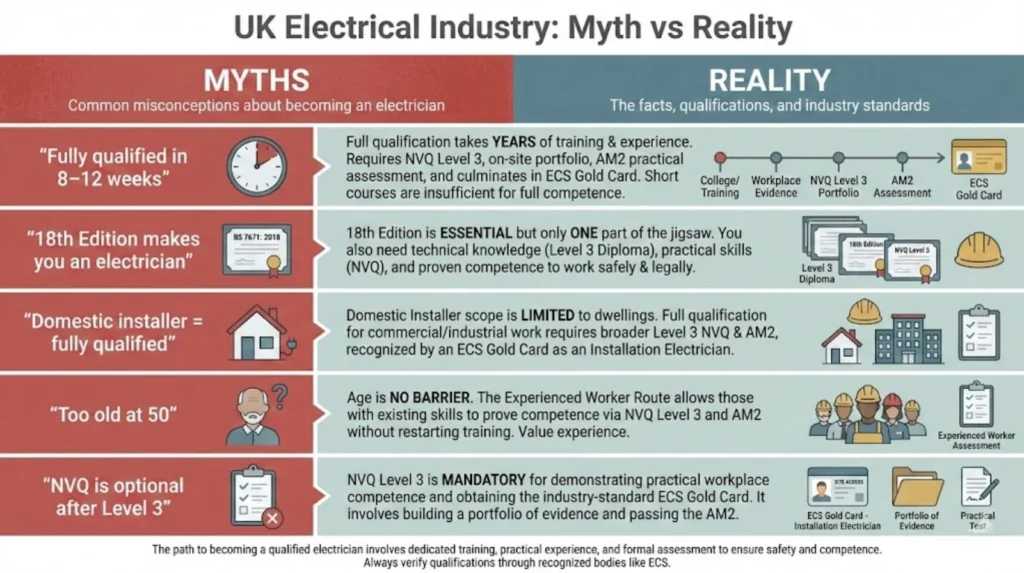
Common claims require factual responses, not motivational reassurance.
“You can be fully qualified in 8 to 12 weeks”
Reality: Short courses typically offer domestic installer training covering Level 2, Level 3, and 18th Edition compressed into intensive blocks. You leave with theory certificates. You cannot obtain ECS Gold Card without NVQ Level 3 (requires workplace evidence over 6 to 18 months) and AM2 (requires NVQ completion first). Domestic installer registration possible in 8 to 12 weeks. Full site-recognised qualification requires 2 to 4 years minimum including workplace evidence gathering.
Verdict: Mostly false. True only for domestic-only scope, misleading for full electrician status.
“18th Edition makes you an electrician”
Reality: 18th Edition (BS 7671:2018+A2:2022) is a 3 to 5 day classroom course on wiring regulations. Covers regulatory requirements, not practical skills. You can pass the exam without ever wiring a circuit. Required component of full qualification but insufficient alone. Holding 18th Edition without NVQ and AM2 provides no legal authority to work unsupervised under Electricity at Work Regulations.
Verdict: Mostly false. Essential component, not standalone qualification.
“Domestic installer equals fully qualified electrician”
Reality: Domestic installer status allows self-certification of residential work under Building Regulations Part P through CPS registration. Scope limited to houses and flats. Cannot work on commercial sites, industrial installations, or three-phase systems. Cannot hold ECS Gold Card. Employers seeking “qualified electricians” mean Gold Card holders (NVQ Level 3 plus AM2), not domestic-only registration. Courts interpreting Electricity at Work Regulations default to NVQ Level 3 plus AM2 as competence standard, not CPS registration.
Verdict: False. Different scope and recognition level entirely.
“You’re too old at 50”
Reality: No legal age limits exist for apprenticeships, NVQ qualifications, AM2 assessments, or ECS cards. Adults at 50, 55, even 60 successfully complete electrical training and work for 10 to 15+ years. Structural barriers exist (employer costs after Year 2, physical demands, time to competence) but aren’t legal prohibitions. Maturity advantages: reliability, life experience, problem-solving, financial stability. Physical challenges: manual handling, working at height, presbyopia affecting close-up work. Success depends on honest assessment of capability, financial planning, and route selection matching circumstances.
Verdict: False regarding legal barriers. True that structural challenges require planning.
“NVQ is optional if you’ve done Level 3”
Reality: Level 3 diploma is technical theory assessed in classroom/workshop. NVQ Level 3 is workplace competence assessed through portfolio evidence from real jobs. Without NVQ, you cannot obtain ECS Gold Card. Without Gold Card, you cannot access most commercial or industrial electrical work. Agencies filter candidates by card status. Main contractors require it for site access. Domestic-only work possible without NVQ (through CPS registration), but limits career scope permanently.
Verdict: Mostly false. Optional only if accepting domestic-only restriction. Essential for full electrician status.
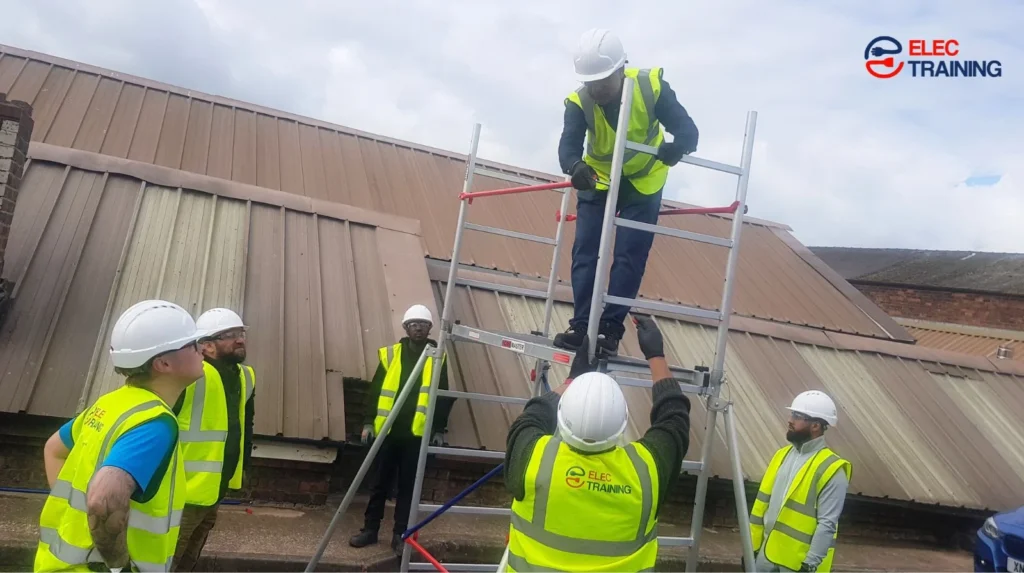
Planning a Second Career at 50
No legal barriers prevent becoming an electrician at 50, but structural realities require honest assessment and careful planning that younger entrants can avoid.
The distinction between legal permissions and commercial realities matters. Apprenticeship eligibility, NVQ enrolment, and ECS card applications don’t restrict by age. However, employers weighing Year 2 wage costs, physical job demands, and projected career length create informal selection pressures absent from written policy. At 50, you’re not fighting legal prohibition. You’re navigating employer economics, your own physical capacity, and financial planning through 2 to 4 years reduced income.
Route selection carries more weight at 50 than at 25 because you’re potentially planning a 15 to 20 year second career rather than 40+ years younger starters expect. Domestic-only training (6 to 12 months, £3,000 to £5,000) provides fastest entry but caps earnings at £30,000 to £40,000 and eliminates commercial opportunities permanently. Gold Card pathway (2 to 4 years, £6,000 to £11,000 if self-funded or free if apprenticeship) takes longer but enables £38,000 to £50,000+ earnings with full commercial and industrial scope for remaining career years.
Financial mathematics matters. Starting training at 50, reaching qualified status at 52 to 54, working until 65 to 67 provides 12 to 15 years at qualified rates. If Gold Card route earns £10,000 annually more than domestic-only (£44,000 versus £34,000 average), that’s £120,000 to £150,000 additional career earnings despite longer training investment. Domestic route saves 18 to 24 months training time but costs significantly more over career span through scope restriction.
Physical capability requires honest assessment, not optimistic assumptions. Working at height, manual handling up to 25kg, prolonged kneeling, and close-up termination work don’t reduce in difficulty with age. Presbyopia affects close-up fault-finding required in AM2 assessments and daily work. Pre-existing back, knee, or shoulder conditions may worsen under repetitive strain. Testing capability early (weekend site work during theory phase, physical training, optician assessment) prevents investing £5,000 to £10,000 and 12 to 24 months before discovering physical limitations prohibit long-term work.
Employer access at 50 varies by route. Apprenticeships require employer sponsorship upfront, difficult when Year 2+ costs increase 60% compared to younger apprentices. College-then-improver route delays employer hunting until after theory completion, but improver market competitive. Experienced Worker requires 5+ years verifiable electrical work, narrowly defined. Domestic-only avoids employer hunting through self-employment but restricts scope. Matching route to employment access improves success probability.
The timeline to qualified status (2 to 4 years) coupled with projected career length (15 to 20 years) creates different calculation than 25-year-olds face (similar training period, 40+ year careers). At 50, training represents approximately 15% to 20% of remaining career length. At 25, it’s 5% to 10%. This doesn’t make training worthless at 50. It makes route selection, financial planning, and physical assessment more critical because training investment comprises larger percentage of total career span.
If you’re considering electrician training at 50, focus on honest physical assessment, financial planning for 2 to 4 years reduced income, route selection matching your circumstances (prior experience, employer access, funding availability), and understanding difference between domestic scope and full Gold Card status. Avoid courses promising fast qualification without workplace evidence components. Confirm funding availability upfront. Plan physically for sustained manual work capacity. And select routes providing full qualification flexibility rather than fast entry with permanent restrictions.
Call 0330 822 5337 to discuss electrician training pathways for 50-year-old career changers. We’ll assess your current situation, explain which routes match your experience level and physical capability, clarify NVQ evidence requirements that don’t change with age, outline financial planning considerations for income reduction during training, and discuss how our network of 120+ contractor partners supports mature entrants securing workplace evidence placements. No false promises about 8-week qualifications or age being irrelevant. Just evidence-based guidance on recognised routes, structural challenges at 50, and what full qualification actually requires for 15 to 20 year second careers.
References
- Electrotechnical Certification Scheme (ECS) – Card Requirements and Age Eligibility – https://www.ecscard.org.uk/
- Joint Industry Board (JIB) – Wage Rates and Grading Structure 2025 – https://www.jib.org.uk/
- Scottish Joint Industry Board (SJIB) – Adult Training Rates and Standards – https://sjib.org.uk/
- Scottish Electrical Charitable Training Trust (SECTT) – Adult Training Scheme – https://sectt.org.uk/
- GOV.UK – Apprenticeships: Age and Eligibility Requirements – https://www.gov.uk/become-apprentice
- GOV.UK – National Minimum Wage and Living Wage Rates April 2025 – https://www.gov.uk/national-minimum-wage-rates
- Skills England – Installation Electrician Standard (ST0152) – https://skillsengland.education.gov.uk/apprenticeship-standards/st0152-v1-1
- Health and Safety Executive (HSE) – Electricity at Work Regulations 1989 – https://www.hse.gov.uk/pubns/books/hsr25.htm
- Office for National Statistics (ONS) – Annual Survey of Hours and Earnings (ASHE) 2024 – https://www.ons.gov.uk/
- National Electrotechnical Training (NET) – AM2, AM2S, AM2E Assessment Information – https://www.netservices.org.uk/am2/
- City & Guilds – 2365 Level 2/3 Diplomas and 2357 NVQ Level 3 – https://www.cityandguilds.com/
- NICEIC – Domestic Installer Scheme and Part P Requirements – https://niceic.com/
- GOV.UK – Building Regulations Part P (Electrical Safety) – https://www.gov.uk/government/publications/electrical-safety-approved-document-p
Note on Accuracy and Updates
Last reviewed: 19 December 2025. This page is maintained; we correct errors and refresh sources as ECS requirements, JIB/SJIB wage agreements, apprenticeship funding rules, and NVW regulations change. Pay data reflects ONS ASHE 2024 and JIB rates effective January 2025. Physical demand data based on HSE construction health guidance. Job advert analysis reflects December 2025 sample across Indeed, Reed, and Totaljobs platforms. Apprenticeship funding rules reflect ESFA 2024/25 academic year. Next review scheduled following publication of JIB 2026 wage agreement (estimated March 2026), changes to apprenticeship age-based pay rules, or updates to ECS card requirements.
