
Becoming an Electrician Without GCSEs: A Practical Guide for Adult Learners (UK)

- Technical review: Thomas Jevons (Head of Training, 20+ years)
- Employability review: Joshua Jarvis (Placement Manager)
- Editorial review: Jessica Gilbert (Marketing Editorial Team)
- Last reviewed:
- Changes: New comprehensive article addressing GCSE requirements for electrician training, Functional Skills equivalency, legal vs funding vs qualification rules, England and Scotland differences, maths competence barriers, and practical routes for adult learners without school qualifications
The question appears constantly in search boxes and training forums: “Can you become an electrician without GCSEs?” The answer creates confusion because the legal position differs from funding rules, which differ from qualification requirements, which differ from employer behavior, and all of it gets wrapped together into blanket statements that aren’t quite accurate.
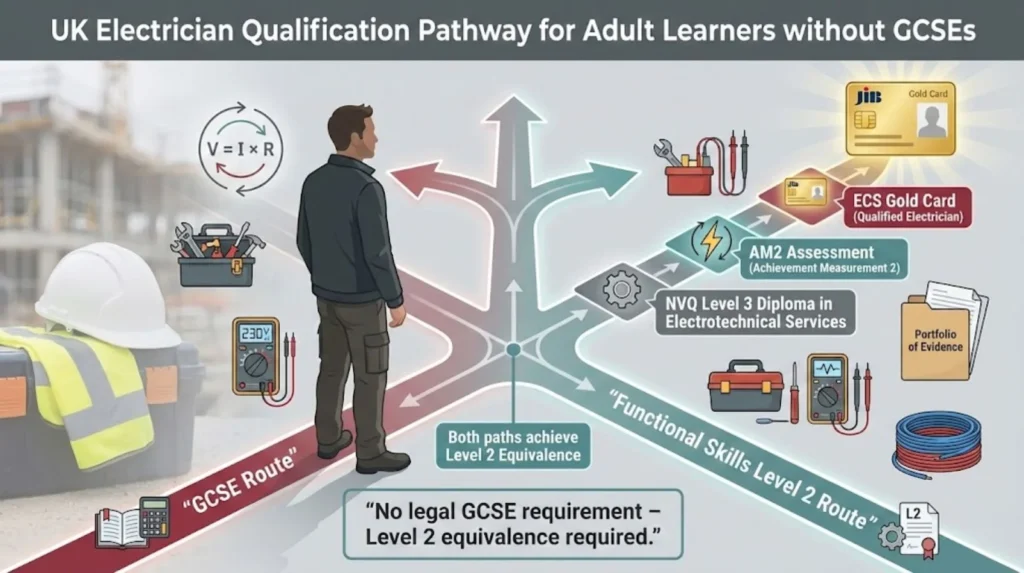
Here is the legal reality. UK law contains no requirement for GCSEs to work as an electrician. The Electricity at Work Regulations 1989 require persons to possess “sufficient technical knowledge and experience” to prevent danger. Nothing specifies school qualifications. You could theoretically have left education at 16 with no certificates, spent decades developing electrical competence through employment, and work legally as electrician if you can demonstrate capability.
However, here is the practical reality. To reach “qualified electrician” status in industry terms (NVQ Level 3, AM2 assessment, ECS Gold Card), you must prove Level 2 Maths and English competence. This requirement appears in funding rules for courses, apprenticeship gateway requirements, and qualification progression pathways. The system doesn’t specifically demand GCSEs. It demands Level 2 equivalence, which GCSEs happen to satisfy automatically.
The confusion exists because when people say “you need GCSEs,” they’re conflating several different requirements. Training providers check qualifications at enrolment for funding eligibility. Apprenticeship standards require Level 2 by completion gateway. Employers sometimes filter candidates by GCSEs because it’s simple screening. But the actual electrician qualification pathway (technical certificates, NVQ portfolio, AM2 practical exam, Gold Card application) never checks GCSE certificates at the assessment stage.
So yes, you can become a qualified electrician without GCSEs. But no, you cannot avoid demonstrating Level 2 Maths and English competence through some alternative means. That alternative is typically Functional Skills Level 2, which thousands of adult career changers use successfully. To be fair, most people don’t know Functional Skills exists or that it’s accepted everywhere GCSEs are.
This article explains what actually requires GCSEs versus what requires Level 2 equivalence, how Functional Skills work as alternatives, where England and Scotland differ, which routes suit adults without school qualifications, and why the real barrier isn’t certificates but maths competence itself. For complete information on the UK electrician qualification framework from Level 2 through Gold Card status, see our complete UK electrician qualification framework guide.

What Actually Requires GCSEs (And What Doesn't)
Understanding where GCSEs matter requires separating law, qualification rules, funding requirements, and employer preferences.
Legal Position
UK law (Electricity at Work Regulations 1989, BS 7671 compliance requirements under Building Regulations) contains zero mention of GCSEs or school qualifications. Legal requirement is “competent person” status demonstrated through capability to work safely and comply with standards. Competence is assessed through practical demonstration and professional qualifications (NVQ Level 3, AM2), not school certificates.
Verdict: No legal GCSE requirement exists.
Technical Certificates (City & Guilds 2365, EAL Equivalents)
Level 2 and Level 3 Electrical Installation diplomas are knowledge-based qualifications teaching theory, safety, regulations, installation methods. City & Guilds and EAL (awarding bodies) do not mandate GCSE entry requirements. Providers typically use diagnostic assessments (BKSB tests, initial assessments) checking whether candidates can handle electrical maths content at appropriate level.
However, to access government funding or employer sponsorship for these courses, you must either hold Level 2 Maths and English or commit to achieving them alongside technical study.
Verdict: GCSEs not required by awarding bodies, but Level 2 equivalence required for funding eligibility.
Apprenticeships (ST0152 Standard)
Installation and Maintenance Electrician apprenticeship standard specifies minimum entry suggestions of 2 to 5 GCSEs including Maths and English. However, “suggestions” means employers set actual requirements, and Functional Skills Level 2 is explicitly accepted as alternative.
The hard requirement appears at “gateway” (point where apprentice completes training and progresses to End Point Assessment). Must hold Level 2 Maths and English by gateway to sit AM2 and complete qualification. If you don’t have them at apprenticeship start, you study them alongside technical training as embedded components.
Verdict: GCSEs preferred but not mandatory. Level 2 equivalence absolutely required by completion gateway.
NVQ Level 3 (Workplace Competence)
NVQ Level 3 (City & Guilds 2357 or 5357) is portfolio-based qualification assessing workplace capability across installations, testing, fault-finding. Assessment focuses on documented evidence from real electrical work: photos of installations, test results, witness statements from qualified supervisors.
NVQ assessors never check GCSE certificates. They verify competence evidence meets unit requirements. However, you need functional literacy for documentation (installation reports, test certificates, risk assessments) and numeracy for calculations appearing in portfolio evidence.
Verdict: GCSEs not checked at NVQ assessment. Literacy and numeracy capability essential for portfolio completion.
AM2 / AM2S / AM2E Assessment
The practical End Point Assessment operated by National Electrotechnical Training tests installation skills, testing procedures, and fault-finding under timed conditions over 2 to 3 days. Assessment includes written elements (installation reports, test result documentation, compliance statements) requiring literacy, and calculations (voltage drop, earth loop impedance, circuit design) requiring numeracy.
AM2 assessors check competence demonstration, not school certificates. Pass criteria: installation to BS 7671, correct testing procedures, accurate fault diagnosis, proper documentation. First-attempt pass rate approximately 60%, failure rate 40% commonly due to testing procedure errors and fault-finding under time pressure.
Verdict: GCSEs never checked. Mathematical and literacy competence non-negotiable for passing.
ECS Gold Card (JIB Registration)
Electrotechnical Certification Scheme issues Gold Cards based on verified qualifications: NVQ Level 3, AM2 pass, 18th Edition current, health and safety training. Application process checks qualification certificates, not school history. Once you hold Gold Card, it proves qualified electrician status for site access and employment.
JIB (Joint Industry Board) grading similarly verifies electrical qualifications, not GCSEs.
Verdict: GCSEs irrelevant. Gold Card proves competence, which is what employers and sites require.
Experienced Worker Assessment (EWA Route)
For adults with 5+ years electrical experience (typically as mates, maintenance roles, facilities work) but no formal qualifications, Experienced Worker Assessment route focuses on skills scan and portfolio of actual work evidence. Assessed on capability demonstrated through employment history, not school certificates.
Must still pass AM2E (Experienced Worker variant of assessment) requiring maths for testing calculations and fault-finding, but eligibility isn’t contingent on GCSEs or school qualifications at all.
Verdict: GCSEs completely irrelevant. Competence from experience is assessment focus.
Thomas Jevons, our Head of Training with 20+ years experience, clarifies:
"GCSE certificates are checked at training enrolment and funding applications. They're never checked at AM2 assessment or ECS Gold Card applications. What's checked is whether you can calculate voltage drop correctly, interpret test results accurately, and install to BS 7671 standards. The competence matters. The paper from age 16 doesn't matter once you're demonstrating practical capability."
Thomas Jevons - Head of Training
GCSEs vs Functional Skills: This Is Where People Get Lost
The confusion around GCSE requirements stems largely from lack of awareness about Functional Skills qualifications.
What Functional Skills Level 2 Actually Is
Functional Skills are practical qualifications in English and Maths designed for adult learners and vocational contexts. Developed by qualification regulators (Ofqual in England) as alternatives to GCSEs focusing on real-world application rather than academic breadth.
Level 1 Functional Skills: Equivalent to GCSE grades 1 to 3 (D to G under old grading). Covers basic literacy and numeracy. Used as foundation before progressing to Level 2.
Level 2 Functional Skills: Equivalent to GCSE grades 4 to 9 (C to A* under old grading). This is the standard “pass” level required for apprenticeships, funding eligibility, and qualification progression. Explicitly accepted as GCSE equivalent by government, awarding bodies, employers, and professional bodies.
Assessment format: Functional Skills exams test practical application. Maths includes problem-solving with electrical context examples (calculating materials, interpreting drawings, working with measurements). English includes reading technical documents, writing reports, communicating effectively. Exams are shorter and more focused than GCSE exams.
Where Functional Skills Are Accepted
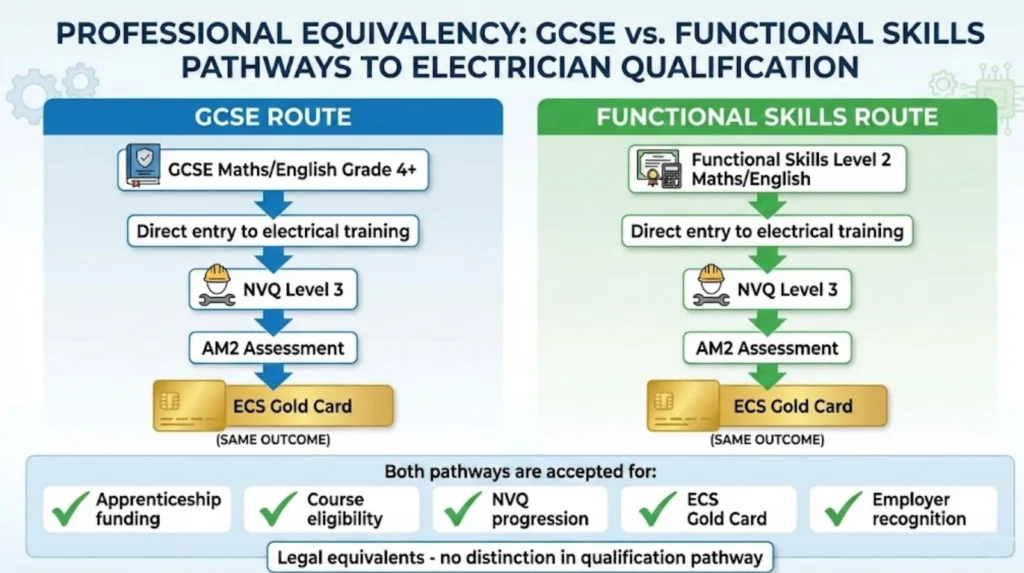
Functional Skills Level 2 Maths and English are legally recognized equivalents in every context where GCSEs are mentioned:
Apprenticeship funding: Government funds apprenticeships for candidates with Functional Skills exactly as for candidates with GCSEs. No distinction or preference.
Course funding (Adult Skills Fund, Advanced Learner Loans): Functional Skills satisfy Level 2 requirement for eligibility. Treated identically to GCSEs in funding calculations.
Qualification progression: City & Guilds, EAL, and all awarding bodies accept Functional Skills for NVQ Level 3 enrolment and progression.
ECS Gold Card applications: Joint Industry Board and Electrotechnical Certification Scheme accept Functional Skills as proof of Level 2 literacy and numeracy.
Apprenticeship gateway requirements: End Point Assessment organizations accept Functional Skills for gateway eligibility to sit AM2.
Employer recognition: Legally, employers cannot discriminate between GCSEs and Functional Skills. Both prove Level 2 competence. In practice, once you hold NVQ Level 3 and Gold Card, nobody asks which qualification provided your Level 2 equivalence.
Why Adults Underestimate Functional Skills
Common misconceptions create barriers:
“Functional Skills are easier than GCSEs”: Content difficulty is comparable. Pass rate for Level 2 Functional Skills Maths is approximately 60% to 65% first attempt, similar to GCSE pass rates. The practical focus suits adult learners better than abstract GCSE content, but that doesn’t mean it’s easier academically.
“Employers won’t accept them”: Legally prohibited discrimination. Functionally, employers care about ECS Gold Card and NVQ Level 3 demonstrating competence. Which qualification got you Level 2 equivalence decades ago is irrelevant to site work.
“They’re ‘second-class’ qualifications”: Government, regulators, awarding bodies, and professional bodies treat them as exact equivalents. The perception exists only among people unfamiliar with vocational training systems.
“You can’t get into university with them”: True in some cases, but irrelevant for electrical trade pathways. If your goal is electrician qualification rather than academic degree, Functional Skills provide everything needed.
Timeline and Study Implications
Adults starting electrical training without Level 2 Maths and English face extended timelines:
If you have Level 1 or Entry Level starting point: Study Functional Skills Level 1 first (3 to 6 months), then Level 2 (6 to 12 months). Total: 9 to 18 months before or alongside electrical technical training.
If you have informal skills but no certificates: Diagnostic assessment determines starting level. Many adults passed GCSEs at lower grades (D, E, F under old system, grades 1 to 3 under current) and start at Level 1. Others have workplace numeracy and literacy placing them directly into Level 2.
Studying Functional Skills alongside electrical diplomas: Extends overall timeline by 6 to 12 months because you’re managing multiple qualifications simultaneously rather than focusing purely on electrical content.
Joshua Jarvis, our Placement Manager, notes:
"Adults studying Functional Skills Level 2 Maths alongside Level 2 and Level 3 electrical diplomas extend their timeline by approximately 6 to 12 months compared to those with GCSEs. They're managing multiple qualifications simultaneously rather than focusing purely on electrical content. That timeline extension creates financial pressure if you're already in reduced-income training phase. It's achievable but demands sustained commitment."
Joshua Jarvis, Placement Manager
The system works. Thousands of qualified electricians working today used Functional Skills rather than GCSEs. However, pretending the pathway is identical in duration or challenge to starting with GCSEs already held creates false expectations.
England vs Scotland: Same Outcome, Different Gates
Regional differences affect when Level 2 equivalence matters rather than whether it matters.
England, Wales, and Northern Ireland (JIB/ECS System)
Entry flexibility: Most colleges and private training providers in England accept adults without GCSEs into Level 2 Electrical Installation (C&G 2365-02) using diagnostic assessments (BKSB tests) rather than demanding certificates upfront. If diagnostic shows capability to handle technical content, enrolment proceeds. Functional Skills studied alongside or afterwards.
Hard requirement appears later: To progress to NVQ Level 3 or complete apprenticeship gateway, must achieve Level 2 Maths and English. This creates “study now, prove later” pathway. Many adults complete Level 2 and Level 3 technical certificates whilst working toward Functional Skills Level 2. Progress stalls at NVQ enrolment without Level 2 equivalence.
Funding structure supports flexibility: Adult Skills Fund and Advanced Learner Loans fund Functional Skills training for adults without Level 2, often fully funded if unemployed or low-income. System designed to enable rather than exclude.
Result: Flexible entry, hard gate before final qualification. Adults can start training, assess capability through technical courses, build Functional Skills competence gradually. However, cannot complete qualification without achieving Level 2 equivalence eventually.
Scotland (SJIB/SECTT System)
Earlier numeracy gate: Scottish Electrical Charitable Training Trust (SECTT) operates adult trainee routes with more stringent entry assessments. Pre-Employment Assessment includes dedicated numeracy and literacy testing. Adults must pass SECTT entry test before registering as trainees.
National 5 equivalents: Scotland’s school qualification system uses National 5s (equivalent to GCSE grades 4 to 9). SECTT accepts various equivalents but typically tests competence upfront rather than allowing deferred study.
Less tolerance for “learn it later”: While routes exist for adults without qualifications, Scotland’s system emphasizes proving capability before starting rather than during training. Diagnostic failures often result in recommendation to complete literacy and numeracy qualifications first, then reapply.
However, more flexible for experienced adults: SECTT recognizes adults with significant electrical experience through alternative pathways. Once competence is demonstrated, formal school qualifications become less relevant.
Result: Stricter entry gate, but clearer pathway once accepted. Adults know competence level upfront rather than discovering gaps midway through training.
Practical Implications
England approach suits adults who need to assess whether electrical training is viable before committing to maths study. Can begin technical training, gauge interest and capability, then pursue Functional Skills if electrical work proves suitable career direction.
Scotland approach suits adults who prefer clarity and structure. Passing entry assessment confirms readiness for training pathway. Less risk of starting, discovering maths gaps, struggling with dual qualifications simultaneously.
Neither system is “easier” for adults without GCSEs. England defers the challenge, Scotland front-loads it. Both ultimately require Level 2 equivalence for qualification completion.
The Three Realistic Routes Without GCSEs
Each route has different implications for adults without school qualifications.
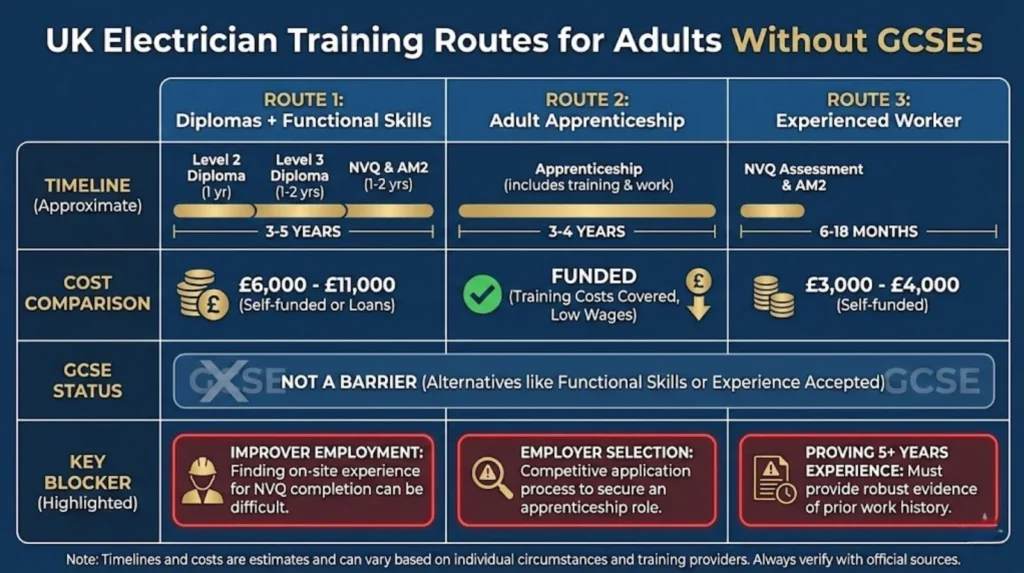
Route 1: Diplomas + Functional Skills + NVQ (Self-Funded or Loan-Funded)
Structure:
Complete Functional Skills Level 1 (if starting below Level 2): 3 to 6 months. Study basic maths and English to foundation level.
Complete Functional Skills Level 2 concurrently or sequentially: 6 to 12 months. Achieve GCSE-equivalent Level 2 Maths and English through practical assessments.
Enrol in Level 2 Electrical Installation (C&G 2365-02): 3 to 6 months full-time or 12 to 18 months part-time. Learn electrical theory, safety, basic installation principles.
Progress to Level 3 Electrical Installation (C&G 2365-03): 4 to 8 months full-time or 12 to 18 months part-time. Advanced theory, three-phase systems, testing, design.
Secure employment as improver or mate: Build workplace evidence for NVQ Level 3 portfolio. Duration: 12 to 18 months.
Complete NVQ Level 3 assessment: 12 to 18 months portfolio building with assessor visits.
Pass AM2 practical assessment: 2 to 3 days installation, testing, fault-finding exam.
Apply for ECS Gold Card: Verification process 4 to 6 weeks.
Total timeline: 3 to 5 years from starting Functional Skills to Gold Card, depending on starting level and study mode (full-time vs part-time).
Costs: Functional Skills often fully funded for adults. Electrical diplomas: £4,000 to £6,000 (may be covered by Advanced Learner Loans). NVQ assessment: £1,500 to £3,000. AM2: £800 to £1,000. Total: £6,300 to £10,900 if not funded.
Who it suits: Adults who can study whilst maintaining current employment. Those with savings or redundancy pay to self-fund. People who want flexibility to gauge electrical training suitability before full career commitment.
Real blocker: Securing improver employment providing diverse work for NVQ evidence after completing theory diplomas. Many adults complete £4,000 to £6,000 diplomas then cannot find positions offering qualifying workplace access.
Route 2: Adult Apprenticeship with Embedded Maths/English (Employed Throughout)
Structure:
Apply for Installation and Maintenance Electrician apprenticeship (ST0152): Most employers accept Functional Skills Level 2 or commitment to achieve during apprenticeship. Some employers prefer GCSEs but cannot legally require them exclusively.
Begin apprenticeship with embedded Level 2 study: Work four days weekly, college one day. If you lack Level 2 Maths and English, study them alongside electrical technical training as apprenticeship components.
Complete technical training: Level 2, Level 3, 18th Edition, NVQ Level 3 portfolio over 3 to 4 years.
Pass gateway requirements: Must hold Level 2 Maths and English by gateway to progress to End Point Assessment.
Complete AM2S assessment: Apprentice variant of practical exam. 2 to 3 days testing competence.
Receive completion certificate and apply for ECS Gold Card.
Total timeline: 3 to 4 years apprenticeship duration, potentially extending 6 to 12 months if you enter without Level 2 and need additional time achieving equivalence alongside technical content.
Costs: Apprenticeships are government-funded. Minimal personal cost beyond tools (£300 to £500) and PPE (£150 to £200).
Who it suits: Adults who can accept apprentice wages (£15,000 to £16,000 Year 1, £24,000+ Year 2+ for ages 21+). Those wanting structured pathway with guaranteed employment throughout. People who learn better through workplace-based training than classroom study.
Real blocker: Finding employers willing to hire adult apprentices without GCSEs. Employers worry about gateway failure risk if apprentice doesn’t achieve Level 2 by completion. Competition from younger candidates who already hold GCSEs or can stay at lower apprentice wage longer.
Route 3: Experienced Worker Assessment (EWA Route, For Those With Site Experience)
Structure:
Verify eligibility: Minimum 3 to 5 years electrical work experience. Must provide evidence through employment history, references from qualified electricians, work samples with dates.
Enrol in Experienced Worker Assessment: Skills scan identifies competence level. Portfolio built from current or recent employment.
Complete any technical training gaps: Often require 18th Edition (BS 7671) if not current. May need inspection and testing training. Duration: 3 to 6 months for gaps.
Build NVQ portfolio: Document evidence from workplace covering required competence units. 6 to 12 months typically.
Pass AM2E assessment: Experienced Worker variant of practical exam. Includes additional containment tasks beyond standard AM2. 2 to 3 days assessment.
Apply for ECS Gold Card: Based on NVQ, AM2E pass, 18th Edition, health and safety training.
Total timeline: 6 to 18 months from EWA enrolment to Gold Card if evidence gathering proceeds smoothly and sufficient experience exists.
Costs: EWA assessment and portfolio support: £1,500 to £2,500. AM2E: £935. 18th Edition if needed: £400 to £600. Total: approximately £2,900 to £4,100.
Who it suits: Adults who worked as electrical mates, facilities maintenance with electrical components, site electricians without formal qualifications for years. People who left education early but developed competence through employment.
Real blocker: Proving 5+ years genuine electrical work with sufficient variety for NVQ evidence. Many adults have repetitive experience (one installation type repeatedly) without breadth across competence requirements. Also, convincing assessors that informal learning meets NVQ standards without structured training gaps.
GCSE relevance: Completely irrelevant for EWA route. Nobody checks school certificates. Assessment focuses entirely on demonstrated workplace competence. However, you still need mathematical capability for AM2E calculations and testing procedures. The skill matters, not the certificate.
For context on how adults at specific life stages navigate career transitions into electrical work including additional considerations, see our guide on electrician career change at 40.
Employer Reality (Not Policy)
What employers actually do differs from what qualification regulations permit.
GCSE Filtering in Practice
Job advert analysis across Indeed, Reed, and Totaljobs for electrician and improver positions shows:
30% to 50% of adverts mention GCSEs or “Level 2 Maths and English” in entry requirements. Phrasing varies: some specify “GCSE Grade C/4 or equivalent,” others simply state “GCSEs preferred.”
However, advert requirements don’t always reflect hiring decisions. Smaller contractors (under 10 employees) rarely check certificates once Gold Card is verified. Larger contractors and agencies use GCSEs as HR screening filters because it’s simple criteria for sorting applications.
Why Large Contractors Filter by GCSEs
Main contractors on commercial sites, particularly those with formal recruitment processes (Balfour Beatty, Laing O’Rourke, major M&E contractors), use GCSEs as quick capability proxy. Reasoning: Person who achieved GCSEs at 16 demonstrated baseline academic capacity. Reduces perceived risk of training failures or competence issues.
This filtering is legally permissible during recruitment if applied consistently and can be justified as occupational requirement (numeracy and literacy essential for electrical work). However, must accept Functional Skills Level 2 as equivalent if candidates present them.
Result: Adults with Functional Skills instead of GCSEs may face additional scrutiny at application stage. Once invited to interview and capability is discussed, equivalence usually becomes non-issue.
Why Small Contractors Rarely Care
One-person or small team electrical firms prioritize practical capability over paperwork. Hiring electrician’s mate or improver, primary concerns are: Can you work safely? Will you show up reliably? Can you learn on site? School qualifications from decades ago are irrelevant to these questions.
Gold Card verification matters (proves NVQ Level 3 and AM2 competence). CSCS card for site access matters. Driving licence often matters (mobile work). GCSEs or Functional Skills certificates don’t get checked because once you hold Gold Card, competence is proven regardless of educational pathway that got you there.
The Gold Card Outweighs School History
Once qualified with ECS Gold Card, employment focuses on:
Competence level (Gold Card indicates qualified electrician, but experience level varies)
Specializations (testing and inspection, industrial, commercial, domestic, specific sectors)
Reliability and site behavior (references from previous employers)
Driving licence (mobility for van-based work)
Additional certifications (IPAF for height work, confined space training, PASMA for scaffolds)
Which qualification (GCSE vs Functional Skills) provided Level 2 equivalence 5 to 10 years earlier is functionally irrelevant. Nobody asks. Nobody checks. Competence demonstration through Gold Card and employment history matters.
Competition for Improver Roles
The GCSE issue affects adults most at improver stage (between completing Level 2 and Level 3 diplomas and securing employment for NVQ evidence). Employers hiring improvers compare candidates:
Younger candidate with GCSEs, fresh from college, willing to work at lower wages
Adult career changer with Functional Skills, potentially higher wage expectations, family commitments affecting flexibility
Employers often choose younger candidates not because GCSEs are superior to Functional Skills (legally equivalent), but because younger workers are perceived as more moldable, less expensive, more available for varied hours and travel.
This creates barrier for adults without GCSEs who also must study Functional Skills whilst competing for improver positions. The qualification equivalence is legal and technical. The practical employment competition is harder.
The Real Barrier Isn't GCSEs: It's Maths
Certificates get checked at enrolment. Competence gets tested throughout training and assessment.
Where Maths Competence Matters Critically
Level 3 electrical science requires formula manipulation:
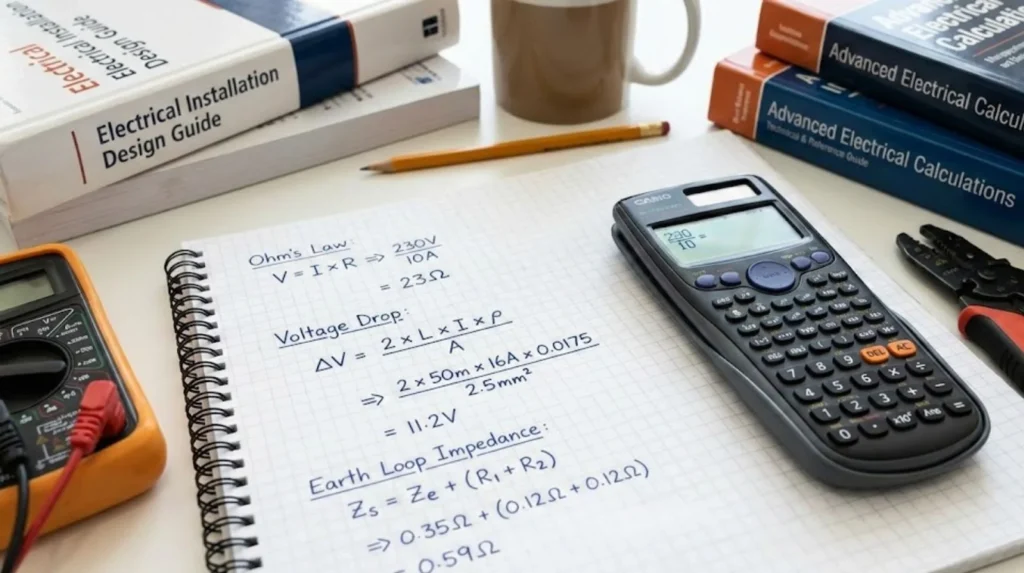
Ohm’s Law applications: V = I × R, rearranged to I = V ÷ R and R = V ÷ I
Power calculations: P = V × I, P = I² × R, P = V² ÷ R
Three-phase formulas: Line/phase relationships, power factor corrections
Impedance calculations: Z² = R² + X² (Pythagorean applications)
Adults who haven’t touched algebra since leaving school often struggle rearranging these formulas. The certificate (GCSE or Functional Skills) doesn’t teach this. The mathematical skill does. Passing Level 2 Maths exam doesn’t automatically mean comfortable manipulating electrical formulas under classroom and exam conditions.
Inspection and testing demands high accuracy:
Earth loop impedance calculations: Zs = Ze + (R1 + R2)
Voltage drop calculations: Vd = (mV/A/m × Ib × L) ÷ 1000
Prospective fault current: Ipf = U0 ÷ Zs
Discrimination and selectivity: Calculating fault levels for protective device coordination
Reading logarithmic scales: Insulation resistance testers use log scales requiring interpretation
These calculations must be accurate. Errors create unsafe installations or incorrect test results. AM2 assessment includes timed testing procedures where calculation errors fail candidates.
AM2 Pressure Points
First-attempt failure rate: approximately 40%. Common failures include:
Testing sequence errors (not electrical certificate issue, but competence and pressure)
Fault-finding under time pressure (typically 90 to 120 minutes for complex diagnosis)
Calculation mistakes in earth loop impedance or voltage drop affecting installation compliance
Adults without strong maths foundation struggle particularly with fault-finding. Must diagnose circuit faults, identify causes, verify through testing, document results, all under time constraints. Mathematical confidence affects capability to work systematically through fault diagnosis using test results.
The Skills Gap vs Certificate Gap
Many adults hold Functional Skills Level 2 or GCSEs from decades ago but haven’t used algebra, formula rearrangement, or technical calculations since. The certificate exists. The competence has atrophied.
Conversely, some adults without certificates have developed numerical capability through trades work (construction estimating, site measurements, materials calculations). Functional aptitude exceeds formal qualifications.
The pathway works when adults recognize: Achieving Level 2 Maths equivalence through Functional Skills is starting point, not finishing point. Must then practice electrical maths specifically (Ohm’s Law applications, testing calculations, circuit design) consistently over months. Certificate gets you enrolled. Competence gets you qualified.
Maths Support Resources
Most electrical training providers offer:
Additional numeracy support sessions for adults struggling with Level 3 science
Electrical maths workshops focusing on formula applications
Online resources (videos, practice problems, worked examples)
One-to-one tutoring if severe gaps exist
However, these are supplementary. Cannot replace sustained personal practice. Adults spending 2 to 3 hours weekly practicing electrical calculations alongside technical study typically handle Level 3 science and AM2 maths competently. Those avoiding maths practice fail assessments regardless of whether they hold GCSEs or Functional Skills certificates.
Myths vs Reality
Myth: “You can’t be an electrician without GCSEs”
Reality: UK law contains no GCSE requirement for electrical work. Qualification pathway (NVQ Level 3, AM2, ECS Gold Card) never checks GCSE certificates at assessment stages. However, must prove Level 2 Maths and English competence through GCSEs or Functional Skills or other recognized equivalents. Thousands of qualified electricians working today used Functional Skills instead of GCSEs. System is designed to include adults who left education early, not exclude them.
Verdict: False. Multiple pathways exist without GCSEs.
Myth: “Maths GCSE is specifically mandatory for electrician qualification”
Reality: Maths GCSE is recommended for entry to courses and apprenticeships, and required by some employers as recruitment filter. However, Functional Skills Level 2 Maths is legally accepted equivalent for all purposes: funding eligibility, apprenticeship gateway, NVQ progression, ECS Gold Card application. Assessment bodies (NET for AM2, awarding bodies for NVQ, ECS for Gold Card) check competence, not which qualification provided Level 2 equivalence. Once qualified, nobody distinguishes between electricians who used GCSEs versus Functional Skills pathways.
Verdict: Partially true. Level 2 Maths is mandatory. GCSE specifically is not, equivalents accepted.
Myth: “Functional Skills are worthless or ‘easier’ qualifications”
Reality: Functional Skills Level 2 are government-regulated qualifications with comparable difficulty to GCSEs (pass rate 60% to 65% first attempt, similar to GCSE rates). Explicitly recognized as Level 2 equivalents by Ofqual, Department for Education, all awarding bodies, funding bodies, professional organizations, and employers. Designed for practical application in vocational contexts rather than academic breadth. More relevant for trades than abstract GCSE content. Used successfully by thousands of adult career changers annually across all vocational sectors including electrical, plumbing, gas, carpentry.
Verdict: False. Functional Skills are equivalent qualifications, different format but comparable rigor.
Myth: “GCSEs matter once you’re qualified as electrician”
Reality: After achieving ECS Gold Card based on NVQ Level 3 and AM2 competence, employment focuses on proven capability: years of experience, specializations, references, reliability, additional certifications. Nobody asks which qualification (GCSE vs Functional Skills vs overseas equivalent) provided Level 2 equivalence years earlier. Gold Card proves competence regardless of educational pathway. Site access, commercial contracts, and job offers depend on Gold Card status and demonstrated experience, not school certificates from decades ago.
Verdict: False. GCSEs or equivalents matter only during training phase, irrelevant post-qualification.
Myth: “Employers won’t hire you without GCSEs”
Reality: Employer behavior varies significantly. Large contractors (30% to 50% of job adverts) mention GCSE preferences as HR screening criteria. However, legally must accept Functional Skills Level 2 as equivalent. Small contractors (majority of electrical firms in UK) rarely check school certificates, focusing on Gold Card verification and practical capability. Once holding Gold Card, competence is proven and school qualification pathway becomes irrelevant. Practical effect: Adults with Functional Skills face slightly more initial application scrutiny at large firms but identical employment prospects once qualified and experienced.
Verdict: Partially true initially, false post-qualification. Employment barriers exist during training, disappear after Gold Card.
For broader context on physical considerations affecting electrician work including vision-related assessment factors, see our guide on colour vision requirements for electricians and workplace accommodations.
What We Still Can't Prove
Transparency about limitations builds trust.
Provider Discretion Varies
Individual colleges and private training centers can set entry requirements stricter than awarding body minimums. City & Guilds and EAL don’t mandate GCSEs for Level 2 and Level 3 diplomas, but specific providers may choose to require them. This varies by institution, region, and whether provider receives government funding (funded providers typically more flexible, following funding body guidelines accepting equivalents).
Cannot provide comprehensive list of which providers accept adults without GCSEs versus those requiring them upfront. Prospective learners must contact providers directly asking: “Do you accept Functional Skills Level 2 as equivalent to GCSEs for entry?” and “Do you offer diagnostic assessments for adults without Level 2 qualifications?”
Overseas Equivalency Inconsistency
Ecctis (formerly UK NARIC) provides official statements of comparability for overseas qualifications. However, acceptance by UK training providers, employers, and funding bodies varies. Some providers accept Ecctis statements automatically. Others require additional verification or aptitude testing. International students and overseas workers cannot rely on universal acceptance despite official equivalency recognition.
GCSE Absence and AM2 Failure Correlation
No published data links GCSE absence specifically to AM2 failure rates. Anecdotal evidence from assessors suggests adults without strong maths foundations struggle more with testing calculations and fault-finding under pressure. However, this could equally apply to adults with decades-old GCSEs where competence has atrophied. Cannot definitively state: “Adults with Functional Skills fail AM2 at X% higher rate than adults with GCSEs” because data doesn’t exist or isn’t public.
What is known: AM2 first-attempt failure rate approximately 40% overall. Common failure points: testing procedure errors, fault-finding under time pressure, calculation mistakes. Whether these correlate with educational pathway (GCSE vs Functional Skills vs no formal qualifications) is unverified.
Employer Survey Data Limitations
Job advert sampling (Reed, Indeed, Totaljobs) suggests 30% to 50% mention GCSEs or Level 2 equivalence. However, this is analysis of advertised requirements, not actual hiring behavior. No comprehensive employer survey data exists showing:
What percentage of electrical employers require GCSEs versus accepting Functional Skills
How many qualified electricians working today used Functional Skills instead of GCSEs
Whether GCSE absence affects wage levels or career progression post-qualification
Claims about employer behavior rest on advert analysis and anecdotal trade forum discussions, not systematic research.
Planning Your Pathway Without GCSEs
Yes, you can become a qualified electrician without GCSEs. Legal requirement doesn’t exist. Qualification pathway accepts Functional Skills Level 2 Maths and English as equivalents in all contexts: funding eligibility, apprenticeship completion, NVQ progression, ECS Gold Card application. Thousands of adults annually use Functional Skills to achieve qualified status.
However, the pathway isn’t identical to starting with GCSEs already held. Timeline extends 6 to 12 months studying Functional Skills alongside or before electrical technical training. Financial pressure increases if you’re already in reduced-income training phase managing multiple qualifications simultaneously. Employer competition for improver roles is tougher because younger candidates with GCSEs seem lower-risk to contractors.
The certificates (GCSE or Functional Skills) enable entry into training. Maths competence determines whether you finish. Electrical Level 3 science requires formula manipulation. Inspection and testing demands calculation accuracy. AM2 assessment tests capability under pressure where mathematical confidence affects fault-finding and documentation. Adults who achieve Level 2 Maths through Functional Skills but then avoid electrical maths practice fail qualifications regardless of certificate held. Adults who practice electrical calculations consistently (2 to 3 hours weekly over months) typically handle technical content and AM2 competently.
Employer behavior creates practical barriers during training phase. Large contractors may filter applications by GCSEs. Small contractors rarely care. Once qualified with Gold Card, school qualification pathway becomes irrelevant. Site work, references, specializations, reliability matter. Which qualification provided Level 2 equivalence years ago doesn’t.
Three routes suit adults without GCSEs: self-funded diplomas plus Functional Skills building toward NVQ (3 to 5 years, £6,000 to £11,000 if unfunded), adult apprenticeships with embedded Maths/English study (3 to 4 years, government-funded but low wages), or Experienced Worker Assessment for those with 5+ years site experience bypassing academic requirements entirely (6 to 18 months, £3,000 to £4,000).
England system offers flexible entry with hard gates later. Scotland system requires upfront competence demonstration through entry assessments. Both ultimately demand Level 2 equivalence for qualification completion. Neither is inherently easier for adults without school qualifications, they just distribute the challenge differently.
If you’re considering electrical training without GCSEs, realistic assessment matters. Can you commit 6 to 12 months studying Functional Skills Level 2 Maths alongside electrical content? Will extended timeline create financial pressure you cannot sustain? Can you practice electrical calculations consistently to build competence beyond certificate achievement? Are you comfortable that employer competition may be tougher initially despite legal equivalence?
If answers are yes, electrical pathway is achievable. Functional Skills provide legitimate route used successfully by thousands. The system works. But pretending the pathway is identical to having GCSEs, or that certificates alone create competence, sets false expectations that lead to drop-outs.
Call 0330 822 5337 to discuss electrical training routes for adults without GCSEs. We’ll assess your current maths and literacy level through diagnostic testing, explain whether you need Functional Skills Level 1 before Level 2 or can start Level 2 directly, clarify exact timeline implications for studying Functional Skills alongside electrical diplomas, discuss which route (self-funded, apprenticeship, or experienced worker if eligible) matches your circumstances, and outline how our recruitment network of 120+ contractors can support securing improver placements despite competitive landscape. No false promises about speed or ease. No claims that qualifications don’t matter. Just honest guidance on recognised pathways, Functional Skills equivalency that’s legally protected, and maths competence requirements that determine success beyond certificate possession.
References
- Electricity at Work Regulations 1989 – https://www.hse.gov.uk/pubns/books/hsr25.htm
- GOV.UK – Functional Skills Qualifications Information – https://www.gov.uk/what-different-qualification-levels-mean/list-of-qualification-levels
- City & Guilds – 2365 Level 2/3 Electrical Installation Diplomas Entry Requirements – https://www.cityandguilds.com/
- City & Guilds – 2357/5357 NVQ Diploma in InstallingElectrotechnical Systems – https://www.cityandguilds.com/
- Electrotechnical Certification Scheme (ECS) – Gold Card Application Requirements – https://www.ecscard.org.uk/
- JIB (Joint Industry Board) – Grading and Qualification Recognition – https://www.jib.org.uk/
- National Electrotechnical Training (NET) – AM2 Assessment Entry Requirements – https://www.netservices.org.uk/am2/
- Institute for Apprenticeships – Installation and Maintenance Electrician Standard (ST0152) – https://www.instituteforapprenticeships.org/
- GOV.UK – Advanced Learner Loans Eligibility – https://www.gov.uk/advanced-learner-loan
- Scottish Electrical Charitable Training Trust (SECTT) – Adult Trainee Routes – https://www.sectt.org.uk/
- SJIB (Scottish Joint Industry Board) – Apprenticeship and Grading System – https://www.sjib.org.uk/
- Ecctis (UK NARIC) – International Qualification Comparability – https://www.ecctis.com/
- Department for Education – Functional Skills Reform and Implementation – https://www.gov.uk/government/publications/functional-skills-reform
- National Careers Service – Electrician Job Profile Entry Requirements – https://nationalcareers.service.gov.uk/job-profiles/electrician
Note on Accuracy and Updates
Last reviewed: 22 December 2025. This page is maintained; we correct errors and refresh sources as Functional Skills regulations, funding rules, awarding body requirements, and apprenticeship standards change. GCSE equivalency information reflects current Ofqual and Department for Education guidance. Functional Skills pass rate data from qualification regulators 2024/25. Training costs reflect December 2025 market pricing. Employer behavior analysis based on job advert sampling December 2025 (Reed, Indeed, Totaljobs). Regional differences (England vs Scotland) reflect current SECTT and JIB/ECS systems. Provider discretion acknowledged as variable requiring individual verification. Next review scheduled following Functional Skills qualification reforms, apprenticeship funding changes (April 2026), or significant changes to Level 2 equivalency recognition.
