

Beginner vs Advanced Electrician Courses: Which Route Is Right for You?

- Technical review: Thomas Jevons (Head of Training, 20+ years)
- Employability review: Joshua Jarvis (Placement Manager)
- Editorial review: Jessica Gilbert (Marketing Editorial Team)
- Last reviewed:
- Changes: Updated experienced worker assessment requirements following JIB 2346 qualification framework changes and NVQ portfolio evidence specifications
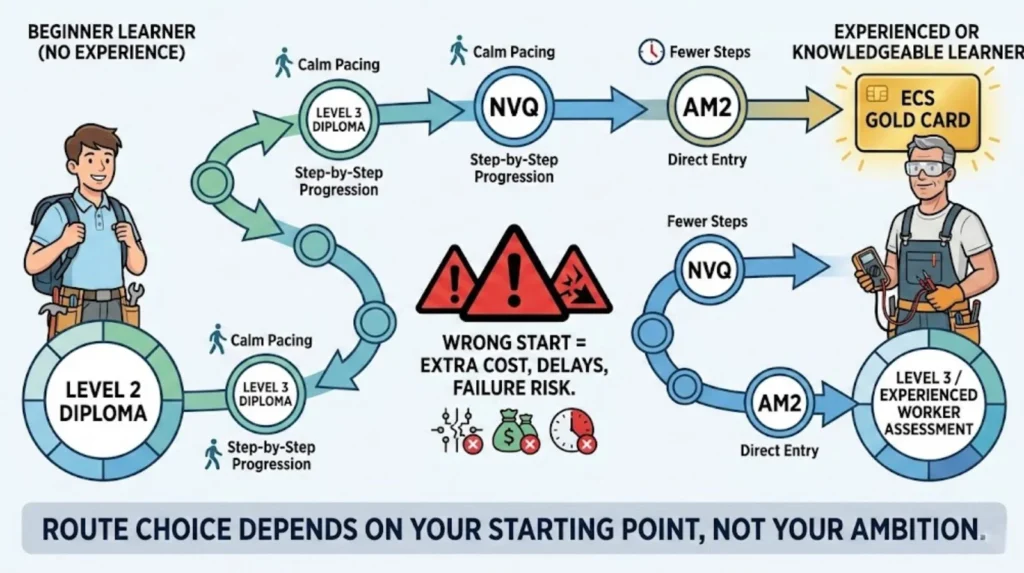
UK electrical training presents learners with fundamental choice between beginner courses (typically Level 2 Diplomas establishing foundational knowledge) and advanced courses (Level 3 qualifications building on existing knowledge or experience), with route selection carrying significant financial consequences when chosen inappropriately for learner starting points.
The terminology confusion begins immediately. Training providers market courses labeled “beginner,” “advanced,” “fast-track,” “intensive,” and “professional” without consistent definitions, creating impression that “advanced” automatically means faster or better regardless of learner background. Job advertisements request “advanced electricians” without clarifying whether they mean Level 3 knowledge qualification holders, NVQ-qualified installers, or experienced electricians with inspection and testing credentials. Learners encounter conflicting advice claiming you can skip Level 2 entirely through accelerated routes, or conversely that everyone must complete full four-year apprenticeships regardless of existing skills.
The financial stakes are substantial. Beginner Level 2 courses typically cost £2,000-£4,000, whilst advanced Level 3 courses range £3,000-£6,000, with complete pathways including NVQ support reaching £10,000-£12,000. Choosing wrong entry point creates expensive consequences: complete beginners attempting advanced courses without Level 2 foundation face high failure rates requiring course repetition at full cost, whilst experienced workers with years of site practice waste time and money repeating beginner content they already understand through practical application.
The knowledge versus competence distinction compounds confusion. Learners completing Level 3 Diploma courses believe they’re “qualified electricians” ready for unsupervised work, only discovering after spending £5,000-£8,000 that diploma alone doesn’t enable ECS Gold Card application or meet employer requirements for qualified status. The diploma provides knowledge assessed through exams and controlled workshop tasks, but qualified electrician status requires NVQ Level 3 proving workplace competence through portfolio evidence, plus AM2 practical assessment verifying independent competence under industry-standard conditions.
This article clarifies beginner versus advanced course distinctions, explains knowledge versus competence qualification differences, identifies appropriate route selection criteria based on starting points rather than ambitions, prevents diploma-only misconceptions that cause employment difficulties, addresses experienced worker assessment routes for those with substantial site experience, and provides age-appropriate guidance for mature learners considering electrical career changes.
Understanding Beginner vs Advanced: What These Terms Actually Mean
Training provider marketing uses “beginner” and “advanced” inconsistently, requiring understanding of official qualification frameworks rather than relying on course naming alone.
Beginner Courses: Level 2 Diplomas
Beginner electrical courses in UK context almost always refer to Level 2 Diplomas in Electrical Installations, offered by awarding bodies including City & Guilds (2365 Level 2), EAL (Level 2 Diploma in Electrical Installation), and LCL Awards (Level 2 domestic qualifications).
Content coverage:
Fundamental electrical principles (Ohm’s Law, series and parallel circuits, power calculations)
Health and safety requirements (safe isolation, PPE, risk assessment, COSHH)
Basic circuit design (lighting circuits, ring finals, radial circuits)
Protection devices (MCBs, RCDs, RCBOs, basic overcurrent protection)
Earthing and bonding fundamentals
Cable selection and installation methods
Basic testing procedures (continuity, insulation resistance, polarity)
Introduction to BS 7671 wiring regulations
Hand tools and basic power tool operation
Workshop-based practical installations on training rigs
Entry requirements: None typically required beyond basic literacy and numeracy (GCSE English and Maths at Grade D/3 or equivalent helpful but not mandatory). Suitable for complete beginners with zero electrical knowledge.
Assessment methods: Multiple-choice examinations testing theoretical knowledge, practical workshop assessments demonstrating basic installation techniques on controlled rigs, written assignments covering health and safety and regulations.
Duration: 6-12 months full-time, or 12-24 months part-time (evening/weekend attendance).
Outcome: Technical certificate proving foundational electrical knowledge. Enables progression to Level 3 courses, apprenticeship applications, or electrical improver/mate positions under supervision. Does NOT enable unsupervised electrical work or ECS Gold Card application.
What Level 2 does NOT provide: Workplace competence assessment, NVQ portfolio evidence, complex circuit design skills, inspection and testing competence, three-phase systems understanding, or commercial/industrial installation experience.
Advanced Courses: Level 3 Qualifications
Advanced electrical courses encompass Level 3 Diplomas building on Level 2 foundations, Level 3 NVQs proving workplace competence, and specialist qualifications like inspection and testing credentials.
Common Level 3 qualifications:
Level 3 Diploma (Knowledge)
City & Guilds 2365 Level 3 Diploma in Electrical Installations
EAL Level 3 Electrotechnical Qualification
Covers advanced circuit design, fault diagnosis theory, three-phase systems, complex protection, detailed BS 7671 application
Level 3 NVQ (Competence)
City & Guilds 2357 NVQ Level 3 Diploma in Installing Electrotechnical Systems and Equipment
Workplace portfolio demonstrating competence on real installations
Requires employer supervision and 12-24 months evidence collection
Inspection and Testing
City & Guilds 2391 Initial Verification and Certification
Specialist qualification for electrical inspection, testing, and condition reporting
Typically undertaken after completing Level 3 Diploma
Experienced Worker Assessment
City & Guilds 2346 Level 3 Electrotechnical Experienced Worker Qualification
Designed for workers with 5+ years site experience but no formal qualifications
Portfolio-based assessment with AM2E practical examination
Content coverage (Level 3 Diploma):
Advanced circuit design and load calculations
Three-phase distribution systems and motor circuits
Complex protection coordination (discrimination, selectivity)
Detailed fault-finding methodologies
Advanced testing techniques and interpretation
Special installations (swimming pools, agricultural, hazardous areas)
Emergency lighting and fire alarm systems
Comprehensive BS 7671 application across installation types
Earthing system types (TN-S, TN-C-S, TT, IT)
Electrical installation design principles
Entry requirements: Level 2 Diploma completion or equivalent site experience (typically 3+ years working as electrical mate under supervision). Some providers accept skills assessments demonstrating equivalent knowledge for experienced workers.
Assessment methods: Complex examinations requiring calculations and regulation application, advanced practical assessments on training rigs simulating commercial/industrial installations, portfolio evidence for NVQ routes showing workplace competence.
Duration:
Level 3 Diploma (knowledge): 8-12 weeks full-time intensive, or 6-12 months part-time
Level 3 NVQ (competence): 12-24 months depending on workplace opportunities
Combined routes: 18 months to 3 years from Level 3 knowledge through NVQ completion and AM2
Outcome:
Diploma alone: Technical certificate proving advanced electrical knowledge, enables NVQ enrollment and skilled improver positions
NVQ completed: Workplace competence certification, when combined with 18th Edition and AM2 enables ECS Gold Card application
Full pathway (Diploma + NVQ + AM2): Qualified electrician status recognized for unsupervised work
What Level 3 Diploma alone does NOT provide: Qualified electrician status, ECS Gold Card eligibility, unsupervised work authorization, or guaranteed employment as “qualified electrician” without completing NVQ and AM2 components.
The Marketing Trap: “Advanced” Doesn’t Mean “Better for Everyone”
Training providers frequently promote “advanced” courses as superior options implying faster qualification or higher earning potential, without adequately explaining that advanced courses assume prerequisite knowledge from Level 2 or equivalent experience.
Marketing claims to scrutinize:
“Fast-track to qualified electrician in 12 weeks” – This timeline covers Level 3 Diploma knowledge only, not NVQ competence assessment or AM2 practical examination. Full qualification pathway takes 18 months to 3 years minimum.
“Advanced professional electrician course” – Marketing terminology without regulated meaning. Check whether this includes NVQ support and AM2, or just diploma knowledge.
“Skip straight to Level 3” – Technically possible but academically high-risk for learners without Level 2 foundation or substantial site experience. High failure rates when learners lack prerequisite knowledge.
“Complete electrician training package” – Verify whether package includes guaranteed workplace placement for NVQ portfolio development. Diploma-only packages leave learners unable to progress to qualified status.
The fundamental truth marketing obscures: Route appropriateness depends on your starting point, not your career ambitions. A complete beginner attempting advanced courses faces same qualification timeline as someone taking beginner route first, but with significantly higher failure risk and potential cost of course repetition.
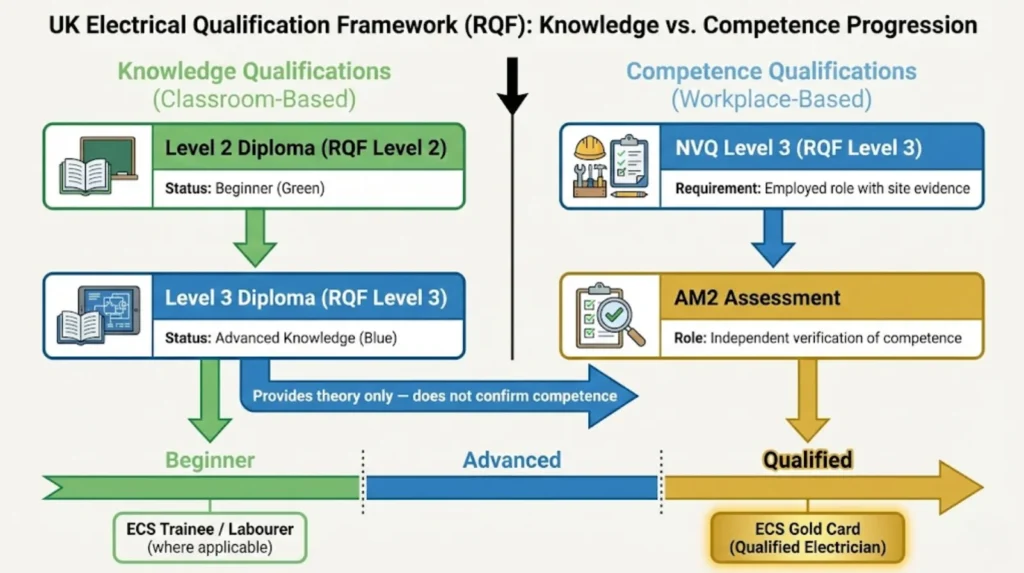
Knowledge vs Competence: The Fundamental Distinction
Understanding difference between knowledge qualifications (diplomas) and competence qualifications (NVQs) prevents the most expensive misconception in electrical training.
Knowledge Qualifications: Diplomas (Level 2 and Level 3)
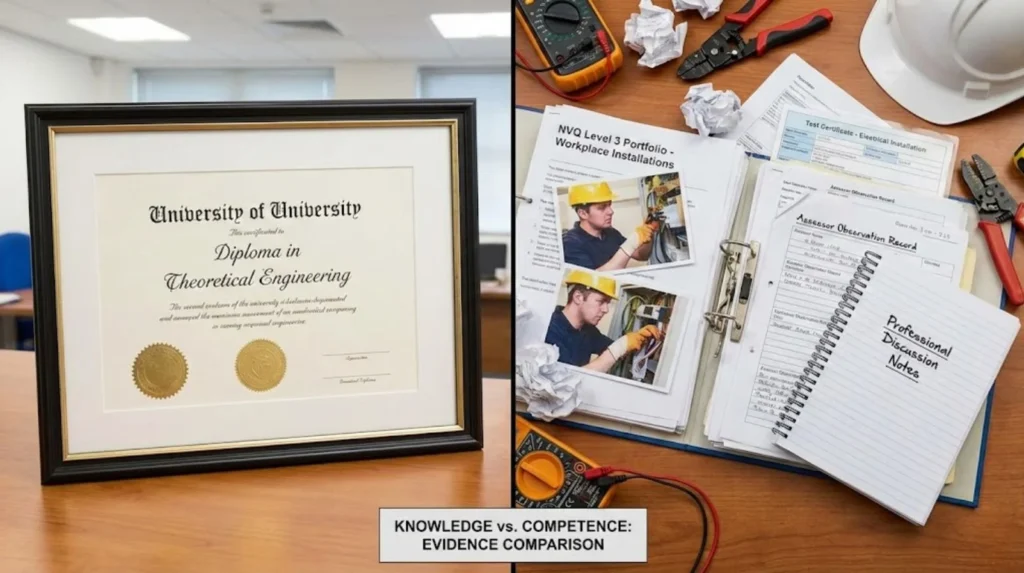
Knowledge qualifications assess theoretical understanding and practical skills demonstrated in controlled training environments.
What knowledge qualifications cover:
Electrical theory and calculations (Ohm’s Law, power formulas, circuit analysis)
BS 7671 wiring regulations interpretation
Circuit design principles and methodology
Testing procedures and equipment operation
Health and safety requirements and risk assessment
Materials selection and specification
How knowledge is assessed:
Written examinations (multiple choice, short answer, calculations)
Practical assessments on training rigs in workshops
Assignments demonstrating understanding of regulations and design principles
Controlled environments where learners have time to reference materials and receive guidance
What knowledge qualifications do NOT prove:
Ability to work independently on live construction sites
Speed and efficiency meeting commercial productivity standards
Problem-solving under real-world time and resource constraints
Adaptability to site conditions differing from training workshop scenarios
Competence managing actual customer interactions or contractor requirements
Where diplomas fit: Essential foundation establishing theoretical understanding and basic practical skills. Diploma alone does not make you “qualified electrician” but provides prerequisite knowledge for competence assessment.
Thomas Jevons, Head of Training:
"Completing a Level 3 Diploma proves you understand electrical theory and can demonstrate skills in controlled workshop environments. It does not make you a qualified electrician. That status requires NVQ Level 3 proving workplace competence through portfolio evidence, plus AM2 assessment verifying you can actually perform installations, testing, and fault-finding to industry standards under time pressure. The diploma gives you the knowledge. The NVQ proves you can apply it safely on real installations. The AM2 confirms you meet competence threshold independently assessed. All three components are essential—diploma alone is insufficient for ECS Gold Card eligibility or unsupervised electrical work."
Thomas Jevons, Head of Training
Competence Qualifications: NVQs (Level 3)
Competence qualifications assess performance in actual workplace environments through portfolio evidence demonstrating sustained capability over extended periods.
What competence qualifications require:
Real workplace installations on construction sites or in customer properties
Portfolio documenting diverse installation types completed independently
Photographic evidence showing work progression and completion
Assessor observations verifying installation quality and safe working practices
Professional discussions demonstrating understanding of decisions made during installations
Evidence spanning 12-24 months showing consistent competent performance
NVQ assessment components:
Workplace observations by qualified assessors visiting sites
Portfolio evidence including photos, test results, installation certificates
Professional discussions explaining installation decisions and problem-solving approaches
Witness testimonies from supervising electricians or contractors
Coverage of multiple NVQ units proving breadth of competence across installation types
What NVQ competence proves:
Ability to work independently meeting commercial productivity and quality standards
Sustained performance over extended period, not one-off demonstration
Problem-solving capability when encountering unexpected site conditions
Safe working practices consistently applied without constant supervision
Customer interaction skills and professional conduct on real projects
Why NVQ is essential: Employers and ECS recognize that passing exams doesn’t guarantee someone can actually perform installations competently on working sites. NVQ provides evidence of real-world capability that diploma knowledge alone cannot demonstrate.
The Gap Between Diploma and NVQ
The most expensive trap learners encounter is completing diploma qualifications then discovering substantial gap before NVQ completion:
Challenge 1: Finding workplace placement Many training providers deliver diploma content but offer no guaranteed employer connections for NVQ portfolio development. Learners complete Level 2 and Level 3 Diplomas spending £5,000-£8,000, then face months or years searching for employers willing to supervise NVQ candidates.
Challenge 2: Employment without qualifications To build NVQ portfolio, you must be working on actual installations. But to get electrician positions, employers want qualified status. This creates catch-22 where diploma holders struggle finding employment enabling NVQ completion.
Challenge 3: Time and income NVQ requires 12-24 months workplace evidence. For adult learners who’ve invested heavily in training, this extended period at improver wages (£12-£18 per hour) whilst waiting for qualified status creates financial pressure many didn’t anticipate.
Challenge 4: Assessor costs NVQ assessment isn’t included in many diploma course prices. Separate assessor fees, portfolio platform subscriptions, and assessment visit costs add £1,500-£3,000 to overall qualification expenses.
The Solution: Select training providers offering guaranteed workplace placements through established contractor relationships. Understanding Elec Training’s electrician courses includes recognizing value of in-house recruitment teams providing placement support with 120+ partner contractors, eliminating the diploma-to-NVQ employment gap that strands many learners.
AM2 Assessment: The Final Competence Verification
AM2 (Achievement Measurement 2) or AM2E (Experienced Worker version) sits between knowledge and competence as independent practical assessment verifying you meet industry-standard threshold.
What AM2 assesses:
Complete installation from circuit design through testing and certification
Time-constrained practical work (typically 2-3 days)
Fault-finding on pre-configured installations with deliberate errors
Safe isolation procedures and verification
Testing sequence and results interpretation
Compliance with BS 7671 under examination conditions
Why AM2 is separate from NVQ: NVQ proves sustained workplace competence over extended period through portfolio evidence. AM2 verifies you can perform complete installation and testing sequence independently under standardized assessment conditions, providing external validation of competence threshold.
AM2 failure rates: Approximately 15-25% of candidates fail AM2 on first attempt, typically due to:
Inadequate testing knowledge (incorrect test sequences, misinterpreted results)
Time management problems (incomplete installations within time limits)
Safe isolation errors (failing to verify dead before commencing work)
Poor fault-finding methodology (random component replacement rather than logical diagnosis)
Failed AM2 requires reattempt at additional cost (£800-£1,000 per attempt), highlighting importance of thorough preparation rather than viewing it as formality.
The Three-Component Qualification Reality
Qualified electrician status requires:
Diploma (knowledge) – Level 3 theoretical understanding
NVQ (workplace competence) – 12-24 months portfolio evidence
AM2 (independent assessment) – Practical examination pass
Plus 18th Edition BS 7671 current wiring regulations certification.
Only when all components are completed can you apply for ECS Gold Card and present yourself as qualified electrician to employers. Diploma alone, regardless of how “advanced,” does not achieve this status.
| Qualification Component | What It Proves | What It Doesn’t Prove | Assessment Method | Typical Duration | Cost Range |
| Level 2 Diploma (Knowledge) | Foundational electrical theory and basic practical skills | Workplace competence or readiness for unsupervised work | Exams and workshop practicals | 6-12 months | £2,000-£4,000 |
| Level 3 Diploma (Knowledge) | Advanced electrical theory and complex system understanding | Ability to work independently on real installations | Exams and advanced workshop practicals | 8-12 weeks intensive or 6-12 months part-time | £3,000-£6,000 |
| Level 3 NVQ (Competence) | Sustained workplace performance over extended period | Speed without supervision or immediate productivity | Portfolio evidence and assessor observations | 12-24 months | £2,000-£4,000 (assessor costs) |
| AM2 / AM2E Assessment | Independent verification of installation competence under time pressure | Mastery of specialized installations or fault diagnosis beyond standard scope | 2-3 day practical examination | 3 days | £800-£1,000 |
| Complete Pathway | Qualified electrician status for unsupervised work and ECS Gold Card | Automatic employment or specialist qualifications | Combined above | 18 months – 3 years | £10,000-£12,000 |
Who Should Take Beginner Courses (Level 2)
Beginner Level 2 courses are appropriate for specific starting points, with clear indicators when this is correct entry level.
Complete Career Changers with Zero Electrical Experience
Your situation: Transitioning from completely unrelated careers (retail, hospitality, office administration, teaching) with no electrical knowledge whatsoever. Never worked on construction sites, haven’t used power tools regularly, don’t understand basic electrical concepts like voltage, current, or resistance.
Why Level 2 is correct: You cannot understand three-phase power, fault-finding, or complex circuit design without foundational principles. Level 2 establishes essential theoretical base preventing dangerous knowledge gaps. Attempting Level 3 without this foundation results in struggling with science modules, failing examinations, and potentially unsafe working practices from missing safety awareness.
What you’ll gain: Fundamental understanding of electrical principles, circuit theory, basic installation techniques, essential health and safety knowledge, foundation for Level 3 progression, eligibility for electrical improver positions supporting qualified electricians.
Realistic timeline: Level 2 completion: 6-12 months. Then Level 3 Diploma: 8-12 weeks to 6-12 months. Then NVQ Level 3: 12-24 months. Plus AM2 preparation and examination. Total: 2.5-4 years to qualified electrician status from complete beginner position.
Financial investment: Level 2: £2,000-£4,000. Level 3: £3,000-£6,000. NVQ support: £2,000-£4,000. AM2: £800-£1,000. Total pathway: £8,000-£15,000 depending on provider and support level.
Avoid the temptation: Fast-track providers marketing “qualified electrician in 12 weeks” target career changers desperate for quick results. These courses cover diploma knowledge only, not competence assessment. You cannot become qualified electrician in 12 weeks regardless of marketing claims. Starting with appropriate Level 2 foundation prevents expensive failure and course repetition.
School Leavers Without Construction Background
Your situation: Recently completed GCSEs or A-Levels, considering apprenticeship or vocational training, limited or no work experience in any trade, physically capable but unfamiliar with construction site environments.
Why Level 2 is correct: Apprenticeships typically include Level 2 as foundation year before progressing to Level 3. Even if pursuing college-based route rather than apprenticeship, Level 2 provides essential grounding before advanced content. Age isn’t substitute for knowledge—young learners need same foundational understanding as older career changers.
What you’ll gain: Industry-standard qualification recognized by employers, foundation for apprenticeship applications, understanding whether electrical work suits you before committing to multi-year pathway, improved employability as electrical improver or mate whilst continuing studies.
Route options: Apprenticeship (employer-sponsored, combines Level 2/3 with workplace training), college-based Level 2 followed by employment-supported NVQ route, adult education funding potentially available depending on local authority.
Avoid the assumption: “I’m young and physically fit so I can skip basics” – electrical work requires theoretical understanding and safety awareness, not just physical capability. Foundation knowledge prevents dangerous situations regardless of age or fitness level.
Those Considering Electrical Work But Uncertain
Your situation: Interested in electrical career but unsure if it’s right long-term choice, want to test suitability before committing substantial time and money, need understanding of work reality before full commitment.
Why Level 2 is correct: Provides comprehensive introduction to electrical trade without requiring immediate multi-year commitment. Investment of £2,000-£4,000 and 6-12 months enables informed decision about pursuing electrical career further, versus discovering after years and £10,000+ that work doesn’t suit you.
What you’ll discover: Whether you enjoy electrical problem-solving and technical work, if you can handle construction site environment and culture, whether theoretical learning (mathematics, physics, regulations) comes naturally or requires significant effort, your aptitude for practical hands-on installation work.
Exit options: If you decide electrical work isn’t suitable, Level 2 qualification isn’t wasted—demonstrates commitment to vocational training, proves technical aptitude to other employers, may transfer to related trades (building services, facilities management), and establishes foundation if you later decide to return to electrical pathway.
People with Relevant but Non-Electrical Trade Experience
Your situation: Worked in related construction trades (plumbing, heating, carpentry, general building), comfortable with power tools and site environments, understand construction drawings and building regulations, but lack specific electrical knowledge.
Why Level 2 is correct despite trade experience: Electrical work has unique safety requirements (electric shock risks, isolation procedures, testing methodologies) not covered in other trades. Plumbers understand pipe sizing but not cable calculations. Carpenters read construction drawings but not electrical schematics. Your trade experience helps with site awareness and practical skills, but doesn’t replace electrical-specific theoretical foundation.
What you’ll gain: Electrical-specific safety knowledge preventing dangerous assumptions from other trades, circuit theory and calculations unique to electrical work, BS 7671 wiring regulations understanding, testing and inspection procedures, proper electrical terminology and practices.
Accelerated potential: Your existing trade experience may enable faster progression through Level 2 content since you already understand site practices, health and safety basics, drawing interpretation, and professional conduct. Many providers offer accelerated Level 2 routes for experienced tradespeople.
Who Should Take Advanced Courses (Level 3)
Advanced Level 3 courses suit learners with existing electrical knowledge or substantial site experience, not complete beginners attempting shortcuts.
Those Who’ve Completed Level 2 Diplomas
Your situation: Successfully completed Level 2 Diploma in Electrical Installations (City & Guilds 2365 Level 2, EAL equivalent, or other regulated Level 2), passed theoretical examinations and practical assessments, achieved satisfactory grades demonstrating understanding of foundational concepts.
Why Level 3 is now appropriate: You have prerequisite knowledge for advanced content. Level 3 builds directly on Level 2 theory, assuming you understand series-parallel circuits, basic protection principles, cable selection fundamentals, and testing sequences. The teaching pace is significantly faster because instructors don’t revisit foundational concepts.
What Level 3 provides: Advanced circuit design capabilities, three-phase system understanding, complex fault-finding methodologies, detailed BS 7671 application, inspection and testing competence, preparation for NVQ Level 3 and AM2 assessment.
Progression timeline: Complete Level 3 Diploma (8-12 weeks intensive or 6-12 months part-time), secure employment enabling NVQ portfolio development (12-24 months), undertake AM2 preparation and assessment (2-3 days), apply for ECS Gold Card. Total from Level 3 start to qualified status: 18 months to 3 years.
Employment considerations: Level 3 Diploma completion without NVQ doesn’t make you qualified electrician, but significantly improves employability compared to Level 2-only qualification. Employers hire Level 3 diploma holders as skilled improvers at higher wages (£14-£20 per hour) versus Level 2 improvers (£10-£14 per hour), with understanding you’re working toward NVQ completion.
Semi-Skilled Improvers or Mates with Site Experience
Your situation: Worked 1-3 years as electrical mate or improver under supervision, gained practical experience pulling cables, installing containment, assisting with terminations, observing testing procedures, but lack formal qualifications or theoretical understanding.
Why Level 3 makes sense (possibly): You understand site practices, safety procedures, and basic installation techniques through hands-on experience. However, verify whether you actually need Level 2 first—don’t assume site experience replaces theoretical foundation.
Critical assessment: Can you calculate cable sizes? Do you understand earthing system differences (TN-S vs TN-C-S vs TT)? Can you explain why RCD protection is required in certain situations? Do you comprehend fault current calculations? If answers are uncertain, consider Level 2 foundation despite site experience. Practical skills don’t automatically equal theoretical understanding.
If proceeding to Level 3: Your site experience accelerates learning because you’ve seen installations in practice. Theoretical content connects to real-world applications you’ve encountered, making concepts more intuitive. However, expect science modules covering calculations and electrical principles to require significant study even with practical experience.
Alternative consideration: If your site experience is substantial (3+ years) and you’ve worked across diverse installation types, investigate Experienced Worker Assessment route instead of standard Level 2/3 progression.
Experienced Workers with 5+ Years Substantial Site Experience
Your situation: Worked 5, 10, or more years as unqualified electrician, electrical mate under supervision, or informal roles performing electrical work, gained extensive practical competence installing circuits, fault-finding, testing, but never obtained formal qualifications or certifications.
Why standard beginner/advanced routes are wrong: You’re wasting time and money sitting through years of classroom training covering knowledge you already possess through practical experience. Standard apprenticeship pathways designed for young learners don’t suit experienced workers.
Correct route: Experienced Worker Assessment (City & Guilds 2346 + AM2E)
The 2346 Level 3 Electrotechnical Experienced Worker Qualification specifically targets workers with substantial site experience but no formal qualifications. This route:
Assesses existing competence through portfolio evidence of work completed over years
Requires demonstrating breadth of installation types (domestic, commercial, industrial)
Combines with AM2E (Experienced Worker version of Achievement Measurement assessment)
Leads directly to ECS Gold Card eligibility without repeating years of classroom training
Portfolio requirements:
Photographic evidence of diverse installations completed
Witness testimonies from contractors or supervisors confirming your experience
Test certificates and inspection reports you’ve completed
Professional discussions demonstrating understanding of installation decisions
Evidence spanning multiple installation types and complexity levels
Timeline: Typically 6-18 months from enrollment to assessment completion and ECS Gold Card application, versus 2-4 years for standard apprenticeship route.
Financial investment: £3,000-£6,000 for experienced worker assessment program including portfolio support, assessor costs, and AM2E examination. Significantly less than full Level 2/3/NVQ pathway costing £10,000-£12,000+.
Critical requirement: You must have substantial, genuine experience. Providers verify experience claims through portfolio evidence and assessor observations. Attempting experienced worker route without genuine competence results in assessment failure.
Domestic Electricians Expanding to Commercial Work
Your situation: Worked in domestic electrical installation (rewires, consumer unit changes, additional circuits in homes) for several years, hold Part P certification or domestic installer qualifications, now want to work on commercial or industrial sites requiring different skills and qualifications.
Why domestic-only background needs enhancement: Domestic installations use different materials, techniques, and design approaches than commercial work. Houses typically have single-phase supplies, basic containment (surface clipping, limited conduit), and simpler protection schemes. Commercial and industrial sites involve three-phase distribution, extensive trunking and conduit systems, motor circuits, emergency lighting, fire alarm integration, and more complex protection coordination.
What you need: Level 3 knowledge covering commercial installation types, potentially Level 3 NVQ demonstrating commercial competence, understanding of three-phase systems and industrial practices, familiarity with steel wire armoured cables, containment systems, and commercial testing requirements.
Bridge training: Some providers offer specific “Domestic to Commercial” courses addressing knowledge gaps between domestic Part P scope and full commercial competence. These typically cover:
Three-phase systems and motor circuits
Containment installation (conduit, trunking, cable tray)
Steel wire armoured cable termination and installation
Commercial testing requirements and procedures
Emergency lighting and fire alarm systems
Industrial control circuits and equipment
Avoid the assumption: “I’ve done electrical work for years so I’m qualified for anything” – domestic and commercial electrical work have significant differences. Attempting commercial work without proper training and qualifications creates liability risks and may result in substandard installations.
Joshua Jarvis, Placement Manager:
"Older career changers frequently ask whether they should attempt accelerated 'fast-track' routes to qualify faster given their age. The honest answer is that route speed matters far less than route appropriateness for your starting point. A 45-year-old complete beginner attempting advanced courses without Level 2 foundation faces the same high failure rates as younger learners—age doesn't compensate for missing knowledge. However, mature learners often bring valuable transferable skills from previous careers including time management, problem-solving, and customer service that help during NVQ portfolio development. The key is starting at the correct entry point regardless of age, then progressing steadily rather than rushing and failing assessments requiring expensive retakes."
Joshua Jarvis, Placement Manager
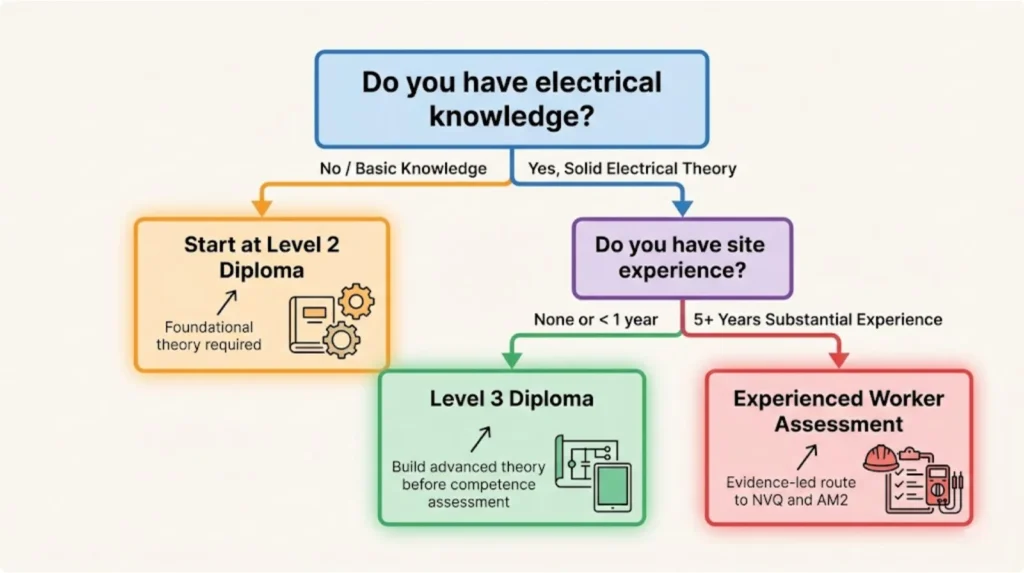
Decision Framework: Which Route Matches Your Starting Point?
Use this systematic approach to determine appropriate entry level based on actual current capabilities, not desired outcomes.
Step 1: Assess Your Electrical Knowledge Honestly
Answer these questions truthfully:
Can you explain Ohm’s Law and perform basic voltage, current, resistance calculations?
Do you understand difference between series and parallel circuits?
Can you calculate power consumption of multiple devices on single circuit?
Do you know cable sizing factors (current capacity, voltage drop, installation method)?
Can you explain earth fault loop impedance and its significance?
Do you understand RCD protection requirements in BS 7671?
Can you read and interpret electrical installation drawings?
Do you know testing sequence for electrical installations (continuity, insulation resistance, polarity, earth fault loop impedance)?
If you answered “no” or “uncertain” to more than half: Level 2 is correct starting point regardless of how much site experience you have watching others work. Practical observation doesn’t replace theoretical understanding necessary for safe independent work.
If you answered “yes” confidently to all questions: Level 3 or Experienced Worker Assessment may be appropriate depending on practical experience level.
Step 2: Evaluate Your Practical Site Experience
Have you installed complete circuits from circuit breaker through to final connections?
Have you terminated cables (singles in containment, twin-and-earth, SWA armored)?
Have you conducted electrical testing using multifunction testers?
Have you installed containment systems (conduit, trunking, cable tray)?
Have you worked with three-phase systems and motor circuits?
Have you interpreted and followed electrical installation specifications?
Have you worked across multiple installation types (domestic, commercial, industrial)?
If you answered “no” to most questions: You need both Level 2 foundation and Level 3 knowledge before attempting NVQ competence assessment.
If you answered “yes” to some questions (1-3 years site experience): Level 3 Diploma may be appropriate if your theoretical knowledge is solid. You’ll still need NVQ assessment of workplace competence.
If you answered “yes” to all questions (5+ years substantial experience): Experienced Worker Assessment route is likely most efficient pathway to qualification.
Step 3: Consider Your Learning Constraints
Age considerations:
Under 19: Apprenticeship route typically provides best value (employer-funded, earn while learning). Standard Level 2 → Level 3 → NVQ progression.
19-25: Mix of apprenticeship and adult education options. Level 2/3 college routes with employment-supported NVQ afterward often work well.
25-45: Adult learner loans available for Level 3. Part-time routes balancing employment and study. Consider accelerated intensive courses if finances allow.
45+: Same routes available as younger learners but financial planning more critical given fewer working years to recoup investment. Experienced Worker Assessment if you have site experience, otherwise standard routes still appropriate.
Time availability:
Full-time learner: Intensive routes possible (Level 2 in 6 months, Level 3 in 8-12 weeks). Requires ability to study full-time without employment income.
Part-time evening/weekend: Extended timelines (Level 2 in 12-24 months, Level 3 in 6-12 months). Balances employment with study.
Distance learning: Limited effectiveness for electrical training requiring hands-on practice. Avoid purely online courses for practical trade skills.
Financial capacity:
Full pathway investment available (£10,000-£12,000): Can proceed through complete beginner to qualified route with placement support included. Reduces employment gaps.
Limited upfront funds: Consider staged approach (Level 2 first, then employment as improver, then Level 3 with evening study, then NVQ through employment). Slower but more financially manageable.
No funds available: Investigate apprenticeship routes (employer-funded), government schemes, adult education grants, or career development loans.
Step 4: Match to Appropriate Route
Based on assessment above:
| Your Profile | Recommended Route | Why This Route | What to Avoid |
| Zero electrical knowledge + no site experience | Level 2 Diploma | Essential foundation preventing dangerous knowledge gaps | Fast-track Level 3, claiming experience substitutes theory |
| Completed Level 2 successfully | Level 3 Diploma + NVQ pathway | Prerequisite knowledge in place for advanced content | Stopping at diploma, thinking you’re qualified |
| 1-3 years site experience as mate but weak theory | Level 2 foundation then Level 3 | Theory gap prevents safe progression despite practical skills | Assuming experience replaces theory, skipping to Level 3 |
| 1-3 years site experience with strong theory | Level 3 Diploma + NVQ pathway | Theory matches experience level enabling direct Level 3 entry | Repeating Level 2 unnecessarily |
| 5+ years substantial diverse experience | Experienced Worker Assessment (2346 + AM2E) | Most efficient qualification route for proven competence | Sitting through years of classroom training covering known material |
| Domestic-only background seeking commercial work | Domestic-to-commercial bridge training + Level 3 NVQ commercial focus | Addresses specific knowledge gaps between sectors | Assuming domestic experience transfers directly to commercial |
| Related trade experience (plumbing, carpentry, etc.) | Level 2 accelerated for tradespeople | Electrical-specific safety and theory whilst leveraging construction experience | Skipping electrical foundation assuming trade knowledge transfers |
| Uncertain if electrical work suits | Level 2 as exploratory qualification | Manageable investment enabling informed decision | Committing to full multi-year pathway without testing suitability |
Common Mistakes in Route Selection
Understanding typical errors prevents expensive misdirection and qualification delays.
Mistake 1: Complete Beginners Attempting “Fast-Track” Advanced Courses
The error: Career changers with zero electrical knowledge enroll in intensive Level 3 courses marketed as “fast-track to qualified electrician,” believing accelerated timeline represents efficient pathway.
Why it’s wrong: Level 3 content assumes Level 2 foundation knowledge. Instructors teach at pace expecting learners understand series-parallel calculations, basic circuit theory, cable selection principles, and safety fundamentals from Level 2. Without this foundation, learners spend entire Level 3 course struggling to catch up on basics whilst simultaneously attempting advanced content, resulting in either:
Failing Level 3 examinations entirely, requiring course repetition at full cost (£3,000-£6,000 wasted)
Passing examinations with superficial understanding lacking depth necessary for safe practical application
Dropping out mid-course having wasted partial fees and time
The financial consequence: Attempting Level 3 without Level 2 foundation typically results in needing to subsequently complete Level 2 anyway after failing Level 3, meaning learners pay for both qualifications in wrong order plus potential Level 3 repetition costs. Total waste: £5,000-£10,000 plus 12-18 months additional time.
The correction: Accept that complete beginners need Level 2 foundation regardless of age, motivation, or desperation to qualify quickly. There are no legitimate shortcuts bypassing fundamental electrical principles.
Mistake 2: Stopping at Diploma and Thinking You’re Qualified
The error: Learners complete Level 3 Diploma (knowledge qualification), receive certificate, and believe they’re now “qualified electricians” ready for unsupervised work and professional rates.
Why it’s wrong: Diploma proves theoretical knowledge and workshop competence only. Qualified electrician status requires:
NVQ Level 3 (workplace competence portfolio)
AM2 practical assessment pass
18th Edition BS 7671 current
Combined, these enable ECS Gold Card application
Diploma alone doesn’t meet employer requirements for qualified positions, doesn’t enable unsupervised work legally or from insurance perspective, and doesn’t satisfy competent person scheme registration requirements.
The consequence: Learners spend £5,000-£8,000 on Level 2 and Level 3 diplomas, then discover they cannot get qualified electrician positions because employers specifically require ECS Gold Card or NVQ completion. They’re stuck in improver positions at lower wages unable to progress without securing employment enabling NVQ portfolio development, which proves difficult without provider placement support.
The correction: Before enrolling in any course, verify whether program includes guaranteed workplace placement for NVQ completion or at minimum strong employer connections facilitating NVQ opportunities. Understand total qualification requirements (diploma + NVQ + AM2) and associated costs (£10,000-£12,000) from outset.
Mistake 3: Experienced Workers Repeating Beginner Content Unnecessarily
The error: Workers with 5-10 years site experience performing electrical installations under supervision enroll in standard Level 2 beginner courses because they lack formal qualifications, believing this is only pathway to certification.
Why it’s wrong: Experienced Worker Assessment route (City & Guilds 2346) specifically exists for this scenario. Sitting through 6-12 months of Level 2 teaching basic concepts you already understand through years of practice wastes time and money, delays qualification by 12-18 months minimum, and creates frustration repeating material far below your competence level.
The consequence: Worker spends £2,000-£4,000 on Level 2, then £3,000-£6,000 on Level 3, taking 18-24 months for both qualifications, when they could have completed Experienced Worker Assessment in 6-18 months at cost of £3,000-£6,000 total, saving £3,000-£8,000 and 12-18 months.
The correction: If you have genuinely substantial experience (not just laboring or helping qualified electricians occasionally, but actually performing installations yourself), investigate Experienced Worker Assessment immediately. Don’t assume standard apprenticeship pathway is only option.
Mistake 4: Assuming Age Requires Different Routes
The error: Mature learners believing they must take “accelerated” or “adult-focused” routes different from younger learners, or conversely that they’re “too old” for standard apprenticeships and qualifications.
Why it’s wrong: Qualification requirements are identical regardless of age. A 45-year-old complete beginner needs same Level 2 foundation as 18-year-old school leaver. Conversely, a 50-year-old with 20 years site experience can pursue Experienced Worker Assessment just as 30-year-old would. Age doesn’t change electrical theory, safety principles, or competence requirements.
What age DOES affect:
Financial considerations (fewer working years to recoup training investment)
Learning style preferences (mature learners often prefer evening/weekend part-time routes over full-time college)
Transferable skills from previous careers (time management, customer service, problem-solving)
Physical demands awareness (electrical work involves significant physical labor including ladder work, heavy lifting, confined spaces)
The correction: Select route based on current electrical knowledge and experience level, not age. Age influences how you finance and schedule training, but doesn’t change qualification pathway requirements.
Mistake 5: Domestic-Only Training for Commercial Career Goals
The error: Learners complete domestic installer qualifications (Part P short courses, LCL Domestic Installer awards) intending to work on commercial construction sites afterward, assuming domestic qualification transfers directly.
Why it’s wrong: Domestic installer scope covers work in dwellings only—single-phase installations, basic circuit types, limited protection requirements, simple containment. Commercial work requires three-phase systems, complex protection coordination, extensive containment installations (conduit, trunking, cable tray), motor circuits, emergency lighting, fire alarm integration, and industrial control systems not covered in domestic qualifications.
The consequence: After completing domestic training at cost of £2,000-£4,000, learner discovers commercial contractors won’t employ them because their qualifications don’t cover commercial installation requirements. They need additional Level 3 commercial-focused training, essentially starting over with broader qualification pathway at additional £6,000-£10,000 cost.
The correction: Before selecting domestic-focused routes, honestly assess career intentions. If you want flexibility working domestic AND commercial, pursue full Level 3 NVQ pathway from start. If you’re certain you only want domestic work in homes (rewires, consumer unit changes, additional circuits), domestic-focused routes are appropriate and more economical. But don’t choose domestic route then expect commercial opportunities afterward without substantial additional training.
Mistake 6: Believing Online-Only Courses Provide Adequate Practical Training
The error: Enrolling in purely distance learning or online electrical courses marketed as providing complete qualification without attending physical training facilities for hands-on practice.
Why it’s wrong: Electrical installation is practical trade requiring physical skills including:
Cable termination techniques (stripping insulation correctly, inserting conductors into terminals with proper torque)
Conduit bending and installation (achieving smooth bends, proper support spacing, correct fitting assembly)
Test equipment operation (proper probe placement, understanding meter readings, interpreting results)
Safe working practices (isolation procedures, PPE use, working at height)
Tool operation (power tools, hand tools, specialized electrical equipment)
You cannot learn these skills through videos or written materials alone. Muscle memory, physical technique, and hands-on problem-solving require in-person practice under supervision.
The consequence: Learners complete online courses spending £1,000-£3,000, receive certificates, but cannot actually perform installations safely or competently. When attempting NVQ assessment or employment, their lack of practical skill becomes immediately evident. They need to redo practical training properly at additional cost.
The correction: Verify any course includes substantial hands-on workshop time in physical training facilities with qualified instructors providing direct supervision and feedback on practical technique. Some theory content can be delivered online, but practical skills absolutely require in-person training.
Understanding comprehensive electrical qualification pathways includes recognizing when route selection mistakes are occurring and correcting course before wasting substantial time and money pursuing inappropriate qualifications for your starting point.
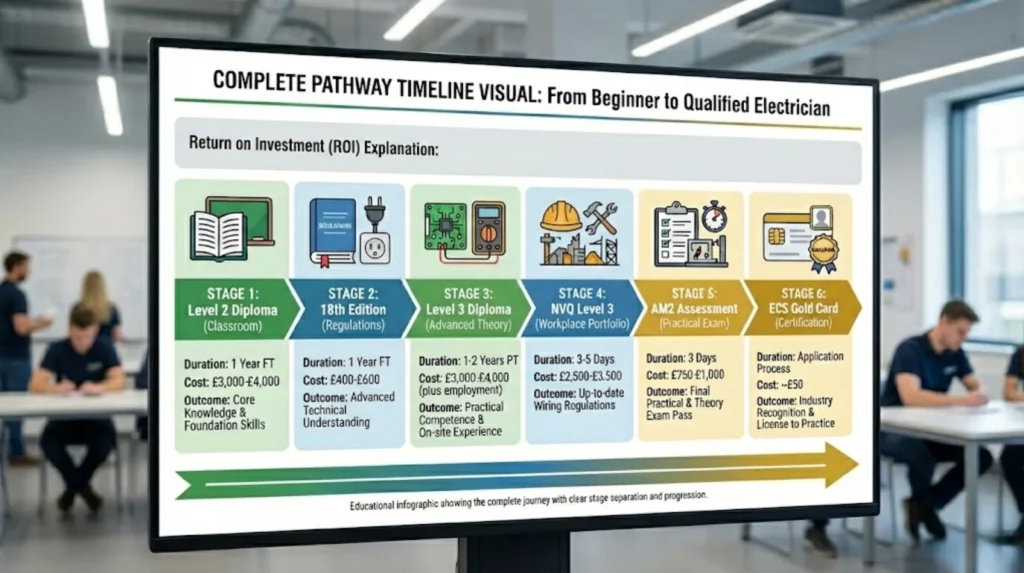
The Complete Pathway: Beginner Through to Qualified Status
Regardless of where you start, understanding complete qualification requirements prevents misconceptions about timeline and costs.
Stage 1: Foundation Knowledge (Level 2 Diploma)
Who needs this: Complete beginners, career changers, school leavers, anyone without electrical foundation knowledge.
Duration: 6-12 months full-time, 12-24 months part-time.
Cost: £2,000-£4,000.
Outcome: Technical certificate proving foundational electrical knowledge. Enables Level 3 progression. Qualifies for electrical improver/mate positions under supervision. ECS Trainee card eligible.
What this does NOT provide: Qualified electrician status, ability to work unsupervised, ECS Gold Card eligibility.
Stage 2: Advanced Knowledge (Level 3 Diploma)
Who needs this: Anyone who’s completed Level 2, or those with equivalent knowledge from site experience.
Duration: 8-12 weeks full-time intensive, 6-12 months part-time.
Cost: £3,000-£6,000.
Outcome: Advanced technical certificate proving complex electrical system understanding. Enables NVQ enrollment. Improves employability as skilled improver. Still not “qualified electrician” status.
What this does NOT provide: Workplace competence assessment, qualified status, ECS Gold Card eligibility, unsupervised work authorization.
Stage 3: 18th Edition BS 7671 Wiring Regulations
Who needs this: Everyone pursuing qualified status regardless of route.
Duration: 3-5 days intensive course plus examination.
Cost: £300-£600.
Outcome: Current wiring regulations certification required for ECS card application and demonstrating up-to-date regulations knowledge.
Validity: Approximately 3-4 years (when new edition published, must update to maintain currency).
Stage 4: Workplace Competence (NVQ Level 3)
Who needs this: Everyone pursuing qualified electrician status—no exceptions or shortcuts.
Duration: 12-24 months typically, depending on workplace opportunities and breadth of installation types completed.
Requirements:
Employment on electrical installations (contractor employment, self-employment with projects, or placement arrangements)
Portfolio documenting diverse installation types
Assessor visits observing work quality
Professional discussions demonstrating understanding
Evidence spanning domestic, commercial, or industrial contexts depending on intended work scope
Cost: £2,000-£4,000 for assessor fees, portfolio platform subscriptions, assessment visits.
Outcome: Competence qualification proving workplace capability. Combined with Level 3 Diploma and 18th Edition, enables AM2 entry and subsequent ECS Gold Card application.
Critical challenge: Finding employment enabling NVQ portfolio completion is often hardest pathway component. Many learners complete diplomas but struggle securing work opportunities necessary for NVQ. This is where provider employer connections become essential.
Stage 5: Independent Competence Assessment (AM2 or AM2E)
Who needs this: Everyone—final verification of competence threshold before ECS Gold Card eligibility.
Duration: 2-3 day practical examination.
Content:
Complete installation from design through testing and certification
Time-constrained work demonstrating productivity alongside quality
Fault-finding on installations with deliberate errors
Safe isolation verification
Testing sequence execution and results interpretation
Cost: £800-£1,000 per attempt.
Pass rate: Approximately 75-85% first attempt (15-25% failure rate).
Outcome: If passed, combined with NVQ Level 3, Level 3 Diploma, and 18th Edition, you can now apply for ECS Gold Card and present yourself as qualified electrician.
If failed: Must reattempt at additional £800-£1,000 cost. Common failure reasons include testing sequence errors, time management problems, safe isolation mistakes, or poor fault-finding methodology.
Stage 6: ECS Gold Card Application
Requirements:
NVQ Level 3 in Installing Electrotechnical Systems (or equivalent competence qualification)
Level 3 knowledge qualification (2365 Level 3 Diploma or equivalent)
18th Edition BS 7671 current certification
AM2 or AM2E pass certificate
ECS Health, Safety and Environmental Assessment pass
Application fee (approximately £36 for three-year card)
Outcome: ECS Installation Electrician Gold Card proving qualified status, enabling unsupervised work, meeting employer requirements for qualified positions, allowing competent person scheme registration, and signaling professional electrician status to customers and contractors.
Total Pathway Investment:
From complete beginner to qualified electrician:
Time: 2.5 to 4 years minimum depending on route intensity and NVQ completion speed
Cost: £10,000 to £15,000 including all qualifications, assessments, and support
Earnings during pathway: Improver/mate wages progressing from £10-£12 per hour initially through £16-£20 per hour as skilled improver approaching qualification
Return on investment: Qualified electricians with ECS Gold Cards command £22-£35 per hour employed rates, or £150-£300 per day self-employed depending on region and specialization. Training investment typically recoups within 6-24 months of achieving qualified status.
Special Considerations for Mature Learners
Adult career changers face unique challenges and opportunities in electrical training requiring specific consideration.
Financial Planning Beyond Course Fees
Mature learners typically have financial responsibilities (mortgages, families, existing standard of living) that young apprentices don’t carry, making training investment more significant.
Hidden costs to budget:
Income reduction during training: Full-time college routes mean no employment income for 6-12 months. Part-time routes mean reduced hours and lower income whilst studying.
Improver wage period: After completing diplomas but before qualified status, expect 12-24 months at improver wages (£12-£18 per hour, £25,000-£35,000 annually) significantly below qualified electrician rates (£30,000-£50,000 annually).
Tools and equipment: Professional-quality electrical tools cost £1,500-£3,000 for comprehensive kit (multifunction tester £400-£800, hand tools £300-£500, power tools £400-£600, PPE and consumables £200-£400).
Transport: Many electrical positions require driving license and vehicle for site access, tools transport, and multiple-site working. Vehicle costs, fuel, insurance, and maintenance add £3,000-£6,000 annually.
Assessment resits: If you fail AM2 first attempt (15-25% of candidates), resit costs £800-£1,000 each attempt.
Total financial commitment: £10,000-£15,000 training costs plus £15,000-£30,000 potential income reduction during 2-4 year qualification pathway. Many mature learners underestimate total financial impact until mid-pathway.
Mitigation strategies: Part-time evening/weekend routes maintaining employment income, adult learner loans spreading costs (repayment only above £31,000 earnings threshold), choosing providers with payment plans, seeking employer sponsorship if transitioning within existing company.
Physical Demands Reality
Electrical work involves significant physical requirements that some mature career changers overlook:
Regular physical activities:
Ladder work and working at height (installing cables in ceiling voids, mounting equipment on walls)
Heavy lifting (reels of cable weighing 20-50kg, consumer units, distribution boards, equipment)
Awkward positions (working in confined spaces, ceiling voids, under floors, reaching behind equipment)
Manual labor (chasing walls for cables, drilling masonry, pulling cables through containment)
Extended standing and walking (site work involves being on feet most of day, walking between locations)
Health considerations: If you have existing back problems, joint issues, or mobility limitations, honestly assess whether physical demands suit your capabilities. Electrical work is less physically demanding than some trades (less heavy lifting than bricklaying, less repetitive strain than plastering) but still requires good physical condition.
Age-related advantages: Mature learners don’t just face disadvantages. You bring valuable transferable skills:
Professional conduct: Customer interaction, time management, appointment scheduling, invoicing, professional communication—skills developed in previous careers directly apply to electrical contracting.
Problem-solving: Analytical thinking, systematic troubleshooting, logical reasoning from previous careers translate to electrical fault-finding and design work.
Life experience: Understanding customer needs, managing difficult situations, working independently, prioritizing tasks—these capabilities developed through career history accelerate professional development as electrician.
Learning approach: Mature learners often take studies more seriously, complete coursework reliably, ask questions when uncertain, and maintain focus better than younger learners treating training as extended school.
Career longevity: A 45-year-old qualifying as electrician still has 20+ years career ahead, providing substantial time to recoup training investment and build successful business or employment progression.
Realistic Expectations
Set appropriate expectations before committing to training:
Timeline reality: You cannot become qualified electrician in 12 weeks, 6 months, or even 1 year as complete beginner. Minimum realistic timeline is 2.5-3 years even with intensive study and accelerated progression. Most learners take 3-4 years. Accept this from outset rather than believing marketing claims about rapid qualification.
Employment reality: Having electrical qualifications doesn’t guarantee employment. You still need to find employers, compete with other candidates, demonstrate value, and potentially accept lower initial wages whilst proving capability. Qualification opens doors but doesn’t guarantee job offers.
Earnings progression: Don’t expect qualified electrician wages (£30,000-£50,000) immediately upon qualification. Most newly qualified electricians start £25,000-£32,000 employed, building toward higher earnings as they gain post-qualification experience and develop specializations or customer base.
Business development: If pursuing self-employment, expect 2-3 years building customer base, reputation, and consistent income after qualification. Very few electricians achieve £50,000+ annual income in first year trading. Business development takes time alongside technical competence.
Route Appropriateness Matters More Than Route Speed
The fundamental principle transcending all route selection considerations is matching training to your actual starting point rather than choosing based on desired outcome timeline or marketing promises.
Fast-track routes don’t eliminate qualification requirements. You still need diploma knowledge, NVQ workplace competence, and AM2 independent assessment regardless of how “accelerated” your course claims to be. Rushing through knowledge content without adequate consolidation creates dangerous gaps affecting safety and competence.
Experience doesn’t automatically equal qualification. Years of site work provide invaluable practical skills but don’t replace formal assessment demonstrating competence breadth across diverse installation types. However, experience does enable more appropriate routes (Experienced Worker Assessment rather than starting from Level 2 beginner position).
Age isn’t barrier or shortcut. Mature learners follow same qualification pathways as younger learners, just with different financial planning considerations and potential transferable skills from previous careers. Start at level appropriate for your current electrical knowledge, not age or urgency.
Diploma alone isn’t qualification. This bears repeating because it’s the most expensive misconception in electrical training. Level 3 Diploma proves knowledge. NVQ proves workplace competence. AM2 proves independent assessment threshold. All three components required for ECS Gold Card and qualified electrician status.
Provider support matters enormously. Training providers delivering diploma content without guaranteed workplace placement support for NVQ completion leave learners stranded mid-pathway unable to progress to qualification. In-house recruitment teams with established contractor relationships eliminate the diploma-to-employment gap that derails many training journeys.
Contact Elec Training on 0330 822 5337 to discuss which route matches your current starting point. We’ll assess your electrical knowledge level, site experience if any, and career goals, then recommend appropriate entry level whether that’s Level 2 foundation, Level 3 advanced progression, or Experienced Worker Assessment for those with substantial site background. Our in-house recruitment team supporting placement opportunities with 120+ partner contractors ensures you won’t complete diploma qualifications then struggle finding employment enabling NVQ portfolio development. We provide honest guidance on complete qualification requirements including diploma knowledge, NVQ competence assessment, and AM2 practical examination, with realistic timelines (2.5-4 years for complete beginners) and transparent costs (£10,000-£12,000 full pathway). No marketing hype about “qualified in 12 weeks.” Just clear, appropriate route selection based on where you actually are now, not where you hope to be quickly.
References
- Ofqual Register of Regulated Qualifications: https://register.ofqual.gov.uk/
- City & Guilds 2365 Level 2 Diploma Specification: https://www.cityandguilds.com/
- City & Guilds 2365 Level 3 Diploma Specification: https://www.cityandguilds.com/
- City & Guilds 2357 NVQ Level 3 Specification: https://www.cityandguilds.com/
- City & Guilds 2346 Experienced Worker Qualification: https://www.cityandguilds.com/
- EAL Level 2 Diploma in Electrical Installation: https://eal.org.uk/
- EAL Level 3 Electrotechnical Qualification: https://eal.org.uk/
- LCL Awards Electrical Qualifications: https://lclawards.co.uk/
- ECS Card Types and Requirements: https://www.ecscard.org.uk/card-types
- ECS JIB Recognised Qualifications: https://www.ecscard.org.uk/content/jib-recognised-electrical-theory-qualifications
- JIB Grading Definitions and Assessment: https://www.jib.org.uk/
- National Careers Service – Electrician Profile: https://nationalcareers.service.gov.uk/job-profiles/electrician
- NET Services AM2 Assessment: https://www.netservices.org.uk/
- NET Services AM2E (Experienced Worker): https://www.netservices.org.uk/am2e/
- Skills Training Group – NVQ Information: https://www.skillstg.co.uk/
- The Electrotechnical Skills Partnership: https://www.the-esp.org.uk/
- ECA Training Guidance: https://www.eca.co.uk/
- SELECT Training Routes: https://electricalapprentice.co.uk/
- Electrical Careers UK: https://www.electricalcareers.co.uk/
- GOV.UK Apprenticeships: https://www.gov.uk/apply-apprenticeship
Note on Accuracy and Updates
Last reviewed: 2 January 2026. This article reflects UK electrical qualification pathways, knowledge versus competence distinction, beginner versus advanced course appropriateness, and route selection criteria as of December 2025. Qualification specifications occasionally change as awarding bodies update content (City & Guilds, EAL, LCL Awards), JIB revises grading frameworks and experienced worker assessment requirements, or ECS modifies card eligibility criteria. Course costs represent approximate December 2025 pricing across various training providers but vary by region, delivery mode (full-time versus part-time), and provider type (private training center versus further education college). Timeline estimates (2.5-4 years for complete beginner to qualified status) reflect typical progression but individual circumstances vary significantly based on learning pace, workplace opportunity availability, and assessment success rates. AM2 pass rates (approximately 75-85% first attempt) represent industry averages but vary by candidate preparation level and prior competence. Learners planning electrical careers should verify current qualification requirements on Ofqual Register, confirm awarding body specifications directly, check ECS card eligibility criteria on ecscard.org.uk, and assess individual provider quality beyond regulated qualification delivery. We update content as qualification frameworks, assessment requirements, and industry standards evolve.
