

Budget 2025’s £150 Energy Bill Cut: Short-Term Relief, Long-Term Uncertainty for UK Electricians

- Technical review: Thomas Jevons (Head of Training, 20+ years)
- Employability review: Joshua Jarvis (Placement Manager)
- Editorial review: Jessica Gilbert (Marketing Editorial Team)
- Last reviewed:
- Changes: Initial publication following Budget 2025 energy policy announcement
Introduction
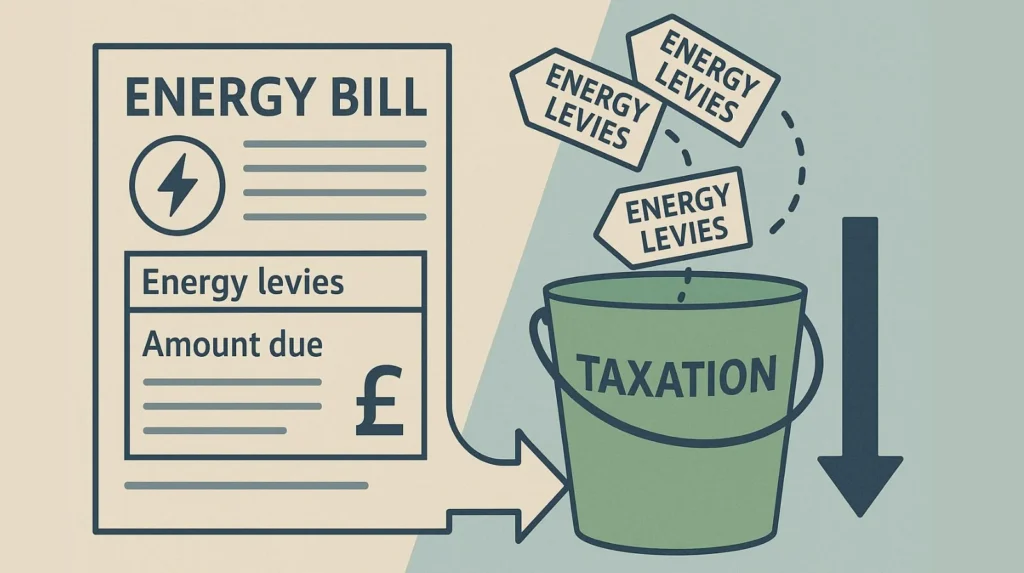
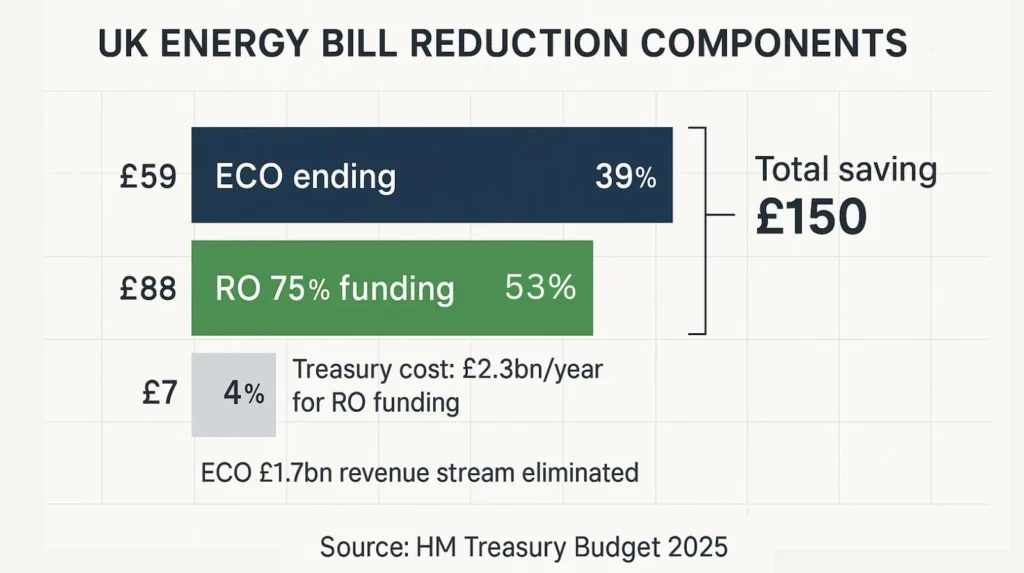
Budget 2025 announced a £150 average reduction in household energy bills from April 2026, achieved by ending the Energy Company Obligation (ECO) scheme and shifting 75% of Renewables Obligation (RO) costs from consumer bills onto general taxation. For households struggling with energy costs, this is welcome relief. The Treasury will fund the RO transfer at £2.3 billion annually, moving the burden from regressive per-unit levies to the broader tax base.
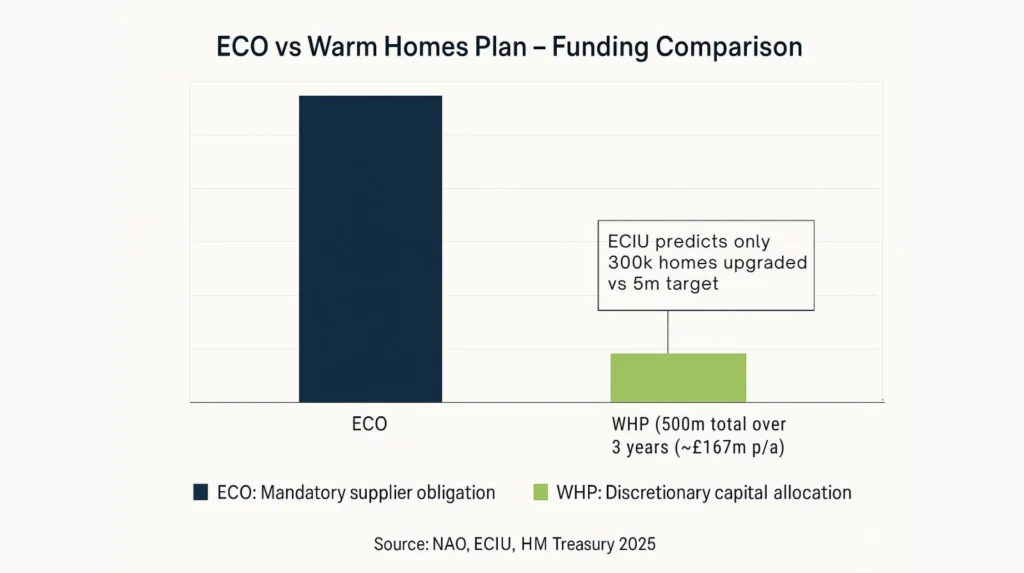
But here’s the problem: the ECO scheme that’s being abolished generated £1.7 billion every year for energy efficiency installations in fuel-poor homes. Insulation, heating upgrades, electrical work that permanently reduces energy demand. That’s gone from March 2026, replaced by the Warm Homes Plan, which has just £500 million allocated over three years. That’s not a replacement. It’s a fraction.
For electricians working in domestic retrofit and energy efficiency, this policy creates immediate uncertainty. ECO-funded work has supported thousands of installers doing cavity wall insulation, loft insulation, heating system upgrades, and associated electrical modifications in low-income properties. The market for that work is about to shrink dramatically unless the Warm Homes Plan scales significantly beyond its current funding commitment.
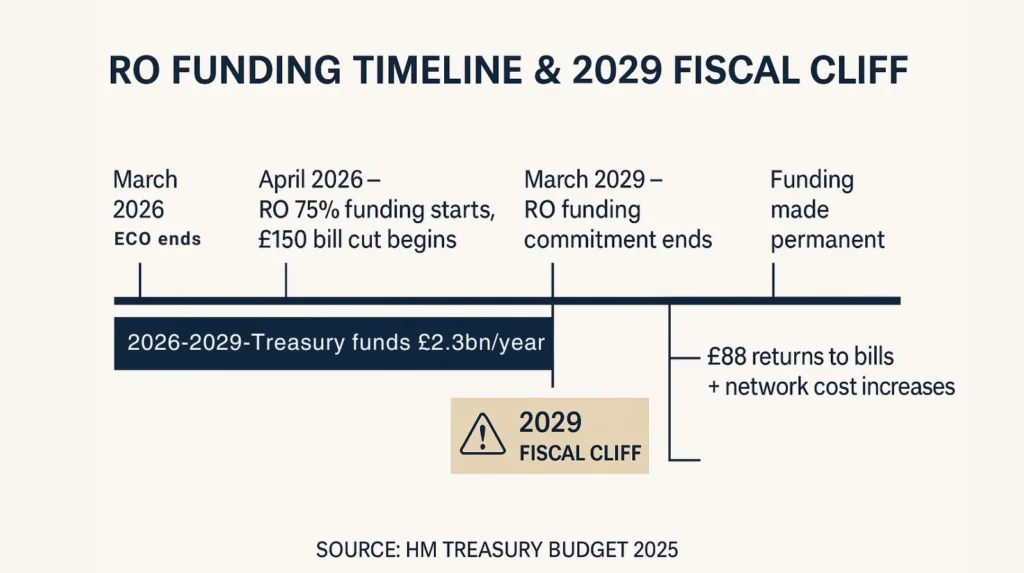
The second issue is the 2029 fiscal cliff. The RO funding commitment is temporary, running from April 2026 to March 2029. After that, unless the government legislates to make it permanent, the £88 per household saving from the RO shift automatically reverts to bills. That’s three years of policy certainty, then a guaranteed bill shock scenario that undermines consumer confidence in electrification.
The policy does achieve one critical goal: it makes electricity cheaper relative to gas by reducing electricity unit rates by 3.37 pence per kWh. This pricing rebalance is essential for encouraging heat pump and EV adoption. But it’s a contradictory policy framework. You’re making electricity cheaper to promote electrification while simultaneously cutting the funding that pays for the insulation upgrades needed to make electrification economically viable.
For electricians considering training in EV charging installation or heat pump systems, the policy creates a window of opportunity (cheaper electricity drives demand) undermined by uncertainty (funding ends in 2029, insulation support has collapsed). This article breaks down what the policy actually means, why it matters for the electrical sector, and what the long-term risks are.
What the Policy Actually Does: ECO Ending and RO Shift
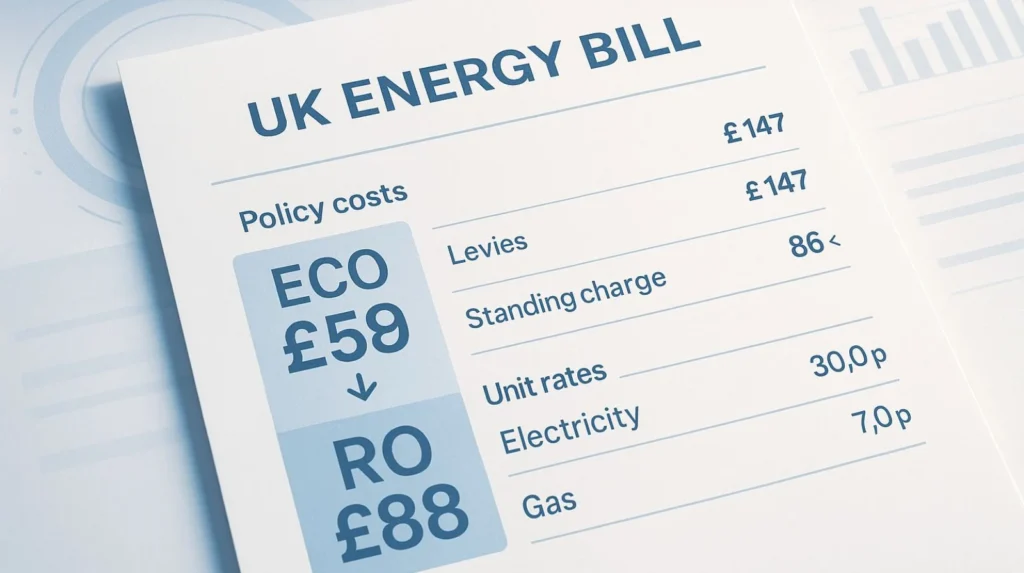
The £150 bill reduction breaks down into two components. First, £59 per household comes from ending the Energy Company Obligation (ECO) scheme. ECO required energy suppliers to fund energy efficiency installations (insulation, boilers, heating upgrades) in low-income and fuel-poor homes. The cost of meeting these obligations was passed onto all consumers via bills. From 31 March 2026, ECO ends, removing that levy permanently.
Second, £88 per household comes from the government funding 75% of the Renewables Obligation (RO) costs through general taxation instead of consumer bills. The RO is a legacy subsidy mechanism supporting renewable energy generation. Generators receive Renewables Obligation Certificates (ROCs) for the electricity they produce, which energy suppliers must purchase to meet their obligations. The cost of buying ROCs gets passed to consumers. From April 2026, the Treasury covers 75% of domestic RO costs, reducing the burden on bills.
Together, these changes deliver an average saving of £154 per household (the £150 figure is rounded). For a typical dual-fuel household using 2,700 kWh of electricity and 11,500 kWh of gas annually, the impact translates to specific unit rate reductions: electricity drops by 3.37 pence per kWh (3.54p including VAT), and gas drops by 0.31 pence per kWh (0.35p including VAT).
The Treasury Cost. Funding the RO shift costs the Exchequer £2.3 billion annually. This is funded from general taxation, which is considered more progressive than per-unit levies because it draws from a broader tax base where higher earners contribute proportionally more. The ECO levy generated approximately £1.7 billion annually. Ending it removes that cost from the system entirely, but also eliminates the revenue stream that paid for energy efficiency work in fuel-poor homes.
What Happens to Existing ECO Projects. The government has proposed a nine-month extension to December 2026 for ongoing ECO projects to avoid abrupt cancellation of installations already in progress. This extension is subject to consultation and would only cover ECO4 measures like insulation and heating upgrades using existing supplier obligations. After that, no new ECO-funded work begins unless a replacement scheme is introduced.
Why ECO Was Abolished: NAO Findings on Systemic Failure
The government’s justification for ending ECO wasn’t just fiscal. It was based on evidence of catastrophic implementation failure documented by the National Audit Office (NAO). The Chancellor framed ECO as a “failed scheme” that cost households £1.7 billion annually while failing to benefit 97% of families in fuel poverty in terms of actual financial savings.
The NAO’s November 2024 report revealed systemic quality failures in ECO installations. The headline finding: 98% of homes with external wall insulation (EWI) installed under ECO required remedial work to correct major defects. These weren’t minor paperwork issues. They were structural problems causing damp, mould, and in some cases, immediate health and safety risks including exposed live electrical cabling and blocked boiler ventilation.
Between 900 and 2,000 homes (6% of EWI installations) posed immediate health and safety risks. The NAO attributed these failures to weak government oversight by the Department for Energy Security and Net Zero (DESNZ), fragmented accountability between DESNZ, Ofgem, and private certification bodies, and insufficient monitoring that allowed installers to game the system.
The report also flagged suspected fraud notified to DESNZ in April 2024, involving retrofit businesses potentially overclaiming for work undertaken. The scale of the quality failure across nearly all EWI installations provided political cover for abolishing the scheme. But ending ECO doesn’t resolve the liability. DESNZ is now obliged to set out a plan for fixing faulty installations, representing a significant uncosted liability that will likely fall on the Exchequer or regulated suppliers.
What This Means for Electricians. ECO-funded retrofit work often involved electrical modifications. Upgrading heating systems, installing new consumer units to handle increased loads from heat pumps, checking circuits after insulation work. The 98% remediation rate means thousands of properties now need electrical safety checks because insulation work has compromised wiring through water ingress or poor installation around electrical fittings. That’s unplanned remedial work that someone has to do, likely falling on electricians who weren’t involved in the original installation.
The Funding Gap: Warm Homes Plan vs ECO's £1.7 Billion
The replacement for ECO is the Warm Homes Plan (WHP), which aims to upgrade five million homes over five years. The government announced an additional £1.5 billion capital investment for the plan, building on £13.2 billion allocated at Spending Review 2025. That sounds substantial until you examine how much is actually allocated to the primary delivery mechanism.
The Warm Homes: Local Grant, which is the main vehicle for delivering upgrades in England, has just £500 million allocated for April 2025 to March 2028. That’s £500 million over three years to replace a scheme that generated £1.7 billion every single year. ECO was a supplier obligation, a mandatory, continuous revenue stream. The Warm Homes Plan relies on discrete capital grants, which are time-bound and subject to future spending decisions.
Eligibility Criteria. The Warm Homes Plan targets low-income households in England with poor energy performance. To qualify for the Local Grant, you need gross annual household income of £36,000 or less, or residence in deprived areas, or receipt of means-tested benefits. Your property must have an Energy Performance Certificate (EPC) rating between D and G.
That’s stricter than ECO’s eligibility. ECO targeted fuel poverty broadly, including homes in bands E, F, and G, with flexible criteria. Warm Homes narrows the scope while dramatically reducing funding. Analysis by the Energy and Climate Intelligence Unit (ECIU) estimates that at current funding levels, only 300,000 homes may be upgraded by the end of the Parliament. That’s a deficit of 4.7 million homes against the 5 million target.
For those 4.7 million households missing out on upgrades, the cost is real. Energy efficiency improvements under ECO saved households an average of £300 per year, rising to £500 for EPC F-rated homes. Without those upgrades, they remain trapped in inefficient properties paying higher bills indefinitely.
Impact on the Electrical Installation Sector. ECO created sustained demand for domestic retrofit work. Cavity wall insulation, loft insulation, heating system upgrades, electrical modifications to support new heating technologies. That work employed installers, electricians, assessors, and certification bodies. The Warm Homes Plan at £500 million over three years cannot sustain that market at anywhere near the same scale. Industry bodies warn the funding gap will collapse the insulation industry, causing job losses estimated at 10,000 installers and disrupting supply chains, making future programmes more expensive to restart.
The 2029 Fiscal Cliff: When the RO Funding Ends
The RO funding shift that delivers £88 per household in savings is explicitly temporary. The Treasury commitment runs from 1 April 2026 to March 2029. Three years. After that, unless new legislation makes the funding permanent, the RO costs automatically revert to consumer bills.
This creates a guaranteed fiscal and political challenge in 2029. The government of the day will face a choice: find £2.3 billion annually in sustained revenue to continue funding the RO subsidy via general taxation, or accept that bills will increase by approximately £88-£100 per household as the levy returns. Given that this will coincide with existing upward pressures from network charges and other non-wholesale costs, the actual bill shock could be significantly higher.
From a consumer perspective, this undermines trust. Households are being told bills are dropping by £150 in 2026, which is true. But that relief is temporary unless action is taken before 2029. The policy creates an expectation of lower bills while building in a structural mechanism for bills to rise again within the electoral cycle.
Why This Matters for Electrification. Policy certainty drives investment in low-carbon technologies. If you’re considering installing a heat pump or buying an electric vehicle, the economics depend on stable, predictable electricity costs. Three years of cheaper electricity isn’t enough to justify the upfront capital investment in these technologies, especially when you know there’s a policy cliff that could see costs spike again.
For electricians training in specialist installations like domestic EV charging, this uncertainty matters. Cheaper electricity should increase demand for EV charging points. But if customers hesitate because they’re unsure whether electricity will remain competitively priced after 2029, adoption slows, and the market for installation work becomes less predictable.
Thomas Jevons, our Head of Training, explains the contradiction:
"Making electricity cheaper relative to gas is essential for heat pump viability. The RO shift helps that by reducing electricity unit rates by 3.37p per kWh. But heat pumps only make economic sense in well-insulated properties. If we've just killed the main funding stream for insulation, we've undermined the foundations needed for electrification to work at scale."
Thomas Jevons, Head of Training
He’s right. Heat pumps are two to three times more efficient than gas boilers, but they run on electricity. If electricity is expensive relative to gas (which it has been historically because of levy loading), heat pumps cost more to run than gas heating despite their efficiency advantage. The RO funding shift corrects this pricing distortion by making electricity cheaper.
But heat pumps only deliver savings if the property is well insulated. Poor insulation means higher heat demand, which means the heat pump runs longer, which means higher electricity consumption. The business case collapses. ECO was meant to fund the insulation upgrades that make heat pumps viable. Without that funding pipeline, heat pump adoption remains concentrated in well-insulated, higher-income properties that can afford to pay for insulation privately.
Fixed Tariff Pass-Through: Will Everyone Get the Saving?
One critical implementation question is whether the £150 saving will reach the approximately 10 million households currently on fixed-price energy contracts. For customers on default tariffs, the savings will automatically flow through the quarterly price cap set by Ofgem. But fixed tariffs are different.
When customers lock into a fixed contract, they agree to pay a set price per unit for the contract duration, typically 12-24 months. Those contracts were priced based on the supplier’s expectation of wholesale costs plus policy costs including ECO and RO levies. If those policy costs are removed from April 2026, suppliers could theoretically keep the savings and increase their margins rather than passing them to customers locked into fixed deals.
The government has stated its expectation that suppliers will pass on the savings. Ofgem has been tasked with working with suppliers to ensure mandatory pass-through to those on fixed contracts as of 1 April 2026. But enforcement requires clear regulatory intervention.
The Precedent. During the Energy Price Guarantee in 2022-23, suppliers passed government subsidies to fixed-tariff customers variably. Some withheld the benefit, leading to Ofgem enforcement action and fines totaling approximately £10 million across five suppliers. Martin Lewis, founder of MoneySavingExpert, has repeatedly pushed for mandatory inclusion of fixed-tariff customers in the £150 saving, warning that without clear regulation, approximately 40% of households risk missing out.
The scale of potential consumer loss is significant. If suppliers pocket the savings for 10 million customers on fixed contracts, that’s approximately £1.5 billion in aggregate. Ofgem consultations in Q1 2026 will determine enforcement mechanisms, likely through adjustments to price cap methodology that apply retrospectively to fixed contracts beginning before April 2026.
Northern Ireland: The Disparity No One's Talking About
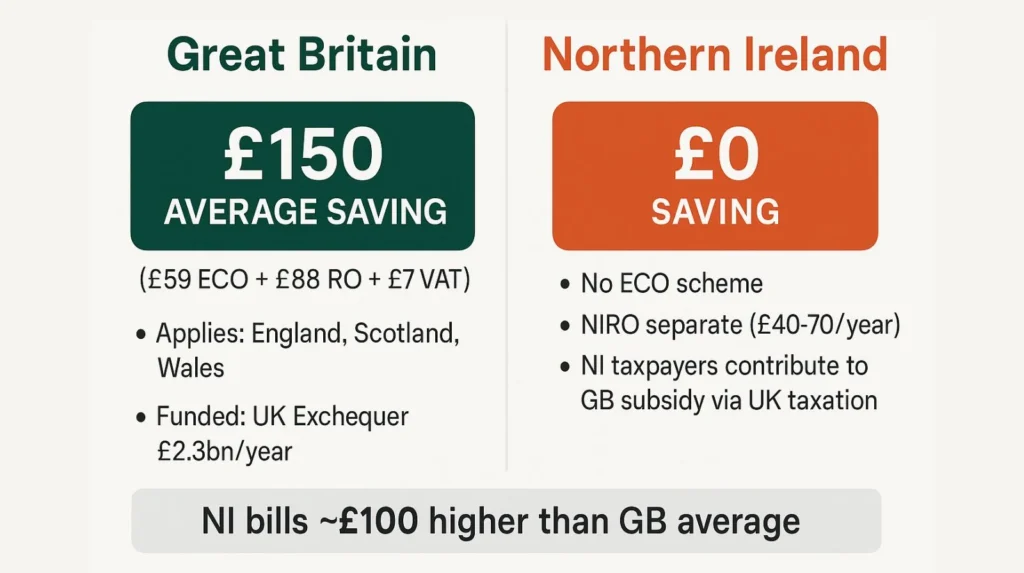
Northern Ireland receives virtually none of the bill reduction benefit announced in Budget 2025. The reason is that NI operates separate energy market regulation and policy schemes. Understanding why this matters requires examining the structural differences.
ECO Doesn’t Apply. Northern Ireland never participated in the Energy Company Obligation scheme. Instead, NI runs the Affordable Warmth Scheme, funded differently through the Northern Ireland Executive budget. The £59 per household saving from ECO ending is therefore entirely irrelevant to NI consumers.
NIRO (Northern Ireland Renewables Obligation). NI operates the Northern Ireland Renewables Obligation (NIRO), a devolved scheme separate from the GB Renewables Obligation. The NIRO obligation level has historically been set significantly lower than GB RO, reflecting NI’s higher levels of consumer vulnerability and fuel poverty. The estimated cost of NIRO to NI billpayers is approximately £40-£70 per household annually, considerably less than the GB RO.
Control over NIRO rests with the Stormont Assembly. Westminster’s policy decision to fund 75% of the GB RO through UK general taxation does not automatically apply to NIRO. The NI Executive would need to decide whether to follow suit using devolved budgets or negotiate additional funding from Westminster.
The Fiscal Transfer Problem. Here’s the inequity: Northern Ireland taxpayers contribute to the UK Exchequer through general taxation. The Exchequer is now allocating £2.3 billion annually to fund GB RO costs. This means NI taxpayers are directly contributing to a subsidy that exclusively benefits Great Britain energy consumers while receiving no reciprocal reduction in their own bills.
This is a negative fiscal transfer. NI pays into the pot funding a GB-only benefit. To replicate the equivalent saving (even just the £40-£70 NIRO portion), Stormont would need to allocate devolved budget funds or demand specific Barnett consequentials from Westminster. Given NI’s constrained fiscal position, this creates political tension and a legitimate grievance about regional equity in UK energy policy.
Northern Ireland bills are already approximately £100 higher than the GB average due to policy and market structure differences. The Budget 2025 energy announcement widens that gap further. NI consumers get no relief while contributing as UK taxpayers to fund relief for GB.
What This Means for Electricians and the Retrofit Sector
For electricians working in domestic installations and energy efficiency, Budget 2025 creates a mixed picture of opportunity and risk.
The Opportunity: Cheaper Electricity Drives Electrification. Making electricity 3.37p per kWh cheaper relative to gas is the single biggest policy signal to support heat pump and EV adoption. Historically, electricity has been expensive because green levies were heavily loaded onto electricity bills (approximately 16% of the total bill) while gas bills carried minimal policy costs. This pricing structure acted as a tax on electrification, discouraging exactly the technologies needed for net zero.
The RO shift reverses this distortion. Cheaper electricity makes EVs more attractive to run, which should increase demand for home charging point installations. For electricians with qualifications in EV charging installation, this creates a genuine opportunity, provided the policy remains stable beyond 2029.
Joshua Jarvis, our Placement Manager, sees both sides:
"Cheaper electricity makes EVs and home charging more attractive, which should increase demand for EV charging installation work. That's a positive for electricians with the right qualifications. But the policy only lasts until 2029 unless they make it permanent. Three years of certainty isn't enough to build a career around specialist installations."
Joshua Jarvis, Placement Manager
He’s correct. Three years of policy certainty isn’t a foundation for long-term career planning. If you’re training to become a domestic electrical installer with the intention of specialising in low-carbon installations, you need to know the market will be there for decades, not just until March 2029.
The Risk: Retrofit Work Market Collapses. ECO generated £1.7 billion annually for energy efficiency installations. Insulation, heating upgrades, electrical modifications to support new heating systems. That’s sustained, predictable work that employed thousands of installers. From March 2026, that revenue stream disappears.
The Warm Homes Plan doesn’t replace it at scale. £500 million over three years is approximately one-third of one year of ECO funding. Unless the Warm Homes budget increases dramatically, the retrofit sector faces a market collapse. Employers are already telling us they’re scaling back recruitment because they can’t see where sustained work will come from.
For electricians doing retrofit work, this creates immediate uncertainty about job security and work pipeline. The remediation work from the 98% of faulty ECO installations might create some short-term demand, but that’s unplanned, reactive work, not a sustainable market.
BS 7671 and Energy Efficiency. The 18th Edition wiring regulations include specific requirements around energy efficiency, load control, and demand reduction. These provisions assume that electrical installations will be designed and modified to support efficient use of energy. But if the funding that drives efficiency upgrades has just been removed, the regulatory framework and the policy reality are misaligned.
Electricians need to understand both the technical requirements in BS 7671 and the policy environment that shapes demand for the work. Right now, those two things are pointing in different directions.
What Should Happen: Making the Policy Sustainable
Budget 2025’s energy policy achieves important short-term goals (bill relief, progressive funding shift, electricity price rebalancing) but creates unsustainable long-term risks. Here’s what needs to change to make this policy work.
Make RO Funding Permanent. The government must legislate now to make the Renewables Obligation funding via general taxation permanent beyond March 2029. Waiting until 2028 to address this creates unnecessary uncertainty and risks a political crisis when bills spike. Permanent funding provides the stability needed for households and businesses to invest in electrification with confidence.
Scale Warm Homes Plan to Match ECO. The Warm Homes Plan needs a dedicated, sustained revenue stream of at least £1.5 billion annually to match the scale of ECO and support the five million home target. Relying on fragmented capital grants doesn’t work. The sector needs predictable, long-term funding to build supply chains, train installers, and deliver upgrades at scale.
Fix the Remediation Liability. The 98% failure rate in ECO external wall insulation creates an immediate, uncosted liability. DESNZ must establish a specific, ring-fenced fund to address remedial work, including electrical safety checks for properties where insulation has compromised wiring. This can’t be left unfunded or pushed onto the sector.
Address Northern Ireland Equity. Westminster must negotiate with the NI Executive to provide specific Barnett consequentials or direct block grant allocation equivalent to NI taxpayers’ contribution to GB RO funding. This allows Stormont to reduce NIRO charges correspondingly and addresses the regional fiscal disparity.
Pair Electricity Price Cuts with Insulation Investment. Cheaper electricity drives electrification, but electrification only works at scale in well-insulated properties. The policy currently cuts electricity costs while removing insulation funding. That’s contradictory. If the goal is mass heat pump adoption, you need both affordable electricity and a pipeline of well-insulated properties. Right now, you’ve got one without the other.
Conclusion: Short-Term Relief, Long-Term Questions
Budget 2025 delivers genuine, immediate relief to households struggling with energy costs. £150 off bills from April 2026 is real money that will help millions of families. Shifting funding from regressive per-unit levies to general taxation is the right approach. Making electricity cheaper relative to gas sends the correct price signal for electrification.
But the policy is structurally incomplete. Ending ECO removes £1.7 billion in annual funding for energy efficiency without a like-for-like replacement. The Warm Homes Plan at £500 million over three years cannot sustain the retrofit sector at anything close to the scale needed. Industry warns of job losses, supply chain collapse, and millions of households trapped in fuel poverty without access to the upgrades that would permanently reduce their bills.
The 2029 fiscal cliff is a guaranteed problem. Unless the RO funding is made permanent, £88 per household automatically returns to bills in three years, reversing the affordability gains and creating exactly the kind of bill volatility that undermines consumer trust in energy policy.
For electricians, the outlook is mixed. Cheaper electricity should drive demand for EV charging installations and heat pump work, creating opportunities for those with the right qualifications. But the retrofit market faces collapse, and the policy uncertainty around 2029 makes it difficult to build long-term career plans around specialist installations.
The policy needs to be completed. Make the RO funding permanent. Scale the Warm Homes Plan properly. Fix the remediation liability. Address Northern Ireland’s exclusion. Pair electricity price cuts with sustained insulation investment.
Right now, we’ve got short-term relief built on long-term uncertainty. That’s not a sustainable energy policy. It’s a political fix that defers the hard decisions to 2029.
References
- HM Treasury – Autumn Budget 2025 (26 November 2025) – https://www.gov.uk/government/collections/budget-2025
- HM Treasury – Budget 2025: What it means for your energy bills (26 November 2025) – https://www.gov.uk/government/news/what-does-the-autumn-budget-mean-for-your-energy-bills
- Office for Budget Responsibility – Economic and Fiscal Outlook (November 2025) – https://obr.uk/efo/economic-and-fiscal-outlook-november-2025/
- National Audit Office – Energy efficiency installations under the Energy Company Obligation (November 2024) – https://www.nao.org.uk/reports/energy-efficiency-installations-under-the-energy-company-obligation/
- Ofgem – Energy Company Obligation (ECO) Overview – https://www.ofgem.gov.uk/environmental-and-social-schemes/energy-company-obligation-eco
- Ofgem – Changes to energy price cap between 1 January and 31 March 2026 – https://www.ofgem.gov.uk/publications/changes-energy-price-cap-between-1-january-and-31-march-2026
- Cornwall Insight – Budget Cuts over £145 from Annual Household Energy Bills, But Affordability Challenge Remains (26 November 2025) – https://www.cornwall-insight.com/press-and-media/press-release/budget-cuts-over-145-from-annual-household-energy-bills-but-affordability-challenge-remains/
- Energy and Climate Intelligence Unit (ECIU) – Warm Homes Plan: gutting funding could see families paying up to £500 extra in bills every year (November 2025) – https://eciu.net/news-and-events/press-releases/warm-homes-plan-funding-analysis
- Resolution Foundation – Stairway to headroom: The Autumn Budget 2025 (October 2025) – https://www.resolutionfoundation.org/publications/stairway-to-headroom/
- Nesta – What does the Budget mean for energy bills? (26 November 2025) – https://www.nesta.org.uk/blog/what-does-the-budget-mean-for-energy-bills/
- UK Green Building Council – UKGBC responds to the Government’s Autumn Budget 2025 (26 November 2025) – https://ukgbc.org/news/ukgbc-responds-to-the-government-autumn-budget-2025/
- BusinessGreen – Chancellor moves to cut energy bills and boost EV funding (26 November 2025) – https://www.businessgreen.com/news/4301627/chancellor-moves-cut-energy-bills-boost-ev-funding
- Energy Saving Trust – Warm Homes: Local Grant guide for local authorities (2025) – https://energysavingtrust.org.uk/grants-and-loans/warm-homes-local-grant/
Note on Accuracy and Updates
Last reviewed: 02 December 2025. This article reflects analysis of Budget 2025 announcements published 26 November 2025. The £150 bill reduction policy takes effect 1 April 2026. ECO scheme ends 31 March 2026 with proposed nine-month extension to December 2026 subject to consultation. Renewables Obligation 75% taxpayer funding runs April 2026 to March 2029 (temporary commitment). Warm Homes Plan funding figures reflect Treasury announcements and initial Warm Homes: Local Grant allocation (£500m, April 2025-March 2028). NAO findings on ECO installation failures published November 2024. Northern Ireland operates separate energy market regulation; NIRO and Affordable Warmth Scheme are devolved. Revenue projections (£2.3bn annually) and unit rate reductions (3.37p/kWh electricity, 0.31p/kWh gas) from HM Treasury impact assessments. This article represents editorial analysis of policy implications for UK electrical installation sector and energy efficiency market. Next review scheduled following Q1 2026 Ofgem consultations on fixed-tariff pass-through and any amendments to ECO extension proposals.
