
Can Customers Trust Trade Directories to Find a Trusted Tradesperson?

- Technical review: Thomas Jevons (Head of Training, 20+ years)
- Employability review: Joshua Jarvis (Placement Manager)
- Editorial review: Jessica Gilbert (Marketing Editorial Team)
- Last reviewed:
- Changes: Complete rewrite targeting homeowners. Added comprehensive analysis of directory vetting gaps across seven trades (electrical, plumbing, carpentry, bricklaying, plastering, roofing, welding), distinction between commercial directory badges vs official registers (NICEIC, Gas Safe, etc.), directory business model economics affecting quality, practical verification steps for homeowners, and red flag identification framework. Integrated CMA guidance on review transparency, ASA rulings on vetting claims, and Consumer Rights Act 2015 protections.
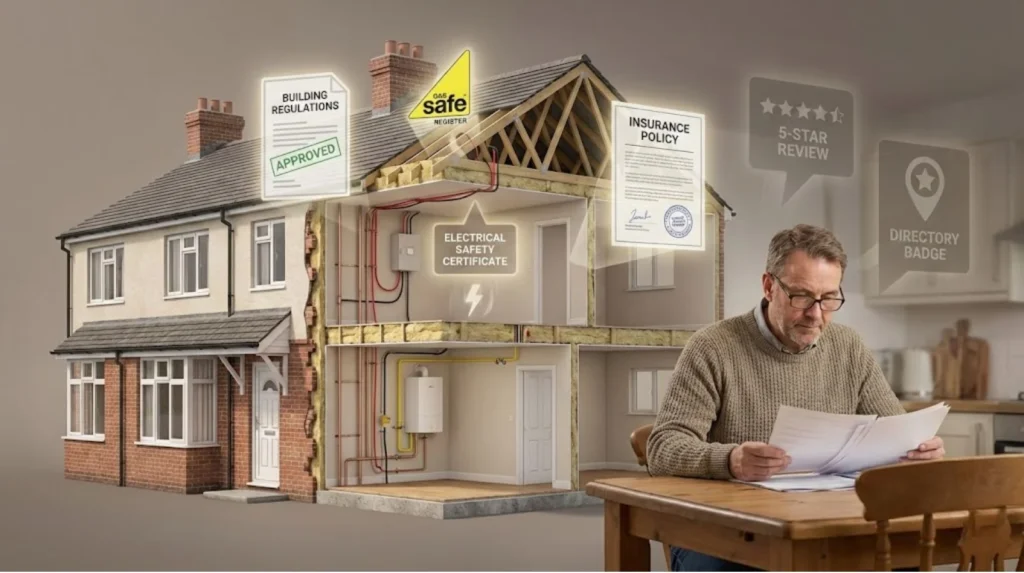
You’re standing in your kitchen looking at a quote for £8,000 to rewire your house. The electrician has a Checkatrade badge, 147 five-star reviews, and a profile that says “fully vetted and approved.” You feel reassured. You shouldn’t.
UK homeowners lose approximately £4 billion annually to rogue traders and substandard work, despite the existence of multiple trade directories promising vetted, trusted, reliable tradespeople. According to industry surveys, 87% of homeowners fear hiring trades due to trust concerns. The directories exist specifically to solve this problem. So why does the problem persist?
Here’s what nobody tells you: those directory badges you’re relying on check if someone has a pulse and a business bank account. They don’t check if that electrician can safely isolate a circuit, if that plumber understands Building Regulations for drainage, if that plasterer knows proper substrate preparation, or if that roofer has actually completed more than three jobs in their entire career.
The gap between what directories claim (vetted, trusted, approved) and what they actually verify (ID, insurance, credit check) is costing homeowners thousands in remedial work, safety hazards, and stress. If you’re about to hire someone based on a directory profile, you need to understand what those badges actually mean, what they definitely don’t mean, and how to verify competence yourself before parting with your money.
This isn’t a “directories are scams” article. Some platforms do rigorous vetting. Some trades on directories are excellent. But understanding the system, the incentives, and the gaps helps you avoid becoming part of that £4 billion statistic.
The Vetting Illusion: What "Approved" Actually Means
The Marketing vs Reality Gap
When a directory says a tradesperson is “vetted,” “approved,” or “trusted,” homeowners hear: “This person is technically competent to do the work safely and correctly.”
What directories actually mean: “We checked this person exists, has some form of insurance, and passed a credit check.”
That’s not the same thing. Not even close.
The Vetting Hierarchy
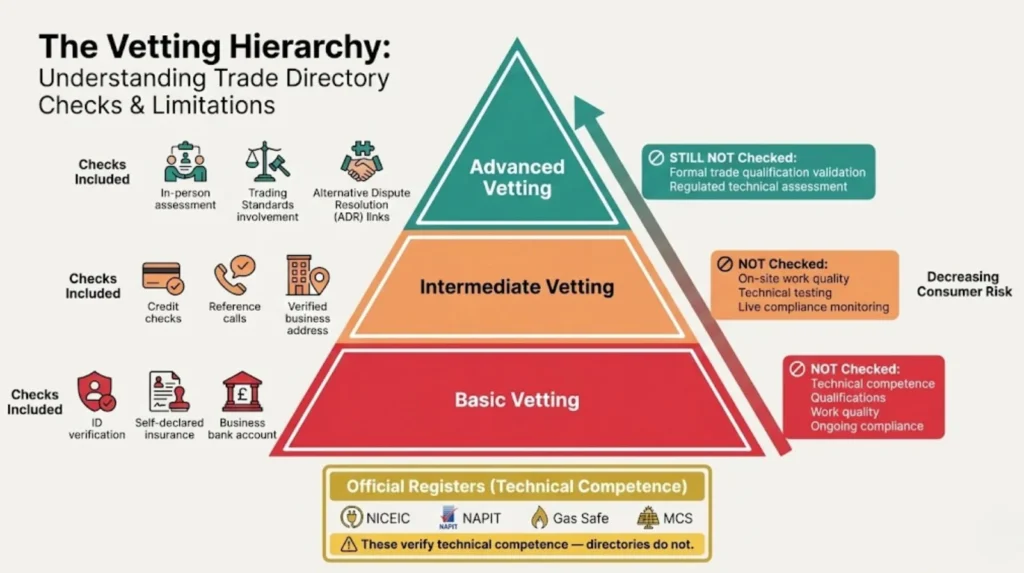
Trade directories operate on three levels of vetting, and most homeowners can’t tell the difference:
Basic Vetting (Rated People, MyBuilder)
Identity verification (passport/driving licence)
Self-declared insurance (public liability, often just checked once at registration)
Basic right-to-work checks
Business bank account verification
What it doesn’t check: Actual qualifications, technical competence, quality of past work, customer satisfaction beyond reviews, ongoing compliance with regulations, tools and equipment, site safety practices, or whether insurance policies are still active.
Intermediate Vetting (Checkatrade, TrustATrader)
Everything from Basic level
Credit checks (financial stability, not technical ability)
Reference calls to previous customers (subjective feedback)
Business address verification
Sometimes visual inspection of business premises
What it doesn’t check: The technical standards of the work those references relate to. A customer can be delighted with terrible electrical work because the lights turn on and the electrician was punctual. They won’t know about undersized cables, missing RCD protection, or lack of earthing until something fails or catches fire.
Advanced Vetting (Which? Trusted Traders, TrustMark)
Everything from Intermediate level
In-person business assessments
Credit reports reviewed by professionals
Trading Standards involvement
Audit of business processes and complaints handling
Links to Alternative Dispute Resolution schemes
What it still doesn’t check: The technical competence of the actual person doing the work on your property. These are business assessments. They verify the company is legitimate and financially stable. They don’t send qualified engineers to test whether your electrician knows BS 7671 or your plumber understands Part L Building Regulations.
The Critical Distinction
There’s a fundamental difference between:
Commercial Directories (Checkatrade, MyBuilder, Rated People, TrustATrader)
Marketing platforms
Business legitimacy verification
Customer service reputation management
Pay-to-play membership or lead generation fees
Official Registers (NICEIC, NAPIT, Gas Safe, CHAS, Construction Skills Certification Scheme)
Regulatory compliance verification
Technical competence assessment
Ongoing monitoring and inspections
Required for legally notifiable work under Building Regulations
Directories are billboards. Registers are licenses.
You wouldn’t hire a surgeon based on a Trustpilot profile. You’d check they’re registered with the General Medical Council. The same principle applies to safety-critical trades work.
Trade-by-Trade Reality Check: What Legitimate Actually Looks Like
Thomas Jevons, Head of Training at Elec Training with over 20 years in the industry, explains the problem:
"Legitimate trades across all sectors share common markers: proper business insurance with adequate coverage levels, documented qualifications specific to their trade, registered business addresses, transparent pricing structures, and membership of relevant professional bodies. Directories blur these distinctions. A roofer and a welder have completely different qualification requirements, but directories present them identically with the same vetting badge."
Thomas Jevons, Head of Training
Here’s what actual competence looks like for each major trade, and what directories can’t verify:
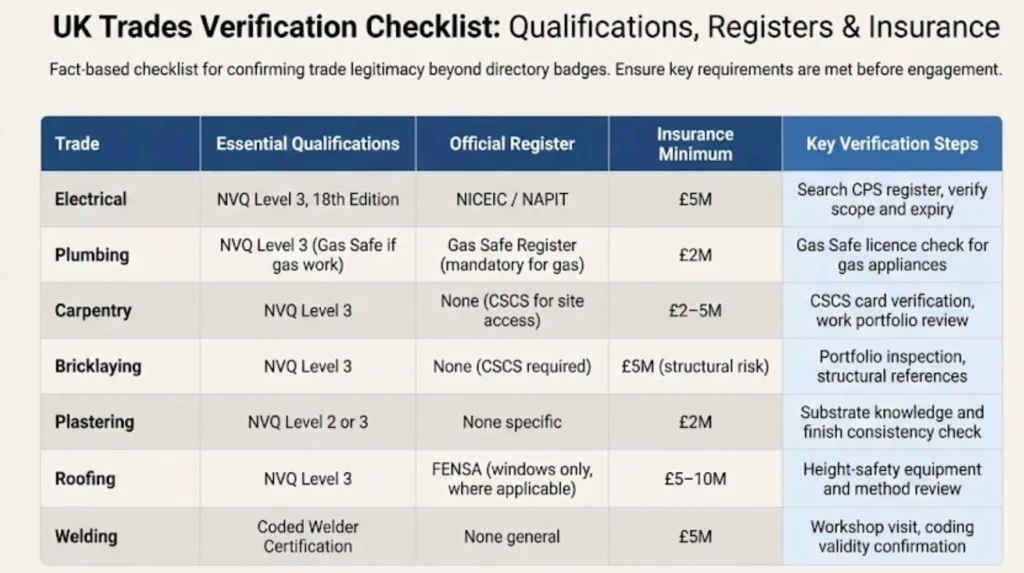
1. Electrical Installation
What Competence Actually Requires:
NVQ Level 3 Diploma in Installing Electrotechnical Systems (2357) or equivalent recognised qualification
18th Edition BS 7671 certification (Wiring Regulations, must be updated every 3-5 years)
Registration with approved Competent Person Scheme (NICEIC, NAPIT, ELECSA, STROMA, etc.)
AM2 assessment pass (practical test of safe working practices)
Public liability insurance specifically covering electrical work (minimum £2 million, ideally £5 million)
What Directories Check:
Self-declared “qualified electrician” status
Generic public liability insurance exists (may not cover electrical work specifically)
Customer reviews saying “lights work fine”
The Gap: Electrical work is legally notifiable under Building Regulations Part P. Only registered electricians through approved schemes can self-certify compliance. Directories don’t verify this registration. Your “vetted” electrician may be technically breaking the law doing your rewire, leaving you without the required Building Control certificates you’ll need when selling your house.
How to Verify Properly:
Search the Electrical Competent Person Scheme register at electricalcompetentperson.co.uk
Ask for their NICEIC/NAPIT card and verify the number directly with the scheme
Check their 18th Edition certificate is dated within the last 5 years
Request sample Building Regulation certificates from previous jobs
2. Plumbing and Domestic Heating
What Competence Actually Requires:
NVQ Level 3 Diploma in Plumbing and Domestic Heating or equivalent
Gas Safe registration (legally required for ANY gas work, renewed annually)
Unvented hot water systems certification (G3 qualification for sealed system cylinders)
Water Regulations approval where required for complex installations
Public liability insurance covering water damage (minimum £2 million)
What Directories Check:
“Qualified plumber” self-declaration
Insurance exists (may not adequately cover water damage or gas work)
Customer reviews saying “no leaks, job done quickly”
The Gap: Gas work is criminally illegal without Gas Safe registration, yet directories routinely list “heating engineers” without verifying registration status. Homeowners hire “vetted” plumbers for boiler installations who aren’t legally allowed to touch gas. Carbon monoxide poisoning, explosions, and insurance invalidation are the consequences.
How to Verify Properly:
Search Gas Safe Register at gassaferegister.co.uk (legally required, no exceptions)
Request G3 certification if work involves unvented cylinders
Check Water Regulations approval if required (water company can advise)
Ask for photos of previous installations showing pipework quality and labelling
3. Carpentry and Joinery
What Competence Actually Requires:
NVQ Level 3 Diploma in Site Carpentry or Bench Joinery depending on specialisation
CSCS card (Construction Skills Certification Scheme, proves health and safety knowledge)
First-fix and second-fix experience documentation for structural vs finishing work
Workshop facilities for bespoke joinery (if applicable)
Public liability and tools insurance (£2-5 million coverage)
What Directories Check:
Self-declared carpentry experience
Insurance exists (generic coverage)
Customer photos of finished kitchens or fitted wardrobes
The Gap: Carpentry spans from structural roof trusses to decorative architraves. Directories don’t differentiate between a site carpenter capable of complex roof structures and someone who assembles flat-pack furniture for a living. Both appear as “carpenters” with five-star ratings.
How to Verify Properly:
Request CSCS card details and verify at cscs.uk.com
Ask for portfolio photos showing work similar to your project (structural vs finishing work)
Check workshop address if custom joinery is required (legitimate joiners have physical premises)
Request references for similar-scale projects (kitchen fitting vs loft conversion carpentry are different skill levels)
4. Bricklaying and Trowel Trades
What Competence Actually Requires:
NVQ Level 3 Diploma in Trowel Occupations covering bricklaying, blockwork, stonework
CSCS card (often blue skilled worker card)
Structural understanding for load-bearing walls, lintels, DPC installation
Experience with different bond patterns (English bond, Flemish bond, cavity walls)
Public liability insurance covering structural work (minimum £5 million for load-bearing projects)
What Directories Check:
“Qualified bricklayer” status
Insurance exists
Photos of garden walls and extension work
The Gap: Bricklaying for decorative garden walls is fundamentally different from structural work on house extensions. Poor brickwork affects building stability, damp penetration, and long-term property value. Directories don’t assess technical knowledge of mortar mixes, movement joints, or Building Regulations compliance for structural walls.
How to Verify Properly:
Request CSCS card and verify skilled worker status
Ask about structural calculations if work is load-bearing (should involve structural engineer)
Check Building Control notification for extensions or structural alterations
Request photos of previous structural projects with dates and client references
Verify mortar mix knowledge specific to your project (sulphate-resisting cement for ground contact, etc.)
5. Plastering, Painting, and Decorating
What Competence Actually Requires:
NVQ Level 2/3 in Plastering for different plaster types and applications
Knowledge of substrate preparation (different approaches for brick, plasterboard, old lime plaster)
Damp and ventilation understanding (plastering over damp causes failures)
Decorating: understanding of paint systems (primer, undercoat, topcoat for different surfaces)
Public liability insurance (£2 million minimum)
What Directories Check:
Self-declared plastering/decorating experience
Insurance exists
Customer photos of smooth walls and painted rooms
The Gap: Plastering over damp walls, using wrong plaster types, inadequate preparation, or incorrect paint systems cause expensive failures within months. Customers review based on immediate appearance, not technical durability. Directories don’t verify knowledge of British Gypsum specifications, lime plaster techniques, or Building Research Establishment guidance on condensation and ventilation.
How to Verify Properly:
Ask about substrate assessment process (how they check for damp, loose material, suction rates)
Request specification of materials they’ll use (plaster types, paint brands, preparation products)
Check understanding of ventilation requirements (especially bathrooms, kitchens)
Verify experience with your specific substrate (old solid walls vs modern plasterboard require different approaches)
Request references for similar property types (period properties with lime plaster vs new builds)
6. Roofing, Fenestration, and Insulation
What Competence Actually Requires:
NVQ Level 3 in Roof Slating and Tiling or equivalent roofing qualification
Working at Height certification and proper safety equipment
Knowledge of Building Regulations Part L (insulation standards) and Part C (weather resistance)
Fenestration: FENSA or CERTASS registration (legally required for window/door replacement)
Public liability insurance covering height work (£5-10 million for roofing projects)
What Directories Check:
Self-declared roofing experience
Insurance exists (may not adequately cover height work or structural damage)
Customer photos of completed roofs
The Gap: Roofing is safety-critical (falls are leading cause of construction deaths) and affects structural integrity (poor roof work causes water ingress, timber rot, ceiling collapse). Window replacement is legally notifiable under Building Regulations and requires FENSA/CERTASS certification to self-certify energy efficiency compliance. Directories rarely verify these specific registrations.
How to Verify Properly:
Request CSCS or CITB card for roofing trades
Verify FENSA or CERTASS registration at fensa.org.uk or certass.co.uk (legally required for windows/doors)
Check scaffolding arrangements and safety equipment (legitimate roofers use proper scaffolding, not ladders for major work)
Ask about Building Control notification for structural alterations or insulation upgrades
Request guarantees backed by insurance schemes (e.g., 10-year insurance-backed guarantees for roofing)
7. Welding and Fabrication
What Competence Actually Requires:
Coded welder certification (BS EN ISO 9606 for different welding processes: MIG, TIG, MMA, etc.)
Material-specific qualifications (mild steel, stainless steel, aluminium require separate certifications)
NDT (Non-Destructive Testing) certification for critical structural work
Workshop facilities with proper ventilation, safety equipment, material storage
Public liability and product liability insurance (£5 million minimum for structural fabrication)
What Directories Check:
Self-declared welding experience
Insurance exists
Customer photos of gates, railings, decorative metalwork
The Gap: Welding for decorative garden gates is fundamentally different from structural steelwork for building extensions or safety-critical applications. Poor welding on load-bearing structures can cause catastrophic failures. Directories don’t verify coded welder status, material certifications, or workshop facilities required for quality fabrication work.
How to Verify Properly:
Request coded welder certificates (specific to materials and processes they’ll use on your project)
Verify workshop address and ask to visit (legitimate fabricators have permanent premises with proper equipment)
Check NDT certification if work is structural or safety-critical
Request calculation sheets for structural work (should involve structural engineer)
Ask about material sourcing and specifications (BS EN standards for structural steel)
How Directories Actually Work: The Economics That Affect Your Experience
The Business Models Behind the Badges
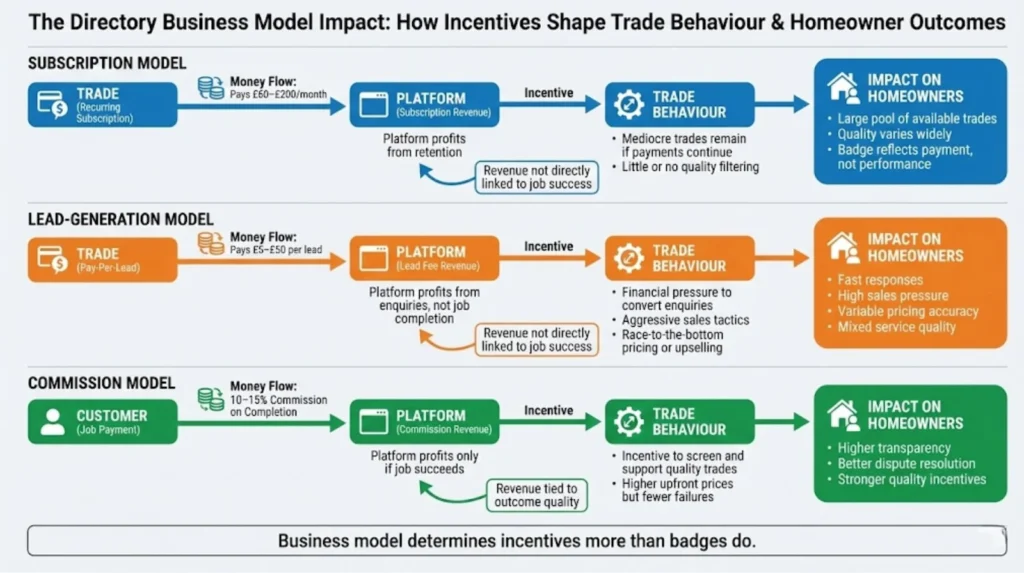
Understanding how directories make money explains why vetting gaps exist:
Subscription Model (Checkatrade, TrustATrader)
Trades pay £60-£200+ monthly for profile visibility
Revenue depends on member retention, not member quality
Economic incentive: Keep paying members subscribed, even if complaints exist
Removal requires serious, documented, repeated issues
Consequence for homeowners: Mediocre trades who pay consistently remain visible indefinitely. The platform profits from both excellent and adequate tradespeople equally.
Lead Generation Model (MyBuilder, Rated People)
Trades pay £5-£50 per lead just to receive your contact details
Trades “bid” on jobs, often competing on price
Revenue depends on lead volume, not lead quality
Economic incentive: Maximise enquiries, regardless of suitability
Consequence for homeowners: Trades under financial pressure to convert leads aggressively. High-pressure sales, unrealistically low quotes to win bids, corner-cutting to maintain margins after paying lead fees.
Commission Model (Local Heroes, backed by British Gas)
Trades pay percentage of job value (typically 10-15%)
Work is guaranteed by the platform for 12 months
Revenue tied to completed work value
Economic incentive: Higher job values, faster completions
Consequence for homeowners: Better protection (guarantees backed by British Gas), but costs often higher to cover commission structure. Trades incentivised to upsell services.
The Review Economy Problem
Most directories rely on customer reviews for quality signalling. This creates systemic issues:
Review Gating: Trades selectively ask only satisfied customers for reviews. Unhappy customers aren’t prompted, skewing ratings artificially high.
Review Moderation: Platforms remove reviews deemed “unfair” or “not constructive,” often siding with paying members over free users (customers).
Review Timing: Homeowners review immediately after job completion based on appearance and customer service. Technical failures (leaks, electrical faults, structural issues) appear months or years later but don’t update the review score.
Review Manipulation: Some trades offer discounts for five-star reviews, ask family members to post fake reviews, or hire reputation management services to suppress negatives.
The Competition and Markets Authority (CMA) has investigated online review practices multiple times, finding widespread problems with fake reviews and misleading endorsements across trade directories. Despite this, the practice continues because enforcement is limited and penalties are minimal.
The Reputation Reality: How Legitimate Trades Actually Get Work
Joshua Jarvis, Placement Manager at Elec Training, explains what separates sustainable tradespeople from directory-dependent ones:
"The trades with 20-30 year sustainable careers don't rely on directories. They're fully booked through word-of-mouth, repeat clients, and professional networks. By the time someone needs to pay for directory visibility, it often signals they haven't built natural client retention. The best plumbers, electricians, and carpenters we place with aren't searching for work on platforms. The work finds them through reputation."
Joshua Jarvis, Placement Manager
The Word-of-Mouth Economics
Legitimate trades with 10+ years experience typically operate at 80-100% capacity through referrals:
Repeat clients for maintenance and additional projects
Recommendations from satisfied customers to friends/family
Professional referrals from architects, surveyors, builders
Trade-to-trade referrals (plumbers recommending electricians they trust, etc.)
Local reputation built through consistently good work
Directory-dependent trades often work at 40-60% capacity, filling gaps with platform leads:
Limited repeat business (suggests quality or customer service issues)
Paying for visibility because natural referrals aren’t sufficient
Competing primarily on price rather than reputation
Higher customer acquisition costs affecting margins and potentially quality
The Price-Quality Signal
Understanding realistic costs for qualified electrical work and other trades helps identify red flags. Suspiciously low quotes often indicate:
Unqualified or under-qualified tradespeople
Cutting corners on materials, time, or compliance
Uninsured or inadequately insured work
Cash-only arrangements avoiding tax (and leaving no legal trail)
Qualified tradespeople charge rates that reflect:
Years of training and qualification costs (NVQ, assessment fees, ongoing CPD)
Professional insurance premiums (£500-£2,000+ annually depending on trade and coverage)
Quality materials meeting British Standards
Time for proper preparation, safe working, and thorough finishing
Business overheads (tools, vehicle, premises, administrative costs)
Electricians: £150-£250 daily rate (employed), £250-£400 (self-employed day rate), £35-£65 hourly for smaller jobs
Plumbers: £40-£80 per hour, £200-£400 daily rate
Carpenters: £150-£250 daily rate for site carpentry, £250-£400 for bespoke joinery
Bricklayers: £200-£350 daily rate depending on project complexity
Plasterers: £150-£250 daily rate for standard work
Roofers: £150-£300 daily rate, project pricing for complete roofs
Welders: £200-£400 daily rate for fabrication work
Quotes significantly below these ranges from “vetted” directory trades should trigger immediate skepticism.
Official Registers vs Commercial Directories: The Crucial Difference
For Safety-Critical Trades, Registers Are Non-Negotiable
Certain types of work are legally notifiable under Building Regulations, requiring competent person scheme registration:
Electrical Work (Part P):
NICEIC (niceic.com/find-a-contractor)
NAPIT (napit.org.uk/consumers)
ELECSA (elecsa.co.uk)
STROMA (stroma.com)
Gas Work (Gas Safety Regulations):
Gas Safe Register (gassaferegister.co.uk) – legally required, no alternatives
Window/Door Replacement (Part L – Energy Efficiency):
FENSA (fensa.org.uk)
CERTASS (certass.co.uk)
What Registration Actually Means:
These aren’t marketing platforms. They’re compliance verification schemes requiring:
Initial Technical Assessment: Qualified assessors review qualifications, test technical knowledge, inspect sample work
Ongoing Monitoring: Random site inspections, work sampling, customer feedback analysis
Annual Renewal: Reassessment of insurance, qualifications, CPD records, complaints history
Disciplinary Powers: Can suspend or remove registration for non-compliance, requiring retraining or additional assessment
Self-Certification Authority: Registered tradespeople can legally certify their own work complies with Building Regulations without separate Building Control inspection, issuing official certificates homeowners need for:
Selling property (solicitors require electrical/gas certificates)
Insurance claims (insurers require certified work)
Mortgage applications (lenders check regulatory compliance)
What Directories Verify:
Directories operate differently:
One-Time Vetting: Checked at joining, rarely updated unless renewal paid
No Technical Monitoring: Never inspect actual work quality or compliance
No Disciplinary Power: Can remove profiles but can’t affect legal right to trade
No Certification Authority: Directory membership provides zero legal documentation of compliance
The Critical Question:
Would you rather hire:
Option A: Someone with a Checkatrade badge (checked ID and insurance once when they joined, 50 five-star reviews)
Option B: Someone registered with NICEIC (technically assessed, annually monitored, can legally certify work complies with Building Regulations, provides official certificates)
Option B is objectively safer and legally necessary for notifiable work. Directories are supplementary at best, misleading at worst.
Practical Verification Steps: What Homeowners Should Actually Do
The Five-Stage Verification Process
Instead of relying on directory badges, follow this sequence:
Stage 1: Official Register Verification (Safety-Critical Trades)
For electrical, gas, or window/door work:
Search official registers FIRST before even looking at directories
Verify registration number directly with the scheme (don’t trust screenshots)
Check registration is current (some trades let it lapse but keep advertising as “NICEIC approved”)
For other trades:
Search CSCS card register at cscs.uk.com for construction competence
Check professional body membership (Federation of Master Builders, Institute of Plumbing, etc.)
Stage 2: Qualification Verification
Ask for copies of:
Specific qualification certificates (NVQ, City & Guilds, HNC, etc.)
Recent training certificates (18th Edition for electricians updated within 5 years, G3 for plumbers, etc.)
Manufacturer certifications for specialist products (Vaillant boiler training, Velux window installer, etc.)
Red Flag: Reluctance to provide documentation. Legitimate trades are proud of qualifications and expect professional clients to verify them.
Stage 3: Insurance Verification
Request:
Public Liability Insurance certificate (minimum £2 million, ideally £5-10 million for structural work)
Employer’s Liability certificate if they have staff
Professional Indemnity insurance for design work
Verify directly:
Note the insurance company and policy number
Contact the insurer to confirm policy is active and covers the specific work you’re hiring for
Check expiry dates (policies can lapse days after showing you the certificate)
Red Flag: Certificates with recent issue dates just before your enquiry (suggests they obtain insurance only when securing work, possibly lapsing between jobs).
Stage 4: Business Verification
Confirm:
Registered business address (physical premises, not PO Box or virtual office)
Companies House registration at companieshouse.gov.uk (check for outstanding debts, director history, company age)
VAT registration if they’re VAT registered (can verify at gov.uk/check-uk-vat-number)
Landline phone number (mobile-only is red flag for businesses trading 5+ years)
Green Flag: Businesses trading 10+ years from same address with clean Companies House records suggest stability and reliability.
Stage 5: Reference Verification
Request:
Three references for similar-scale projects completed within last 2 years
Full contact details (not just first names and mobile numbers)
Actually contact references:
Ask specific questions about quality, timekeeping, problem-solving, site cleanliness
Ask if work was completed to agreed specification and budget
Ask if they’d hire them again (ultimate test)
Red Flag: References who are vague, overly enthusiastic without specific details, or difficult to contact suggest fake references.
When Directories Are Useful vs When They're Dangerous
Legitimate Use Cases for Directories
Directories serve specific purposes effectively:
Emergency/Urgent Work:
Finding available trades quickly for urgent repairs
Getting multiple responses rapidly for time-sensitive issues
Comparing availability when speed matters
Non-Critical Cosmetic Work:
Painting and decorating (low safety risk)
Garden maintenance
Furniture assembly
General handyman tasks without safety implications
Initial Lead Generation:
Creating shortlist of potential trades to then verify independently
Discovering local businesses you weren’t aware of
Reading customer feedback as ONE data point among many
For Elec Training learners seeking proper qualification pathways, the contrast between directory marketing and actual training requirements is stark. Legitimate electrical careers require NVQ Level 3, 18th Edition, AM2 assessment, and competent person scheme registration – none of which directories verify despite claiming trades are “fully qualified.”
Dangerous Reliance on Directories
Never use directories as sole verification for:
Safety-Critical Work:
Electrical installations or repairs
Gas work of any kind
Structural alterations
Roofing work (height safety risk)
Anything involving Building Regulations compliance
High-Value Projects:
Full house rewiring
Bathroom/kitchen installations
Extensions or conversions
Complete heating system replacements
Legally Notifiable Work:
Electrical work under Part P
Gas work under Gas Safety Regulations
Window/door replacement affecting energy efficiency
Structural work requiring Building Control
For these categories, directory membership should be supplementary verification after confirming registration with official schemes, not primary verification.
Red Flags and Green Flags: Quick Recognition Guide
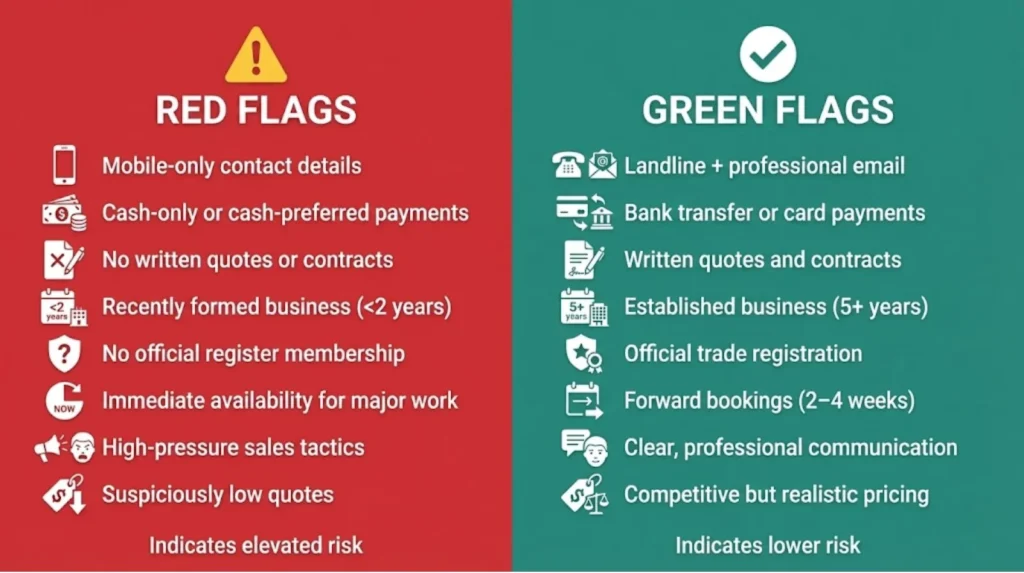
Red Flags (Avoid These Trades)
Profile and Credentials:
No registered business address or uses residential address as business premises
Mobile phone only, no landline or business email
Recent business registration (less than 2 years) with major project claims
Reluctance to provide qualification certificates
Can’t provide evidence of official register membership for safety-critical work
Insurance certificates dated just before your enquiry
No professional body memberships relevant to their trade
Communication and Behaviour:
Immediate availability with no forward bookings (suggests lack of regular work)
Pressure to make immediate decisions or “limited time” offers
Requests large upfront deposits (over 25% of project value)
Cash-only payment demands
Reluctance to provide written quotes with specifications
Vague answers about regulations, materials, or timescales
Reviews and References:
Only five-star reviews with no negatives or criticisms
Generic reviews without specific project details
All reviews from same time period (suggests review campaign)
Reluctance to provide verifiable references
References provided are only first names or uncontactable
Pricing and Contracts:
Quote significantly below others (20%+ cheaper than competitors)
Verbal quotes only, no written breakdown
Refusal to provide written contract or terms
Unclear payment structure or milestones
No mention of warranties, guarantees, or complaint procedures
Green Flags (Positive Indicators)
Credentials and Registration:
Registered with official schemes relevant to their trade (NICEIC, Gas Safe, FENSA, etc.)
Verifiable qualification certificates provided willingly
Current insurance with adequate coverage levels for project type
Professional body membership (FMB, Institute of Plumbing, SELECT, etc.)
Business trading 5+ years from same address
Communication and Professionalism:
Forward bookings of 2-4 weeks minimum (suggests regular work)
Written quote with detailed specification breakdown
Clear payment structure tied to project milestones
Willing to discuss regulations, materials, and Building Control requirements
Provides written contract with terms and conditions
References and Reputation:
Mix of positive reviews with occasional constructive criticisms (realistic)
Reviews spanning several years with specific project details
Provides verifiable references with full contact details
Word-of-mouth recommendations from trusted sources
Happy to arrange site visits to see previous work
Project Approach:
Site visit before quoting (won’t quote over phone without seeing job)
Asks questions about property specifics affecting work
Explains process, timescales, and potential complications
Discusses warranties and guarantees clearly
Provides clear complaints procedure and dispute resolution process
The Consumer Protection Framework: Your Legal Rights
What Protection Actually Exists
Despite directory claims, your main protections come from legislation, not platform policies:
Consumer Rights Act 2015:
Work must be carried out with “reasonable care and skill”
Work must be completed within a “reasonable time”
Charges must be “reasonable”
Services must match verbal or written descriptions
Consumer Protection from Unfair Trading Regulations 2008:
Traders must not mislead you about their qualifications, affiliations, or approval status
Directories must not falsely claim trades are “approved” or “endorsed” by authorities
Building Regulations:
Certain work legally requires Building Control notification
Competent person scheme registration allows self-certification
Non-compliant work can require expensive remediation
Local authority Building Control can enforce compliance
What to Do When Work Goes Wrong
If a “vetted” directory trade does substandard or non-compliant work:
Step 1: Document Everything
Photos of defects or non-compliance
Copy of original quote and specifications
Written communications about problems
Independent assessment from qualified tradesperson if possible
Step 2: Complaint to Trader
Written complaint detailing issues (email creates paper trail)
Reasonable deadline for rectification (14-28 days typical)
Statement of your legal rights under Consumer Rights Act 2015
Step 3: Directory Complaint
Report to directory platform with full documentation
Request their dispute resolution process
Note that directories typically have limited power to force remedies
Step 4: Official Channels
Trading Standards via Citizens Advice Consumer Service
Professional body complaints (if trade is member)
Ombudsman schemes if directory participates (rare)
Step 5: Legal Action
Small Claims Court for values up to £10,000
County Court for higher values
Consider legal costs vs recovery potential
The Reality: Most directory “guarantees” are limited, capped, and subject to extensive conditions. You’re primarily relying on Consumer Rights Act 2015 and the trader’s own insurance, not directory protection.
Directories Are Tools, Not Guarantees
What Directories Do Well
Trade directories serve legitimate purposes:
Visibility: Making local trades discoverable to homeowners
Initial Vetting: Filtering out completely uninsured or fake businesses
Review Aggregation: Collecting customer feedback in one place
Emergency Response: Providing quick access to available trades
What Directories Can’t Do
Directories fundamentally cannot:
Verify Technical Competence: They don’t assess actual work quality or regulatory knowledge
Monitor Ongoing Compliance: They don’t inspect work or track complaints systematically
Guarantee Outcomes: Their terms explicitly limit liability for trade failures
Replace Official Registers: They have no authority over Building Regulations compliance
The Homeowner’s Responsibility
The uncomfortable truth is that hiring tradespeople safely requires homeowner due diligence:
Verify official register membership for safety-critical work
Check qualifications independently
Confirm insurance is current and adequate
Obtain written quotes and contracts
Use payment structures that protect you (staged payments, retention amounts)
Get Building Control certificates for notifiable work
Directory membership should be ONE data point in your decision, never the sole verification.
The Trust Equation
Low-Risk Approach:
Official register verification (NICEIC, Gas Safe, FENSA, etc.)
Independent qualification and insurance checks
Personal recommendations from trusted sources
Written quotes and contracts
Directory reviews as supplementary information
High-Risk Approach:
Directory badge alone
High star rating without verification
Verbal agreements
Cash payments
No official documentation
The £4 billion lost annually to rogue traders and substandard work predominantly comes from the high-risk approach. The directory badge feels like protection. It isn’t.
When Directories Work Best
Use directories effectively by:
Starting with official registers for safety-critical trades
Using directories to discover local trades, then verifying independently
Reading reviews critically (look for specific details, not generic praise)
Treating directory membership as business legitimacy verification, not technical competence
Combining directory information with personal recommendations
Never bypassing independent checks based on directory badges alone
Elec Training’s approach to electrical training demonstrates what genuine competence verification looks like: NVQ assessment, technical testing, work placement with established contractors, ongoing monitoring, and competent person scheme registration. That’s worlds apart from a directory profile with customer reviews about punctuality and politeness.
You’re standing in your kitchen with that £8,000 rewiring quote again. The electrician has a Checkatrade badge and 147 five-star reviews.
Now you know what questions to ask:
“What’s your NICEIC registration number?” (Verify at electricalcompetentperson.co.uk)
“Can I see your 18th Edition certificate?” (Must be dated within 5 years)
“What Building Control certificates will I receive?” (You need Part P compliance certification)
“Can you provide current insurance details?” (Minimum £5 million public liability for electrical work)
“What’s your NVQ Level 3 qualification number?” (City & Guilds 2357 is standard for qualified electricians)
The directory badge told you they exist and have some form of insurance. Those five questions tell you if they’re legally qualified to rewire your house.
The difference between those two levels of verification is the difference between:
Scenario A: Compliant, certified electrical installation that you can sell your house with and insurance will cover if something goes wrong.
Scenario B: Non-compliant installation you discover when selling 5 years later, requiring complete rewire at your expense to satisfy solicitors, losing you the sale and costing £12,000+ to remedy.
The directory badge costs the electrician £120/month. The verification process costs you 20 minutes and possibly discovers they’re not actually qualified.
Those 20 minutes are worth £12,000.
Directories are marketing platforms. Official registers are compliance verification. Reviews are customer satisfaction data. Qualifications are technical competence proof. Insurance is financial protection. Building Control certificates are legal documentation.
Only one of those things comes from a directory badge.
Use directories as a starting point. Verify everything else independently. Your home, your safety, and your financial security depend on understanding the difference between “vetted by Checkatrade” and “registered with NICEIC.”
The trades who’ve built 20-year careers on reputation don’t need directory badges. The ones who do need them should trigger additional verification, not less.
References
Tier 1 (Official Legislation, Standards, and Government Data)
- Competition and Markets Authority (CMA) guidance on online reviews and endorsements: https://www.gov.uk/government/organisations/competition-and-markets-authority
- Advertising Standards Authority (ASA) rulings on trade directory claims: https://www.asa.org.uk/rulings.html
- Electrical Competent Person Scheme search tool: https://www.electricalcompetentperson.co.uk/
- FENSA (Fenestration Self-Assessment Scheme): https://www.fensa.org.uk/
- Building Regulations Approved Documents (Parts C, L, P): https://www.gov.uk/government/collections/approved-documents
Tier 2 (Industry Reports, Professional Bodies, Standards)
- TrustMark government-endorsed quality scheme: https://www.trustmark.org.uk/
- NICEIC registered contractor search: https://www.niceic.com/find-a-contractor
- Federation of Master Builders (FMB) guidance: https://www.fmb.org.uk/
- Institute of Plumbing and Heating Engineering: https://www.iphe.org.uk/
- Construction Skills Certification Scheme (CSCS): https://www.cscs.uk.com/
Tier 3 (Forum Patterns, Practitioner Sentiment, Market Signals)
- Reddit r/DIYUK discussions on trade directory reliability: https://www.reddit.com/r/DIYUK/
- Reddit r/HousingUK experiences with directory-listed trades: https://www.reddit.com/r/HousingUK/
- ElectriciansForums.co.uk practitioner perspectives: https://www.electriciansforum.co.uk/
- HomeOwnersAlliance forum discussions: https://hoa.org.uk/
Note on Accuracy and Updates
Last reviewed: 13 January 2026. This guide reflects current Consumer Rights Act 2015 protections, Competition and Markets Authority guidance on online reviews (updated 2024), Building Regulations requirements for notifiable work (Parts C, L, P), and typical directory vetting practices as of January 2026. Directory platforms may update their vetting processes; homeowners should verify current practices directly with platforms. Official register requirements (NICEIC, Gas Safe, FENSA) are statutory and subject to change through Building Regulations amendments. Professional body membership requirements vary by organisation and trade. Insurance coverage levels recommended represent industry minimums; specific projects may require higher coverage. Quote price ranges reflect typical UK rates January 2026; regional variations exist. The £4 billion annual figure for rogue trader/substandard work losses comes from industry surveys and Trading Standards estimates; comprehensive official statistics are not centrally tracked. The 87% homeowner fear statistic comes from consumer research surveys 2023-2025; exact methodology varies by source. Directory business models and pricing accurate January 2026 but subject to commercial changes.
FAQs
What do trade directories actually check when they label a tradesperson as “vetted”, “approved”, or “trusted”?
Commercial trade directories like Checkatrade and TrustATrader typically perform background checks including identity verification, proof of public liability insurance, customer references, and sometimes basic qualifications or criminal records. However, these checks vary by platform and focus more on business legitimacy than in-depth technical competence. According to ASA expectations, such labels must be substantiated with evidence, but they do not equate to official certification. Homeowners should note that “vetted” claims under ASA rules require directories to hold proof, yet this may not cover all legal requirements for specific trades. Always cross-verify with official registers for safety-critical work.
How reliable are directory badges and star ratings as proof of technical competence?
Directory badges indicate a tradesperson has met the platform’s entry criteria, such as insurance and references, but they rarely guarantee technical competence, as checks are not as rigorous as official schemes. Star ratings rely on customer feedback, which aligns with CMA guidance requiring genuine, unbiased reviews, but customers often lack expertise to assess technical quality. Per CMA principles, platforms must prevent fake reviews and ensure transparency, yet ratings can be skewed by selective feedback or incentives. They are useful for gauging customer service but unreliable for proving skills like electrical safety—always check qualifications separately to avoid pitfalls like undetected non-compliance.
What’s the difference between a commercial trade directory and an official register (like NICEIC or Gas Safe)?
Commercial directories, such as MyBuilder or Rated People, are private platforms for listing tradespeople, focusing on marketing, reviews, and basic vetting like insurance and references. They help homeowners find local options but do not mandate or verify trade-specific competence. Official registers, like Gas Safe for gas engineers (mandatory under UK law) or NICEIC/NAPIT/ELECSA for electricians, are government-backed or industry-regulated schemes ensuring legal qualifications, ongoing training, and compliance with safety standards. TrustMark encompasses multiple schemes for broader home improvements, while CSCS cards verify construction site competence. Use official registers for assurance on regulated work to meet Consumer Rights Act 2015 standards.
Can a tradesperson appear on a directory without having the legally required qualifications or registrations?
Yes, tradespeople can list on commercial directories without legally required qualifications, as platforms like Checkatrade or TrustATrader primarily check business basics like ID, insurance, and references, not trade-specific certifications. For instance, a gas fitter might appear without Gas Safe registration, which is mandatory for gas work under UK regulations. Directories may encourage but not enforce official memberships, leading to potential non-compliance. ASA rules require “vetted” claims to be accurate, but homeowners risk substandard service if relying solely on directories—always verify via official schemes like NICEIC for electrics or FENSA for windows to ensure adherence to safety laws.
Why do customer reviews often fail to reveal poor workmanship or unsafe work until months later?
: Customer reviews are typically posted soon after job completion, when issues like poor workmanship—such as faulty installations or subpar materials—may not yet be evident. Problems like leaks, electrical faults, or structural weaknesses often emerge over time due to wear or environmental factors. Per CMA guidance, reviews must be genuine and platforms should allow updates, but initial feedback focuses on immediate aspects like politeness or timeliness, not long-term quality. Homeowners, lacking technical expertise, may not spot non-compliance at handover. This aligns with Consumer Rights Act 2015, where services must show reasonable care and skill, but defects discovered later still entitle remedies.
How do trade directory business models (subscriptions, pay-per-lead, commission) affect the quality of tradespeople listed?
Subscription models, like Checkatrade’s fixed fees, allow any tradesperson meeting basic vetting to list, potentially including those with varying quality levels, as inclusion depends on payment rather than performance. Pay-per-lead systems (e.g., MyBuilder or Rated People) charge for job inquiries, incentivizing directories to attract more listings for revenue, which may dilute quality control. Commission-based platforms take a cut from jobs, encouraging volume over rigorous screening. While CMA requires transparent practices and genuine reviews, these models can prioritise business growth over strict competence checks, leading to uneven quality. Homeowners benefit from diverse options but should verify independently to mitigate risks.
What verification steps should homeowners take before hiring an electrician, plumber, or other safety-critical trade?
For safety-critical trades, go beyond directories:
- Check official registers: Use Gas Safe for gas engineers, NICEIC/NAPIT/ELECSA for electricians, WaterSafe for plumbers, or FENSA/CERTASS for windows/doors.
- Request proof: Ask for qualifications, ID cards, public liability insurance, and recent references.
- Verify compliance: Confirm CSCS cards for construction or TrustMark endorsement for broader assurance.
- Get quotes in writing: Ensure details match Consumer Rights Act 2015 standards for reasonable care, price, and time.
- Research reviews: Cross-check across platforms, noting CMA guidance on genuine feedback.
These steps help ensure legal competence and reduce risks of substandard work.
What are the most common red flags that suggest a directory-listed tradesperson may not be trustworthy?
A: Even on directories, watch for:
- No verifiable references or portfolio: Reluctance to provide past work examples or contacts.
- Demands for upfront/full payment: Especially cash-only, without a contract.
- Unusually low quotes or immediate availability: May indicate poor quality or desperation.
- Lack of official registrations: No evidence of Gas Safe, NICEIC, or similar for regulated trades.
- Pushy tactics or vague details: Evasive about qualifications, insurance, or timelines.
These align with Citizens Advice warnings on rogue traders; always verify independently to avoid breaches of Consumer Rights Act 2015, like services not as described.
What legal protections do homeowners have in the UK if work is substandard, misleadingly sold, or non-compliant?
Under the Consumer Rights Act 2015, services must be performed with reasonable care and skill, at a reasonable price and time, and as described. If substandard (e.g., poor workmanship), homeowners can demand repair, price reduction, or repeat performance at no extra cost. For misleading sales, like false “vetted” claims, remedies include refunds or compensation. Non-compliant work, such as unsafe gas installations, violates regulations and entitles claims. Contact the trader in writing first; if unresolved, use alternative dispute resolution or small claims court. CMA and ASA enforce transparency in reviews and ads, bolstering protections.
When are trade directories useful, and when is relying on them risky for homeowners?
Trade directories like Checkatrade or MyBuilder are useful for discovering local tradespeople, comparing quotes, and reading initial reviews to shortlist options, especially for non-regulated work like painting. They provide convenience and customer insights, aligning with CMA guidance on genuine feedback. However, relying solely on them is risky for safety-critical trades (e.g., electrical or gas), as they may not verify legal qualifications, leading to non-compliance or poor quality under Consumer Rights Act 2015. Risks include fake reviews or inadequate vetting per ASA standards—always cross-check official registers like Gas Safe or NICEIC for robust protection.
