
Can You Become an Electrician on a Budget? Realistic Low-Cost Options in the UK

- Technical review: Thomas Jevons (Head of Training, 20+ years)
- Employability review: Joshua Jarvis (Placement Manager)
- Editorial review: Jessica Gilbert (Marketing Editorial Team)
- Last reviewed:
- Changes: Updated 2025-2026 wage data, JIB rates, and funding eligibility criteria
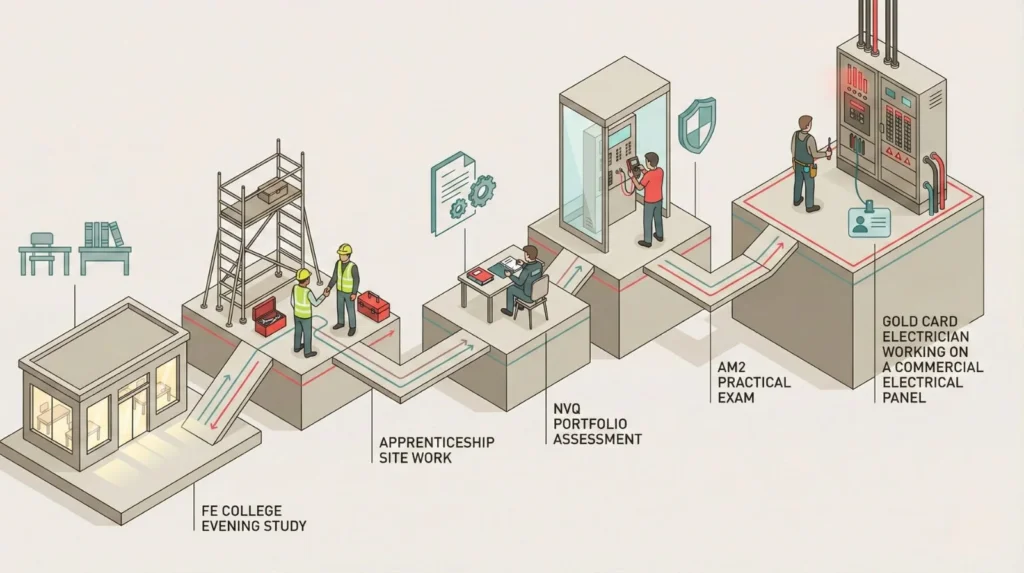
The electrician shortage keeps pushing wages higher. Gold Card holders are invoicing £200-£300 daily. PAYE positions advertise £32,000-£45,000 starting salaries. Naturally, people want in, but the first question is always about cost.
Can you actually become a qualified electrician on a budget? The answer is yes, but the route that looks cheapest upfront often costs you tens of thousands in lost earnings over 2-3 years. When you compare complete UK electrical qualification pathways properly, the maths gets interesting. A £300 monthly payment over 12 months might deliver qualification 18 months faster than a “free” evening course, and that 18-month head start translates to £20,000-£30,000 in additional earnings by year three.
This article breaks down what routes actually cost when you account for wages, timelines, and real employment outcomes. We’ll look at apprenticeships, FE college diplomas, fast-track programmes, and experienced worker routes, then compare total economic impact rather than just sticker prices.
What “Becoming an Electrician” Actually Means (The Formal Standard)
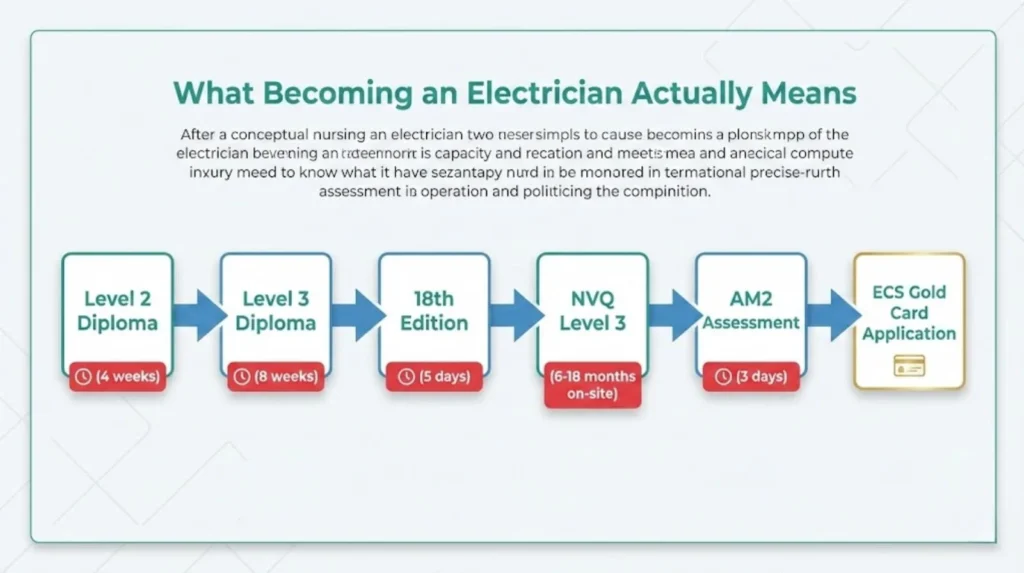
First, let’s clarify what counts as qualified. In the UK electrical industry, you’re not an electrician until you hold an ECS Gold Card. That requires four components working together:
NVQ Level 3 Diploma in Installing Electrotechnical Systems and Equipment (City & Guilds 2357, EAL equivalent, or 5357 Electrical Maintenance). This is performance-based evidence collected on real sites under assessor supervision. It proves competence, not just knowledge.
AM2/AM2S/AM2E Assessment. The end-point practical test where you install, test, and certify circuits under timed conditions. This costs £860-£935 through NET and serves as the final unit for NVQ Level 3 qualification.
18th Edition BS 7671:2018+A2:2022. The UK wiring regulations exam. Essential for legal compliance and updated every few years as amendments release.
ECS Gold Card (Installation Electrician or Maintenance Electrician). Issued by the Electrotechnical Certification Scheme, part of the JIB framework. This card verifies your competence and grants site access. Without it, you’re legally an electrical trainee or improver, not an electrician.
Level 2 or Level 3 diplomas (2365 courses) alone don’t qualify you. They cover theory and workshop practice but lack the on-site evidence and end-point assessment required by employers and scheme providers like NICEIC, NAPIT, and ECA. Diploma holders work as “mates” or “improvers” on reduced wages until they complete NVQ and AM2 requirements.
What "On a Budget" Really Means (Based on Real UK Costs)
Budget means different things depending on your cash flow situation. Let’s define two realistic thresholds based on what low-income learners actually face:
Severe budget: Under £1,000 available upfront. This covers initial enrollment, basic tools and PPE, or travel costs without needing loans or depleting savings entirely.
Moderate budget: Under £3,000 total out-of-pocket over the training journey. This includes all direct payments for courses, assessments, tools, and transport, but excludes loans that you’ll repay from future earnings or items your employer reimburses.
The confusion happens when people conflate different cost categories. Out-of-pocket costs are what you actually pay: course fees (£0-£8,500 for FE diplomas depending on funding), tools and PPE (£350-£600 starter kit), travel (£200-£500 annually), ECS card (£50-£100), AM2 assessment (£860-£935), and NVQ portfolio assessment if paying privately (£1,500-£1,800).
Opportunity costs are the wages you don’t earn. An apprentice on £7.55 per hour (Year 1 minimum wage) compared to unskilled work at £12.21 per hour (National Living Wage) represents £9,000+ annually in foregone income. A 30-year-old studying Level 2 and 3 diplomas part-time for two years whilst staying in a £24,000 warehouse job is choosing stability over the £32,000-£40,000 they could be earning as a qualified electrician during Year 2 and beyond.
When we talk about budget routes, we need to compare both. The route with zero fees might cost you £40,000 in lost earnings over three years. The route with £8,000 fees and 0% interest repayments might deliver qualification fast enough that you recover that investment in Year 2 alone.
The Apprenticeship Route (£0 Fees, But 3-4 Years at Lower Wages)
Apprenticeships remain the gold standard for younger learners. Training fees are covered 100% by government levy funding for 16-18 year olds, and 95%+ for adults. You earn whilst you learn, build genuine on-site experience, and graduate with NVQ Level 3, AM2, 18th Edition, and immediate employability.
Your direct costs are minimal: tools and PPE (£350-£600), travel to college and work (£200-£500 annually), and your ECS card application (£50-£100). Total out-of-pocket over 3-4 years: approximately £800-£1,500. That’s genuinely budget-friendly from a cash flow perspective.
The opportunity cost is substantial though. JIB apprentice rates for 2025 start at £8.16 per hour (Stage 1) and progress to £14.03 per hour (Stage 4). Many employers pay above JIB minimums to attract adults, often £10-£12 per hour, but you’re still earning £15,000-£22,000 annually compared to £22,000-£28,000 in unskilled work or £32,000-£45,000 as a qualified electrician.
For a 19-year-old school leaver, this trade-off makes complete sense. You’re building a career from scratch, and the 3-4 year timeline doesn’t cost you qualified electrician wages because you wouldn’t have them yet anyway. For a 30-year-old leaving a £28,000 role, the economic calculation changes. Four years earning £18,000-£22,000 means £40,000-£60,000 in lost income compared to qualifying faster and accessing higher wages sooner.
Apprenticeships also depend on availability. Larger contractors and house builders run structured programmes, but availability is limited and competitive. Smaller firms may not have the administrative capacity to manage apprenticeship frameworks. If you’re in a rural area or a region with fewer electrical employers, securing an apprenticeship placement becomes the main barrier, not the cost.
FE College Diplomas + Self-Sourced NVQ (The Adult "Budget Hack")
This is the route most budget-conscious adults pursue: study Level 2 and Level 3 diplomas part-time at a local FE college whilst keeping your current job, then transition to electrical employment to complete your NVQ portfolio.
The cost breakdown:
Level 2 and Level 3 diplomas at FE colleges typically cost £2,000-£3,000 combined if you’re paying standard fees. However, government funding schemes often reduce this to zero for eligible learners.
Free Courses for Jobs (England) covers Level 3 electrical qualifications fully if you’re 19+, earning under £27,000, or unemployed. Personal Learning Accounts (Wales) fund courses for those earning under £34,303. SAAS (Scotland) waives fees for low-income and benefit claimants. Skills for Growth (Northern Ireland) prioritizes green skills and electrical training.
If you don’t qualify for free provision, Advanced Learner Loans cover tuition fees for Level 3 courses with no upfront payment and no credit checks. You only repay at 9% of earnings above £27,000, making them safe debt compared to credit cards or commercial finance.
After completing Level 2 and 3, you find work as an electrical mate or improver earning £13-£15 per hour (£27,000-£31,000 annually). Your employer may or may not support your NVQ portfolio. If they do, excellent. If not, you pay privately for NVQ assessment (£1,500-£1,800) and AM2 (£860-£935).
Total out-of-pocket if you secure full funding: £2,400-£2,700 for NVQ and AM2 plus tools. That’s genuinely achievable on a tight budget. The timeline though is 2-4 years from starting Level 2 to achieving Gold Card status, depending on how quickly you secure electrical employment and complete your NVQ portfolio evidence.
Thomas Jevons, Head of Training:
"The biggest hidden cost of budget routes is the NVQ placement gap. You finish your Level 2 and 3 diplomas, then spend 6-12 months searching for electrical employment willing to support your portfolio. During that searching period, you're still earning labourer wages whilst your course fees might have been zero, but your career progression has stalled. Programmes with integrated placement support eliminate that gap entirely."
Thomas Jevons, Head of Training
Fast-Track Programmes With Integrated Placement Support (Why Speed Matters)
Here’s where the economic calculation flips. Fast-track electrical training programmes typically cost £8,000-£12,000 for comprehensive packages including Level 2, Level 3, 18th Edition, NVQ assessment support, and AM2 preparation. That sounds expensive compared to “free” FE college options. Until you factor in earning timelines.
Elec Training’s approach: £10,500 total package cost covering NVQ Level 3 (2365-02 and 2365-03), 18th Edition, AM2 fee, PPE, and crucially, guaranteed placement support through an in-house recruitment team actively calling 120+ partner contractors. The programme offers 0% interest financing spread over 12 months, meaning some students pay as little as £300 monthly whilst training.
The timeline difference is substantial. Instead of 2-4 years studying part-time and then searching for NVQ-supporting employment, structured programmes deliver qualification in 18-24 months including on-site portfolio completion. Students can start working as electrical improvers after Level 2 plus 18th Edition (approximately 5-6 weeks into training) at £14-£16 per hour. After completing Level 3 (2365-03), wages increase to £16-£18 per hour. Regional differences apply: London and South East see £18-£22 at this stage, whilst Midlands and Northern regions typically offer £14-18.
Joshua Jarvis, Placement Manager:
"One advantage students often overlook with structured programmes is the ability to start working as electrical improvers after Level 2 plus 18th Edition, whilst still completing Level 3. You're earning £14-16 per hour in e lectrical roles, not £10-12 in general labour, and building your NVQ portfolio simultaneously. 'Free' part-time routes often mean staying in your existing job at existing wages for 2-3 years whilst studying evenings."
Joshua Jarvis, Placement Manager
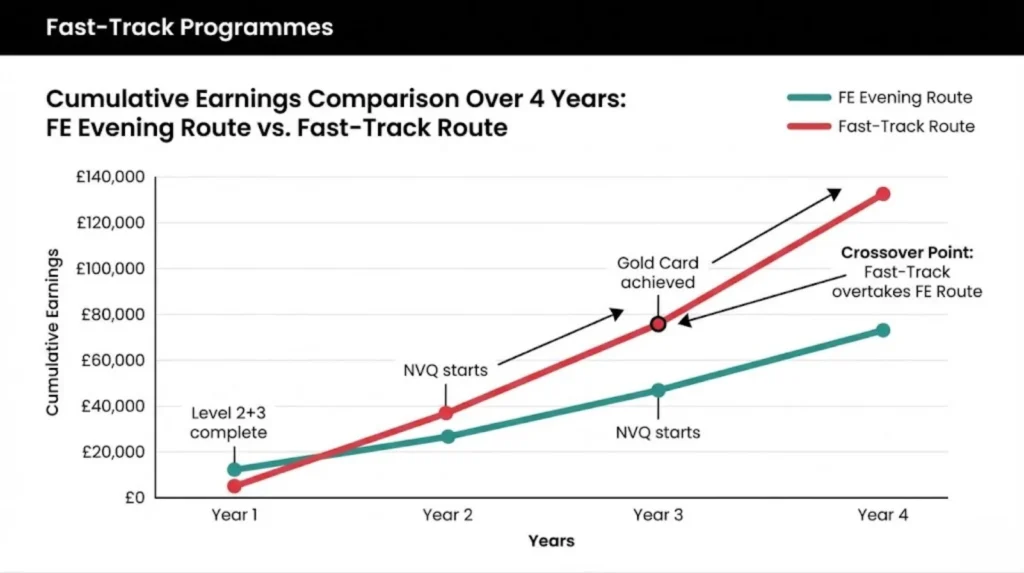
Person A enrolls in free FE evening classes. Keeps warehouse job for 18 months whilst completing Level 2 and 3. Spends 6 months searching for electrical employment. Secures improver role at £14/hour (£29,000) and works 12 months completing NVQ. Total time to Gold Card: 3 years. Total earnings during those 3 years: £24,000 + £24,000 + £29,000 = £77,000. Out-of-pocket cost: £2,500.
Person B enrolls in fast-track programme with 0% finance at £875/month. Starts working as improver at £14/hour after 6 weeks (whilst paying down financing from improved wages). Completes Level 3 after 4 months, wages increase to £16/hour (£33,000). Achieves Gold Card at 18 months, secures qualified role at £35,000. Total earnings during first 3 years: approximately £25,000 (Year 1 mixing warehouse/improver) + £33,000 (Year 2) + £35,000 (Year 3) = £93,000. Out-of-pocket cost: £10,500 (but paid from increased earnings).
Person B paid £8,000 more upfront but earned £16,000 more over the same period. By Year 4, when Person A is finally earning £35,000-£40,000 as a qualified electrician, Person B has 2.5 years of qualified experience and is positioned for £40,000-£45,000 roles or self-employment at £220-£300 daily rates.
The “free” route cost Person A approximately £16,000 in lost earnings compared to the fast-track route, despite zero course fees. This is why total economic cost matters more than sticker price when you’re comparing full range of electrician training options.
The Experienced Worker Assessment (Cheapest Upgrade for Those Already Working)
If you’ve been working as an electrical mate or improver for 3-5+ years without formal qualifications, the Experienced Worker Assessment (EWA) route offers the fastest and cheapest path to Gold Card status.
The EWA process (City & Guilds 2346/2347) costs £1,750-£2,200 including portfolio registration and AM2E assessment. If you need gap training for 18th Edition or Inspection & Testing, add £400-£800. Total investment: approximately £2,000-£3,000.
This only works if you already have site access and an employer willing to verify your experience. You can’t use EWA as a career change route or if you’re starting from scratch. It’s designed specifically for people who’ve been doing the work but lack the paperwork. Timeline is 6-18 months depending on how quickly you compile evidence and book your AM2E.
For improvers stuck earning £13-£15/hour despite years of experience, this represents the highest ROI of any route. £2,200 investment converts you from £28,000 annually to £35,000-£45,000 within 12 months. Payback period is approximately 4-6 months of qualified wages.
Funding Options That Genuinely Reduce Cash-Flow Pressure
Beyond the free course schemes mentioned earlier, several funding mechanisms reduce the cash you need available upfront:
College hardship funds provide £100-£500 grants for travel, tools, or emergency expenses. These are means-tested and available through FE college student support services.
JIB Skills Development Fund offers bursaries for apprentices facing financial barriers. Contact via JIB for eligibility.
City & Guilds Foundation awards grants up to £6,000 for vocational learners from disadvantaged backgrounds. Competitive but worth applying if eligible.
Employer tool schemes are common. Many contractors supply PPE and basic tools during apprenticeships or improver positions, allowing you to defer personal equipment costs until you’re earning electrical wages.
0% interest payment plans (like Elec Training’s 12-month option) spread costs over time without adding interest charges. At £300-£400 monthly, this is comparable to many people’s existing car finance or subscription costs, but with substantially higher ROI since it directly increases earning capacity by £10,000-£15,000 annually once qualified.
Advanced Learner Loans require no credit checks, no minimum income, and only trigger repayment above £27,000 earnings at 9%. If you qualify slowly and earn below the threshold for years, you’re essentially studying for free. If you qualify quickly and exceed £27,000, the 9% deduction is minimal compared to your wage increase.
Minimum Tools, PPE & Equipment (What You Actually Need To Start)
Don’t buy a van or £1,000 test kit before you have a job. Most employers provide these for apprentices and improvers.
Employed improver/apprentice starter kit:
VDE screwdrivers and pliers (CK, Knipex, or Wera): £60-£100
Side cutters (quality matters for safety): £25-£40
Basic voltage indicator (NOT a full multimeter yet): £40-£60
Work trousers and steel-toe boots: £60-£100
High-visibility vest and basic PPE: £30-£50
Total: £200-£250. This gets you hired and working safely under supervision.
Self-employed minimum (only needed if doing private work):
Public liability insurance: £65-£100 annually (legally mandatory)
Multifunction Tester (MFT): £400-£600 used (Megger 1553/1720 from eBay), £900+ new. Requires annual calibration (£45-£100)
Additional hand tools: £200-£300
Work vehicle: Used Euro 6-compliant van £4,000-£6,000 minimum
The self-employed route requires £5,000-£7,000 minimum when you include insurance, calibrated test equipment, vehicle, and compliance costs (CPS registration, ECS card). Marketing claims suggesting £2,000 total are ignoring legal and insurance requirements. You cannot legally certify work without calibrated test equipment and public liability insurance, regardless of your qualifications.
Budget Strategies by Age and Circumstance
Your optimal route depends on your starting position and financial constraints:
16-18 School Leavers
Best route: Direct apprenticeship. Zero course fees, earn £15,000-£22,000 whilst training over 3-4 years, graduate with Gold Card and no debt. Competition exists but 2025-2026 shortage conditions favor applicants. Apply early via UCAS, direct to contractors, or through training providers like JTL.
Costs: Tools/PPE (£350-£600), travel (£200-£500/year). Use college hardship funds and JIB bursaries.
19-24 Young Adults
Best route: Apprenticeship remains ideal if available. Alternative: AEB-funded Level 2 at FE college (£0-£500 cost) whilst working part-time, then transition to improver role for Level 3 and NVQ. Employers increasingly pay above minimum apprentice rates for over-21s (often £10-£12/hour) to remain competitive with other employment.
25+ Career Changers
Best route if budget-constrained: AEB/ALL-funded evening classes at FE college whilst maintaining current employment. Stay in your £24,000-£30,000 job until Level 2 and 3 complete, then transition to improver role at £28,000-£33,000 to complete NVQ. Timeline: 2-3 years. Out-of-pocket: £2,000-£3,000.
Best route if career acceleration is priority: Fast-track programme with integrated placement support and 0% financing. Pay £300-£875 monthly whilst training, start electrical employment within 6-12 weeks at £14-£16/hour, complete qualification in 18-24 months. Higher upfront cost but £15,000-£25,000 higher cumulative earnings by Year 3 compared to part-time evening route.
Already Working as Electrical Mate/Improver
Best route: EWA (Experienced Worker Assessment). Don’t restart education. Leverage your existing site access and employer relationship. Cost: £2,000-£3,000. Timeline: 6-18 months. This converts your underpaid experience directly into Gold Card status and qualified wages.
Myth-Busting Common Budget Route Misconceptions
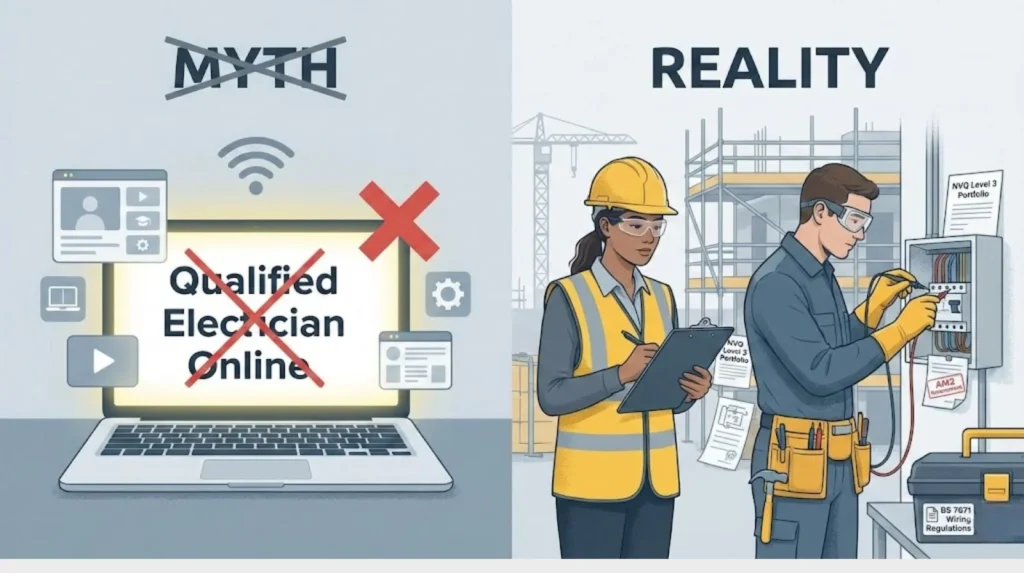
Myth 1: “You can become a qualified electrician online or through distance learning.”
Reality: Impossible. The NVQ Level 3 requires minimum two on-site assessor visits observing you perform electrical installation, testing, and certification work in real environments. BS 7671 compliance and AM2 competence cannot be assessed remotely. Online courses can deliver theory (18th Edition, health and safety knowledge), but they cannot replace practical competence assessment. Anyone claiming you can gain Gold Card status online is misrepresenting UK qualification requirements.
Myth 2: “A £2,000-£3,000 short course makes you a fully qualified electrician.”
Reality: These courses typically deliver Level 2 and/or Level 3 diplomas (2365 units) which cover essential knowledge and workshop skills. However, they do not include NVQ Level 3 portfolio assessment or AM2 end-point testing. You graduate as a qualified electrical trainee or improver, not an electrician. The Competition and Markets Authority has warned training providers about misleading advertisements that conflate diploma qualifications with full trade competence. Budget diploma courses are legitimate starting points, but they’re not complete qualifications.
Myth 3: “You need a van, £1,000 of tools, and test equipment before you can start training.”
Reality: Only required for self-employed work, not employment. Apprentices and improvers use company vehicles and employer-supplied test equipment. Your personal starter kit costs £200-£250. Buying a van and Megger MFT before you have electrical employment is premature and financially inefficient. Build your personal equipment gradually as your income increases and your career direction clarifies.
Why Total Economic Cost Matters More Than Sticker Price
The electrical training market creates confusion by advertising course fees without contextualizing earning timelines. A “free” qualification that takes 4 years to achieve costs you 2 years of qualified electrician wages compared to a paid route that qualifies you in 2 years. Those 2 years represent £60,000-£80,000 in additional lifetime earnings by the time you retire.
Real-world economic comparison:
| Route | Course Cost | Timeline to Gold Card | Year 1-3 Cumulative Earnings* | Net Position Year 3 |
| Apprenticeship (Age 18) | £0 | 3-4 years | £54,000-£66,000 | +£54,000-£66,000 |
| FE Evening + Self-Sourced NVQ | £2,500 | 3 years | £77,000-£82,000 | +£74,500-£79,500 |
| Fast-Track + Integrated Placement | £10,500 | 18 months | £88,000-£98,000 | +£77,500-£87,500 |
| EWA (Existing Improver) | £2,200 | 12 months | £88,000-£95,000 | +£85,800-£92,800 |
*Assumes starting from £24,000 baseline earnings for adult career changers; 16-18 apprentices start from £0 baseline.
The fast-track route costs £8,000 more than the FE evening route but delivers £11,000-£16,000 more in cumulative earnings by Year 3. By Year 5, the person who paid for speed is £25,000-£35,000 ahead despite the higher course fees.
This is why Elec Training structures financing at 0% interest over 12 months. At £875 monthly, you’re paying from improved electrical wages (£14-£16/hour) rather than from your pre-training income. The course essentially pays for itself through wage increases during the training period, then continues paying dividends for your entire career.
For existing improvers using EWA, the ROI is even more dramatic. £2,200 investment converts £28,000 annual earnings to £38,000-£45,000 within 12-18 months. Payback period is 4-6 months, making it one of the highest-return investments available to working-class people in the UK economy.
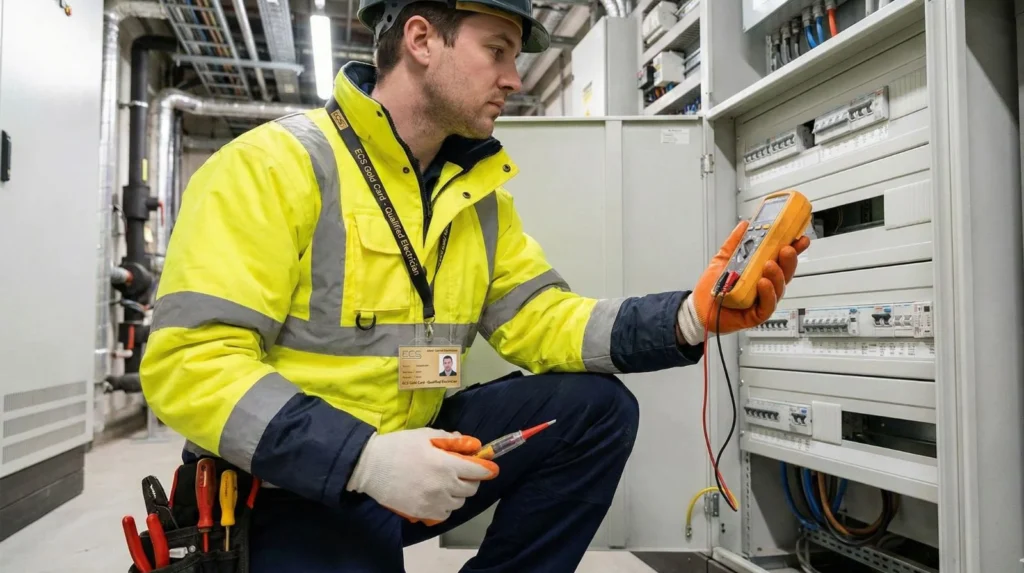
Yes, you can become a qualified electrician on a budget in the UK, but “budget” needs careful definition. If budget means zero upfront cash, apprenticeships and fully-funded FE college routes achieve this through government schemes, though timelines extend to 3-4 years and opportunity costs accumulate.
If budget means optimizing total economic return rather than minimizing sticker price, fast-track programmes with integrated placement support often deliver better financial outcomes. The £8,000-£10,500 course investment recovers within 12-18 months through earlier access to qualified wages, then compounds over your entire career. Regional wage variations apply, with London and South East offering 20-30% premiums over Midlands and Northern regions, but the pattern holds nationally.
The genuine budget traps are incomplete qualifications (diploma-only courses without NVQ pathways) and extended timelines that keep you in lower-wage positions for years whilst “saving” on course fees. The UK electrical industry pays for competence, not diplomas. The faster you demonstrate competence through NVQ, AM2, and Gold Card achievement, the faster you access the £35,000-£45,000 salary bracket or £220-£300 daily self-employed rates that define qualified electrician earnings in 2025-2026.
For detailed breakdowns of each qualification route, realistic timelines, and current costs, explore our comprehensive guide to pathway from training to qualified status options available across the UK. Every route works for someone; the question is which route works for your specific financial situation, career timeline, and regional employment opportunities.
call us on 0330 822 5337 to discuss realistic budgets for electrical training and how 0% financing makes fast-track qualification accessible even when you don’t have £10,000 sitting in savings. We’ll explain exactly what you need, how long it takes, what you’ll earn at each stage, and what our in-house recruitment team can do to eliminate the NVQ placement gap that stalls so many budget-route learners. No hype. No unrealistic promises. Just practical guidance from people who’ve placed hundreds of learners with UK contractors and understand what actually leads to employment.
References
- Joint Industry Board (JIB) – Apprentice wage rates 2025: https://www.jib.org.uk
- NET Services – AM2/AM2E Assessment fees 2025/26: https://www.netservices.org.uk
- GOV.UK – Free Courses for Jobs eligibility: https://www.gov.uk/guidance/free-courses-for-jobs
- GOV.UK – Advanced Learner Loans: https://www.gov.uk/advanced-learner-loan
- Electrotechnical Certification Scheme (ECS) – Card requirements: https://www.ecscard.org.uk
- Institution of Engineering and Technology (IET) – BS 7671 wiring regulations: https://electrical.theiet.org
- City & Guilds – 2357 NVQ Level 3 specification: https://www.cityandguilds.com
- Student Awards Agency Scotland (SAAS) – Fee waiver criteria: https://www.saas.gov.uk
- Welsh Government – Personal Learning Accounts: https://gov.wales
- Office for National Statistics (ONS) – Construction wage data 2024-2025: https://www.ons.gov.uk
Note on Accuracy and Updates
Last reviewed: 16 December 2025. This page is maintained to reflect current JIB wage agreements, government funding eligibility, and qualification requirements. We correct errors and refresh sources as standards change. Regional wage data reflects 2025-2026 market conditions and may vary by location and employer.
