

Colour Blindness Medical Standards for Electrical Roles in India (Shipyards & PSUs)

- Technical review: Thomas Jevons (Head of Training, 20+ years)
- Employability review: Joshua Jarvis (Placement Manager)
- Editorial review: Jessica Gilbert (Marketing Editorial Team)
- Last reviewed:
- Changes: Initial publication covering Indian PSU and shipyard medical board colour vision requirements for electrical trainees and executive roles
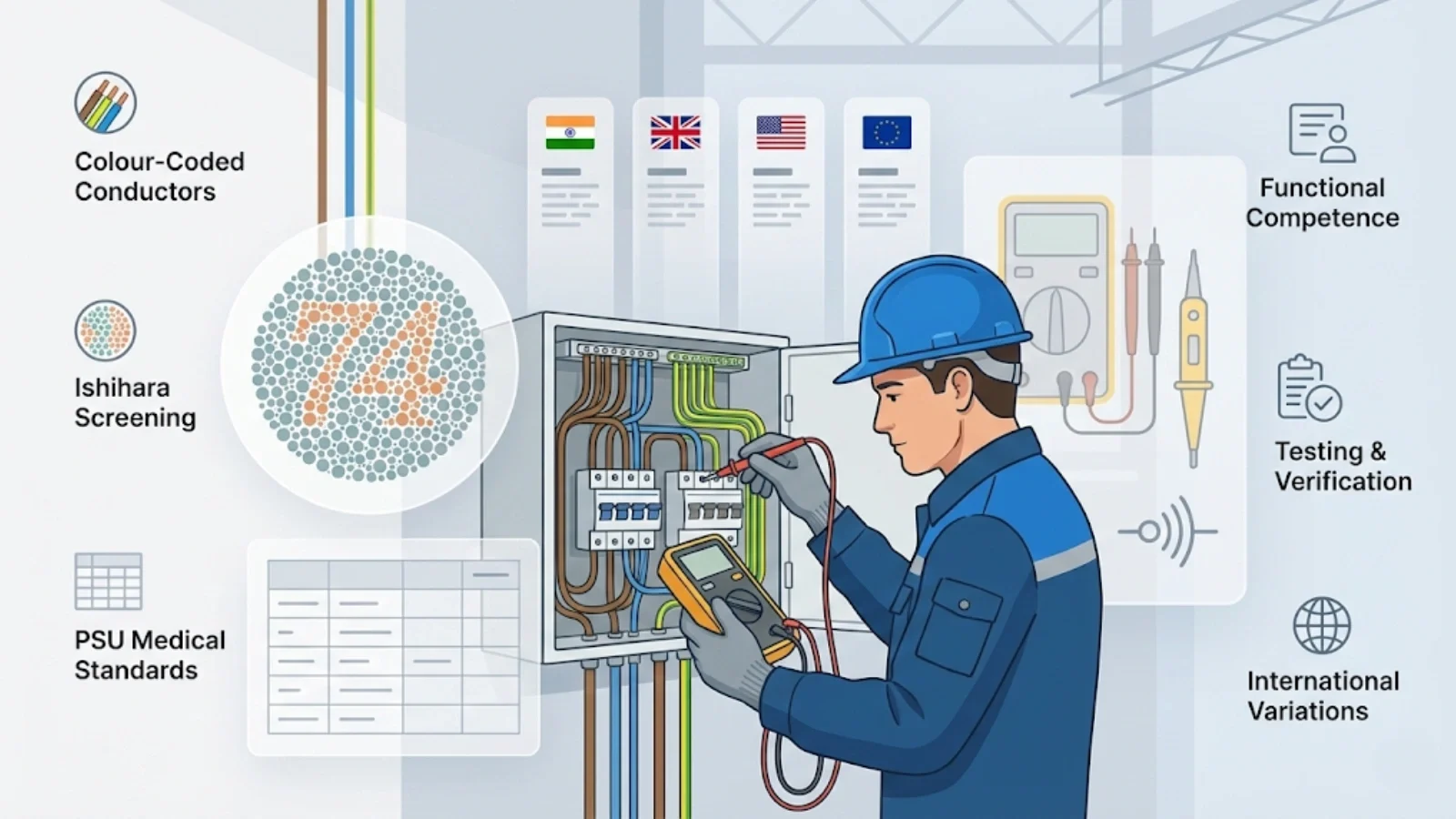
If you’re applying for electrical trainee or executive trainee positions at Indian PSUs or shipyards, you’ve probably seen “Normal Colour Vision Required” buried in the medical standards section of recruitment notifications. That single line can end months of preparation if you have colour vision deficiency (CVD), commonly called colour blindness.
The reality is straightforward: colour vision deficiency frequently disqualifies candidates from technical electrical roles in Indian Public Sector Undertakings and shipyards. This isn’t about discrimination but safety protocols in environments where misidentifying colour-coded wiring, control panel indicators, or alarm systems could cause serious accidents.
But the outcomes aren’t uniform. Standards vary between employers, between technical and non-technical roles, and between countries. Understanding exactly what’s assessed, why it matters, and what your options are makes the difference between wasted applications and realistic career planning.
This article explains how Indian medical boards assess colour vision for electrical roles, what tests you’ll face, how standards differ across PSUs like BHEL and NTPC versus shipyards like Cochin Shipyard and Mazagon Dock, what happens if you fail screening, and how international systems (particularly the UK) handle colour vision differently.
What is Colour Vision Deficiency and Why Does It Matter?
Colour vision deficiency refers to difficulty distinguishing certain colours, most commonly reds and greens. It’s usually inherited and affects approximately 8% of men and 0.5% of women globally. The severity ranges from mild confusion between similar shades to complete inability to differentiate specific colours.
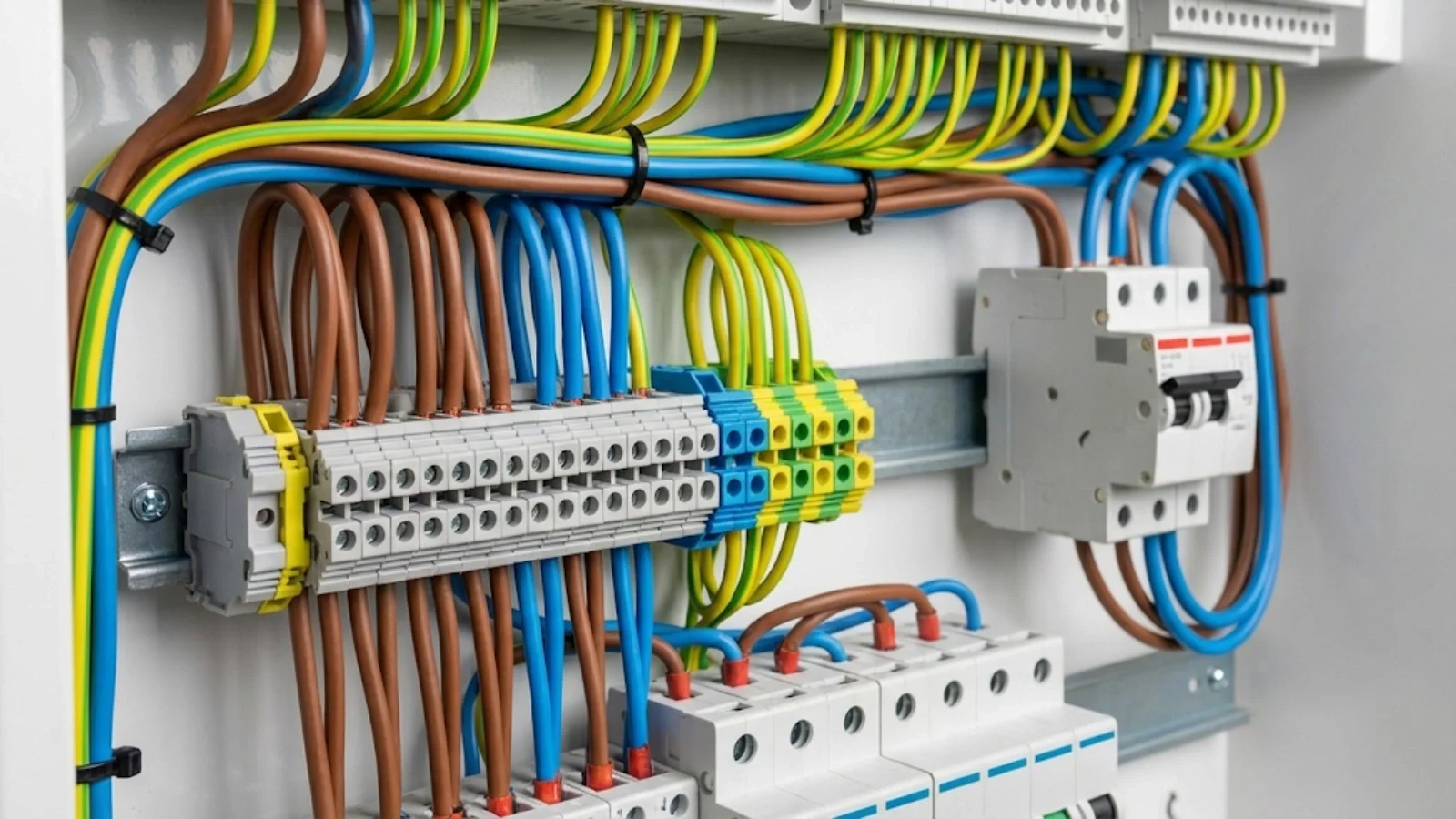
In electrical work, accurate colour perception isn’t just helpful but safety-critical. Indian electrical installations follow colour coding standards for phase identification (red/yellow/blue for three-phase systems, brown for single-phase live), neutral conductors (black or blue depending on system), and protective earth (green or green-yellow striping). Misidentifying these during installation, maintenance, or fault-finding creates serious hazards.
Beyond wiring, industrial environments use colour-coded control panels, status indicators (red for danger/trip, green for safe/running), alarm systems, and safety signage. In confined shipyard spaces with variable lighting, or in power plants where grime and dust obscure surfaces, colour vision deficiency compounds identification challenges.
The question isn’t whether CVD makes someone incompetent, but whether the risk in high-stakes environments justifies exclusion. Indian PSUs and shipyards, particularly those linked to defence or heavy industry, err on the side of caution with zero-tolerance policies.
However, it’s worth noting that colour vision standards aren’t universal. Thomas Jevons, Head of Training at Elec Training with 20+ years experience, explains: “Standards vary significantly internationally. Some countries mandate normal colour vision for any electrical work, while others assess functional ability. The UK approach emphasises documented competence and verification procedures, which creates more inclusive pathways into the profession.”
"Standards vary significantly internationally. Some countries mandate normal colour vision for any electrical work, while others assess functional ability. The UK approach emphasises documented competence and verification procedures, which creates more inclusive pathways into the profession."
Thomas Jevons, Head of Training
How Indian Medical Boards Assess Colour Vision
Medical boards in Indian PSUs and shipyards conduct comprehensive pre-employment fitness assessments. These happen after you’ve cleared written exams and interviews, making rejection at this stage particularly frustrating.
The process typically involves examination at designated government hospitals or empanelled medical centres. A panel of doctors assesses vision, hearing, cardiovascular health, and general physical fitness. Colour vision assessment occurs during the eye examination, usually in a controlled lighting environment.
The examining doctor uses standardised colour vision tests (detailed in the next section) to classify candidates as having normal colour vision, deficient colour vision, or colour blindness. Results are recorded on medical fitness certificates using categories like “A-1” for perfect fitness including normal colour vision, or “Unfit” for roles requiring colour perception.
The board’s assessment is descriptive rather than advisory. They verify compliance with pre-defined medical standards specified in recruitment notifications, not make case-by-case accommodations. If the notification states “Normal Colour Vision Required” and you fail the screening, rejection is typically immediate and final.
Some employers require candidates to bring recent eye examination reports or medical certificates, though this varies. BHEL, for instance, requires documentation for chronic conditions but colour vision is assessed fresh during the board examination. Crucially, most boards don’t offer functional testing (assessing real-world performance) after initial screening failure.
Understanding what tests you’ll face and how they work helps you prepare realistically rather than hoping for flexibility that doesn’t exist in rigid PSU systems.
What Colour Vision Tests Are Used?
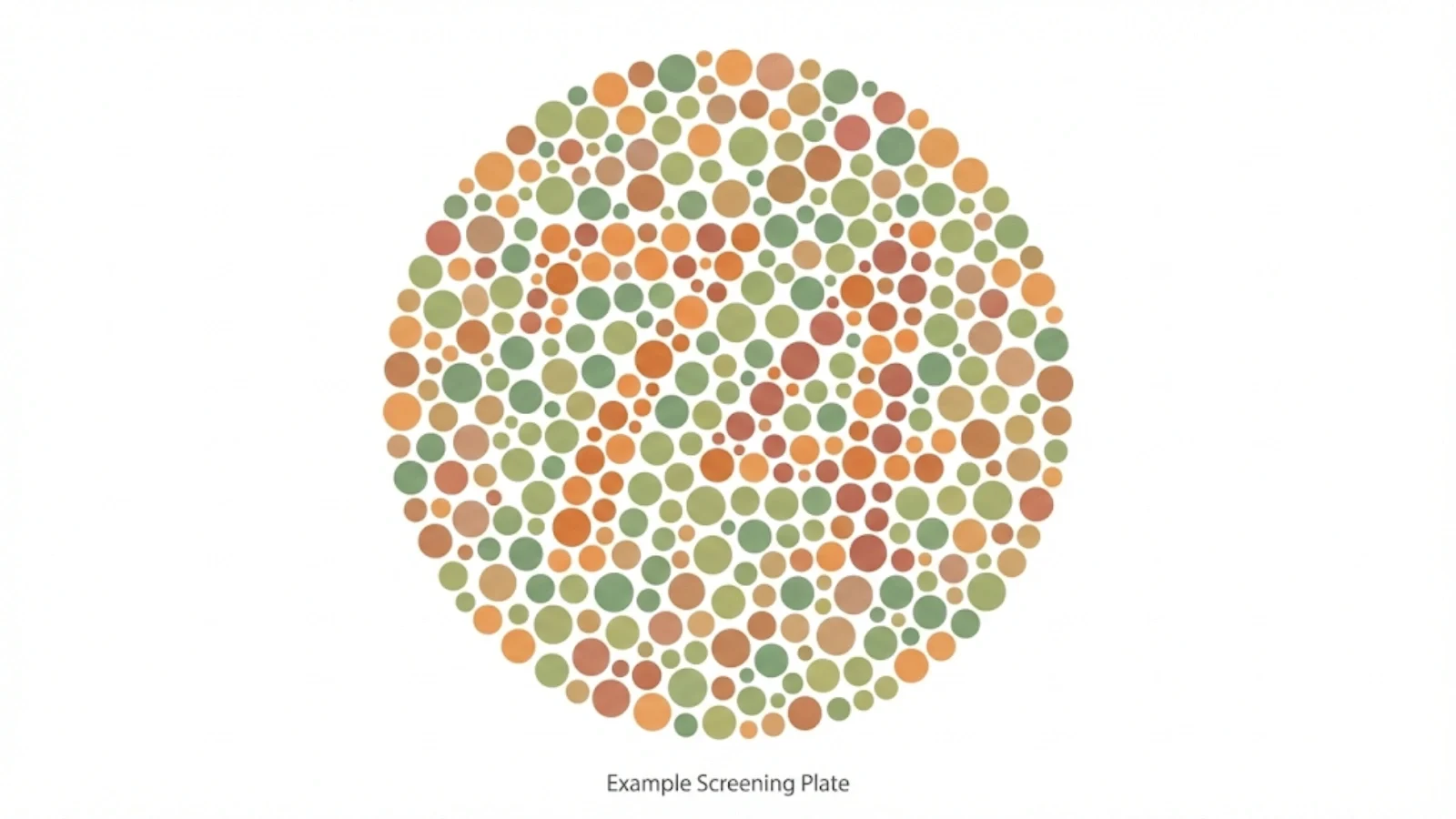
The Ishihara Pseudoisochromatic Plate Test is the universal screening tool in Indian PSU and shipyard recruitment. It consists of 38 plates showing numbers or patterns formed by coloured dots against backgrounds of different coloured dots. Candidates must identify what they see within a time limit (typically 3 seconds per plate).
The test primarily detects red-green deficiencies, which are the most common forms of CVD. Results are binary for recruitment purposes: you either pass (identifying sufficient plates correctly) or fail. There’s no “mild deficiency” category that gets you through. Missing the threshold number of plates results in classification as colour deficient.
Limitations of Ishihara testing:
- High sensitivity means it may flag people who could function adequately with tools and procedures
- Variable lighting conditions affect results (though boards use controlled lighting)
- Fatigue or stress during examination can impact performance
- No assessment of functional ability to do actual electrical work
Some organisations may use Lantern Tests (like Edridge-Green or Martin Lantern) as secondary assessments. These simulate real-world signals by showing coloured lights at a distance under dim lighting, testing functional colour recognition rather than just deficiency detection. However, in practice, most Indian PSUs stop at Ishihara failure without offering functional testing.
Re-tests are possible if initial results are borderline or if you can demonstrate testing conditions were improper (poor lighting, examiner error). But single-test limits are strict: once you’re classified as colour deficient based on Ishihara results, overturning that classification is difficult without specialist ophthalmologist evidence showing the initial test was wrong.
This contrasts sharply with approaches in other countries. For those researching whether a medical board rejection for electricians based on colour vision is universal, the answer is no. Assessment methods and acceptance criteria vary significantly between countries and regulatory systems.
Standards Across Indian PSUs and Shipyards
Medical fitness requirements vary by employer and role, but patterns emerge across the Indian public sector.
Defence-linked shipyards (Cochin Shipyard Limited, Mazagon Dock Shipbuilders Limited, Garden Reach Shipbuilders & Engineers) apply the strictest standards. These organisations build naval vessels and submarines where electrical systems are safety-critical. “Normal Colour Vision” is mandatory for electrical trainee, apprentice, and technician roles. Executive trainee positions face similar scrutiny because early career phases involve field exposure.
Power sector PSUs (NTPC, BHEL, IOCL) reference medical standards in recruitment notifications under sections like “Annexure – Medical Fitness Criteria.” For technical electrical roles, normal colour vision is typically required. BHEL’s medical examination rules explicitly list colour blindness as disqualifying for positions involving electrical installation or maintenance. NTPC applies similar criteria for executive trainees in electrical engineering, though supervisory roles with minimal field exposure might have slightly relaxed requirements depending on specific job descriptions.
How to verify specific requirements:
- Download the full recruitment notification PDF from the official website (not third-party job sites)
- Search for keywords: “colour vision,” “Ishihara,” “visual acuity,” “medical standards,” “annexure”
- Look for fitness classification tables (often listing A-1, A-2, B-1 categories)
- Check role-specific requirements (some notifications differentiate between technical and non-technical posts)
Common notification language:
- “Normal colour perception required for safety-critical tasks”
- “Candidate must not be colour blind”
- “Vision: 6/6 in better eye, 6/9 in worse eye, with normal colour vision”
- “Colour blindness is a disqualifying factor for technical positions”
When in doubt, query HR departments before investing months in exam preparation. Most PSUs provide email contacts or helpline numbers in notifications specifically for pre-application queries about eligibility criteria.
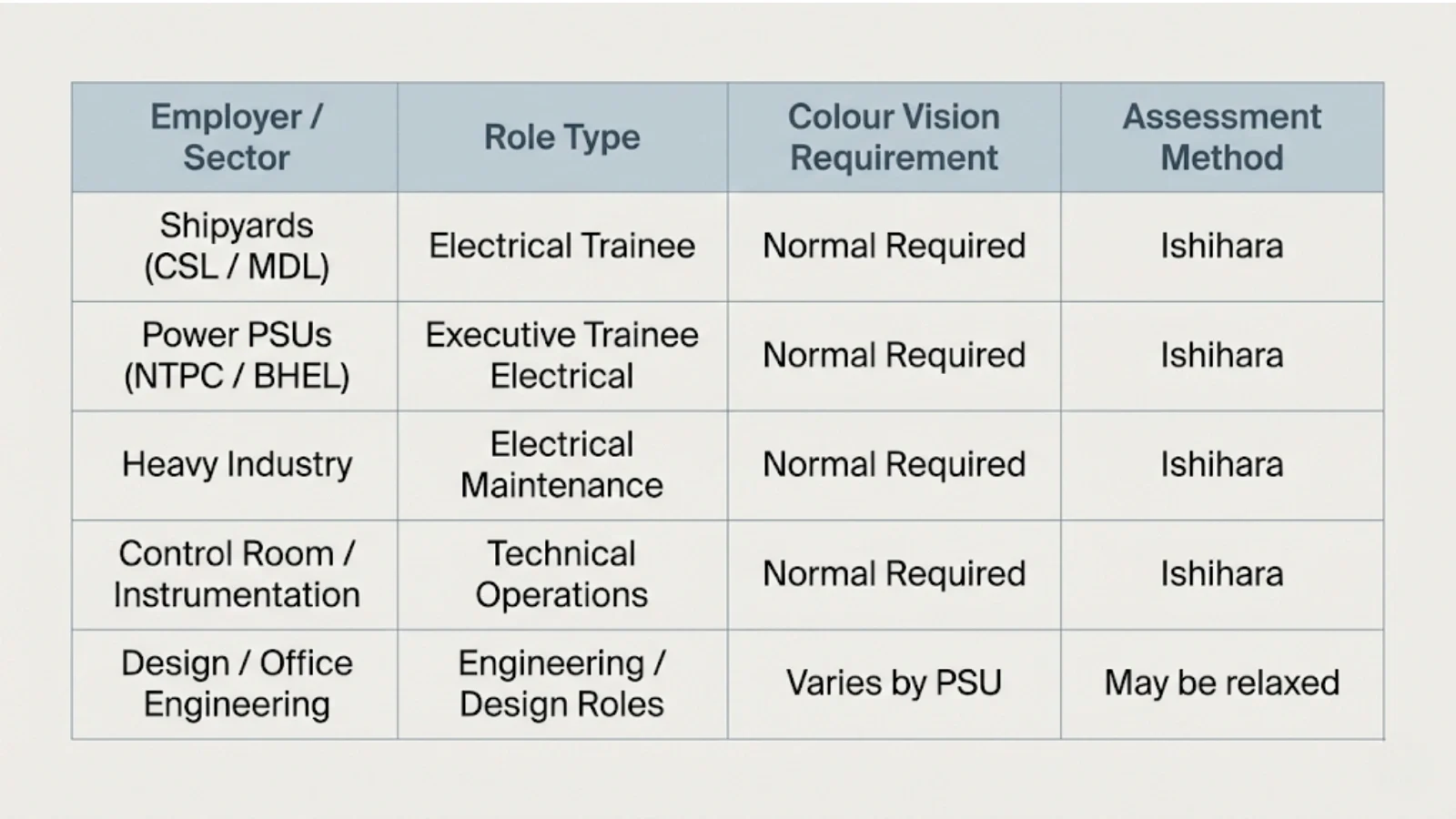
Outcomes by Role Type: Risk Assessment Matrix
Not all electrical roles face equal scrutiny, though the bar remains high across technical positions.
Shipyard Electrical Trainee/Technician: Very High likelihood of disqualification. These roles involve hands-on fieldwork with complex marine electrical systems in confined spaces with variable lighting. Defence shipyards like Mazagon Dock apply rigid standards with no adjustments. The risks assessed include miswiring leading to explosions or electrical failures in critical ship systems.
Executive Trainee (Electrical): High likelihood of disqualification. While the role has supervisory elements that might suggest flexibility, PSUs like NTPC require normal colour vision because training phases involve commissioning work, control panel operation, and field exposure. Errors in oversight of safety protocols or system commissioning create unacceptable risks in power generation or heavy industry.
Electrical Maintenance (Heavy Industry): Very High likelihood of disqualification. Direct handling of live systems in factories and plants requires unambiguous conductor identification. BHEL standards mandate normal colour vision to avoid accidents in high-voltage industrial setups. Faulty repairs cause downtime and safety hazards.
Control Room/Instrumentation/Protection: Medium to High likelihood of disqualification. These roles rely on colour-coded screens, status lights, and alarm systems. Functional testing might theoretically mitigate mild CVD, but in practice, rejection remains common in utilities where delayed response to colour-coded alarms could affect critical operations.
Design/Office-Based Engineering: Low to Medium likelihood of disqualification. Some PSUs may allow CVD for purely administrative or design roles without field responsibilities. However, this flexibility is rare and inconsistent. Even office-based electrical engineering roles often require some field exposure during training periods.
For comparison, outcomes differ significantly in less regulated sectors. Those wondering if you can work as a colour blind electrician in UK domestic or commercial settings will find considerably more flexibility in private sector roles where functional competence and tool-based verification reduce reliance on colour alone.
What to Do If You Have or Suspect CVD
If you suspect colour vision deficiency before applying, take proactive steps rather than hoping it won’t matter.
Self-assess early: Online Ishihara test simulations give rough indications, though they’re not diagnostic. If you consistently struggle with these, consult a qualified ophthalmologist for proper assessment using the 38-plate Ishihara edition. Knowing your specific deficiency type (protanopia, deuteranopia, or anomalous trichromacy) helps you understand severity and realistic prospects.
Review recruitment notifications carefully: Don’t assume all electrical roles require normal colour vision. Some PSUs differentiate between technical field positions and office-based engineering roles. Check specific medical standards in annexures before investing time in applications.
If you fail screening during medical board:
Request re-test if conditions were questionable: Poor lighting, examiner rushing through plates, or extreme fatigue can affect results. Politely request re-examination citing specific concerns.
Ask about functional testing: Some organisations might allow secondary assessment via Lantern tests to demonstrate real-world capability. This is uncommon in rigid PSU systems but worth enquiring.
Gather specialist evidence: An ophthalmologist’s detailed report showing mild deficiency with minimal functional impact might support an appeal, though success rates are low in safety-critical positions.
Explore alternative roles: Non-technical executive positions, administrative paths, or design-focused engineering might have different requirements. Check if the same PSU has openings in areas where colour vision isn’t critical.
Communication templates for HR queries:
Template 1 (Pre-application): “Dear Sir/Madam, regarding Advertisement No. [X], I am interested in the Executive Trainee (Electrical) position. Could you please clarify if ‘Normal Colour Vision’ is a mandatory requirement for this role, or if candidates with mild colour vision deficiency are eligible for functional assessment? I would appreciate guidance on relevant medical standards.”
Template 2 (Post-rejection appeal): “Dear Recruitment Team, I appeared for the medical board on [date] and was declared unfit due to colour vision deficiency. I respectfully request information on the appeal process and whether functional testing or specialist ophthalmologist reports are considered as supporting documentation for reassessment.”
Template 3 (Functional capability evidence): “Dear [HR Contact], Following my medical examination result, I attach a specialist ophthalmologist’s report indicating mild red-green deficiency with minimal functional impact. I would like to request consideration for functional testing demonstrating my ability to identify colour-coded systems using standard electrical test equipment and verification procedures.”
Remain factual and professional. Focus on capabilities and willingness to use verification tools rather than disputing the importance of colour vision in electrical safety.
International Comparison: How Other Systems Handle CVD
Understanding that colour vision requirements aren’t universal helps contextualize Indian PSU standards and identify alternative pathways.
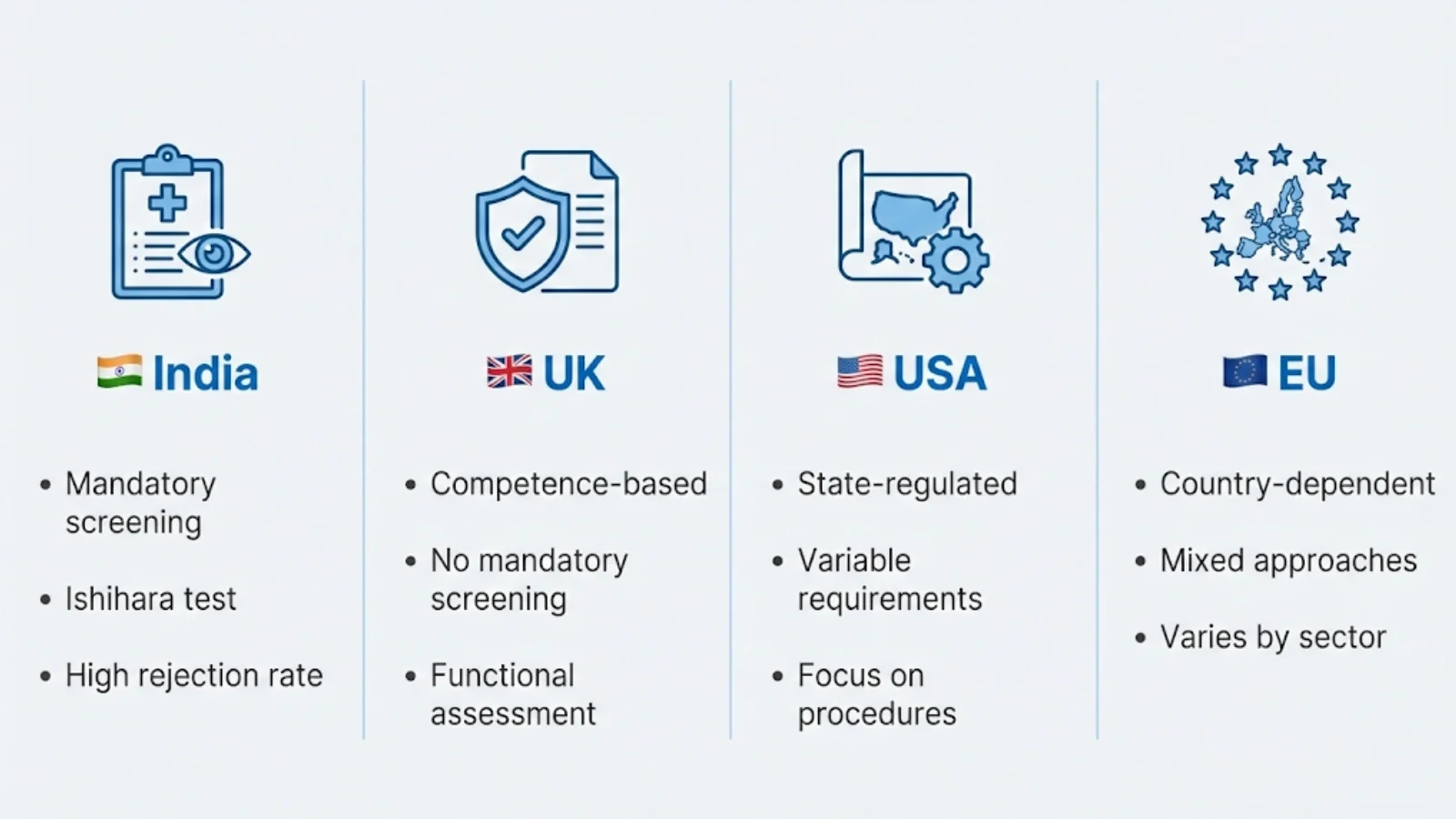
United Kingdom: The UK doesn’t mandate colour vision screening for electrical qualification. BS 7671 Wiring Regulations focus on documented competence, systematic verification procedures, and functional testing rather than medical prerequisites. Electricians prove capability through NVQ portfolios demonstrating safe installation, testing, and certification practices using instruments and labelling systems that don’t rely solely on colour. Joshua Jarvis, Placement Manager at Elec Training, notes from direct experience:
"We've had enquiries from candidates affected by medical board rejections in other countries exploring UK qualification routes. The UK system assesses what you can do through practical demonstration, not what screening tests suggest you can't do."
Joshua Jarvis, Placement Manager
Australia and New Zealand: Standards vary by state and employer. Some require colour vision for specific high-risk electrical work (mining, aviation), while general domestic and commercial electrical work may not mandate screening. Competency-based assessment is common.
European Union: Requirements vary by country. Some nations include colour vision in vocational medical assessments, while others rely on functional training outcomes. Germany, for instance, has structured vocational training (Ausbildung) with medical checks that may include colour vision, though outcomes depend on specific industrial contexts.
United States: Electrical licensing is state-regulated with no universal colour vision requirement. OSHA safety standards focus on proper procedures, labelling, and verification rather than medical screening. Colour-blind electricians work successfully using systematic testing and documentation practices.
Why these differences matter:
If your career path is blocked in India due to medical board requirements, understanding that other regulatory systems assess differently opens possibilities. This isn’t about circumventing safety but recognizing that safety can be achieved through different mechanisms: systematic procedures, tool-based verification, comprehensive labelling, and functional competence assessment.
For those considering Whether UK training is suitable as an alternative pathway, the key consideration is whether you can demonstrate safe electrical work through documented competence rather than passing a screening test. UK NVQ Level 3 qualifications assess exactly that capability through workplace portfolios and practical assessments.
"We've had enquiries from candidates affected by medical board rejections in other countries exploring UK qualification routes. The UK system assesses what you can do through practical demonstration, not what screening tests suggest you can't do."
Joshua Jarvis, Placement Manager
Guidance for Employers and Training Providers
While this article focuses on candidate perspectives, clarity from employers prevents wasted effort on all sides.
Recruitment notifications should explicitly state colour vision requirements: Phrases like “normal colour perception required for safety-critical tasks, assessed via Ishihara plates” allow candidates to self-select based on known deficiencies. Burying requirements in dense medical annexures creates frustration when candidates discover barriers at final stages.
Link requirements to specific safety risks: Rather than blanket “colour blindness disqualifies” statements, explain why: “Essential for identifying phase conductors in three-phase systems” or “Required for interpreting colour-coded alarm panels in control rooms.” This demonstrates thoughtfulness rather than arbitrary exclusion.
Consider functional testing for borderline cases: Lantern tests or practical demonstrations of colour-coded system identification provide functional assessment beyond screening. While this requires additional process, it balances safety with inclusivity.
Training providers can prepare all students for colour-independent verification: Including clear labelling practices, systematic testing procedures, and instrument-based verification in curricula benefits everyone. These practices improve safety for all electricians, not just those with CVD.
Adopt consistent, documented standards: Referencing international guidelines (CIE standards, IEC recommendations) and training medical boards on CVD severity distinctions prevents arbitrary rejections while maintaining safety thresholds.
The goal isn’t eliminating colour vision assessment where genuinely safety-critical but ensuring fairness, transparency, and evidence-based decision-making in recruitment processes.
Colour vision deficiency frequently results in medical board rejection for electrical trainee and executive trainee roles in Indian PSUs and shipyards. The Ishihara test is the universal screening tool, and failure typically ends candidature without functional assessment or appeals.
Standards are strictest in defence-linked shipyards and field-based technical positions where colour-coded systems are safety-critical. Power sector PSUs apply similar rigour. Executive roles offer slightly more variability depending on field exposure requirements, but the bar remains high.
If you have CVD, realistic career planning means:
- Self-assessing early using proper ophthalmologist evaluation
- Reading recruitment notifications carefully for medical requirements
- Understanding that Indian PSU standards prioritise zero-risk policies
- Knowing that international systems assess colour vision differently
- Exploring alternative pathways if electrical work in regulated Indian sectors is closed
For those affected by rigid medical requirements in one system, understanding that competence-based assessment exists elsewhere contextualizes rejection as systemic rather than personal limitation. Your capability to work safely as an electrician isn’t universally determined by a single screening test result.
The information here helps you navigate Indian PSU medical boards with realistic expectations, prepare appropriately, and make informed decisions about career alternatives if standard pathways are blocked.
FAQs
What does “Normal Colour Vision Required” mean in Indian PSU and shipyard electrical recruitment, and how strictly is it enforced?
“Normal colour vision required” means the ability to accurately distinguish key colours, particularly red, green, and blue, which are essential for safety-critical electrical tasks such as identifying wiring, indicators, and signal systems.
In Indian PSUs and shipyards, this requirement is enforced strictly in most electrical and technical roles. Candidates who fail prescribed colour vision tests are commonly declared medically unfit by recruitment medical boards. While minor variations exist between organisations and specific recruitment notifications, disqualification is the norm rather than the exception for electrical field roles.
Which colour vision tests are most commonly used, and what counts as pass or fail?
The Ishihara plate test is the most commonly used colour vision assessment for PSU and shipyard electrical recruitment. Candidates are required to correctly identify numbers or patterns on a series of coloured plates.
A typical pass standard allows no more than two errors on the core test plates (often plates 2–17), indicating normal red–green colour perception. Exceeding this threshold is usually recorded as colour vision deficiency. Some organisations may use secondary confirmation tests, such as lantern tests, but this depends on the role and governing authority.
Do Indian PSUs or shipyards accept candidates with mild colour vision deficiency for electrical roles?
In most cases, no. Indian PSUs and shipyards generally treat any level of colour vision deficiency as a disqualifying condition for electrical roles due to safety risks.
While non-technical or administrative positions may allow candidates with colour vision deficiency, technical electrical roles involving wiring, signalling, or equipment identification almost always require normal colour vision. Acceptance depends on the specific recruitment notification, but automatic rejection is common.
Are standards different between defence shipyards and power or heavy-industry PSUs?
Yes, standards in defence-linked shipyards are often stricter. Shipyards operating under maritime or defence regulations typically follow medical standards aligned with DG Shipping requirements, which mandate normal colour vision and may include both Ishihara and lantern testing.
Power and heavy-industry PSUs may apply similar standards but sometimes show minor procedural differences depending on the post. However, for electrical roles, the end result is usually the same: normal colour vision is required.
Do requirements differ between trainee/technician roles and executive trainee (electrical) roles?
Requirements can differ slightly, but normal colour vision is still commonly required across both levels.
Trainee and technician roles involve hands-on fieldwork with colour-coded systems, so enforcement is typically strict. Executive trainee roles may involve more supervision and planning, but many PSUs apply the same medical standards across all electrical cadres. Candidates should always check the specific recruitment advertisement.
What should candidates do before applying if they suspect colour vision deficiency?
Candidates who suspect colour vision deficiency should undergo a pre-application eye examination with a qualified ophthalmologist.
The Ishihara plate test is the most useful initial screening tool, as it mirrors what is used in PSU and shipyard medical boards. Confirming colour vision status early helps candidates avoid failed medicals after clearing written or interview stages.
If a candidate fails the medical board colour vision test, is appeal or re-testing possible?
Appeal or re-testing may be possible, but success rates are low.
Some organisations allow appeals to a higher or designated medical authority, often requiring fees and repeat examinations. Additional evidence such as specialist reports or alternative test results may be submitted, but unless procedural error is proven, original findings are rarely overturned.
Are lantern tests or functional assessments used, and when do they apply?
Lantern tests are sometimes used, particularly in shipyards or maritime-linked roles, to assess real-world signal colour recognition.
They are more likely to appear:
- After an Ishihara failure, as a confirmatory test
- In defence or maritime environments
- Under DG Shipping–aligned medical rules
Many PSUs rely solely on Ishihara testing for initial and final decisions.
What alternative role routes exist for candidates with colour vision deficiency?
Candidates with colour vision deficiency may consider:
- Non-field engineering roles
- Design and planning functions
- Quality assurance or inspection roles
- Procurement, contracts, or project coordination
Eligibility depends entirely on the recruitment notification. Candidates must carefully review medical standards listed for non-technical or administrative posts, where colour vision requirements may be relaxed.
How do India’s colour vision rules compare with the UK approach, and what does “competence-based” assessment mean?
India generally applies medical exclusion-based rules, where failure of colour vision tests leads to automatic rejection for electrical roles.
The UK follows a competence-based approach, assessing whether a person can perform tasks safely through risk assessment, mitigation, and system design rather than blanket exclusion. This may include alternative labelling, procedural controls, or task-specific assessment rather than outright disqualification.
In practice, this means India focuses on medical eligibility, while the UK focuses on demonstrated safe competence.
References
- Indian Oil Corporation Limited – Guidelines and Criteria for Physical Fitness for Pre-Employment Medical Examination – https://iocl.com/admin/img/UploadedFiles/LatestJobOpening/Files/a41b5a2710fa4ecc809d16e5f4547fd9.pdf
- Bharat Heavy Electricals Limited – Medical Examination Rules – https://careers.bhel.in/st_2023/Bhel_medical_examination_rules.pdf
- Directorate General of Shipping, India – Medical Standards for Seafarers – https://www.dgshipping.gov.in/
- Ministry of Health and Family Welfare, India – Guidelines for Medical Boards – https://main.mohfw.gov.in/
- Cochin Shipyard Limited – Recruitment Notifications and Medical Standards – https://www.cochinshipyard.com/
- Mazagon Dock Shipbuilders Limited – Careers and Medical Fitness Criteria – https://www.mazagondock.in/
- National Thermal Power Corporation (NTPC) – Recruitment Medical Standards – https://www.ntpc.co.in/
- Garden Reach Shipbuilders & Engineers – Medical Fitness Requirements – https://www.grse.in/
- International Electrotechnical Commission (IEC) – Standards for Electrical Safety – https://www.iec.ch/
- BS 7671:2018+A2:2022 – Requirements for Electrical Installations (IET Wiring Regulations) – https://electrical.theiet.org/bs-7671
- Ishihara Colour Vision Test – Clinical Assessment Standards – Medical literature reference
- Occupational Health Guidelines – Colour Vision Assessment in Safety-Critical Roles – International standards reference
Note on Accuracy and Updates
Last reviewed: 16 February 2026. This page is maintained; we correct errors and refresh guidance as medical standards, PSU recruitment policies, and international assessment practices evolve. Information reflects Indian PSU and shipyard medical requirements current as of February 2026 but subject to updates in individual employer notifications. Colour vision assessment methods and standards cited are based on publicly available recruitment documents and medical board practices. Candidates should verify specific requirements in current recruitment notifications from target employers. International comparison data reflects regulatory approaches in referenced countries as of early 2026. This article provides informational guidance on medical assessment practices, not medical advice on colour vision conditions. Consult qualified ophthalmologists for personal medical assessment. Next review scheduled following significant changes to Indian PSU medical standards or international regulatory approaches to colour vision in electrical work.
