

Colour Blindness Standards for Shipyard & Industrial Electrical Roles

- Technical review: Thomas Jevons (Head of Training, 20+ years)
- Employability review: Joshua Jarvis (Placement Manager)
- Editorial review: Jessica Gilbert (Marketing Editorial Team)
- Last reviewed:
- Changes: Initial publication covering colour vision standards for shipyard, marine, and heavy industrial electrical roles in India and internationally
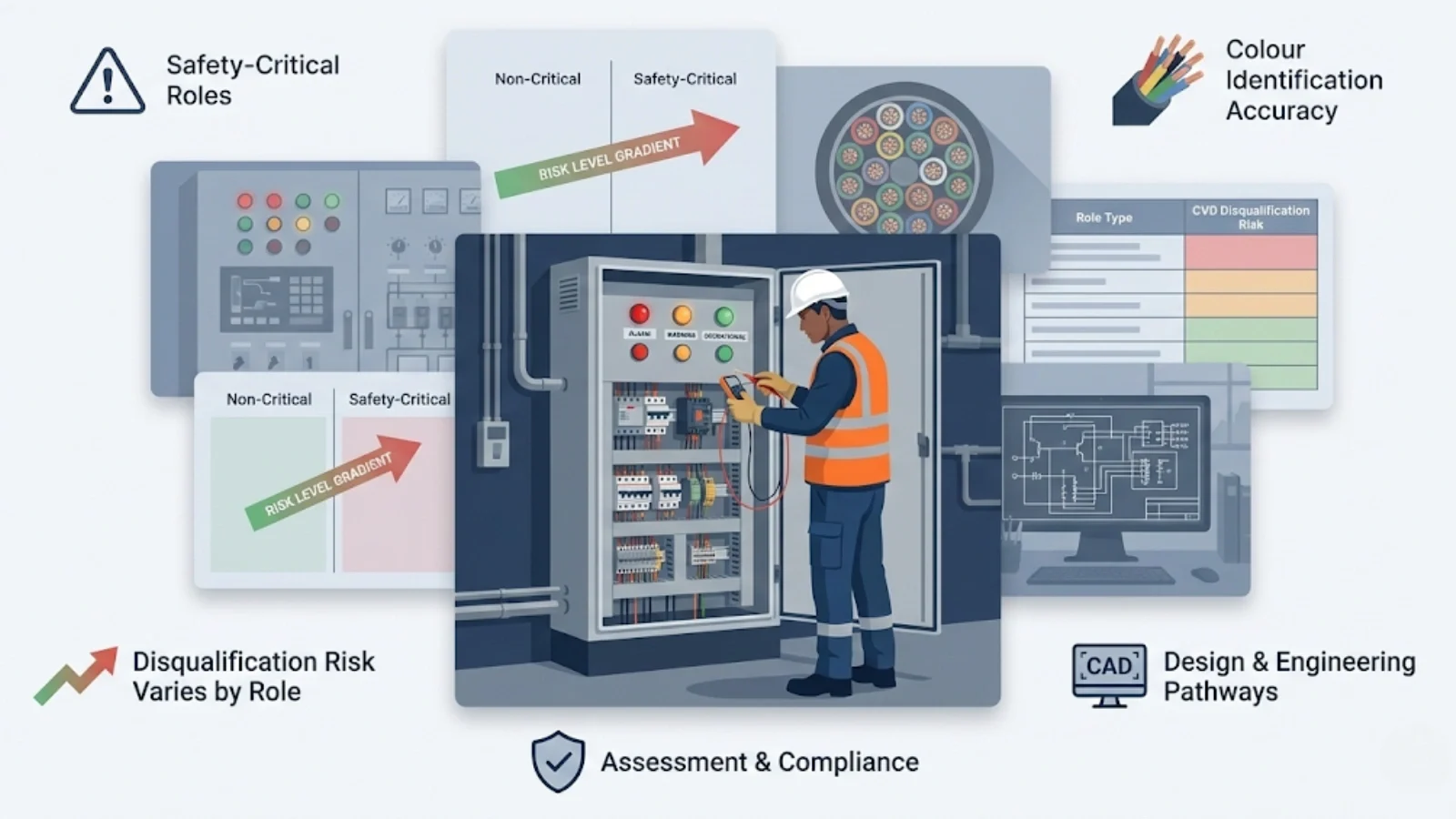
If you’re targeting electrical roles in Indian shipyards like Cochin Shipyard Limited, Mazagon Dock, or Garden Reach Shipbuilders, or heavy industry positions at BHEL, NTPC, or Larsen & Toubro, you need to understand something critical: colour vision standards in these sectors are significantly stricter than domestic electrical work.
This isn’t arbitrary discrimination. Shipyard electrical work involves high-voltage power distribution systems on vessels where a single identification error could disable fire suppression during an emergency with 200 workers in confined spaces. Heavy industry electrical roles include commissioning protection systems in chemical plants where misreading a colour-coded alarm could delay shutdown procedures, leading to equipment damage worth crores or loss of life.
The stakes in these environments are fundamentally different from domestic installations where a wiring mistake trips a circuit breaker. In shipyards and heavy industry, electrical errors can cause catastrophic fires, explosions, or vessel loss. Colour vision standards reflect those consequences.
This article explains why shipyards and heavy industry apply stricter colour vision requirements than general electrical work, what defines safety-critical electrical roles in these sectors, how medical assessments work for high-risk positions, what tests you’ll face and what they actually measure, which specific roles carry highest disqualification risk, and what alternative electrical pathways exist if shipyard work is medically closed to you.

Why Shipyards and Heavy Industry Are Different
In domestic electrical work, if you wire a socket incorrectly, the worst outcome is usually a tripped circuit breaker or damaged appliance. The homeowner calls you back, you fix it, life continues. In shipyards and heavy industrial plants, the stakes escalate exponentially.
Consequence severity: Shipyard electrical systems power life-safety equipment on vessels. Fire suppression pumps, emergency lighting, navigation systems, and communication equipment all depend on reliable electrical supply. A commissioning error affecting any of these during a vessel’s operation at sea creates immediate danger for crew and passengers.
Multi-layered complexity: Marine and industrial electrical installations involve high-density, multi-core cables where individual conductors are identified by colour-coded tracers. A 37-core control cable might have subtle colour variations identifying specific functions. Mixing up two similar colours during termination could cross instrumentation signals, causing incorrect readings in critical monitoring systems.
Emergency conditions: Engineers often work under emergency lighting, in confined spaces with poor ventilation, or during breakdown situations where rapid identification is essential. The ability to distinguish between a red “trip” indicator and a green “safe” indicator under stress, fatigue, and suboptimal lighting literally becomes the difference between safe shutdown and catastrophic failure.
High-voltage protection systems: Heavy industry electrical work includes commissioning protection relays, circuit breakers, and interlocking systems in power distribution networks operating at 11kV, 33kV, or higher. Errors in protection logic wiring don’t just damage equipment but can cause arc flash incidents, fires, or explosions affecting entire facilities.
This risk profile drives stricter medical standards. Employers in these sectors err toward zero-tolerance policies because the liability and safety consequences of colour-related errors are unacceptable. Understanding this context helps frame why Indian medical board requirements are particularly rigid for shipyard and heavy industrial electrical positions.
What Makes an Electrical Role Safety-Critical?
Not all electrical work carries equal risk. Understanding the distinction between safety-critical and non-critical roles helps you assess realistic career prospects based on colour vision capabilities.
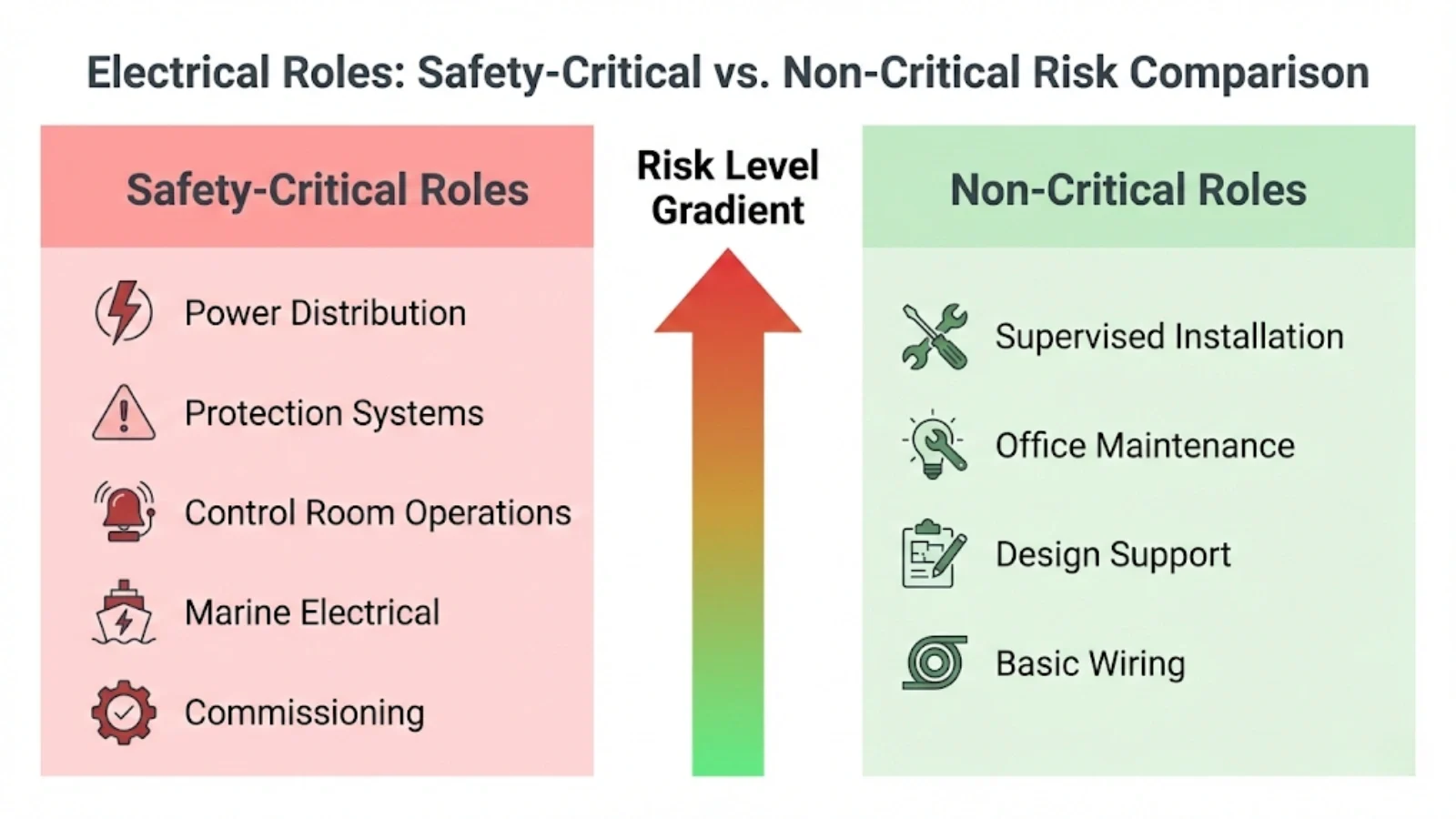
Safety-critical electrical roles are positions where a single error in technical execution or judgment could lead to serious injury, environmental damage, or significant loss of assets. In Indian shipyards and heavy industry, this classification includes:
Power distribution engineers: Responsible for high-voltage systems supplying entire facilities or vessels. Work involves commissioning switchgear, protection relays, and bus-bar systems where incorrect wiring or settings could cause system-wide failures.
Protection and commissioning technicians: Handle the testing and setup of protective devices that isolate faults automatically. These systems prevent cascading failures that could shut down entire plants or disable vessel power during critical operations.
Control room operators: Monitor human-machine interfaces (HMI) displaying colour-coded status for pressure, temperature, flow, and alarm conditions. Delayed recognition of alarm severity based on colour could postpone emergency responses.
Instrumentation and control specialists: Work with sensors, transmitters, and control logic where colour-coded wiring identifies specific measurement loops. Cross-connections due to colour confusion create false readings affecting automated safety systems.
Marine electrical systems technicians: Maintain and repair electrical installations on ships and offshore platforms, working with international maritime colour codes for navigation lights, emergency systems, and communication equipment.
Non-safety-critical roles, by contrast, include positions where errors are contained and correctable without immediate life-safety implications:
Supervised cable installation: Basic cable pulling and containment work under direct supervision where verification occurs at multiple stages before energisation.
Administrative building maintenance: General electrical work in office environments with standard domestic-style installations and low-voltage systems.
Design and engineering support: Office-based roles focusing on calculations, specifications, and documentation rather than hands-on identification of conductors.
The key differentiator is consequence timeline and severity. Safety-critical work requires immediate correct identification under pressure, while non-critical work allows time for verification, double-checking, and supervised correction.
How Medical Boards Assess Colour Vision in High-Risk Roles
Medical boards for shipyard and heavy industry positions don’t treat colour vision deficiency as simple pass/fail. They assess where candidates fall on a spectrum and whether functional capability matches the specific hazards of the role.
The assessment process typically involves occupational health practitioners evaluating overall fitness including physical capability, sensory acuity, and cognitive function against site-specific risks. Colour vision forms part of vision screening alongside visual acuity, peripheral vision, and depth perception.
Risk-based classification: Medical boards categorise candidates based on deficiency severity and role demands. Someone with mild red-green confusion might be acceptable for general industrial installation but disqualified from marine commissioning work. The classification reflects practical safety requirements, not blanket exclusion.
Functional versus screening tests: Initial screening using tests like Ishihara plates detects the presence and type of colour vision deficiency. However, some boards allow functional assessment for borderline cases, where candidates demonstrate ability to identify actual equipment, wiring, and indicators under conditions matching real work environments.
Role-specific standards: A power distribution engineer working with high-voltage protection systems faces stricter assessment than an electrical designer working with circuit diagrams and specifications. Medical standards vary by position, reflecting the consequences of potential errors in each role.
Environmental factors: Boards consider where work occurs. Confined shipyard spaces with variable lighting, offshore platforms with harsh conditions, or emergency scenarios under stress all influence whether mild colour vision deficiency poses acceptable risk.
Referral pathways: Candidates who fail initial screening may be referred for specialist ophthalmologist assessment to determine deficiency severity and functional impact. Some boards allow secondary testing using lantern tests or practical demonstrations, though this flexibility varies significantly between employers.
The key principle is that medical assessment aims to match individual capability with role demands. Rigid employers apply absolute standards, while others use nuanced evaluation balancing safety with inclusivity. Understanding your target employer’s approach helps set realistic expectations before investing in specialised training.
What Tests Are Used and What They Actually Measure
Understanding the testing process helps you prepare mentally and assess whether specific roles are realistically accessible based on your colour vision.
Ishihara Pseudoisochromatic Plate Test: The universal screening tool consists of 38 plates showing numbers or patterns formed by coloured dots. Candidates identify what they see within 3 seconds per plate. The test primarily detects red-green deficiencies (deuteranomaly and protanomaly), which are the most common forms affecting approximately 8% of males.
The Ishihara test is highly sensitive, meaning it flags anyone with even mild deficiency. This makes it excellent for screening but potentially over-conservative for determining functional capability. Someone who misses several plates might still work safely using verification tools and systematic procedures.
Lantern Tests: Secondary assessments like the Holmes-Wright, Farnsworth, or Edridge-Green lantern tests simulate signal lights shown at distance under dim lighting. These are considered more “role-relevant” because they mimic actual shipboard navigation lights or control panel indicators rather than abstract patterns.
Lantern tests assess functional colour recognition rather than just deficiency presence. Passing a lantern test after failing Ishihara suggests mild deficiency that might be manageable in some industrial roles, though many Indian employers don’t offer this secondary assessment.
Trade Tests or Practical Assessment: Some modern shipyards and progressive employers use workplace simulations where candidates identify actual wiring, terminals, and indicators from equipment they would maintain. This functional approach directly assesses job capability under realistic conditions.
For example, a candidate might be asked to identify phase conductors in a multi-core control cable, interpret colour-coded status lights on an actual control panel, or locate specific terminals in a distribution board under normal workshop lighting. Performance in these practical tests provides better prediction of workplace safety than abstract screening.
Re-testing and specialist referrals: Borderline results or inconsistencies between tests may trigger referral to ophthalmologists for detailed assessment using more sophisticated equipment. However, in rigid PSU systems, initial Ishihara failure often ends candidature without further evaluation.
The critical point is that screening tests measure colour perception, not workplace competence. Someone might fail Ishihara but work safely using proper verification procedures. Conversely, someone with mild deficiency might perform adequately under ideal conditions but struggle under stress or poor lighting. Medical boards attempt to predict real-world performance from test results, with varying success.

Disqualification Likelihood by Specific Role
Not all electrical positions in shipyards and heavy industry face equal medical scrutiny. Understanding the risk matrix helps target realistic opportunities.
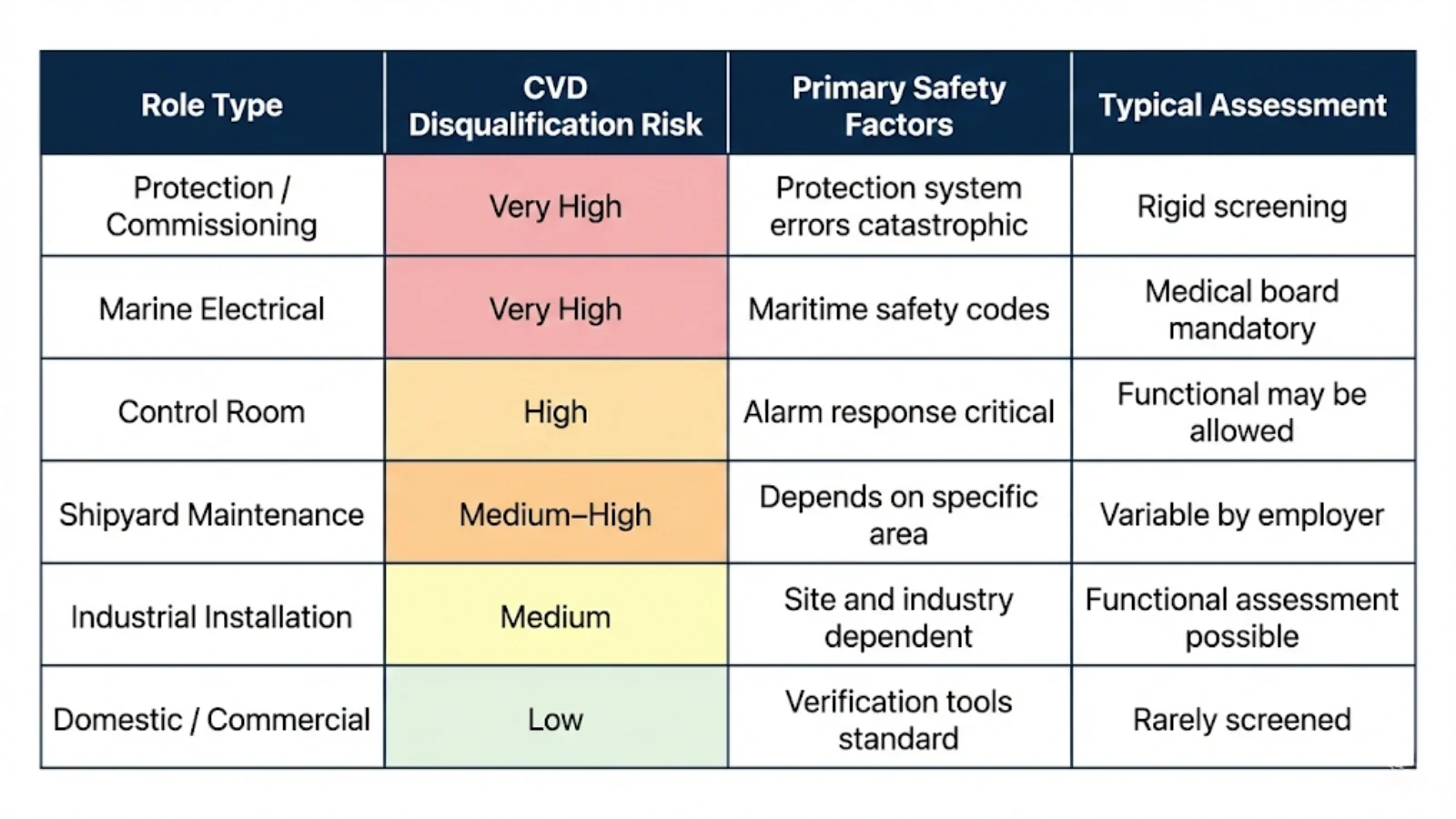
Very High Disqualification Risk:
Protection and commissioning roles: Working with high-voltage protection relays, circuit breakers, and interlocking logic leaves zero margin for error. Incorrect wiring in protection systems could prevent fault isolation, causing cascading failures affecting entire facilities or vessels. Indian shipyards and heavy industry PSUs almost universally require normal colour vision for these positions.
Marine electrical systems: Critical reliance on international maritime colour codes for navigation lights, emergency indicators, and communication systems makes colour vision mandatory. Work occurs in confined spaces, often under emergency conditions where rapid correct identification is essential for crew safety.
High Disqualification Risk:
Control room and instrumentation: Monitoring safety-critical software interfaces and hardware panels where colour denotes alarm severity (red for critical, amber for warning, green for normal). Delayed response to colour-coded alarms could postpone emergency actions affecting plant stability or vessel safety. Many employers require normal colour vision, though some allow mild deficiency with documented functional capability.
Shipyard electrical maintenance: Depends heavily on specific work area. Maintenance involving live high-voltage systems, emergency equipment, or safety-critical installations typically requires normal colour vision. General maintenance in less critical areas might have flexibility.
Medium Disqualification Risk:
Industrial electrical installation: Standards vary by industry sector and employer risk profile. Heavy chemical or petrochemical industries apply stricter requirements due to explosion hazards. General manufacturing or commercial building projects may assess more flexibly, particularly for supervised roles where verification procedures are standard.
Electrical design and engineering: Office-based positions focusing on calculations, specifications, and CAD drawings have lower colour vision requirements. However, some employers still mandate normal vision because design engineers may need site presence during commissioning or troubleshooting.
Low Disqualification Risk:
Domestic and commercial electrical work: Lower voltage systems, simplified wiring standards (brown/blue/green-yellow), and routine use of verification tools make these roles more accessible. Private sector employers rarely screen for colour vision, focusing instead on demonstrated competence and safe work practices.
Thomas Jevons, Head of Training with 20+ years experience, provides international context:
"Shipyard electrical standards vary significantly internationally. Some countries mandate colour vision screening for any marine electrical work. Others assess functional capability through practical demonstration in conditions matching actual work environments. Both approaches prioritise safety but use different verification methods."
Thomas Jevons, Head of Training
What to Do If You're Targeting These Roles
If you’re interested in shipyard or heavy industrial electrical work but have concerns about colour vision, strategic planning prevents wasted effort and disappointment.
Research before training investment: Specialised marine electrical training or heavy industry qualifications require significant time and money. Before committing, verify whether colour vision requirements would block employment regardless of technical competence.
Read recruitment notifications carefully: Job advertisements and PSU recruitment notices use specific language indicating medical requirements. Keywords to watch for include:
“Safety-critical duties required” “Category A medical clearance mandatory” “Occupational health assessment as per company standards” “Normal colour perception essential” “Marine electrical work – DGS medical standards apply”
These phrases signal rigorous colour vision assessment. Their absence doesn’t guarantee flexibility, but their presence confirms strict evaluation.
Query employers proactively: Contact HR departments or recruitment agencies early in the application process. Frame enquiries professionally, focusing on understanding requirements rather than seeking exceptions:
“Could you please clarify the colour vision standards for this position? Specifically, does the role require normal colour perception, or is functional assessment available for mild deficiency?”
This approach demonstrates safety awareness and professional maturity while gathering information to make informed career decisions.
Consider functional testing: If you have mild colour vision deficiency and fail initial Ishihara screening, ask whether the employer offers secondary assessment through lantern tests or practical workplace demonstrations. Some progressive employers use these methods to distinguish between screening test failure and actual functional incapability.
Explore alternative specialisations: If safety-critical shipyard work is medically closed, electrical expertise applies across many sectors. Those wondering if you can work as an electrician with colour blindness will find considerably more flexibility in domestic, commercial, and some industrial settings where systematic verification procedures reduce reliance on colour alone.
International pathway consideration: Standards vary between countries. UK electrical work, for instance, focuses on competence demonstrated through NVQ portfolios rather than medical screening.
Joshua Jarvis, Placement Manager at Elec Training, notes:
"What determines employability in UK electrical work is demonstrated competence through portfolios and practical assessment. If someone can prove they work safely using proper testing and verification procedures, that's what matters to employers, not screening test results."
Joshua Jarvis, Placement Manager
Alternative Electrical Career Paths
A colour vision deficiency diagnosis doesn’t end electrical career prospects. It redirects focus toward roles where functional capability matches requirements.
Electrical design and engineering: Office-based positions focusing on circuit calculations, load assessments, protection coordination studies, and CAD drawings rely on technical knowledge rather than hands-on colour identification. While some site presence might be required during commissioning, the primary work involves specifications and documentation.
Electrical estimation and project management: These roles leverage electrical knowledge for tendering, project planning, resource allocation, and client liaison. Colour vision isn’t relevant to cost estimation, programme scheduling, or contract management.
Domestic and commercial electrical installation: Private sector electrical work in residential and commercial buildings offers significantly more flexibility. Standard wiring colour codes (brown for live, blue for neutral, green-yellow for earth) combined with routine use of voltage testers, continuity meters, and systematic verification procedures make these roles accessible for many with mild colour vision deficiency.
Renewable energy installation: Solar PV, wind turbine electrical systems, and EV charging point installations often involve standardised colour-coded cabling with comprehensive verification requirements. These growing sectors prioritise competence and safety procedures over screening tests.
Electrical maintenance (non-safety-critical): Maintenance roles in commercial buildings, data centres, or general manufacturing (excluding heavy chemical or high-hazard industries) may have relaxed colour vision requirements. Work focuses on planned maintenance, testing, and repair rather than emergency commissioning or protection system setup.
Training and education: Electrical trainers, assessors, and vocational instructors use their technical knowledge to teach others. While some practical demonstration is involved, the emphasis is on explanation, assessment, and verification rather than rapid colour identification under pressure.
Technical support and application engineering: Manufacturers of electrical equipment, protection relays, or instrumentation systems employ electrical engineers for customer support, product application guidance, and technical troubleshooting. These roles combine electrical expertise with communication skills.
For those exploring alternative career paths in electrical work after shipyard or heavy industry medical rejection, the key is identifying sectors where systematic procedures, verification tools, and adequate time for double-checking ensure safety regardless of colour perception. These aren’t “workarounds” but legitimate career paths that match functional capabilities appropriately.

Shipyards and heavy industrial electrical roles apply significantly stricter colour vision standards than domestic or commercial electrical work. This reflects genuine safety requirements in high-hazard environments where identification errors could cause catastrophic consequences.
Safety-critical positions including protection and commissioning, marine electrical systems, and control room operations face very high disqualification likelihood for colour vision deficiency. Industrial installation and maintenance roles show more variability depending on specific employer and sector.
Medical boards assess colour vision through screening tests like Ishihara plates, with some employers allowing functional assessment for borderline cases. However, many Indian PSUs and shipyards maintain rigid standards without secondary evaluation, prioritising zero-risk policies over individual functional capability.
If you have colour vision deficiency and target shipyard or heavy industry electrical work:
- Research employer medical requirements before training investment
- Look for “safety-critical” keywords in job notifications indicating strict assessment
- Query HR proactively about specific colour vision standards and functional testing availability
- Understand that medical board rejection doesn’t reflect your technical competence but systemic risk management
- Explore alternative electrical sectors (domestic, commercial, design, renewable energy) where requirements are more flexible
International variation in standards means that colour vision requirements aren’t universal. Some countries assess functional capability through practical demonstration rather than screening tests, creating opportunities if domestic pathways are blocked.
The key is realistic career planning that matches your capabilities with appropriate roles, ensuring both your professional satisfaction and workplace safety.
FAQs
What do employers mean by “normal colour vision” in shipyard and heavy industrial electrical roles?
“Normal colour vision” is typically shorthand for being able to reliably distinguish key colours used for identification and safety in electrical systems (commonly red/green/blue, plus colours used in wiring identification and status indication).
In shipyards and heavy industry, the reason is simple: colour is still used as a fast, primary cue for things like:
- identifying conductors and terminations in multi-core cables
- reading panel status lights (fault/healthy/warning states)
- recognising alarms, interlocks, and safety states
- marine systems where signal recognition and fault indication can be colour-led
Employers usually don’t define it clinically in adverts. In practice it means: you must pass the organisation’s medical board colour vision test(s), under the medical fitness standard used for that recruitment.
What this means in practice
- “Normal” does not mean perfect eyesight; it usually means no colour vision deficiency that fails the employer’s pass standard.
- Most employers rely on pass/fail outcomes from approved tests, rather than debating definitions.
How to verify for a real job advert
- Download the full notification / annexures and search: “medical standards”, “colour vision”, “fitness”, “visual acuity”.
- If unclear, ask HR: which tests are used and whether any secondary testing exists after a fail.
Sources (plain URLs):
https://www.dgshipping.gov.in/WriteReadData/userfiles/file/Medical_Examination_Rules_2015.pdf
https://www.hse.gov.uk/pubns/books/hsg85.htm
https://assets.publishing.service.gov.uk/government/uploads/system/uploads/attachment_data/file/1133796/MSN_1886_Amendment_2.pdf
https://www.mazagondock.in/pdf/career/Advertisement_for_Executive_Trainees.pdf
Why are colour vision standards stricter in shipyards, marine electrical work, and high-hazard industrial plants than in domestic electrical work?
Because the risk profile is different.
In shipyards and high-hazard plants, a colour misidentification can contribute to high-consequence failures (arc flash risk, hazardous area errors, safety system faults, or plant-wide shutdown risks). Employers therefore screen more tightly to reduce the chance of a predictable human-factor error in a safety-critical environment.
Domestic electrical work can still be hazardous, but the systems are usually less complex, less densely colour-dependent, and may be easier to control with labelling, checks, and simple verification steps. Some sectors therefore take a more flexible, risk-assessed approach.
What this means in practice
- Safety-critical environments often prefer prevention by screening, not post-hoc accommodation.
- Standards tend to be least flexible where hazardous areas, high voltage, marine systems, or emergency response dependence is involved.
How to verify for a real job advert
- Look for phrases like “safety-critical”, “hazardous area”, “marine systems”, “explosive atmosphere”, then cross-check the medical annexure.
Sources (plain URLs):
https://www.dgshipping.gov.in/Content/PageUrl.aspx?page_name=Medical
https://www.hse.gov.uk/pubns/indg231.pdf
https://www.osha.gov/laws-regs/regulations/standardnumber/1910/1910.179
https://www.factoriesact.in/
Which specific electrical tasks in shipyards/industry rely most on colour identification?
The most colour-dependent tasks tend to be the ones where fast recognition and dense wiring/indications matter:
- Multi-core cables / terminations: identifying conductors accurately, often in poor lighting and tight spaces
- Control panels and switchboards: reading indicator lights and states quickly (fault/healthy/warn)
- Alarms and signalling: responding correctly under pressure
- Marine systems: navigation-related circuits and marine switchboards where signal colours and conventions matter
- Instrumentation terminations: correct connection of terminals, loops, and interface points (often colour-led plus labelling)
What this means in practice
- These tasks are commonly treated as safety-sensitive because mistakes can scale quickly.
- Lighting, grime, and ageing can reduce colour clarity, which is why employers want high confidence in recognition.
How to verify for a real job advert
- Scan duties for: “control panels”, “multi-core”, “switchboard”, “PLC”, “alarms”, “signalling”, “commissioning”.
- Then check medical standards for explicit “colour vision” disqualification.
Sources (plain URLs):
https://webstore.iec.ch/publication/2779
https://www.hse.gov.uk/pubns/books/hsr25.htm
https://www.osha.gov/laws-regs/regulations/standardnumber/1910/1910.303
https://www.dgshipping.gov.in/WriteReadData/userfiles/file/DGS_Circular_001_2015.pdf
https://journals.lww.com/joem/fulltext/2010/05000/Color_Vision_Deficiency_in_Industrial_Workers.10.aspx
What makes an electrical role “safety-critical” in shipyards and heavy industry, and who decides?
A role is generally classed as safety-critical when an error could plausibly lead to serious injury, multiple casualties, major equipment damage, environmental harm, or loss of control of a critical system.
Who decides varies, but commonly includes:
- the employer’s safety / risk / engineering leadership
- regulatory expectations for the sector
- the recruiting organisation’s occupational health / medical board, applying the published medical standard
What this means in practice
- The same qualification can be treated differently depending on whether the employer classifies the job as safety-critical.
- Screening often becomes stricter when the role includes HV work, hazardous areas, marine systems, emergency response dependence, or commissioning/protection.
How to verify for a real job advert
- Check if the advert labels the post safety-critical or references hazard classification.
- Look in annexures for medical category terms (e.g., “fit / unfit” categories).
Sources (plain URLs):
https://www.iso.org/standard/51528.html
https://www.hse.gov.uk/managing/risk.htm
https://www.osha.gov/laws-regs/regulations/standardnumber/1910/1910.119
https://www.factoriesact.in/
https://www.theiet.org/media/9611/safety-critical-systems.pdf
Which roles carry the highest disqualification risk for colour vision deficiency?
Typically, the highest risk roles are those with dense colour-coded interfaces or where errors have high consequence:
- Protection / commissioning: relays, testing, switching states, live verification contexts
- Marine systems electricians: vessel systems, trials, marine switchboards/signalling conventions
- Control room / operations monitoring: alarms, HMI states, rapid-response decisions
- Instrumentation / process environments: terminations and controls in hazardous/process-critical areas
What this means in practice
- These roles are more likely to be treated as non-negotiable for colour vision standards.
- Private employers sometimes use task-based assessment; many PSUs apply stricter pass/fail rules.
How to verify for a real job advert
- Search the recruitment PDF for “colour vision” and see if it lists automatic disqualification.
- Cross-check whether the role is described as safety-critical.
Sources (plain URLs):
https://www.dgshipping.gov.in/Content/PageUrl.aspx?page_name=ShipBuilding
https://www.hse.gov.uk/pubns/indg163.pdf
https://www.osha.gov/process-safety-management
https://journals.lww.com/optvissci/fulltext/2015/08000/Color_Vision_Deficiency_in_Professional_Drivers.12.aspx
https://www.ntpc.co.in/sites/default/files/downloads/MedicalStandards.pdf
How do medical boards assess colour vision, and what’s the typical screening process?
A typical screening flow looks like this:
- Basic medical intake and vision checks
- Colour vision screening (commonly Ishihara under standard lighting)
- If permitted and relevant: secondary test (often a lantern test)
- Recorded outcome: fit / unfit against the role’s medical standard
- If the employer allows it: appeal / re-test process via a designated pathway
What this means in practice
- Many boards operate a strict pass/fail standard for safety-critical roles.
- Secondary testing is not guaranteed; it depends on the employer’s published standard.
How to verify for a real job advert
- Look for terms like “medical board”, “Ishihara”, “lantern test”, “re-examination”, “appeal” in annexures.
Sources (plain URLs):
https://www.dgshipping.gov.in/WriteReadData/userfiles/file/MS_Notice_01_of_2015.pdf
https://assets.publishing.service.gov.uk/government/uploads/system/uploads/attachment_data/file/1133796/MSN_1886_Amendment_2.pdf
https://www.hse.gov.uk/pubns/priced/l25.pdf
https://www.mazagondock.in/pdf/career/Medical_Fitness.pdf
Which tests are most commonly used, and what do they measure?
- Ishihara plates: screens mainly for red–green colour vision deficiency; good as a quick discriminator
- Lantern tests (e.g., signal lights): assesses functional recognition of coloured lights in realistic conditions (often used in maritime contexts)
- Functional / task-based assessments (less common in PSUs): evaluates whether you can safely complete real tasks even if a deficiency is present
What this means in practice
- Ishihara is often the gatekeeper.
- Lantern tests tend to matter more where signal recognition is fundamental (maritime-linked roles).
How to verify for a real job advert
- Search for “Ishihara”, “lantern”, “Holmes-Wright”, “functional assessment” in the medical annexure.
Sources (plain URLs):
https://www.dgshipping.gov.in/WriteReadData/userfiles/file/Medical_Examination_Rules_2015.pdf
https://assets.publishing.service.gov.uk/government/uploads/system/uploads/attachment_data/file/848720/MSN_1839__M_F__Amendment_1.pdf
https://bjo.bmj.com/content/84/5/538
https://www.hse.gov.uk/research/rrpdf/rr365.pdf
https://www.aoa.org/healthy-eyes/eye-and-vision-conditions/color-vision-deficiency
If someone fails initial screening, are re-tests, appeals, or secondary assessments offered?
Sometimes, but it depends on:
- the employer’s policy
- whether the role is treated as safety-critical
- whether the medical standard provides a secondary pathway (e.g., lantern test)
In some systems, re-tests are only allowed where procedural error is claimed, not to overturn a genuine deficiency.
What this means in practice
- Appeals can exist but may be limited and tightly controlled.
- Outcomes vary more by employer than by any universal right.
How to verify for a real job advert
- Search the recruitment PDF for: “appeal”, “review medical board”, “re-examination”, “referee”.
Sources (plain URLs):
https://www.dgshipping.gov.in/WriteReadData/userfiles/file/DGS_Order_04_of_2016.pdf
https://assets.publishing.service.gov.uk/government/uploads/system/uploads/attachment_data/file/1133796/MSN_1886_Amendment_2.pdf
https://www.hse.gov.uk/equality/colour-vision.htm
https://www.icohweb.org/site/multimedia/core_documents/pdf/icoh_guidelines_occupational_visual_capability.pdf
Do standards vary by employer, sector, or country, and how should candidates verify before applying?
Yes. Variation is common across:
- country (India often more prescriptive; UK often more risk-assessed outside maritime)
- sector (maritime / shipyards typically stricter)
- employer (PSUs often more standardised; private industry sometimes more flexible)
What this means in practice
- Don’t assume one employer’s rule applies to another.
- Verification up front can save you time and disappointment.
How to verify for a real job advert
- Download the full notification and search: “medical standards”, “colour vision”, “Ishihara”.
- Email HR to confirm test type and whether any secondary testing exists.
- If the advert references a regulator standard, cross-check that regulator page.
Sources (plain URLs):
https://www.dgshipping.gov.in/Content/MedicalExaminers.aspx
https://www.hse.gov.uk/pubns/guidance/e3.pdf
https://assets.publishing.service.gov.uk/government/uploads/system/uploads/attachment_data/file/848720/MSN_1839__M_F__Amendment_1.pdf
https://www.mazagondock.in/pdf/career/Medical_Standards.pdf
https://www.gov.uk/government/publications/equality-act-guidance
If shipyard / safety-critical industrial electrical work is medically closed, what alternatives are realistic?
Common alternatives that reduce reliance on colour-dependent tasks include:
- Electrical design (schematics, calculations, documentation)
- Estimating / commercial / tendering
- Project coordination / project management
- Domestic and light commercial work (varies by employer; may be more adaptable with labelling and robust test processes)
- Renewables (varies by role; some installation work still uses colour cues, but many systems are heavily labelled and tested)
What this means in practice
- Many “electrical careers” are not field wiring in hazardous environments.
- The practical route is to target roles where colour is not a primary safety control.
How to verify for a real job advert
- Check whether the advert omits strict medical standards or safety-critical classification.
- Look for roles that are office-based or design-led, and confirm any medical requirements in writing.
Sources (plain URLs):
https://www.theiet.org/career/routes-to-engineering/
https://www.tatapower.com/careers.aspx
https://www.osha.gov/electrical
https://mnre.gov.in/solar/off-grid/standards-specifications
https://www.hse.gov.uk/work-equipment-machinery/puwer.htm
References
- Health and Safety Executive (HSE) – Colour Vision Examination Guidelines – https://www.hse.gov.uk/pubns/ms7.htm
- Institution of Engineering and Technology (IET) – Colour Vision in the Workplace – https://www.theiet.org/media/9460/colour-vision-in-the-workplace.pdf
- Directorate General of Shipping, India – Medical Standards for Seafarers – https://www.dgshipping.gov.in/
- Maritime and Coastguard Agency (MCA) – Seafarer Medical Examination System – https://www.gov.uk/government/publications/seafarer-medical-examination-system-mcms-procedural-manual
- Cochin Shipyard Limited – Recruitment and Medical Standards – https://www.cochinshipyard.com/
- Mazagon Dock Shipbuilders Limited – Careers and Medical Fitness – https://www.mazagondock.in/
- Garden Reach Shipbuilders & Engineers – Medical Requirements – https://www.grse.in/
- Bharat Heavy Electricals Limited (BHEL) – Medical Examination Rules – https://careers.bhel.in/
- National Thermal Power Corporation (NTPC) – Recruitment Medical Standards – https://www.ntpc.co.in/
- Larsen & Toubro – EPC Medical Fitness Standards – https://www.larsentoubro.com/
- International Electrotechnical Commission (IEC) – Electrical Safety Standards – https://www.iec.ch/
- Occupational Safety and Health Administration (OSHA) – Electrical Safety Guidelines – https://www.osha.gov/
- BS 7671:2018+A2:2022 – Requirements for Electrical Installations (IET Wiring Regulations) – https://electrical.theiet.org/bs-7671
Note on Accuracy and Updates
Last reviewed:16 February 2026. This page is maintained; we correct errors and refresh guidance as medical standards, shipyard recruitment policies, and occupational health practices evolve. Information reflects Indian shipyard and heavy industry colour vision requirements current as of February 2026 but subject to updates in individual employer notifications. International comparison data reflects regulatory approaches in referenced countries as of early 2026. Medical assessment practices described are based on publicly available recruitment documents and occupational health standards. Candidates should verify specific requirements in current recruitment notifications from target employers. Colour vision test descriptions are educational overviews, not diagnostic guidance. Consult qualified ophthalmologists for personal medical assessment. This article provides informational guidance on career planning for electrical roles with colour vision considerations, not medical advice on colour vision conditions. Next review scheduled following significant changes to Indian shipyard medical standards, heavy industry occupational health requirements, or international maritime electrical work regulations.
