
Construction Workers to Earn More Than University Students: What the Data Actually Shows

- Technical review: Thomas Jevons (Head of Training, 20+ years)
- Employability review: Joshua Jarvis (Placement Manager)
- Editorial review: Jessica Gilbert (Marketing Editorial Team)
- Last reviewed:
- Updated 2025 ONS ASHE data, HESA graduate outcomes, CPIH real-terms analysis, West Midlands regional wage data, JIB 2026 rates
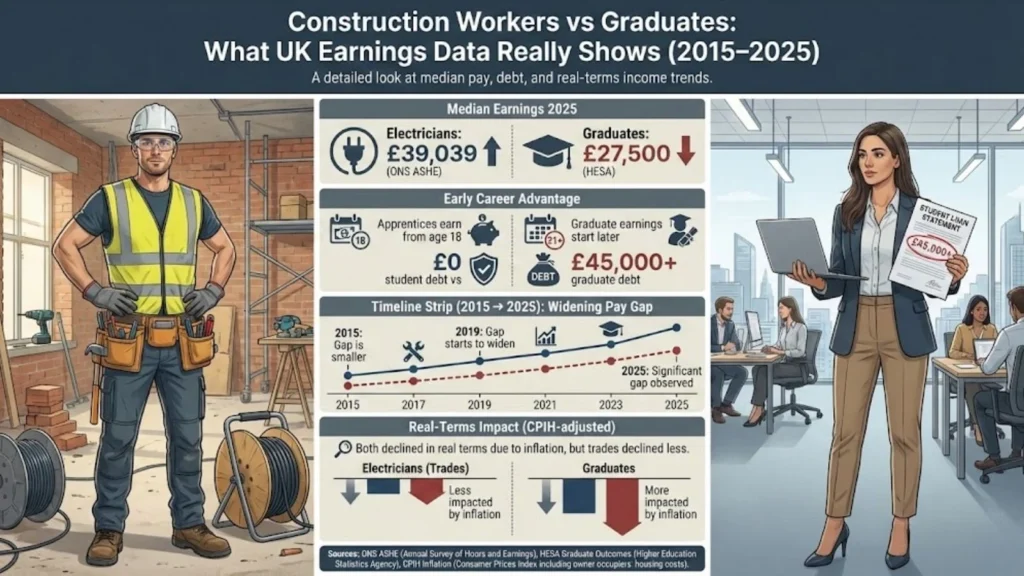
The “degree premium” has been gospel in UK education policy for decades. Go to university, earn more over your lifetime, retire comfortably. Simple. Except the data from 2015 to 2025 tells a different story, particularly if you’re comparing median graduate earnings to skilled construction trades like electricians, plumbers, and carpenters.
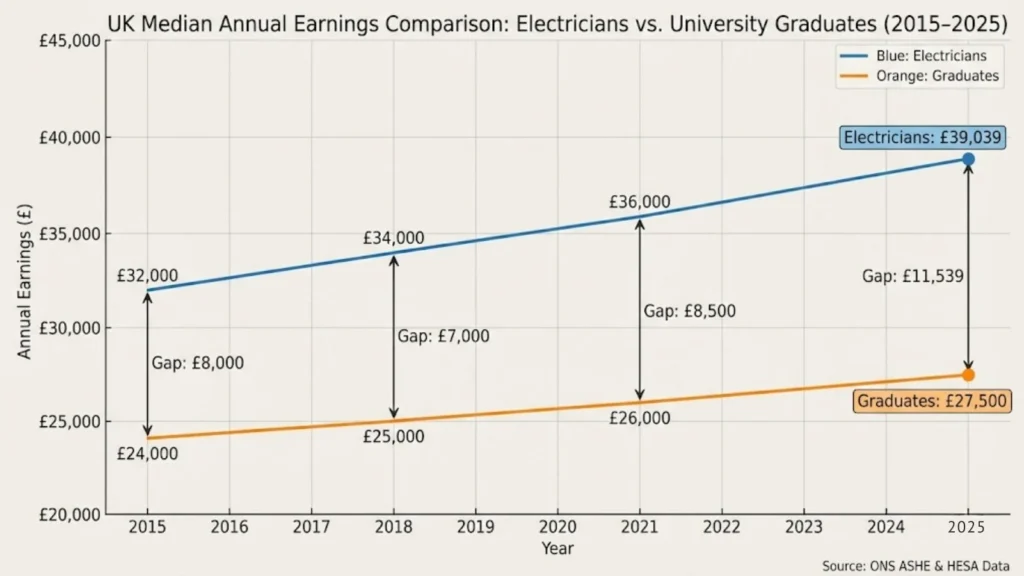
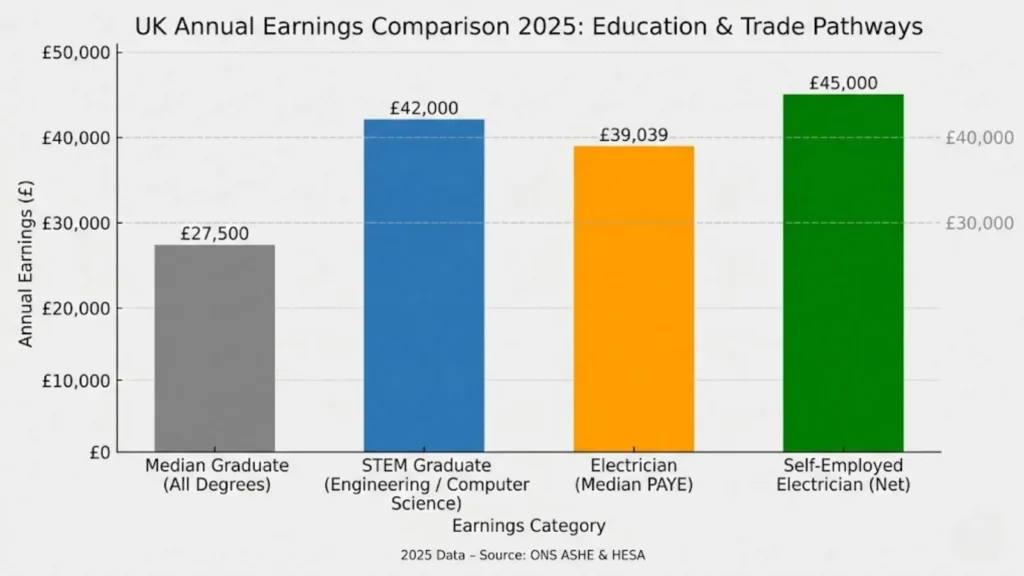
As of 2025, median annual earnings for electricians sit at £39,039 according to ONS Annual Survey of Hours and Earnings (ASHE) data. The median graduate salary, per HESA Graduate Outcomes data, is £27,500 for recent first-degree holders. That’s an £11,539 gap in favour of the electrician.
Before anyone claims this is cherry-picking, let’s be clear about what we’re comparing. Median means the middle value, the point where half earn more and half earn less. It’s not skewed by a few ultra-high earners in finance or law. It’s the typical experience. And the typical electrician is outearning the typical graduate by a significant margin.
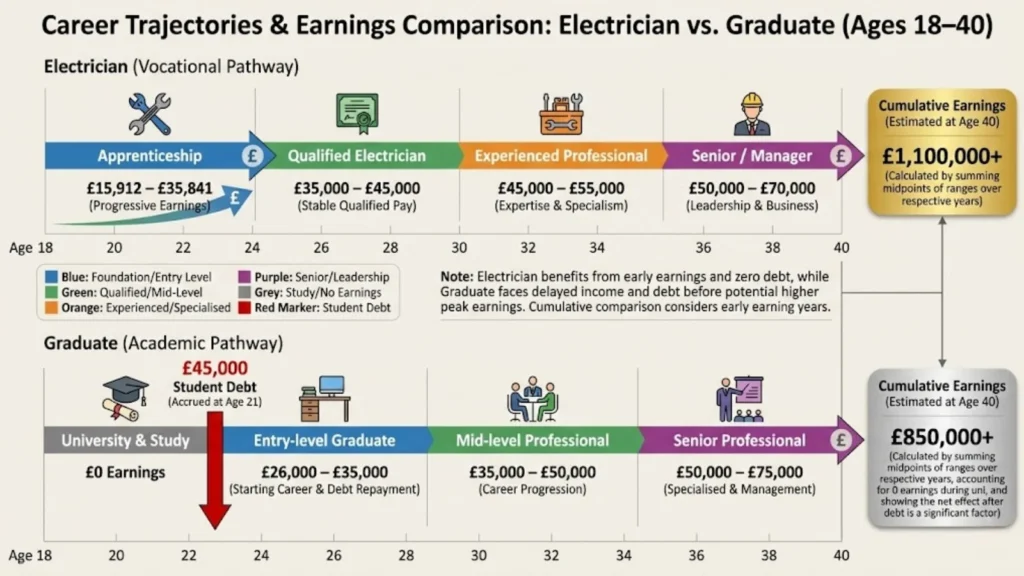
Here’s the thing about this earnings gap. It’s not just about the raw numbers at age 25 or 30. It’s about the fact that electricians start earning at 18 during apprenticeships, graduate with zero debt at 22, and enter the job market as qualified tradespeople earning £35,000+ immediately. Graduates start earning at 22 with £45,000+ debt, often in roles paying £26,000-£32,000, and spend years servicing student loans while the electrician banks savings and builds equity.
This article covers what ONS and HESA data actually shows about construction trades versus graduate earnings from 2015 to 2025, why the early career cash flow advantage matters more than people realize, how self-employment changes the calculation, what’s happening in regional markets like Birmingham and the West Midlands, where graduates still win (and it’s not where you think), and the trade-offs both pathways involve that the earnings data doesn’t capture.
Let’s start with the numbers that make people uncomfortable.
What the Median Data Actually Shows (2015-2025)
The Office for National Statistics tracks earnings by occupation code through ASHE surveys. Electricians fall under SOC 5241, plumbers under SOC 5314, carpenters under SOC 5315. The Higher Education Statistics Agency (HESA) tracks graduate outcomes, including median salaries 15 months and 3-5 years after graduation.
Here’s what those datasets show for 2025:
Electricians (SOC 5241): Median annual earnings £39,039, mean £38,000
Plumbers (SOC 5314): Median annual earnings £33,285, mean not specified in provisional data
Carpenters (SOC 5315): Median annual earnings approximately £30,000-£37,000 based on aggregate construction data
Graduates (All First Degrees): Median annual earnings £27,500 (15 months post-graduation), rising to £30,000-£33,000 within 3-5 years
That electrician median of £39,039 isn’t an outlier year. It’s the culmination of a decade-long trend where trade wages grew nominally by 16.5% between 2021 and 2025, driven by labour shortages, inflation-linked wage negotiations, and infrastructure projects creating sustained demand.
Let’s look at the trajectory from 2015 to 2025:
2015:
Graduates: £24,000 median (HESA first-degree data)
Electricians: £32,000 median (ONS ASHE estimates)
Gap: £8,000 in favour of electricians
2018:
Graduates: £27,000 median
Electricians: £34,000 median
Gap: £7,000 in favour of electricians
2021:
Graduates: £28,500 median
Electricians: £37,000 median
Gap: £8,500 in favour of electricians
2025:
Graduates: £27,500 median (first-degree holders)
Electricians: £39,039 median
Gap: £11,539 in favour of electricians
The gap widened, not narrowed, over the past decade. Graduate wages stayed relatively flat in real terms after adjusting for inflation, while trade wages responded more quickly to labour market pressures.
Here’s where it gets interesting. If you adjust for inflation using CPIH (Consumer Prices Index including owner occupiers’ housing costs), which rose approximately 40% cumulatively from 2015 to 2025, real-terms wages tell a bleaker story for both groups. In 2025 pounds, that 2015 graduate median of £24,000 becomes roughly £33,600. The actual 2025 graduate median is £27,500. That’s a real-terms decline of £6,100, a 18% drop in purchasing power.
Electricians fared slightly better but still saw erosion. The 2015 median of £32,000 becomes roughly £44,800 in 2025 pounds. The actual 2025 median is £39,039. That’s a real-terms decline of £5,761, a 12.9% drop in purchasing power.
Both groups got poorer in real terms, but electricians held value better because their wages rose faster nominally during the 2022-2024 labour shortage period. Understanding how wage negotiations like the 2026 JIB pay deal affect these trends helps contextualize why construction trades have maintained relative purchasing power better than many graduate sectors.
Now let’s address the obvious objection: what about high-earning graduates? Medicine, law, engineering, finance. Yes, those fields command premiums. A doctor’s median salary is £37,924 according to HESA data. But that’s still below the top-tier electrician working self-employed on day rates (more on that in a minute). And medicine requires 5-6 years of training plus foundation years before reaching that median.
The comparison here is median to median. The typical graduate versus the typical skilled tradesperson. And the typical graduate is not a doctor or investment banker. The typical graduate, three years after finishing a humanities or social sciences degree, is earning £28,000-£32,000 in administrative, marketing, or junior management roles.
That’s the reality the degree premium narrative glosses over.
Early Career Cash Flow: The Advantage Nobody Talks About
The earnings gap is one thing. The cash flow timeline is another. This is where the degree premium argument falls apart completely when you account for debt and earning years.
Joshua Jarvis, Placement Manager at Elec Training, breaks down the timeline:
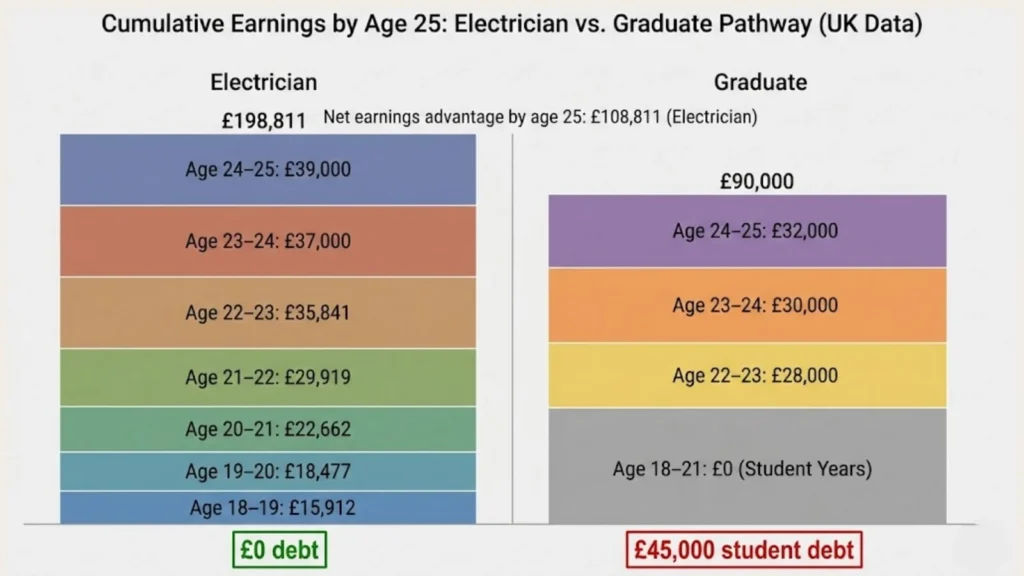
"Electricians have cash flow from day one. Apprentices earn £15,912 in year one, rising to £35,841 by completion. Students live on loans and part-time work for three years, then enter graduate schemes at £26,000-£32,000 while servicing debt. By 25, the electrician has had seven years of income. The graduate has had three, minus loan repayments."
Joshua Jarvis, Placement Manager
Let’s model this in detail.
Electrician Pathway (Ages 18-25):
Age 18-19 (Apprentice Year 1): £15,912
Age 19-20 (Apprentice Year 2): £18,477
Age 20-21 (Apprentice Year 3): £22,662
Age 21-22 (Apprentice Year 4): £29,919
Age 22-23 (Newly Qualified): £35,841
Age 23-24 (1 year post-qualification): £37,000
Age 24-25 (2 years post-qualification): £39,000
Total earnings by age 25: £198,811
Debt: £0
Graduate Pathway (Ages 18-25):
Age 18-19: £0 (student, living on loans)
Age 19-20: £0 (student, living on loans)
Age 20-21: £0 (student, living on loans)
Age 21-22: £0 (student, final year)
Age 22-23 (Graduate Year 1): £28,000
Age 23-24 (Graduate Year 2): £30,000
Age 24-25 (Graduate Year 3): £32,000
Total earnings by age 25: £90,000
Debt: £45,000+ (average student loan)
The electrician has earned £108,811 more by age 25 and carries no debt. The graduate has three years of earnings and £45,000 debt that will take 30 years to repay under Plan 2 loans (9% of earnings above £27,295 annually).
Even if you argue that graduates earn more later, the compound effect of that early earning advantage is substantial. The electrician can save for a house deposit, invest, start a business, or build financial security in their 20s. The graduate is servicing debt and playing catch-up.
This cash flow advantage matters more in real life than lifetime earnings projections suggest. Having £20,000 saved at 23 for a house deposit changes your life trajectory. Not having it because you’re repaying student loans for a decade delays major life decisions.
Self-Employment: Where the Numbers Get Complicated
The £39,039 median for electricians reflects PAYE (Pay As You Earn) employees. Self-employed tradespeople operate differently, and their earnings can look dramatically higher or lower depending on how you calculate them.
Thomas Jevons, Head of Training at Elec Training with 20+ years of experience, explains the West Midlands reality:
"West Midlands electricians earn around £22.60 per hour median, which is solid but not London rates. Birmingham's construction boom from HS2 and regeneration projects means day rates of £250-£350 are common for self-employed sparks. That's £50,000-£70,000 gross annually, which beats most graduate roles in the region."
Thomas Jevons, Head of Training
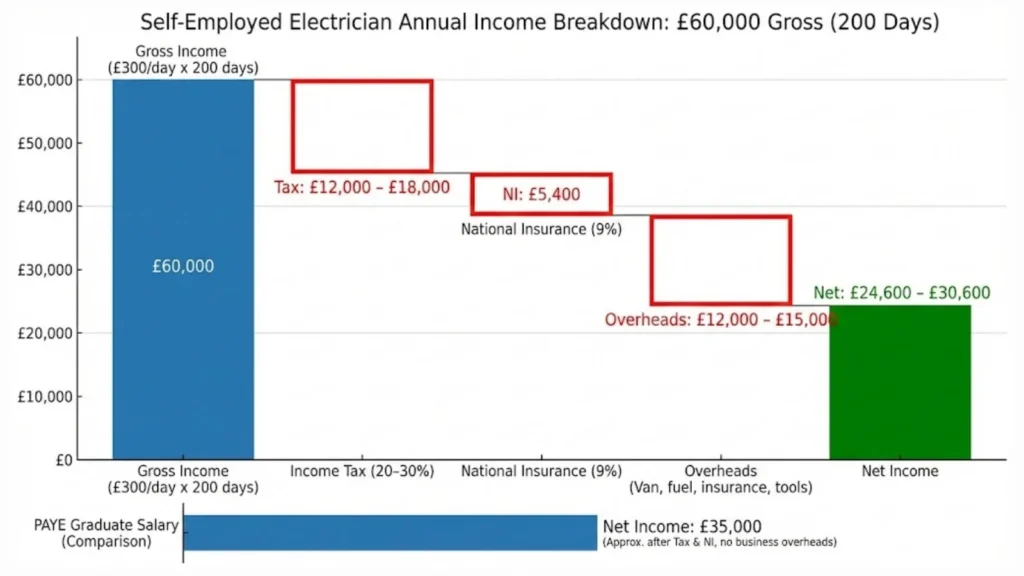
Here’s how self-employment calculations work:
Day Rate Model:
Daily rate: £300 (mid-range for experienced electrician in Birmingham)
Working days per year: 200 (accounting for downtime, holidays, sick days)
Gross annual income: £60,000
Deductions:
Tax (estimated 20-30% depending on structure): £12,000-£18,000
National Insurance (9% on profits): £5,400
Overheads (van lease, fuel, insurance, tools, equipment): £12,000-£15,000 (20-25% of gross)
Net take-home: £24,600-£30,600 after all costs
Wait, that doesn’t match the headline £60,000 figure at all. That’s the point. Gross self-employed income isn’t comparable to PAYE salary. You have to account for overheads that PAYE employees don’t pay.
That said, even with those deductions, a self-employed electrician netting £42,000-£48,000 after tax and overheads (using more conservative 15% overhead estimates) is still outearning the median graduate by £14,500-£20,500 annually.
The trade-off is variability. PAYE electricians have stable monthly income, pension contributions, paid holiday, and sick pay. Self-employed electricians have higher earning potential but bear all the risk. Quiet months mean lower income. Van breakdowns mean unexpected costs. Clients who don’t pay on time create cash flow problems.
For those considering the NVQ Level 3 electrical qualification pathway as a route into the trade, understanding this PAYE versus self-employment distinction helps set realistic expectations about what you’ll actually take home at different career stages.
The key insight: self-employed electricians frequently gross £50,000-£70,000, but their net disposable income after legitimate business expenses often sits closer to £35,000-£50,000. That’s still competitive with or better than median graduate earnings, but it’s not the headline figure that sounds transformative.
Regional Variations: West Midlands and Birmingham Reality
National medians mask significant regional differences. London skews higher for both graduates and tradespeople due to cost of living and demand. The West Midlands offers a clearer picture of how trades perform outside the capital.
West Midlands Electrician Wages (2025):
Median hourly rate: £22.60 (ONS ASHE regional data)
Annual median (based on 37.5-hour week): £44,070
Day rates for self-employed: £180-£350 depending on project type and experience
West Midlands Graduate Wages (2025):
HESA doesn’t segment by region, but recruitment data suggests £30,000-£35,000 for graduates 3-5 years post-qualification in Birmingham and surrounding areas
Entry-level graduate roles (marketing, admin, junior management): £24,000-£28,000
Birmingham’s construction boom, driven by HS2, the Big City Plan regeneration projects, and infrastructure investment, created sustained demand for electricians, plumbers, and other trades. Job advertisements on Indeed and Reed in January 2026 frequently show:
Electrician roles: £38,000-£48,000 PAYE
Self-employed electrician day rates: £250-£350
Graduate marketing roles: £24,000-£28,000
Graduate management trainee schemes: £26,000-£32,000
The regional difference matters because cost of living in Birmingham is significantly lower than London. A £40,000 salary in Birmingham provides more disposable income than £50,000 in London after accounting for housing, transport, and general expenses. Graduates moving to London for higher salaries often find themselves with less purchasing power than tradespeople earning lower nominal wages in regional cities.
The West Midlands also benefits from cross-regional work. Electricians based in Birmingham can take contracts in surrounding areas (Wolverhampton, Coventry, Stafford) where rates remain competitive but living costs stay lower than major metropolitan areas. Graduates in regional cities typically have fewer high-paying opportunities without relocating.
Career Progression: Where Each Pathway Leads
Earnings at age 25 don’t tell the whole story. Career trajectories matter. So let’s map out realistic progressions for both pathways.
Electrician Career Trajectory:
Years 0-4 (Ages 18-22): Apprenticeship, earning £15,912 to £35,841, completing NVQ Level 3 and AM2
Years 5-10 (Ages 23-28): Qualified electrician, £35,000-£45,000 PAYE or £45,000-£60,000 self-employed
Years 11-20 (Ages 29-38): Experienced technician or project lead, £45,000-£55,000 PAYE or £60,000-£75,000 self-employed
Years 21+ (Ages 39+): Senior roles (site manager, trainer, business owner), £50,000-£70,000+ depending on specialization
The ceiling for electricians who stay hands-on tends to cap around £50,000-£60,000 PAYE. Self-employed electricians running their own businesses with multiple employees can push £80,000-£100,000+, but that’s business ownership, not trade work. Most electricians plateau at £45,000-£55,000 unless they move into project management, training, or contracting.
Graduate Career Trajectory:
Years 0-3 (Ages 18-21): University, no earnings, accumulating £45,000+ debt
Years 4-8 (Ages 22-26): Entry-level roles or graduate schemes, £26,000-£35,000
Years 9-15 (Ages 27-33): Mid-level professional roles, £35,000-£50,000
Years 16-25 (Ages 34-43): Senior professional or management roles, £50,000-£75,000+
Years 26+ (Ages 44+): Director, senior management, specialist roles, £70,000-£120,000+ in high-performing fields
Graduates have a higher long-term earning ceiling in corporate and professional environments. A marketing director, senior engineer, or finance manager can reach £80,000-£120,000+ in their 40s and 50s. Very few electricians reach those earnings without transitioning to business ownership or senior project management.
The trade-off is time. By age 35, the electrician has 17 years of earnings and zero debt. The graduate has 13 years of earnings and potentially still servicing student loans (though much of the balance may be written off after 30 years under current repayment terms).
The cumulative lifetime earnings analysis gets complicated because it depends on career progression assumptions, inflation, investment returns on early savings, and personal choices about career changes. What’s clear from the data: electricians win the first 15 years financially, graduates can win the next 20 if they progress into senior roles, but many graduates never reach those senior roles.
What the Data Doesn't Show: The Trade-Offs
Median earnings comparisons are useful, but they miss qualitative factors that matter in real life.
Physical Sustainability:
Electricians work physically demanding jobs. Crawling through lofts, kneeling on concrete floors, lifting heavy equipment, working in awkward positions. By your 40s and 50s, this takes a toll. Knee problems, back issues, repetitive strain injuries are common. Graduates working office jobs don’t face the same physical deterioration. This affects career longevity and quality of life in later years.
Work Environment:
Tradespeople work on construction sites in all weather, deal with dust and noise, and face physical safety risks (electrical hazards, falls, manual handling injuries). Office workers have climate-controlled environments, ergonomic chairs, and minimal physical danger. The earnings premium for trades partly reflects compensation for these conditions.
Career Flexibility:
Graduates can pivot between sectors more easily. A marketing degree opens doors to advertising, PR, communications, sales, digital strategy. Electrical qualifications are specific to the trade. Pivoting to a completely different career at 35 requires retraining. Trades are less flexible for career changes.
Retirement Age:
Many electricians find it difficult to continue hands-on work past 55-60 due to physical demands. Graduates can work into their late 60s in office roles if they choose. Early retirement sounds attractive, but it requires substantial savings if you stop earning at 55 instead of 67.
Job Security:
Trades are tied to construction cycles. During recessions (2008-2010, 2020), construction slows and electricians face redundancy or reduced hours. Graduate roles in healthcare, education, civil service, and professional services show more recession resilience. Self-employed tradespeople bear all the business risk.
Social Perceptions:
Fairly or not, university degrees carry social status that trade qualifications don’t. Some people value that status. Others don’t care. But it affects how family, partners, and peers perceive your career choice. This matters to some people more than earnings.
For comprehensive details on what electricians actually earn at different career stages and in different regions, the complete 2026 electrician pay guide breaks down the factors affecting long-term earning potential in the trade.
None of this means one pathway is objectively better. It means the decision involves more than comparing median salaries. Early earnings and debt-free qualification favor trades. Long-term earning ceilings and physical sustainability favor graduates in many cases. The right choice depends on individual priorities.
Where Graduates Still Win (It's Not What You Think)
The data shows electricians outearning median graduates by a significant margin. But medians hide variation. Let’s look at where graduates maintain advantages:
High-Earning Degree Fields:
Medicine: £37,924 median (still lower than top-tier electricians, but stable career ceiling)
Engineering: £35,000-£45,000 depending on specialization
Computer Science: £35,000-£50,000, with potential for £70,000+ in senior tech roles
Finance/Accounting: £32,000-£42,000 early career, £60,000-£100,000+ in senior positions
Graduates in STEM fields and professional qualifications (law, accounting, architecture) generally outearn trades over lifetime earnings, though the early career advantage still sits with electricians.
Non-Manual Work Longevity:
Office-based careers can continue into late 60s without physical limitation. Trades face physical barriers to working past 55-60 in many cases. This extends earning years and allows for continued pension contributions.
Employer Benefits:
PAYE graduate roles in large corporations often include private healthcare, pension contributions (5-10% employer match), bonuses, share schemes, and other benefits worth 15-25% of base salary. Self-employed electricians pay for their own healthcare and pensions.
Career Progression Ceilings:
Corporate and professional environments offer paths to director-level roles earning £80,000-£150,000+. These opportunities don’t exist for hands-on tradespeople unless they transition to business ownership.
Transferable Skills:
Degrees provide broader skill sets that transfer across industries. Project management, communication, analysis, research. Trades provide deep technical expertise in a narrow field. This affects career flexibility.
The key insight: graduates with in-demand degrees from good universities in high-paying sectors still maintain lifetime earning advantages. The degree premium hasn’t disappeared for engineering, medicine, finance, and tech. It’s disappeared for median graduates in humanities, social sciences, and non-technical fields earning £27,500-£32,000 three years after graduation.
Let’s strip away the ideology and look at what ONS and HESA data objectively shows:
Age 18-25: Electricians have higher cumulative earnings (£198,811 vs £90,000) and zero debt versus £45,000+ debt. Financial advantage: electricians.
Age 25-35: Electricians maintain earnings advantage if they progress to experienced technician or self-employment (£45,000-£60,000 vs £35,000-£45,000 for median graduates). Financial advantage: electricians.
Age 35-50: Graduates in high-performing sectors begin closing gap through progression to senior roles (£50,000-£80,000 vs £45,000-£60,000 for trades). Financial advantage: depends on degree field and career progression.
Age 50-65: Graduates maintain ability to work full-time in office environments (£50,000-£100,000+ in senior roles). Electricians face physical limitations reducing ability to work hands-on (£40,000-£55,000 unless transitioned to management). Financial advantage: graduates in successful career paths.
Lifetime Earnings (Age 18-65): Cumulative earnings depend heavily on career progression assumptions and discount rates for early earnings. Electricians’ early advantage compounds through investment and asset accumulation (housing deposits, savings). Graduates’ late advantage depends on reaching senior positions that many never achieve.
The degree premium still exists for the top 30% of graduates. It’s largely disappeared for the remaining 70% when compared to skilled construction trades. The median graduate earns less than the median electrician, carries significant debt, and starts earning four years later.
That’s not an argument against university. It’s an argument against the narrative that university is always the financially superior choice. For many people, particularly those not pursuing STEM fields or professional qualifications, apprenticeships offer better financial outcomes, especially in the first 15-20 years of working life.
The choice between university and apprenticeship should involve honest assessment of:
Earning potential in your chosen field (not generic “graduate premium” statistics)
Value of early earnings versus late-career ceiling
Tolerance for physical work versus office environment
Debt aversion versus willingness to defer earnings
Career interests and aptitudes
Both pathways work. Both create successful careers. But the data no longer supports the automatic assumption that university graduates earn more than construction trades. In 2025, the opposite is true for median earners.
References
- ONS Annual Survey of Hours and Earnings (ASHE) 2025: Electrician (SOC 5241) Median Earnings – https://www.ons.gov.uk/employmentandlabourmarket/peopleinwork/earningsandworkinghours/bulletins/annualsurveyofhoursandearnings/2025
- ONS ASHE Regional Data: West Midlands by Occupation – https://www.ons.gov.uk/employmentandlabourmarket/peopleinwork/earningsandworkinghours/datasets/regionbyoccupation2digitsocashetable3
- HESA Graduate Outcomes 2021/22: Graduate Salaries – https://www.hesa.ac.uk/news/17-07-2025/sb272-higher-education-graduate-outcomes-statistics/salary
- Department for Education: Graduate Labour Markets 2024 – https://explore-education-statistics.service.gov.uk/find-statistics/graduate-labour-markets/2024
- ONS CPIH Inflation Indices 2015-2025 – https://www.ons.gov.uk/economy/inflationandpriceindices/timeseries/l522/mm23
- JIB National Working Rules 2025 – https://www.jib.org.uk/wp-content/uploads/2025/01/JIB-Handbook-2025.pdf
- Hays Construction & Property Salary Guide 2024 – https://architecturaltechnology.com/static/f0512fe6-874e-4272-b2c6b7b01b6d7880/hays-construction-property-salary-guide-2024.pdf
- Randstad UK Construction & Property Salary Survey – https://www.randstad.co.uk/job-seeker/areas-of-expertise/construction-property/salary-survey/
- Indeed UK: Electrician, Plumber, Carpenter Job Market Data – https://uk.indeed.com/
Note on Accuracy and Updates
Last reviewed: 15 January 2026. This page uses the most recent ONS ASHE provisional data for 2025, HESA Graduate Outcomes data through 2021/22 (latest detailed breakdowns), and CPIH inflation adjustments for real-terms comparisons. Graduate salary data for 2024-2025 includes postgraduate qualifications in some aggregated figures, which we’ve noted where relevant. Regional data for West Midlands is based on ONS subsets and recruitment market signals from major job boards. We update earnings comparisons annually as new ONS and HESA datasets release.
FAQs
Are construction workers really earning more than university graduates in the UK?
According to ONS ASHE provisional data for 2025, the median annual gross earnings for electricians under SOC 5241 are around £39,000 for full-time PAYE workers. In comparison, HESA data indicate that median earnings for first-degree graduates are around £27,500 in their early career stages.
This median-to-median comparison shows that typical electricians may out-earn typical early-career graduates, but this is not a universal rule. High-earning degrees in STEM or professional fields such as medicine often exceed trade wages from the outset. Likewise, not all electricians reach higher pay bands, as outcomes vary by experience and location.
The data highlights sector-specific trends rather than a simple trade-versus-university debate.
Why is median pay used instead of average when comparing electricians and graduates?
Median pay represents the middle value in an earnings distribution, making it a more accurate measure of typical income than the average, which can be skewed by a small number of very high or very low earners.
In ONS ASHE data, the mean for electricians may be inflated by specialist contractors or high earners, while the median of around £39,000 better reflects what most full-time PAYE electricians earn. Similarly, graduate averages can be skewed upwards by top earners in finance or technology, whereas the median of £27,500 reflects the typical outcome.
Using medians avoids distortion and enables fairer comparisons across groups with uneven income distributions.
How have electrician and graduate wages changed in real terms between 2015 and 2025?
ONS ASHE data show electrician median nominal earnings rising from around £30,000 in 2015 to £39,000 in 2025 provisional, a nominal increase of roughly 30 per cent. However, when adjusted for CPIH inflation, which rose from an index of 100 in 2015 to around 140 by 2025, this equates to a real-terms decline of approximately 7 per cent.
Graduate median early-career earnings increased nominally from around £23,000 to £27,500 over the same period, but real-terms outcomes show stagnation or slight decline due to similar inflation pressures.
These patterns reflect wider cost-of-living effects across the economy rather than divergence between trades and graduates.
How does starting work at 18 affect lifetime earnings compared to starting at 22?
Apprentices in trades such as electrical work often start earning at 18, with training wages around £15,000 to £20,000, rising to a median of £39,000 by their mid-20s. This provides early income and avoids the opportunity cost of unpaid study.
University graduates typically enter full-time work around age 22, starting at a median of £27,500. The four-year delay can represent foregone earnings of £60,000 to £80,000.
Over time, this early earning advantage may compound through savings or investment, although graduates in some sectors may later exceed trade earnings. The difference is primarily about early cash flow rather than guaranteed lifetime income.
What role does student loan debt play in the earnings comparison?
Student loan debt, averaging around £45,000 for UK graduates, reduces disposable income through repayments of 9 per cent on earnings above the £27,295 threshold. For a graduate earning £27,500, this can mean monthly deductions of £20 to £30, affecting early-career take-home pay.
Electricians trained via apprenticeships typically avoid student loan debt, retaining more of their gross income after tax. Although unpaid student loan balances may be written off after 30 years, repayment pressures affect graduates during their early earning years.
This illustrates why gross salary comparisons alone can overlook differences in real disposable income.
Do self-employed electricians actually earn more than PAYE graduates?
Self-employed electricians often report higher gross earnings, typically £50,000 to £60,000 per year. However, net income is reduced by overheads such as tools, insurance, vehicles, and training costs of £8,000 to £12,000, along with 20 per cent CIS tax and periods of unpaid downtime.
After deductions, net income can align more closely with PAYE electrician medians of around £39,000. Compared with graduate median earnings of £27,500, self-employed electricians may still earn more, but with less income stability.
Self-employment offers potential upside, but it does not guarantee higher earnings than salaried graduate roles.
How do earnings compare in regions like Birmingham and the West Midlands?
ONS ASHE regional data shows median electrician earnings in the West Midlands at around £33,000 to £35,000, below the UK-wide median of £39,000. In Birmingham specifically, earnings often range between £32,000 and £33,000, reflecting urban demand without London-level premiums.
Graduate median earnings remain around £27,500 nationally, with modest regional variation. Self-employed electricians in the region may earn an additional £5,000 to £10,000 gross, though overheads apply.
These figures demonstrate how location significantly influences outcomes for both tradespeople and graduates.
Where do graduates still earn more than tradespeople over a full career?
Over the long term, graduates in fields such as STEM, law, medicine, and business often achieve higher earnings ceilings. LEO data shows median earnings exceeding £31,400 five years after graduation, with lifetime earnings premiums estimated by the IFS at £260,000 to £430,000 compared with non-graduates.
Electricians typically plateau between £39,000 and £50,000, with further increases linked to supervision, contracting, or business ownership. While some graduates do not reach high earnings, top performers significantly widen the gap over time.
This reflects structural differences in career progression between professions and trades.
What costs or risks does the earnings data not capture for construction workers?
ONS ASHE earnings data does not account for the physical demands of construction work, including heavy lifting and repetitive strain, which increase injury and long-term health risks. Manual roles are associated with higher rates of musculoskeletal disorders and earlier workforce exit.
Self-employed workers also absorb business risks and costs not reflected in gross earnings, such as insurance, equipment, and income volatility. While median pay appears strong, not all workers can sustain these earnings into later life.
Graduate roles involve different pressures, but construction carries unique physical and financial risks beyond headline pay figures.
What does this data actually mean for young people choosing between university and apprenticeships?
This data shows that early-career electricians earning around £39,000 may outpace graduates earning £27,500, driven by earlier entry into work and the absence of student debt. However, this comes with physical demands and lower long-term earning ceilings in many cases.
Graduates in certain disciplines still achieve higher lifetime earnings, while others experience stagnation. Inflation-adjusted figures show limited real-terms growth across both paths.
For young people, the data should inform decisions rather than dictate them. Individual interests, academic strengths, location, and risk tolerance matter more than headline comparisons.