

100,000 Electricians Needed by 2032: What the Forecast Actually Means (And What It Doesn’t)

- Technical review: Thomas Jevons (Head of Training, 20+ years)
- Employability review: Joshua Jarvis (Placement Manager)
- Editorial review: Jessica Gilbert (Marketing Editorial Team)
- Last reviewed:
- Changes: Updated with 2025 ONS employment data, apprenticeship starts, and regional demand signals
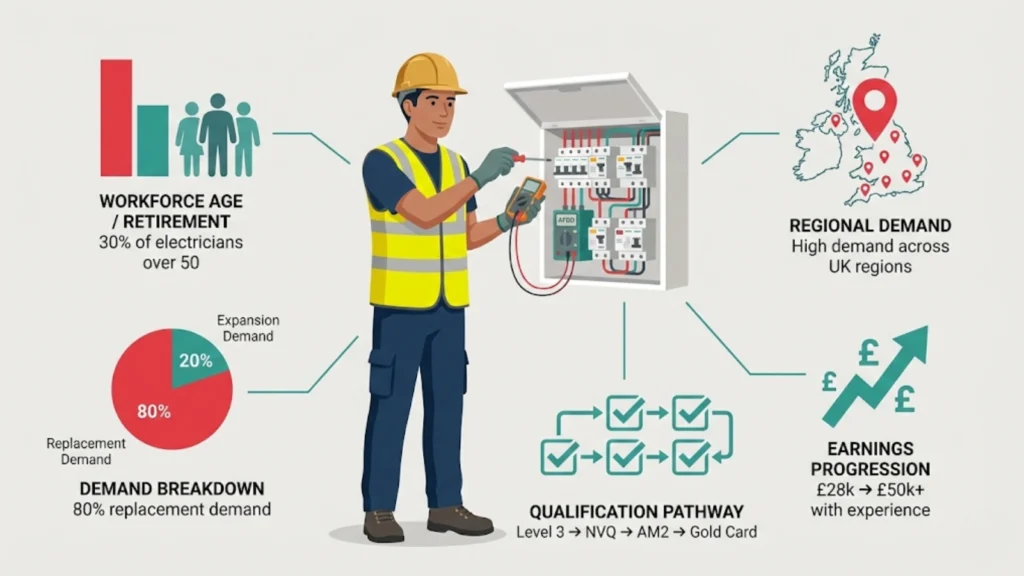
“UK needs 100,000 more electricians by 2032.”
You’ve seen the headline. It’s been circulating since the UK Trade Skills Index dropped in 2023. It sounds urgent. It sounds like opportunity. It sounds like guaranteed employment for anyone who completes electrical training.
Here’s what it actually means: the UK electrical industry needs to recruit approximately 100,000 people over the next decade just to prevent the workforce from shrinking. That’s not 100,000 brand-new jobs appearing. It’s not 100,000 immediate vacancies waiting to be filled today. It’s a recruitment target to address an ageing workforce, modest industry growth, and the shift toward green technology installations.
The distinction matters. Because understanding what’s driving demand, where opportunities actually exist, what qualifications employers require, and what you can realistically earn affects whether you should invest 18 months to 3 years becoming a qualified electrician.
This isn’t a hype piece about “soaring demand” or “guaranteed careers.” It’s an honest breakdown of where the 100,000 figure comes from, what it represents, what current market signals actually show, and what it means for your training decisions in 2026.
Where the "100,000" Figure Actually Comes From
The number originates from the UK Trade Skills Index 2023, a report commissioned by Checkatrade and produced by Capital Economics. It’s not government data. It’s not ONS projection. It’s industry-commissioned economic modeling.
The methodology:
Capital Economics combined several data sources: forecast GDP growth rates, the UK government’s 300,000-homes-per-year housing target, ONS retirement projections for the construction sector, and historical vacancy trends.
They modeled total construction sector demand through 2032, identifying a cumulative skills gap of approximately 937,000 workers across all trades. Of that total, they allocated 104,000 to electrical installation roles specifically.
The assumptions:
The UK successfully delivers on net-zero targets, housing commitments, and infrastructure investment at planned levels. GDP grows at projected 1-2% annually without major recession. Retirement rates match historical patterns (approximately 10,000-12,000 electricians leaving annually). Training output remains at current levels rather than increasing to meet demand.
The limitations:
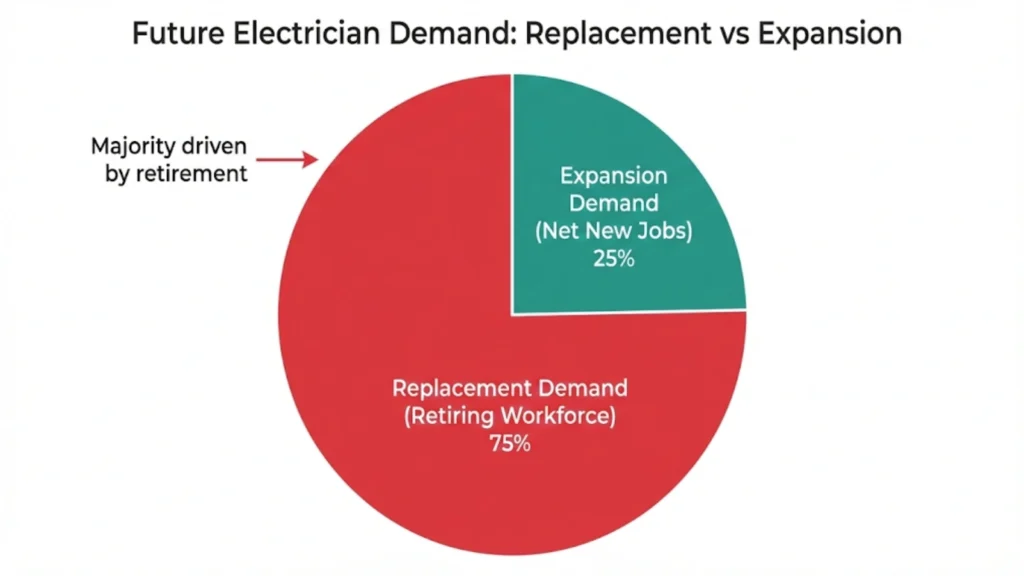
This is a forecast, not a guarantee. If housing targets aren’t met, infrastructure investment delays, or economic growth slows, the actual demand drops. The figure includes both replacement demand (filling roles left by retirees) and expansion demand (net new jobs from growth). The majority is replacement demand.
The headline “100,000 more needed” conflates these categories, suggesting explosive job creation when the reality is sustained recruitment to prevent workforce decline.
Replacement Demand vs Expansion Demand (What You're Actually Filling)
Here’s the breakdown that changes how you interpret “100,000 jobs.”
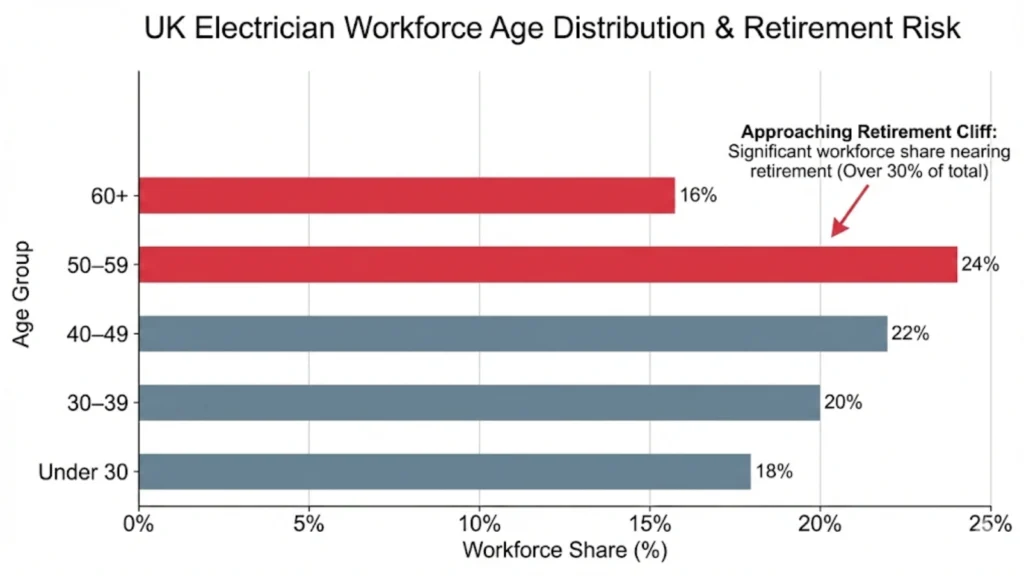
Replacement demand: Approximately 70-80% of the recruitment need comes from replacing electricians who retire, leave the trade, or move into non-electrical roles. With 30% of the current workforce over age 50 and approximately 10,000-12,000 electricians retiring annually, replacement demand creates steady, ongoing vacancies.
Expansion demand: The remaining 20-30% represents actual net job growth from new construction, increased electrification (EV charging, heat pumps, solar PV), and infrastructure projects. This is genuine job creation, but it’s modest growth (1-2% annually), not explosive expansion.
What this means practically:
You’re not competing for 100,000 brand-new roles that didn’t exist before. You’re competing for positions vacated by experienced electricians, which means employers expect you to reach competence relatively quickly.
The opportunities are steady and sustained rather than sudden and massive. Job security is strong for qualified electricians, but it’s not a feeding frenzy where anyone with basic training walks into premium employment.
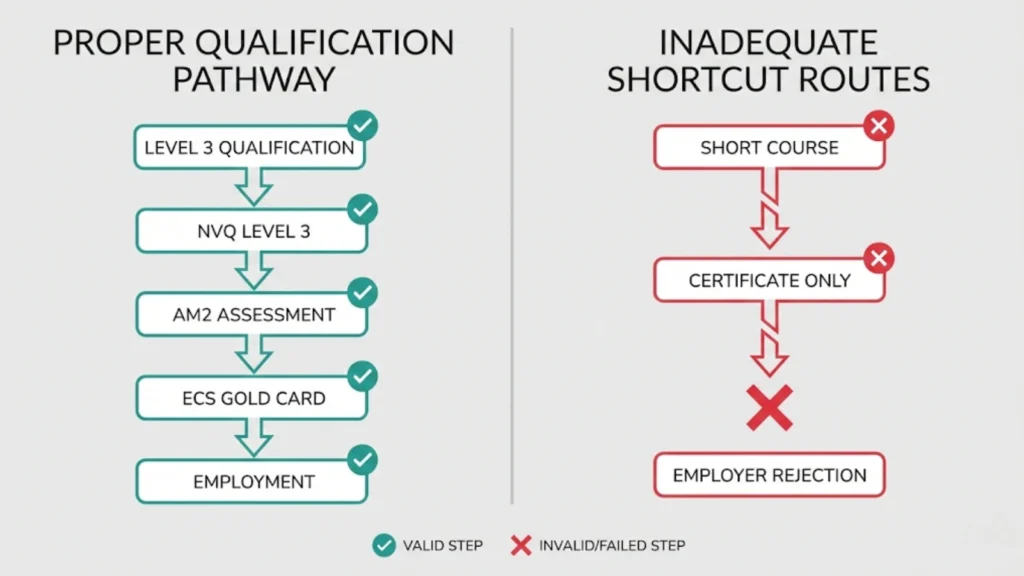
The demand exists, but it’s filtered through qualification requirements. Only electricians with proper credentials (NVQ Level 3, AM2, Gold Card) benefit from this demand. Short-course certificate holders don’t.
What Current Market Signals Actually Show (2025 Reality Check)
Forget forecasts for a moment. What’s happening right now?
Employment levels: ONS data shows approximately 222,800 electricians currently working in the UK (SOC code 5241). That’s up 6% from 2019 but down nearly 20% from the 2018 peak. The workforce recovered from pandemic lows but hasn’t returned to pre-decline levels.
Vacancy trends: Electrician vacancies remain 15-20% higher than pre-pandemic (2019) levels despite overall UK job market cooling. Total UK vacancies fell 9.6% year-on-year to November 2025, but electrical trades haven’t seen the same decline.
Earnings data: Median gross annual pay for electricians sits at £39,039 (2025 ONS data). That’s solid, but it’s not the £50,000+ some headlines suggest. Self-employed rates in high-demand areas can exceed this significantly, but employed positions cluster around the median.
Apprenticeship pipeline: Total apprenticeship starts increased to 353,500 in 2024/25 (up 4.1%), but electrical-specific starts remain around 7,540 annually. Industry analysis suggests we need 10,000+ annual starts just to maintain current workforce levels. The gap between starts and completions is significant, with less than one-third of apprenticeship starters reaching full Gold Card qualification.
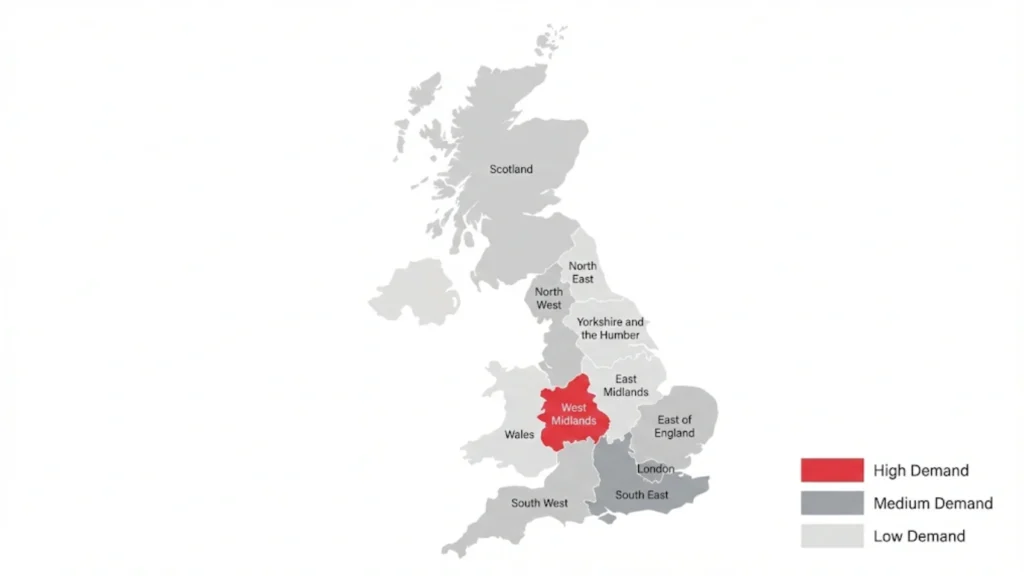
Regional variation: Demand isn’t uniform. The West Midlands shows particularly strong project-driven demand (HS2, Birmingham Smithfield regeneration). Other regions have different patterns based on local construction activity and renewable energy infrastructure development.
The pattern? Steady, sustained demand rather than explosive growth. Opportunities exist but are filtered through qualification requirements and regional factors.
The Green Skills Shift (Demand Is Changing, Not Just Growing)
Here’s what the 100,000 forecast misses: it’s not just about quantity of electricians. It’s about different types of electrical work. Regional wage patterns vary significantly based on local demand drivers, with areas experiencing strong renewable energy and infrastructure growth offering different earning potential than regions focused primarily on traditional domestic work
What’s driving the shift:
Net-zero commitments requiring massive electrification of heating (heat pumps replacing gas boilers) and transport (EV charging infrastructure). Government estimates suggest 400,000 additional clean energy jobs by 2030, with electricians forming a significant proportion.
Prosumer installations becoming mainstream. Buildings that generate (solar PV), store (battery systems), and consume electricity simultaneously. These require understanding BS 7671 Chapter 82 and bidirectional power flow concepts that weren’t part of traditional training.
Building regulations tightening energy efficiency requirements. New builds and major renovations now routinely include renewable energy systems, EV charge point readiness, and smart home integration.
What this means for employment:
An electrician with only traditional installation skills faces increasing competition. One who’s upskilled for EV charging, solar PV, battery storage, and heat pump integration has significantly better prospects.
The demand exists, but it’s concentrated in areas where electricians have updated their knowledge beyond baseline 18th Edition requirements. Chapter 82 understanding, low-carbon technology training, and smart building system integration are becoming differentiators, not specializations.
"The shift toward EV charging, solar PV, and heat pumps means demand is changing, not just growing. An electrician without Chapter 82 understanding or low-carbon technology training is less competitive than someone who's upskilled. It's not enough to just be 'qualified' anymore."
Thomas Jevons, Head of Training
Regional Lens: West Midlands Demand Drivers
Not all regions experience the same demand patterns. The West Midlands provides a useful case study.
Current drivers:
Birmingham Smithfield regeneration (£1.9 billion investment) creating thousands of construction hours and long-term maintenance requirements. HS2 infrastructure requiring commercial electrical contractors with experience in large-scale projects. Regional automotive heritage pivoting toward EV infrastructure, creating demand for charge point installation expertise.
Labour market signals:
The West Midlands requires approximately 35,600 additional construction workers by 2028 (CITB data). Electrician vacancies outpace other trades in the region. Project pipelines create concentrated demand around Birmingham, Wolverhampton, and Coventry.
Training and supply:
Local training providers report high Level 3 course enrollment but limited placement availability with smaller contractors. Larger regional contractors can absorb apprentices, but SMEs struggle with supervision capacity.
What this demonstrates:
Demand forecasts are averages. Actual opportunities vary significantly by location. Project-driven demand creates temporary hotspots. Regional specialization (automotive electrical, commercial installation, renewable infrastructure) affects which skills are most valuable locally.
What Employers Actually Require (Not Just "Any Electrical Course")
The demand exists, but it’s filtered through specific qualification requirements.
Baseline requirements in most job ads:
NVQ Level 3 Electrical Installation (2357) or equivalent competence-based qualification. City & Guilds 2382 (18th Edition Wiring Regulations) current to latest amendment. AM2 or AM2E practical assessment demonstrating competence under test conditions. JIB Gold Card or equivalent ECS scheme registration. Understanding how JIB pay structures reward different experience levels and specializations helps calibrate realistic earnings expectations as you progress from newly qualified through to experienced electrician grades.
Increasingly common requirements:
City & Guilds 2391 (Inspection and Testing) for roles involving certification work. Specialist qualifications for EV charging, solar PV, or heat pump installations. 2-3 years post-qualification experience, not just certification.
What doesn’t meet employer requirements:
Short courses (5-day, 10-day, even 8-week programs) that promise “become an electrician” without NVQ assessment. Domestic Installer certificates without commercial experience or testing qualifications. 17th Edition certification without 18th Edition update (employers filter CVs automatically).
The qualification gap:
Approximately 7,540 electrical apprentices start annually. Industry needs 10,000+ to maintain workforce levels. But completion rates are low, with estimates suggesting less than one-third reach full qualification.
The bottleneck isn’t demand. It’s training completion and achieving the qualification standard employers actually require.
Earnings Reality Check (What You Actually Make vs Headlines)
“Electrician shortage means £50,000+ salaries guaranteed!”
Not quite.
Current earnings data (ONS 2025):
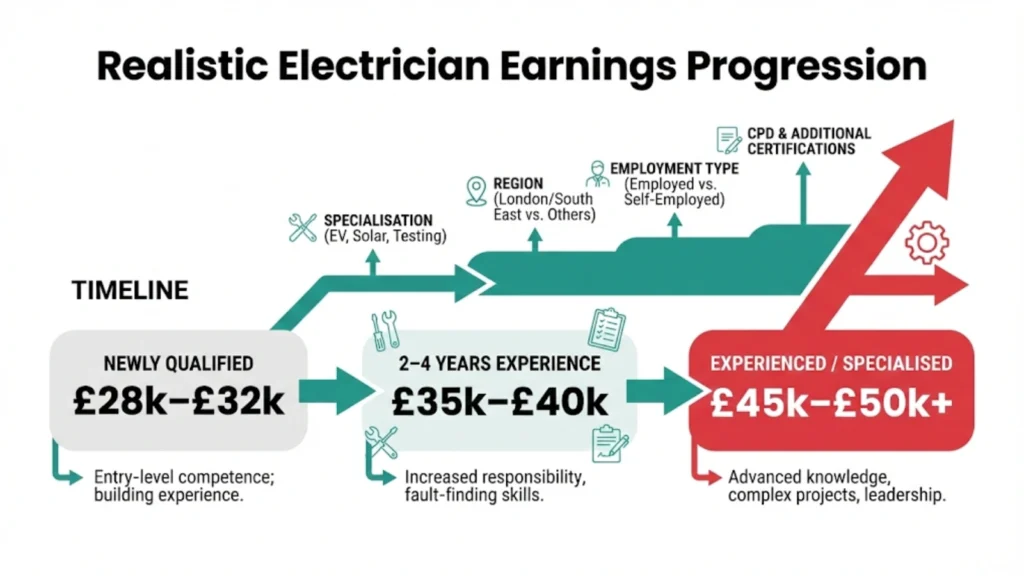
Median gross annual pay: £39,039 for employed electricians. 25th percentile (less experienced): £30,000-£32,000 annually. 75th percentile (experienced/specialized): £45,000-£50,000+ annually.
Regional variation matters:
London and South East: Higher median (£42,000-£45,000) but offset by living costs. North and Midlands: Lower median (£36,000-£39,000) but better cost-of-living ratio. Scotland: Competitive rates for commercial and renewable energy work.
Self-employed vs employed:
Self-employed rates in high-demand areas can significantly exceed employed medians. Daily rates for qualified sparks: £180-£250 depending on experience and specialization. But self-employment includes periods without work, business expenses, and tax considerations that reduce take-home compared to day rates.
Starting salaries for newly qualified:
Realistic range: £28,000-£32,000 for first role after achieving Gold Card. Progression to median (£39,000) typically takes 2-4 years with consistent work and skill development. Premium earnings (£45,000+) require experience, specialization, or self-employment risk.
The pattern? Demand creates job security and steady earnings progression, but it doesn’t guarantee immediate premium salaries for newly qualified electricians.
Timeline Expectations (2026 to 2032 Isn't Tomorrow)
The 100,000 figure is a 2032 target. That’s 6-7 years from now. Understanding the timeline changes how you approach training.
For someone starting training in 2026:
18 months to 3 years to achieve full qualification (depending on pathway: apprenticeship vs adult training route). 2-4 years post-qualification to build experience and reach median earnings. Total timeline: 4-7 years from “deciding to become an electrician” to “experienced electrician at solid earnings.”
What happens during that timeline:
Market conditions change. Green technology demand evolves. Some infrastructure projects complete while others begin. Immigration rules potentially shift, affecting labor supply. Amendment cycles continue (BS 7671 updates every 2-3 years).
Why this matters:
The 100,000 forecast represents steady, sustained demand over nearly a decade, not immediate vacancies. Training decisions made in 2026 position you for a career through the 2030s, not just 2026-2027 job market conditions. Understanding what employers actually look for when hiring at different experience levels, from mates through improvers to qualified electricians, helps set realistic expectations about progression timelines and skill development requirements.
"The 100,000 forecast is to 2032. That's steady, sustained demand over nearly a decade, not immediate vacancies. For someone starting training now, it means good long-term job security if they complete qualifications properly. But it doesn't mean they'll walk into £50,000 salaries on day one of qualification."
Joshua Jarvis, Placement Manager
Common Myths About the 100,000 Forecast
Let’s address misconceptions directly.
Myth: “100,000 new jobs means guaranteed employment for anyone with electrical training.” Reality: The forecast represents total recruitment needed, mostly replacement demand. Only properly qualified electricians (NVQ Level 3, AM2, Gold Card) benefit. Short-course certificate holders don’t meet employer requirements.
Myth: “Shortages mean I can demand £50,000+ immediately after qualifying.” Reality: Newly qualified electricians start at £28,000-£32,000. Progression to premium earnings takes 2-4 years of experience plus often specialization or self-employment. Demand creates job security, not immediate premium pay.
Myth: “The demand is uniform across the UK.” Reality: Regional variation is significant. West Midlands, London, South East show stronger demand due to specific projects and infrastructure development. Other regions have different patterns based on local construction activity.
Myth: “Any electrical course qualifies me for these opportunities.” Reality: Employers specifically filter for NVQ Level 3, 18th Edition (current amendment), and AM2 assessment. Domestic Installer certificates, short courses, and 17th Edition qualifications don’t meet requirements.
Myth: “Demand means easy entry without experience.” Reality: Employers want qualified electricians with 2-3 years post-qualification experience. The bottleneck is training completion and building competence, not availability of positions.
Myth: “The 100,000 represents explosive job growth in electrical work.” Reality: 70-80% is replacement demand from retirements. Only 20-30% represents actual net job creation. Growth is steady (1-2% annually), not explosive.
What You Should Actually Focus On
Forget chasing headlines. Here’s what matters for your training and career decisions.
Complete proper qualifications. Full NVQ Level 3 pathway including AM2 assessment and 18th Edition. Not short courses. Not “fast-track” programs that skip competence assessment. Employers filter specifically for these qualifications.
Plan for specialization. Develop skills beyond baseline electrical installation. EV charging, solar PV, heat pump integration, battery storage systems. These areas show strongest demand growth and command better rates.
Understand regional patterns. If you’re geographically flexible, target areas with strong project pipelines (West Midlands, London, South East currently). If location-limited, understand local demand drivers and adapt specialization accordingly.
Set realistic timeline expectations. 18 months to 3 years to qualify, then 2-4 years to build experience and reach median earnings. This is a 4-7 year career development path, not a quick route to premium employment.
Build continuous learning habits. BS 7671 amendments every 2-3 years. Green technology evolving rapidly. The electricians thriving in 2032 will be those who maintained currency throughout, not those who qualified in 2026 and stopped learning.
Focus on completion, not just enrollment. Less than one-third of apprenticeship starters reach full qualification. The opportunity exists for those who actually complete training properly, not just those who start.
The 100,000 forecast represents genuine long-term career security for qualified electricians who complete training and maintain competence. It doesn’t represent easy money for anyone who takes a short course.
Ready to Build Real, Long-Term Career Security?
Call us on 0330 822 5337 to discuss how our NVQ Level 3 pathway meets the qualification requirements employers actually filter for when recruiting. We’ll explain the realistic timeline, genuine earning progression, and why completion matters more than enrollment.
What we’re not going to tell you:
- That 100,000 jobs means guaranteed £50,000 salaries immediately
- That any electrical course qualifies you for these opportunities
- That demand means employers drop qualification requirements
- That you’ll walk into employment without completing proper training
What we will tell you:
- The realistic 18-month to 3-year timeline to proper qualification
- Why NVQ Level 3 + AM2 + Gold Card matters specifically
- How green technology specialization creates competitive advantage
- What newly qualified electricians actually earn (£28,000-£32,000 starting)
- Why less than one-third of apprenticeship starters complete qualification
- How our in-house placement team addresses the bottleneck between qualification and employment
No hype about “soaring demand.” No unrealistic salary promises. Just honest guidance on building the complete qualification that benefits from long-term industry security.
References
Primary Official Sources
- ONS Labour Market Statistics (Employment, Earnings, Vacancies): https://www.ons.gov.uk/employmentandlabourmarket
- ONS Annual Survey of Hours and Earnings (ASHE) 2024: https://www.ons.gov.uk/employmentandlabourmarket/peopleinwork/earningsandworkinghours/bulletins/annualsurveyofhoursandearnings/2024
- Working Futures 2022-2035 Employment Projections: https://warwick.ac.uk/fac/soc/ier/news?newsItem=8a1785d883cbb6ba018410abe1174858
- DfE Apprenticeship Statistics 2024/25: https://explore-education-statistics.service.gov.uk/find-statistics/apprenticeships/2024-25
- UK Government Assessment of Priority Skills to 2030: https://www.gov.uk/government/publications/assessment-of-priority-skills-to-2030
- BEIS Clean Energy Jobs Estimates: https://www.gov.uk/government/news/clean-energy-jobs-boom-to-bring-thousands-of-new-jobs
Industry Bodies and Construction Sector
- CITB Construction Skills Network 2024-2028: https://www.citb.co.uk/about-citb/construction-industry-research-reports/construction-skills-network-csn/
- JTL “Powering the Future” Workforce Report: https://jtltraining.com/wp-content/uploads/2025/05/JTL-Report-FINAL-Powering-the-Future.pdf
- ECA Industry Survey (Skills Shortages): https://www.eca.co.uk/news/2025/mar/industry-survey-shows-growth-remains-flat-as-skill-shortages-and-volatile-pricing-persist
- NICEIC Electrotechnical Skills Shortage Analysis: https://niceic.com/views/the-electrotechnical-skills-shortage
- Checkatrade UK Trade Skills Index 2023/2024: https://www.electricaltimes.co.uk/demand-for-electricians-set-to-soar-as-trade-sector-vacancies-hit-record-highs
Regional and Market Data
- CITB West Midlands Labour Market Intelligence: https://www.citb.co.uk/media/fl4ncutm/westmidlands-lmi-final.pdf
- IBISWorld UK Electricians Industry Data: https://www.ibisworld.com/united-kingdom/industry/electricians/2500
- Indeed UK Electrician Job Listings: https://uk.indeed.com/q-electrician-jobs.html
- Adzuna Vacancy Trends Analysis: https://www.adzuna.co.uk/blog/top-in-demand-sectors-and-jobs-for-2025
Note on Accuracy and Updates
Last reviewed: 29 January 2026. This page is maintained; we correct errors and refresh sources as employment data, apprenticeship statistics, and industry forecasts update. ONS employment figures and vacancy trends reflect latest available data through December 2025. Next review scheduled following publication of 2026 ONS Annual Survey of Hours and Earnings and updated CITB Construction Skills Network forecasts.
FAQs
Where does the “100,000 electricians needed by 2032” figure actually come from, and who produced it?
The figure originates from the UK Trade Skills Index 2023, a report commissioned by Checkatrade and produced by economists at Capital Economics. It estimates that over 100,000 additional electricians will be required by 2032 to address skills gaps in the UK trades sector.
The forecast is based on:
- ONS labour market data
- Industry surveys
- Projections for construction, infrastructure, and housing demand
It includes both replacement demand (retirements and exits) and expansion demand from growth. Similar figures appear in CITB reports, but the Checkatrade study is the most widely quoted. These are forecasts, not guarantees, and demand could shift with economic or policy changes.
Does “100,000 needed” mean 100,000 brand-new jobs?
No. The figure represents total job openings, not entirely new roles.
It combines:
- Replacement demand: electricians retiring, changing careers, or leaving the workforce
- Expansion demand: new roles created by housing, infrastructure, and net-zero projects
Around 70–80% of the forecast openings are replacements. This matters because it shows the forecast is about sustaining the workforce as much as growing it. Not all openings will go to new entrants; some will be filled by retraining or internal progression.
What’s the difference between replacement demand and expansion demand, and why does it matter?
Replacement demand accounts for vacancies caused by:
- Retirement
- Career changes
- Workforce attrition
Expansion demand reflects new jobs created by sector growth.
This distinction matters because most projected demand comes from replacement, meaning stability rather than a sudden job boom. Economic slowdowns may reduce expansion demand, but replacement demand remains relatively constant due to the ageing workforce, with the average electrician aged around 45–50.
Understanding this helps new entrants avoid unrealistic expectations.
What assumptions sit behind the forecast, and what could change the numbers?
The forecast assumes:
- Steady economic growth
- Delivery of housing targets (around 300,000 homes per year)
- Continued progress toward net zero by 2050
Factors that could increase demand:
- Accelerated infrastructure spending
- Stricter energy-efficiency regulations
- Faster EV and renewable uptake
Factors that could reduce demand:
- Recession or delayed construction
- Automation reducing labour intensity
- Immigration policy changes
Regional differences and high retirement rates add uncertainty. The figure should be treated as an estimate, not a fixed outcome.
What do current UK market signals show compared to the forecast?
- Around 15,000–20,000 electrician vacancies nationwide
- Employment levels at roughly 276,000, down around 26% since 2018
- Median pay around £39,000, with wide regional variation
Vacancies are strongest in London and the South East, but overall demand is steady rather than explosive. Pay growth has been modest, with recent JIB increases around 4%, largely offset by inflation.
The forecasted demand has not fully materialised yet, reflecting economic caution.
How does low-carbon technology change what “demand” means?
Low-carbon technologies shift demand from traditional wiring toward specialised work, including:
- EV charging
- Solar PV
- Battery storage
- Heat pumps
Government targets could add 15,000–20,000 roles by 2030, but this depends on policy delivery and uptake. Demand increasingly focuses on upskilling existing electricians, not just increasing headcount.
Core qualifications remain essential, but renewable add-ons improve employability. This is a gradual shift, not an immediate surge.
Is demand consistent across the UK?
No. Demand varies significantly by region.
- London and South East: strongest demand, 30–40% of national vacancies
- Midlands and North: moderate demand linked to industrial upgrades
- Scotland and Wales: more variable, influenced by local projects
Higher pay in London (£45,000–£55,000) is offset by higher living costs. National forecasts mask these regional differences, so local research is critical.
What qualifications do employers actually require for these roles?
Typically required:
- NVQ Level 3 in Electrotechnical Services (or equivalent)
- AM2 / AM2E assessment
- 18th Edition BS 7671
- ECS or JIB Gold Card
Short courses and unaccredited training do not count toward these requirements. Experience alone is not sufficient without formal recognition.
For renewables-focused roles, additional training in EV charging or solar PV is increasingly valued.
Does high demand automatically mean high pay?
No. Pay depends on:
- Experience
- Location
- Employment type (PAYE vs self-employed)
Typical progression:
- Apprentice: £20,000–£25,000
- Newly qualified: £35,000–£45,000
- Specialist or self-employed: £50,000+ (with overheads)
Real-terms pay growth has been modest and often eroded by inflation. Long-term earnings depend more on skills and reputation than demand headlines.
If you’re training in 2026, what should you focus on?
Prioritise:
- NVQ Level 3
- AM2 / AM2E
- 18th Edition BS 7671
- ECS/JIB Gold Card eligibility
Supplement with low-carbon skills such as EV charging and solar PV. Choose recognised providers with real site experience pathways. Avoid shortcuts or unaccredited courses.
Research regional demand and build practical experience. The 2032 forecast signals opportunity, not a job guarantee. Adaptability and competence will determine who benefits.
