
Do Online Electrical Courses Count Toward Becoming an Electrician?

- Technical review: Thomas Jevons (Head of Training, 20+ years)
- Employability review: Joshua Jarvis (Placement Manager)
- Editorial review: Jessica Gilbert (Marketing Editorial Team)
- Last reviewed:
- Changes: Initial publication
Introduction
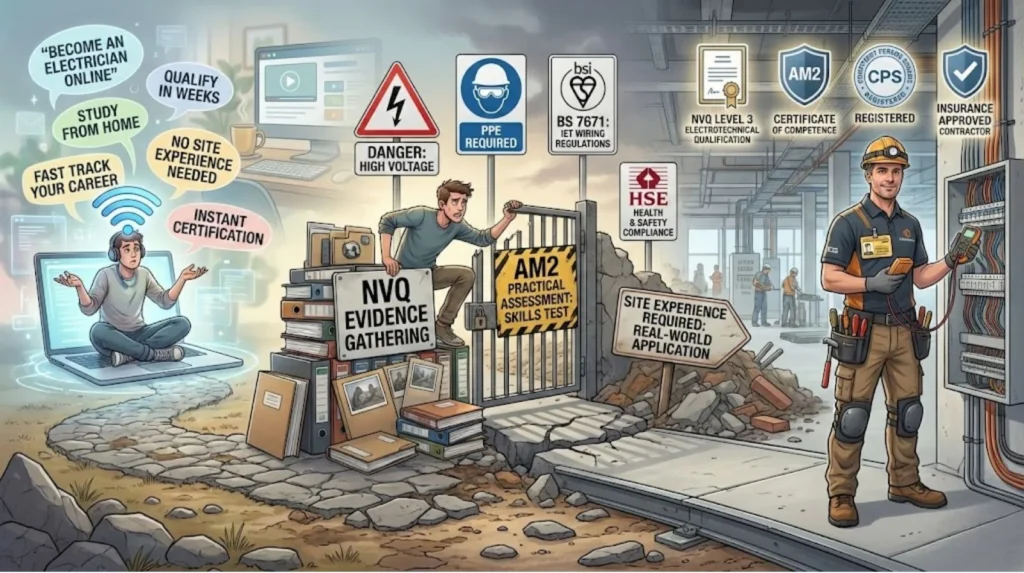
Search “become an electrician online” and you’ll find dozens of providers claiming you can qualify in weeks through distance learning. Some advertise “fully online Level 3 electrical courses.” Others promise you can “become a qualified electrician from home.” The marketing is slick, the pricing is appealing, and for people juggling work or family commitments, the flexibility sounds perfect.
Here’s what these advertisements don’t emphasise: you cannot become a fully qualified electrician solely through online courses in the UK. Not legally. Not practically. Not in a way that leads to employment, insurance coverage, or ECS Gold Card eligibility.
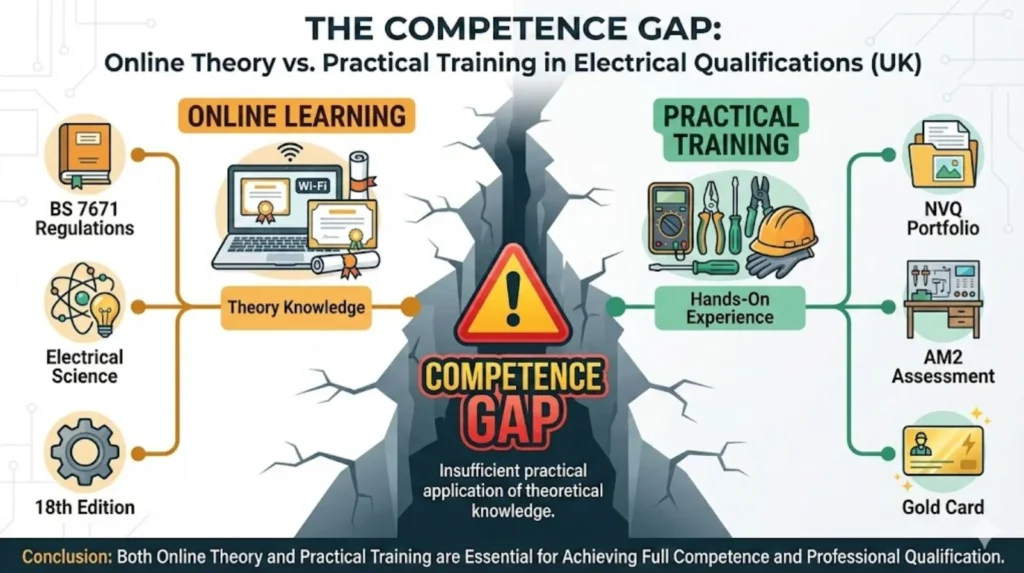
Online electrical training plays a legitimate role in delivering theoretical knowledge. You can study Ohm’s law, cable calculations, and BS 7671 regulations remotely. The 18th Edition qualification can be completed entirely online. But the moment you need to prove competence (the ability to safely install, test, and certify electrical work), online learning hits a legal and practical barrier called Regulation 16 of the Electricity at Work Regulations 1989.
Understanding where online training fits within structured electrical qualification routes requires examining the legal framework that defines electrical competence, the qualification pathways that lead to electrician status, what employers actually require, and what insurers accept. This guide breaks down what online courses can and cannot achieve using data from HSE competence guidance, City & Guilds qualification structures, ECS card requirements, JIB grading standards, and employer hiring criteria.
The Legal Framework: What the Law Says About Online Training
UK electrical competence isn’t defined by certificates. It’s defined by statutory regulations that explicitly require both technical knowledge and practical experience.
Electricity at Work Regulations 1989 – Regulation 16
Regulation 16 states: “No person shall be engaged in any work activity where technical knowledge or experience is necessary to prevent danger or, where appropriate, injury, unless he possesses such knowledge or experience, or is under such degree of supervision as may be appropriate having regard to the nature of the work.”
The critical distinction: “technical knowledge or experience” – both components are required, not just one.
What online training can satisfy: The “technical knowledge” component. You can learn electrical science principles, cable sizing calculations, voltage drop formulas, and BS 7671 regulation references through online delivery. Many people pass the 18th Edition qualification entirely remotely.
What online training cannot satisfy: The “experience” component. Competence under EAWR requires demonstrated ability to safely perform electrical work, assess hazards, and take appropriate precautions. This can only be proven through supervised practical work on real electrical systems.
The legal consequence: A person with only online training – regardless of how many certificates they hold – is not competent to work unsupervised under EAWR. They would require the same level of close supervision as an apprentice, which negates the value of their “qualification” in employment terms.
HSE prosecutions following electrical incidents routinely examine whether the person who carried out the work possessed the necessary experience. A retail company was fined £1 million after an electrician suffered severe burns due to inadequate planning and competence verification. In that case, the individual held theory qualifications but lacked sufficient practical experience for the complex isolation required. Online certificates alone would not have satisfied HSE investigators.
BS 7671 Wiring Regulations – Theory vs Application
BS 7671:2018+A2:2022 (the IET Wiring Regulations) is the UK standard for electrical installations. Understanding it is essential. Applying it safely is a different skill entirely.
The City & Guilds 2382 (18th Edition) qualification tests knowledge of BS 7671. It asks questions like “What is the maximum Zs for a 32A Type B MCB?” or “Which regulation covers RCD protection for socket outlets?” You can pass this exam having never stripped a cable or tested a circuit.
What 18th Edition proves: You can navigate the regulation book and answer theoretical questions correctly.
What 18th Edition does not prove:
Ability to safely isolate electrical systems (prove dead, test, prove dead again)
Competence in inspection procedures (visual examination, identification of non-compliances)
Testing skills (insulation resistance, continuity, earth fault loop impedance, RCD trip times)
Fault diagnosis on real installations with environmental variables and equipment failures
Installation techniques that result in BS 7671-compliant work
This is why the industry treats 18th Edition as a prerequisite knowledge component, not a qualification to work as an electrician. It’s necessary but nowhere near sufficient.
Electrotechnical Assessment Specification (EAS) 2024-2025
The EAS sets the competence requirements for Competent Person Schemes (NICEIC, NAPIT) and defines the qualification structure for electrical workers.
Key EAS categories:
Installation Electrician (A1.1): Full scope competence. Requires NVQ Level 3 + AM2/AM2S practical assessment.
Domestic Electrician (A1.2): Limited to dwellings. Requires Level 3 Electrotechnical Services (Dwellings) + AM2D.
Installer (A1.3): Specific tasks only (e.g., EV charging points).
Experienced Worker Route: Portfolio-based for those with extensive site experience.
EAS requirements for online learning: The specification explicitly states that performance evidence must be generated in the workplace. Simulated environments (training centres) are acceptable only for initial skills development, not for final NVQ assessment. Online simulations are categorically rejected for NVQ portfolio evidence.
What this means practically: You cannot achieve EAS-recognised competence through online-only training. The NVQ Level 3 that underpins Installation Electrician and Domestic Electrician status requires documented proof of real work on actual electrical systems under supervision.
Building Regulations Part P and Competent Person Schemes
Part P of the Building Regulations governs electrical safety in dwellings. To self-certify notifiable work (new circuits, consumer unit replacements, work in bathrooms), electricians register with Competent Person Schemes like NICEIC Domestic Installer or NAPIT.
CPS registration requirements:
Relevant qualifications (typically NVQ Level 3 or equivalent)
Public liability insurance
On-site assessment of completed work (usually two jobs)
Demonstration of practical competence in installation and testing
What CPS schemes explicitly reject: Theory-only qualifications. NICEIC and NAPIT do not accept candidates with online-only certificates for Qualified Supervisor (QS) roles. The assessment process includes physical inspection of real installations, verification of testing procedures, and competence demonstration that cannot be achieved through online learning.
ECS Card System and JIB Grading
The Electrotechnical Certification Scheme (ECS) card system is how UK construction sites verify electrical competence.
Card eligibility based on qualifications:
Green Card (Labourer): No electrical qualifications required
Red Card (Trainee): Enrolled on electrical apprenticeship
Gold Card (Installation Electrician): Requires NVQ Level 3 (2357/5357) + AM2/AM2S + 18th Edition
Gold Card (Domestic Electrician): Requires Level 3 Electrotechnical Services (Dwellings) + AM2D + 18th Edition
Online-only outcomes: Completing Level 2 and Level 3 diplomas (C&G 2365) through online theory with in-centre practicals makes you eligible for a Trainee card only. Without the NVQ Level 3 and AM2, you cannot progress to a Gold Card. This restricts site access, employer acceptance, and job opportunities.
JIB grading requirements: The Joint Industry Board grades electricians as Electrician (base), Approved Electrician, or Technician based on qualifications and experience. All grades require NVQ Level 3 + AM2 as minimum. Online qualifications alone do not map to any JIB grading.
Qualification Routes: What Can and Cannot Be Done Online
Understanding which components of electrical qualification can be delivered online requires breaking down each qualification stage.
Level 2 & 3 Diplomas (City & Guilds 2365)
Theory components: Can be delivered online or through blended learning. Electrical science principles, cable calculations, voltage drop, circuit design theory, regulation knowledge – all suitable for remote study.
Practical assessments: Must be completed in-person at an approved training centre. These include:
Safe isolation procedures (prove-test-prove sequence)
Installation techniques (containment, cable termination, consumer unit wiring)
Inspection procedures (visual examination, identification of defects)
Testing procedures (continuity, insulation resistance, polarity, earth fault loop impedance, RCD testing)
Provider models: Reputable providers like Trade Skills 4U offer blended delivery – online theory modules with mandatory in-person practical weeks. Pure online providers offering “complete Level 3 qualifications” without physical attendance are misrepresenting what they deliver.
Employment impact: Employers recognise the difference. Candidates with blended learning (online theory + in-centre practicals) are treated as having foundation knowledge. Candidates with online-only certificates struggle to demonstrate basic practical skills and are often rejected or treated as complete beginners despite holding “Level 3” certificates.
NVQ Level 3 (City & Guilds 2357/5357)
Core requirement: The NVQ is a performance-based qualification requiring workplace evidence. You must document real installations you’ve completed under supervision across domestic, commercial, and industrial environments.
What can be done online: Portfolio submission. Modern NVQ systems use e-portfolios (like OneFile) where you upload photographs, videos, and written documentation from your phone or computer. This administrative component is legitimately online.
What cannot be done online: The actual work. You need documented evidence of:
Steel conduit installation and bending
Cable tray and ladder systems
Three-phase distribution board termination
SWA (Steel Wire Armoured) cable glanding
Motor installations and starter wiring
Complex testing sequences on polyphase systems
Fault diagnosis and rectification
The barrier for online learners: If you’ve only studied theory online, you have no workplace to generate this evidence. You cannot use training centre mock-ups or simulations. The work must be genuine electrical installations on real sites under supervision. This creates a fundamental barrier – online learners hit a “competence ceiling” where they cannot progress to the NVQ without securing electrical employment, but employers won’t hire them without the NVQ.
AM2/AM2S/AM2E Assessment
Thomas Jevons, our Head of Training with 20+ years of experience, explains the reality:
"The AM2 assessment is conducted in-person at independent NET centres under strict conditions. You're given three days to install, test, fault-find, and commission a complex electrical system. There's no online equivalent because the whole point is proving you can physically perform the work safely to industry standards."
Thomas Jevons, Head of Training
AM2 assessment components:
Day 1: Installation of containment, cabling, consumer unit/distribution board, lighting circuits, socket circuits, control circuits
Day 2: Testing and commissioning (full test sequence, certification completion, fault rectification)
Day 3: Fault-finding exercise (identifying and rectifying deliberate faults in installed systems), professional discussion
Zero online options: The AM2 must be taken at an independent NET assessment centre. No remote invigilation, no online alternatives, no exceptions. Candidates who attempt AM2 with only theoretical knowledge almost universally fail because they lack the physical skills developed through supervised site work.
18th Edition (City & Guilds 2382)
100% online delivery possible: This is the one major electrical qualification that can legitimately be completed entirely online, including the exam (remotely invigilated).
What it proves: Knowledge of BS 7671:2018+A2:2022 Wiring Regulations, understanding of regulation structure, ability to answer questions about protection against electric shock, cable selection, earthing arrangements, and special installations.
What it does not prove: Any practical ability whatsoever. You can pass 18th Edition having never seen electrical tools, entered a consumer unit, or tested a circuit.
Industry treatment: Essential prerequisite for all electrical workers. Necessary but not sufficient. Often the first qualification people complete when exploring electrical careers, but employers treat it as “step one of fifty” rather than evidence of electrician competence.
Inspection & Testing Courses (City & Guilds 2391-52)
Theory components: Can be delivered online. Understanding test sequences, interpreting results, identifying defects, completing certification – all suitable for remote study.
Practical assessment: Must be in-person and is notoriously demanding. The 2391 practical exam requires:
Conducting full inspection and testing on unfamiliar installations
Identifying deliberate defects and non-compliances
Completing accurate test results and certification under time pressure
Professional discussion defending observations and recommendations
Success rates: Candidates attempting 2391 with minimal hands-on testing experience have high failure rates (30-40%). Those with extensive practical experience typically pass first time. This demonstrates the gap between theoretical knowledge and practical competence.
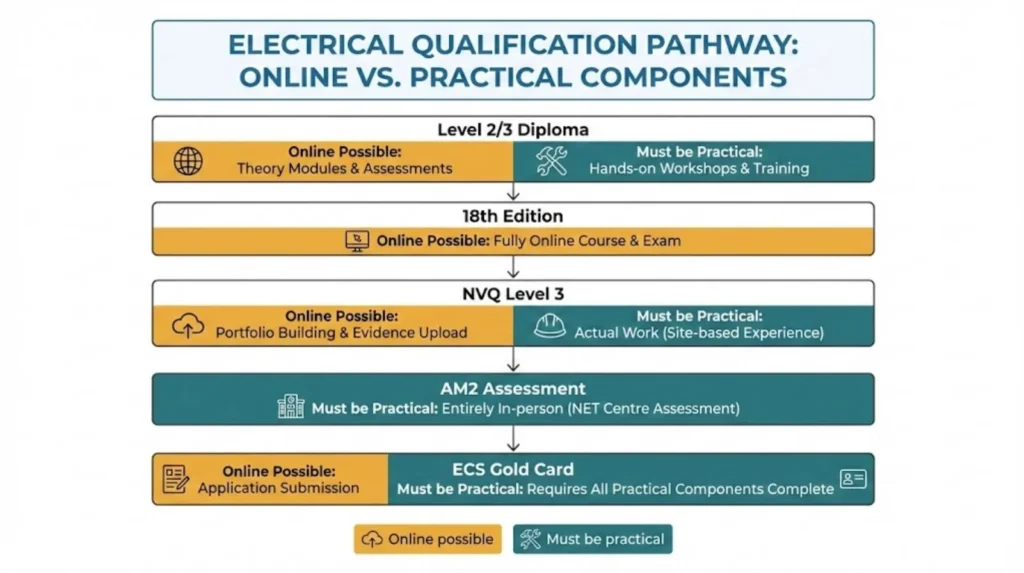
A detailed comparison across legitimate electrician courses:
| Qualification Stage | Course Code | Online Possible? | In-Person Requirements |
| Level 2 Diploma | C&G 2365-02 | Theory only | Practical assessments mandatory |
| Level 3 Diploma | C&G 2365-03 | Theory only | Inspection & testing practicals mandatory |
| 18th Edition | C&G 2382-22 | 100% (theory + exam) | None – fully remote possible |
| NVQ Level 3 | C&G 2357/5357 | Portfolio upload only | All workplace evidence must be real site work |
| AM2 Assessment | NET AM2/AM2S | 0% | 3-day in-person practical exam |
| 2391 Testing | C&G 2391-52 | Theory only | Practical exam in-person |
Industry Perception: What Employers Actually Think
The gap between marketing claims and employment reality is significant.
Job Advertisement Analysis
Analysis of electrical job postings on Indeed, Reed, and Totaljobs reveals consistent patterns:
Typical requirements for “Electrician” roles:
“NVQ Level 3 Electrical Installation essential”
“ECS Gold Card required”
“AM2 qualified”
“Proven experience on commercial/industrial sites”
“Full UK driving licence” (indicates mobile site work, not office-based)
Example: Major contractor requirements (Mears Group, 2024): “NVQ Level 3 in Electrical Installation or similar (required). ECS Gold Card. Experience in social housing maintenance. Must be able to demonstrate practical competence in fault-finding and testing.”
What’s missing from these ads: Any mention of accepting theory-only qualifications, online certificates, or Level 2/3 diplomas without NVQ. The industry standard is explicit: NVQ + AM2 + Gold Card or don’t apply.
The “Paper Electrician” Problem
Employer forums and industry discussions use the term “paper electrician” to describe candidates who hold certificates but cannot demonstrate basic practical competence.
Common employer experiences:
Candidates with “Level 3 Electrical Installation” certificates unable to wire a two-way lighting circuit correctly
Online course graduates who cannot identify basic tools or explain safe isolation procedures
Applicants with multiple certificates but zero workplace experience or NVQ portfolio
Typical employer response: Treat these candidates as complete beginners regardless of certificates held. Some employers refuse to interview online-only candidates at all, viewing it as a red flag for unrealistic expectations and lack of genuine preparation.
Real-World Forum Sentiment
Reddit r/electricians (2024):
"Online courses would not prepare you for the reality of being an electrician. You need hands-on experience under supervision. Get into an apprenticeship or trainee position with actual site work."
ElectriciansForums.net (2023):
"The course is completely misleading and does not lead to the employment that was promised. I completed everything online, got my certificates, and now I can't find anyone willing to hire me because I have no NVQ or site experience."
Screwfix Community (2022):
"Fast-track online electrical training is basically a scam. You end up with worthless certificates and no pathway to becoming qualified. Employers see right through it."
The Practical Competence Test
Many employers conduct simple practical tests on the first day:
“Wire this two-way lighting circuit”
“Safe isolate this distribution board and test for dead”
“Identify the fault in this circuit”
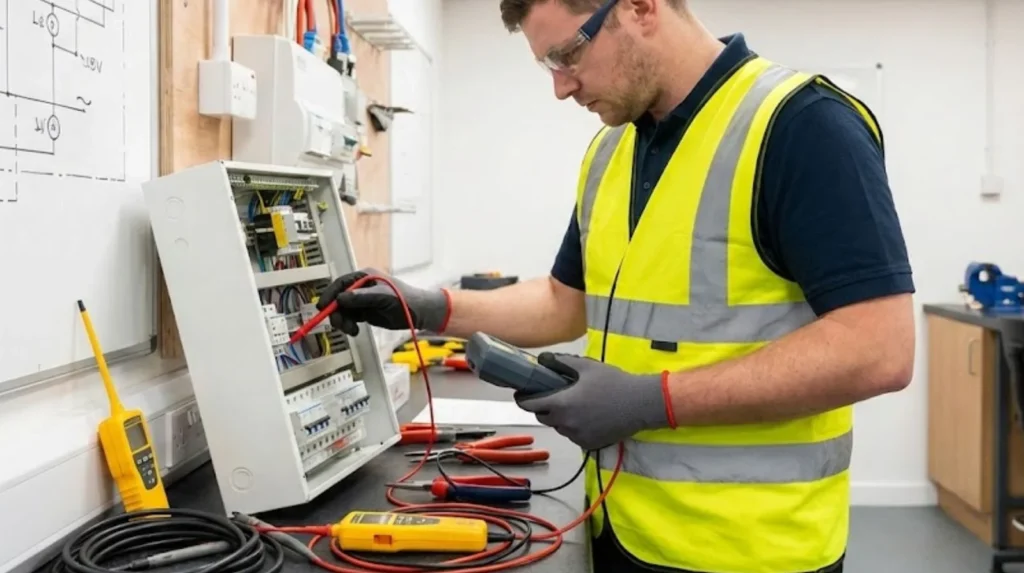
Online-only candidates routinely fail these basic tasks, leading to immediate dismissal or reclassification as labourers. The disconnect between holding “Level 3” certificates and being unable to perform Level 1 tasks damages credibility and wastes everyone’s time.
What Online Training IS Good For
Despite the limitations, online electrical training serves legitimate and valuable purposes when used correctly.
Theory Knowledge Development
Excellent for:
Electrical science principles (Ohm’s law, resistance, capacitance, inductance)
Cable sizing calculations and voltage drop formulas
BS 7671 regulation structure and requirements
Circuit design theory and protective device selection
Electrical safety principles and hazard awareness
Value: Flexible, self-paced learning that allows people to build foundational knowledge while working or managing other commitments. Online delivery is often more cost-effective than classroom-based theory teaching.
18th Edition Wiring Regulations
Fully online qualification: The City & Guilds 2382 can be completed entirely remotely, including the exam. This is widely accepted across the industry for:
Qualified electricians updating from 17th to 18th Edition
Apprentices completing the mandatory 18th Edition component
Related trades (plumbers, builders) needing regulation awareness
Convenience: No time off work required, study at own pace, exam can be taken at home with remote invigilation.
Realistic expectation: This proves regulation knowledge, not electrician competence. It’s one component of many required for full qualification.
CPD and Refresher Training
Ideal applications:
Qualified electricians updating knowledge (Amendment 2 changes, EV charging updates)
Experienced workers returning to the trade after time away
Specialist topic courses (solar PV theory, heat pump electrical principles, BMS basics)
Regulation refreshers and safety updates
Target audience: People who already hold NVQ Level 3 and AM2, using online learning to maintain and expand knowledge efficiently.
Blended Learning Components
Joshua Jarvis, our Placement Manager, explains the legitimate role:
"Online learning has its place - it's excellent for 18th Edition updates, CPD for qualified electricians, and delivering electrical science theory efficiently. For people balancing work or family commitments, online theory components in a blended programme make training accessible. But it must be combined with supervised practical work. Online alone doesn't lead to electrician status."
Joshua Jarvis, Placement Manager
Structured blended approach:
Complete electrical science and regulations theory online (flexible, self-paced)
Attend mandatory in-person practical weeks (safe isolation, testing, installation techniques)
Secure electrical employment or placement (supervised site work)
Build NVQ portfolio through real workplace installations
Complete AM2 practical assessment at NET centre
Achieve Gold Card and full electrician status
This model uses online delivery where it’s effective (theory) while ensuring practical competence is developed through supervised hands-on work.
Remote Portfolio Submission
Modern NVQ administration: E-portfolio systems like OneFile allow apprentices to upload evidence from their phones:
Photographs of completed installations
Videos of testing procedures
Written documentation and risk assessments
Supervisor sign-offs and witness statements
This is legitimately online: The submission process is digital, making NVQ administration more efficient. But the crucial distinction: the work being documented must still be real, on actual sites, under supervision. You’re using online tools to submit evidence of practical work, not replacing practical work with online simulation.
What Online Training Cannot Replace
This is the critical section for anyone considering online-only routes.
Cannot Prove Competence Under EAWR
Regulation 16 requires both technical knowledge and experience. Online training might satisfy the knowledge component, but it categorically cannot provide the experience component. Legal competence to work unsupervised requires demonstrated ability to:
Assess electrical hazards in real environments with variables (existing installations, environmental factors, equipment conditions)
Safely isolate complex systems (multiple sources, interlinked circuits, potential for borrowed neutrals)
Perform testing sequences correctly (instrument selection, test lead verification, result interpretation)
Diagnose faults on unfamiliar installations (not pre-prepared training scenarios)
Legal consequence: If an incident occurs, HSE investigations will examine competence. Online certificates alone will not satisfy the EAWR requirement for “experience necessary to prevent danger.”
Cannot Replace Supervised Site Work
The NVQ Level 3 requires extensive workplace evidence across diverse environments. Online learners have no workplace to generate this evidence. They cannot:
Document steel conduit installations they haven’t performed
Provide photos of three-phase panels they haven’t terminated
Show supervisor sign-offs from qualified electricians they haven’t worked under
Demonstrate progression from basic to complex tasks over time
The career barrier: Without NVQ evidence, you cannot progress to AM2. Without AM2, you cannot get a Gold Card. Without a Gold Card, employers won’t hire you for electrical roles. This creates a closed loop where online-only learners are permanently stuck as “qualified” on paper but unemployable in practice.
Cannot Prepare Adequately for AM2
The AM2 practical assessment requires physical skills developed over hundreds of hours of supervised work:
Speed and efficiency in installation (timed tasks)
Muscle memory for testing sequences (prove-test-prove must be automatic)
Fault-finding under pressure (unfamiliar systems, limited time)
Professional work quality (neat terminations, secure fixings, cable management)
Success data: Apprentices with 2-3 years of site experience typically pass AM2 first time (80-90% pass rate). Candidates attempting AM2 with minimal practical experience have much higher failure rates (40-60% fail first attempt). Online theory knowledge does not translate to physical competence.
Cannot Satisfy CPS Requirements
Competent Person Schemes require:
On-site assessment of actual completed work
Demonstration of practical testing competence
Verification of safe working practices
Evidence of genuine workplace experience
NICEIC and NAPIT explicitly reject: Theory-only qualifications, online certificates without practical verification, candidates with no documented site experience, and NVQ claims without proper workplace evidence.
Cannot Support Insurance Coverage
Public Liability and Professional Indemnity insurance policies require electricians to be “qualified and competent” for the work they undertake. Insurers assess this through:
Recognised qualifications (NVQ Level 3, AM2)
Documented workplace experience
Competent Person Scheme membership
Evidence of continuing professional development
Claims rejection risk: If an incident occurs and the insurer discovers the electrician holds only online theory certificates without NVQ/AM2, they may reject the claim. This leaves the individual personally liable for damages that could run into six or seven figures.
Cannot Provide EICR/Commercial Testing Competence
Electrical Installation Condition Reports (EICRs) require:
C&G 2391-52 qualification (or equivalent experience)
Practical testing competence across unfamiliar installations
Ability to identify defects, assess risk, and code observations correctly
Understanding of installation methods, historical regulations, and special locations
Online learning limitation: While you can study EICR theory online, the competence to conduct and certify testing requires extensive hands-on experience. Landlord EICRs and commercial periodic inspections carry legal liability – inspectors must demonstrate genuine competence, not just certificate collection.
Safety, Liability, and Insurance Implications
The consequences of working based on online-only training extend beyond employability.
HSE Prosecution Risk
Case example 1: Retail company fined £1 million after electrician suffered 15% burns from inadequate isolation planning and competence verification on complex three-phase systems. Investigation revealed insufficient practical experience for the task.
Case example 2: Electrical contractor prosecuted following severe shock injury when incorrect wiring was installed. HSE found the individual lacked competence for the work undertaken, despite holding theory qualifications.
Common factor: In both cases, technical knowledge (regulations, theory) was present, but practical experience and demonstrated competence were lacking. Online certificates would not have prevented these incidents or satisfied HSE investigators.
Insurance Claim Rejection
Policy requirements: Professional Indemnity and Public Liability insurance for electrical work requires proof that the person undertaking work is “qualified and competent.”
What insurers accept: NVQ Level 3, AM2, Competent Person Scheme membership, demonstrated workplace experience, continuing professional development.
What insurers reject: Theory-only qualifications, online certificates without practical verification, DIY or uncertified work, individuals operating beyond their demonstrated competence.
Real consequence: If a fire, shock injury, or property damage occurs and the insurer discovers the electrician was “qualified” only through online courses without NVQ/AM2, they will reject the claim. The individual becomes personally liable for all damages, medical costs, and legal fees.
Risk to Homeowners and Property
The competence gap: Someone who has studied electrical theory online but never performed supervised practical work poses genuine risk:
Safe isolation procedures (prove-test-prove) may be understood theoretically but performed incorrectly in practice
Testing sequences may be incomplete or inaccurate, missing dangerous faults
Installation quality may not meet BS 7671 requirements despite theory knowledge
Fault diagnosis may be inadequate, leading to dangerous conditions
Property damage risk: Incorrect electrical work can lead to fires, shock hazards, equipment damage, and invalidated building insurance. Homeowners who hire online-trained “electricians” may discover their insurance is void if issues arise.
Comparative Outcomes: Online-Only vs Proper Qualification Routes
The employment and earnings data clearly shows the difference in outcomes.
Traditional Apprenticeship Route
Pathway: 3-4 year apprenticeship with employer, combining work-based learning with college attendance, leading to NVQ Level 3 + AM2.
Outcomes:
80-90% employment rate post-qualification
Starting salary: £32,000-£38,000 (PAYE)
ECS Gold Card eligibility immediate
Clear progression to Approved Electrician (£42,000-£55,000)
Access to commercial, industrial, and specialist roles
JIB grading and wage structure applies
Employer acceptance: Universally recognised across the industry. Apprentice-trained electricians are the preferred hire for major contractors.
Blended Learning (Proper Structured Route)
Pathway: Online theory components + mandatory in-person practicals + workplace placement for NVQ + AM2 assessment.
Outcomes:
Good employment rates (70-80%) if placements secured
Starting salary: £30,000-£36,000
Gold Card achievable
Faster than full apprenticeship (18 months to 3 years)
Suitable for career changers and adult learners
Employer acceptance: Recognised if properly structured with genuine NVQ evidence and AM2 pass. Some employers prefer apprentice route but accept well-qualified blended learners with good references.
Online-Only Route
Pathway: Remote study of Level 2, Level 3 theory, 18th Edition, no practical verification, no workplace experience, no NVQ, no AM2.
Outcomes:
Very low employment rates as electricians (<10%)
Those who find work typically start as labourers or mates (£18,000-£24,000)
No Gold Card eligibility (maximum Trainee card)
Require full retraining to achieve NVQ + AM2
High frustration and sense of mis-selling
Employer acceptance: Rejected for electrician roles. Sometimes accepted as electrical labourer or mate with expectation of retraining from scratch.
Regional Earnings Comparison
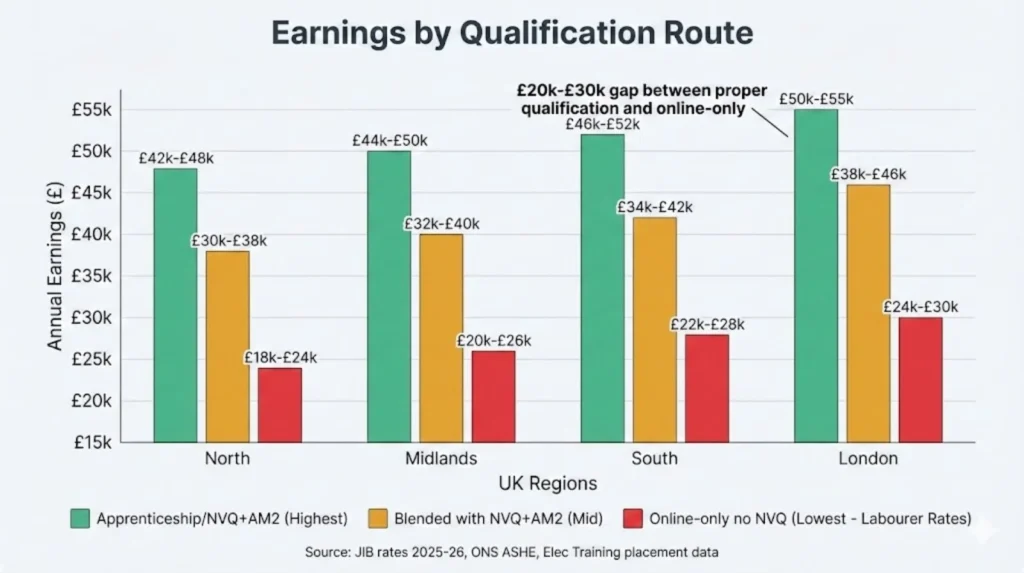
| Route | North | Midlands | South | London |
| Apprenticeship NVQ+AM2 | £32k-£38k | £36k-£42k | £38k-£45k | £45k-£55k |
| Blended (proper NVQ+AM2) | £30k-£36k | £34k-£40k | £36k-£42k | £42k-£50k |
| Online-only (no NVQ) | £18k-£24k (labourer) | £20k-£26k (labourer) | £22k-£28k (labourer) | £24k-£30k (labourer) |
The earnings gap: Online-only learners earn 40-50% less than properly qualified electricians and remain stuck in labourer roles because they lack the NVQ and AM2 required for progression.
The Future of Online Electrical Training
The role of online learning in electrical training is evolving but will always have fundamental limitations.
Virtual Reality and Augmented Reality Developments
Emerging technologies: Companies like Metaverse Learning and E.ON are piloting VR/AR systems for electrical training:
VR safe isolation simulations
AR-guided testing procedures
Virtual electrical installations for practice
Immersive fault-finding scenarios
Potential benefits:
Safe practice of dangerous procedures without risk
Unlimited repetition for skill development
Realistic visual and procedural training
Reduced reliance on physical training centre equipment
Current limitations:
Cannot replicate physical skills (cable stripping, termination tightness, conduit bending)
Lacks haptic feedback for real tool use
No assessment of actual safety practices under physical constraints
Not accepted by EAS, CPS, or ECS for competence verification
Likely future: VR/AR may supplement training as preparation tools, but physical assessment will remain mandatory for NVQ and AM2. Technology can enhance learning but cannot replace demonstrated competence on real systems.
Blended Learning Expansion
Industry trend: More training providers offering structured blended models:
Online theory delivery for flexibility
Mandatory intensive practical weeks at training centres
Supported workplace placements for NVQ evidence
Remote tutoring and assessment check-ins
Benefits over pure online:
Combines flexibility with practical competence development
Suitable for adult learners and career changers
More affordable than full-time college attendance
Faster than traditional apprenticeships if workplace secured
Requirements remain unchanged: NVQ evidence must still be from real workplaces, AM2 must still be in-person, competence must still be physically demonstrated.
Post-Grenfell Competence Tightening
Following the Grenfell Tower fire and subsequent Building Safety Act 2022, competence verification is under increased scrutiny:
EAS expected to tighten requirements in 2025-26 reviews
Greater emphasis on demonstrated workplace experience
Potential restrictions on fast-track routes without proper supervision
Industry moving away from certificate-based competence toward evidence-based verification
Impact on online training: Likely to face additional restrictions rather than expanded acceptance. The regulatory direction is toward more rigorous practical verification, not acceptance of theory-only routes.
Continuing Professional Development
Growing sector: Online CPD for qualified electricians is expanding rapidly:
EV charging installation updates
Solar PV and battery storage technical training
Heat pump electrical principles
Smart home and BMS integration
Amendment updates and regulation changes
Target audience: Electricians who already hold NVQ Level 3 + AM2 using online learning to maintain and expand expertise efficiently. This is appropriate use of online delivery – adding specialist knowledge to an existing competence foundation.
What You Should Actually Do
If you’re considering electrical training and evaluating online options, here’s the realistic pathway.
If You Want to Become a Qualified Electrician
Do not rely on online-only courses. They will not lead to electrician status, regardless of marketing claims.
Proper pathways:
Traditional apprenticeship (recommended for 16-24 year olds):
Apply for electrical apprenticeships with contractors or through training providers
3-4 year programme combining work and college
Guaranteed NVQ evidence through employment
Employer pays for training
Leads directly to Gold Card
Adult learner route (18 months to 3 years):
Choose provider offering structured pathway including NVQ placement support
Complete Level 2/3 theory (can include online components)
Attend mandatory practical training weeks
Secure electrical employment or placement for NVQ evidence
Build portfolio over 12-24 months
Pass AM2 assessment
Achieve Gold Card
Experienced Worker Assessment (for those with site experience):
If you’ve worked in related trades with electrical exposure
Evidence existing competence through portfolio
Complete any qualification gaps (18th Edition, testing)
Take AM2E assessment
Faster route but requires proven experience first
If You’re Using Online Learning as Part of Proper Training
Appropriate uses:
Study electrical science and regulations theory online for flexibility
Complete 18th Edition qualification remotely
Use online resources to supplement practical training
Prepare for exams and assessments while working
Must combine with:
Mandatory in-person practical training at approved centres
Supervised workplace experience for NVQ evidence
AM2 assessment at NET centre
Competent Person Scheme assessment if self-certifying
If You’re a Qualified Electrician
Online CPD is valuable:
Regulation updates (Amendment changes)
Specialist topic courses (EV, PV, heat pumps)
Refresher training and knowledge updates
New technology awareness (BMS, smart systems)
Maintains competence: Qualified electricians using online learning to stay current and expand expertise is entirely appropriate and efficient.
Online electrical courses serve a legitimate purpose in delivering theoretical knowledge efficiently and flexibly. They’re excellent for 18th Edition updates, electrical science theory, and CPD for qualified electricians. For people balancing work or family commitments, online components within a structured blended programme make electrical training accessible.
But online learning alone does not and cannot lead to qualified electrician status in the UK. The legal framework (EAWR Regulation 16), qualification requirements (NVQ Level 3, AM2), industry standards (EAS, CPS, ECS), and employer expectations all require demonstrated practical competence through supervised workplace experience.
The “become a qualified electrician online” marketing is misleading. What you actually get is theory knowledge – the “technical knowledge” component of EAWR competence. You’re still missing the “experience” component, the NVQ workplace evidence, the AM2 practical assessment, and the pathway to Gold Card eligibility.
At Elec Training’s electrical training programmes, we’re transparent about this. Online theory has its place in our blended delivery model – it makes learning flexible and reduces time away from work. But we combine it with mandatory in-person practical training, supported workplace placements for NVQ evidence, and clear pathways to AM2 assessment and Gold Card achievement.
Our placement team works with 120+ UK contractors to secure supervised electrical employment for learners building NVQ portfolios. We don’t claim you can become an electrician purely online because that’s not how UK electrical competence works. We provide structured routes that use online delivery where it’s effective while ensuring you develop genuine practical competence through supervised site work.
Call us on 0330 822 5337 to discuss realistic electrical training pathways. We’ll explain exactly what can be studied online, what requires in-person attendance, how NVQ portfolios work, what AM2 involves, and what our placement support actually delivers. No misleading “fully online electrician courses.” No false promises about qualifying in weeks. Just honest guidance on how online learning fits within the proper qualification route to becoming a fully qualified electrician with NVQ Level 3, AM2, and Gold Card status.
References
- HSE Guidance on Electrical Competence – https://www.hse.gov.uk/electricity/withequip.htm
- IET Wiring Regulations BS 7671:2018+A2:2022 – https://www.theiet.org/
- Electrotechnical Assessment Specification (EAS) 2024-2025 – https://electrical.theiet.org/
- Building Regulations Part P (Electrical Safety – Dwellings) – https://www.gov.uk/government/publications/electrical-safety-approved-document-p
- City & Guilds 2365 Level 2 & 3 Diplomas – https://www.cityandguilds.com/
- City & Guilds 2357/5357 NVQ Level 3 – https://www.cityandguilds.com/
- City & Guilds 2382 (18th Edition) – https://www.cityandguilds.com/
- City & Guilds 2391-52 Inspection and Testing – https://www.cityandguilds.com/
- Net-JATES AM2/AM2S/AM2E Assessment Information – https://www.netservices.org.uk/
- ECS Card Scheme Requirements – https://www.ecs.co.uk/
- JIB (Joint Industry Board) Grading and Wage Rates 2025-2026 – https://www.jib.org.uk/
- NICEIC Competent Person Schemes – https://www.niceic.com/
- NAPIT Competent Person Schemes – https://www.napit.org.uk/
- ONS Annual Survey of Hours and Earnings (ASHE) – Electrical Trades – https://www.ons.gov.uk/
Note on Accuracy and Updates
Last reviewed: 13 December 2025. This page is maintained; we correct errors and refresh sources as electrical regulations, EAS requirements, qualification standards, and training delivery methods change. All qualification details reflect current City & Guilds specifications and ECS/JIB requirements as of December 2025. HSE guidance on competence and EAWR interpretation reflects current enforcement standards. Next review scheduled following EAS 2026 updates and any changes to remote learning acceptance in electrical qualifications.
