
Domestic Installer vs Fully Qualified Electrician: What’s the Real Difference?

- Technical review: Thomas Jevons (Head of Training, 20+ years)
- Employability review: Joshua Jarvis (Placement Manager)
- Editorial review: Jessica Gilbert (Marketing Editorial Team)
- Last reviewed:
- Changes: More in depth ONS data coverage.
Your enjoying your weekend, you click on to Facebook to see what the local gossip is, and what hits you? A Fast-track domestic installer course, which ever social media platform on, and they are everywhere.
Scroll through Facebook, TikTok or Instagram and you cant get away from “become a qualified electrician in 4 weeks” or “start earning as an electrician this month.” The reality is considerably more complicated or lets be brutally honest, you cant become a fully qualified electrician in 4 weeks, full stop and any one telling you, that you can is either lying to you, or breaking the law. But that said, what can you do with a short course, and what you cant do.
As I would say the “the devils in the detail”
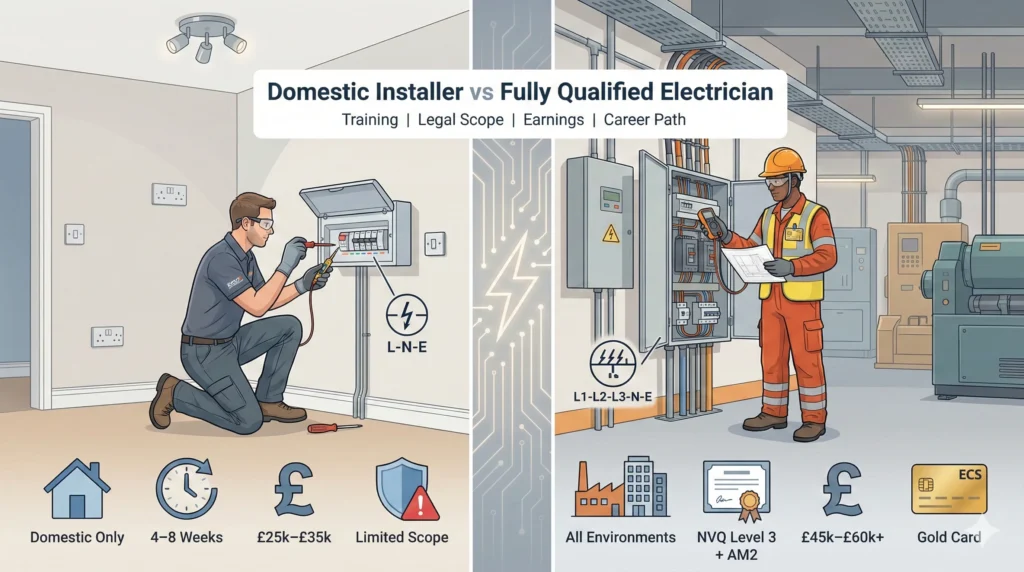
What’s the biggest difference between a Domestic Installer and a Fully Qualified Electrician, its more than just bragging rights, it affects what work you can legally do, what sites you can access, how much you’ll earn, and whether you’ll hit a career ceiling at £35,000 or progress to £60,000+ with specialist roles. It impacts insurance coverage, legal liability under the Electricity at Work Regulations 1989, and whether major contractors will hire you.
Like every article need to do some self marketing with no shame, if you want to become fully qualified check out our comprehensive electrician training programmes that lead to full qualification.
Now that’s out the way we can get back to business, this guide breaks down the legal framework, training pathways, scope of work, pay differences, and career progression for each route using data from the Office for National Statistics, JIB wage agreements, industry forums, and our own placement network of 120+ UK contractors. So this is not what bob down the pub who’s been playing with wires for 20 years is saying, this is about data statistics that are government and industrial body backed.

The Legal Framework: What Competence Actually Means (yes we are starting with the “boring part” but its so essential)
The confusion starts with how the UK defines electrical competence. There isn’t a single “electrician licence” that covers everything. Competence is defined by three overlapping frameworks, and understanding them explains why the domestic installer route is legally limited.
Electricity at Work Regulations 1989 (EAWR)
Regulation 16 of the EAWR requires anyone working on electrical systems to possess “adequate knowledge, training, and experience to prevent danger and injury.” The critical word is “adequate.” Adequate for what?
Competence must match the specific work and environment. A person competent to wire a domestic socket circuit is not automatically competent to install a three-phase motor starter or diagnose faults on an industrial distribution board. The regulations explicitly recognise that competence is task-specific.
A Domestic Installer trained via a 4-8 week course focused on single-phase residential work meets the EAWR threshold for unsupervised domestic tasks, provided their training and experience covers that scope. They do not meet the threshold for commercial or industrial work because they haven’t been trained or assessed on the complex risks present in those environments (three-phase systems, motors, control gear, hazardous areas, industrial containment methods).
BS 7671 Wiring Regulations (18th Edition)
Both Domestic Installers and Fully Qualified Electricians must understand BS 7671:2018+A2:2022 (the IET Wiring Regulations). Both hold the 18th Edition qualification (City & Guilds 2382). But here’s where the paths diverge dramatically.
Thomas Jevons, our Head of Training with 20+ years of experience, explains:
"Both routes require knowledge of BS 7671, but the assessment depth is completely different. A domestic-only course covers single-phase residential applications. The NVQ route proves you can apply the regulations across everything from a house rewire to an industrial motor installation."
Thomas Jevons, Head of Training
Domestic installer courses assess BS 7671 application almost exclusively in single-phase domestic scenarios. They don’t cover design calculations for three-phase distribution, industrial earthing arrangements, motor circuit protection, or the advanced testing protocols required for periodic inspection in commercial premises. The NVQ Level 3 route, by contrast, requires demonstrating BS 7671 application across all environments through a comprehensive portfolio of evidence and the AM2 practical assessment.
Part P of the Building Regulations
Part P applies to electrical safety in dwellings in England and Wales. It defines “notifiable work” (new circuits, consumer unit replacements, work in special locations like bathrooms) and requires it to be done by a “competent person” or notified to Building Control.
Domestic Installer schemes run by Competent Person Schemes (CPS) like NICEIC and NAPIT allow self-certification of Part P notifiable work in homes. Critically, this registration is explicitly limited to domestic dwellings. It does not permit self-certification of commercial or industrial installations, which fall outside Part P’s scope entirely.
The Part P “competent person” definition for domestic work does not equate to full competence under EAWR for all electrical work. This is a source of significant confusion in the market.
Training Pathways: How Each Route Works
The difference in what each role can do stems directly from how they’re trained and assessed.
Domestic Installer Route (4-8 Weeks)
This is a fast-track route aimed at people wanting to enter the domestic electrical market quickly.
Typical qualifications required:
City & Guilds 2382 (18th Edition Wiring Regulations)
City & Guilds 2393 (Building Regulations and Approved Document P)
Basic Inspection & Testing (often C&G 2392 or a proprietary short course)
Provider-specific Domestic Installer practical course
Duration: 4-8 weeks of classroom-based training, sometimes offered as intensive full-time courses.
What these courses cover: Single-phase domestic installations (lighting, sockets, cookers), consumer unit installation and replacement, basic testing and initial verification of new domestic work, minor works certification, and the legal/regulatory framework for Part P compliance.
What these courses do NOT cover:
Three-phase power systems
Industrial containment methods (cable tray, ladder, trunking, rigid conduit systems)
Motors, motor starters, and control circuits
Advanced fault diagnosis
SWA (Steel Wire Armoured) cable installation and termination
Periodic inspection and testing (C&G 2391 level)
Large-scale commercial electrical distribution
Competent Person Scheme registration: After completing the courses, domestic installers apply to join a CPS (NICEIC Domestic Installer, NAPIT Domestic Installer, etc.). This requires public liability insurance, tool ownership, and an on-site assessment of two domestic jobs. Membership allows self-certification of Part P notifiable work in homes.
The Qualified Supervisor limitation: A Domestic Installer can become a Qualified Supervisor (QS) for the Domestic Installer scheme, but this QS status only covers domestic work. It does not qualify them to be the QS for an Approved Contractor scheme, which covers commercial and industrial installations.
Fully Qualified Electrician Route (18 Months to 4 Years)
This is the industry-standard pathway to comprehensive electrical competence.
Core qualification: NVQ Level 3 in Electrical Installation (City & Guilds 2357 or 5357) or Maintenance (2346). This is a vocational qualification requiring the collection of on-site performance evidence across multiple environments.
Mandatory practical assessment: AM2, AM2S, or AM2E (Achievement Measurement 2). This is a hands-on practical exam in a controlled environment, testing installation skills, testing procedures, and fault diagnosis on systems including three-phase power. It proves the ability to work unsupervised to industry standards.
Duration:
Traditional apprenticeship: 3-4 years
Experienced Worker Assessment route: 18 months to 2 years (requires existing relevant site experience)
Full adult learner pathway with placements: 18 months to 3 years
Evidence requirements: The NVQ portfolio must include documented evidence of work across domestic, commercial, and industrial installations. This includes cable sizing calculations, circuit design, fault-finding, testing and inspection, containment installation, and compliance with BS 7671 across all environments.
Industry mapping: The NVQ Level 3 + AM2 combination maps directly to:
ECS Installation Electrician Gold Card (the industry-standard proof of competence)
JIB Electrician grade (minimum grading for a fully qualified operative)
Eligibility for Approved Electrician status (with additional C&G 2391-52 qualification and two years’ experience)
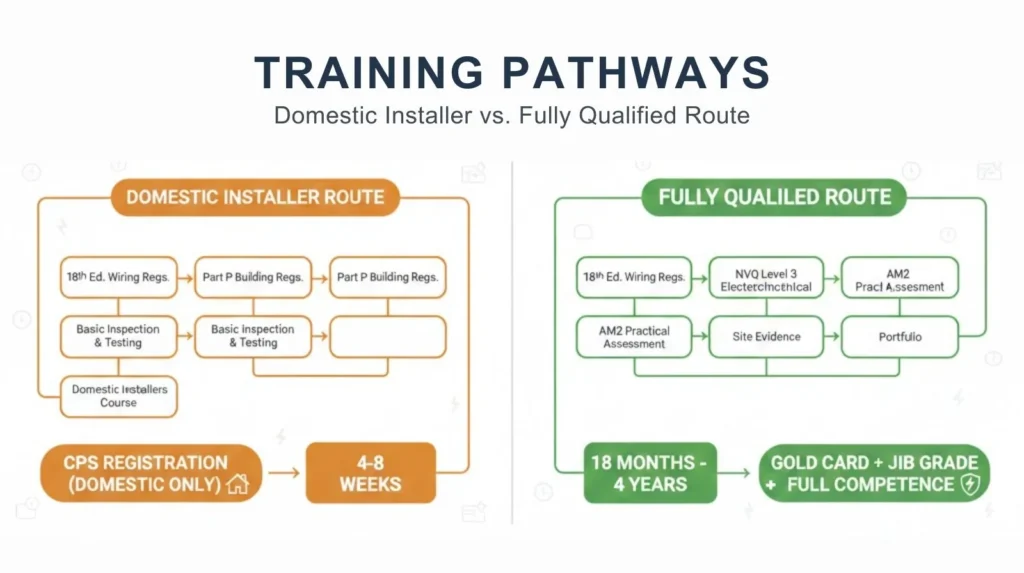
Here’s the comprehensive training pathway comparison in our UK electrician course options:
| Feature | Domestic Installer | Fully Qualified Electrician |
| Primary Qualification | C&G 2382 + 2393 + Basic Testing + Domestic Course | NVQ Level 3 (2357/5357/2346) + AM2/AM2S/AM2E |
| Duration | 4-8 weeks (fast-track) | 18 months to 4 years (depending on route) |
| Assessment Scope | Single-phase domestic installations only | Domestic, commercial, and industrial across all voltages |
| Evidence Required | Classroom scenarios + 2 assessed domestic jobs | Comprehensive on-site portfolio across multiple environments |
| Industry Recognition | CPS registration (NICEIC/NAPIT Domestic only) | ECS Gold Card + JIB Electrician grade |
| Career Ceiling | Domestic market only, limited progression | Full industry access, supervisory and specialist roles |
What Work Each Role Can Actually Do
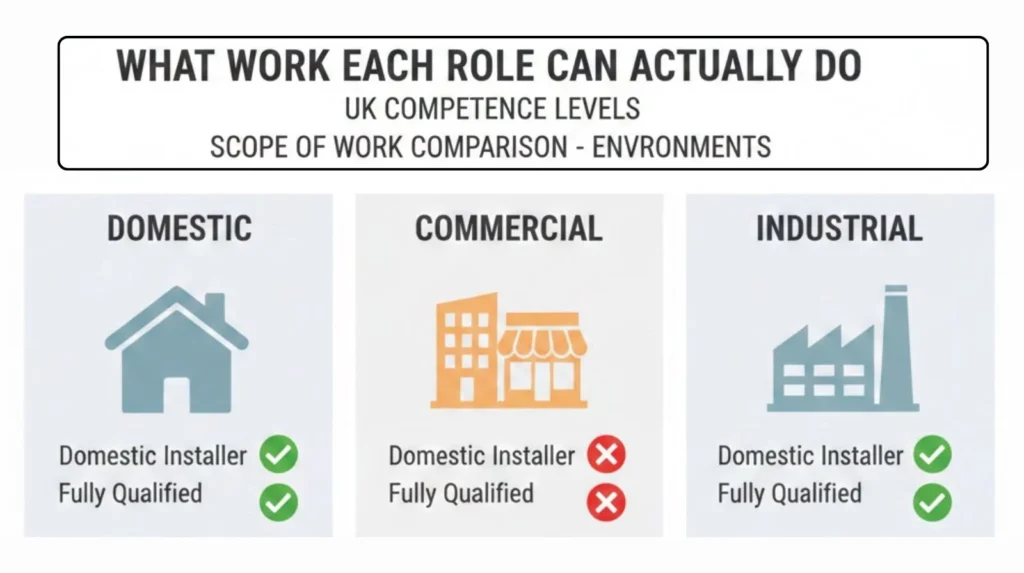
The scope limitations aren’t arbitrary. They’re defined by training depth, assessment standards, insurance coverage, and legal competence under EAWR.
Domestic Installer Scope
Can do (legally and with insurance coverage):
All single-phase electrical work in domestic dwellings (houses, flats, apartments)
Consumer unit installation and replacement in homes
Lighting circuits, socket circuits, cooker circuits, immersion heaters
Basic EV charger installation in domestic driveways (often requires additional short course)
Initial verification and certification of their own new domestic work
Minor works certification in residential properties
Cannot do (or severely restricted):
Any work on three-phase systems
Commercial premises installations (offices, shops, warehouses)
Industrial installations (factories, processing plants, distribution centres)
Large-scale agricultural installations
Act as Qualified Supervisor on Approved Contractor schemes
Issue formal Electrical Installation Condition Reports (EICRs) for landlords or property transactions (requires C&G 2391)
Main contractor site work (no Gold Card means no site access)
Insurance exclusions: Public Liability and Professional Indemnity policies for domestic installers typically contain explicit exclusions for work outside the domestic scope. Any claim arising from commercial or three-phase work would likely be rejected, leaving the installer personally liable.
Fully Qualified Electrician Scope
Full competence across:
Domestic, commercial, industrial, and agricultural installations
Single-phase and three-phase power distribution
Motor installations, starters, and control circuits
SWA cable installation, jointing, and termination
All forms of containment (conduit, trunking, cable tray, cable ladder)
Advanced fault diagnosis across complex systems
Emergency lighting systems, fire alarm systems (with additional specific training)
Testing and inspection with C&G 2391-52 qualification, including EICRs for all property types
Legal certification authority: With the appropriate qualifications (NVQ Level 3 + AM2 + C&G 2391 for testing), a fully qualified electrician can act as the Qualified Supervisor on an Approved Contractor scheme, certifying all categories of work across all environments.
The Risks of Staying Domestic-Only
Career progression isn’t the only consideration. There are tangible legal and financial risks for those who remain domestic installers long-term.
Insurance and Legal Liability
In the event of an electrical fire, shock, or fatality, HSE investigations examine whether the person who carried out the work was competent under EAWR for that specific task. A domestic installer who has worked on a small office (even if it “looked like a house”) would struggle to prove competence if their training consisted only of a 6-week domestic course with no commercial experience or NVQ evidence.
Their insurance would likely reject any claim, leaving them personally liable for damages that could run into six or seven figures.
Employer Rejection
Major electrical contractors, mechanical and electrical (M&E) firms, and facilities management companies will not hire domestic-only installers for core site work. Job advertisements for “Electrician” roles almost universally specify “NVQ Level 3 + Gold Card” or “JIB Electrician grade minimum.”
Our placement team at Elec Training speaks with 120+ contractors daily. Domestic installer certificates are not accepted as equivalent to NVQ qualifications. Contractors need the Gold Card for site access, insurance purposes, and client requirements.
Real Industry Sentiment
The frustration is well-documented across UK electrician forums:
Reddit r/electricians (2024):
"I've finished my fast-track course, but all the job adverts ask for a Gold Card and won't accept my Domestic Installer certificate."
ElectriciansForums.co.uk (2023):
"My short-course training provider told me I was 'fully qualified,' but my local NICEIC assessor says I only qualify for the Domestic Installer scheme, and I can't get Approved Contractor status."
Screwfix Community (2022):
"I've been doing domestic work for 5 years, but now I want to get the NVQ. The assessor says my work is too limited and doesn't meet the evidence requirements for three-phase or containment. I need to get commercial experience."
The NVQ Catch-Up Problem
For domestic installers who later decide they want the full qualification, there’s a structural problem. The NVQ requires evidence of work across domestic, commercial, and industrial installations. If you’ve spent 3-5 years only doing domestic work, you don’t have that evidence.
This forces a “restart” where the installer must find employment or placements that expose them to commercial and industrial environments, then build the portfolio from scratch. It’s a frustrating and costly detour that could have been avoided by taking the proper route initially.
Joshua Jarvis, our Placement Manager, sees this regularly:
"The biggest frustration we hear is from domestic installers who want to progress to testing roles, EV installations, or supervisory positions. Those opportunities require the full qualification pathway. Employers won't take the risk on someone who hasn't demonstrated commercial or industrial competence."
Joshua Jarvis, Placement Manager
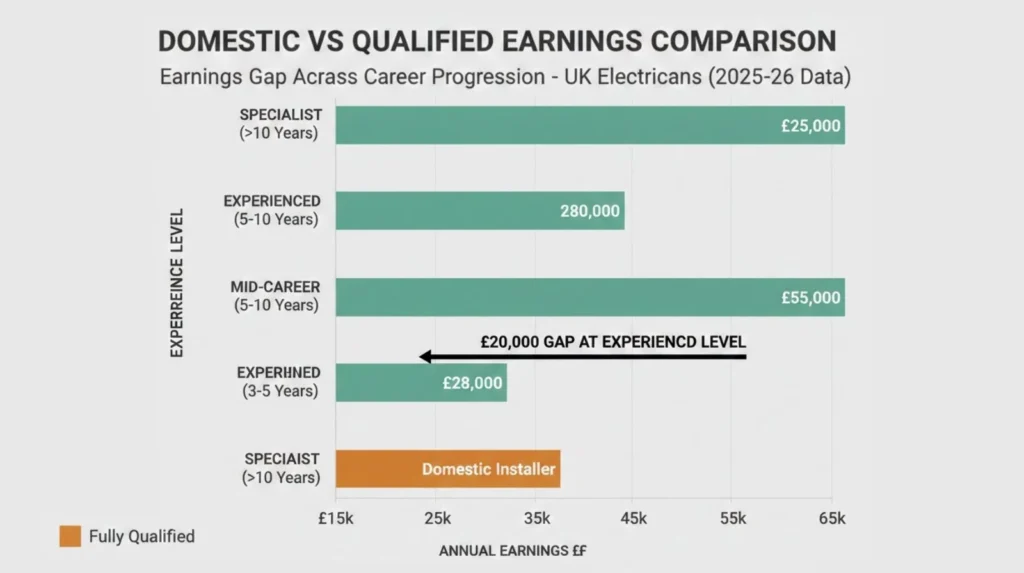
Pay Differences: The Numbers Don't Lie
The earnings gap between domestic installers and fully qualified electricians is substantial and well-documented.
Domestic Installer Earnings
PAYE employed:
New/trainee: £18,000 – £22,000 annually
Experienced (3-5 years): £26,000 – £35,000 annually
Upper ceiling: £38,000 – £40,000 (rare, requires very high workload and established client base)
Self-employed (CIS day rates):
Typical: £150 – £200 per day
Regional variation significant (London slightly higher at £180-£220)
Fully Qualified Electrician Earnings
PAYE employed (JIB graded):
JIB Electrician grade: £34,000 – £42,000 annually (base rate £19.50/hour, London +£3-£5/hour)
JIB Approved Electrician: £42,000 – £52,000 annually (base rate £21.50/hour)
With testing qualification (C&G 2391): £45,000 – £60,000+
Self-employed (CIS day rates):
Standard commercial rate: £200 – £250 per day
Testing/inspection roles: £250 – £300 per day
Specialist (EV, solar, industrial maintenance): £280 – £350 per day
Regional Pay Breakdown
| Region | Domestic Installer (Annual) | Fully Qualified Electrician (Annual) | JIB Hourly Rate (Electrician) |
| North | £28,000 – £35,000 | £32,000 – £38,000 | £19.50 |
| Midlands | £30,000 – £38,000 | £36,000 – £42,000 | £19.50 |
| South | £32,000 – £40,000 | £38,000 – £45,000 | £19.50 |
| London | £35,000 – £45,000 | £45,000 – £55,000 | £22.50+ (with weighting) |
The gap is driven by three factors: lack of Gold Card prevents access to higher-paying commercial and industrial contracts, inability to certify testing work (C&G 2391 typically adds £5,000-£10,000 to earning potential), and limitation to the competitive, price-sensitive domestic market.
ECS Cards, JIB Grading, and Site Access
The ECS (Electrotechnical Certification Scheme) card system is how the UK construction industry verifies electrical competence. It’s the single biggest barrier for domestic installers trying to access commercial work.
Domestic Installer Cards
Domestic installers are typically eligible for a Domestic Installer card (white card) or, if they meet new requirements, a Domestic Electrician Gold Card (limited scope). Critically, neither of these cards provides access to mainstream commercial or industrial sites.
Main contractors, M&E firms, and project managers require the Installation Electrician Gold Card as the minimum standard. Site inductions won’t proceed without it. Insurance and client contracts mandate it.
Fully Qualified Electrician Cards
The ECS Installation Electrician Gold Card requires:
NVQ Level 3 in Electrical Installation (C&G 2357/5357 or equivalent)
Successful completion of AM2/AM2S/AM2E practical assessment
Current 18th Edition qualification (C&G 2382)
This Gold Card proves competence to work unsupervised across all electrical environments and is required for access to virtually all major construction sites, commercial fit-outs, and industrial facilities.
Approved Electrician status (higher grade) requires the Gold Card plus C&G 2391-52 (Inspection, Testing and Certification) and proof of two years’ experience at Electrician grade. This grade is essential for testing roles, supervisory positions, and acting as the Qualified Supervisor on an NICEIC Approved Contractor scheme.
Why This Matters
Site access isn’t a theoretical concern. It directly impacts earning potential and job availability. Commercial electrical contracts typically pay £200-£300 per day on CIS rates. Industrial maintenance roles offer stable PAYE employment at £38,000-£50,000+. These opportunities are completely inaccessible without the Gold Card.
Career Progression: Where Each Path Leads
The long-term trajectory of each route differs dramatically.
Domestic Installer Career Ceiling
Typical progression:
Year 1-2: Building client base, learning domestic installations
Year 3-5: Established domestic installer, earning £28,000-£35,000
Year 5+: Earning ceiling reached, limited options to progress further
Barriers:
Cannot move into commercial or industrial roles without NVQ
Cannot become Qualified Supervisor on Approved Contractor schemes
Cannot supervise other electricians on non-domestic work
Cannot access testing/inspection roles (landlord EICRs, periodic testing)
Cannot access specialist roles (EV, solar, CompEx hazardous areas)
The restart problem: To progress beyond this ceiling, domestic installers must effectively “start again” by pursuing the NVQ Level 3 through the Experienced Worker route. This requires finding employers willing to provide commercial/industrial experience for portfolio evidence, which creates a catch-22 (employers want qualified staff, but you need the experience to get qualified).
Fully Qualified Electrician Progression
Career pathways open:
JIB Approved Electrician (with C&G 2391 + experience)
Electrical Supervisor/Foreman
Testing and Inspection Specialist (landlord EICRs, commercial periodic inspection)
EV Charging Infrastructure Specialist (high-demand, requires full quals)
Solar PV and renewable energy installations
CompEx (hazardous areas, oil & gas, chemical processing)
High-voltage authorised person (with additional HV training)
Qualified Supervisor on NICEIC/NAPIT Approved Contractor schemes
Electrical Project Manager
Electrical Contractor (self-employed with full scope)
Earning progression: A qualified electrician who adds C&G 2391 (testing) typically sees earnings increase by £5,000-£10,000. Those who specialise further (CompEx, HV, solar) can reach £55,000-£70,000+ in employed roles or £300-£400 per day self-employed.
The NVQ pathway aligns with the entire JIB grading structure, providing clear progression through Electrician, Approved Electrician, Technician, and into supervisory and management roles.
What Top Industry Sites Don't Tell You
Most online comparisons miss several critical points:
The EAWR competence mismatch: The Electricity at Work Regulations explicitly state competence must match the work. Domestic installer courses don’t cover the knowledge needed to perceive risks in three-phase or industrial environments, creating a legal gap.
Insurance exclusions: Very few guides mention that domestic installer insurance typically excludes commercial work. This leaves individuals personally liable for incidents outside their scope.
The NVQ evidence problem: If you spend years doing only domestic work, you can’t gather the NVQ portfolio evidence required for commercial/industrial installations. This forces a restart later.
JIB rates and contractor hiring: The pay gap isn’t just about experience; it’s structural. Contractors hiring for commercial projects specifically request NVQ-qualified electricians with Gold Cards. Domestic installer certificates don’t meet that standard.
The “Part P equals qualified” myth: Being registered with a Part P Competent Person Scheme only proves competence for domestic notifiable work. It doesn’t make someone a “fully qualified electrician” under industry or legal definitions.
What You Should Actually Do
If you’re deciding between these routes, the choice depends on your long-term goals.
Choose the domestic installer route if:
You’re certain you only want to work in residential properties
You’re happy with an earning ceiling around £35,000-£40,000
You understand you won’t be able to access commercial, industrial, or specialist roles
You’re aware this may require a costly restart later if your goals change
Choose the fully qualified route if:
You want the full scope of electrical work available to you
You want access to commercial and industrial contracts
You want the ability to progress to testing, supervisory, or specialist roles
You want long-term earning potential of £45,000-£65,000+ including specialist work
You want the industry-standard Gold Card and JIB recognition
At Elec Training, we’re transparent about what each pathway offers. The domestic installer route has its place for those genuinely committed to residential-only work. But for most people entering the electrical industry, the NVQ Level 3 pathway provides the comprehensive training, legal competence, and career flexibility that leads to sustainable long-term employment.
We offer the full NVQ package (£10,500 including AM2 fee and PPE) with guaranteed placement support through our network of 120+ UK contractors. Our in-house recruitment team doesn’t just hand you a list of email addresses; we actively call contractors daily to secure placements for learners building their portfolios.
Call us on 0330 822 5337 to discuss which pathway matches your goals. We’ll explain exactly what each route involves, how long it takes, what you’ll earn at each stage, and what our placement team can do to secure your first role. No misleading claims. No “qualified in 4 weeks” nonsense. Just honest guidance on what it actually takes to become a fully qualified electrician in the UK.

References
- IET Wiring Regulations BS 7671:2018+A2:2022 – https://www.theiet.org/
- Building Regulations Part P (Electrical Safety – Dwellings) – https://www.gov.uk/government/publications/electrical-safety-approved-document-p
- City & Guilds 2357 NVQ Level 3 Electrical Installation Specification – https://www.cityandguilds.com/
- City & Guilds 2391-52 Inspection and Testing Qualification – https://www.cityandguilds.com/
- ECS Card Scheme Requirements – https://www.ecs.co.uk/
- JIB (Joint Industry Board) Grading and Wage Rates 2025-2026 – https://www.jib.org.uk/
- NICEIC Competent Person Schemes – https://www.niceic.com/
- NAPIT Competent Person Schemes – https://www.napit.org.uk/
- HSE Guidance on Electrical Safety and Competence – https://www.hse.gov.uk/electricity/
- ONS Annual Survey of Hours and Earnings (ASHE) – Electrical Trades – https://www.ons.gov.uk/
Note on Accuracy and Updates
Last reviewed: 22 December 2025. This page is maintained; we correct errors and refresh sources as electrical regulations, qualification standards, and JIB wage agreements change. All salary data cited reflects 2025 JIB rates and ONS Annual Survey of Hours and Earnings for electrical trades. Next review scheduled following 2026 JIB wage agreement publication (expected April 2026).
