
Electrical Courses in Birmingham: Level 2, Level 3 and NVQ Explained

- Technical review: Thomas Jevons (Head of Training, 20+ years)
- Employability review: Joshua Jarvis (Placement Manager)
- Editorial review: Jessica Gilbert (Marketing Editorial Team)
- Last reviewed:
- | Changes: Initial publication clarifying Level 2, Level 3, and NVQ distinctions for Birmingham learners
You’ve just paid £3,800 for what Birmingham training centre advertisements called a “Level 3 Professional Electrician Course.” The certificate arrives. City & Guilds 2365-03 Diploma in Electrical Installations. You apply for electrician positions on Indeed and Reed. Every rejection email says the same thing: “We require NVQ Level 3 and AM2 assessment.”
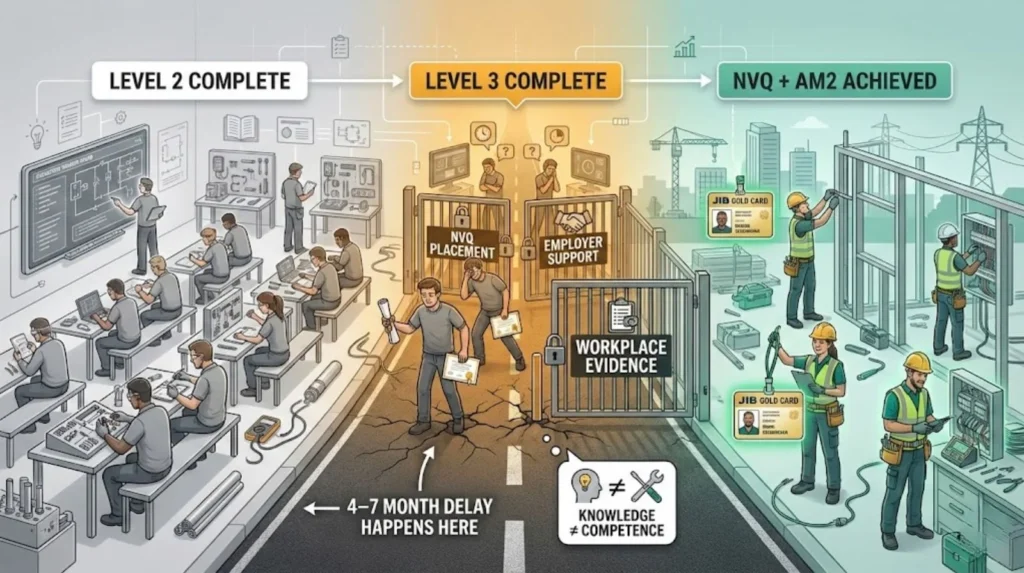
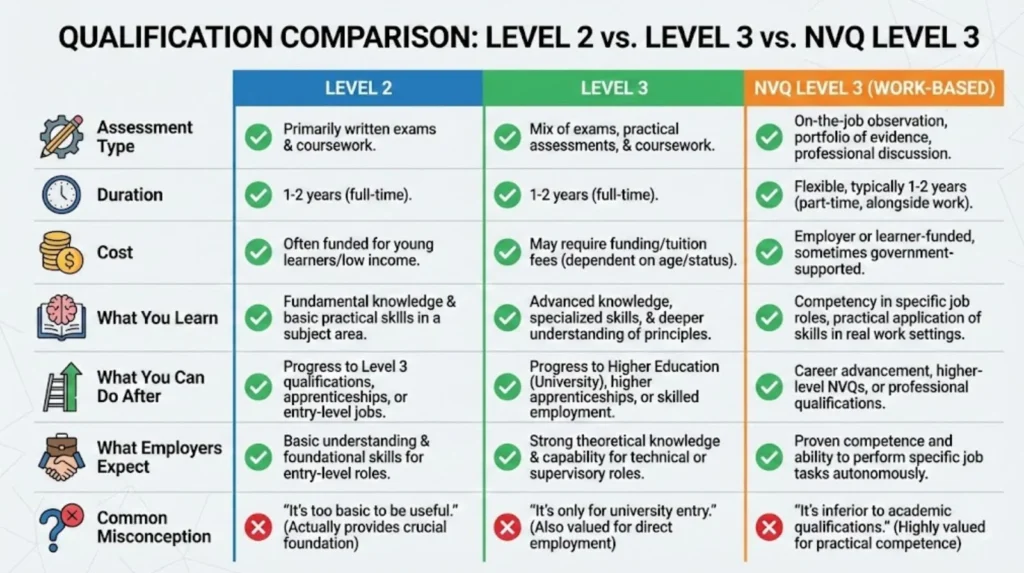
Here’s what the training centre didn’t explain upfront: Level 3 diplomas prove you understand electrical theory. NVQ Level 3 proves you can safely perform electrical work on real sites under real conditions. Employers want both. Most electrical courses Birmingham providers advertise only deliver the first part, leaving you qualified on paper but unemployable in practice.
Birmingham has dozens of providers teaching Level 2 diplomas, Level 3 diplomas, and claiming these make you a “qualified electrician.” The reality is more complicated. Level 2 covers basic electrical science and single-phase domestic circuits. Level 3 advances to three-phase systems, inspection and testing theory, and fault diagnosis. NVQ Level 3 requires workplace evidence proving you’ve actually installed, tested, and certified electrical work to BS 7671 standards.
If you’re trying to understand what Level 2, Level 3, and NVQ actually mean in Birmingham’s electrical training market, here’s the breakdown nobody gives you before taking your money.
Level 2: The Foundation Nobody Calls "Beginner" Anymore
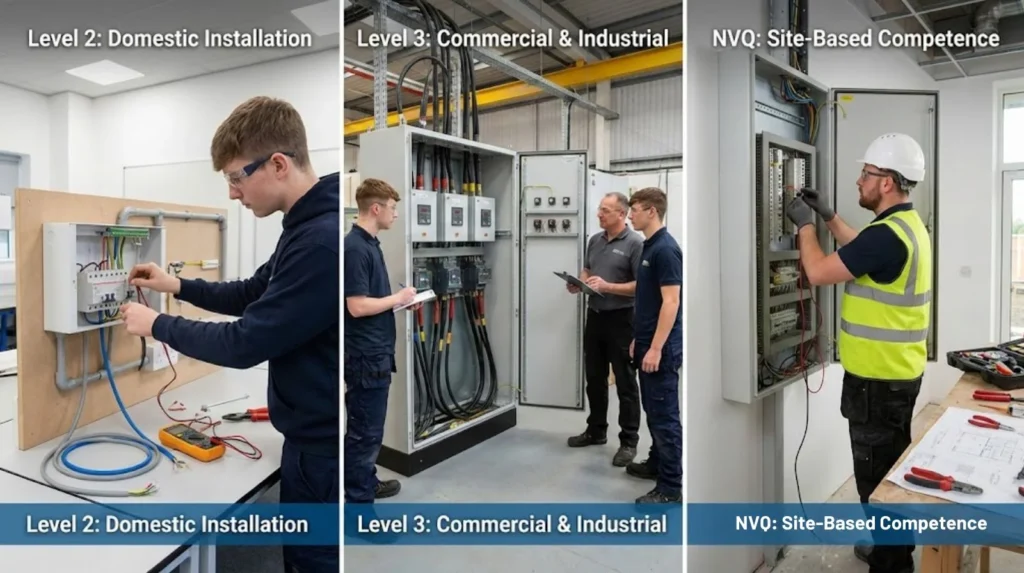
City & Guilds 2365-02 Level 2 Diploma in Electrical Installations is where everyone without existing electrical experience starts. Elec training offers this at £3750.00 full time for 5 weeks with your 18th edition and work placement, other Colleges in Birmingham deliver this over one year part-time.
The curriculum covers DC and AC theory, Ohm’s law and circuit calculations, earthing and bonding principles, safe isolation procedures, basic installation methods for domestic circuits, and introduction to BS 7671 wiring regulations. You’ll wire practice boards in workshops hundreds of times. Lighting circuits, socket outlets, radial circuits, basic consumer unit work. All simulated. All supervised. Nothing live.
What Level 2 enables: progression to Level 3 study, eligibility for white Trainee ECS cards (with health and safety test), access to Electrician’s Mate positions on Birmingham sites where you’re pulling cables, mounting back-boxes, and assisting qualified sparks. What it doesn’t enable: independent electrical work, signing off installations, applying for skilled electrician roles, or calling yourself qualified.
Birmingham job ads for Electrical Mate positions typically list “Level 2 electrical installation or equivalent” in requirements. They’re offering £16 to £18 per hour, expecting you to work under constant supervision, and assuming you’ll be progressing toward Level 3 and eventually NVQ. The role exists specifically for people who’ve completed classroom training but haven’t yet demonstrated workplace competence.
Level 3: Where Marketing Gets Deliberately Confusing
City & Guilds 2365-03 Level 3 Diploma in Electrical Installations builds on Level 2 by covering three-phase distribution systems, advanced circuit design calculations, inspection and testing theory, fault diagnosis procedures, and commercial installation practices. Birmingham providers deliver this over 6 to 12 months part-time at FE colleges or 8 at private centres like Elec training.
The qualification is comprehensive. You’ll learn complex electrical science, detailed BS 7671 regulation interpretation, testing sequences for different installation types, and theoretical approaches to fault-finding. Exams are rigorous. Practical assessments in workshops test your ability to wire three-phase systems, calculate voltage drop, and identify circuit faults. Pass rates at Birmingham colleges average 70% to 80%, suggesting most learners who complete the course achieve certification.
Here’s where Birmingham training providers engage in creative marketing: “Level 3 Electrical Installation Course” gets advertised as “Professional Electrician Training” or “Electrician Qualification Course” without clarifying that Level 3 diplomas are knowledge-only qualifications. Learners complete the course, receive their certificate, then discover employers want NVQ Level 3 and AM2 assessment which weren’t included in the package and cost another £4,000 to £6,000 to complete.
The detailed look at West Midlands electrical training reveals this pattern across multiple Birmingham providers: prominent advertising of Level 3 courses, minimal mention of NVQ requirements, buried explanations about workplace evidence needs, and surprised learners six months later when they can’t find electrical work.
NVQ Level 3: The Qualification That Requires A Job First
City & Guilds 2357 NVQ Level 3 in Installing Electrotechnical Systems and Equipment (or EAL equivalent 5357) is the competence qualification employers actually want. It cannot be completed in college workshops. It requires workplace evidence gathered over 12 to 24 months of actual electrical installation work on real sites under qualified supervision.
The NVQ covers units including electrical installation, testing and commissioning, planning and overseeing work, diagnosing and correcting electrical faults, and health and safety practices. Evidence includes photographs of installations you’ve completed, risk assessments for specific jobs, test results from equipment you’ve certified, witness statements from supervisors, and assessor observations of your work on site.
Thomas Jevons, Head of Training with 20 years on the tools, explains:
"The NVQ portfolio isn't just photos of work you've done. Assessors need to see evidence of planning, risk assessment, testing sequences, and certification for multiple installation types. You can't fake that in a training bay."
Thomas Jevons, Head of Training
Cost for NVQ Level 3 in Birmingham varies significantly. If you secure an apprenticeship, your employer covers the cost. If you’re working as an improver and your employer supports NVQ development, expect to pay £2,000 to £3,000 for tutor support and assessor visits. If you’re piecing together evidence from sporadic work without employer backing, costs can reach £4,000 to £5,000 because you’ll need more intensive support to ensure evidence quality.
The timeline is non-negotiable. NVQ Level 3 requires evidence across multiple installation types: domestic, commercial, industrial if possible. You need to demonstrate competence in different scenarios: new installations, additions to existing systems, fault diagnosis and repair, testing and certification. This takes time. Rushing produces inadequate evidence that assessors reject.
Why Birmingham Learners Get Stuck Between Level 3 and NVQ
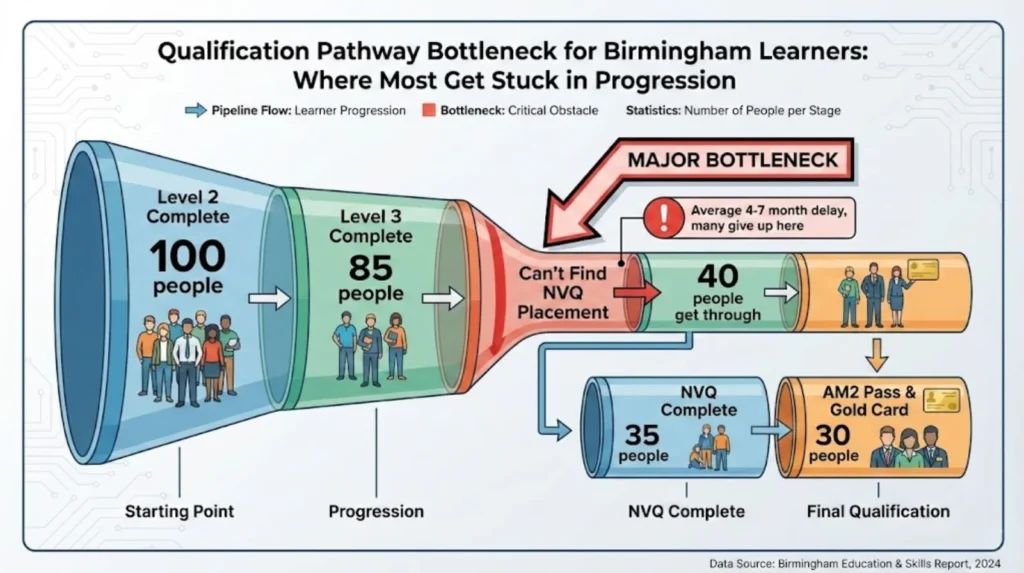
The progression pathway looks simple on paper: complete Level 2, progress to Level 3, begin NVQ, pass AM2, achieve Gold Card status. In practice, Birmingham learners hit a massive bottleneck between Level 3 completion and NVQ commencement because they can’t find employers willing to support workplace evidence gathering.
Birmingham’s electrical labour market has Electrician’s Mate positions (requiring Level 2), Improver positions (requiring Level 3), and Qualified Electrician positions (requiring NVQ Level 3 and AM2). The transition from Improver to Qualified requires an employer who’ll supervise your work, allow assessor site visits every 6 to 8 weeks, provide varied work for portfolio evidence, and commit to supporting you through 12 to 24 months of NVQ development.
Not all employers offer this. Small domestic contractors often don’t have capacity to support NVQ learners. Large commercial firms prefer taking apprentices through structured programmes rather than supporting improvers. The sweet spot is medium-sized contractors doing varied work across domestic, commercial, and occasionally industrial projects, but competition for these positions is fierce.
Forum discussions and job board patterns suggest Birmingham learners spend 4 to 7 months on average between Level 3 completion and securing improver work with NVQ support. During this period, they’re applying for dozens of positions, often accepting mate work at lower wages hoping to prove themselves and transition internally, or considering moving beyond Birmingham to Wolverhampton, Dudley, Walsall, or Coventry where contractor networks might offer better opportunities.
Joshua Jarvis, Placement Manager, explains:
"We see Birmingham learners stuck between Level 3 completion and NVQ start because they can't find the placements independently. That's where having 120+ contractor partnerships makes the difference - we're actively placing people, not just teaching them."
Joshua Jarvis, Placement Manager
The AM2 Assessment: Final Hurdle After NVQ
AM2 (Achievement Measurement 2) is the independent end-point assessment administered by NET (National Electrotechnical Training) at approved centres. Birmingham learners typically attend centres in West Bromwich, Wolverhampton, or Great Barr for their three-day practical examination. Cost: approximately £1,000 to £1,200 including registration, assessment, and resit insurance.
The exam covers fault diagnosis, installation work, inspection and testing, and design calculations under timed conditions. You’re given installation scenarios, asked to plan the work, execute it safely, test it correctly, and certify it to BS 7671 standards. Assessors watch every step. Mistakes that would be correctable on a real job site become instant failures in the exam environment.
National pass rates hover around 75% for first-time candidates. Birmingham-specific data isn’t published, but anecdotal evidence from training providers suggests similar rates locally. The 25% who fail typically do so because of poor installation practices (loose terminations, inadequate mechanical protection), incorrect testing sequences, or inability to complete work within time limits.
You cannot take AM2 until your NVQ portfolio is complete or nearly complete. Most learners book AM2 assessment 18 to 22 months into their NVQ journey, after logging sufficient evidence and receiving confirmation from their assessor that they’re ready. Booking too early (common mistake among impatient learners) results in failure because you haven’t developed the muscle memory and workflow efficiency the exam demands.
What These Qualifications Actually Cost in Birmingham
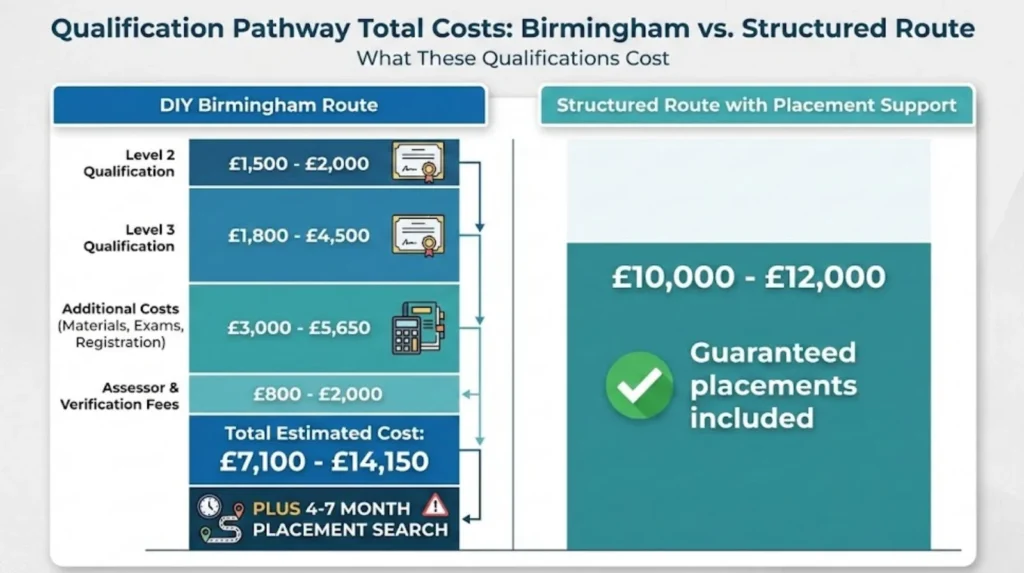
If you piece together the complete qualification pathway through Birmingham colleges and private providers independently, here’s the realistic cost breakdown:
Level 2 diploma at FE college: £1,500 to £2,000 (potentially free with WMCA funding). Level 3 diploma at FE college or private centre: £1,800 to £4,500 depending on delivery speed. 18th Edition Wiring Regulations: £300 to £500 for 3 to 5 day course. NVQ Level 3 tutor support and assessor visits: £2,000 to £5,000 depending on employer support level. AM2 assessment: £1,000 to £1,200. Health and safety tests for ECS card: £100 to £150. PPE and basic tools: £400 to £800.
Total: £7,100 to £14,150 depending on which providers you use, whether you access any free provision, and how much employer support you receive for NVQ costs.
Compare this to Elec Training’s structured pathway: £10,000 to £12,000 covering Level 2 (2365-02) over 4 weeks, Level 3 (2365-03) over 8 weeks, 18th Edition over 5 days, NVQ Level 3 (2357) with guaranteed placement support through in-house recruitment team working with 120+ contractor partnerships, tutor support and assessor visits throughout NVQ period, and ongoing support until qualification completion. Not included: AM2 exam fee (approximately £1,000, paid separately when assessment-ready) and PPE or essential equipment (approximately £400 to £600).
The cost difference narrows significantly when you factor in the time value of the 4 to 7 month gap most Birmingham learners experience searching for NVQ placements independently. If you’re earning £18 per hour as an improver during that period versus £22 to £24 per hour building NVQ evidence, the opportunity cost exceeds £2,000 to £3,000 in lost wages.
The Timeline: How Long This Actually Takes
If you start Level 2 in Birmingham in September 2026, here’s the realistic progression timeline:
September 2026 to June 2027: Level 2 diploma, two evenings weekly or 4 months intensive. You’re learning electrical fundamentals, passing exams, wiring practice boards.
September 2027 to June 2028: Level 3 diploma, continuing evening study or 8 weeks intensive. Advanced electrical science, three-phase systems, testing theory.
July to November 2028: Job search period. Applying for improver roles, attending interviews, networking with Birmingham contractors. This is where many learners get stuck for 4 to 7 months.
December 2028 to December 2030: NVQ Level 3 portfolio building while working as improver. Logging evidence, assessor visits every 6 to 8 weeks, gradually demonstrating competence across all required units. This takes 18 to 24 months of consistent site work.
January 2031: AM2 assessment. Three days of intensive practical examination. Results typically within 2 to 4 weeks.
February 2031: Apply for JIB Gold Card with completed NVQ, AM2 pass, and 18th Edition certificate.
Total timeline: 4.5 years from September 2026 beginner start to February 2031 Gold Card qualified electrician. Faster if you study full-time and secure placements immediately (potentially 2 to 3 years). Slower if job search extends or NVQ progress stalls (could reach 5 to 6 years).
How Elec Training Structures This Differently
Elec Training’s approach eliminates the qualification gap by integrating placement support throughout the pathway rather than leaving learners to navigate the Birmingham job market independently after completing diplomas.
The standard route covers Level 2 (2365-02) delivered intensively over 4 weeks, Level 3 (2365-03) over 8 weeks, then immediate progression into NVQ Level 3 (2357) with guaranteed placement support. The in-house recruitment team actively contacts 120+ contractor partnerships across the UK, including extensive West Midlands coverage (Birmingham, Wolverhampton, Dudley, Walsall, Sandwell, Coventry), to secure improver positions where learners can build NVQ evidence.
This doesn’t accelerate the NVQ timeline (workplace evidence still requires 12 to 24 months to gather properly), but it eliminates the 4 to 7 month gap between diploma completion and workplace access that stalls most Birmingham learners. You’re progressing toward qualification continuously rather than cycling through job applications hoping someone will take a chance on an unproven improver.
The recruitment team difference matters specifically for Birmingham learners because local contractor networks are relationship-based. Having someone who speaks with employers daily, understands their specific needs, and can advocate for your placement based on completed Level 2 and Level 3 credentials removes the cold-application barrier most learners face.
If you’re trying to understand Level 2, Level 3, and NVQ distinctions in Birmingham’s electrical training market, start by recognizing that no single course makes you a qualified electrician. The pathway requires multiple qualifications, workplace evidence, and independent assessment over 2 to 4.5 years depending on your route.
What we’re not going to tell you: that Level 3 diplomas alone qualify you for electrical work, that Birmingham has shortcuts around NVQ requirements, that you can complete the full pathway in 6 months with “fast-track” courses, or that finding improver work with NVQ support is easy.
What we will tell you: Level 2 and Level 3 are essential knowledge qualifications but prove theory not competence, NVQ Level 3 requires 12 to 24 months of workplace evidence you can’t fake in training centres, the biggest challenge Birmingham learners face is securing placements between Level 3 and NVQ start, realistic total costs are £10,000 to £12,000 for structured support or £7,000 to £14,000 piecing together local provision, and the complete timeline is 2 to 4.5 years depending on study intensity and placement access.
Call us on 0330 822 5337 to discuss the step-by-step guide to Birmingham electrician courses with honest explanations of what Level 2, Level 3, and NVQ actually involve. We’ll clarify exactly what each qualification enables, what the workplace evidence requirements look like, and how our in-house recruitment team helps Birmingham learners secure the placements that turn diplomas into genuine qualifications. No misleading claims about “qualified in weeks.” No confusion about knowledge versus competence. Just practical guidance on the complete pathway.
References
- City & Guilds 2365 Level 2 & 3 Electrical Installation Qualifications – https://www.cityandguilds.com/
- City & Guilds 2357 NVQ Level 3 Electrotechnical Qualifications – https://www.cityandguilds.com/
- EAL Level 3 Electrical Installation Qualifications – https://www.eal.org.uk/
- Birmingham Metropolitan College (BMet) Electrical Courses – https://www.bmet.ac.uk/
- South & City College Birmingham – https://www.sccb.ac.uk/
- University College Birmingham Electrical Installation – https://www.ucb.ac.uk/
- National Careers Service: Electrician – https://nationalcareers.service.gov.uk/job-profiles/electrician
- JIB Grading and Gold Card Requirements – https://www.jib.org.uk/
- ECS Card Types and Eligibility – https://www.cscs.uk.com/ecs/
- NET AM2 Assessment Information – https://www.netservices.org.uk/am2/
- IET Wiring Regulations BS 7671:2018+A2:2022 – https://www.theiet.org/
- Ofqual Register of Regulated Qualifications – https://register.ofqual.gov.uk/
- West Midlands Combined Authority Skills Funding – https://www.wmca.org.uk/
- Electrotechnical Skills Partnership (TESP) Training Routes – https://www.electricalcareers.co.uk/
Note on Accuracy and Updates
Last reviewed: 5 January 2025. This page is maintained; we correct errors and refresh sources as qualification structures, Birmingham provider offerings, and NVQ assessment criteria change. City & Guilds and EAL qualification codes and content are subject to periodic updates by awarding bodies. Learners should verify current course specifications, costs, and NVQ requirements directly with providers and awarding bodies before enrolling. Next review scheduled for June 2026.
