
Electrical Courses in Wolverhampton: Level 2, Level 3 and NVQ Explained

- Technical review: Thomas Jevons (Head of Training, 20+ years)
- Employability review: Joshua Jarvis (Placement Manager)
- Editorial review: Jessica Gilbert (Marketing Editorial Team)
- Last reviewed:
- Changes: Initial publication clarifying Level 2, Level 3, and NVQ distinction for Wolverhampton learners
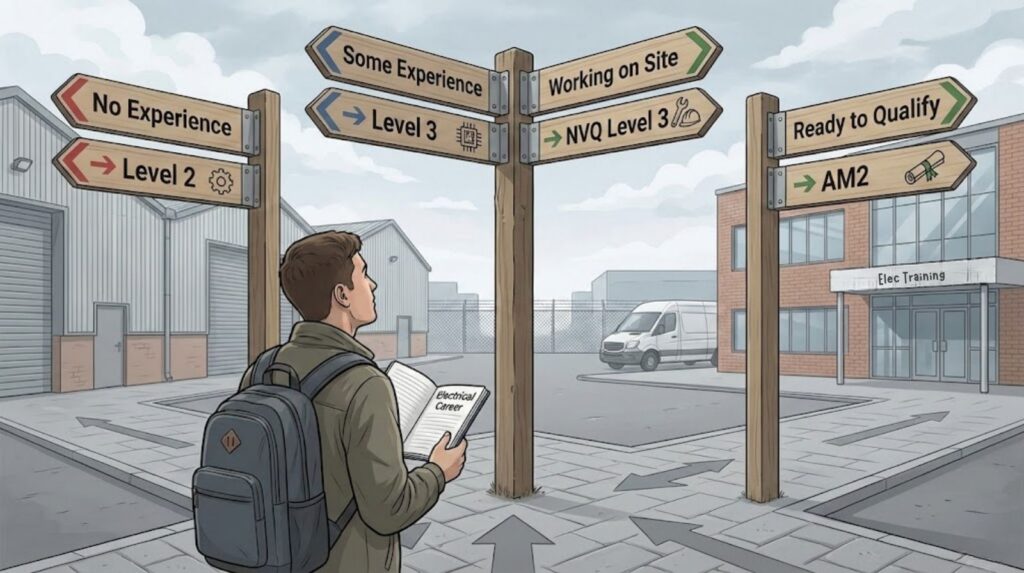
If you’re researching electrical training in Wolverhampton, you’ve probably seen course names like “Level 2 Diploma,” “Level 3 Certificate,” “NVQ Level 3,” and “18th Edition” scattered across provider websites. Some are bundled together in packages. Others are sold separately. The pricing varies wildly. And nowhere does anyone clearly explain what each qualification actually does, what it doesn’t do, and why you need all of them to become a qualified electrician.
Here’s the reality: becoming a qualified electrician in the UK isn’t a single course. It’s a structured pathway involving three distinct types of qualification: knowledge diplomas (Level 2 and Level 3), workplace competence assessment (NVQ Level 3), and practical examination (AM2). Understanding the electrician course Wolverhampton providers offer means understanding which qualification sits where in that pathway, what each one proves, and what gaps remain if you only complete some of them.
This guide breaks down Level 2, Level 3, and NVQ qualifications in plain English, explains what employers in Wolverhampton actually mean when they ask for each one, and clarifies the realistic progression from absolute beginner to JIB Gold Card holder.
The Core Distinction: Knowledge vs Competence
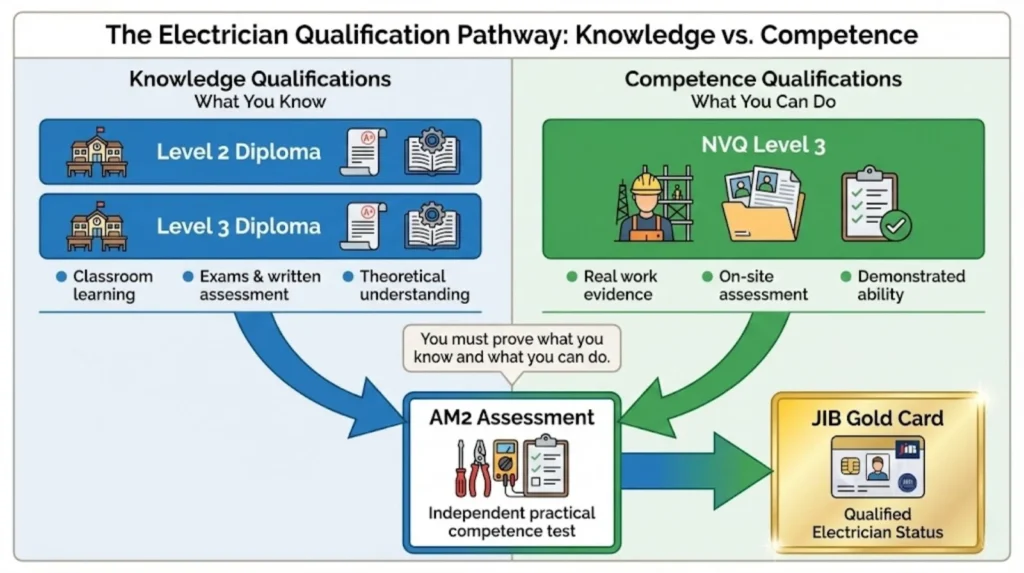
Before we dive into specific levels, you need to understand the fundamental split in UK electrical qualifications: knowledge versus competence.
Knowledge qualifications (Level 2 and Level 3 diplomas) are delivered in classrooms and workshops. They’re assessed through written exams and practical tasks on training rigs. They prove you understand electrical theory, BS 7671 regulations, and installation principles. You learn Ohm’s Law, circuit design, testing procedures, and fault-finding techniques. This is essential. You cannot work safely without this foundation. But it’s only half the picture.
Competence qualifications (NVQ Level 3) are delivered in workplaces. They’re assessed through portfolio evidence and on-site observations. They prove you can apply that knowledge safely on real electrical installations, under real site conditions, with real clients and real time pressure. You demonstrate actual competence, not just theoretical understanding.
The mistake most Wolverhampton learners make is thinking knowledge equals qualification. It doesn’t. You need both. Level 2 and Level 3 get you the knowledge. NVQ proves the competence. AM2 tests whether you can perform under exam conditions. Only then do you get your Gold Card and become a “qualified electrician” in the industry’s eyes.
Level 2: The Foundation Stage (What It Actually Covers)
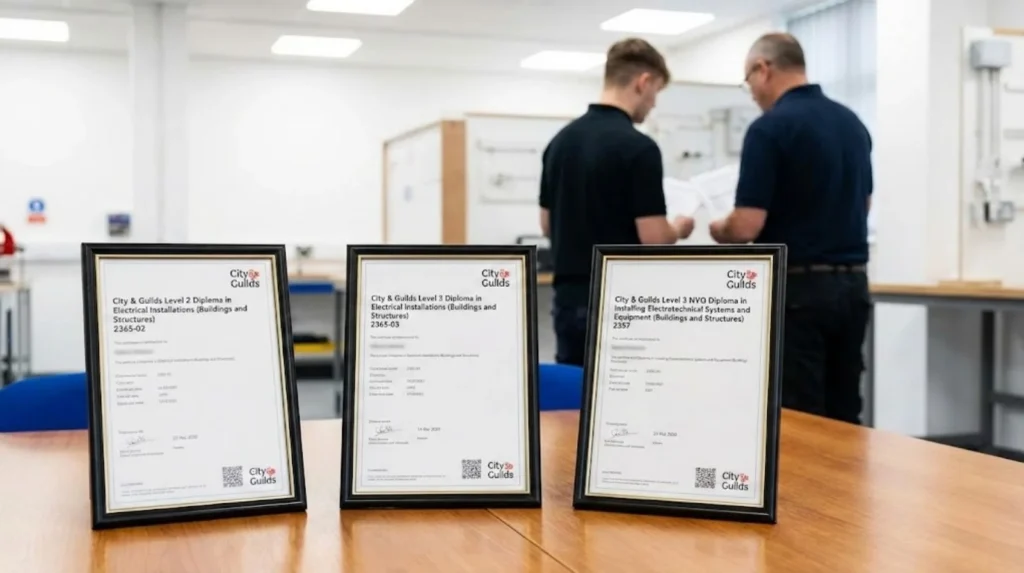
The Level 2 Diploma in Electrical Installations (typically City & Guilds 2365-02) is where absolute beginners start. In Wolverhampton, you can study this at City of Wolverhampton College part-time over an academic year, or at private centres like Elec Training in intensive 4-5 week blocks.
Content-wise, Level 2 covers electrical science fundamentals (voltage, current, resistance, power), health and safety regulations, basic hand tools and equipment, simple circuit wiring (lighting and power), and BS 7671 introduction. You’ll learn about ring finals, radial circuits, earthing systems, and protective devices. The maths involves Ohm’s Law calculations, power formulas, and basic circuit design.
What Level 2 enables: It qualifies you for electrician’s mate or labourer roles. It allows you to progress to Level 3. It gets you an ECS Trainee or Labourer card (white or red). It proves you understand the basics well enough to work under supervision.
What Level 2 does not enable: Working as a qualified electrician. Signing off electrical installations. Getting a JIB Gold Card. Working unsupervised on commercial sites. Joining competent person schemes like NICEIC or NAPIT.
The reality for Wolverhampton learners is that Level 2 is your entry ticket to the trade. It makes you employable as a mate. That’s not insignificant. Mate roles in the West Midlands currently pay £11-£14 per hour. You’re on site, you’re learning, you’re earning. But you’re not qualified, and you need supervision for everything you do.
Level 3: The Advanced Knowledge Stage (Why It's Still Not "Qualified")
The Level 3 Diploma (City & Guilds 2365-03) builds directly on Level 2. You cannot skip Level 2 and go straight to Level 3 unless you’ve got prior engineering qualifications or significant electrical experience that proves you’ve already mastered the fundamentals.
Level 3 content includes advanced electrical science and maths (three-phase systems, power factor correction), inspection and testing theory, fault diagnosis procedures, electrical design and calculation (maximum demand, voltage drop, cable sizing), and deeper BS 7671 coverage including special locations. The maths gets significantly harder. You’re dealing with algebra, trigonometry, and complex circuit analysis.
What Level 3 enables: Progression to NVQ Level 3. Improver roles with more responsibility and independence (still under supervision). Higher wages than mate positions. ECS Improved Trainee card. Better employability for trainee roles.
What Level 3 does not enable: Qualified electrician status. Working unsupervised. Signing off installations. Gold Card eligibility (you need NVQ and AM2 for that). Independent electrical contracting.
Here’s where the confusion happens most in Wolverhampton. Learners complete Level 3, celebrate finishing their “electrical qualification,” then discover employers won’t hire them as qualified electricians. Job ads that say “Level 3 qualified” usually mean improver roles, not fully qualified positions. The language is loose, and it catches people out.
Thomas Jevons, our Head of Training with over 20 years in the trade, sees this regularly:
"Completing Level 3 makes you an improver, not a qualified electrician. You understand advanced theory, you can work under supervision, but you cannot sign off installations or work unsupervised on commercial sites. That requires NVQ completion and AM2 pass."
Thomas Jevons, Head of Training
NVQ Level 3: The Workplace Competence Assessment (Why It's Different)
The NVQ Level 3 in Electrical Installation (typically City & Guilds 2357 or the apprenticeship equivalent 5357) is fundamentally different from Level 2 and Level 3 diplomas. It’s not classroom-based. You cannot study for it in evenings at college. You cannot complete it on training rigs in a workshop.
The NVQ is a portfolio of workplace evidence. You must be employed or have regular access to electrical work sites. Over 12-24 months, you collect photographic evidence, completion records, test results, and client documentation proving you can safely install electrical systems, test circuits and equipment, diagnose and rectify faults, and comply with BS 7671 in real-world conditions.
An assessor visits your workplace (usually twice, sometimes more depending on your role and evidence variety) to observe you working. They verify your evidence is genuine. They watch you perform safe isolation, conduct tests, install circuits, interpret drawings. This cannot be simulated. It must be real electrical work, on real jobs, with real clients.
The evidence requirements are substantial. You need to demonstrate competence across multiple unit outcomes: domestic installations, commercial work, testing procedures, fault-finding, health and safety compliance. Thomas Jevons is clear on standards: “NVQ evidence needs to be substantial and varied. You can’t photograph the same domestic consumer unit 20 times and call it a portfolio. Assessors want to see you’ve installed different circuit types, tested across varied systems, and solved actual problems on real jobs.”
This is where the pathway stalls for many Wolverhampton learners. They complete Level 2 and Level 3, often spending £3,000-£5,000 on courses, then discover they cannot progress without workplace access. No job means no NVQ evidence. No NVQ means no AM2. No AM2 means no Gold Card. The certificates sit in a drawer, and the qualification journey stops.
What AM2 Actually Tests (The Final Hurdle)
Once your NVQ portfolio is complete, you’re eligible for AM2 (Achievement Measurement 2), the practical end-point assessment. This is a 2.5-3 day hands-on exam where you install, test, and fault-find electrical systems under timed conditions at an independent assessment centre.
You’re given installation drawings and must wire circuits correctly, connect protective devices, test earth continuity, measure insulation resistance, verify RCD operation, and diagnose intentional faults planted in the test rig. It’s intense. The pass rate isn’t published, but anecdotally, first-time pass rates sit around 70-75%. People fail. Often because they’ve done their NVQ primarily in domestic work and the AM2 includes commercial containment (tray, trunking, conduit) they’re not comfortable with.
AM2E is the equivalent for experienced workers following the Experienced Worker Assessment route rather than NVQ. The content is similar, but entry requirements differ.
The point is this: you cannot get your ECS Gold Card without passing AM2 or AM2E, regardless of how many diplomas you hold. The fee (paid directly to NET, the assessment body) is currently £850-£950. You travel to a regional centre (West Midlands options include Birmingham, Walsall, and sometimes Wolverhampton depending on availability). And you need to be genuinely competent, not just theoretically knowledgeable.
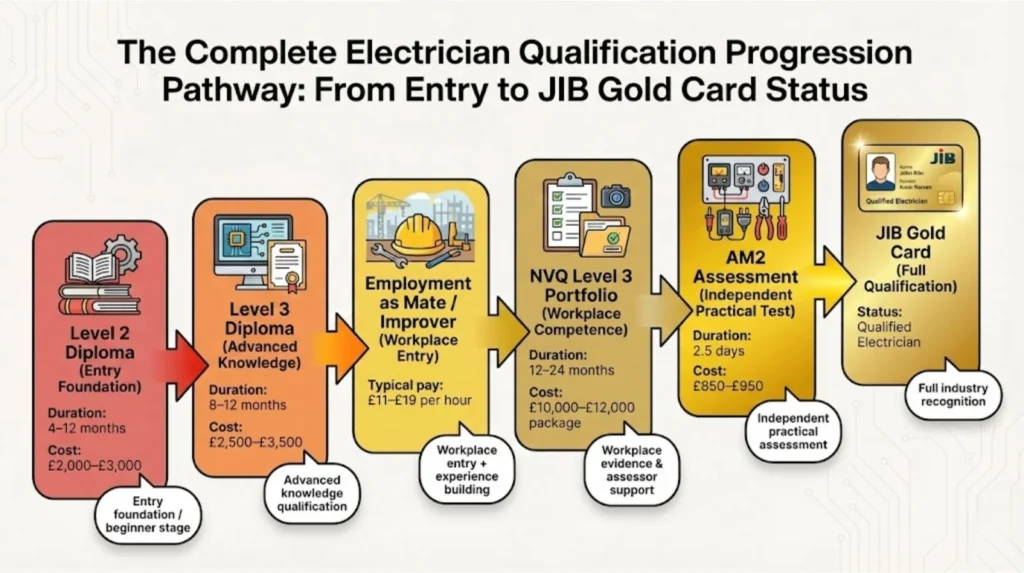
The Complete Progression Pathway (Start to Finish)
Here’s the realistic sequence for someone starting from zero in Wolverhampton:
Stage 1: Level 2 Diploma (4 weeks intensive or 8-12 months part-time). Cost: £2,000-£3,000 typically. Outcome: Mate-level employability, ECS Trainee card eligibility.
Stage 2: Level 3 Diploma (8 weeks intensive or 8-12 months part-time). Cost: £2,500-£3,500 typically. Outcome: Improver-level employability, NVQ eligibility.
Stage 3: Secure employment as mate or improver. This is the bottleneck. Without this, you cannot progress. Wage range: £11-£14/hour for mates, £16-£19/hour for improvers in the Wolverhampton area.
Stage 4: NVQ Level 3 Portfolio (12-24 months while working). Cost: Typically included in packages like Elec Training’s £10,000-£12,000 NVQ support package (which includes tutor support, assessor visits, and placement assistance but excludes AM2 fees and PPE). Outcome: AM2 eligibility.
Stage 5: AM2 Assessment (2.5-3 days). Cost: £850-£950 paid to NET. Outcome: If you pass, you’re qualified.
Stage 6: ECS Gold Card application. Cost: £36-£180 depending on grading. Outcome: You’re now a “Qualified Installation Electrician” in the industry’s eyes.
Total realistic timeline: 18 months to 3 years from absolute beginner to Gold Card, depending on how quickly you secure workplace access for your NVQ. Total realistic cost: £12,000-£15,000 including courses, NVQ support, AM2, tools, PPE, and card applications.
What Wolverhampton Employers Actually Mean When They Ask For Each Level
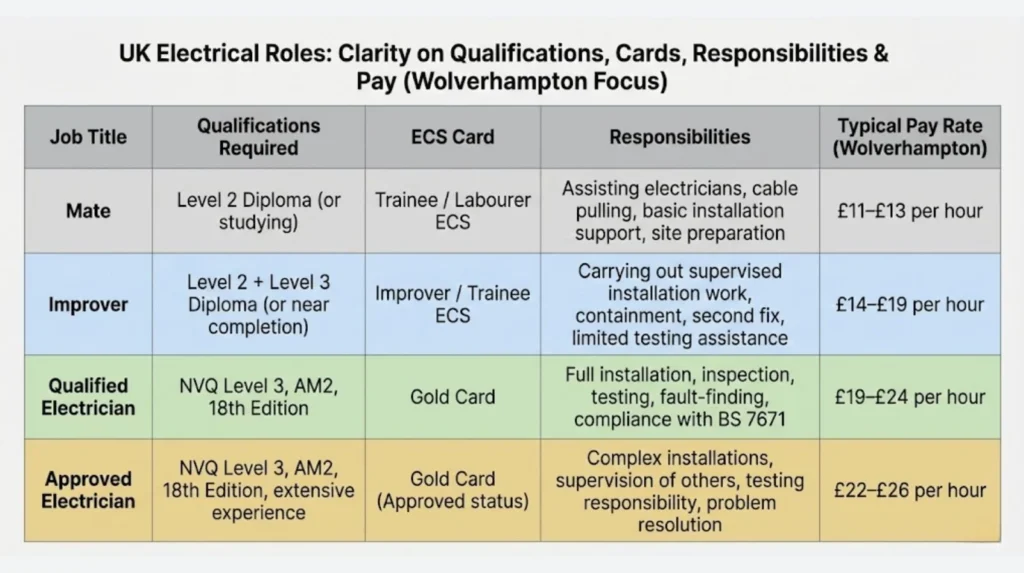
This is where the disconnect happens between formal qualifications and job market language. Wolverhampton and West Midlands job ads use terms loosely, and understanding what employers really mean helps you apply for appropriate roles.
“Electrician’s Mate” or “Electrical Labourer”: Usually requires Level 2 minimum, ECS Labourer or Trainee card, basic hand tools, driving licence. Responsibilities: pulling cables, preparing materials, assisting qualified electricians, site housekeeping. Pay range: £11-£14/hour in Wolverhampton area.
“Improver” or “Trainee Electrician”: Usually requires Level 2 and Level 3 completed, working toward or enrolled in NVQ, ECS Improved Trainee card. Responsibilities: wiring circuits under supervision, basic testing, assisting with installations, following drawings. Pay range: £16-£19/hour.
“Qualified Electrician” or “Installation Electrician”: Specifically requires NVQ Level 3 completed, AM2 passed, ECS Gold Card, 18th Edition current. Responsibilities: independent installation work, signing off circuits (if registered with competent person scheme), testing and certification, supervising mates/improvers. Pay range: £22-£26/hour employed, £30-£45/hour self-employed in Wolverhampton area.
“Approved Electrician” or “Electrical Tester”: Requires everything above plus 2391 Inspection & Testing qualification (or equivalent), significant post-qualification experience (typically 3-5 years). Responsibilities: periodic inspection and testing (EICRs), fault-finding, remedial work specifications, supervision. Pay range: £28-£32/hour employed, £45-£60/hour self-employed.
Joshua Jarvis, our Placement Manager, clarifies this daily:
"With just Level 2, you're looking at labourer or very junior mate positions at £11-£14 per hour. Add Level 3, you move into proper improver roles at £16-£19 per hour with more independence under supervision. Complete your NVQ and AM2, you're a qualified spark at £22-£26 per hour employed, more if you go self-employed."
Joshua Jarvis, Placement Manager
Common Misconceptions About Levels and NVQ
The biggest misconception is that Level 3 equals qualified status. It doesn’t. Level 3 is knowledge. NVQ is competence. You need both.
The second misconception is that you can do an NVQ without a job. You can’t. The entire point of NVQ is workplace evidence. No workplace means no evidence means no NVQ.
The third misconception is that fast-track courses make you qualified in 6-12 weeks. They don’t. They cover Level 2 and Level 3 knowledge quickly, but that’s only the first stage. You still need workplace NVQ (12-24 months) and AM2 after that.
The fourth misconception is that the 18th Edition is “the main qualification.” It isn’t. It’s a 3-day regulations update course. Essential, yes. But it’s a component of the pathway, not the pathway itself.
The fifth misconception is that domestic installer courses equal full electrician status. They don’t. Domestic-only routes (often through Part P schemes) qualify you for limited scope work in houses. Commercial and industrial sites require the full NVQ route.
What Elec Training Offers for the Complete Pathway
We’re based on Thomas Street in Wolverhampton, opposite St John’s Retail Park. For learners navigating Level 2, Level 3, and NVQ, we offer structured progression with clear expectations at each stage.
Our Level 2 and Level 3 diplomas (City & Guilds 2365) are delivered intensively or flexibly depending on your circumstances. These cover the knowledge foundation you need before workplace competence assessment.
But the critical component for Wolverhampton learners is our NVQ Level 3 package (£10,000-£12,000), which includes tutor support throughout your portfolio building, scheduled assessor visits to your workplace, and crucially, active placement support through our in-house recruitment team working with 120+ contractor partners across the West Midlands.
This is the comprehensive qualification pathway structure Wolverhampton learners need to understand: knowledge courses alone won’t get you qualified. You need workplace competence support. We don’t just hand you Level 2 and Level 3 certificates and leave you to figure out NVQ alone. We actively support the transition from knowledge to workplace competence.
That package does not include AM2 exam fees (you pay NET directly, typically £850-£950) or PPE and tools (budget £300-£500 separately). But it does include the element most learners struggle with: bridging from classroom diplomas to genuine workplace NVQ completion with employer support.
If you’re at the start of your electrical training journey in Wolverhampton, your first decision is understanding where you actually are in the pathway. If you’re an absolute beginner, you start with Level 2. If you’ve completed Level 2, you progress to Level 3. If you’ve completed both, your priority becomes securing workplace access for NVQ, not collecting more classroom certificates.
Your second decision is verifying any provider offers genuine support across the full pathway, not just knowledge courses. Ask specifically: “How do you support learners through the NVQ stage? Do you offer placement assistance? What happens after I complete Level 3?”
Your third decision is being realistic about timeline and total cost. From zero to Gold Card, you’re looking at 18 months to 3 years and £12,000-£15,000 total. Understanding that upfront prevents frustration when you realize Level 2 and Level 3 alone don’t make you qualified.
Call us on 0330 822 5337 to discuss your specific qualification pathway in Wolverhampton and where you are in the Level 2, Level 3, NVQ progression. We’ll explain exactly what each stage involves, what it enables, what gaps remain if you stop at any point, and how our placement support works to get you from classroom knowledge to workplace competence. No confusing marketing language. Just clear explanation of the actual qualification structure.

References
- City & Guilds 2365 Level 2 Diploma Specification: https://www.cityandguilds.com/
- City & Guilds 2365 Level 3 Diploma Specification: https://www.cityandguilds.com/
- City & Guilds 2357 NVQ Level 3 Specification: https://www.cityandguilds.com/
- Ofqual Register of Regulated Qualifications: https://register.ofqual.gov.uk/
- ECS Card Types and Requirements: https://www.ecscard.org.uk/card-types
- JIB Grading and Qualification Pathways: https://www.jib.org.uk/
- National Electrotechnical Training (AM2 Assessment): https://www.netservices.org.uk/am2/
- National Careers Service – Electrician Profile: https://nationalcareers.service.gov.uk/job-profiles/electrician
- BS 7671:2018+A2:2022 Wiring Regulations: https://electrical.theiet.org/
- Elec Training Courses and Pathways: https://elec.training/courses/
Note on Accuracy and Updates
Last reviewed: 14 January 2026. This page is maintained; we correct errors and refresh sources as UK electrical qualification requirements and Wolverhampton provider offerings change. Qualification specifications are stable, but delivery patterns and costs fluctuate. AM2 fees are set by NET and updated periodically. ECS card requirements align with JIB agreements updated annually. Next review scheduled: March 2026 following spring qualification updates.
