
Electrical Installation Condition Report (EICR) – What It Is, Costs, Rules & Validity

- Technical review: Thomas Jevons (Head of Training, 20+ years)
- Employability review: Joshua Jarvis (Placement Manager)
- Editorial review: Jessica Gilbert (Marketing Editorial Team)
- Last reviewed:
- Changes: Initial publication covering EICR requirements, costs, validity periods, and qualification pathways for England, Wales, Scotland, and Northern Ireland
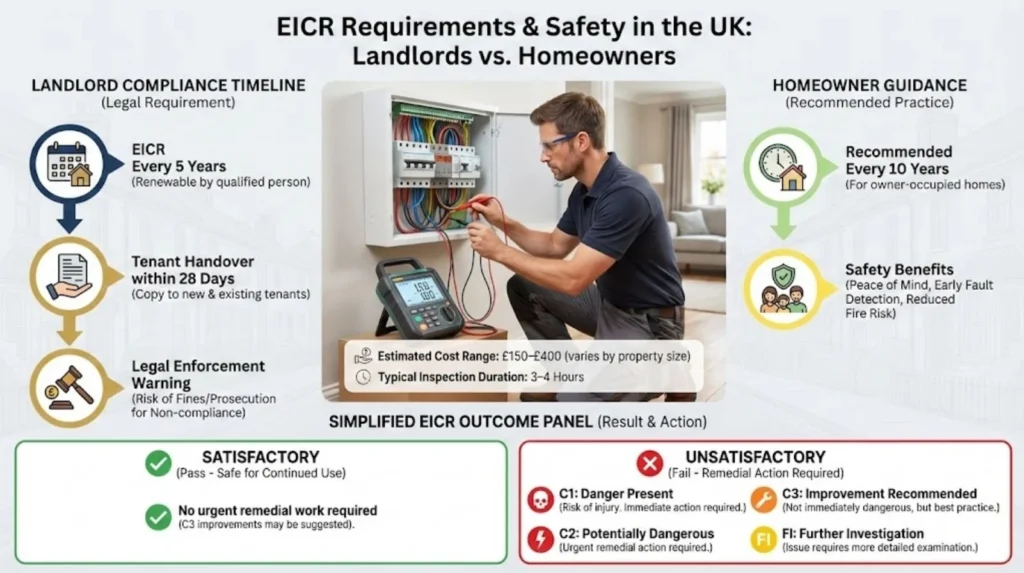
An EICR (Electrical Installation Condition Report) is the inspection certificate that proves your property’s fixed electrical installation is safe, compliant with BS 7671, and fit for continued use. If you’re a landlord in England, Wales, or Scotland, you legally need one every five years. If you’re selling a house, buyers increasingly expect to see one. If you’re a homeowner in a property built before 2000, you probably should have had one by now.
Here’s what the glossy landlord compliance websites won’t tell you: EICRs are frequently misunderstood, mis-sold, and mis-applied. Cheap inspectors produce worthless reports. Expensive ones over-code observations to generate remedial work. Landlords panic about C3 advisory codes thinking their property has failed. Homeowners ignore them entirely until something catches fire.
This guide explains what an EICR actually is, who legally needs one, what it costs, how long it lasts, what those C1/C2/C3 codes mean, and what qualifications electricians need to conduct them properly.
What Is an EICR?
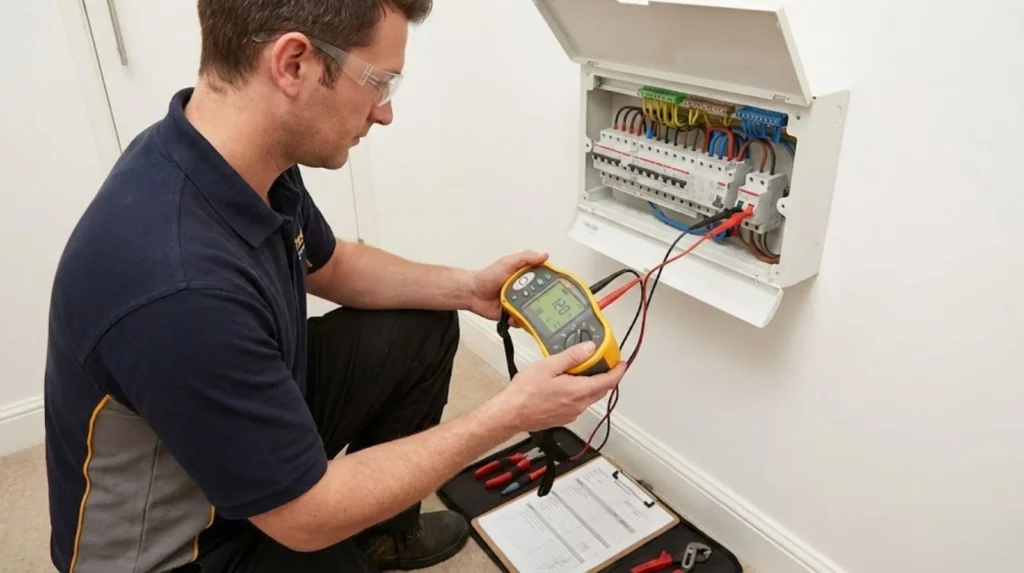
EICR stands for Electrical Installation Condition Report. It’s the formal document produced after a qualified electrician inspects and tests your property’s fixed electrical installation to assess whether it’s safe for continued use.
“Fixed installation” means the permanent electrical system: the cables hidden in your walls and ceilings, the consumer unit (modern fuse box), the sockets, switches, light fittings, and any hardwired equipment like electric showers or cookers. It doesn’t cover portable appliances like kettles, TVs, or phone chargers (that’s what PAT testing is for).
The report identifies anything that’s dangerous, potentially dangerous, or worth improving. It checks whether circuits are overloaded, whether there’s proper earth protection, whether RCDs (safety switches) are present and working, and whether the installation complies with BS 7671:2018+A2:2022 (the UK Wiring Regulations).
An EICR is not a “pass or fail” test in the traditional sense. The outcome is either “Satisfactory” or “Unsatisfactory” based on whether any dangerous conditions exist. It’s also not a quote for repairs, though it identifies what needs fixing.
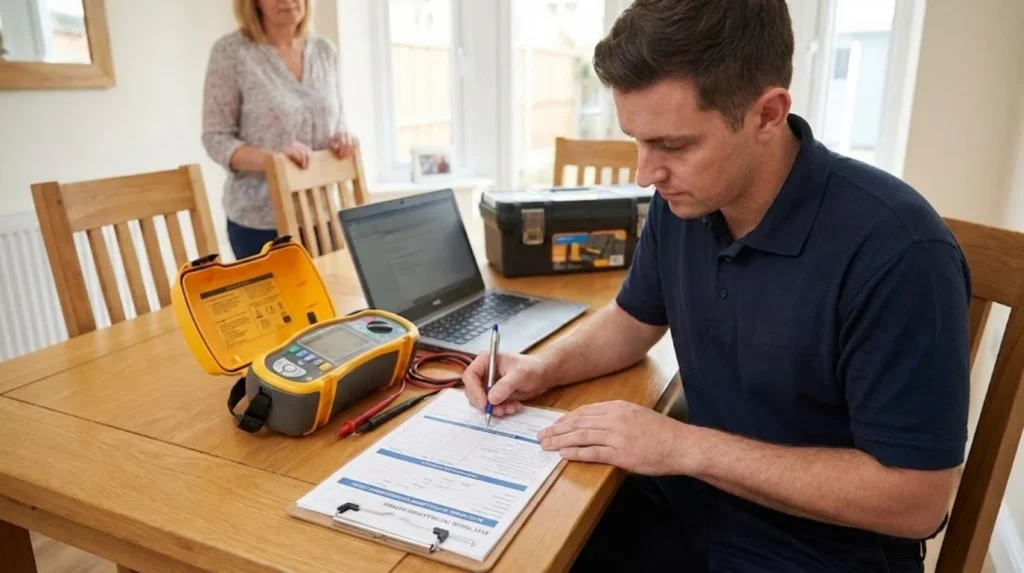
The inspection typically takes 3-4 hours for a standard 3-bedroom house, longer for larger properties or those with complex electrical systems. Anyone telling you they can do a thorough EICR in 45 minutes is cutting corners.
Who Legally Needs an EICR (and When)
The legal requirements vary depending on whether you’re a landlord, homeowner, or business, and which part of the UK you’re in.
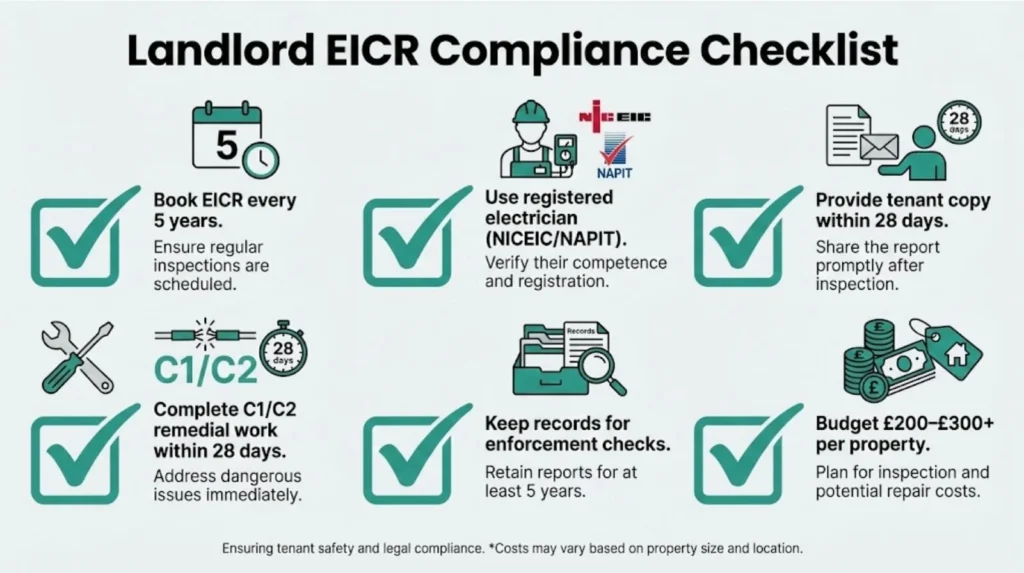
Private Landlords (England & Wales): Legally required every 5 years or at change of tenancy, whichever comes first. You must provide a copy to the tenant within 28 days of the inspection. If the report is unsatisfactory, you must complete remedial work within 28 days (or sooner if the inspector specifies immediate danger). These rules came into force in June 2020 for new tenancies and April 2021 for existing tenancies. Fines for non-compliance can reach £30,000.
Private Landlords (Scotland): Same requirements, every 5 years under the Electrical Safety Standards in the Private Rented Sector (Scotland) Regulations 2022.
Private Landlords (Northern Ireland): EICRs required for new tenancies from April 2024, with existing tenancies following.
Social Housing (England): New rules under the Social Housing (Regulation) Act 2023 require EICRs for new tenancies from 2025, with all existing tenancies to be covered by 2026. This brings social housing in line with private rental requirements.
Business & Commercial Premises: The Electricity at Work Regulations 1989 require employers to maintain safe electrical systems. While EICRs aren’t explicitly mandated by name, they’re the standard way of demonstrating compliance. Recommended frequency is every 5 years for offices, 3-5 years for commercial premises, and as little as 1 year for high-risk environments like swimming pools.
Homeowners (Owner-Occupiers): No legal requirement. However, EICRs are strongly recommended every 10 years, or when buying/selling a property, or after significant electrical work or renovations. Insurance companies increasingly ask for evidence of electrical safety in older properties.
If you’re selling your house, an EICR isn’t legally required but buyers’ solicitors frequently request one, especially for properties built before 2000 or with obvious outdated electrical installations.
What Happens During an EICR Inspection
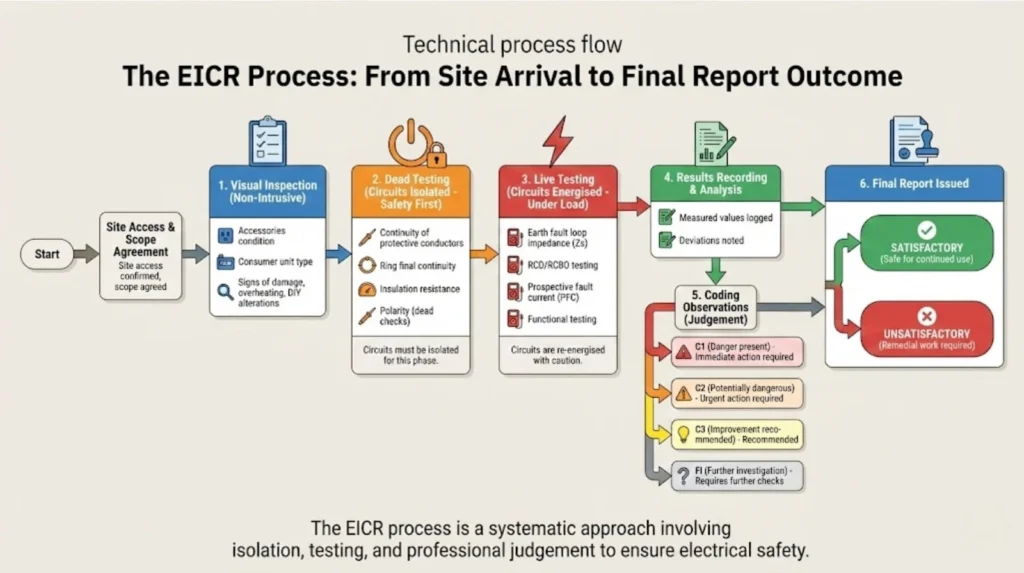
An EICR follows a structured process set out in BS 7671 and Electrical Safety First’s Best Practice Guide 4. The inspector doesn’t just glance at your consumer unit and tick some boxes. They systematically work through your entire electrical installation.
Visual Inspection: The inspector checks for visible damage, signs of overheating (scorch marks around sockets or switches), DIY electrical work that looks dodgy, damaged cable insulation, missing earth connections, and anything that obviously doesn’t comply with current standards. They’ll open the consumer unit to check the condition of connections, protective devices, and labeling.
Dead Testing (Power Off): With circuits isolated, the inspector tests continuity (checking that protective conductors are properly connected end-to-end), insulation resistance (ensuring the plastic insulation around cables hasn’t deteriorated and is preventing current leakage), and polarity (confirming live, neutral, and earth are connected correctly).
Live Testing (Power On): With the system energized, they test earth fault loop impedance (measuring how quickly a fault would cause the protective device to disconnect), RCD operation (checking the safety switch trips within 40 milliseconds at rated current), and voltage levels.
Every circuit gets documented. The inspector records test results for each ring final, radial, lighting circuit, cooker circuit, shower circuit, and any other circuits present. They note observations against specific regulation numbers from BS 7671.
The entire process requires calibrated test equipment (multifunction testers cost £800-£2,000), knowledge of testing procedures, and the ability to interpret results correctly. It’s not something you can DIY, even if you’re handy with electrics.
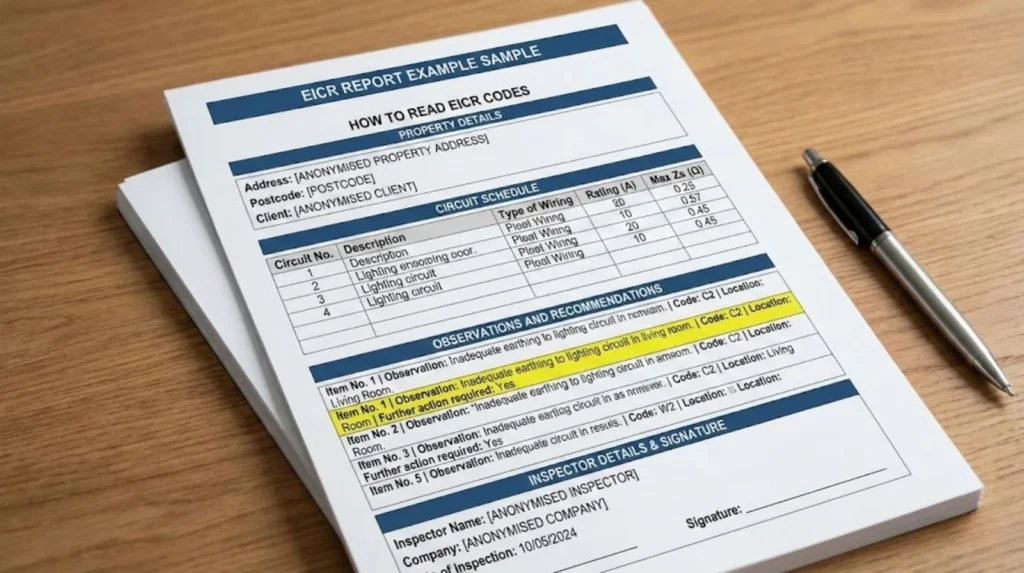
How to Read EICR Codes (C1, C2, C3, FI)
Every observation the inspector makes gets assigned a code. Understanding these codes is critical because they determine whether your EICR is satisfactory or not.
C1 (Danger Present): Immediate danger to persons or property. The inspector may isolate the dangerous circuit on the spot. Examples: exposed live parts (bare wires accessible), loss of earth continuity to accessible metalwork, equipment damaged to the point it’s dangerous. Action required: Immediate remedial work. Do not use the circuit until it’s fixed.
C2 (Potentially Dangerous): Urgent remedial work required. Not an immediate danger right now, but could become one. This is the most commonly assigned code and the most contentious. Examples: socket circuits without RCD protection, inadequate main earthing conductor size, missing supplementary bonding in bathrooms, damaged cable insulation that’s deteriorating. Action required: Must be fixed to achieve a satisfactory report. Landlords must complete C2 remedial work within 28 days.
C3 (Improvement Recommended): The installation doesn’t meet current standards but isn’t dangerous. These are advisory observations. Examples: old consumer unit that works fine but lacks modern surge protection, socket heights that don’t meet current accessibility standards, circuits that could benefit from additional RCD protection. Action required: None legally. Consider improvements for enhanced safety, but a report with only C3 codes is still satisfactory.
FI (Further Investigation): The inspector found something they couldn’t fully assess. Maybe they couldn’t access part of the installation, or test results were inconclusive and need specialist investigation. Examples: suspected cable fault that needs tracing, inaccessible junction boxes that need opening, outdoor circuits buried underground. Action required: Investigation needed. The report remains unsatisfactory until the issue is resolved or confirmed as safe.
Here’s the critical point: any EICR with C1, C2, or FI codes is classified as “Unsatisfactory.” Only reports with no codes, or only C3 advisory codes, are “Satisfactory.”
To be fair, there’s significant debate within the electrical industry about C2 vs C3 coding. Some inspectors are overly cautious and code everything as C2 to cover themselves legally. Others are more pragmatic and only use C2 for genuine immediate hazards. This inconsistency is frustrating for property owners.
How Long Is an EICR Valid For?
The validity period depends on the type of property and risk level, not on when you had it done.
Standard recommendations: Rental properties: 5 years (legally required in England, Wales, Scotland). Homeowner properties: 10 years. Commercial premises: 5 years. High-risk premises (swimming pools, construction sites): 1-3 years. HMOs (Houses in Multiple Occupation): 5 years.
However, the inspector can recommend a shorter interval if they identify concerns. If your property has very old wiring, evidence of DIY electrical work, or operates in a harsh environment (high moisture, vibration, heavy use), they might recommend re-inspection in 1-2 years.
Equally importantly, an EICR is a snapshot in time. Like an MOT for a car, it’s valid at the point of inspection but doesn’t guarantee nothing will go wrong. If you make significant electrical changes (major rewiring, new circuits, extensions), you should get a new EICR rather than rely on an old one.
If you’re a landlord with an unsatisfactory EICR, the clock starts ticking immediately. You’ve got 28 days to complete remedial work and either get the same inspector back to verify fixes, or get a new EICR showing the installation is now satisfactory.
How Much Does an EICR Cost?
EICR pricing varies significantly by property size, location, and inspector experience. Here’s what you can realistically expect to pay in 2026.
Typical domestic costs: 1-2 bedroom flat: £150-£220. 3-bedroom house: £200-£300. 4-5 bedroom house: £250-£400. Large property (6+ bedrooms): £400-£600+.
Commercial premises are quoted based on circuit count and complexity, typically £300-£800+ for small businesses, more for industrial installations.
London and South East England prices run 20-30% higher than Northern regions. Expect to pay £250-£350 for a standard 3-bed house in London versus £180-£250 in Yorkshire or the North West.
What affects the price: Number of circuits (more circuits = more testing = more time). Property age and condition (older installations take longer to assess). Access issues (tenanted properties where the inspector has to work around occupants). Distance traveled (inspectors charge travel time for remote properties). Remedial work requirements (some inspectors quote for inspection and repairs together).
Be extremely wary of EICRs advertised at £80-£100. These are either loss-leaders where the inspector plans to “find” expensive remedial work to make their money back, or they’re rushed inspections that miss dangerous faults. A thorough domestic EICR takes 3-4 hours minimum. At £100, that’s £25-£30 per hour before equipment costs, insurance, and travel time. The maths doesn’t work unless corners are being cut.
On the flip side, don’t assume expensive means thorough. Some large electrical firms charge £400+ for a standard EICR because they have high overheads, not because they’re doing anything different.
The sweet spot is typically £200-£300 for a standard 3-bed property with a registered, insured electrician who has proper inspection qualifications and takes the time to do it properly.
What Qualifications Do You Need to Conduct an EICR?
This is where things get serious if you’re an electrician considering offering EICR services, or a property owner trying to verify whether your inspector is actually qualified.
Thomas Jevons, Head of Training at Elec Training with over 20 years of experience, explains:
"To legally conduct and certify an EICR, you need City & Guilds 2391 or equivalent inspection and testing qualification. That's on top of being a qualified electrician with NVQ Level 3. The 2391 course teaches you inspection methodology, testing sequences, interpretation of results, and how to code observations correctly. You can't just decide you're doing EICRs because you've got an 18th Edition certificate."
Thomas Jevons, Head of Training
The qualification pathway looks like this: First, become a qualified electrician through the standard electrical training route (NVQ Level 3, 18th Edition, AM2 assessment). Gain 2-3 years of installation and fault-finding experience across different property types. Complete the City & Guilds 2391-52 Inspection, Testing and Certification qualification. Register with a competent person scheme (NICEIC, NAPIT, ELECSA, etc.). Obtain calibrated test equipment and professional indemnity insurance.
The 2391-52 course typically takes 5-7 days and covers initial verification of new installations and periodic inspection and testing of existing installations. It’s the gold standard qualification for inspection work and the one that letting agents, solicitors, and insurance companies recognize.
You can verify whether an electrician is properly registered by checking the Electrical Competent Person register at www.competentperson.co.uk or through individual scheme websites (NICEIC, NAPIT, etc.).
Here’s what property owners need to check before booking an EICR: Are they registered with NICEIC, NAPIT, or equivalent? Can they show proof of 2391 qualification? Do they have professional indemnity insurance (minimum £2 million)? Do they have calibrated test equipment (ask to see calibration certificates)? Will they provide a full written report with circuit schedules and test results?
If an electrician can’t or won’t answer these questions clearly, walk away. An EICR is a legal safety document. It needs to be conducted by someone who knows what they’re doing and carries insurance in case they miss something that causes harm.
What Property Owners Actually Need to Know
If you’re a landlord or homeowner trying to navigate EICR requirements, here’s the practical reality stripped of jargon.
Joshua Jarvis, Placement Manager at Elec Training, notes:
"The electricians who build successful inspection practices are the ones who can explain findings to non-technical clients clearly. A landlord doesn't care about earth loop impedance readings. They want to know: is it safe, what needs fixing, how much will it cost, and do I need to do it now or can it wait. Communication skills matter as much as technical competence."
Joshua Jarvis, Placement Manager
When you receive an EICR, focus on these key sections: The overall conclusion (Satisfactory or Unsatisfactory). Any C1 or C2 codes and what they mean in plain English. The recommended re-inspection date. The inspector’s registration details (verify these independently). The remedial work estimate (get a second opinion if it seems excessive).
If your EICR comes back unsatisfactory with C2 codes, don’t panic. Get quotes from at least two other registered electricians for the remedial work. The original inspector isn’t obliged to do the repairs, and you might find cheaper options. Be wary if the inspector who “failed” your installation then quotes £3,000+ for a new consumer unit and rewire. Get second opinions.
For landlords specifically: Keep copies of all EICRs in your property file. Provide tenants with a copy within 28 days of any inspection. If you’re selling a rental property, having up-to-date EICRs adds value and speeds up the sale. If you’ve got multiple properties, schedule EICRs systematically rather than letting them all expire at once. Budget £200-£300 per property every five years for inspection costs, plus remedial work if needed.
Common red flags that your EICR might be dodgy: The inspection took less than 2 hours for a whole house. The inspector didn’t open the consumer unit or lift any floorboards. There’s no circuit schedule or test results, just vague observations. Every observation is coded C2 to force expensive remedial work. The inspector insists only they can do the remedial work. The report has spelling errors or uses outdated terminology (calling it a PIR instead of EICR).
If you suspect a dodgy EICR, you can request a second opinion inspection from a different registered electrician. If the two reports conflict significantly, report the issue to the relevant competent person scheme (NICEIC, NAPIT, etc.) who regulate their members.
Common EICR Myths Debunked
Let’s clear up some persistent misconceptions about EICRs that circulate on landlord forums and property Facebook groups.
Myth: An EICR is only needed for landlords. Reality: Strongly recommended for all homeowners every 10 years, especially in properties over 25 years old. Insurance companies increasingly ask for evidence of electrical safety.
Myth: If the lights work and nothing’s tripping, the wiring is fine. Reality: Hidden defects like degraded cable insulation, inadequate earthing, or missing RCD protection can exist without obvious symptoms until something catastrophic happens.
Myth: A C3 code means you’ve failed. Reality: C3 codes are advisory only. A report with only C3 observations is classified as Satisfactory. You don’t legally have to act on C3 codes, though they’re worth considering for improved safety.
Myth: New homes don’t need EICRs. Reality: Even new installations should have periodic inspection. Faults can develop, DIY alterations can introduce hazards, and standards change over time.
Myth: EICRs are a scam for electricians to generate work. Reality: They’re legally required for landlords for good reason. Faulty electrics cause over 20,000 house fires annually in the UK, killing dozens of people. Proper EICRs identify these risks before they become fatal.
Myth: PAT testing is the same as an EICR. Reality: PAT testing checks portable appliances (kettles, TVs, computers). EICRs check fixed installations (wiring, consumer units, sockets). You need both for full electrical safety in commercial premises, but landlords only legally need EICRs.
Myth: You can DIY an EICR if you’re handy with electrics. Reality: Absolutely not. EICRs require calibrated test equipment (£800-£2,000), specific qualifications (2391), professional indemnity insurance, and registration with a competent person scheme. A DIY “inspection” has no legal standing.
Myth: Cheap EICRs are fine as long as you get the certificate. Reality: Cheap EICRs (£80-£100) are either rushed and miss dangerous faults, or deliberately identify non-existent problems to generate remedial work income. Penny-wise, pound-foolish.
When Should You Get an EICR?
Here’s a practical decision framework based on your situation.
You’re a landlord: Every 5 years maximum, or at tenancy change if it’s been over 5 years. Non-negotiable. Budget for it in your annual property costs.
You’re buying a house: Always get an EICR as part of your survey, especially for properties built before 2000. The £200-£300 cost could save you from buying a property needing a £5,000+ rewire.
You’re selling a house: Get one proactively. Buyers will ask for it. Having one ready speeds up the sale and gives buyers confidence.
You’re a homeowner in an older property: If your house was built before 1990 and you’ve never had an EICR, book one. Properties from this era often lack RCD protection and may have deteriorating cable insulation.
You’ve noticed electrical issues: Flickering lights, frequently tripping circuits, burning smells, scorch marks around sockets, sockets or switches that feel warm. These are emergency situations. Get an EICR immediately, potentially followed by remedial work.
You’ve done DIY electrical work or extensions: Even if you think you’ve done it right, get an EICR to verify. DIY electrical work is a leading cause of house fires and the main reason properties fail EICRs.
You’re running a business from home: If clients or employees visit your premises regularly, you have duty of care responsibilities under health and safety legislation. An EICR provides evidence you’ve maintained electrical safety.
You’re applying for landlord insurance: Many insurers now require proof of valid EICR for rental properties. No EICR can mean no insurance or significantly higher premiums.
If you need an EICR for your property, here’s the action plan.
For landlords: Verify your current EICR is still valid (check the date and recommended re-inspection period). If it’s expired or expiring soon, contact 2-3 registered electricians for quotes. Check they’re on the NICEIC or NAPIT register. Book the inspection with at least 28 days before your legal deadline. Provide tenant access and inform them of the inspection date. Review the report when complete and address any C1/C2 codes within 28 days. Provide a copy to your tenant within 28 days of inspection.
For homeowners: If your property is over 10 years old or you’ve never had an EICR, book one. If you’re buying or selling, factor EICR costs into your budget (£200-£300 typically). If your electrical installation looks dated (old fuse box, round-pin sockets, fabric-covered cables), prioritize getting an EICR. Keep the report for insurance purposes and property records.
For electricians: If you’re a qualified electrician considering offering EICR services, you’ll need the City & Guilds 2391-52 qualification first. The course typically costs £800-£1,200 and takes 5-7 days. You’ll also need to invest in calibrated test equipment (£800-£2,000 for a decent multifunction tester), register with a competent person scheme (£300-£600 annually), and obtain professional indemnity insurance (£200-£500 annually depending on turnover). The market for inspection work is strong, particularly for landlord compliance, and it’s less weather-dependent than outdoor installation work.
Call us on 0330 822 5337 to discuss the Inspection and Testing qualification pathway if you’re a qualified electrician looking to add EICR services to your business. We’ll explain the 2391-52 course requirements, practical assessment, and how to build an inspection practice that provides consistent income.
What we’re not going to tell you: • That you can conduct EICRs with just an 18th Edition certificate • That inspection work is easy money • That you’ll be fully booked from day one
What we will tell you: • The exact qualification pathway (2391-52 after NVQ Level 3) • Realistic equipment and insurance costs • How electricians actually build inspection client bases • Why communication skills matter as much as technical competence • What letting agents and landlords look for in inspectors
No hype. No unrealistic promises. Just the qualification pathway and practical guidance for electricians who want to conduct EICRs properly and build profitable inspection practices.
References
- GOV.UK: Electrical Safety Standards in the Private Rented Sector (England) Regulations 2020 – https://www.gov.uk/government/publications/electrical-safety-standards-in-the-private-rented-sector-guidance-for-landlords-tenants-and-local-authorities
- Health and Safety Executive (HSE): Electricity at Work Regulations 1989 – https://www.hse.gov.uk/electricity/index.htm
- Institution of Engineering and Technology (IET): BS 7671:2018 + A2:2022 Wiring Regulations – https://electrical.theiet.org/bs-7671/
- Electrical Safety First: Best Practice Guide 4 – Electrical Installation Condition Reporting (EICR) – https://www.electricalsafetyfirst.org.uk/
- NICEIC: EICR Explained – https://www.niceic.com/
- NAPIT: Periodic Inspection and Testing – https://www.napit.org.uk/
- City & Guilds: 2391-52 Inspection, Testing and Certification Qualification – https://www.cityandguilds.com/
- Electrical Competent Person Register: UK Competent Person Scheme Directory – https://www.competentperson.co.uk/
Note on Accuracy and Updates
Last reviewed: 14 January 2026. This page is maintained regularly. We correct errors and refresh sources as electrical safety regulations and guidance change. EICR legal requirements updated following Social Housing (Regulation) Act 2023 implementation. BS 7671 references current as of 18th Edition Amendment 2 (2022). Costs and market expectations reviewed quarterly based on industry data. Next review scheduled: April 2026 following any regulatory changes.
FAQs
What is an EICR (Electrical Installation Condition Report) and what does it actually check in a property?
An EICR is a formal assessment of the electrical installations in a property, evaluating their safety and compliance with BS 7671 (18th Edition). It identifies defects, deterioration, or non-compliances that could pose risks and confirms whether the installation is safe for continued use. The report does not cover portable appliances and focuses only on fixed electrical elements.
The inspection checks the condition of wiring, sockets, switches, light fittings, consumer units (fuse boxes), earthing, and bonding arrangements. It includes visual inspections for damage or wear, alongside electrical testing for continuity, insulation resistance, polarity, and earth fault loop impedance. Any issues found are coded based on severity.
EICRs are recommended under Part P of the Building Regulations for domestic properties, especially where alterations have been made. They help reduce the risk of electric shock and electrical fires.
What to do next:
Contact a qualified electrician registered with a competent person scheme to arrange an EICR if your property is over 10 years old or before renting it out.
Who is legally required to have an EICR in the UK, and how do the rules differ across England, Wales, Scotland, and Northern Ireland?
Landlords of privately rented properties are legally required to have an EICR. Homeowners are not legally required but are strongly advised to obtain one for safety and insurance purposes. Businesses must comply with the Electricity at Work Regulations 1989, which require periodic inspections based on risk assessments, although these are not always referred to as EICRs.
Rules differ slightly by nation:
- England and Wales: Required before new tenancies and every five years thereafter under the Electrical Safety Standards in the Private Rented Sector Regulations.
- Scotland: Required every five years under the Electrical Safety Standards in the Domestic Sector Regulations.
- Northern Ireland: Five-year inspection requirements introduced for private rentals under 2024 legislation, with enforcement variations.
Non-compliance can lead to fines of up to £30,000 in England and Wales, with penalties also applied in Scotland and Northern Ireland.
What to do next:
Check the rules for your property’s location and arrange an EICR if you are a landlord.
How often does an EICR need to be renewed for landlords, homeowners, and businesses?
Renewal frequency depends on property type and usage:
- Landlords: Every five years in England, Wales, Scotland, and Northern Ireland.
- Homeowners: Recommended every 10 years, or sooner after major alterations or a change of occupancy.
- Businesses: Determined by risk assessment under the Electricity at Work Regulations 1989. High-risk environments may require annual inspections, while offices are often inspected every three to five years.
Regular inspections help identify faults early and reduce the risk of accidents.
What to do next:
Check your last inspection date and book a renewal if you are approaching the recommended interval.
How much does an EICR cost in 2026 for different property types, and what affects the price?
Typical EICR costs in 2026 are:
- One-bedroom flat: £100–£150
- Three-bedroom house: £180–£300
- Large properties: £300–£500+
Prices vary based on:
- Property size and number of circuits
- Age and condition of the wiring
- Accessibility of electrical points
- Location and urgency of the inspection
Very low quotes may indicate rushed inspections that do not fully comply with BS 7671.
What to do next:
Request quotes from at least three registered electricians and provide full property details.
What happens during an EICR inspection, and how long should it take?
An EICR begins with a visual inspection to identify obvious defects such as damage, overheating, or poor workmanship. Electrical tests are then carried out, including insulation resistance, earth continuity, polarity, and RCD operation. Power isolation may be required during testing.
No remedial work is carried out during the inspection unless agreed separately.
Typical timescales:
- Flat or small house: 2–4 hours
- Larger properties: 4–8 hours
Shorter inspections may indicate an incomplete assessment.
What to do next:
Ensure access to all electrical points and allow sufficient time for a proper inspection.
What do EICR codes C1, C2, C3, and FI mean, and which make a report “Unsatisfactory”?
- C1: Danger present; immediate risk of injury
- C2: Potentially dangerous condition
- C3: Improvement recommended
- FI: Further investigation required
A report is classed as Unsatisfactory if it contains C1, C2, or FI observations. A Satisfactory report contains none of these codes.
What to do next:
Arrange remedial work immediately if your report contains C1, C2, or FI observations.
What is the difference between an EICR and PAT testing?
An EICR assesses fixed electrical installations such as wiring and consumer units. PAT testing applies to portable appliances like kettles, extension leads, and lamps.
Landlords require EICRs for installations and may also need PAT testing for supplied appliances. Businesses typically require both.
What to do next:
Book an EICR for fixed wiring and PAT testing if appliances are provided or used in a work environment.
If an EICR is “Unsatisfactory,” what are the legal timelines for remedial work?
For landlords in England and Wales, remedial work must be completed within 28 days, or sooner for serious hazards. Scotland and Northern Ireland require prompt action under similar landlord duties.
Once work is completed, the property owner should receive written confirmation of the remedial work and, where applicable, a new EICR.
What to do next:
Instruct a qualified electrician to complete remedial work and retain all documentation.
What are the most common C1 and C2 issues found on an EICR?
Common C1 issues include exposed live conductors, incorrect polarity, and severely damaged accessories.
Common C2 issues include lack of RCD protection, inadequate earthing or bonding, outdated consumer units, and deteriorated insulation.
These issues are most common in older properties or those altered without proper electrical oversight.
What to do next:
Discuss your report with a qualified electrician to prioritise corrective work.
What qualifications should an electrician have to carry out an EICR properly?
An electrician should hold:
- Inspection and testing qualifications (e.g. City & Guilds 2391-52 or equivalent)
- BS 7671 (18th Edition) qualification
- Registration with a competent person scheme such as NICEIC, NAPIT, or ELECSA
Verification steps include checking scheme registers, confirming insurance, and requesting qualification evidence.
What to do next:
Use competent person scheme directories to verify credentials before booking an EICR.
