

Electrical Training Courses in Birmingham: Classroom vs Practical Learning

- Technical review: Thomas Jevons (Head of Training, 20+ years)
- Employability review: Joshua Jarvis (Placement Manager)
- Editorial review: Jessica Gilbert (Marketing Editorial Team)
- Last reviewed:
- Changes: Initial publication clarifying classroom vs workshop vs workplace learning distinctions for Birmingham electrical training
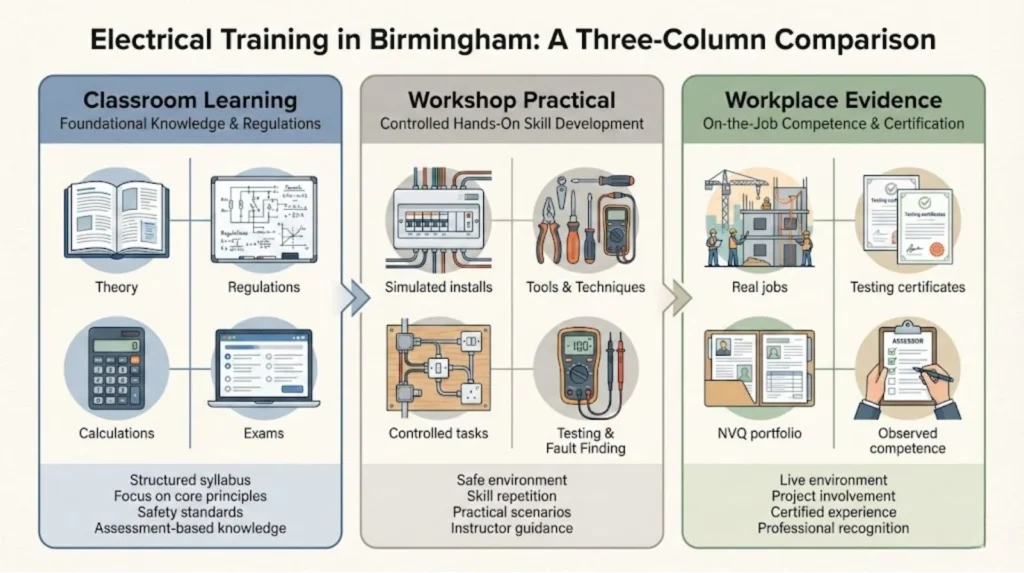
Birmingham training providers advertise “90% Practical Electrical Course” alongside photographs of learners wiring consumer units in workshop booths. You enrol, expecting hands-on site experience. Week one arrives. You’re in a classroom learning Ohm’s law. Week two puts you in a plywood booth wiring practice boards. Week twelve finishes with a certificate and zero actual construction site experience.
Here’s the confusion built into electrical training Birmingham marketing: “practical” can mean workshop simulation, not workplace evidence. “Hands-on” can describe controlled booth practice, not real installations under time pressure. Providers aren’t technically lying, they’re just using language that obscures the three distinct types of learning required for qualified electrician status.
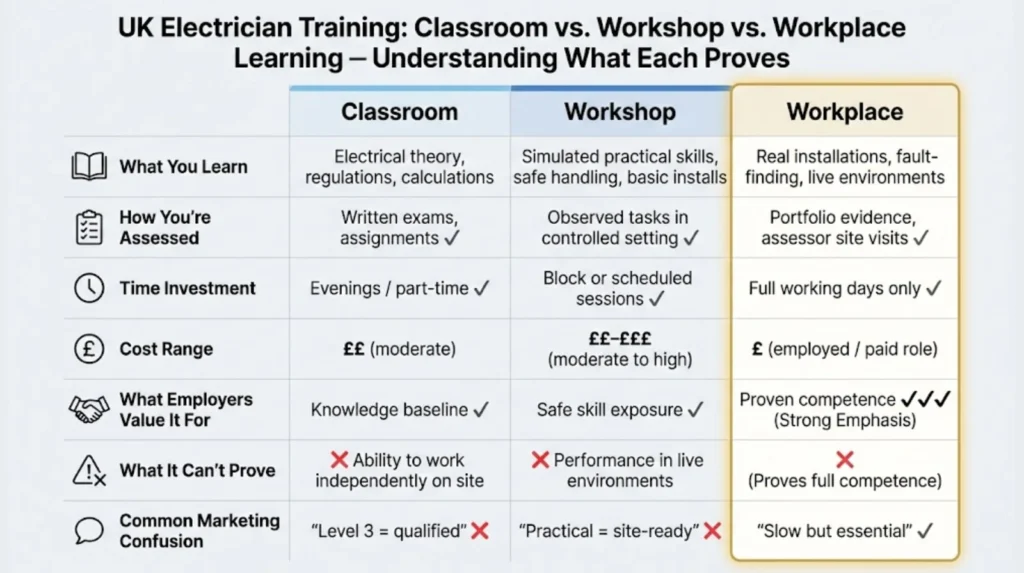
Classroom learning teaches electrical theory, regulations knowledge, and calculation methods assessed through written exams. Workshop practical learning develops installation technique, tool skills, and testing procedures in simulated environments assessed through controlled tasks. Workplace learning gathers competence evidence from real jobs, observed by assessors, proving you can work safely and independently on live sites.
Birmingham learners need all three. Most providers deliver the first two excellently. The third requires employer access, site placements, and NVQ portfolio support that classroom colleges and workshop-intensive centres can’t guarantee. If you’re trying to understand what “classroom vs practical” actually means for your electrical training journey in Birmingham, here’s the breakdown.
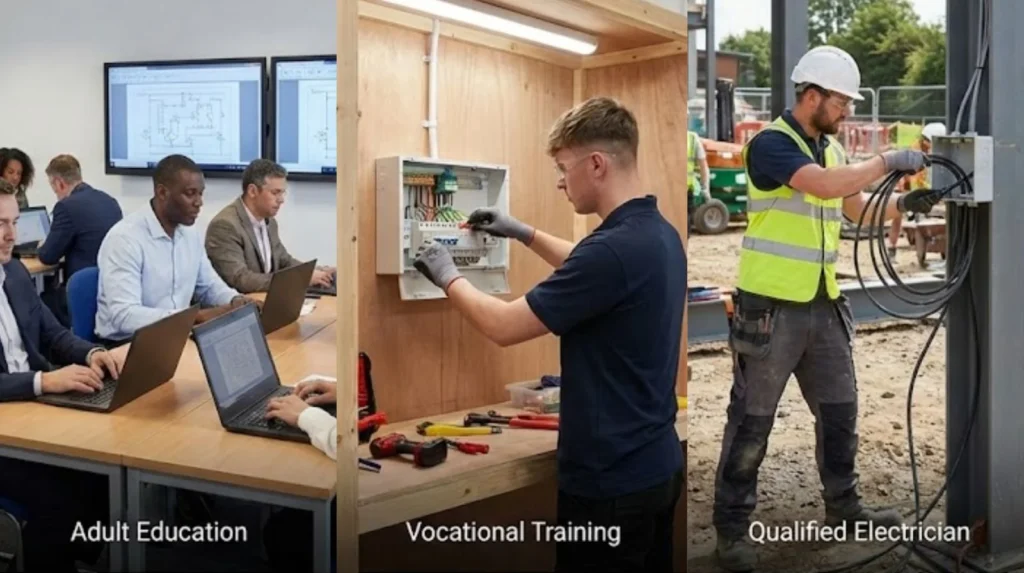
Classroom Learning: The Theory Foundation Birmingham Colleges Excel At
South & City College Birmingham delivers Level 2 electrical installation through evening classes, two nights weekly, heavy emphasis on classroom theory. You’ll spend hours learning DC and AC electrical principles, circuit calculations using Ohm’s law, BS 7671 wiring regulation interpretation, earthing and bonding requirements, and health and safety legislation. Assessment happens through online multiple-choice exams, written assignments, and short-answer tests.
BMet’s Great Barr campus structures Level 3 similarly. Advanced electrical science dominates: three-phase system calculations, voltage drop computations, diversity factors, protective device coordination, and fault current analysis. The classroom teaching is comprehensive, often excellent, covering material you genuinely need to understand for safe electrical work.
What classroom learning enables: passing knowledge-based qualification exams (Level 2 and Level 3 diplomas), understanding the “why” behind electrical regulations, developing calculation skills for circuit design, and building theoretical foundation for inspection and testing work. What it doesn’t enable: proving you can physically wire installations correctly, demonstrating safe isolation procedures under pressure, or gathering evidence for NVQ portfolio completion.
Birmingham FE colleges charge £1,500 to £2,000 for Level 2 classroom-heavy diplomas, £1,800 to £2,200 for Level 3. Both are Ofqual-regulated City & Guilds qualifications. Both are legitimate, essential components of the electrician pathway. Both are incomplete without workshop practice and workplace evidence.
Workshop Practical Learning: Where Birmingham Providers Compete on "Hands-On" Claims
Private centres advertise “intensive practical electrical training” featuring workshop booths equipped with consumer units, distribution boards, and installation materials. You’ll physically wire circuits, terminate cables, mount accessories, and practice testing procedures hundreds of times in controlled environments.
Workshop practical learning builds genuine skills. You develop muscle memory for cable stripping and termination. You practice safe isolation sequences until they’re automatic. You learn to use multifunctional testers, identify faults in controlled scenarios, and wire complex circuits correctly. Tutors observe, correct mistakes immediately, and ensure you’re developing proper technique before bad habits form.
Assessment in workshops uses practical tasks: wire a ring final circuit correctly within time limits, identify and rectify three deliberate faults in a lighting circuit, test and certify a radial circuit to BS 7671 standards. Pass these assessments and you’ve proven simulated competence. You can perform electrical work correctly when conditions are controlled, time pressure is minimal, and tutors are available for guidance.
The limitation: workshop booths aren’t real sites. You’re not working in occupied buildings with live systems nearby. You’re not coordinating with other trades, dealing with unexpected complications, or managing customer expectations. You’re not proving competence under actual working conditions, which is what electrician training courses Birmingham ultimately need to demonstrate for employer recognition.
Workplace Learning: The NVQ Bottleneck Nobody Advertises Upfront
NVQ Level 3 in Installing Electrotechnical Systems and Equipment cannot be completed in classrooms or workshop booths. It requires portfolio evidence gathered from actual electrical work on real construction sites, commercial premises, or industrial facilities. This evidence includes photographs of installations you’ve completed, risk assessments for specific jobs, test certificates you’ve issued, witness statements from qualified supervisors, and direct observations by NVQ assessors visiting your workplace.
Birmingham learners discover this requirement after completing classroom Level 2 and Level 3 diplomas, after finishing workshop-intensive practical courses, often after spending £5,000 to £8,000 on training. Then they’re told: “Now you need to find an employer willing to support your NVQ portfolio development over 12 to 24 months.” No guaranteed placements. No structured employer partnerships. Just job boards, cold applications, and hope.
The workplace learning requirement covers installation of wiring systems and enclosures, testing and commissioning electrical systems, diagnosing and correcting electrical faults, planning and overseeing electrical work, and applying health and safety requirements in workplace contexts. Evidence must span multiple installation types: domestic, commercial, ideally some industrial exposure. You can’t cherry-pick easy jobs. Assessors want breadth and depth.
Thomas Jevons, Head of Training with 20 years on the tools, explains:
"In practice, classroom assessments test knowledge through exams. Workshop assessments test simulated competence through controlled tasks. NVQ assessments test real competence through portfolio evidence from actual jobs. Employers want all three, not just the first two."
Thomas Jevons, Head of Training
Cost for workplace learning varies dramatically based on employer support. If you’re in an apprenticeship, your employer covers NVQ costs. If you secure improver work with NVQ backing, expect £2,000 to £3,000 for assessor visits and portfolio support. If you’re piecing together evidence from sporadic work without employer commitment, costs reach £4,000 to £5,000 because you need intensive support to ensure evidence quality meets assessment standards.
How Birmingham Providers Use "Practical" to Obscure the Workplace Gap
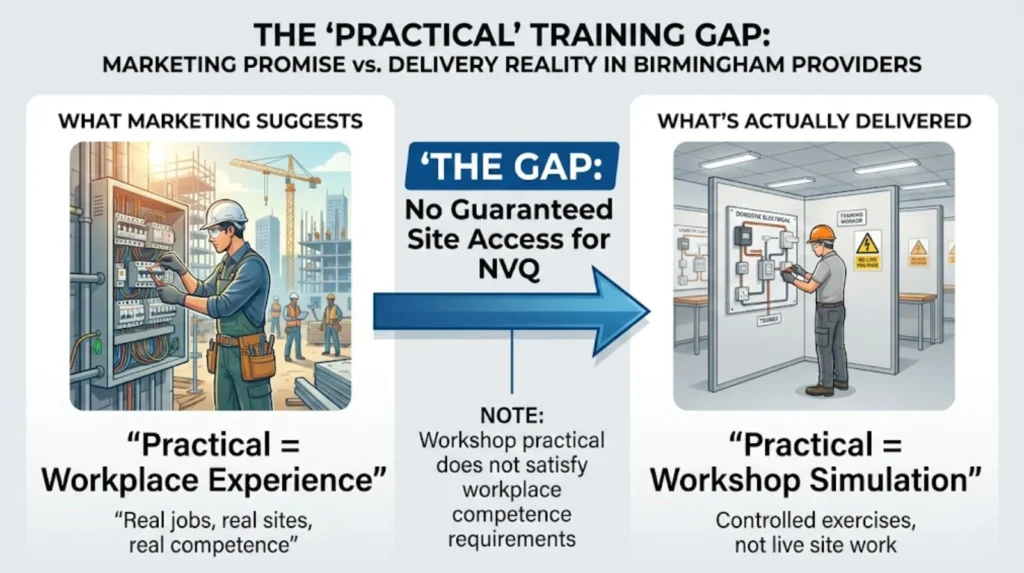
Search “practical electrician courses Birmingham” and you’ll find dozens of providers advertising “hands-on training,” “90% practical delivery,” and “real-world electrical skills.” The photographs show learners in workshop booths. The marketing copy emphasizes tool use, installation practice, and testing procedures. What’s conspicuously absent: any mention of guaranteed workplace access for NVQ evidence gathering.
The language is technically accurate but deliberately misleading. “Practical” means workshop simulation, not workplace competence. “Hands-on” describes controlled booth practice, not real site conditions. “Real-world skills” refers to techniques applicable to real work, not evidence gathered from actual employment. Providers know beginners won’t understand the distinction until they’ve already paid.
Joshua Jarvis, Placement Manager, notes:
"What we're seeing at the moment is Birmingham providers advertising 'practical electrician training' that turns out to be workshop simulation with no guaranteed workplace access afterward. That's where our placement support makes the difference - bridging that final gap."
Joshua Jarvis, Placement Manager
The result: Birmingham learners complete intensive workshop courses believing they’re qualified for electrical work, then discover employers want NVQ Level 3 and AM2 assessment neither of which were included in their “practical” package. They’ve spent £3,000 to £5,000 on legitimate Level 2 and Level 3 diplomas with excellent workshop components, but they’re stuck at exactly the same bottleneck as learners who took slower, cheaper FE college routes.
What Different Birmingham Routes Actually Deliver
If you choose South & City College Birmingham’s evening Level 2 electrical installation course, you’re getting classroom-heavy delivery (60% to 70% theory, 30% to 40% workshop) over 12 months. Total cost approximately £1,500. What you’ll have afterward: solid theoretical foundation, basic workshop skills, Level 2 diploma certificate. What you won’t have: NVQ portfolio evidence, site experience, or immediate employability for anything beyond Electrician’s Mate positions.
The apprenticeship route is ideal but requires finding an employer willing to take you on, which is competitive. The college and private intensive routes both deliver legitimate qualifications but leave the NVQ workplace challenge unsolved. Neither is a scam, both have value, but neither completes the journey to qualified electrician status without additional steps most learners don’t anticipate. Please note this is why Elec training do things differently.
The Balanced Route: Why You Need All Three Learning Types
Electrical work requires understanding principles (classroom), developing technique (workshop), and proving competence (workplace). Skip classroom theory and you can wire circuits but can’t fault-find effectively when something doesn’t work as expected. Skip workshop practice and you understand theory but lack the muscle memory for safe, efficient installation work. Skip workplace evidence and you’ve got knowledge and simulated skills but can’t prove real competence to employers or regulatory bodies.
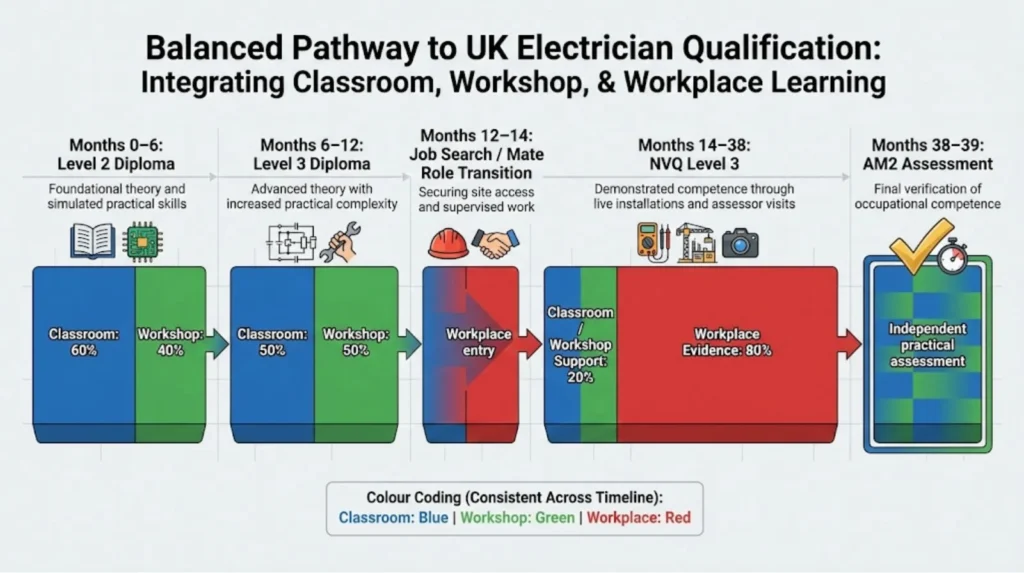
Birmingham learners who succeed typically follow this sequence: Level 2 classroom and workshop (either FE college long route or private intensive), progress to Level 3 classroom and workshop, secure Electrician’s Mate or Improver position providing site access, begin NVQ Level 3 portfolio gathering workplace evidence over 12 to 24 months, complete AM2 assessment, achieve JIB Gold Card status.
The timeline is non-negotiable. Classroom learning takes 4 to 12 months for Level 2 and Level 3 combined depending on full-time vs part-time study. Workshop skill development happens alongside classroom or in intensive blocks. Workplace evidence gathering requires 12 to 24 months of consistent site work with assessor visits every 6 to 8 weeks. Total realistic timeline: 2 to 4 years from beginner to qualified electrician.
How Elec Training Structures Classroom, Workshop, and Workplace Integration
Elec Training delivers Level 2 (2365-02) intensively over 4 weeks combining classroom theory with workshop practice in balanced proportion. Level 3 (2365-03) follows over 8 weeks with similar integration. 18th Edition wiring regulations covers 5 days. This accelerated knowledge and skill development phase totals approximately 3 months rather than 12 to 18 months at Birmingham FE colleges.
The differentiation isn’t speed for speed’s sake, it’s integrated planning. While Birmingham colleges deliver excellent classroom and workshop training then leave learners to find workplace access independently, Elec Training’s structure assumes workplace progression from the start. The in-house recruitment team works with 120+ contractor partnerships across the UK including extensive West Midlands coverage.
This means Level 2 and Level 3 completion leads directly into NVQ Level 3 portfolio development with guaranteed placement support. Birmingham learners benefit from contractor relationships in Wolverhampton, Dudley, Walsall, Sandwell, and Coventry alongside Birmingham city opportunities. You’re not cycling through Indeed applications hoping someone will take a chance on an unproven improver, you’re being actively placed with employers who need electrical trainees and understand the NVQ supervision requirements.
Total package cost: £10,000 to £12,000 covering classroom knowledge delivery (Level 2 and Level 3), workshop skill development (integrated throughout), NVQ Level 3 tutor support and assessor visits for workplace evidence gathering, placement support through in-house recruitment team, and ongoing support until qualification completion. Not included: AM2 exam fee (approximately £1,000, paid separately when assessment-ready) and PPE or essential equipment (approximately £400 to £600).
The timeline remains realistic: 18 months to 3 years depending on NVQ evidence gathering speed. You can’t shortcut workplace competence development. The advantage is eliminating the 4 to 7 month gap between workshop completion and workplace access that stalls most Birmingham learners who piece together training independently.
If you’re evaluating classroom vs practical electrical training options in Birmingham, recognize that the question itself is incomplete. The real question is: which providers deliver classroom knowledge, workshop skills, and workplace evidence access in an integrated pathway rather than leaving you stuck after completing the first two elements?
What we’re not going to tell you: that classroom-only routes are sufficient, that workshop-intensive courses complete your qualification, that “practical” marketing claims guarantee workplace access, or that you can become a qualified electrician without NVQ portfolio evidence from real jobs.
What we will tell you: classroom learning is essential for passing exams and understanding electrical principles, workshop practice builds installation technique and tool skills effectively, workplace evidence is the non-negotiable requirement employers actually care about, Birmingham FE colleges and private centres both deliver excellent classroom and workshop training but rarely guarantee the workplace access needed for NVQ completion, and realistic total costs for structured support including placement assistance are £10,000 to £12,000 versus £7,000 to £14,000 piecing together local provision without guaranteed workplace progression.
Call us on 0330 822 5337 to discuss the full guide to West Midlands electrician options with honest explanations of what classroom, workshop, and workplace learning actually involve. We’ll clarify what Birmingham providers deliver well (classroom theory, workshop skills), what they consistently fail to provide (guaranteed workplace access for NVQ), and how our in-house recruitment team bridges that gap with 120+ contractor partnerships. No misleading “practical” claims. No confusion about simulation versus real competence. Just integrated pathway support from knowledge through to qualification.
References
- City & Guilds 2365 Level 2 & 3 Electrical Installation Qualifications – https://www.cityandguilds.com/
- City & Guilds 2357 NVQ Level 3 Electrotechnical Qualifications – https://www.cityandguilds.com/
- Birmingham Metropolitan College (BMet) Electrical Courses – https://www.bmet.ac.uk/
- South & City College Birmingham Electrical Installation – https://www.sccb.ac.uk/
- National Careers Service: Electrician – https://nationalcareers.service.gov.uk/job-profiles/electrician
- IET Electrical Qualifications Guidance – https://electrical.theiet.org/
- NET AM2 Assessment Information – https://www.netservices.org.uk/am2/
- JIB Grading and Gold Card Requirements – https://www.jib.org.uk/
- Ofqual Register of Regulated Qualifications – https://register.ofqual.gov.uk/
Note on Accuracy and Updates
Last reviewed: 3 January 2026. This page is maintained; we correct errors and refresh sources as Birmingham provider delivery models, classroom vs workshop ratios, and workplace access arrangements change. Providers may adjust course structures and delivery formats; learners should verify current classroom/workshop balance, NVQ support availability, and workplace placement guarantees directly with providers before enrolling. Next review scheduled for June 2026.
