
Electrical Training Courses in Wolverhampton: Classroom vs Practical Learning

- Technical review: Thomas Jevons (Head of Training, 20+ years)
- Employability review: Joshua Jarvis (Placement Manager)
- Editorial review: Jessica Gilbert (Marketing Editorial Team)
- Last reviewed:
- Changes: Initial publication addressing classroom versus practical learning balance in Wolverhampton electrical training
If you’re researching electrical training in Wolverhampton, you’ve probably seen course descriptions emphasizing “hands-on practical learning” or “workshop-based training” or “real-world experience.” Every provider claims their approach is the most practical, the most job-focused, the most employer-ready. But what does “practical” actually mean in electrical training? And why do some Wolverhampton learners complete courses marketed as hands-on, then discover employers still won’t hire them without supervision?
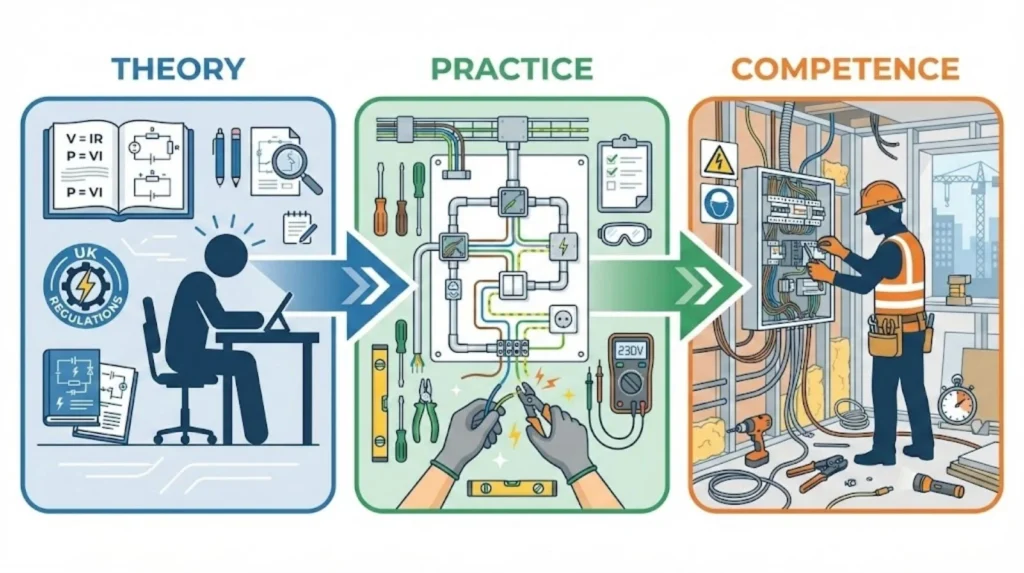
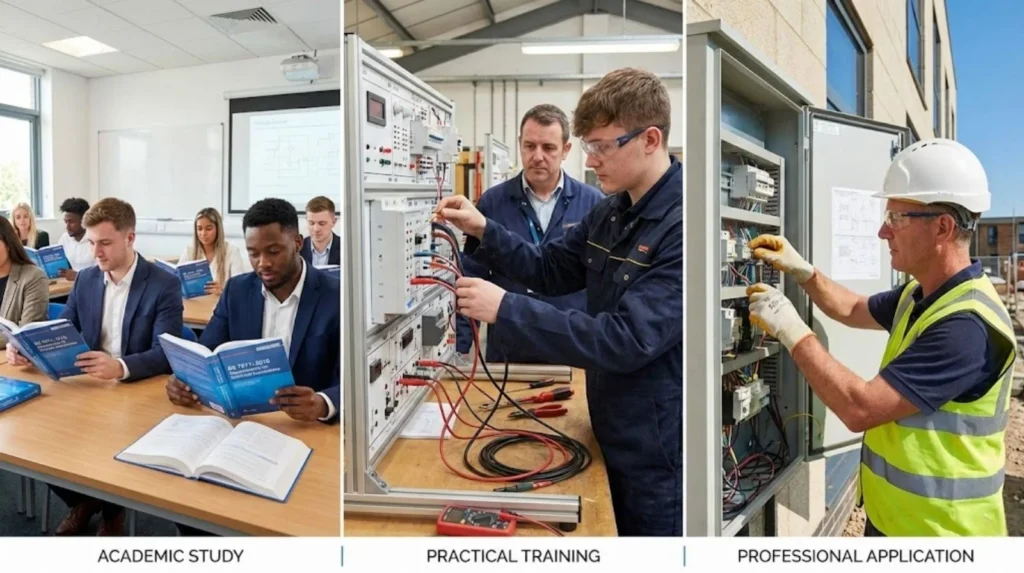
Here’s the reality: electrical training involves three distinct learning environments, not two. Classroom learning builds theoretical knowledge (regulations, calculations, principles). Workshop practice develops physical skills in controlled settings (wiring training rigs, using test equipment safely). Workplace competence demonstrates you can apply both under real site conditions (time pressure, client interactions, unpredictable problems). Understanding which electrician course wolverhampton providers offer across these three environments clarifies what “practical” genuinely means and what gaps remain if you only experience one or two of them.
This guide breaks down classroom versus practical learning in electrical training, explains what each environment proves (and doesn’t prove), and clarifies the realistic pathway from theory knowledge to workplace competence.
The Three Learning Environments (What Each Actually Proves)
The mistake most Wolverhampton learners make is thinking “practical training” means one thing. It doesn’t. Practical has different meanings depending on where you’re learning.
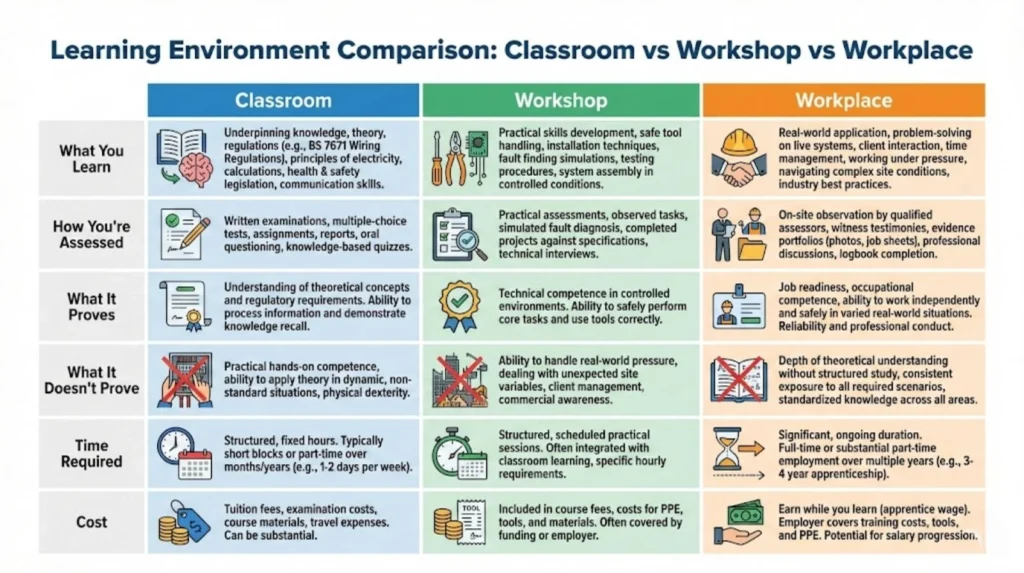
Classroom learning covers theoretical knowledge: electrical principles (Ohm’s Law, power calculations, circuit theory), BS 7671 regulations (what the wiring regs require and why), health and safety legislation, design calculations (cable sizing, voltage drop, maximum demand), and testing theory (insulation resistance, continuity, earth fault loop impedance). Assessment happens through written exams and online tests. What it proves: you understand how electrical systems work, what regulations require, and the theory behind safe installation. What it doesn’t prove: you can physically install circuits, use test equipment correctly, or work safely on real sites.
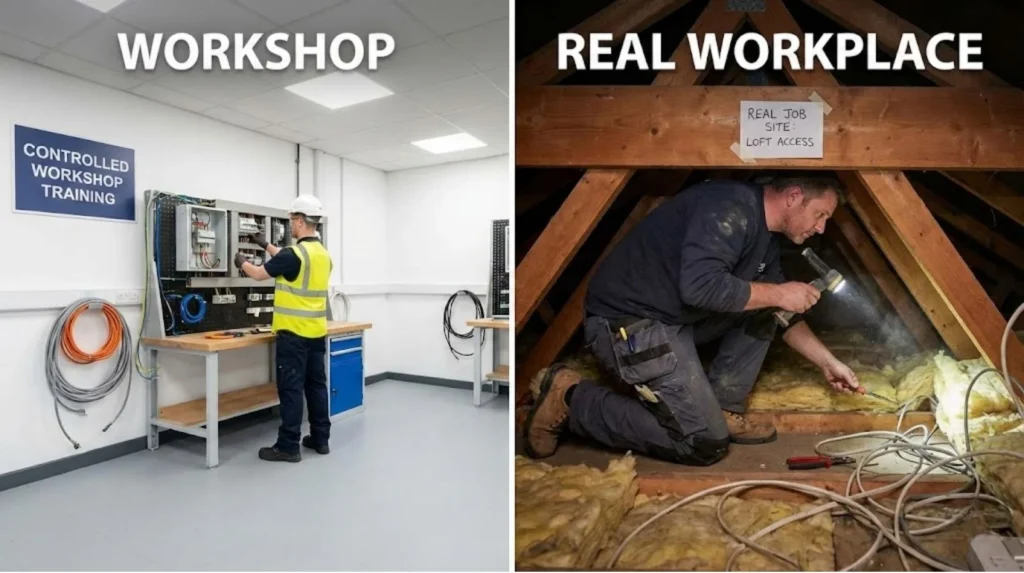
Workshop practice covers controlled hands-on training: wiring circuits on training rigs (ring finals, radial circuits, two-way switching), using test equipment (multifunctional testers, proving units, insulation testers), physical installation skills (cable routing, terminations, containment fixing), and safe isolation procedures on single isolators with clear labelling. Assessment happens through practical tasks under supervision. What it proves: you can follow procedures, use tools correctly, and complete installations in controlled conditions without time pressure. What it doesn’t prove: you can work at commercial speed, handle unpredictable site problems, or perform under real client expectations.
Workplace competence covers application under real conditions: installing electrical systems in varied buildings (domestic, commercial, industrial), testing live installations with other trades working around you, diagnosing faults nobody planted intentionally, working to client deadlines and site constraints, and dealing with installations that don’t match drawings or have undocumented modifications. Assessment happens through NVQ portfolio evidence and on-site assessor observations. What it proves: you can consistently perform electrical work safely and to standard under genuine site conditions. This is the only environment that leads to qualified electrician status.
What You Actually Learn in Each Environment (The Detailed Breakdown)
Let’s be specific about what happens in each learning environment, because the marketing often blurs these distinctions.
In Wolverhampton classrooms (City of Wolverhampton College, private centres like Elec Training), you learn electrical science and maths (current, voltage, resistance, power, three-phase calculations), BS 7671 wiring regulations (special locations, protective devices, earthing systems), health and safety law (Electricity at Work Regulations 1989, CDM 2015), circuit design principles (ring versus radial, lighting circuits, cooker circuits), and testing procedures theory (the 10-step safe isolation sequence, test instrument use, acceptable readings). The assessment is written exams, multiple choice tests, and calculation papers. You’re proving theoretical understanding.
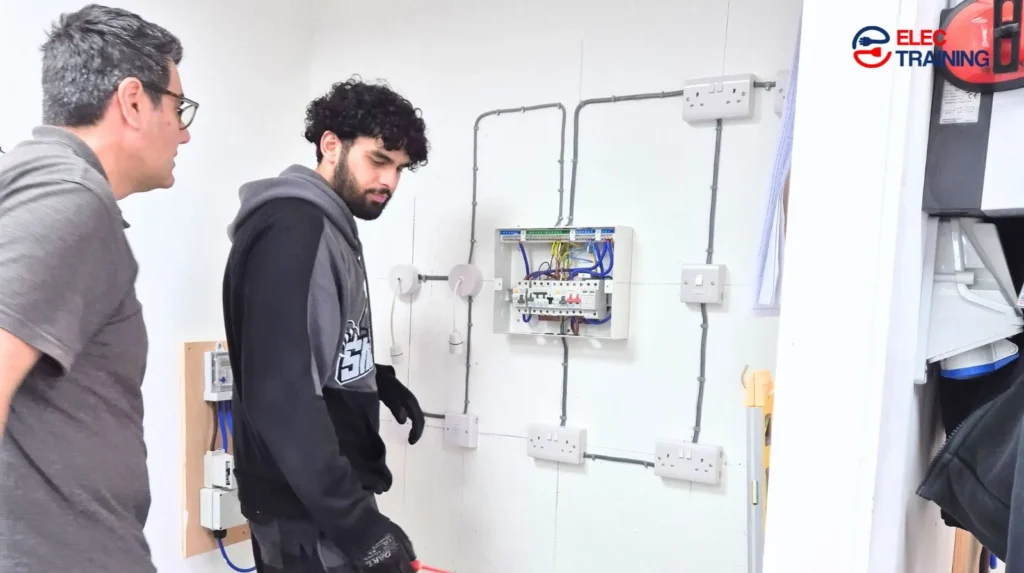
In Wolverhampton workshops (training bays with purpose-built rigs), you practice physical installation (stripping and terminating cables, fixing containment, connecting accessories), safe working procedures (isolation, proving dead, locking off), circuit wiring (following circuit diagrams, identifying conductors, making secure connections), basic testing (continuity, insulation resistance, polarity), and tool use (screwdrivers, strippers, crimpers, multifunctional testers). The assessment is practical tasks observed by tutors. You’re proving you can follow procedures safely in a controlled environment.
On Wolverhampton work sites (domestic installations in Tettenhall, commercial work in Willenhall, industrial sites in Bilston), you apply everything under real constraints: working in tight spaces (loft voids, under floors, behind existing installations), routing cables through buildings with obstacles (steel beams, existing services, structural limitations), installing in varied conditions (weather, temperature, access restrictions), fault-finding on systems with no intentional faults (tracing intermittent problems, diagnosing circuit issues), and working around other trades (coordinating with plumbers, builders, decorators). The assessment is NVQ portfolio evidence collected over 12-24 months. You’re proving workplace competence.
Why Workshop Practice Isn't the Same as Job Readiness
This is where the biggest confusion happens for Wolverhampton learners. You complete a course marketed as “hands-on” or “practical,” you’ve spent weeks in workshops wiring training rigs, and you reasonably assume you’re job ready. You’re not. You’re workshop proficient, which is different.
Workshop training rigs are purpose-built for learning. The circuit layouts are standard. The cables are neatly routed with clear access. The isolators are clearly labelled. The environment is well-lit, temperature controlled, and free from other trades. You can take your time, ask questions, and retry if you make mistakes. This is essential for learning, but it’s not representative of real work.
Real Wolverhampton job sites present challenges workshops can’t simulate. Domestic installations: crawling through 40-year-old loft insulation to route cables, working around existing wiring with questionable condition, explaining work to homeowners who want it done cheaper and faster. Commercial work: installing containment (steel tray, trunking, conduit) at height, working around active business operations, coordinating with project managers on tight schedules. Industrial sites: navigating complex safety protocols, working on three-phase systems with serious hazard potential, fault-finding on equipment that’s costing the client money every minute it’s down.
Thomas Jevons, our Head of Training with over 20 years in the trade, is clear on this distinction:
"NVQ assessors want evidence of competence across varied installation types, not just photos of the same domestic consumer unit. You need to demonstrate you can handle commercial containment, three-phase systems, fault diagnosis under pressure. Workshop practice prepares you for that, but it doesn't replace it."
Thomas Jevons, Head of Training
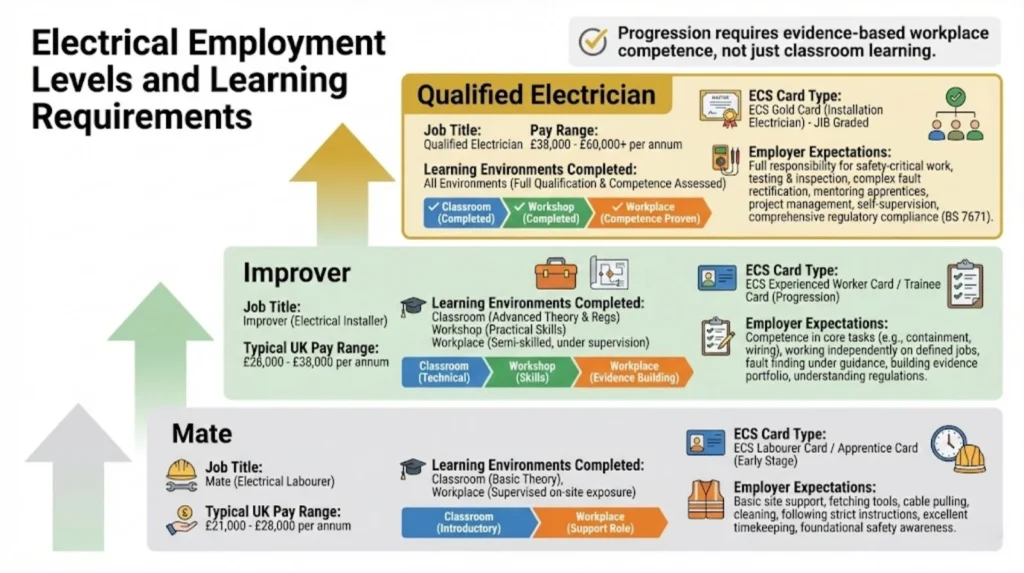
This is why employers in Wolverhampton distinguish between workshop-trained improvers and NVQ-qualified electricians. Improvers have theoretical knowledge and controlled practical skills. Qualified electricians have proven workplace competence through assessed evidence over time.
The Fast-Track Reality (What Can and Cannot Be Compressed)
Wolverhampton has no shortage of “fast-track” electrical courses promising qualification in weeks. Understanding what can legitimately be fast-tracked versus what requires time prevents expensive mistakes.
What can be compressed: Classroom theory delivery. If you’re studying full-time, you can cover Level 2 and Level 3 theoretical content in 12-16 weeks through intensive daily teaching. The knowledge can be transmitted quickly if you’re willing to study intensively. Workshop practice teaching. Intensive courses can deliver 6-8 weeks of hands-on training in compressed blocks, teaching you the physical skills and procedures under supervision.
What cannot be compressed: Workplace competence building. NVQ evidence requires 12-24 months of actual electrical work across varied installation types. There’s no shortcut. You cannot compress the repetition needed to build speed and proficiency employers expect. Your first ring final might take 4 hours in a workshop. By your 100th on real sites, you’re completing them in 45 minutes while maintaining quality. That comes from repetition under genuine conditions, not classroom compression. Fault-finding intuition develops through experiencing hundreds of real problems, not simulated workshop scenarios.
The issue with fast-track courses isn’t that they’re dishonest about what they teach. Most clearly state they cover Level 2 and Level 3 knowledge and basic workshop skills. The issue is learners assume that equals job readiness, when it only equals the foundation stage. You still need workplace NVQ access after that, which takes another 18-24 months minimum.
What Wolverhampton Employers Actually Want from Each Stage
Let’s translate the three learning environments into what Wolverhampton and West Midlands employers actually look for when hiring at different levels.
For electrician’s mate roles (£11-£14/hour in Wolverhampton): Employers want classroom knowledge confirmation (Level 2 minimum, proves you understand basic electrical principles and safety), workshop safety awareness (you won’t create immediate liability on site), basic hand tool competence (you can use screwdrivers, strippers, and basic equipment without supervision), and willingness to learn (you follow instructions and ask questions). They don’t expect speed, independence, or problem-solving ability. You’re assisting, not installing.
For improver roles (£16-£19/hour): Employers want classroom knowledge completion (Level 2 and Level 3, proves advanced theoretical understanding), workshop skills demonstration (you can wire standard circuits correctly under supervision), some site experience (ideally from mate roles, proves you understand site protocols), and ECS Improved Trainee card (proves you’re on the qualification pathway). They expect you to work with less checking than mates but still under qualified electrician supervision.
For qualified electrician roles (£22-£26/hour employed, £30-£45/hour self-employed): Employers want workplace competence proof (NVQ Level 3 completed, proves assessed competence over time), practical assessment pass (AM2, proves you can perform under exam conditions), current regulations knowledge (18th Edition, proves you know BS 7671:2018+A2:2022), and ECS Gold Card (proves JIB recognition). They expect independence, fault-finding ability, client interaction skills, and the confidence to make site decisions without constant supervision.
Joshua Jarvis, our Placement Manager, sees this progression daily with Elec Training’s Wolverhampton electrical course graduates :
"The biggest challenge we see with Wolverhampton learners is finishing their classroom and workshop training, then struggling to find employers who'll take them on for NVQ evidence gathering. That's why our in-house recruitment team exists. Practical skills from workshops make you placeable, but you still need active support to secure that first role."
Joshua Jarvis, Placement Manager
Common Misconceptions About Practical Training
The biggest misconception is that “practical course” means you’ll be job ready immediately. Practical means different things at different stages. Workshop practical makes you site safe. Workplace practical makes you competent. These aren’t the same.
The second misconception is that you can skip classroom theory if you’re “hands-on” focused. You can’t. Level 2 and Level 3 exams test electrical science, calculations, and regulations knowledge. Without that foundation, you’ll fail the assessments required for NVQ progression and you won’t understand why installations work or what BS 7671 requires.
The third misconception is that workshop hours directly translate to site speed. They don’t. Workshop installations might take 3-4 hours with breaks and questions. Site installations of the same circuit need completing in 45 minutes to an hour to be commercially viable. That speed comes from repetition under genuine conditions, not training rig practice.
The fourth misconception is that evening or weekend courses can cover everything. They can cover classroom and workshop components over extended timelines (2-3 years part-time versus 12-16 weeks intensive). But they cannot deliver the workplace competence stage. That requires actual employment, gathering NVQ evidence, which you do through mate or improver roles while working.
The NVQ Evidence Bottleneck (Why Classroom and Workshop Alone Aren't Enough)
Here’s where many Wolverhampton learners get stuck. You complete Level 2 classroom and workshop. You complete Level 3 classroom and workshop. You’ve spent £5,000-£7,000 and 4-6 months studying. You reasonably expect to start working as a qualified electrician. You can’t. You’re an improver with knowledge and basic skills, but you lack workplace competence proof.
The NVQ Level 3 requires portfolio evidence from real electrical work. Photographic evidence of installations you’ve completed (domestic consumer units, commercial containment, industrial three-phase systems), test certificates you’ve signed off (insulation resistance, continuity, earth fault loop impedance readings), fault diagnosis documentation (problems you’ve identified and rectified), and supervisor sign-offs confirming you worked safely and competently. This evidence must cover multiple unit outcomes across 12-24 months of employment.
An assessor visits your workplace at least twice to observe you working. They watch you perform safe isolation, install circuits, conduct tests, interpret drawings. They verify your portfolio evidence is genuine. They confirm you can work consistently to BS 7671 standards without constant supervision. This cannot happen in a college workshop or private training centre. It requires genuine employment in the electrical trade.
This is the bottleneck. Completing classroom and workshop training makes you employable as a mate or improver, but it doesn’t make you qualified. You need an employer willing to supervise your NVQ evidence gathering, which means transitioning from your current job (if you have one) into electrical work, often at lower initial wages (£16-£19/hour for improvers versus whatever you’re earning now).
What Elec Training Offers for the Complete Journey
We’re based on Thomas Street in Wolverhampton, opposite St John’s Retail Park. For learners navigating classroom, workshop, and workplace stages, we offer structured progression with realistic expectations at each point.
Our Level 2 and Level 3 courses (City & Guilds 2365) cover both classroom theory and workshop practical training. We deliver these intensively (12-16 weeks full-time) or flexibly (evenings/part-time) depending on your circumstances. This gives you the knowledge foundation and controlled practical skills employers expect from mates and improvers.
But the critical component for Wolverhampton learners is our NVQ Level 3 package (£10,000-£12,000), which includes tutor support throughout portfolio building, assessor visits to your workplace, and crucially, active placement support through our in-house recruitment team working with 120+ contractor partners across the West Midlands. We don’t just deliver classroom and workshop training, then leave you to figure out the workplace competence stage alone.
This is how we address the NVQ evidence bottleneck that stops most learners: we actively place you with employers who will support your portfolio evidence gathering. Without workplace access, you cannot complete NVQ. Without NVQ, you cannot sit AM2. Without AM2, you cannot get Gold Card. The pathway stops. Our placement support ensures it doesn’t.
That package does not include AM2 exam fees (you pay NET directly, typically £850-£950) or PPE and tools (budget £300-£500 separately). But it does include the element that differentiates complete training from knowledge-only courses: genuine support through the workplace competence stage.
If you’re researching classroom versus practical training in Wolverhampton, your first step is understanding you need both, plus workplace competence. One without the others leaves gaps that prevent qualification.
Your second step is evaluating providers on what they offer across all three environments. Ask directly: “Do you provide classroom theory and workshop practice? How do you support learners through the workplace NVQ stage? Do you offer placement assistance?” If the answer stops at classroom and workshop, you’re looking at a knowledge-and-skills provider, not a complete qualification pathway.
Your third step is being realistic about timeline. Classroom and workshop can be completed in 12-16 weeks intensive or 18-24 months part-time. Workplace NVQ requires another 12-24 months minimum while employed as a mate or improver. Total realistic timeline from zero to Gold Card: 18 months to 3 years. Anyone promising significantly faster is omitting the workplace competence stage.
Call us on 0330 822 5337 to discuss how classroom, workshop, and workplace training work together in our Wolverhampton electrical courses. We’ll explain what you learn in each environment, what each proves and doesn’t prove, and how our placement support bridges from workshop skills to workplace competence evidence. No misleading “practical training” marketing. Just clear explanation of the three learning environments and realistic pathways through all of them.
References
- City & Guilds 2365 Diploma Specifications (Classroom and Workshop Components): https://www.cityandguilds.com/
- City & Guilds 2357 NVQ Specification (Workplace Competence): https://www.cityandguilds.com/
- Ofqual Register of Regulated Qualifications: https://register.ofqual.gov.uk/
- ECS Card Types and Requirements: https://www.ecscard.org.uk/card-types
- JIB Grading and Qualification Pathways: https://www.jib.org.uk/
- National Electrotechnical Training (AM2 Assessment): https://www.netservices.org.uk/am2/
- Installation and Maintenance Electrician Apprenticeship Standard: https://www.instituteforapprenticeships.org/
- National Careers Service – Electrician Profile: https://nationalcareers.service.gov.uk/job-profiles/electrician
- BS 7671:2018+A2:2022 Wiring Regulations: https://electrical.theiet.org/
- HSE Guidance on Electrical Safety and Competence: https://www.hse.gov.uk/electricity/
Note on Accuracy and Updates
Last reviewed: 14 January 2026. This page is maintained; we correct errors and refresh sources as UK electrical qualification requirements and Wolverhampton training delivery patterns change. The distinction between classroom, workshop, and workplace learning remains consistent across awarding bodies (City & Guilds, EAL, Pearson). NVQ evidence requirements are set by qualification specifications and cannot be bypassed. Next review scheduled: March 2026 following spring qualification updates.
