
Electrician Courses in Birmingham: What Options Are Available for Beginners

- Technical review: Thomas Jevons (Head of Training, 20+ years)
- Employability review: Joshua Jarvis (Placement Manager)
- Editorial review: Jessica Gilbert (Marketing Editorial Team)
- Last reviewed:
- Changes: Initial publication covering Birmingham beginner training routes and local provider landscape
If you type “electrician courses Birmingham” into Google, you’ll get roughly 40 different results claiming to turn you into a qualified spark. University College Birmingham offers Level 2 diplomas. BMet runs apprenticeships. Private centres promise “fast-track” routes. And somewhere in the middle, someone’s selling a 4-week course that sounds too good to be true (because it is).
Here’s what most Birmingham beginners don’t realise until they’re three months and £3,000 in: not all electrician courses Birmingham providers are offering the same thing. Some are teaching regulated qualifications that lead to proper employment. Others are teaching theory-only courses that leave you qualified on paper but unemployable in practice.
The city has genuine options for beginners. Level 2 diplomas at FE colleges, Level 3 apprenticeships through providers like JTL, evening courses at Walsall College for career changers, and NVQ pathways that actually lead to site work. What Birmingham doesn’t have is a magic shortcut that gets you from zero experience to Gold Card electrician in six weeks, no matter what the Facebook ads claim.
If you’re starting from scratch in Birmingham, here’s what’s actually available, what each option enables, and what the marketing materials won’t tell you.
What "Beginner" Actually Means in Birmingham's Electrical Training Market
When Birmingham providers say “beginner course,” they mean different things. BMet’s Level 2 diploma assumes you’ve never touched a screwdriver. JTL’s apprenticeships want GCSEs in English and maths but no electrical experience. Private centres advertising “beginner fast-track” courses often expect you to already understand three-phase systems.
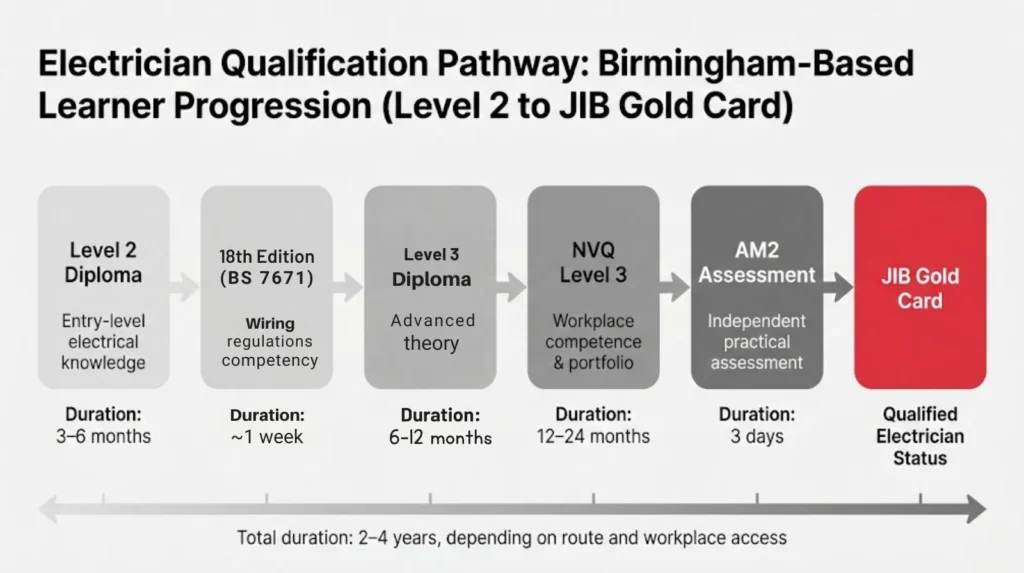
True beginner routes in Birmingham start with City & Guilds 2365 Level 2 Diploma in Electrical Installations. This is the regulated qualification that teaches basic electrical science, safe isolation, and fundamental wiring practices in a controlled workshop environment. It’s not glamorous. You’ll spend weeks learning Ohm’s law, calculating cable sizes, and wiring practice boards that look nothing like real installation work.
University College Birmingham runs this Level 2 over one year part-time or 15 weeks intensive. South & City College offers similar timing. BMet (Birmingham Metropolitan College) at Great Barr delivers it as part of their apprenticeship framework. All three use City & Guilds as the awarding body, all three are Ofqual-regulated, and all three cost roughly £1,200 to £1,800 if you’re self-funding.
What Level 2 enables: progression to Level 3 study, access to “Electrician’s Mate” roles on Birmingham sites (Digbeth developments, Tyburn industrial estates, city centre refurbishments), and eligibility for a white Trainee ECS card. What it doesn’t enable: independent electrical work, domestic installations, or calling yourself an electrician.
Level 2 Diplomas: Your Starting Point in Birmingham
Every legitimate electrician in Birmingham started somewhere, and for most people without apprenticeships, that somewhere is Level 2. The course covers DC theory, AC single-phase and three-phase systems, earthing and bonding, safe isolation procedures, basic test equipment use, and fundamental wiring techniques.
Birmingham’s FE colleges structure this as two evenings per week plus occasional Saturdays (Walsall College does this), or as intensive daytime blocks running Monday to Friday for 15 to 20 weeks (University College Birmingham and BMet both offer this). Private centres like Birmingham Electrical Training compress it further, sometimes into 10-week intensive formats, though the total teaching hours remain similar.
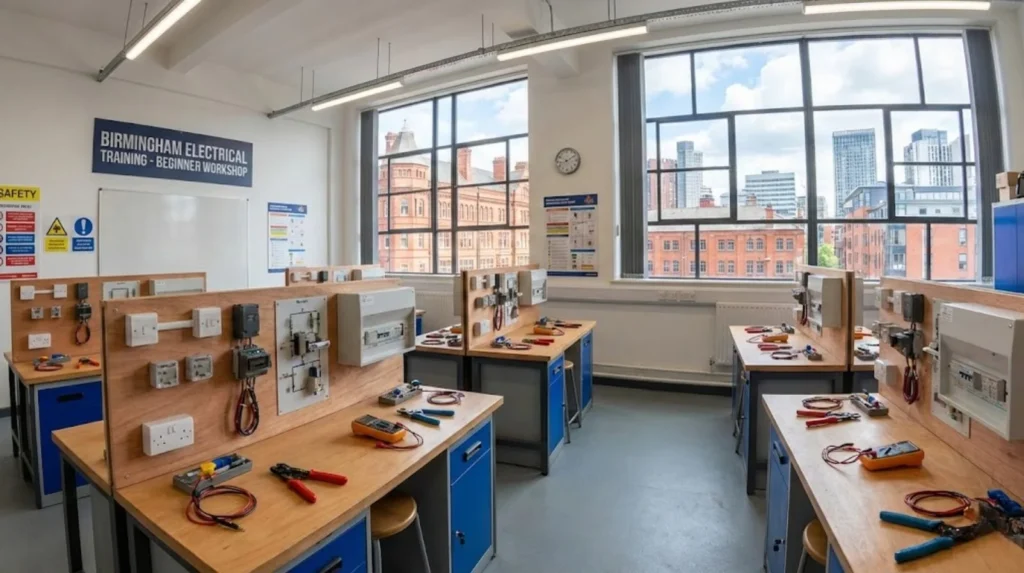
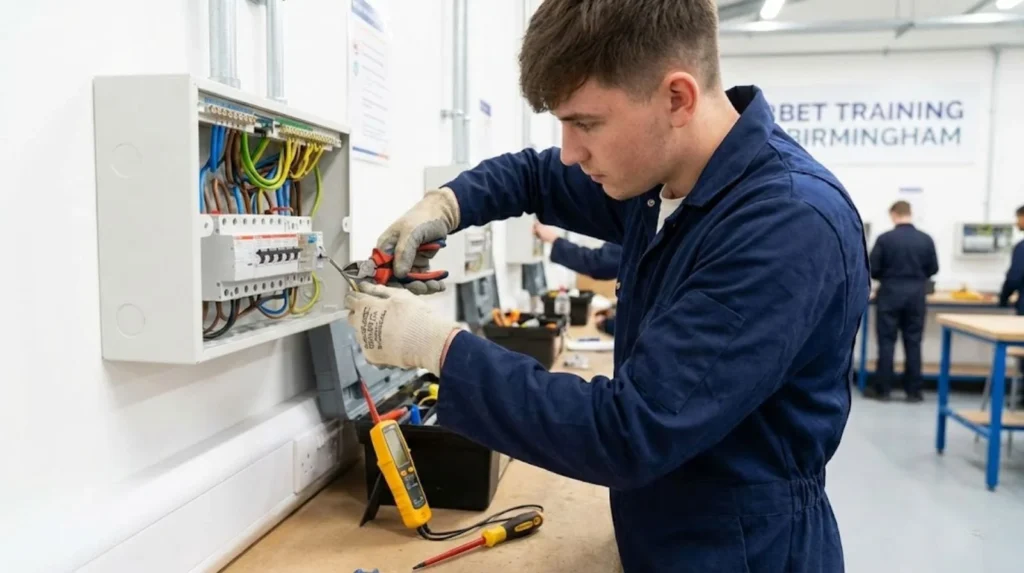
The classroom-to-workshop ratio matters. BMet’s Great Barr campus has dedicated electrical workshops with consumer unit rigs, lighting circuits, and power distribution boards that mirror real installations. You’ll physically wire circuits, test continuity, and practice safe isolation hundreds of times. Online providers or theory-heavy courses can’t replicate this. Electrical work is a physical trade. You need muscle memory for stripping cables, terminating conductors, and identifying faults by feel as much as by meter readings.
Cost varies: £1,200 to £1,800 self-funded at FE colleges, potentially free if you’re under 24 or earning under £25,000 (check West Midlands Combined Authority funding eligibility). Private centres charge £2,000 to £3,500 for the same regulated qualification, often justified by faster completion times or weekend availability.
For a complete guide to becoming an electrician in Birmingham, Level 2 is the non-negotiable foundation, but it’s only the first 25% of the journey.
Level 3 Diplomas: The Next Step (But Not the End)
City & Guilds 2365 Level 3 builds on Level 2 by covering advanced wiring systems, design calculations, inspection and testing theory, and commercial installation practices. It’s still a knowledge-based qualification. You’re learning what should be done, not proving you can do it under real site conditions.
Birmingham providers deliver Level 3 over one year part-time (two evenings weekly at South & City College), or as intensive blocks (12 to 16 weeks full-time at private centres). The content includes three-phase distribution, motor control circuits, fire alarm systems, and emergency lighting installations. Useful knowledge. Essential for progression. But on its own, Level 3 doesn’t make you competent to work independently.
Here’s where Birmingham beginners get misled: marketing materials that say “Level 3 Electrical Installation Course” without clarifying it’s a diploma, not an NVQ. Diplomas prove knowledge. NVQs prove competence through workplace evidence. Employers want both. Sites won’t let you touch live installations with only a diploma, no matter how high you scored on the exam.
Thomas Jevons, Head of Training with 20 years on the tools, explains:
"Level 3 diplomas teach you the regulations and calculations, but they don't prove you can safely isolate a three-phase supply or correctly terminate a 6mm² SWA cable in a gland. That's what the NVQ and AM2 assessment demonstrate."
Thomas Jevons, Head of Training
Cost for Level 3 in Birmingham: £1,500 to £2,200 at FE colleges, £3,000 to £4,500 at private centres. Duration: 6 to 12 months depending on intensity. What it enables: access to NVQ Level 3 portfolio building, eligibility for Approved Electrician trainee status, and progression toward proper site work. What it doesn’t enable: signing off your own installations, working without supervision, or applying for a Gold Card.
The Apprenticeship Route Through Birmingham Providers
If you can secure an employer willing to take you on, apprenticeships remain the gold standard route. JTL’s Aston training centre and Birmingham Electrical Training (BET) in Hockley both deliver Level 3 Installation and Maintenance Electrician apprenticeships, combining on-the-job learning with block or day release at their facilities.
Apprenticeships bypass the diploma-then-NVQ separation by integrating everything: you earn while you learn, build your portfolio through actual paid work, and complete all required qualifications (Level 2, Level 3, 18th Edition, NVQ, AM2) within a structured four-year programme. Starting wages in Birmingham typically range from £14,000 to £18,000 in year one, rising to £22,000 to £26,000 by year four.
The catch: you need an employer first. JTL and BET maintain waiting lists of applicants hoping for placement with their contractor networks, but demand far exceeds supply. Construction firms in Birmingham (particularly those working on HS2 related projects, city centre developments, and industrial estates) prefer taking on apprentices who arrive through recommendations, family connections, or who’ve already demonstrated commitment by completing Level 2 independently.
Birmingham apprenticeships aren’t restricted to 16-year-olds. Adult apprenticeships exist for career changers, though funding structures differ. If you’re over 24, you’ll likely need to contribute toward training costs, and employers may be less willing to invest four years in someone starting later in their career. Realistic, not discouraging, it’s worth understanding the landscape before applying.
For Birmingham learners who can’t secure apprenticeships, the alternative is completing Level 2 and Level 3 independently, then seeking “Electrician’s Mate” or “Improver” roles that provide the site access needed for NVQ portfolio evidence.
Evening and Part-Time Options for Birmingham Career Changers
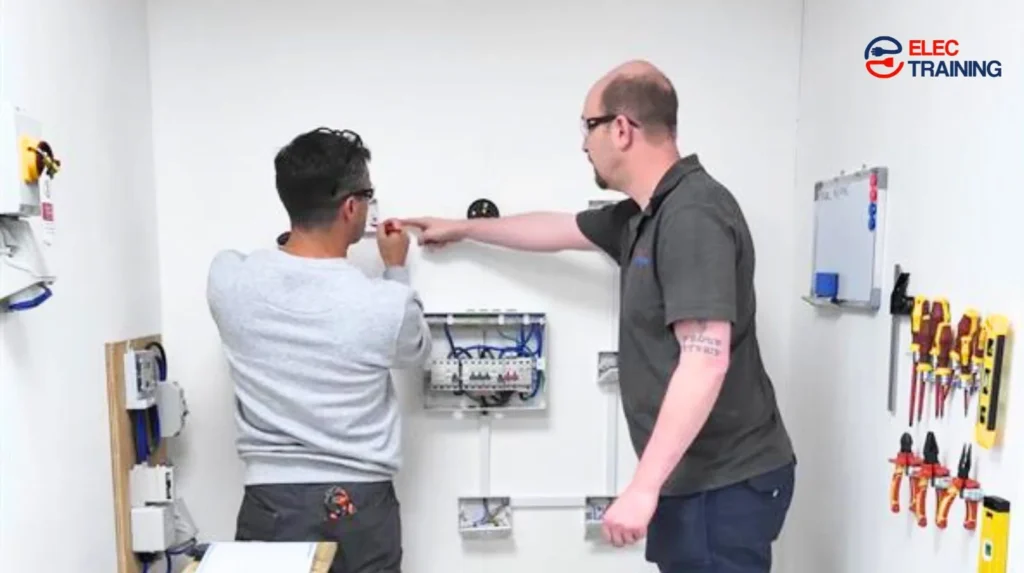
Walsall College (technically just outside Birmingham but serving the West Midlands) runs Level 2 electrical installation two evenings per week over one year. Trade Skills 4U near Coventry offers similar evening provision. These part-time routes let career changers keep their current jobs while building electrical qualifications, though progress is slower than full-time study.
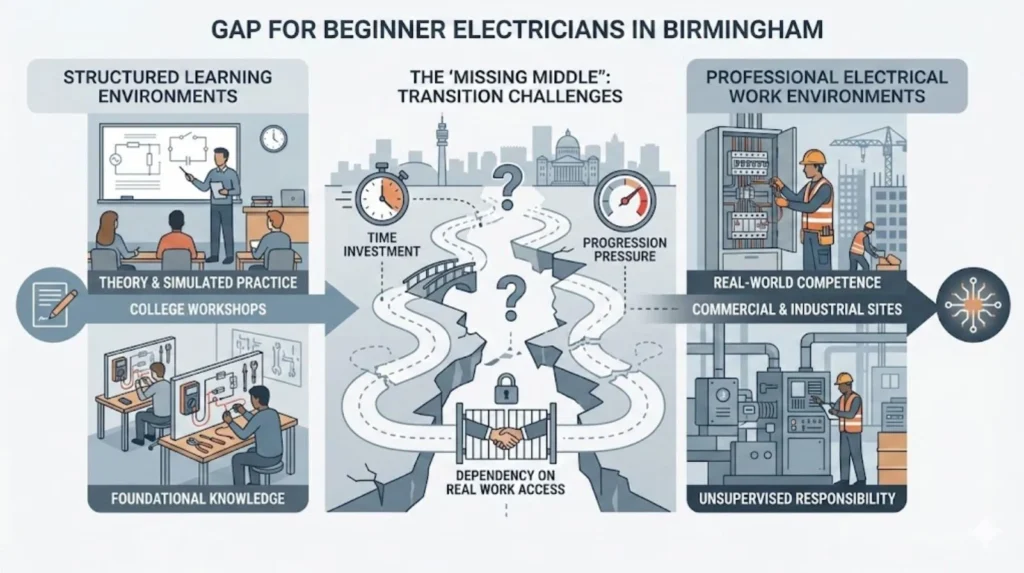
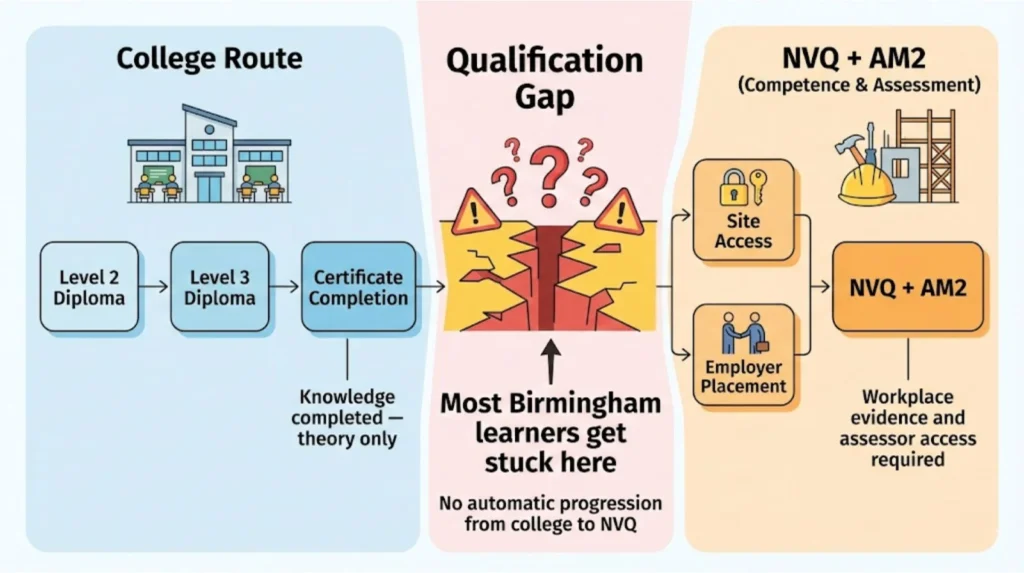
Evening courses work for knowledge-based qualifications (Level 2, Level 3, 18th Edition). They don’t work for NVQ Level 3 or AM2 assessment, both of which require substantial daytime site access. This creates a progression bottleneck: you can complete your diplomas in evenings, but you’ll still need to transition to daytime work, either as a mate or through employer-sponsored NVQ time, to finish your qualification journey.
Birmingham employers advertising for Electrician’s Mates or Improvers typically want Level 2 as a minimum, a white Trainee ECS card (which requires Level 2 plus health and safety test), and willingness to work across multiple sites (Erdington, Bournville, Solihull, and beyond). Having your own transport matters. Public transport doesn’t reliably serve 7am starts at industrial estates in Tyburn or Minworth.
The evening route extends your timeline. Level 2 takes 12 months part-time instead of 3 to 6 months full-time. Level 3 adds another 12 months. Then you’re looking for mate work to start your NVQ portfolio. Total time from starting evenings to Gold Card qualification: realistically 4 to 5 years, compared to 2 to 3 years if you can study full-time and secure placements quickly.
The NVQ Reality: Why Birmingham Colleges Can't Complete Your Journey
Here’s the part most Birmingham electrical courses don’t advertise upfront: City & Guilds 2365 diplomas (Level 2 and Level 3) don’t make you a qualified electrician. Neither do short courses in 18th Edition wiring regulations. The only route to industry-recognised qualified status is NVQ Level 3 (City & Guilds 2357 or EAL equivalent) plus AM2 practical assessment, and neither can be completed in a college workshop.
NVQ Level 3 is a portfolio of workplace evidence covering units like electrical installation, testing and commissioning, planning and overseeing work, and health and safety practices. You need to be working on real sites, under supervision, logging hours and gathering photographic evidence of installations you’ve physically completed. Birmingham colleges can’t simulate this. Private training centres can’t shortcut it. It requires actual employment or guaranteed placements with contractors.
AM2 assessment happens at independent centres (JTL Aston, BET Hockley, BMet Great Barr all host AM2 testing). You’re given a set of installation tasks, design requirements, and testing scenarios. You have three days to prove you can safely and correctly install, test, and certify electrical work to BS 7671:2018+A2:2022 standards. Pass rate nationally hovers around 75%. If you’ve built your portfolio properly and logged genuine site hours, you’ll pass. If you’ve rushed through with minimal hands-on experience, you’ll fail.
Joshua Jarvis, Placement Manager at Elec Training, notes:
"Birmingham learners often complete Level 2 and Level 3 locally, then struggle to find the site placements needed for NVQ evidence. That's where having an in-house recruitment team makes the difference. We're calling 120+ contractors daily to secure those placements, not just pointing learners at job boards and wishing them luck."
Joshua Jarvis, Placement Manager
What Elec Training Offers Birmingham Learners
Elec Training operates UK-wide, including support for Birmingham-based learners who need more than just classroom qualifications. The standard pathway covers Level 2 (2365-02) over 4 weeks, Level 3 (2365-03) over 8 weeks, 18th Edition over 5 days, then progression into NVQ Level 3 (2357) portfolio building with guaranteed placement support.
The difference isn’t faster diplomas (those timelines are standard across providers). The difference is what happens after Level 3. Elec Training’s in-house recruitment team works with 120+ contractor partnerships across the UK, including West Midlands firms operating in Birmingham, Wolverhampton, Coventry, and surrounding areas. That means when you finish your Level 3, you’re not searching Indeed and Reed hoping someone will take a chance on an unproven trainee. You’re being actively placed with contractors who need electrical improvers and are willing to supervise NVQ portfolio development.
The full NVQ package costs £10,000 to £12,000, which includes NVQ tutor support and portfolio guidance, assessor visits to your workplace, placement support through the in-house recruitment team, and ongoing support until qualification completion. What’s not included: AM2 exam fee (paid separately when you’re assessment-ready) and PPE or essential equipment (your responsibility to provide).
Timeline: 18 months to 3 years depending on how quickly you log the required site hours and complete portfolio evidence. Not a shortcut. Not a 6-week miracle. A structured, supported route that acknowledges the reality: you need workplace access to finish your qualification, and most Birmingham beginners can’t secure that independently.
For Birmingham learners, this means you can complete initial diplomas locally (or through Elec Training’s delivery), then benefit from national placement networks when it’s time to start your NVQ. You’re not limited to Birmingham-only opportunities. West Midlands contractors in Walsall, Dudley, Sandwell, and Solihull are all within reach, expanding your options significantly.
If you’re in Birmingham with zero electrical experience, here’s the practical starting point: enrol in Level 2 at an FE college (BMet, South & City, University College Birmingham) if you want the cheapest route and don’t mind slower progression, or consider Elec Training’s structured pathway if you want integrated support from diplomas through to guaranteed placements for NVQ completion.
What we’re not going to tell you: that electrician course Birmingham searches will find you a 4-week route to Gold Card status, that Level 3 diplomas alone make you employable, or that evening study gets you qualified without eventually transitioning to daytime site work.
What we will tell you: the full journey takes 2 to 4 years depending on route, proper qualifications cost £10,000 to £12,000 for the complete NVQ package at Elec Training (or £5,000 to £8,000 if you piece together diplomas locally then struggle to find NVQ placements), Birmingham has legitimate beginner options at FE colleges and through apprenticeship providers, and the bottleneck is always workplace access for NVQ evidence, not classroom availability.
Call us on 0330 822 5337 to discuss the full breakdown of electrical training pathways available for Birmingham beginners. We’ll explain exactly what you need, how long it realistically takes, and what our in-house recruitment team can do to secure the placements Birmingham colleges can’t provide. No hype. No fast-track fantasies. Just practical guidance from people who place learners with West Midlands contractors every week.
References
- City & Guilds 2365 Level 2 & 3 Electrical Installation Qualifications – https://www.cityandguilds.com/
- Birmingham Metropolitan College (BMet) Electrical Courses – https://www.bmet.ac.uk/
- University College Birmingham Electrical Installation – https://www.ucb.ac.uk/
- South & City College Birmingham – https://www.southandcity.ac.uk/
- Walsall College Electrical Installation – https://www.walsallcollege.ac.uk/
- JIB Grading and Gold Card Criteria – https://www.jib.org.uk/
- National Careers Service: Electrician – https://nationalcareers.service.gov.uk/job-profiles/electrician
- IET Wiring Regulations BS 7671:2018+A2:2022 – https://www.theiet.org/
- Ofqual Register of Regulated Qualifications – https://register.ofqual.gov.uk/
- West Midlands Combined Authority Skills & Training – https://www.wmca.org.uk/
Note on Accuracy and Updates
Last reviewed: 1 January 2026. This page is maintained; we correct errors and refresh sources as Birmingham provider offerings and qualification structures change. Birmingham college and private centre information is accurate as of December 2025 but is subject to change. Learners should verify current course availability, costs, and start dates directly with providers before enrolling. Next review scheduled for June 2026.
