

Electrician Overtime Weekend Rates Real Earnings Breakdown

- Technical review: Thomas Jevons (Head of Training, 20+ years)
- Employability review: Joshua Jarvis (Placement Manager)
- Editorial review: Jessica Gilbert (Marketing Editorial Team)
- Last reviewed:
- Changes: Initial publication covering 2025/2026 JIB, SJIB, and NAECI overtime frameworks
Introduction
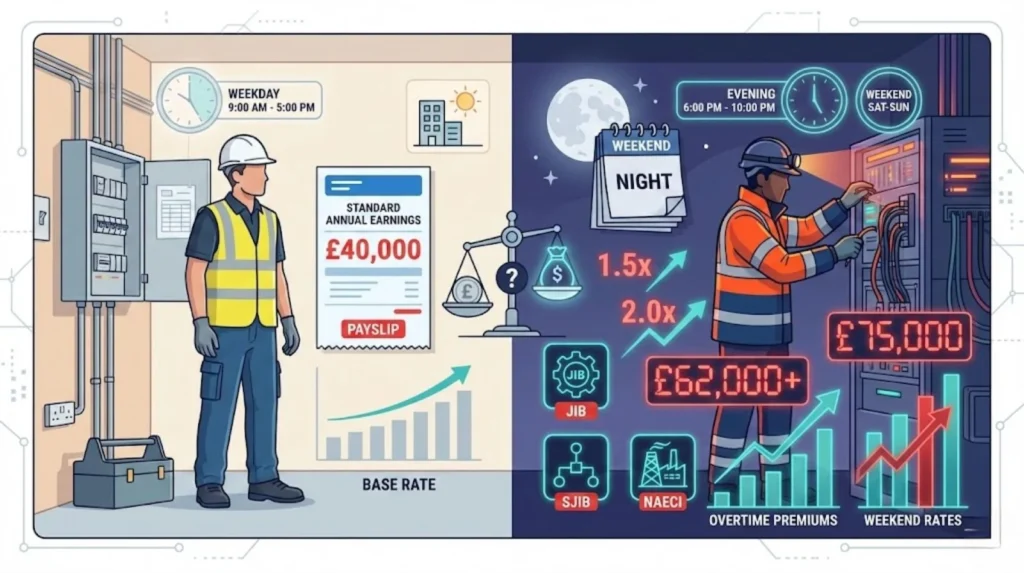
Base electrician salaries tell you almost nothing about actual take-home pay. A £40,000 annual salary sounds reasonable until you realise the spark in the industrial unit next door is clearing £62,000 doing the same work, just with structured weekend shifts and night premiums built into their contract.
The difference isn’t luck or connections. It’s understanding how overtime, weekend rates, and shift multipliers work across the three major UK frameworks that govern electrical work: JIB (England, Wales, Northern Ireland), SJIB (Scotland), and NAECI (industrial engineering construction). These frameworks don’t just set base pay. They define exactly when you’re entitled to time-and-a-half, when double time kicks in, and what happens when you’re called out at 11pm on a Sunday.
If you’ve looked at electrician salary uk data and thought the numbers seemed low, you’re not wrong. You’re just looking at basic hours. The real earnings come from what happens when those basic hours end.

How Working Hours Are Actually Defined
Before we get into rates and multipliers, you need to understand what counts as what. The frameworks are specific about this, and knowing the definitions matters when you’re checking whether you’re being paid correctly.
Basic hours under JIB and SJIB are 37.5 hours per week, Monday to Friday, typically falling between 7am and 7pm. NAECI uses 38 hours per week with a slightly different pattern (8 hours Monday to Thursday, 6 hours Friday). Anything outside these hours is either overtime, weekend work, or night shifts, each with different payment rules.
Overtime means hours worked beyond your basic week. If you’re on a JIB contract and you work 42 hours in a Monday-to-Friday pattern, those extra 4.5 hours are overtime and paid at time-and-a-half (1.5x your hourly rate). Weekend work is defined as any hours between 00:00 Saturday and 24:00 Sunday. Night work varies slightly by framework but generally covers 9pm to 6am.
Call-out work is different again. This is unscheduled emergency attendance, attracting a specific standby payment plus a minimum number of hours paid regardless of how long the job actually takes. JIB pays time-and-a-half home-to-home plus £20 for the first call-out and £10 for subsequent ones. The clock starts when you leave your house and stops when you get back.
The reason this matters is simple. If you don’t know what constitutes overtime versus weekend work versus a call-out, you won’t know if you’re being underpaid. Employers who aren’t following JIB or SJIB frameworks might try to class Saturday work as “standard hours” or pay flat rates when multipliers should apply.
Official Overtime Rules: JIB, SJIB, and NAECI Compared
These three frameworks set the floor for organised electrical work. Large commercial and industrial sites typically follow these rules strictly, and understanding them helps you identify whether a job advert is offering genuine premium rates or trying to shortchange you.
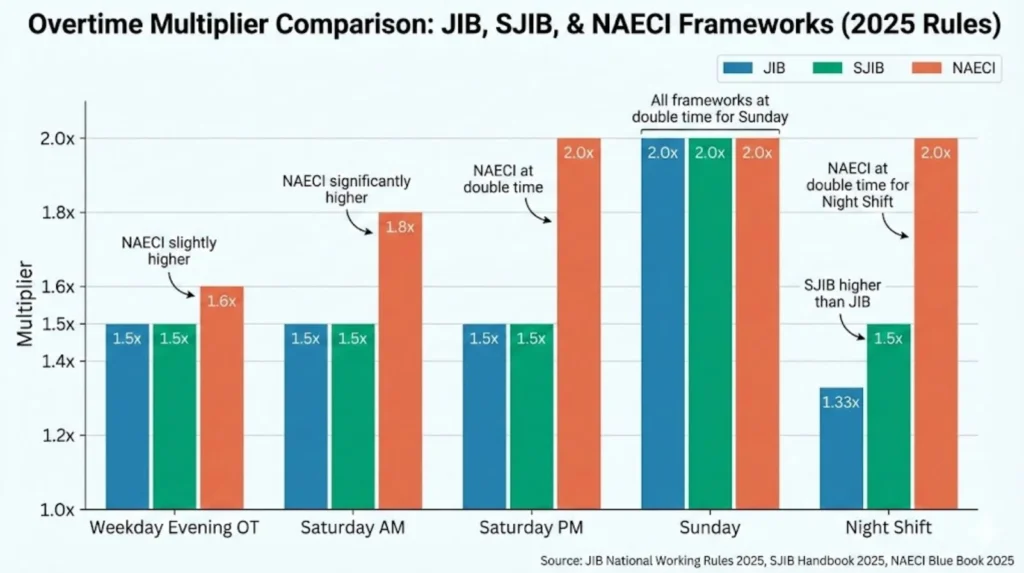
JIB (England, Wales, Northern Ireland) uses a standard 37.5-hour week. Overtime after those 37.5 hours on a weekday is paid at 1.5x your base rate. Saturdays are split: the first four to six hours (depending on agreement) are paid at 1.5x, then it jumps to double time (2.0x) after 1pm or 4pm. Sundays and bank holidays are double time for all hours worked. Night shifts attract an uplift of basic pay plus 33.3% for working 37.5 hours over five nights. Travel beyond 15 miles one way is covered by a daily allowance (around £15-£20 depending on zone), and if you’re working away, lodging is paid at £51.29 per night tax-free.
SJIB (Scotland) mirrors JIB closely with a 37.5-hour standard week and similar overtime multipliers: 1.5x after 37.5 hours during the week, 1.5x for the first portion of Saturday, then 2.0x for Sundays and late Saturdays. The main difference is in night shift rules. If you’re working three or more nights, you get basic pay plus a percentage uplift. Fewer than three nights and you’re paid at standard overtime rates (1.5x or 2.0x depending on timing). SJIB also pays for protracted travel journeys at basic rate for up to 7.5 hours per day.
NAECI (the “Blue Book”) governs industrial and engineering construction work, the kind of roles you’ll find on power stations, refineries, water treatment plants, and large infrastructure projects. The standard week is 38 hours. Overtime is categorised into Rate A (approximately 1.5x, used for weekday evenings and the first portion of Saturday) and Rate B (approximately 2.0x, used after midnight, late Saturday, and all of Sunday). Shift premiums are higher under NAECI, with rotating three-shift patterns often adding 25% or more to your base rate before overtime even kicks in. Travel is strictly defined using radius allowances and mileage bands, with clear splits between taxed and untaxed payments.
The effect of these frameworks is that premium earnings are guaranteed if the work is available. A JIB electrician working one Sunday a month at double time adds roughly £8,000 to their annual income. An NAECI spark on a structured shift pattern with regular weekends can be earning 40-50% more than their base salary through multipliers alone.
What Employers Are Actually Paying (Market Reality)
The frameworks set the standard, but the market doesn’t always follow them. Job boards and agency rate cards tell a messier story, particularly in the CIS (Construction Industry Scheme) and agency sectors where flat rates often replace structured overtime multipliers.
Domestic PAYE roles typically advertise £35,000 to £42,000 annual salaries with limited or optional overtime. Commercial PAYE positions range from £35,000 to £50,000 with overtime more commonly available during project-intensive periods. Industrial PAYE roles often quote base rates around £27 per hour or £45,000 annually, but the “OTE” (on-target earnings) figure jumps to £50,000+ once structured overtime and shift premiums are factored in.
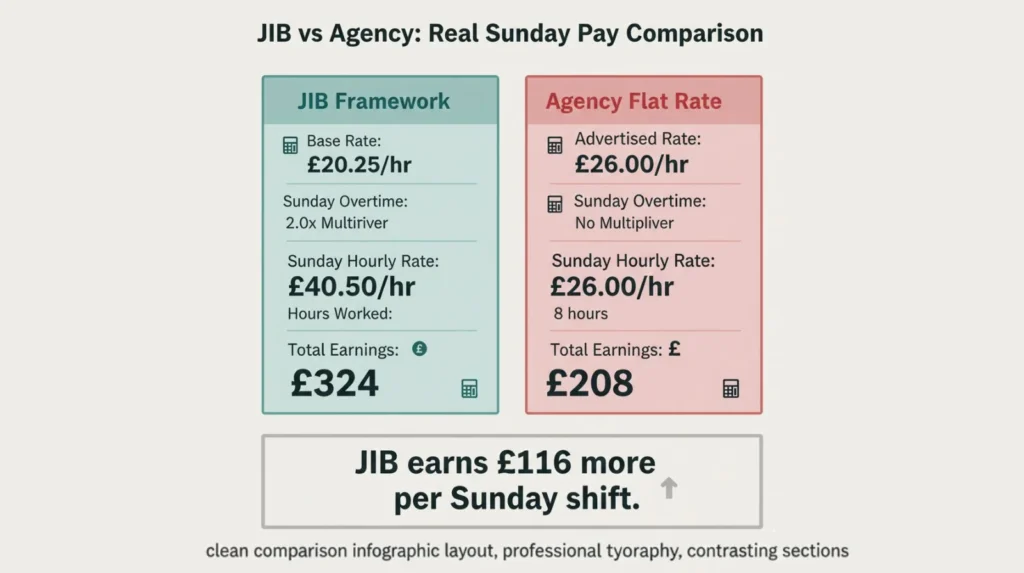
Agency and CIS roles frequently advertise £24 to £28 per hour, but here’s the catch: many of these are flat rates. An advert saying “£26/hr all hours” means you’re getting £26 whether it’s a Tuesday afternoon or a Sunday morning. Compare that to a JIB Approved Electrician on £20.25 per hour whose Sunday rate jumps to £40.50 (double time), and you can see the agency “premium” isn’t actually a premium at all for weekend work.
London and the South East add 15-20% to these figures through regional weighting or consolidated higher base rates. A £50,000 commercial role in Birmingham might be £58,000 in London doing identical work, and weekend premiums stack on top of that.
Weekend premiums in job adverts vary wildly. JIB-compliant roles advertise strict 1.5x and 2.0x multipliers. Agency roles might show 1.3x or 1.7x for Sundays, which sounds reasonable until you realise it’s still lower than the 2.0x a framework contract guarantees. Some data centre and industrial maintenance roles in the M4 corridor are currently advertising £300+ per day flat rates (around £32-£35/hr), but this is for 10-12 hour shifts where overtime multipliers aren’t applied.
The lesson here is to read beyond the headline hourly rate. A £24/hr agency role with no overtime multipliers can leave you worse off than a £20.25/hr JIB role once you factor in weekend and evening work.
Self-Employed and Call-Out Work: The Highest Hourly Rates
If you want to see the highest single-hour earnings in the electrical trade, look at self-employed emergency call-outs on weekends and bank holidays. The rates are eye-watering compared to PAYE work, but they come with significant caveats.
Typical day rates for self-employed domestic electricians range from £250 to £350 for standard 8am-4pm work, roughly £30-£45 per hour depending on the job and region. Emergency call-outs during normal working hours (weekdays 8am-5pm) start at £80 to £120 for the first hour including attendance. Out-of-hours and weekend emergency work jumps to £120-£180 for the first hour, then £80-£100 per hour after that. Bank holidays can command £250+ just for attending, before you’ve even started the work.
A self-employed spark dealing with a Sunday night emergency (let’s say a consumer unit fault affecting power to the property) could realistically charge £150 attendance, two hours work at £90/hour, plus parts. That’s £330 for two hours, equivalent to £165/hour. For comparison, a JIB electrician at £20.25/hour base would need to work over 16 hours to gross the same amount.
But here’s the reality nobody mentions in those “go self-employed and double your income” discussions: unpaid time. That Sunday call-out required you to answer the phone, drive to the property (unpaid travel), assess the fault, potentially source parts from an emergency supplier, complete the work, test and certify it, then handle invoicing and payment follow-up. The job might have taken two hours on-site, but you’ve actually committed four hours total. Your effective rate just dropped to £82.50/hour. Still good, but not £165/hour.
Self-employed electricians doing 24/7 emergency cover charge higher baseline rates precisely because of this unpredictability. You’re not just selling your time, you’re selling your availability. That £150 call-out fee partially compensates for the evenings you stayed in waiting for the phone to ring.
Platform data from Checkatrade and MyBuilder shows emergency call-out rates at the top end: £80-£125/hour weekdays, £120-£180 first hour weekends. But the volume is unpredictable. One week you might get three Sunday call-outs. The next week, none. That volatility is the trade-off for the premium rates.
Thomas Jevons, Head of Training with 20+ years on the tools, puts it clearly:
"Working overtime doesn't mean cutting corners. BS 7671 compliance applies whether you're installing at 3pm on a Tuesday or 9pm on a Saturday. If you're rushing to hit overtime hours and skipping proper testing, you're creating liability, not income."
Thomas Jevons, Head of Training
What Electricians Actually Report (Lived Experience)
Trade forums and direct conversations with working electricians paint a more nuanced picture than job adverts and framework documents. Earnings are real, but so are the trade-offs.
Industrial maintenance electricians frequently report annual earnings between £36,000 and £57,000 depending on overtime and shift patterns. Day shifts might bring in £30,000-£40,000, while rotating shift patterns (continentals, four-on-four-off) push that to £40,000-£50,000, and continental shifts with regular weekend and night work can reach £45,000-£55,000. The money is there, but it’s in the inconvenience.
Self-employed electricians report wide variation. At the lower end, particularly in the first few years of trading, £20/hour for 40-50 hours per week yielding around £3,000/month take-home (after tax and expenses) is common. At the higher end, experienced self-employed sparks with established client bases and consistent emergency call-out work report £60,000-£80,000 profit before burnout becomes a concern. One forum user noted they hit £80,000 but couldn’t sustain it :
"I was working 60-hour weeks and missing the kids growing up."
Travel time is a consistent complaint. JIB frameworks pay for travel beyond 15 miles, but many domestic and smaller commercial firms don’t. The result is you’re working 8 hours on-site but spending 10-11 hours out of the house when commuting is factored in. That reduces your effective hourly rate significantly. A £200 day rate for a 10-hour day (including unpaid travel) is actually £20/hour, not the £25/hour it looks like on paper.
Unpaid admin time affects self-employed electricians particularly hard. Quoting, invoicing, chasing payments, ordering materials, managing tax returns. These can easily add 10 hours per week to your workload with zero income attached. Some electricians report this reduces their effective hourly rate by 20-30%.
The consistent theme is this: overtime and weekend premiums create genuine earning potential, but they come with clear costs. Time away from family, physical fatigue from long shifts, unpredictability in self-employed emergency work, and the reality that the highest hourly rates often require the most unsociable hours.
Worked Examples: What Overtime Actually Adds
Let’s translate frameworks and forum anecdotes into concrete numbers. These scenarios use real 2025/2026 rates and typical working patterns.
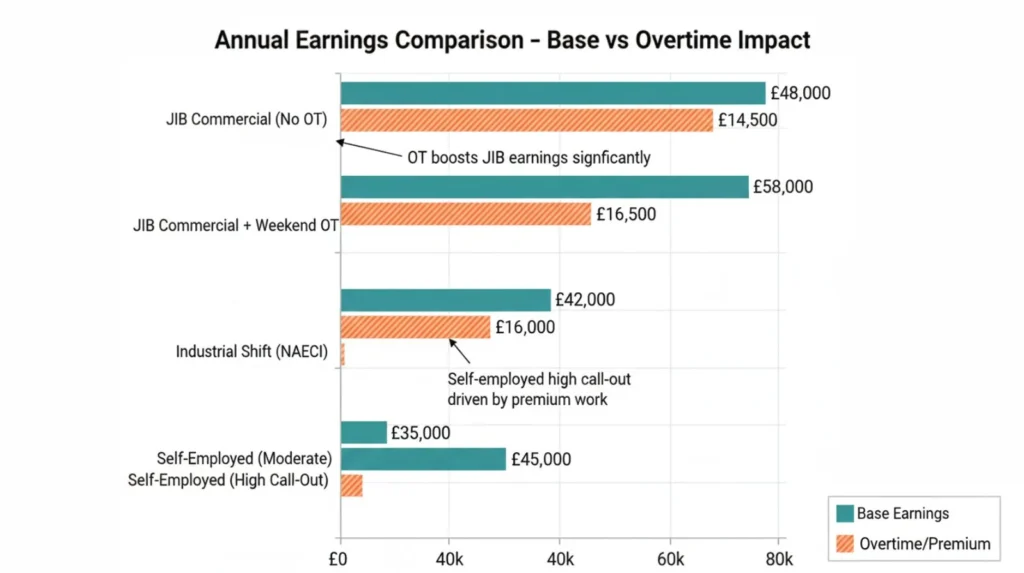
JIB Commercial Electrician (PAYE). Approved Electrician on JIB National Rate: £20.25 per hour. Standard 37.5-hour week with no overtime earns £759 per week or roughly £39,500 annually across 48 working weeks. Add midweek overtime (5 hours at 1.5x) and you’re at £911 per week. Include one Saturday per month (6 hours at 1.5x) averaged across all weeks, and you’re at £957 per week or £49,800 annually. Work two Sundays per month at double time and annual gross jumps to £56,800. The difference between “basic hours only” and “regular weekend work” is over £17,000 per year.
Industrial Maintenance Electrician (NAECI framework). Base rate £22 per hour on a four-on-four-off shift pattern with 25% shift premium, making your effective rate £27.50. Standard 38-hour week without additional overtime earns £1,045 per week or £54,300 annually. With structured weekend and night shifts attracting Rate A and Rate B uplifts built into the rota, annual gross reaches £62,000-£70,000. If you’re working on a major project with lodging allowance (£51.29/night tax-free, five nights per week), add another £13,400 annually. Total package: £75,000-£83,000. The overtime and allowances more than double the base hourly rate’s annual value.
Self-Employed Domestic Electrician. Billing £300 per day for standard weekday work, five days per week, gives you £1,500 weekly revenue or £72,000 annual gross across 48 weeks. Add one Saturday per month at the same rate (£75/week averaged) and you’re at £75,600. Add one emergency call-out per week averaging £150, and you’re at £83,100 gross annual revenue. Now deduct van costs, insurance, tools, public liability, unpaid admin time (10 hours/week), and your net taxable profit is closer to £50,000-£55,000. The gross looks impressive. The net is solid but not extraordinary, and it requires consistent work sourcing and client management.
Agency CIS Electrician on Large Site. Flat rate £26/hour for 50 hours per week. Weekly gross: £1,300. Annual gross: £62,400 across 48 weeks. That looks competitive with the NAECI example above, but remember: no holiday pay, no sick pay, no pension contributions, no structured career progression. Take four weeks off (unpaid) and you’ve earned £57,200. The flat rate simplicity hides the lack of employment protections and benefits.
These examples show that overtime is the difference maker. A base salary might be £40,000. Structured weekend work pushes it to £55,000. Industrial shifts with premiums can reach £70,000+. Self-employment offers the highest gross but also the most variability and hidden costs.
Thomas Jevons adds:
"The electricians earning £60k+ with overtime aren't doing it on Level 2 theory alone. They've completed their NVQ Level 3, passed AM2, and have the competence to work independently on sites that demand weekend and shift work. The qualifications unlock the opportunities."
Thomas Jevons, Head of Training
Sector Differences: Who Earns the Most with Overtime?
Not all sectors offer the same overtime opportunities or patterns. Understanding where the money is helps you make better training and career decisions.
Domestic work is mostly self-employed, meaning overtime is optional and self-driven. You decide whether to take on weekend work or emergency call-outs. Weekend rates are premium (clients expect to pay more for Saturday or Sunday attendance), and emergency call-outs offer the highest single-hour earnings in the entire trade. The trade-off is unpredictability. One month you might have six weekend jobs. The next month, two. Income is volatile, and burnout risk comes from the constant availability expectation and driving between jobs.
Commercial work (office fit-outs, retail, schools, hospitals) sees overtime during project-intensive periods. If a shopping centre refurbishment is running behind schedule, weekend work becomes available and is typically paid at JIB rates (1.5x Saturday, 2.0x Sunday). Overtime is predictable within projects but not year-round. Earnings ceiling is around £50,000-£55,000 with regular but not excessive overtime. Work-life balance is generally better than industrial, but peak project periods can mean sustained long hours.
Industrial and data centre work offers structured and expected overtime. Shift patterns often include regular weekends and nights built into the rota, meaning premium rates are a guaranteed part of your income rather than an optional extra. Shutdowns, maintenance windows, and 24/7 operations create consistent demand for out-of-hours work. This is where the highest PAYE earnings come from (£60,000-£100,000+ for specialists and offshore roles), but burnout risk is also highest. Missing family weekends for years and working rotating night shifts takes a toll.
The sector you choose during training significantly affects your lifetime earnings potential through overtime access. If you’re optimising purely for income, industrial and commercial sectors with JIB or NAECI frameworks offer the most structured and lucrative overtime. If you value flexibility and are willing to accept income variability, self-employed domestic work offers the highest hourly rates but the least predictability.
Joshua Jarvis, Placement Manager at Elec Training, explains:
"Confidence and communication matter just as much as your 18th Edition cert when it comes to accessing overtime. Employers offering weekend and call-out work need electricians who can deal with clients independently, explain delays professionally, and work without constant oversight."
Joshua Jarvis, Placement Manager
Pitfalls and Hidden Problems
Overtime earnings look attractive on paper, but several common pitfalls reduce take-home pay or create unexpected problems.
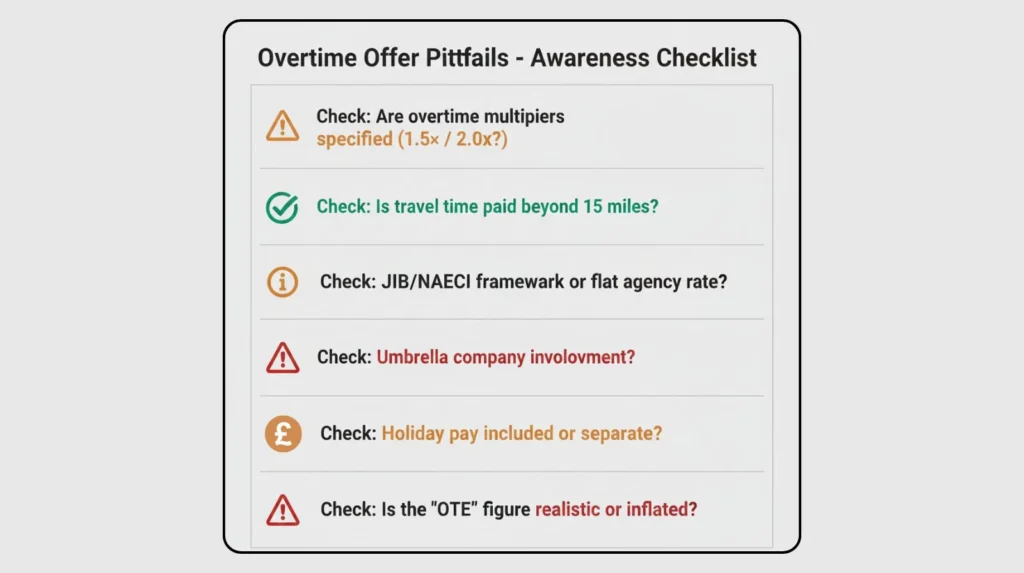
Unpaid travel time. JIB frameworks pay for travel beyond 15 miles, but many employers outside these frameworks don’t. If you’re commuting 90 minutes each way to a site, that’s three hours per day unpaid. A £200 day rate for 11 hours out of the house (8 hours work, 3 hours travel) is actually £18.18 per hour, not £25. The longer your commute, the more your effective hourly rate drops.
Umbrella company deductions. Many agency roles require you to be paid through an umbrella company, which takes a weekly margin (typically £20-£30) and deducts Employer’s National Insurance before paying you. A headline rate of “£28/hour” can result in take-home closer to £21-£23/hour after umbrella deductions, Employer’s NI, and income tax. Some umbrella companies have been involved in tax avoidance schemes that collapse, leaving workers with unexpected tax bills years later.
Banked hours instead of paid overtime. Some non-JIB employers ask you to “bank” overtime at your normal rate to use as holiday later, denying you the 1.5x or 2.0x premium you should be receiving. This effectively steals money from you by converting premium-rate work into standard-rate time off.
Domestic emergency unpredictability. While emergency call-out rates are high, the work is unpredictable. You might need to stay available on Friday and Saturday evenings for three weeks without a single call, then get two calls in one night. The standby time is unpaid, but it restricts your life. Small emergency jobs also often don’t cover your overheads once you factor in travel time and admin.
Agency flat rates masking poor weekend pay. An agency advertising “£26/hr all hours” sounds premium until you realise it’s the same rate on Sunday as Tuesday. JIB double-time Sunday rate for an Approved Electrician (£40.50/hr) is significantly better, but the lower base rate (£20.25) makes the agency role look attractive at first glance.
What You Should Actually Do
Overtime and weekend work can genuinely add £15,000 to £25,000 to your annual earnings, but only if you understand the frameworks, avoid the pitfalls, and choose the right sector for your priorities.
If you’re training to become an electrician or considering a career change, the route you choose affects your overtime earning potential significantly. Completing your NVQ Level 3 and AM2 assessment gives you access to JIB-aligned commercial and industrial roles where structured overtime is both common and well-paid. Staying at Level 2 or skipping the NVQ portfolio limits you to domestic work or lower-paid roles where overtime premiums aren’t guaranteed.
Our complete UK electrician earnings breakdown covers base salaries, regional variations, and career progression in detail. If you want to access the roles offering structured overtime at JIB or NAECI rates, you need the proper qualifications. A five-week theory course won’t get you there. The full pathway (Level 2, Level 3, 18th Edition, NVQ, AM2) takes 18 months to 3 years depending on your route, but it’s what unlocks access to the better-paid opportunities.
Call us on 0330 822 5337 to discuss electrician training routes that lead to roles with structured overtime potential. We’ll explain exactly what qualifications you need, how long each takes, and what our in-house recruitment team can do to secure placements with contractors offering JIB frameworks and genuine career progression. No hype about “instant qualifications.” Just honest guidance about the routes that lead to the £50,000+ earnings overtime makes possible.
References
- JIB National Working Rules 2025 – https://www.jib.org.uk/
- SJIB Handbook 2025 – https://www.sjib.org.uk/
- NAECI Blue Book (Engineering Construction Industry Agreement) – https://www.ecia.co.uk/
- Office for National Statistics (ONS) – Annual Survey of Hours and Earnings (ASHE) 2024 – https://www.ons.gov.uk/employmentandlabourmarket/peopleinwork/earningsandworkinghours
- Checkatrade – Electrician Rates and Pricing Data – https://www.checkatrade.com/
- MyBuilder – Electrician Day Rates – https://www.mybuilder.com/
- Indeed UK – Job Market Data (Electrician Roles Q4 2024 – Q1 2025) – https://uk.indeed.com/
- IET Wiring Regulations BS 7671:2018+A2:2022 – https://www.theiet.org/
- City & Guilds 2357 NVQ Level 3 Electrical Installation – https://www.cityandguilds.com/
- ECS/JIB Gold Card Requirements – https://www.jib.org.uk/
Note on Accuracy and Updates
Last reviewed: 13 December 2025. This page is maintained; we correct errors and refresh sources as JIB, SJIB, and NAECI frameworks update rates and conditions. Overtime multipliers and base rates cited reflect 2025/2026 frameworks. Next review scheduled following JIB 2026/2027 wage determination (expected January 2026).
