
Electrician Training in Birmingham for Adults and Career Changers

- Technical review: Thomas Jevons (Head of Training, 20+ years)
- Employability review: Joshua Jarvis (Placement Manager)
- Editorial review: Jessica Gilbert (Marketing Editorial Team)
- Last reviewed:
- Changes: Initial publication covering Birmingham adult learner routes, evening options, and career change realities
At 35, you’ve spent twelve years in retail management. The pay’s been decent, but the sector’s contracting, and you’ve watched three colleagues take redundancy in eighteen months. You Google electrician course Birmingham at 11pm on a Tuesday, scrolling through college websites, Facebook ads promising “qualified in 6 weeks,” and forums full of people asking if they’re too old to retrain.
Here’s what nobody tells you upfront: Birmingham has genuine training options for adults. Evening courses at South & City College. Part-time Level 2 diplomas that don’t require quitting your job. Experienced Worker Assessment routes if you’ve got maintenance background. But the pathway isn’t quick, it’s rarely fully funded once you’re over 24, and the biggest challenge isn’t learning electrical theory but securing the site placements needed to complete your NVQ.
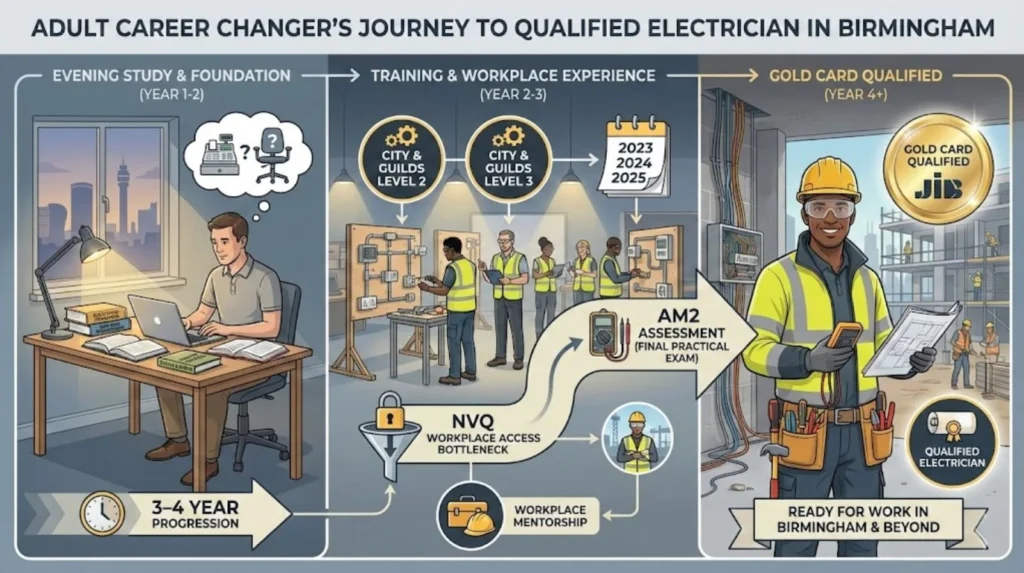
Adult learners in Birmingham typically spend 3 to 4 years going from zero experience to JIB Gold Card qualified electrician. That’s not marketing pessimism, that’s the reality of balancing evening study, finding mate work, logging portfolio evidence, and passing AM2 assessment. Shorter timelines exist if you can study full-time and secure placements quickly, but for career changers keeping current jobs while retraining, expect the longer route.
If you’re considering electrical work as a second career in Birmingham, here’s what’s actually available for adults, what the funding landscape looks like, and why most career changers get stuck at the transition from college diplomas to workplace NVQ.
The Adult Learner Reality in Birmingham's Electrical Training Market
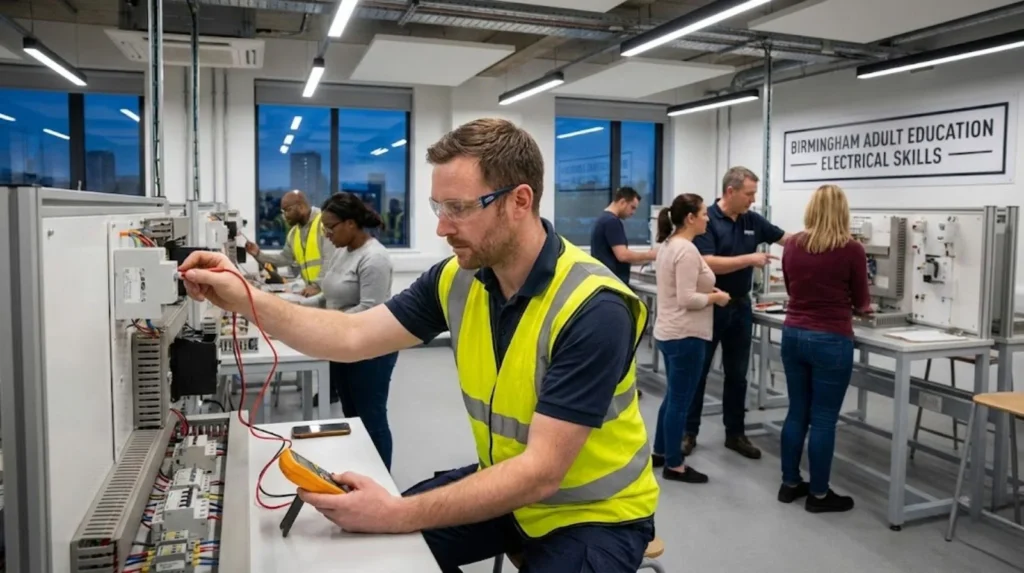
When Birmingham colleges market electrical courses, their promotional materials show 17-year-olds in hi-vis. The reality in evening classes at South & City College or Walsall College looks different: 32-year-old warehouse supervisors, 41-year-old retail managers, 28-year-old admin workers who’ve watched their roles get automated, and 48-year-old construction labourers wanting to upskill into skilled trades.
Adult learners bring different strengths and different challenges. You’ve got life experience, workplace discipline, and motivation that 16-year-olds often lack. You understand project management from your previous career, customer service skills transfer surprisingly well to explaining electrical work to homeowners, and you’re less likely to drop out because you’ve made a conscious decision to retrain rather than drifting into it.
The challenges are practical, not intellectual. You’re studying two evenings per week after working 9 to 5. You’ve got mortgage payments, childcare responsibilities, and limited flexibility to take unpaid time off for site placements. Birmingham’s FE colleges understand this and structure adult provision accordingly, but they can’t solve the fundamental bottleneck: NVQ Level 3 requires workplace evidence that evening study alone can’t provide.
BMet’s James Watt campus in Great Barr runs adult Level 2 diplomas on Tuesday and Thursday evenings, 6pm to 9pm, over 40 weeks. You’ll cover the same City & Guilds 2365-02 content as full-time learners but at a pace that accommodates working adults. The challenge isn’t the academic content (most adults grasp electrical theory faster than teenagers), it’s finding the energy to practice cable terminations after an eight-hour shift and commute.
Evening and Part-Time Options Actually Available in Birmingham
Walsall College delivers Level 2 electrical installation on Monday and Wednesday evenings, 6pm to 9:30pm. South & City College Birmingham at Bordesley Green offers similar Tuesday/Thursday evening provision. University College Birmingham runs part-time day release (Fridays) for those with flexible working arrangements. All three are Ofqual-regulated City & Guilds qualifications, all three cost roughly £1,500 to £2,000 for adults self-funding.
Evening courses work for knowledge-based qualifications: Level 2 diplomas, Level 3 diplomas, and 18th Edition Wiring Regulations. They provide the classroom theory, workshop practice on training rigs, and assessment evidence required for these certificates. What they can’t provide is the 12 to 24 months of real site experience needed for NVQ Level 3 portfolio completion.
Private centres like Trade Skills 4U (near Coventry, serving Birmingham learners) and Birmingham Electrical Training offer weekend intensive blocks. You’ll attend Saturday and Sunday for 10 to 15 consecutive weekends, covering the same curriculum as evening courses but in compressed timeframes. Faster completion, higher intensity, less time to digest complex electrical science between sessions.
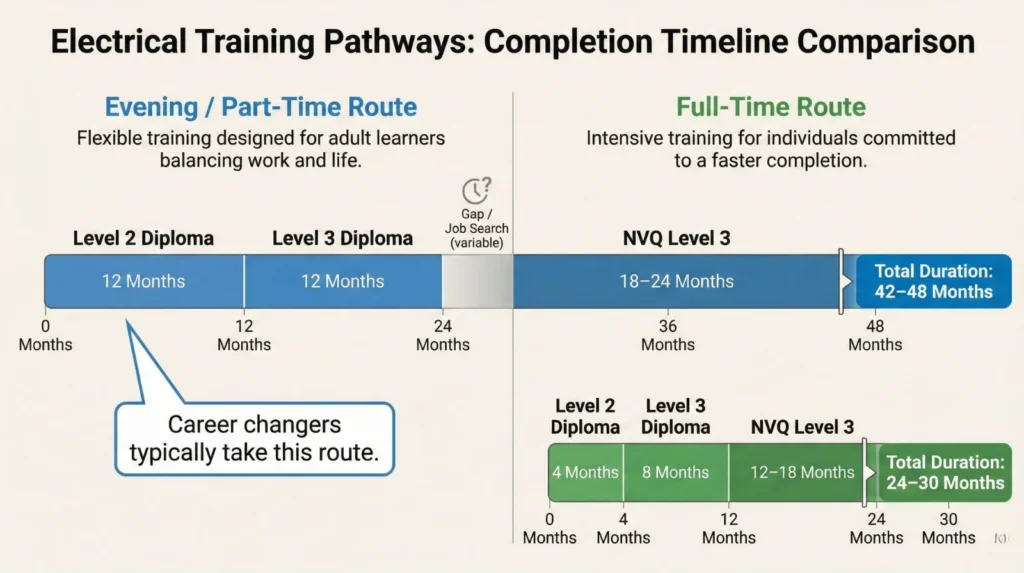
Cost comparison matters for adults self-funding: FE colleges charge £1,500 to £2,000 for Level 2 evening courses, private centres charge £2,500 to £3,500 for weekend intensives. Both deliver the same regulated qualification. The difference is timing (12 months evenings vs 4 months weekends) and teaching style (colleges emphasize depth, private centres emphasize pace).
For a Birmingham electrical training overview, evening routes provide access to the first 50% of the qualification pathway (Level 2 and Level 3 diplomas) while maintaining current employment, but they don’t solve the workplace access challenge required for the second 50% (NVQ and AM2).
The Funding Gap: What's Available for Adults in Birmingham
If you’re under 19, electrical training in Birmingham is fully funded through college provision or apprenticeships. Once you turn 19, funding becomes complicated, conditional, and often insufficient to cover the full qualification pathway.
West Midlands Combined Authority (WMCA) “Free Courses for Jobs” funding covers some Level 3 qualifications for adults earning under £25,000 annually or without prior Level 3 qualifications. This can make Level 3 diplomas free at FE colleges if you meet eligibility criteria, but it doesn’t extend to Level 2, 18th Edition, NVQ portfolio support, or AM2 assessment costs.
Advanced Learner Loans exist for Level 3 and above, allowing adults to defer payment until earning over £27,295 annually. Birmingham colleges advertise these for Level 3 electrical diplomas, but the loan covers tuition only. You’re still self-funding Level 2 (£1,500 to £2,000), 18th Edition (£300 to £500), NVQ portfolio support and assessor visits (£3,000 to £5,000), AM2 assessment (£800 to £1,200), and all PPE and tools (£400 to £800).
Total realistic cost for Birmingham adults self-funding the complete pathway through local colleges and private NVQ providers: £6,000 to £10,000 depending on whether you access any free provision. Compare this to Elec Training’s structured NVQ package at £10,000 to £12,000, which includes integrated support from diplomas through to guaranteed placements, and the cost difference becomes less significant when you factor in the time saved searching for NVQ opportunities independently.
Most Birmingham career changers underestimate total costs because they focus on advertised course fees (Level 2: £1,800) without accounting for the cascade of additional qualifications, assessments, and workplace support needed to reach qualified status.
Career Changers Who Already Have Relevant Experience
If you’ve worked in building maintenance, facilities management, or construction for 3 to 5 years, you might qualify for Experienced Worker Assessment routes that bypass traditional beginner diplomas. This isn’t widely advertised by Birmingham colleges because it requires specialized NVQ assessment and AM2E (Experienced Worker version) rather than standard teaching provision.
The Experienced Worker route assesses existing competence through portfolio evidence of work you’ve already completed. You’ll need employer references, proof of installation and testing work, photographic evidence of projects, and demonstration that you’ve been operating at Level 3 competence without formal qualifications. If verified, you can proceed directly to AM2E assessment and 18th Edition, then apply for JIB Gold Card.
Birmingham providers delivering Experienced Worker Assessment include private centres like Optima Electrical Training and WMD Electrical Training, both offering portfolio development support and AM2E preparation. Cost ranges from £2,500 to £4,000 depending on how much portfolio work requires development versus simple verification.
The reality check: you need genuinely substantial electrical experience to qualify. “I’ve changed light fittings in my house” doesn’t count. “I’ve worked as a building services technician for four years replacing ballasts, fault-finding on emergency lighting systems, and carrying out minor repairs under supervision” potentially does count, provided you can evidence it properly.
Thomas Jevons, Head of Training with 20 years on the tools, notes:
"Experienced Worker routes work brilliantly for maintenance electricians who've been doing the job without formal quals, but they're completely unsuitable for career changers from unrelated sectors. If your experience is retail, office work, or logistics, you need the full beginner pathway starting at Level 2."
Thomas Jevons, Head of Training
The Diploma-to-NVQ Transition Where Most Adults Get Stuck
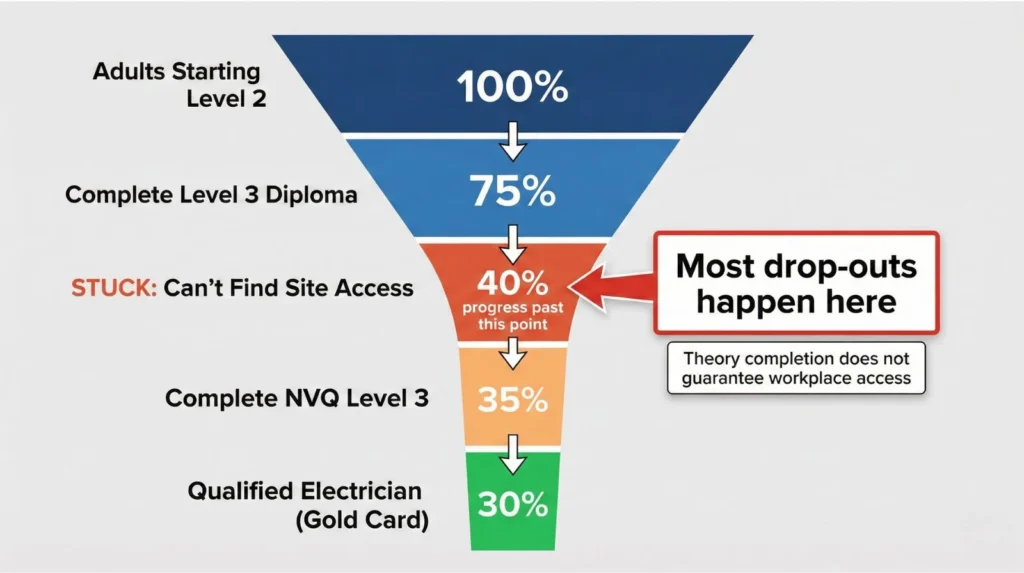
Birmingham colleges excel at delivering Level 2 and Level 3 diplomas. Evening courses run consistently, workshops are well-equipped, tutors are experienced, and pass rates are respectable. What colleges can’t provide is the transition support adults need to move from diploma completion to workplace NVQ evidence gathering.
You finish your Level 3 diploma in July 2026. You’ve got certificates proving knowledge of three-phase systems, inspection and testing theory, commercial installation practices, and BS 7671 compliance. Now what? You need to find an employer willing to take on an unproven trainee with no site experience, supervise your work, allow assessor visits, and commit to supporting your NVQ portfolio development over 12 to 24 months.
Birmingham’s electrical labour market has mate and improver positions, but competition is fierce. Contractors advertising on Reed and Indeed receive 30 to 50 applications per role. They’re prioritizing candidates with Level 2 and some hands-on experience, driving licenses for multi-site work, and willingness to start on £16 to £18 per hour. Your evening diploma makes you eligible, but it doesn’t make you the obvious choice over someone who’s been helping their uncle on domestic jobs for six months.
The gap period between diploma completion and securing mate work averages 4 to 7 months for Birmingham adults based on forum discussions and job board patterns. During this period, you’re not progressing toward qualification, you’re in limbo waiting for opportunity. Some adults give up. Some accept labouring roles hoping to transition internally. Some piece together sporadic work that doesn’t provide the consistent employer relationship needed for proper NVQ assessment.
This is where Elec Training’s in-house recruitment team creates genuine advantage. Rather than pointing you at job boards after Level 3 completion, the recruitment team is actively calling 120+ contractors daily to secure placements. Birmingham adults benefit from West Midlands contractor partnerships (Wolverhampton, Dudley, Walsall, Sandwell) that extend placement opportunities beyond Birmingham city limits.
What Birmingham Employers Actually Want From Career Changers
Job ads for Electrical Mate or Improver positions in Birmingham tell you what contractors actually prioritize. Level 2 diploma appears in “essential” or “desirable” criteria, but it’s rarely the deciding factor. Here’s what matters more:
Driving license and own transport. Birmingham’s electrical work isn’t centralized. You might start Monday in Erdington, Tuesday in Bournville, Wednesday at a Solihull industrial estate, Thursday in Digbeth, Friday in Tyburn. Public transport doesn’t reliably serve 7am starts at construction sites. No car equals no job for most Birmingham contractors.
Work attitude and reliability. Employers have been burned by people who complete diplomas, last three weeks on site, then disappear because the work was harder or less glamorous than expected. Career changers in their 30s and 40s often have better track records for showing up consistently, but you’ll need references from previous employment proving reliability.
Physical capability and safety awareness. Electrical work involves crawling in lofts, working at height, lifting cable drums, spending hours on your knees. If you’re coming from desk-based work, contractors want assurance you understand the physical demands and won’t last two days before claiming you didn’t realize it would be this hard.
Basic tool knowledge and willingness to invest. Employers expect improvers to arrive with basic PPE (safety boots, hi-vis, hard hat) and hand tools (side cutters, screwdrivers, voltage tester, knife). Total initial investment: £300 to £500. This tests commitment. Someone who’s serious about electrical work invests in proper tools before they start.
Joshua Jarvis, Placement Manager, explains:
"Birmingham employers tell us they'd rather take someone who's 38 with decent work history and clear motivation than a 19-year-old who might disappear after the first month. Age isn't the barrier adults think it is. Lack of site experience and unrealistic salary expectations are the real barriers."
Joshua Jarvis, Placement Manager
Realistic Timeline Expectations for Birmingham Adults
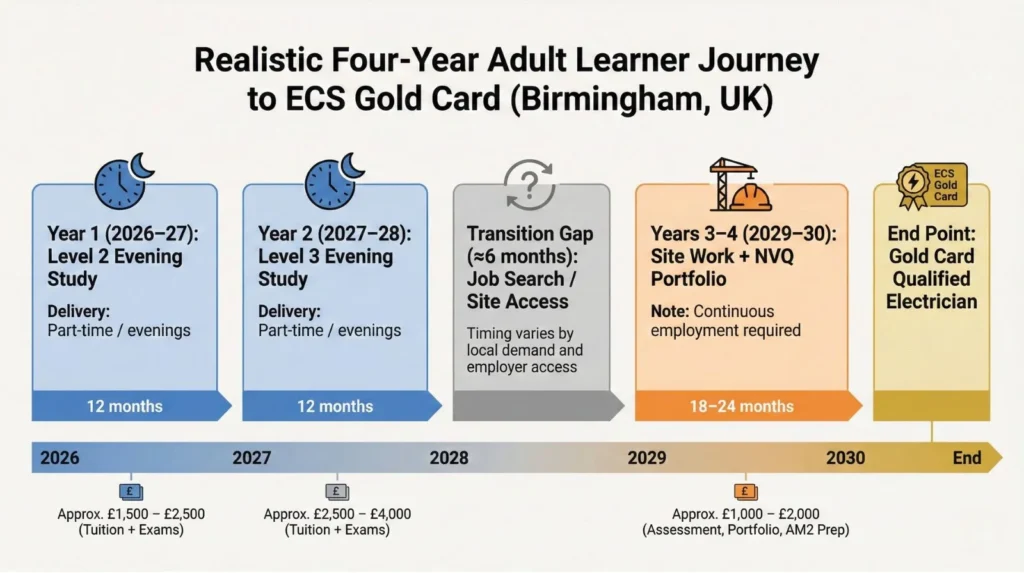
If you start Level 2 evenings in September 2026 while keeping your current job, here’s what the timeline looks like:
September 2026 to June 2027: Level 2 diploma, two evenings per week, 40 weeks. Cost: £1,500 to £2,000. You’re still earning full salary from current employment.
September 2027 to June 2028: Level 3 diploma, two evenings per week, 40 weeks. Cost: £1,800 to £2,200 (potentially free if you qualify for WMCA funding). Still in current employment.
July to December 2028: Job search period. Applying for mate/improver roles, attending interviews, possibly taking CSCS/ECS health and safety tests (£100 to £150). Zero progression toward qualification during this period, just searching.
January 2029 onwards: Secure mate position at £16 to £18 per hour. Begin NVQ Level 3 portfolio building. Assessor visits every 6 to 8 weeks. This stage takes 12 to 24 months depending on how quickly you log required units and how supportive your employer is with allowing varied work for portfolio evidence.
Mid-2030 to Late 2030: Complete NVQ portfolio, book and pass AM2 assessment, complete 18th Edition if not already done, apply for JIB Gold Card.
Total timeline: 4 years from September 2026 start to qualified status in 2030. That’s maintaining evening study while employed for first two years, transitioning to site work for final two years. Faster if you can study full-time or secure placements immediately after Level 3. Slower if the job search extends or NVQ progress stalls.
How Elec Training Supports Birmingham Career Changers
Elec Training’s approach differs from Birmingham colleges and private centres in one critical aspect: integrated placement support through the complete qualification pathway rather than just delivering diplomas then wishing you luck.
The structured route includes Level 2 (2365-02) delivered over 4 weeks intensive, Level 3 (2365-03) over 8 weeks intensive, 18th Edition over 5 days, then direct progression into NVQ Level 3 (2357) with guaranteed placement support through the in-house recruitment team. For Birmingham adults, this eliminates the 4 to 7 month gap between diploma completion and site access.
Total package cost: £10,000 to £12,000 covering NVQ tutor support and portfolio guidance, assessor visits to workplace, placement support through in-house recruitment team working with 120+ contractor partnerships, and ongoing support until qualification completion. Not included: AM2 exam fee (approximately £1,000, paid separately when assessment-ready) and PPE or essential equipment (your responsibility, approximately £400 to £600).
Timeline: 18 months to 3 years depending on how quickly you progress through NVQ evidence gathering. Birmingham adults benefit from West Midlands contractor network including Wolverhampton, Dudley, Walsall, Sandwell, and Coventry opportunities, significantly expanding placement options beyond Birmingham city limits.
The recruitment team difference matters specifically for career changers because you’re competing against younger candidates with family connections in the trades. Having someone actively advocating for your placement, explaining your mature work ethic to contractors, and managing the employer relationship during your NVQ period removes the single biggest barrier most Birmingham adults face.
If you’re a Birmingham adult considering electrical training as a career change, start by being honest about your timeline flexibility, financial situation, and commitment level. Can you afford 3 to 4 years to reach qualified status? Can you manage evening study while working full-time? Are you physically capable of manual labour in all weather conditions?
What we’re not going to tell you: that age is a barrier (it isn’t, provided you’re physically capable), that evening courses make you qualified without site work, that Birmingham has abundant funding for adult learners, or that you’ll easily find mate work immediately after Level 3.
What we will tell you: career changers in their 30s and 40s often succeed better than teenagers because of work discipline and clear motivation, the full pathway takes 3 to 4 years for adults maintaining current employment through evening study, realistic total costs are £10,000 to £12,000 for structured support or £6,000 to £10,000 piecing together local provision independently, and the biggest challenge is securing workplace access for NVQ completion, not passing diploma exams.
Call us on 0330 822 5337 to discuss the comprehensive guide to becoming an electrician in Birmingham as an adult learner. We’ll explain exactly what’s involved, what the realistic timeline looks like, and how our in-house recruitment team helps Birmingham career changers secure the placements local colleges can’t guarantee. No hype about 6-week qualifications. No promises that age doesn’t matter in physical trades. Just practical guidance from people who’ve supported hundreds of adult learners through complete qualification pathways.
References
- City & Guilds 2365 Level 2 & 3 Electrical Installation Qualifications – https://www.cityandguilds.com/
- West Midlands Combined Authority Skills Funding – https://www.wmca.org.uk/
- Advanced Learner Loans Information – https://www.gov.uk/advanced-learner-loan
- National Careers Service: Electrician – https://nationalcareers.service.gov.uk/job-profiles/electrician
- JIB Grading and Gold Card Requirements – https://www.jib.org.uk/
- IET Wiring Regulations BS 7671:2018+A2:2022 – https://www.theiet.org/
- City & Guilds NVQ Level 3 Electrotechnical (2357) – https://www.cityandguilds.com/
- Experienced Worker Assessment Routes – https://www.netservices.org.uk/
Note on Accuracy and Updates
Last reviewed: 2 January 2026. This page is maintained; we correct errors and refresh sources as Birmingham adult education funding, provider offerings, and labour market conditions change. Funding eligibility criteria (WMCA, Advanced Learner Loans) are subject to annual review and may change. Learners should verify current course costs, funding availability, and start dates directly with providers before enrolling. Next review scheduled for June 2026.
