
Electrician Training in Wolverhampton for Adults and Career Changers

- Technical review: Thomas Jevons (Head of Training, 20+ years)
- Employability review: Joshua Jarvis (Placement Manager)
- Editorial review: Jessica Gilbert (Marketing Editorial Team)
- Last reviewed:
- Changes: Initial publication addressing adult learner and career changer pathways in Wolverhampton
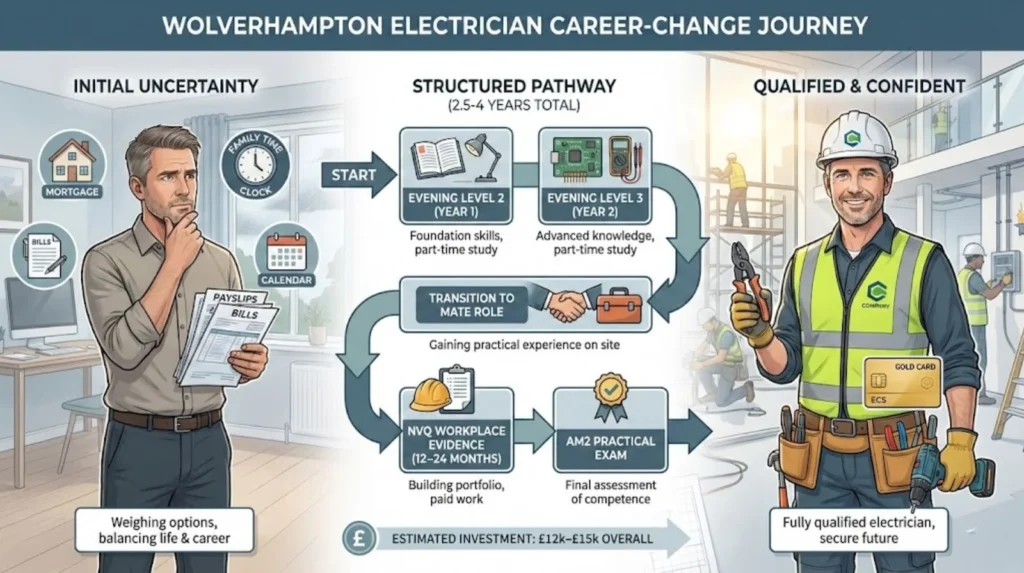
If you’re 28, 35, 42, or older and you’re looking at retraining as an electrician in Wolverhampton, you’re probably asking yourself whether it’s realistic. You’ve got a mortgage, maybe kids, definitely bills. You can’t just quit your job and hope for the best. You need a pathway that actually works for adults with responsibilities.
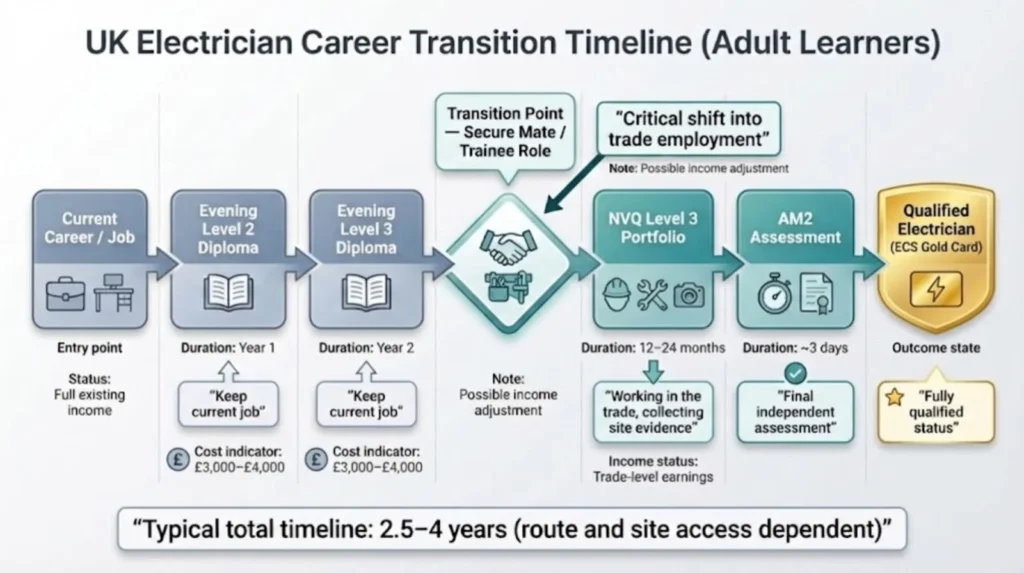
Here’s what matters: Wolverhampton has legitimate routes for career changers, but the journey from zero electrical experience to qualified electrician isn’t a single course you can knock out over a few weekends. It’s a structured sequence involving part-time classroom learning, workplace competence building, and national assessment. The electrician courses Wolverhampton offers for adults include evening options at City of Wolverhampton College and intensive blocks at private centres like Elec Training, but understanding which route fits your situation makes the difference between wasted money and genuine career transition.
This guide breaks down the realistic pathways for adults and career changers in Wolverhampton, what you can do while keeping your current job, and where the transition points happen that require commitment.
Why Adults Choose Electrical Training (The Reality Check)
The reasons career changers look at electrical work aren’t complicated. The trade can’t be automated. It can’t be outsourced. Demand is consistent regardless of economic cycles. Office sectors are seeing layoffs and AI displacement, but qualified electricians in the West Midlands face near-zero unemployment.
We’ve seen a 34% increase in enquiries from career changers at our Wolverhampton centre over the past year. These aren’t people chasing a fantasy. They’re 32-year-old former warehouse supervisors who’ve watched logistics jobs disappear. They’re 38-year-old retail managers whose stores are closing. They’re 45-year-old office workers who’ve been made redundant twice in five years.
What they have in common is they’ve researched properly. They understand electrical training isn’t quick. They know it requires genuine commitment. They’re not looking for shortcuts. They’re looking for a legitimate pathway that doesn’t require them to quit their current job immediately and hope they land a trainee role before their savings run out.
That’s where Wolverhampton’s part-time evening routes become critical. You can start the knowledge stage (Level 2 and Level 3 diplomas) while working full-time. The transition point comes later, when you need workplace access for your NVQ portfolio.
The Part-Time Evening Route (What It Actually Involves)
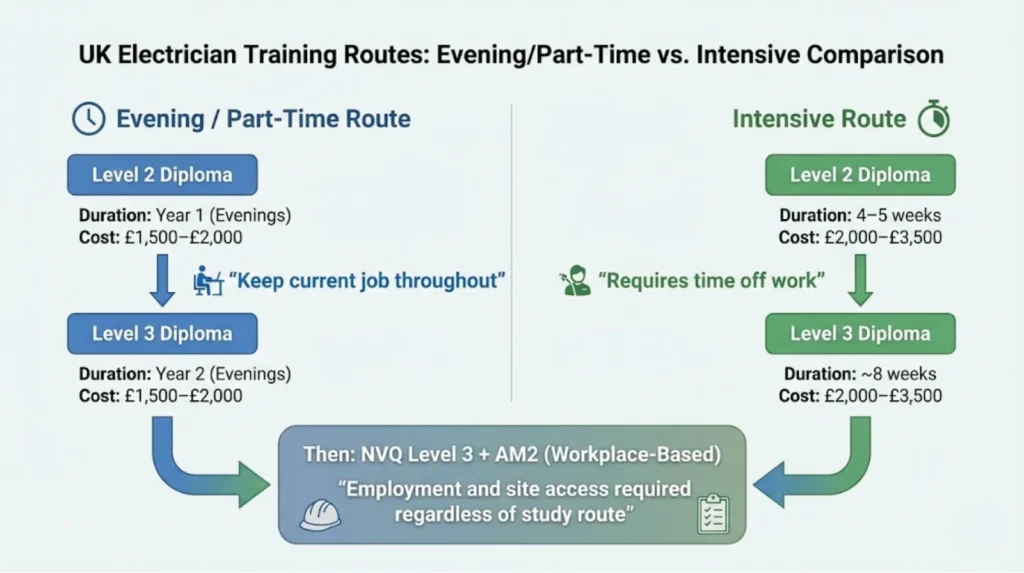
City of Wolverhampton College runs Level 2 and Level 3 electrical installation courses on weekday evenings, typically 6pm-9pm, one or two nights per week. These are regulated City & Guilds qualifications (8202 Technical Certificate series), identical to what school leavers study full-time during the day.
The Level 2 course runs across an academic year (September to June). You’ll cover electrical science, health and safety, basic installation theory, and workshop practice. The pace is slower than intensive courses, but that’s often beneficial for adults who haven’t studied formal science or maths since school. You get time to absorb complex topics like Ohm’s Law, parallel circuits, and earth fault protection without feeling overwhelmed.
The Level 3 course follows the same pattern, running evenings across a second academic year. This builds on Level 2 with advanced topics: inspection and testing procedures, electrical design calculations, fault diagnosis, and protective device selection. It’s still knowledge-based. You’re proving you understand the theory behind what qualified electricians do, not that you can physically do it unsupervised.
The advantage of this route is financial and practical. You keep your current income. You test whether you actually like electrical work before committing fully. You spread the cost over two years rather than finding several thousand pounds upfront. The disadvantage is time. Two years of evenings gets you the knowledge certificates, but you still need workplace NVQ and AM2 after that.
The Intensive Private Route (When Speed Matters)
Private Wolverhampton providers like Elec Training offer compressed versions of the same qualifications. Level 2 runs as a 4-5 week intensive block. Level 3 runs as an 8-week block. Both use the same City & Guilds 2365 Diploma structure, same RQF levels, same regulatory standards.
This route suits career changers who’ve saved enough to take unpaid leave or who’ve been made redundant with a severance package. You can complete the knowledge stage in 12-14 weeks rather than two years. The teaching is faster-paced, the workshop hours are concentrated, and you’re immersed in electrical theory daily rather than trying to remember what you learned last Tuesday night.
The cost is higher upfront. Where college evening courses might run £1,500-£2,000 per level (depending on funding eligibility), intensive private courses typically cost £2,000-£3,500 per level. But you’re also compressing two years into three months, which has value if your current job situation is precarious or if you’ve got a clear plan to transition into electrical work immediately after qualifying.
Thomas Jevons, our Head of Training with over 20 years in the trade, sees both routes succeed:
"I've trained 42-year-old former retail managers who outperformed 19-year-olds in workshop assessments. Age isn't the barrier. The barrier is whether you're willing to commit to the full pathway: classroom knowledge, workplace NVQ, and AM2 assessment."
Thomas Jevons, Head of Training
What Level 2 and Level 3 Actually Get You (The Honest Version)
Let’s be clear about what completing Level 2 and Level 3 diplomas achieves. It proves you understand electrical theory. It qualifies you for trainee or mate roles. It allows you to apply for an ECS Trainee Card. It’s the prerequisite for NVQ Level 3 enrolment.
It does not make you a qualified electrician. It does not allow you to sign off electrical work. It does not get you a JIB Gold Card. It does not permit you to register with competent person schemes like NICEIC or NAPIT.
This is where career changers sometimes feel misled. They’ve spent two years doing evening courses or several thousand pounds on intensive training, and they discover they’re still not “qualified” in the industry sense. They can work, but only under supervision. They can learn, but they can’t certify. They’ve completed the knowledge stage, but the competence stage (NVQ and AM2) is still ahead.
The reason Wolverhampton providers don’t always make this crystal clear is marketing. “Complete your electrician training” sounds better than “complete the theoretical component of a multi-stage qualification pathway.” But understanding this upfront prevents frustration later.
The NVQ Reality for Career Changers
Here’s the part that stops many career changers: you cannot complete an NVQ Level 3 in Electrical Installation without being employed in the trade. It’s not a classroom qualification. It’s a workplace assessment portfolio where you collect evidence from real electrical jobs over 12-24 months.
This means at some point, you need to transition from your current career into electrical work. You need to secure a position as an electrician’s mate or trainee. You need an employer who will support your NVQ evidence gathering. You need access to varied electrical work (domestic installations, testing, fault-finding) to complete your portfolio units.
Joshua Jarvis, our Placement Manager, sees this challenge daily:
"We see adults successfully balance full-time work with evening Level 2 and Level 3 courses. The challenge comes at the NVQ stage. Technically you can do it part-time, but most employers prefer full-time commitment for workplace evidence gathering, which means transitioning into the trade."
Joshua Jarvis, Placement Manager
This is why Elec Training’s NVQ package (£10,000-£12,000) includes active placement support through our in-house recruitment team. We work with over 120 contractor partners across the West Midlands, actively matching learners to trainee roles where they can build their portfolios. Without that support, career changers often hit a dead end after Level 3, with certificates but no clear pathway to workplace competence.
What Wolverhampton Employers Want from Career Changers
We’ve analysed West Midlands job listings for electrician’s mate and trainee roles over the past six months. Here’s what Wolverhampton area employers consistently look for when hiring career changers:
Basic qualifications: Level 2 minimum, ideally Level 3 completed or in progress. Very few employers take on adults with zero electrical knowledge.
ECS Trainee Card: This requires registering as a learner, completing a basic health and safety test, and proving you’re enrolled in an electrical qualification pathway. It’s your site access pass.
Driving licence: Almost universal for Wolverhampton roles. Electrical work requires traveling between job sites (domestic installations in Tettenhall, commercial work in Willenhall, industrial sites in Bilston). Public transport doesn’t cut it.
Own hand tools: Basic kit (insulated screwdrivers, side cutters, pliers, wire strippers). Expect to spend £150-£300 on entry-level tools before you start.
The soft skills matter more than you might expect. Reliability, punctuality, communication with clients, ability to follow instructions, willingness to learn. Career changers often have these in abundance from previous roles. A 35-year-old who’s managed retail staff knows how to deal with customers. A 42-year-old who’s worked in logistics understands site safety protocols. These transferable skills genuinely help.
Starting wages for mates in the Wolverhampton area typically range £11-£14 per hour, rising to £16-£19 as you progress through your NVQ. It’s a pay cut for many career changers initially, but the trajectory is clear: qualified electricians in the West Midlands earn £22-£26 per hour employed, significantly more self-employed or specialising in inspection and testing.
Common Career Changer Mistakes in Wolverhampton
The first mistake is choosing a course based on marketing rather than substance. If someone promises you “qualified electrician in 12 weeks,” they’re selling you knowledge courses and hoping you won’t notice the competence gap. You’ll have Level 2 and Level 3 certificates. You won’t be qualified in any meaningful industry sense.
The second mistake is underestimating the workplace transition. Adults assume completing Level 2 and Level 3 means employers will be queuing up. The reality is more nuanced. You’re competing with younger apprentices who cost less and have more years ahead of them. You need to demonstrate maturity, reliability, and transferable skills to offset the age disadvantage.
The third mistake is not planning financially for the full pathway. Evening courses at college might cost £1,500-£2,000 per level if you’re not eligible for funding. Add 18th Edition (£300-£500), NVQ registration and assessor fees (included in our £10,000-£12,000 package), AM2 exam (£850-£950 paid directly to NET), PPE and tools (£300-£500), ECS card applications (£36-£180 depending on card type). The total from zero to Gold Card typically runs £12,000-£15,000 when you factor in everything, plus the income reduction when you transition to a mate role.
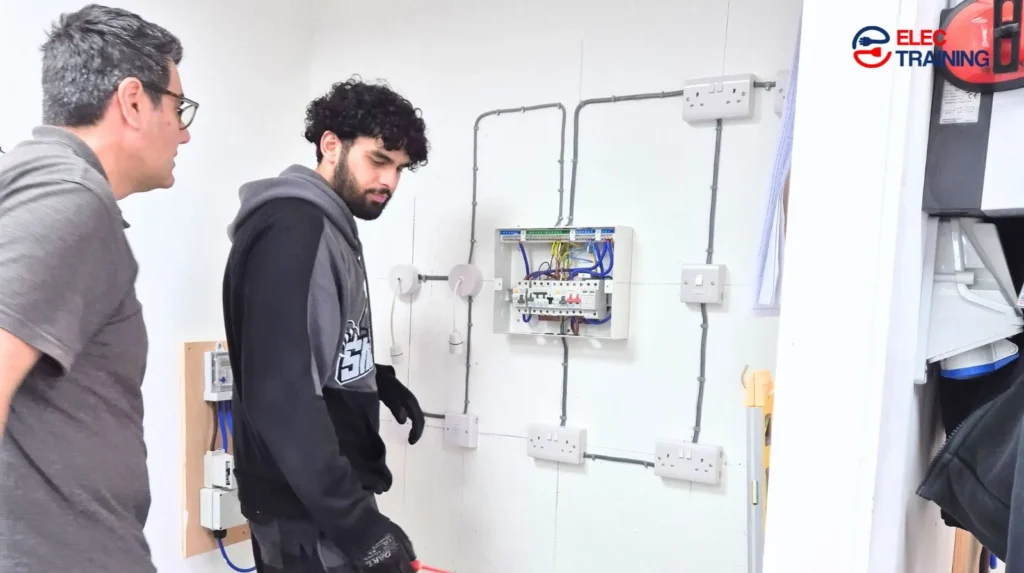
The fourth mistake is ignoring the physical demands. Electrical work involves crawling through lofts, working in confined spaces, lifting equipment, standing for extended periods. If you’ve spent 15 years in office work, the physical adjustment is significant. Part-time evening courses give you a reality check before you commit fully.
The Experienced Worker Route (If You've Got Construction Background)
If you’ve worked in construction trades for several years (plumbing, carpentry, HVAC) but not specifically in electrical installation, there’s potentially a faster route. The Experienced Worker Assessment (EWA) combined with AM2E allows you to prove existing competence without going through the full apprenticeship or NVQ pathway.
This requires at least three to five years of relevant electrical work, documented evidence of installations you’ve completed, and the ability to demonstrate competence across the required units. You’ll still need the 18th Edition, and you’ll still sit the AM2E practical exam, but you can potentially compress the timeline significantly.
The catch is “relevant electrical work.” Changing lightbulbs in a maintenance role doesn’t count. You need genuine electrical installation experience, ideally documented with photos, certificates, or employer confirmation. If you’re coming from a completely non-electrical background (retail, office work, logistics without electrical components), the experienced worker route isn’t available. You’re going through the full beginner pathway.
What Elec Training Offers Wolverhampton Career Changers
We’re based on Thomas Street in Wolverhampton, opposite St John’s Retail Park. For career changers, we offer both intensive and flexible delivery of Level 2 and Level 3 diplomas (City & Guilds 2365), allowing you to choose the pace that fits your circumstances.
But the critical component for adults is our complete training and placement pathway for electrical work in Wolverhampton. Our NVQ Level 3 package (£10,000-£12,000) includes tutor support, assessor workplace visits, and crucially, active placement assistance through our in-house recruitment team. We’re not just handing you certificates and wishing you luck finding a mate role. We’re actively calling contractors, matching learners to opportunities, and supporting the transition from knowledge to workplace competence.
That package does not include the AM2 exam fee (you pay NET directly, typically £850-£950) or PPE and tools (budget £300-£500 separately). But it does include the element most career changers struggle with: bridging from classroom certificates to genuine electrical employment where you can complete your portfolio.
If you’re a career changer in Wolverhampton, your first decision is whether to start with part-time evening courses while keeping your current job (safer, slower) or commit to intensive training (faster, higher risk). Both routes are legitimate. Evening courses reduce financial pressure and give you time to be certain about the career change. Intensive courses get you to the transition point faster but require more upfront resources.
Your second decision is verifying the provider offers genuine NVQ placement support, not just knowledge courses. Ask directly: “How do you help career changers find mate roles after Level 3?” If the answer is vague (“we have industry connections”), you’re looking at a knowledge-only provider. If the answer is specific (“our in-house recruitment team works with 120+ contractors and we actively place learners”), that’s a complete pathway.
Your third decision is being realistic about timeline and cost. From zero electrical experience to JIB Gold Card, you’re looking at 2.5-4 years including the workplace NVQ stage. Total cost including everything (courses, exams, tools, cards) runs £12,000-£15,000. Anyone promising significantly faster or cheaper is omitting critical components.
Call us on 0330 822 5337 to discuss career change pathways into electrical work in Wolverhampton and how our placement support works for adults transitioning from other industries. We’ll explain the realistic timeline from your current position, what evening and intensive options look like, and how we actively support the transition from knowledge certificates to workplace NVQ opportunities. No false promises. Just practical guidance based on what actually works for career changers in the West Midlands.
References
- City of Wolverhampton College – Electrical Installation Courses: https://www.wolvcoll.ac.uk/courses/electrical/
- Elec Training Wolverhampton – Career Changer Routes: https://elec.training/electrician-courses-wolverhampton/
- National Careers Service – Electrician Career Profile: https://nationalcareers.service.gov.uk/job-profiles/electrician
- City & Guilds 2365 Diploma Specification: https://www.cityandguilds.com/
- City & Guilds 8202 Technical Certificate Specification: https://www.cityandguilds.com/
- Ofqual Register of Regulated Qualifications: https://register.ofqual.gov.uk/
- ECS Card Requirements and Application: https://www.ecscard.org.uk/
- JIB Grading and Qualification Pathways: https://www.jib.org.uk/
- National Electrotechnical Training (AM2/AM2E Assessment): https://www.netservices.org.uk/
- BS 7671:2018+A2:2022 Wiring Regulations: https://electrical.theiet.org/
- Experienced Worker Assessment Routes: https://www.netservices.org.uk/am2ed/
Note on Accuracy and Updates
Last reviewed: 5 January 2026. This page is maintained; we correct errors and refresh sources as Wolverhampton provider offerings and UK electrical qualification requirements change. Adult funding eligibility for evening courses fluctuates based on government policy; always verify current fee status with City of Wolverhampton College directly. NVQ placement opportunities vary with regional labour market conditions. Next review scheduled: March 2026.
