
Fast Track vs Traditional College – Outcomes, Duration & Cost

- Technical review: Thomas Jevons (Head of Training, 20+ years)
- Employability review: Joshua Jarvis (Placement Manager)
- Editorial review: Jessica Gilbert (Marketing Editorial Team)
- Last reviewed:
- Changes: Initial publication
Why This Comparison Matters
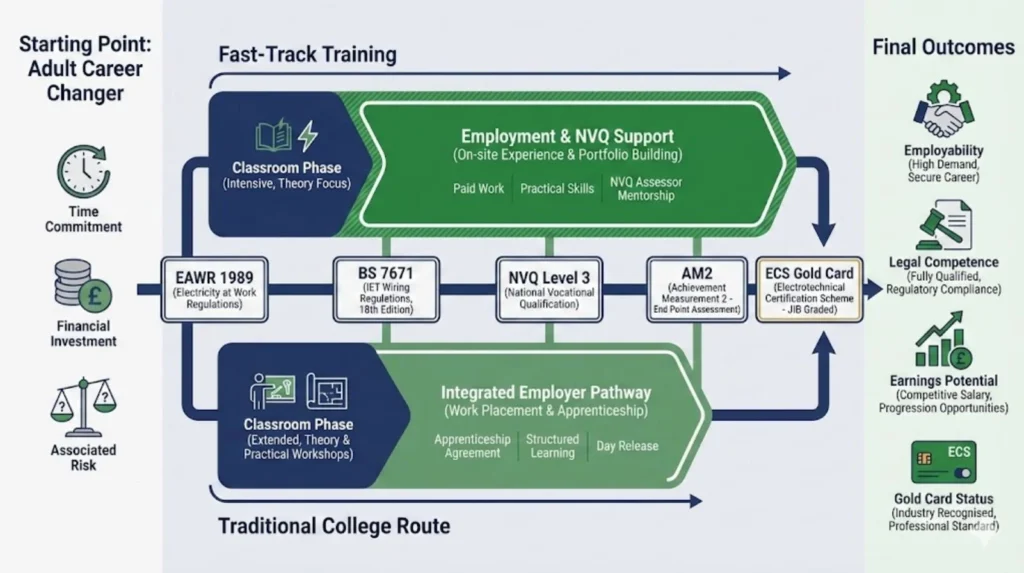
If you’re researching how to become an electrician in the UK as an adult career changer, you’ve probably encountered two very different training pathways: fast-track diplomas offered by private training centres, and traditional FE college programmes spread over one to two years.
Both routes award the same Level 2 and Level 3 technical qualifications (typically City & Guilds 2365-02 and 2365-03). Both teach to the same BS 7671 wiring regulations. Both are accepted by awarding bodies. So what’s the actual difference, and why does it matter?
Here’s what you need to understand: becoming a fully qualified electrician in the UK requires far more than classroom diplomas. You need NVQ Level 3 evidence demonstrating on-site competence, you need to pass the AM2 practical assessment, and you need supervised experience that meets legal competence requirements under the Electricity at Work Regulations 1989.
The real question isn’t “Which route teaches better theory?” It’s “Which route actually gets you from classroom certificates to a JIB Gold Card and employable status?”
That depends almost entirely on one factor: whether your training provider actively supports your progression into NVQ-eligible work placements, or whether they hand you diplomas and disappear.
This article compares fast-track and traditional college routes across regulatory compliance, duration, cost, practical depth, NVQ readiness, employer perception, earnings potential, and long-term career outcomes. We’ll use official awarding body data, government regulations, industry body guidance, employer sentiment from forums, and real learner experiences to show you exactly what each pathway delivers.
For a comprehensive breakdown of fast-track versus traditional electrician training pathways, including honest timelines and what happens after classroom training ends, this comparison is based on evidence rather than marketing promises.
The Regulatory Framework: What the Law Actually Requires
Before we compare routes, let’s establish what “qualified electrician” legally means in the UK. This matters because many training providers blur the line between “completed diplomas” and “legally competent to work.”
Electricity at Work Regulations 1989 (EAWR)
Regulation 16 of the EAWR is the foundation of electrical competence in the UK. It states that no person shall engage in electrical work where technical knowledge or experience is necessary to prevent danger unless they possess such knowledge or experience, or work under adequate supervision.
The critical phrase is “technical knowledge or experience.” Not “knowledge alone.” Not “certificates alone.” Knowledge and experience together.
What this means in practice:
Diploma holders (fast-track or traditional) are not legally competent to work unsupervised. The diplomas prove you have technical knowledge. They don’t prove you have the supervised experience required to prevent danger in real installations.
Competence develops over time through supervised site work. This is why the NVQ Level 3 exists. It’s the qualification that proves you’ve applied your knowledge safely across varied real-world scenarios under assessment.
Short intensive courses meet the “knowledge” part but cannot replicate the “experience” part. You can learn BS 7671 regulations in weeks. You cannot develop the intuitive fault-finding skills, safe working habits, and practical judgement needed to work competently in months. That requires sustained, supervised repetition over 12-18+ months of site work.
HSE enforcement cases confirm this. Prosecutions for electrical incidents consistently highlight inadequate supervision, insufficient training, and workers operating beyond their competence level. The law doesn’t distinguish between fast-track and traditional diplomas. It cares whether you can do the work safely based on knowledge and experience.
Building Regulations Part P (Domestic Work)
Part P applies to electrical work in domestic dwellings in England and Wales. Notifiable work (consumer units, new circuits, work in bathrooms) must either be carried out by a Competent Person Scheme (CPS) registered electrician, or notified to Building Control.
Here’s the problem for diploma-only holders:
CPS registration requires NVQ Level 3 + AM2 + relevant insurance. You cannot register with NICEIC, NAPIT, ELECSA, or other CPS bodies using just Level 2/3 diplomas.
Building Control notification costs £100-£300+ per job. This makes you commercially unviable for domestic work compared to CPS-registered electricians.
Insurance for notifiable work requires demonstrated competence. Insurers want NVQ Level 3 or equivalent proven on-site experience, not classroom certificates.
Part P competence, like EAWR competence, relies on practical experience verified through the NVQ process. Fast-track and traditional diplomas are equally insufficient on their own.
BS 7671:2018+A2:2022 (18th Edition Wiring Regulations)
Both training routes teach to BS 7671. The regulations are identical. The exam is identical. So what’s the difference?
Application competence versus theoretical knowledge.
Traditional college students typically get 300-400 hours of workshop practice spread over two academic years. They install containment systems, terminate cables, test circuits, and apply BS 7671 requirements dozens of times with immediate instructor feedback and the opportunity to repeat until competent.
Fast-track students get the same total Guided Learning Hours (GLH) on paper, but compressed into intensive block weeks. They learn the same content but with less repetition, less supervised practice, and less time for skills to embed.
The result shows up later during NVQ assessments and AM2. College-trained candidates generally demonstrate stronger practical application of BS 7671 because they’ve had sustained, paced reinforcement of the concepts.
This isn’t about one route being “better.” It’s about the reality that practical competence develops through repetition over time. You can accelerate knowledge transfer. You cannot accelerate skill development to the same degree.
Electrotechnical Assessment Specification (EAS 2024-2025)
The EAS is an industry-agreed framework maintained by the JIB and supported by major trade bodies (ECA, Unite, SELECT, NICEIC, NAPIT). It sets the standard for what constitutes acceptable training and competence in the UK electrotechnical industry.
Key EAS requirements:
NVQ Level 3 (or equivalent competence-based qualification) is mandatory for Installation Electrician status. The Level 2/3 diplomas are knowledge qualifications. They’re necessary but not sufficient.
AM2 (or AM2E for experienced workers) is required to demonstrate practical competence. This is a three-day timed practical assessment testing safe isolation, installation, testing, and certification under exam conditions.
Supervised on-site experience is essential. The EAS explicitly warns against candidates from highly compressed programmes being underprepared for NVQ and AM2 assessments.
GLH must be met, but delivery quality matters. Fast-track providers can meet the minimum GLH requirements through intensive delivery and self-study, but the EAS notes that compressed delivery often results in weaker practical skill foundations.
The EAS doesn’t ban fast-track routes. It questions whether highly compressed programmes can realistically prepare candidates for the rigorous practical assessments and on-site competence required for full qualification.
ECS and JIB Card Requirements
The Electrotechnical Certification Scheme (ECS) issues cards that prove qualification status. The JIB (Joint Industry Board) sets employment standards and grading.
Here’s how each training route aligns:
Fast-track diploma graduates (before NVQ):
Eligible for: ECS Labourer Card or ECS Electrical Mate Card (with some site experience)
Not eligible for: ECS Gold Card (Installation Electrician)
JIB grading: Labourer (until NVQ + AM2 completed)
Traditional college diploma graduates (before NVQ):
Eligible for: Same as above (Labourer or Electrical Mate)
Not eligible for: ECS Gold Card
JIB grading: Labourer (until NVQ + AM2 completed)
After completing NVQ Level 3 + AM2 (either route):
Eligible for: ECS Gold Card (Installation Electrician)
JIB grading: Electrician (£17.68-£18.80/hour as of January 2025)
Progression available to: Approved Electrician (after 2+ years + 2391 qualification)
Thomas Jevons, Head of Training at Elec Training, explains:
"The JIB Gold Card doesn't care whether your Level 2 and 3 diplomas took 4 months or 2 years. What matters is your NVQ Level 3 portfolio evidence and your AM2 performance. Both demonstrate real-world competence under BS 7671. The classroom phase (whether fast-track or traditional) is just the theory foundation. The qualification itself is built on-site, with proper supervision and assessment."
Thomas Jevons, Head of Training
The regulatory framework is clear: diplomas are step one. NVQ + AM2 + supervised experience is the qualification. The training route that gets you from step one to full qualification most effectively is the one that works.
The Qualification Pathways: What You Actually Learn
Let’s break down exactly what each route delivers in terms of content, structure, and practical preparation.
Fast-Track Diplomas (Private Providers)
Typical structure:
Level 2 Diploma (C&G 2365-02): 4-6 weeks intensive
Level 3 Diploma (C&G 2365-03): 8-12 weeks intensive
18th Edition (BS 7671): 3-5 days
Total classroom time: 13-17 weeks for all three qualifications
Delivery method:
Block-release intensive training (full-time attendance for consecutive weeks)
Compressed workshop sessions (often 8-10 hours per day)
Heavy reliance on self-study and eLearning between blocks
Small class sizes (typically 8-12 students)
Focused, fast-paced delivery of syllabus content
What you learn:
Same syllabus content as traditional college
Same City & Guilds exams and assessments
Same BS 7671 regulations and design principles
Same testing procedures and fault-finding theory
Same health and safety requirements
What you practice:
Containment installation (limited repetition due to time constraints)
Cable termination (fewer attempts to perfect technique)
Testing procedures (compressed into intensive sessions)
Safe isolation (taught but less embedded through repetition)
Design calculations (learned but less applied practice)
GLH (Guided Learning Hours) reality:
City & Guilds specifies minimum GLH for each qualification. Fast-track providers meet this through a combination of in-centre intensive training and mandatory self-study eLearning modules.
For example:
In-centre practical: 40-50 hours per level
Self-study eLearning: 250-300 hours per level
Total GLH: Meets awarding body requirements
The issue isn’t whether GLH requirements are met. It’s whether compressed delivery provides equivalent depth of supervised practical skill development compared to paced delivery over academic terms.
NVQ readiness after fast-track diplomas:
Mixed. Fast-track graduates have the theoretical knowledge required to begin NVQ Level 3 portfolio building. They understand regulations, design principles, and testing theory.
However, they often report:
Feeling rushed through practical content
Insufficient time to embed cable termination techniques
Limited confidence in real-world application
Need for significant on-site mentoring to reach improver competence
Difficulty demonstrating practical skills in job interviews
The diplomas are valid. The knowledge is there. The practical confidence and embedded skills are often weaker compared to traditional routes.
Traditional FE College Diplomas
Typical structure:
Level 2 Diploma (C&G 2365-02): 1 academic year (September to June)
Level 3 Diploma (C&G 2365-03): 1 academic year (September to June)
18th Edition (BS 7671): Integrated or separate 5-day course
Total time: 2 academic years (18-20 months of term-time learning)
Delivery method:
Term-based learning (3 terms per academic year)
Consistent weekly schedule (typically 2-3 full days per week)
Structured practical workshops integrated throughout
Larger class sizes (15-25 students)
Paced delivery with time for consolidation and repetition
What you learn:
Identical syllabus content to fast-track route
Same City & Guilds exams and assessments
Same BS 7671 regulations and design principles
Same testing procedures and fault-finding theory
Same health and safety requirements
What you practice:
Containment installation (repeated multiple times across terms)
Cable termination (dozens of attempts to perfect technique)
Testing procedures (practiced regularly throughout the year)
Safe isolation (embedded through consistent repetition)
Design calculations (applied across multiple practical projects)
GLH reality:
FE colleges deliver the same minimum GLH but spread over a longer period with more in-centre supervised practical time.
For example:
In-centre practical: 200-250 hours per level (across full academic year)
Classroom theory: 150-200 hours per level
Self-study: Expected but not as heavily relied upon
Total GLH: Exceeds awarding body minimums
The additional supervised workshop time is the key differentiator. Students have more opportunities to repeat tasks, receive feedback, correct mistakes, and embed skills through spaced repetition.
NVQ readiness after traditional college:
Generally higher. College graduates report:
Stronger practical confidence
Better cable termination technique
More comfortable with testing procedures
Readier for improver/apprentice roles
Easier transition into NVQ-supported work
This isn’t because the qualifications are different. It’s because sustained, paced practical training develops more embedded skills than compressed intensive training.
The critical advantage: employer networks
FE colleges typically have decades-long relationships with local electrical contractors, M&E firms, and construction companies. They’re often the direct training providers for apprenticeships in their region.
This means college students have:
Direct pathways into apprenticeships
Easier access to improver roles with NVQ support
Employer visits and recruitment days on campus
Work placement coordination built into the programme
Stronger reputations with local hiring managers
Fast-track providers rarely have these established networks. Their students compete in the open market with no track record and limited practical confidence.
What Both Routes Don’t Provide (Until NVQ)
It’s critical to understand what diplomas alone (fast-track or traditional) do not qualify you to do:
You cannot:
Work unsupervised on any electrical installation
Sign off your own work (no CPS registration without NVQ)
Carry out notifiable domestic work without Building Control notification
Work on commercial or industrial installations independently
Apply for JIB Electrician grading (only Labourer grade available)
Obtain ECS Gold Card (only Labourer or Electrical Mate cards available)
Legally claim to be a “qualified electrician”
Install 3-phase distribution systems
Carry out Electrical Installation Condition Reports (EICRs)
Work on HV systems or specialist installations
You can (under supervision):
Assist qualified electricians as a mate or improver
Carry out basic domestic wiring tasks under direct supervision
Learn on-site whilst building NVQ portfolio evidence
Work towards AM2 assessment preparation
Develop practical competence through supervised experience
The pathway to full qualification is identical regardless of diploma route: secure employment that supports NVQ portfolio building, complete NVQ Level 3 across all units (typically 12-18 months of site work), prepare for and pass AM2 assessment, apply for ECS Gold Card.
The question is: which training route makes that pathway more achievable?
Duration Comparison: Real Timelines to Full Qualification
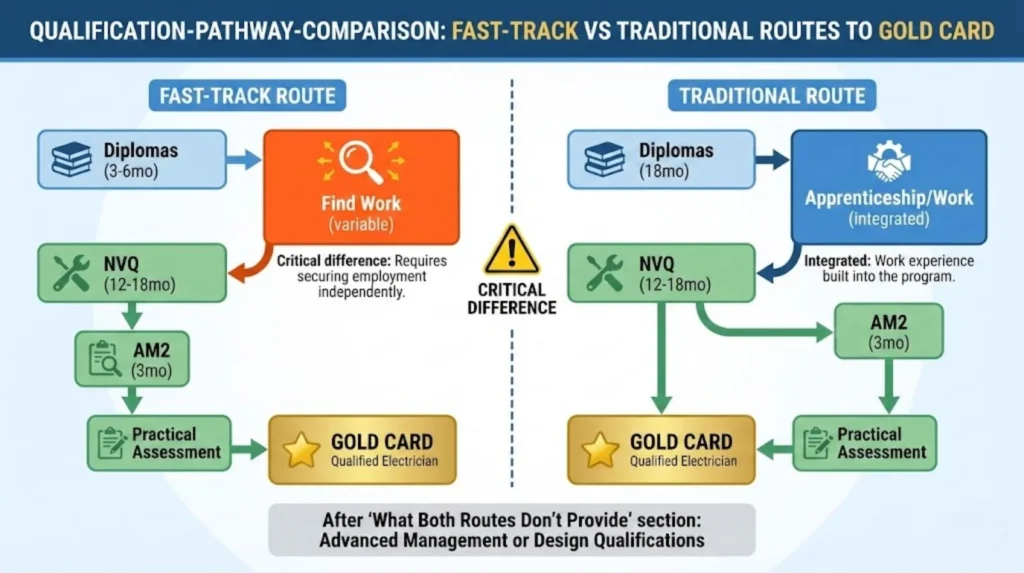
Marketing claims and reality often differ significantly. Let’s compare actual timelines to JIB Gold Card status.
Fast-Track Route Timeline
Provider marketing claims: “Qualified in 16 weeks” or “Career-ready in 4 months”
Reality:
Stage 1: Classroom diplomas (3-6 months)
Level 2 Diploma: 4-6 weeks
Level 3 Diploma: 8-12 weeks
18th Edition: 3-5 days
Total: 13-23 weeks (approximately 3-6 months)
At this point, you have theoretical knowledge certificates. You are not a qualified electrician.
Stage 2: Finding NVQ-eligible employment (1-12+ months)
This is the critical variable that providers rarely discuss honestly.
Fast-track graduates must secure employment with:
An employer willing to supervise NVQ portfolio building
Varied work covering all NVQ units (domestic, commercial, testing, fault-finding)
Regular assessor access
Commitment to supporting your qualification progression
Best case: 1-2 months if the provider has strong contractor networks (like Elec Training’s 120+ partner network with active recruitment support)
Typical case: 6-12 months of searching, often settling for mate/labourer roles that don’t support NVQ progression
Worst case: 12+ months or never securing suitable NVQ-supporting employment, becoming stuck with diplomas but no progression pathway
Joshua Jarvis, Placement Manager at Elec Training, explains:
"We see fast-track students complete their full qualification (diplomas, NVQ, AM2, Gold Card) in 18-24 months when they have guaranteed placement support. That's faster than traditional routes and produces identical competence. The students who struggle are the ones whose providers disappeared after the classroom phase. Speed isn't the problem. Abandonment is."
Joshua Jarvis, Placement Manager
Stage 3: NVQ Level 3 portfolio building (12-18 months)
Once employed, building the NVQ portfolio requires:
12-18 months minimum of on-site work (City & Guilds allows up to 3 years)
Evidence across all units (installation, testing, fault-finding, maintenance)
Regular assessor visits (typically every 4-6 weeks)
Photographic evidence and written assignments
Supervisor sign-offs and observations
Timeline depends on:
Full-time versus part-time work (part-time doubles the timeline)
Variety of work available (repetitive domestic work extends timeline)
Employer understanding of NVQ requirements
Assessor reliability and availability
Stage 4: AM2 preparation and assessment (3-6 months)
Preparation courses and self-study: 1-3 months
Booking wait time: 2 weeks to 3 months
Assessment itself: 3 days
Certificate processing: 4-6 weeks
Potential resit if failed first time: add 3-6 months
Stage 5: ECS Gold Card application (1-2 months)
Document submission and processing: 4-6 weeks
Total fast-track timeline (with proper placement support):
Best case: 18-24 months (classroom 4 months + immediate placement + 12-month NVQ + 4-month AM2 + 2-month card)
Typical case: 24-36 months (classroom 5 months + 6-month employment search + 18-month NVQ + 5-month AM2 inc. prep + 2-month card)
Worst case without placement support: 36-48+ months or never completing due to inability to secure NVQ placement
Traditional College Route Timeline
Advertised duration: “2-year diploma programme” or “Full-time college course”
Reality:
Stage 1: Classroom diplomas (18-20 months)
Level 2 Diploma: 1 academic year (9-10 months of term-time)
Level 3 Diploma: 1 academic year (9-10 months of term-time)
18th Edition: Integrated or separate
Total: 18-20 months of actual learning time (spread over 2 calendar years)
At this point, you have the same theoretical knowledge certificates as fast-track graduates.
Stage 2: Progression to NVQ-supporting work (typically integrated)
FE colleges usually facilitate:
Direct apprenticeship placements (with NVQ integrated from start)
Improver roles with established employer partners
Work experience programmes during college
Recruitment events connecting students with contractors
Typical timeline: 1-3 months between finishing diplomas and starting NVQ-supporting work (often faster due to established employer relationships)
For apprenticeship route (started alongside or after diplomas):
Employment secured from the beginning or immediately after Level 2/3
NVQ building happens concurrently with work
No employment gap
Stage 3: NVQ Level 3 portfolio building (12-18 months)
Same requirements as fast-track route. However:
College students often have better preparation for NVQ assessments
Employer relationships are typically more established
Work variety is more commonly available (commercial/industrial access)
Stage 4: AM2 preparation and assessment (3-6 months)
Same process, but:
College-prepared candidates typically have higher first-time pass rates
More workshop hours means better practical preparation
Less need for expensive external AM2 prep courses
Stage 5: ECS Gold Card application (1-2 months)
Same timeline.
Total traditional college timeline:
Via integrated apprenticeship: 36-48 months (3-4 years from start to Gold Card, but earning throughout)
Via college then NVQ: 30-42 months (18-month diplomas + 1-3 month employment transition + 12-18 month NVQ + 4-6 month AM2)
The Real Comparison
Fast-track with proper placement support: 18-36 months total
Advantage: Faster classroom phase (3-6 months vs 18-20 months)
Risk: Dependent on provider’s ability to secure NVQ placements
Outcome: Identical Gold Card if placement support is strong
Traditional college: 30-48 months total
Advantage: Integrated employer networks, higher NVQ readiness, earning during apprenticeships
Risk: Longer overall timeline
Outcome: More predictable progression to Gold Card
Fast-track without placement support: 36-48+ months or incomplete
This is the common failure mode
Students finish diplomas quickly but then spend 12-24+ months unable to progress
Many never complete NVQ, leaving them with debt and partial qualifications
Some eventually return to college or apprenticeship routes
The classroom speed difference (3-6 months vs 18 months) is real. But the overall timeline to Gold Card depends almost entirely on employment access, not classroom duration.
A fast-track student with immediate, guaranteed placement support reaches Gold Card status faster than a traditional student. A fast-track student without placement support takes longer than a traditional student, or never completes at all.
For a detailed comparison of accelerated training routes and long-term career outcomes, the critical factor is what happens after the classroom phase, not the classroom duration itself.
The Honest Conclusion
The comparison between fast-track and traditional college routes isn’t simple. The right answer depends on what happens after the classroom diplomas, not during them.
The diploma qualifications themselves are identical. City & Guilds doesn’t distinguish between delivery methods. Level 2, Level 3, and 18th Edition certificates are the same regardless of whether you studied for 4 months or 18 months.
The critical difference is progression to NVQ + AM2 + ECS Gold Card. This is where training routes diverge dramatically:
Traditional college routes provide:
Established employer networks facilitating NVQ placements
Deeper practical skill foundation through extended workshop hours
Stronger employer trust and perception
Lower cost (often £0 for eligible adults)
More predictable progression pathway
Lower financial risk
Fast-track routes with proper placement support provide:
Faster classroom phase (3-6 months vs 18-20 months)
Flexibility for working adults or those with time constraints
Identical final qualification (NVQ + AM2 + Gold Card)
Faster time to full qualification (18-24 months vs 30-48 months)
Higher 10-year cumulative earnings due to earlier Gold Card status
Fast-track routes without placement support create:
High risk of becoming stuck with diplomas but no NVQ progression
Extended unemployment or underemployment (labourer roles)
Significant debt with uncertain ROI
Potential complete abandonment of electrical pathway
Wasted time and money
For most adult career changers starting from zero, the traditional college pathway or a formal apprenticeship provides the most reliable, industry-aligned, and financially sound route to ECS Gold Card status. The employer networks, practical depth, lower cost, and predictable progression outweigh the longer classroom timeline.
For learners who already have guaranteed site access (existing employment, family connections, or provider with verified recruitment infrastructure), fast-track routes work extremely well. The compressed classroom phase is legitimate, and reaching Gold Card in 18-24 months is entirely achievable with proper support.
The determining factor is employment access for NVQ building. Everything else is secondary.
If you’re researching training options, focus your questions on this: “How exactly will this provider support my progression from classroom diplomas to NVQ-supporting employment?” If they can’t give specific, verifiable answers, you’re taking a significant risk.
For a realistic assessment of which fast-track training options actually deliver results, including transparent information about what happens after classroom training ends and how we support NVQ placements through our contractor network, the evidence-based comparison shows that placement support is everything.
At Elec Training, we deliver fast-track diplomas (Level 2, Level 3, 18th Edition) in 3-6 months, and we provide active NVQ placement support through our recruitment team and 120+ partner contractor network. We’re transparent about timelines: expect 18-24 months total from starting classroom training to holding your ECS Gold Card, provided you engage with our placement process and demonstrate work-readiness. We don’t claim “qualified in weeks” because it’s false. We claim “full pathway support from classroom to Gold Card” because that’s what we deliver.
Call us on 0330 822 5337 to discuss your specific circumstances, whether fast-track or traditional college makes sense for you, how our placement support works, what realistic timelines look like, and what you should expect at each stage. We’ll give you honest answers about costs, timelines, and progression pathways based on your starting point and employment situation. No false promises about instant qualification. Just practical guidance about the pathway that will actually work for you.
References
Regulatory and Legal Framework:
- HSE – Electricity at Work Regulations 1989 (EAWR), Regulation 16 competence requirements
- IET – Electrotechnical Assessment Specification (EAS) 2024-2025
- GOV.UK – Building Regulations Part P (domestic electrical work)
- BS 7671:2018+A2:2022 – Wiring Regulations (18th Edition)
- ECS – Electrotechnical Certification Scheme card requirements and grading
- JIB – Joint Industry Board qualification standards and grading structure
- NICEIC, NAPIT – Competent Person Scheme registration requirements
Awarding Bodies and Training Standards:
- City & Guilds – 2365-02 (Level 2), 2365-03 (Level 3) qualification specifications and GLH requirements
- EAL – Alternative awarding body qualification specifications
- NET – National Electrotechnical Training, AM2 assessment standards
- Ofqual – Qualification regulation and oversight
Funding and Education Policy:
- Department for Education (DfE) – Advanced Learner Loans, Free Courses for Jobs
- Education and Skills Funding Agency (ESFA) – Adult Education Budget (AEB) funding rules
- GOV.UK – Skills Bootcamp programmes and funding criteria
Industry Discussion and Learner Experience:
- ElectriciansForums – UK electrician community discussions on training routes and employment
- Reddit (r/UKElectricians) – Career changer experiences, training route outcomes, NVQ placement challenges
- Screwfix Community – Trade professional discussions on training quality and competence
- Trustpilot – Training provider reviews (multiple providers, anonymised where critical)
Employment and Earnings Data:
- JIB – Official wage rates 2025, grading structure, progression requirements
- Indeed, Reed, Totaljobs, CV-Library – Job advertisement analysis for qualification requirements
- ONS – Office for National Statistics labour market data
Safety and Competence:
- HSE – Enforcement notices and prosecution case studies (electrical safety failures)
- IET Wiring Matters – Professional guidance on competence and safety
Note on Accuracy and Updates
Last reviewed: 13 December 2025. This comparison is maintained and updated as regulatory requirements, funding rules, training standards, and industry practices evolve. Information is based on official awarding body requirements, government regulations, industry body guidance, and real learner/employer experiences from forums and published reviews (2023-2025). If you spot inaccuracies, have training route experiences to share, or need clarification on specific pathways, contact us at charanjit@elec.training.
