
Free Electrician Courses: What’s Actually Free in the UK? The 2026 Guide

- Technical review: Thomas Jevons (Head of Training, 20+ years)
- Employability review: Joshua Jarvis (Placement Manager)
- Editorial review: Jessica Gilbert (Marketing Editorial Team)
- Last reviewed:
- Changes: Comprehensive 2026 update covering Free Courses for Jobs eligibility (income threshold £25,750), Skills Bootcamps expansion, Wales PLA green skills priority, NI Skill Up academies, apprenticeship funding rules 2025-2026, realistic opportunity cost calculations comparing 4-year timelines across all routes.
Introduction: The Free Course Reality Check
Search “free electrician courses UK” and you’ll find dozens of providers advertising zero-cost training. Some of these offers are genuine. Government schemes like Free Courses for Jobs, Adult Education Budget, Skills Bootcamps, and devolved equivalents in Scotland, Wales, and Northern Ireland do fund electrical qualifications at no direct cost to eligible learners.
However, “free tuition” and “fully qualified electrician” are not the same thing. Most free courses cover classroom diplomas (Level 2 and Level 3 knowledge qualifications) but exclude the components that actually make you qualified: the NVQ Level 3 portfolio requiring 12-24 months of verifiable site work, the AM2 practical assessment costing £860-£935, and the 18th Edition Wiring Regulations certification.
More significantly, free courses often take substantially longer to complete than intensive alternatives. A part-time Level 3 Diploma at Further Education college stretches across 18-24 months of evening and weekend classes. The same qualification can be delivered in 8 weeks through intensive block courses. That 16-20 month difference isn’t just about convenience, it represents a massive financial impact through delayed earnings, extended time at lower wage grades, and postponed progression to qualified electrician status.
This guide explains exactly what electrical training is genuinely free in 2026, what remains unfunded, which hidden costs exist even when tuition is zero, and critically, when free courses make financial sense versus when they cost significantly more than paid alternatives once opportunity costs are calculated.
The reality is counterintuitive: for adults aged 25+ with existing income, free courses often represent the most expensive pathway to qualification when measured by total financial impact over the training period. The cheapest course fees do not equal the lowest total cost of becoming qualified.
What You Actually Need to Become a Qualified Electrician
Before evaluating free course options, understanding the complete qualification pathway prevents expensive mistakes and unrealistic expectations about what “free” actually delivers.
The UK Qualified Electrician Standard (2026):
Qualified electrician status, evidenced by the ECS Gold Card required by most employers and all major construction sites, mandates four distinct components:
1. Level 2 and Level 3 Diplomas in Electrical Installation
These are knowledge-based qualifications (City & Guilds 2365, EAL 8202, or equivalents) covering electrical theory, health and safety, circuit design, BS 7671 application, and installation principles. They prove you understand electrical installation work conceptually but do not demonstrate occupational competence. Diplomas can be completed in FE colleges (1-3 years part-time or full-time) or through intensive courses (12-16 weeks).
2. NVQ Level 3 Diploma in Installing Electrotechnical Systems and Equipment
This is the occupational competence qualification (City & Guilds 2357/5357, EAL equivalents) requiring verifiable workplace evidence gathered over 12-24 months of continuous employment as an Improver or Electrical Mate. The NVQ portfolio demonstrates you can perform electrical installation, testing, inspection, fault-finding, and certification work safely and correctly in real work environments under supervision. This cannot be completed in classrooms or workshops, it requires actual construction sites, commercial installations, or domestic electrical work with paying clients.
3. AM2, AM2S, or AM2E Assessment
The Achievement Measurement 2 practical examination, administered by NET (National Electrotechnical Training), is a three-day hands-on test of installation, testing, and fault-finding skills under controlled conditions. Candidates must design, install, test, certify, and present electrical installations meeting BS 7671 requirements within strict time limits. The assessment fee for 2025-2026 is £860-£935 depending on version (AM2 standard, AM2S apprenticeship, AM2E experienced worker).
4. 18th Edition Wiring Regulations (BS 7671:2018+A2:2022)
The City & Guilds 2382 qualification demonstrates knowledge of UK electrical installation standards. This is a knowledge exam, typically 3-5 days of study followed by a multiple-choice test. Cost: £400-£600 for course and exam.
Additional Requirements:
ECS Gold Card application: Approximately £50-£60
Tools and PPE: £500-£1,000 minimum for basic kit
BS 7671 Wiring Regulations book: £80-£99
On-Site Guide: £35
The Critical Point:
Free courses typically fund Component 1 only (the diplomas). Components 2, 3, and 4 remain learner-funded in most cases, adding £2,500-£4,500 to the total cost even when tuition is free. More importantly, Component 2 (the NVQ) requires employment, which many diploma holders cannot secure independently.
Only apprenticeships include all four components at zero cost to the learner, funded entirely by employer levy contributions and government co-funding.
The True Cost of a Free Course
The price tag attached to a training course represents only a fraction of its true financial impact. For adults with existing income or earning potential, the opportunity cost of training time often exceeds tuition fees by tens of thousands of pounds.
Four-Year Earnings Comparison: Apprenticeship vs Free College vs Fast-Track
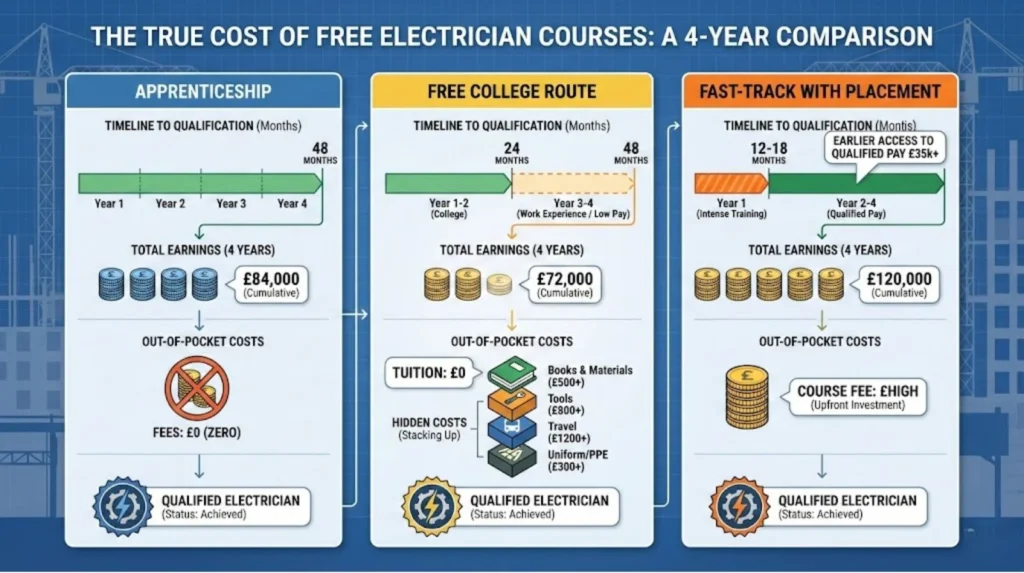
To demonstrate the real financial impact of different training routes, we’ve calculated total earnings and out-of-pocket costs over a four-year period for three pathways: apprenticeship, free FE college route, and fast-track intensive training with guaranteed NVQ placement.
Scenario: 25-year-old career changer, currently earning £25,000 annually in non-electrical work, seeking to become a fully qualified electrician with ECS Gold Card.
ROUTE 1: Electrical Apprenticeship (4 Years)
Timeline:
Years 1-4: Employed as apprentice, 80% on-site work + 20% college
Earnings (JIB Rates 2025-2026):
Year 1 (Stage 1): £8.16/hour = £15,912
Year 2 (Stage 2): £10.18/hour = £19,851
Year 3 (Stage 3): £12.70/hour = £24,765
Year 4 (Stage 4): £14.03/hour = £27,359
Total 4-year earnings: £87,887
Out-of-pocket costs:
Course fees: £0 (employer-funded)
NVQ assessment: £0 (employer-funded)
AM2S assessment: £0 (typically employer-funded)
Tools/PPE: £500-£1,000 (apprentice responsibility)
Total out-of-pocket: £500-£1,000
Outcome at 4 years: Fully qualified electrician with Gold Card, 4 years’ site experience, no training debt.
Net financial position: £87,887 earned – £750 average costs = £87,137 net positive
ROUTE 2: Free FE College Evening Route (4 Years)
Timeline:
Years 1-2: Part-time evening Level 2 and Level 3 Diplomas (18-24 months), working full-time day job
Year 2.5-3: Seeking improver employment (3-6 months job search average)
Years 3-4: Improver role building NVQ portfolio (18 months)
End of Year 4: AM2 assessment and Gold Card application
Earnings:
Years 1-2: Current job £25,000/year = £50,000
Year 2.5-3 (job search, 6 months): £25,000 × 0.5 = £12,500
Years 3-4 (Improver, 18 months): £24,000 × 1.5 = £36,000
Total 4-year earnings: £98,500
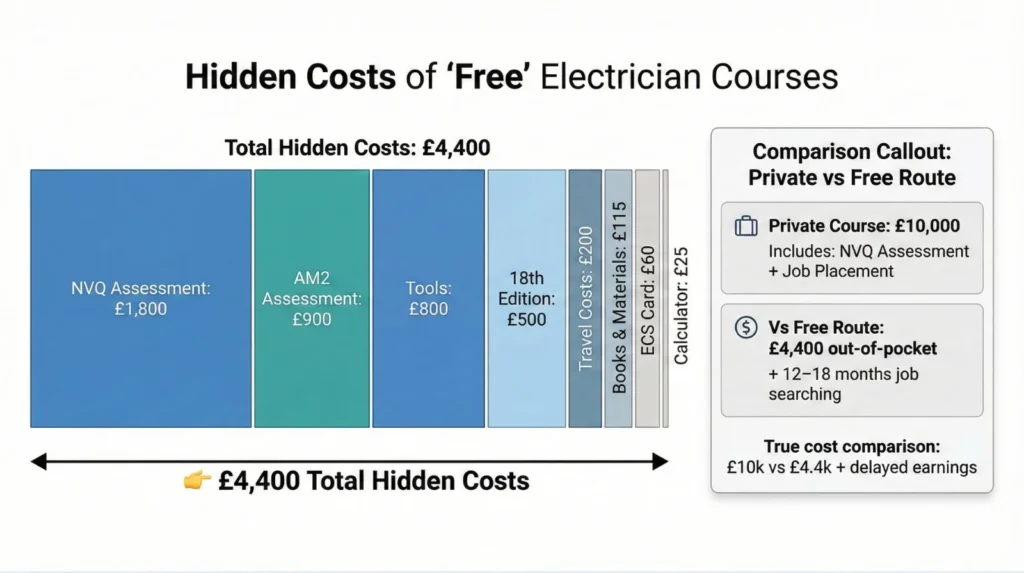
Out-of-pocket costs:
Level 2/3 tuition: £0 (AEB + Free Courses for Jobs funded)
18th Edition: £500
NVQ assessment: £1,800 (not funded for adult learners)
AM2 assessment: £900
Tools/PPE: £800
Travel to college (2 years): £400
Total out-of-pocket: £4,400
Outcome at 4 years: Fully qualified electrician with Gold Card, 18 months’ site experience, minimal debt.
Net financial position: £98,500 earned – £4,400 costs = £94,100 net positive
BUT: This assumes successful improver placement within 6 months. Reality is often 12-18 months of searching, reducing earnings significantly.
ROUTE 3: Fast-Track Intensive Course with Guaranteed NVQ Placement (4 Years)
Timeline:
Months 1-3: Intensive Level 2, Level 3, 18th Edition block course (12 weeks full-time)
Months 4-21: Improver role building NVQ portfolio (18 months) via guaranteed placement
Month 22: AM2 assessment
Months 23-48: Qualified electrician earning full rates (26 months)
Earnings:
Months 1-3 (training): £0
Months 4-21 (Improver, 18 months): £24,000 × 1.5 = £36,000
Months 23-48 (Qualified, 26 months): £35,000 × 2.17 = £75,950
Total 4-year earnings: £111,950
Out-of-pocket costs:
Course package (Level 2/3/18th Ed): £10,000
NVQ assessment: £0 (included in package)
AM2 assessment: £900 (or included in some packages)
Tools/PPE: £800
Living costs during 3-month training: £0 (staying with family) or £3,000 (accommodation/food if relocating)
Total out-of-pocket: £11,700 (or £14,700 if accommodation needed)
Outcome at 4 years: Fully qualified electrician with Gold Card, 18 months’ improver experience + 26 months as qualified electrician, moderate training debt but highest total earnings.
Net financial position: £111,950 earned – £11,700 costs = £100,250 net positive
Financial Impact Summary (4-Year Comparison)
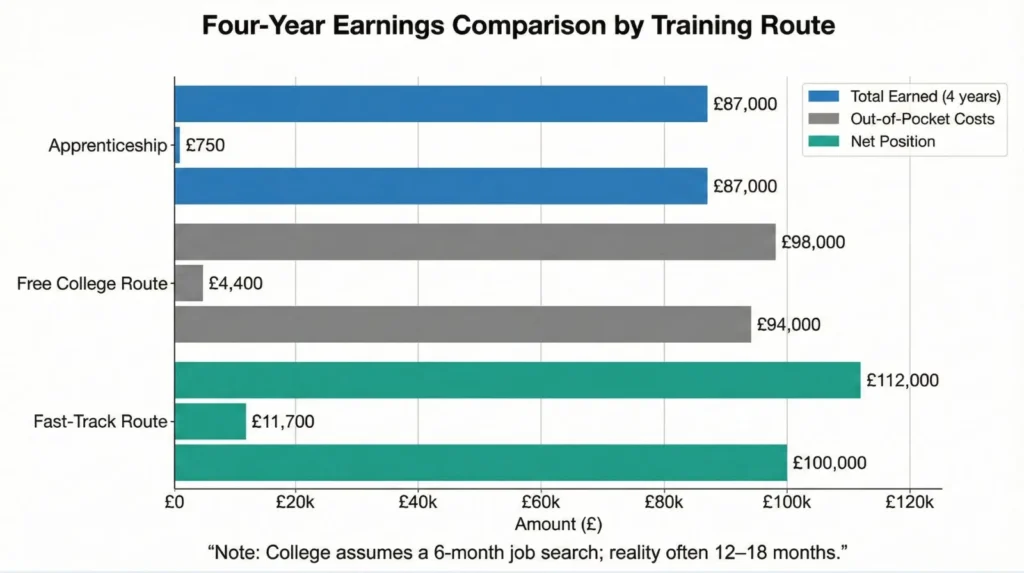
| Route | Total Earned | Out-of-Pocket | Net Position | Qualified Status at Year 4 |
| Apprenticeship | £87,887 | £750 | £87,137 | ✓ Fully Qualified |
| Free College | £98,500* | £4,400 | £94,100* | ✓ Fully Qualified |
| Fast-Track | £111,950 | £11,700 | £100,250 | ✓ Fully Qualified |
*Assumes 6-month job search. Reality often 12-18 months, reducing total earned to £85,000-£92,000.
Key Findings:
Fast-track delivers £13,000-£24,000+ higher net earnings over 4 years despite £10,000 upfront cost
Qualification speed matters more than tuition cost: Fast-track graduates earn qualified rates (£35,000+) for 26 months while college route graduates are still building portfolios or searching for work
Free college route is middle-ground: Better than apprenticeship wages but slower to qualified status than fast-track
Apprenticeship produces lowest net earnings due to 4 years at below-market wages, but zero debt and comprehensive experience
The critical variable: Employment access for NVQ work. Free college route assumes 6-month job search, which is optimistic. Forum discussions and training provider data suggest 12-18 months is more realistic for adults without connections, reducing total earnings to £85,000-£92,000 and potentially making it the worst financial outcome of all three routes.
The Hidden Cost: Time at Lower Wages
The earnings comparison reveals the most expensive element of free courses: extended time at Electrical Mate or Improver wages before reaching qualified status.
Wage differential:
Electrical Mate: £18,000-£22,000 annually
Improver: £22,000-£28,000 annually
Qualified Electrician: £33,000-£42,000 annually (employed), £45,000-£70,000 (self-employed CIS)
Every month delayed reaching qualified status costs:
£1,000-£1,500 in potential earnings (qualified rate vs improver rate)
Compounding effect: Earlier qualification = earlier ability to self-employ and access highest earnings
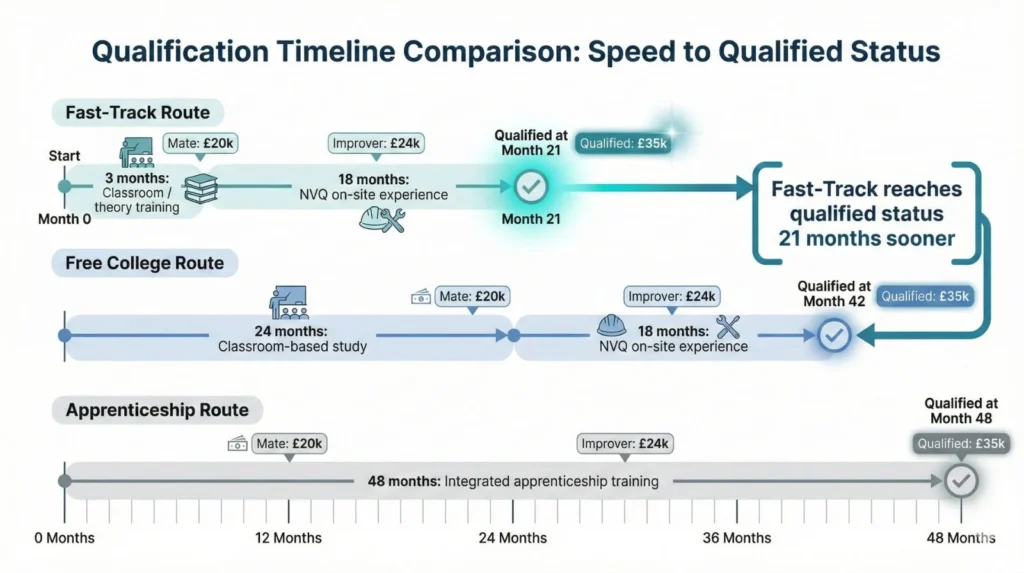
Part-time college route timeline: 24-30 months from start to improver role, then 18-24 months portfolio building = 42-54 months to Gold Card
Fast-track timeline: 3 months classroom + 18-24 months portfolio building = 21-27 months to Gold Card
Difference: 21-27 months, representing £21,000-£40,500 in additional potential earnings by reaching qualified status faster.
Thomas Jevons, Head of Training at Elec Training, explains the time cost clearly:
"Part-time Level 3 courses take 18 to 24 months when the same qualification can be delivered in 8 weeks intensive. That's not because the content is different, it's just stretched across evenings and weekends. The longer it takes, the longer you're delaying your NVQ start date, which delays your AM2, which delays your qualification. Time is the most expensive cost in training, not tuition."
Thomas Jevons, Head of Training
Free Courses in England: What's Actually Available
England offers the most comprehensive government-funded electrical training options across multiple schemes, though each comes with specific eligibility requirements and limitations.
Free Courses for Jobs (Level 3 Diploma Funding)
The Department for Education’s flagship skills initiative funds over 400 Level 3 qualifications, including the City & Guilds 2365 Level 3 Diploma in Electrical Installations, for eligible adults.
What’s free:
Full tuition for Level 3 Diploma (equivalent to A-Level)
Typically 1 year full-time or 18-24 months part-time evening/weekend classes
Course content: Circuit design, BS 7671 application, inspection and testing principles, fault diagnosis, environmental systems
Eligibility (2025-2026 rules):
Age 19+
No existing full Level 3 qualification in any subject, OR
Hold a Level 3 but earn below £25,750 annually (Low Wage Threshold), OR
Currently unemployed
What’s NOT included:
NVQ Level 3 assessment and portfolio (£1,500-£3,000)
AM2 practical exam (£860-£935)
18th Edition if not bundled with diploma
Tools, PPE, books (£800-£1,200)
Employment guarantee for NVQ work
Strategic use: Complete Level 2 via Adult Education Budget (see below), then Level 3 via Free Courses for Jobs, then secure improver employment for NVQ. This requires proactive job searching and may take 6-18 months to find placement.
FE Colleges offering Free Courses for Jobs Level 3 Electrical (2025-2026):
City of Bristol College (full-time 1 year, age 19+, Bristol postcode required)
Warrington & Vale Royal College (part-time evenings)
Cornwall College (entry bootcamp leading to full qualification)
Leeds City College (part-time 2 years)
Adult Education Budget (AEB) – Free Level 2 Courses
The Adult Skills Fund allocates approximately £1.6 billion annually for foundational skills training, including Level 2 Electrical Installation Diplomas.
What’s free:
Level 2 Diploma in Electrical Installations (City & Guilds 2365-02)
Introduction to electrical science, safe isolation, basic installation principles, wiring systems
Qualifies learners for Electrical Mate positions
Eligibility:
Age 19+
Earning below £25,750 (some regions lower, e.g., £20,319 for full fee remission)
OR unemployed receiving benefits (Universal Credit, JSA, ESA)
OR first Level 2 qualification in any subject
Timeline: 6-12 months part-time evening/weekend or 3-6 months full-time
Strategic value: Level 2 alone doesn’t qualify you as an electrician, but it demonstrates commitment to employers and prepares you for Level 3. Use AEB for Level 2, then Free Courses for Jobs for Level 3, minimizing out-of-pocket costs for the diploma stage.
Skills Bootcamps (12-16 Weeks, Fully Funded)
DfE and Local Authority-funded intensive training programs targeting unemployed adults and career changers, with strong focus on green technologies and construction skills gaps.
What’s free:
12-16 week intensive courses
Focus areas: EV charging installation, solar PV basics, electrical pre-apprenticeship skills, building services electrotechnical
Guaranteed job interview with partner employers (80%+ interview rate)
Cost to learner: £0 (fully government-funded)
Examples (Active 2025-2026):
Tech Lancaster Electech Bootcamp: Online + lab sessions, EV charging and solar PV fundamentals, 16 weeks
ECTA Electrical Installation Bootcamp: Level 2 skills, pre-apprenticeship content, 12 weeks, Greater Manchester
What they DON’T provide:
Full electrician qualification (NVQ Level 3, AM2, Gold Card)
Long-term employment guarantee
In-depth BS 7671 coverage
Best use: Entry route for career changers with zero electrical background seeking Electrical Mate positions or apprenticeship opportunities. Bootcamps demonstrate commitment and provide basic skills making you more employable, but do not replace the qualification pathway.
Apprenticeships: The Only Fully Free Complete Route
Electrical apprenticeships (Level 3 Installation & Maintenance Electrician Standard) are the only pathway where all components, including tuition, NVQ, and AM2, cost the learner nothing.
What’s free:
Level 2 and Level 3 Diploma tuition
NVQ Level 3 portfolio assessment
AM2S End-Point Assessment
18th Edition Wiring Regulations
College attendance and materials
Funding mechanism:
Employers with £3 million+ payrolls pay 0.5% Apprenticeship Levy, creating dedicated training funds
Smaller employers receive 95% government co-funding, paying only 5% of training costs
Total funding per apprentice: £23,000 over 42-54 months
Eligibility:
Age 16+ (no upper limit legally, but employers strongly prefer 16-24)
GCSE Maths and English Grade 4 or Functional Skills Level 2
Employment contract with participating employer
What learners still pay:
Tools and PPE (£300-£500)
Travel to site and college (£500-£1,500 annually)
Lower wages during training (see earnings comparison above)
The trade-off: Apprentices earn below qualified rates for 4 years (£15,912-£27,359 total vs £35,000+ qualified), but emerge with zero training debt, comprehensive site experience, and strong employer relationships.
Age barrier reality: While legally open to all ages, electrical apprenticeships heavily favor 16-20 year olds. Employer recruitment data shows 70-80% of apprenticeship places go to school leavers despite no legal age restrictions. Adults 25+ seeking apprenticeships face rejection rates exceeding 90% at large contractors due to higher wage requirements and perceived shorter career duration.
Free Courses in Scotland, Wales & Northern Ireland
Devolved nations operate different funding structures with varying levels of electrical training support.
Scotland: Fee Waivers and SAAS
Scottish residents access free FE college courses through fee waiver systems administered by the Scottish Funding Council, with broader eligibility than England’s means-tested approach.
What’s free:
Level 2 and Level 3 Electrical Installation Diplomas at Scottish FE colleges (e.g., Glasgow Kelvin College, Edinburgh College, Fife College)
SVQ Level 3 Electrical Installation (Scottish equivalent to NVQ)
Pre-apprenticeship programs via Skills Development Scotland
Eligibility:
Scottish resident (minimum 3 years)
Low income (no specific cap like England’s £25,750, assessed case-by-case)
OR unemployed
OR under 25 pursuing first qualification
Key differences from England:
More generous income thresholds (fewer exclusions)
Stronger full-time college provision (less reliance on evening/weekend classes)
Modern Apprenticeships (Scottish apprenticeship system) more accessible to adults than English equivalent
What’s NOT free:
NVQ/SVQ assessment fees (though sometimes included in college delivery)
AM2 assessment
Tools/PPE
Wales: Personal Learning Accounts (PLA)
Wales operates a unique part-time and upskilling-focused funding model prioritizing employed workers and green skills development.
What’s free:
Up to £2,000 per learner for approved courses
Priority sectors: Green technologies (EV charging, solar PV, battery storage, heat pumps), building services electrotechnical
Level 3 Electrical Installation qualifications eligible
Inspection & Testing (EAL Level 3) commonly funded
Eligibility:
Age 16-59
Welsh resident (6+ months)
Employed earning below £34,303 (median wage threshold)
OR facing redundancy
OR self-employed with variable income
Examples:
Level 3 Electrical Installation at Coleg Cambria (PLA-funded, part-time 2 years)
Green PLA for Building Services Electrotechnical (priority scheme for net-zero skills)
Key differences from England:
Strong part-time/evening focus (less full-time provision)
Prioritizes upskilling existing workers rather than career changers
Green technologies more generously funded than traditional electrical installation
What’s NOT free:
NVQ Level 3 assessment (rarely included)
AM2 assessment
Tools/PPE
Hidden Costs Even When Tuition Is Free
“Free tuition” creates the illusion of zero-cost training, but significant expenses remain regardless of which funded scheme covers classroom delivery.
Non-Tuition Costs Breakdown
| Item | Cost (2025-2026) | Funded? | Notes |
| BS 7671 Wiring Regulations Book | £80-£99 | No | Essential reference, required for exams and work |
| On-Site Guide | £35 | No | Practical companion to BS 7671 |
| 18th Edition Course & Exam | £400-£600 | Sometimes | Included in some college courses, separate cost in others |
| NVQ Level 3 Assessment & Registration | £1,500-£3,000 | Rarely | CITB grants cover if employer-registered pre-March 2025 |
| AM2 Assessment Fee | £860-£935 | Apprentices only | User-pays for all other routes |
| AM2 Preparation Day | £175-£250 | No | Optional but recommended, improves pass rates |
| Tools & PPE Starter Kit | £500-£1,000 | No | Multimeter, hand tools, voltage tester, safety equipment |
| ECS Gold Card Application | £50-£60 | No | Health, Safety & Environmental test plus card fee |
| Travel to College | £100-£300/year | No | Public transport or fuel costs, 2-3 years part-time |
| DBS Check | £25-£45 | No | Required for some employer sectors |
| Scientific Calculator | £15-£30 | No | Casio FX-83/85 required for exams |
Total hidden costs for "free" course route: £3,740-£6,344
This is substantially lower than private course fees (£7,000-£15,000), but it’s not zero. More importantly, these costs don’t include the biggest expense: opportunity cost of time.
The Part-Time Evening College Trap
Part-time delivery of Level 2 and Level 3 Diplomas appears convenient for adults maintaining full-time employment during study, but the extended timeline creates significant financial drag through delayed qualification.
Typical part-time timeline:
Level 2 Diploma: 12-18 months (evenings/weekends, 1-2 days per week)
Level 3 Diploma: 18-24 months (evenings/weekends, 1-2 days per week)
Total diploma phase: 30-42 months
Same content via intensive delivery:
Level 2 Diploma: 4 weeks (full-time block course)
Level 3 Diploma: 8 weeks (full-time block course)
Total diploma phase: 12 weeks
Time difference: 27-39 months
Financial impact of delay:
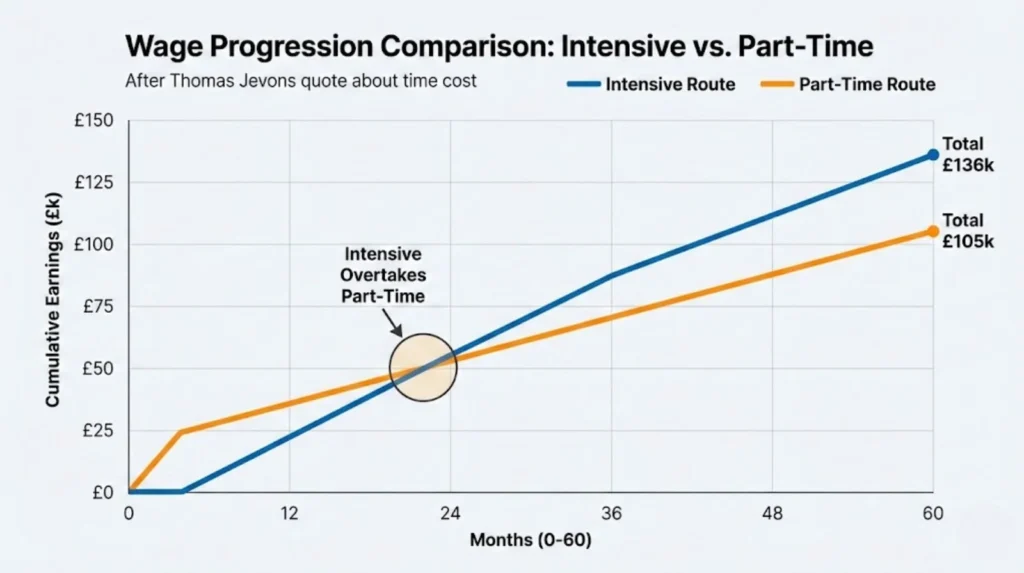
During those extra 27-39 months, part-time learners remain at whatever wage they’re currently earning (let’s assume £25,000 in non-electrical work) while they could have been progressing through improver work (£24,000 building NVQ) then qualified wages (£35,000+).
Scenario comparison:
Intensive route: Month 3, start improver work at £24,000. Month 21, achieve qualified status at £35,000. Months 21-42, earn 21 months × £35,000/12 = £61,250.
Part-time route: Months 1-36, still in evening college earning £25,000 non-electrical = £75,000. Month 36-42 (6 months), finally start improver work at £24,000 = £12,000. Total months 1-42 = £87,000.
At first glance, part-time appears better (£87,000 vs £85,250). But this ignores what happens after month 42:
Intensive graduate: Already qualified at month 21, been earning £35,000+ for 21 months, positioned for further progression.
Part-time graduate: Just started improver role at month 36, still needs 18-24 months NVQ portfolio building before AM2 and qualification.
By month 60 (5 years):
Intensive route: Qualified for 39 months earning £35,000+ = total career earnings £136,500+
Part-time route: Qualified for 6 months earning £35,000 = total career earnings £105,000
Lifetime earnings gap: £30,000+ in favor of intensive route, despite “free” part-time college.
Thomas Jevons, Head of Training at Elec Training, emphasizes this reality:
"Part-time Level 3 courses take 18 to 24 months when the same qualification can be delivered in 8 weeks intensive. That's not because the content is different, it's just stretched across evenings and weekends. The longer it takes, the longer you're delaying your NVQ start date, which delays your AM2, which delays your qualification. Time is the most expensive cost in training, not tuition."
Thomas Jevons, Head of Training
The Post-Diploma Employment Gap
The second hidden cost of free college routes is the employment gap between completing diplomas and securing improver work for NVQ portfolios.
FE colleges provide excellent classroom education but typically cannot guarantee employment. Learners completing Level 2 and Level 3 Diplomas must independently find electrical contractors willing to:
Hire diploma holders with zero site experience
Provide sufficient work variety for NVQ portfolio evidence
Allow access to qualified supervision and NVQ assessors
Maintain employment for 18-24 months during portfolio completion
Forum discussions across ElectriciansForums.net, Reddit r/ukelectricians, and NICEIC community boards consistently report diploma holders spending 6-18 months seeking improver positions, with many never successfully transitioning.
Common barriers:
Employers prefer apprenticeship-trained candidates with verified work history
Age discrimination (adults 25+ competing against 18-22 year olds for improver roles)
Oversupplied markets (London, Birmingham, Manchester have 100+ diploma applicants per improver vacancy)
Geographic constraints (rural areas with limited electrical contractors)
Financial impact of 12-month employment gap:
12 months unemployed or remaining in previous non-electrical career represents:
£24,000+ lost improver wages
£12,000+ delayed start to NVQ portfolio (each month unemployed is one month later you qualify)
Potential need to accept mate wages (£18,000-£22,000) rather than improver wages (£24,000-£28,000) due to desperation for any electrical site access
How Elec Training addresses this gap:
Unlike providers offering diplomas only, Elec Training operates in-house recruitment managers who call 100+ electrical contractors daily across the UK. Students completing Level 2 and 18th Edition are placed into paid Improver or Electrical Mate positions (£20,000-£28,000 annually) with partner employers, removing the employment bottleneck entirely.
This guaranteed placement model means:
No 6-18 month gap searching for work after diplomas
Immediate NVQ portfolio commencement
Faster progression to qualified status
Reduced total training timeline despite higher upfront course cost
The employment gap risk is the hidden cost that makes “free” courses expensive for many learners. Without active placement support, diploma qualifications alone don’t translate to employment, creating extended periods of unemployment or underemployment that cost far more than any tuition fee savings.
When Free Courses Are Actually Worth It
Free electrical training isn’t universally bad, it’s situationally appropriate. Understanding when zero-tuition routes make financial sense versus when they represent false economy prevents costly mistakes.
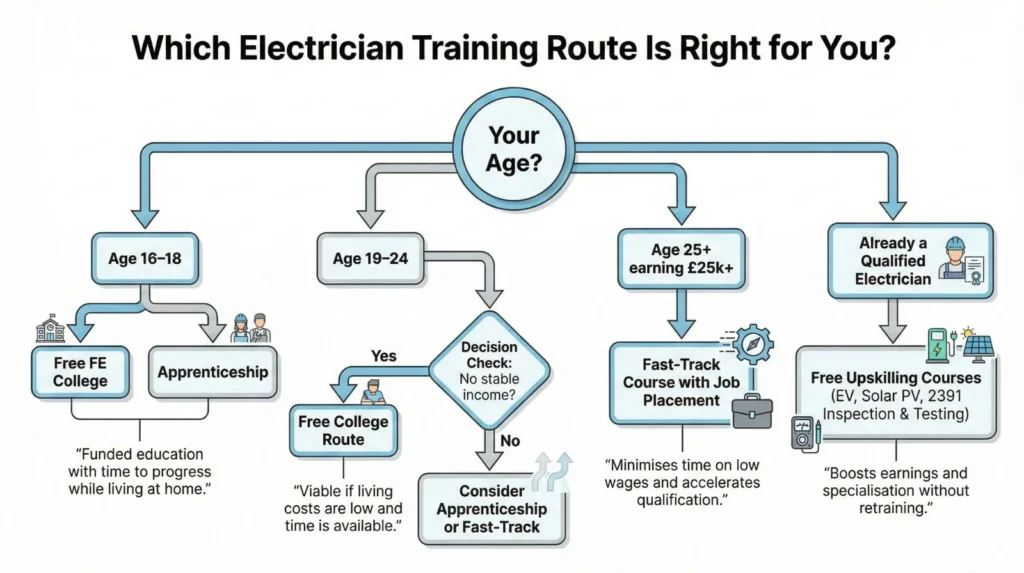
For School Leavers Aged 16-18
Free FE college courses and apprenticeships make perfect financial sense for young people without existing income or career history.
Why free works at this age:
Minimal opportunity cost: 16-18 year olds aren’t earning £25,000+ in alternative careers. The earnings sacrifice of apprentice wages (£15,912 year 1) or full-time college (£0 income) is offset by living with family, minimal financial obligations, and no mortgage/rent responsibility.
Time isn’t expensive: Spending 2-3 years in FE college or 4 years in apprenticeship doesn’t delay qualified status relative to earning potential. An 18-year-old completing apprenticeship at 22 or college route at 21 is entering qualified employment at prime career-building age.
Lower wage expectations: Employers readily hire 18-22 year old improvers at £22,000-£24,000. The age barrier affecting 30+ career changers doesn’t apply.
Educational development: Younger learners often benefit from the extended timeline of part-time college, allowing knowledge consolidation and maturity development alongside technical skills.
Joshua Jarvis, Placement Manager at Elec Training, explains the age distinction clearly:
"Free courses work perfectly for 16-18 year olds who aren't earning £25,000+ anyway. The opportunity cost is negligible. But for career changers at 30 with mortgages and families, the two-year timeline is financially devastating compared to intensive training with immediate placement into improver work. It's not about the tuition cost, it's about speed to qualified status."
Joshua Jarvis, Placement Manager
Recommendation for 16-18s: Pursue free FE college Level 2 and Level 3 (2-3 years) or electrical apprenticeship (4 years), both funded via AEB/Free Courses for Jobs or apprenticeship levy. Avoid expensive private fast-track courses. The time investment is justified at this life stage.
For Qualified Electricians Adding Specializations
Free courses deliver pure value when qualified electricians use government-funded upskilling for post-qualification specializations.
High-value free upskilling options:
EV Charging Installation (City & Guilds 2921):
Skills Bootcamps often fund this fully (£600-£900 value)
Wales Personal Learning Accounts cover up to £2,000 for EV training
Adds £2,000-£6,000 annual earning potential from domestic EV installation work (£800-£1,500 per installation, 4-6 hours)
Solar PV and Battery Storage:
Wales PLA prioritizes green technologies, funding £1,200-£1,800 courses at zero cost
Commercial solar installations generate £3,000-£8,000 per project
Payback: Single installation covers entire training value
Inspection & Testing Refreshers (2391 CPD):
Some Skills Bootcamps include 2391 updates
Wales PLA funds 2391 Level 3 Award (£1,000-£1,500 value)
Essential for maintaining Qualified Supervisor status for CPS membership
18th Edition Updates (BS 7671 revisions):
Typically £400-£600 for commercial course
Often funded via AEB or bootcamps when amendments publish
Mandatory for ECS card renewal
Why this makes sense:
Qualified electricians already earning £35,000-£50,000+ are sacrificing minimal income (1-2 weeks off for intensive training) to add specializations worth £2,000-£10,000 annually. The ROI is immediate and substantial. Tuition-free delivery via government schemes is genuinely valuable, not false economy.
Example calculation:
Qualified electrician earning £40,000 annually takes 5 days off (£770 lost wages) for free EV charging bootcamp (£900 tuition value). Installs 10 domestic EV chargers in first year post-training at £1,200 average = £12,000 additional revenue. Net benefit: £11,230 in year 1 alone.
When Free Courses Don’t Make Sense
Despite eligibility and zero tuition, free courses represent poor financial decisions in specific circumstances.
For adults 20+ earning £20,000+ in current careers:
The opportunity cost of 2-3 years part-time college (18-36 months to complete Level 2 and Level 3) delays qualification by 18-30 months compared to intensive routes. That delay costs £20,000-£45,000 in lost lifetime earnings through postponed access to qualified rates.
Cost-benefit fails when:
Current income is stable (£20,000+)
Mortgage/rent obligations require continuous income
Family financial responsibilities exist
Time to qualification matters (wanting career change within 2 years vs 4+ years)
Better option: Fast-track intensive course with guaranteed NVQ placement, accepting £10,000-£12,000 upfront cost in exchange for 21-27 month qualification timeline instead of 42-54 months.
For adults who cannot relocate or travel:
Free FE college courses require 2-3 year commitment to fixed location. If local electrical employment market is weak (rural areas, oversupplied cities), the post-diploma employment gap extends indefinitely.
Cost-benefit fails when:
Local area has <5 electrical contractors (insufficient improver vacancy supply)
Cannot travel 1+ hours for college attendance
Cannot relocate for employment after diploma completion
Better option: If cannot relocate, reconsider electrical trade entirely. Portfolio evidence requires site access, which requires electrical employment in reasonable proximity.
For learners without financial buffer:
Free tuition doesn’t eliminate the £3,500-£5,000 in non-tuition costs (NVQ assessment £1,800, AM2 £900, tools £800, books £200, travel £500, ECS £60). Without savings or income to cover these, learners become stuck at diploma stage unable to progress.
Cost-benefit fails when:
No savings for hidden costs
Cannot work during study (full-time college requires daytime availability)
No financial support from family
Better option: Apprenticeship (all costs employer-funded) or delay training until £5,000 saved.
Marketing Traps to Avoid
Government-funded training schemes are legitimate, but marketing practices around “free” courses create traps for uninformed learners.
Trap 1: Private Provider “Free Course” Packages
Some private training companies advertise “government-funded training” while bundling free diplomas into £8,000-£15,000 packages.
How it works:
Provider enrolls learners in FE college Level 3 Diploma (actually funded by Free Courses for Jobs at zero cost)
Provider charges £8,000-£12,000 for “support services,” “career coaching,” “NVQ preparation,” “guaranteed placement”
Learner believes they’re paying for the diploma, unaware college would deliver it free if they applied directly
The deception: The government already funds the diploma. The provider is charging for ancillary services, not the core qualification. In some cases, the “support” consists of access to job boards and generic CV advice, services available free elsewhere.
How to avoid: Always check whether qualifications are on the Free Courses for Jobs list. If yes, apply directly to local FE colleges. Ask private providers: “Is the diploma itself government-funded, and if so, what am I actually paying for?”
Legitimate use of funded diplomas: Some providers legitimately bundle funded diplomas with genuinely valuable services like guaranteed NVQ placement infrastructure, dedicated assessors, intensive AM2 preparation, and active employer partnerships. This adds value beyond free college provision. The key is transparency: providers should clearly state “diploma is government-funded, you’re paying for placement support and NVQ logistics.”
Trap 2: Taster Courses Advertised as "Training"
One-day or two-day “free electrician courses” exist, usually delivered by private companies or tool manufacturers, claiming to provide “electrical installation training.”
What they actually are:
Product demonstrations (tool company showcasing equipment)
Basic DIY wiring workshops (changing sockets, fitting light fixtures)
Sales funnels (free taster leading to £10,000 course upsell)
Marketing events (collecting contact details for sales teams)
What they DON’T provide:
City & Guilds or EAL qualifications
Progression toward NVQ Level 3
Employment opportunities
Meaningful skill development
Red flags:
No qualification code (C&G 2365, EAL 8202) mentioned
Course duration under 5 days
“Introduction to wiring” or “basic electrical skills” language
Hosted at hotels, conference centers, or non-educational venues
Requires providing contact details before seeing course content
How to avoid: If it’s shorter than 1 week, it’s not meaningful training. If it doesn’t state the exact qualification code and awarding body, it’s not a recognized course.
Trap 3: Online “Electrician Courses” Claiming Qualification
Multiple websites advertise “online electrician training” with “accredited certificates” for £50-£200, implying these qualify learners for electrical work.
The reality:
MOOCs (FutureLearn, Coursera, OpenLearn) provide basic circuit theory and electrical principles
Useful for building foundational knowledge before starting real qualifications
Zero value toward NVQ Level 3, AM2, or ECS Gold Card
No online course can replace:
Physical practical assessments (City & Guilds 2365 includes hands-on testing)
On-site NVQ portfolio evidence (must be real installations on real properties)
AM2 three-day practical exam at NET assessment centers
Industry position: NICEIC, NAPIT, and JIB explicitly state online-only training does not meet competence requirements under Electricity at Work Regulations 1989 Regulation 16. Practical demonstration is mandatory.
Legitimate use of online learning:
FutureLearn “Electrify” course: Excellent 6-week introduction to DC/AC circuits, UK-aligned to BS 7671 basics
IET YouTube content: Official BS 7671 guidance and updates
Open University OpenLearn: General engineering modules building maths/physics foundations
These are preparatory tools, not qualification substitutes. Use them before starting FE college or intensive courses to strengthen foundational knowledge.
Trap 4: “Guaranteed Qualification” Without NVQ Placement
Some training providers advertise “guaranteed qualification” or “fully qualified electrician” outcomes from classroom courses alone.
The deception:
Course delivers Level 2, Level 3, and 18th Edition (classroom components)
Marketing implies this equals “qualified electrician”
Omits that NVQ Level 3 and AM2 are still required
Provides no employment support for gathering NVQ evidence
Outcome: Learners complete diplomas believing they’re qualified, discover they cannot obtain ECS Gold Card, cannot join CPS (NICEIC/NAPIT), cannot self-certify installations, and employers won’t hire them without NVQ.
Regulatory action: The Competition and Markets Authority (CMA) and Advertising Standards Authority (ASA) have investigated electrical training providers for misleading qualification claims. Several providers received enforcement notices for advertising “fully qualified” outcomes from diploma-only courses.
How to avoid: Ask explicitly: “Does this course include NVQ Level 3 portfolio work, and if so, how do you provide the 18-24 months of site evidence?” If the answer is vague (“we help with job searches,” “you can build your portfolio independently”), it’s not a complete qualification package.
Elec Training’s approach: Guaranteed NVQ placement is explicitly included. In-house recruitment managers secure paid improver positions with 120+ partner contractors across the UK. Learners progress from classroom to employed site work within weeks, not months or years of independent job searching.
The Free Course Paradox
The cheapest course fees don’t produce the lowest total cost of qualification. For adults with existing income or earning potential, “free” tuition combined with 2-4 year timelines often costs £20,000-£40,000+ more in lost earnings and delayed qualification than £10,000-£15,000 intensive courses delivering qualified status in 18-24 months.
Free courses make financial sense when:
You’re 16-18 years old without existing career income
You’re a qualified electrician adding specializations (EV, PV, 2391 updates)
You’re unemployed with no alternative income during training
You have 2-4 years available and strong local employer networks for NVQ placement
Free courses are false economy when:
You’re 25+ earning £20,000+ in current career (opportunity cost exceeds tuition savings)
You need qualification within 18-24 months for career change timeline
You lack employer connections for NVQ portfolio work (employment gap costs exceed tuition)
You live in weak electrical employment market (cannot secure improver role post-diploma)
The critical variable is employment access for NVQ work. Free diplomas without guaranteed placement leave learners stuck at knowledge-only stage, unable to progress to qualified status despite completing funded training.
For adults seeking fastest, most reliable route to qualified electrician status:
Elec Training’s NVQ Level 3 electrical package combines intensive classroom delivery (Level 2, Level 3, 18th Edition in 12-16 weeks) with guaranteed placement into paid improver roles through in-house recruitment infrastructure. This model addresses the employment bottleneck that prevents most free-course graduates from progressing beyond diploma stage.
Investment: £10,000 package covering diplomas, NVQ assessment, and placement support
Timeline: 18-24 months from enrollment to ECS Gold Card
Outcome: Qualified electrician earning £35,000+ employed or £45,000-£70,000 self-employed CIS
Compare this to the free college route (£0 tuition, 42-54 months timeline, 6-18 month employment gap, £4,000 hidden costs) and the financial advantage of intensive training with guaranteed placement becomes clear.
For a full comparison of all qualification routes including apprenticeships, FE college pathways, experienced worker assessment, and realistic timelines, read our comprehensive guide: How to Become an Electrician in the UK: The 2026 Complete Guide.
To discuss whether free courses or intensive training with guaranteed NVQ placement best suits your circumstances, career timeline, and financial situation, call us on 0330 822 5337. We provide honest assessments of which pathway aligns with your age, existing income, location, and qualification urgency, helping you avoid expensive mistakes that cost years of lost earnings.
References
- GOV.UK, Free Courses for Jobs: Guidance for Learners 2025-2026: https://www.gov.uk/guidance/free-courses-for-jobs
- Education and Skills Funding Agency, Adult Skills Fund Funding Rules 2025-2026: https://www.gov.uk/government/publications/adult-skills-fund-funding-rules
- Department for Education, Skills Bootcamps Programme: https://www.gov.uk/government/publications/esfa-skills-bootcamps
- Institute for Apprenticeships and Technical Education, Apprenticeship Funding Rules: https://www.gov.uk/guidance/apprenticeship-funding-rules
- Welsh Government, Personal Learning Accounts: https://careerswales.gov.wales/courses-and-training/funding-your-studies/personal-learning-accounts
- Student Awards Agency Scotland, Part-time Fee Grant: https://www.saas.gov.uk/
- Department for the Economy NI, Skill Up Programme: https://www.economy-ni.gov.uk/articles/skill
- NET (National Electrotechnical Training), AM2 Assessment Fees 2025-2026: https://www.netservices.org.uk
- CITB, Qualification Grants and Funding 2025: https://www.citb.co.uk/levy-grants-and-funding/grants-and-funding/qualification-grants/
- NICEIC, Qualified Electrician Requirements: https://niceic.com/
- ECA (Electrical Contractors’ Association), Training Standards: https://www.eca.co.uk/
- Competition and Markets Authority, Misleading Advertising Investigations: https://www.gov.uk/cma-cases
- Elec Training, How Much Can You Make as an Electrician? 2026 Pay Guide: https://elec.training/news/how-much-can-you-make-as-an-electrician-a-2026-pay-guide/
- ElectriciansForums.net, Adult Training Routes Discussions: https://www.electriciansforums.net/
- Reddit r/ukelectricians, Free Course Experiences: https://www.reddit.com/r/ukelectricians/
Last reviewed: 16 December 2025. This guide reflects 2025-2026 funding rules for Free Courses for Jobs (income threshold £25,750), Adult Education Budget eligibility, Skills Bootcamps expansion, apprenticeship levy structures, and devolved nation schemes (Wales PLA, Scotland fee waivers, NI Skill Up). Funding criteria, income thresholds, and qualification lists update annually. Always verify current eligibility with training providers, FE colleges, and government funding portals before enrolling. This guide provides evidence-based financial analysis for planning purposes but cannot replace personalized advice considering individual circumstances. Contact Elec Training on 0330 822 5337 for tailored route assessment, realistic timeline guidance, and guaranteed NVQ placement support addressing the employment gap that prevents most free-course graduates from reaching qualified electrician status.
