
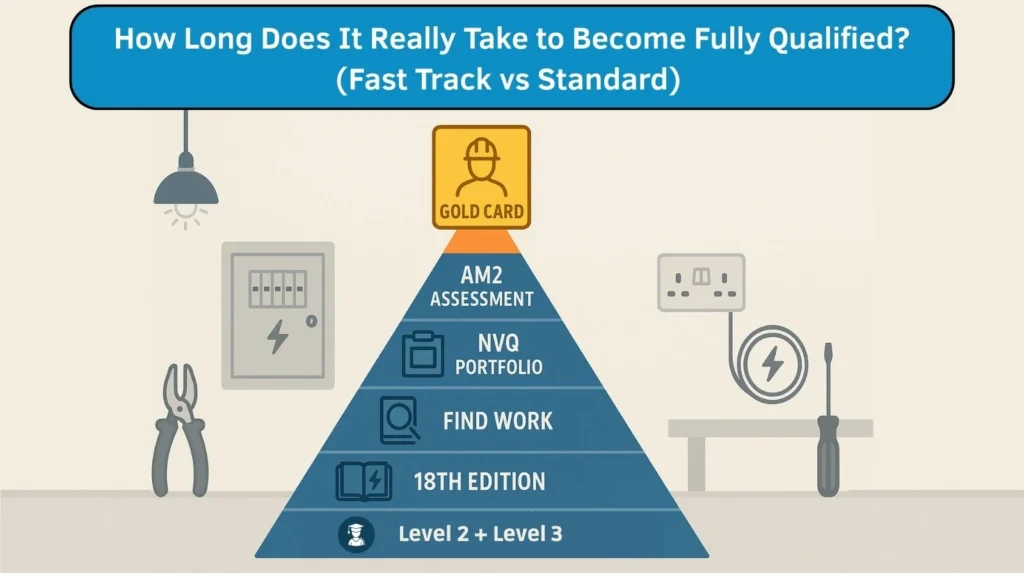
How Long Does It Really Take to Become Fully Qualified? (Fast Track vs Standard)

- Technical review: Thomas Jevons (Head of Training, 20+ years)
- Employability review: Joshua Jarvis (Placement Manager)
- Editorial review: Jessica Gilbert (Marketing Editorial Team)
- Last reviewed:
- Changes: Initial publication
Why Timeline Information Matters (And Why It's So Confusing)
If you’ve researched becoming an electrician in the UK, you’ve probably seen wildly different timelines. “Qualified in 8 weeks!” says one provider. “3-4 years minimum” says another. “12-18 months as an adult learner” claims a third. So which is it?
The confusion exists because different providers are measuring different things. Some count only classroom time. Others include the entire pathway to full qualification. Some are honest. Some are deliberately misleading.
Here’s what actually matters: How long does it take from starting with zero qualifications to holding an ECS Gold Card and being employable as a qualified electrician?
That’s the question this article answers, using official qualification requirements, real candidate timelines from forums and case studies, and data from awarding bodies like City & Guilds, JIB, and ECS.
We’ll compare fast-track routes (intensive short courses) with standard routes (apprenticeships and college programmes), break down each stage of qualification, explain what affects your timeline, and show you what real people actually experience.
This is a comprehensive comparison of fast-track and standard training pathways based on evidence, not marketing. If you want honest timeline information that helps you plan realistically, this is it.
What "Fully Qualified Electrician" Actually Means (Official Requirements)
Before we discuss timelines, let’s establish what you’re working towards. “Fully qualified electrician” in the UK typically means you have:
1. Level 2 Diploma in Electrical Installations (City & Guilds 2365-02)
Foundation knowledge covering electrical science, regulations, and basic installation principles.
2. Level 3 Diploma in Electrical Installations (City & Guilds 2365-03)
Advanced theory including design, inspection, testing, and fault-finding.
3. 18th Edition Wiring Regulations (BS 7671:2018+A2:2022)
Current regulations governing electrical installations in the UK.
4. NVQ Level 3 in Electrical Installation (City & Guilds 2357)
On-site portfolio demonstrating competence across multiple installation types, testing procedures, and real-world work. This is the critical component that proves practical competence, not just classroom knowledge.
5. AM2 or AM2E Assessment
Three-day practical exam testing your ability to safely install, test, and certify electrical work under timed conditions.
6. ECS Gold Card
Electrotechnical Certification Scheme card confirming you hold the above qualifications and can work on construction sites. JIB Gold Card for those working under JIB grading agreements.
According to the IET (Institution of Engineering and Technology):
"An electrician is generally someone who has completed a 3-4 year apprenticeship and holds a Level 3 technical and vocational qualification or Level 3 Diploma."
National Careers Service confirms:
"There are 2 assessment routes available, with one requiring at least 3 years' experience and the other needing 5 years."
This is the standard. Fast-track courses that claim “fully qualified” status in weeks are not measuring against this standard. They’re measuring classroom components only.
The Official Timelines (From Awarding Bodies and Regulators)
Let’s start with what City & Guilds, JIB, ECS, and the Department for Education officially state about qualification timelines.
Level 2 and Level 3 Diplomas (2365)
Official duration:
Level 2 (2365-02): Can be completed in 4 weeks full-time intensive
Level 3 (2365-03): Can be completed in 8-12 weeks full-time intensive
Combined: Typically 3-6 months full-time, or 1-2 years part-time
City & Guilds confirms these courses can be delivered intensively. Fast-track providers are correct that the classroom component can be completed quickly.
What this covers: Theory, regulations, and simulated practical work in training bays.
What this doesn’t cover: Real on-site experience, NVQ portfolio, or competence demonstration.
18th Edition (BS 7671)
Official duration:
- 5 days full-time (some providers offer 3-day intensive options)
- Online self-study versions: typically 4-8 weeks
This is a straightforward regulations course with an exam at the end. Duration is consistent across providers.
NVQ Level 3 (2357)
Official duration from City & Guilds:
- Minimum: 6 months with full-time site access and varied work
- Typical: 12-18 months
- Maximum registration period: 3 years
City & Guilds states:
"This City and Guilds NVQ Level 3 electrical qualification is aimed at Electrical Trainees or Electrical Improvers who have completed their Level 2 & 3 Diplomas. As a rough guide, we find most people will complete it in 6-18 months."
The NVQ 2357 is designed for those with less than 5 years of experience. It requires building a portfolio of evidence across multiple units, covering installation, testing, fault-finding, and maintenance work.
What affects this timeline:
- Site access (full-time vs part-time work)
- Variety of work available (domestic, commercial, industrial)
- Employer support for assessment
- Assessor availability
- Your own work rate and reliability
Experienced Worker Assessment (EWA 2346)
For those with 5+ years of verified electrical experience:
- Duration: 6-12 months to complete portfolio and AM2E
- Requires evidence of at least 5 years on the tools
- Portfolio submission proving competence
- AM2E assessment
AM2 Assessment
Official duration:
- The assessment itself: 3 days
- Preparation: typically 1-3 months
- Booking wait times: can vary from 2 weeks to 3+ months depending on test centre availability
The AM2 tests your ability to install, test, and certify electrical work safely under timed exam conditions. Pass rates for first-time candidates are around 60%, with over 85% passing if they’ve done preparation courses.
NET (the official AM2 test provider) states: “This can take between 4-6 weeks” for certificate processing after passing.
Apprenticeships
Official duration from Department for Education:
- Traditional apprenticeship: 3-4 years (recently reduced minimum from 12 months to 8 months as of August 2025, but electrical apprenticeships typically remain 3-4 years)
- Domestic Electrician apprenticeship: 36 months on-programme, plus 6 months for end-point assessment
Apprenticeships include:
- Level 2 and Level 3 diplomas
- NVQ Level 3 portfolio building throughout
- 18th Edition
- AM2 or AM2S assessment
- Supervised site work from day one
Fast-Track Route: Realistic Timeline Breakdown
Let’s map out what actually happens when you follow a fast-track route as an adult learner with no existing qualifications or experience.
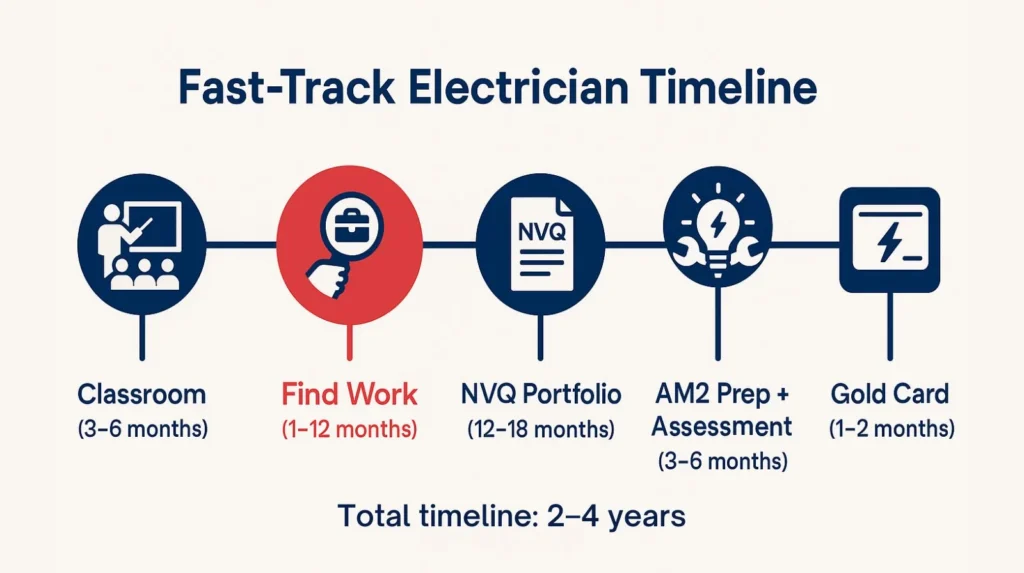
Stage 1: Classroom Qualifications (3-6 months)
What’s included:
- Level 2 Diploma (2365-02): 4 weeks full-time
- Level 3 Diploma (2365-03): 8-12 weeks full-time
- 18th Edition: 1 week
Total classroom time: 13-17 weeks if done consecutively
Cost: £2,500 to £6,000 depending on provider
Outcome: You have classroom qualifications showing theoretical knowledge and basic practical skills in training bays.
What you can do at this stage: Very little. You’re not qualified to work unsupervised, you can’t join NICEIC/NAPIT, you don’t have a Gold Card. Employers will only consider you for mate or labourer roles at this point.
Stage 2: Finding Employment (Timeline: Unknown and Variable)
This is where fast-track routes hit their first major problem. You’ve finished classroom training, but you now need to secure employment where you can build your NVQ portfolio.
Typical timeline: 1 week to 12+ months
Factors affecting this:
- Quality of provider’s placement support
- Local market demand
- Your location (easier in London/South-East, harder in rural areas)
- Your age, attitude, and willingness to start on low wages
- Employer willingness to take on fast-track learners
Joshua Jarvis, Placement Manager at Elec Training, explains:
"Lack of employer support is the biggest timeline barrier we see. Adult learners coming from fast-track courses often can't find employers willing to supervise their NVQ portfolio building. They end up stuck with diplomas but no progression pathway, adding months or years to their timeline whilst they search for opportunities. That's why a training provider that gets you into work is essential."
Joshua Jarvis, Placement Manager
Real examples from forums:
Reddit user:
"I have done the 16 week fast course (I know, not the best route) as I rang every single company for an apprenticeship but with no luck. I'm now stuck trying to find someone to take me on."
Another:
"Finished my Level 2 and 3 six months ago. Can't find a single employer who'll take me on to build my NVQ. Starting to think I've wasted my money."
ElectriciansForums:
"Did the fast-track. Got my certificates. Been looking for work for 8 months. Employers either want apprentices or experienced electricians. They don't want fast-track grads with no site time."
If you secure employment quickly (within 1-2 months), you’re lucky. Many learners take 6-12 months or longer. Some never find suitable employment and abandon the pathway.
Stage 3: NVQ Level 3 Portfolio Building (12-18 months minimum)
Once you’ve secured work, you can start building your NVQ 2357 portfolio.
Official timeline: 6-18 months, but heavily dependent on circumstances
What’s involved:
- Working on real installations under supervision
- Gathering photographic evidence of your work
- Completing written assignments for each unit
- Having your work observed and signed off by a qualified assessor
- Demonstrating competence across multiple installation types, testing scenarios, and fault-finding situations
Units to complete (NVQ 2357-93 Installation route):
- Unit 102: Understanding health and safety
- Unit 103: Understanding the principles of planning and selection
- Unit 104: Understanding the principles of inspection, testing and commissioning
- Unit 105: Understanding the practices and procedures for the termination and connection of conductors, cables and cords
- Unit 110: Installing wiring enclosures, cable management systems and fixing, positioning and identifying electrical equipment
- Unit 111: Installing electrical wiring systems, wiring enclosures and equipment
Each unit requires specific evidence types, and your assessor must observe you completing tasks in real installations.
Realistic timelines from Reddit/forums:
"My NVQ took 14 months. I was working full-time on varied commercial work, had a good assessor who visited every 6 weeks, and my employer was supportive. Even then it was tight."
"Took me 22 months to complete my NVQ. I was on domestic work which is quite repetitive, so it took longer to get evidence of different installation types."
"If you're only working 2-3 days a week or stuck doing the same repetitive tasks, your NVQ will take 2+ years easily."
City & Guilds allows a 3-year window for registration,
"deemed a reasonable time to expect to complete this NVQ process."
Timeline killers:
- Limited site access (part-time work)
- Repetitive work that doesn’t cover all units
- Assessor delays or cancellations
- Employer not understanding NVQ requirements
- Personal circumstances (illness, family commitments)
- Poor relationship with employer
Stage 4: AM2 Preparation and Assessment (3-6 months)
Once your NVQ portfolio is complete, you can book your AM2.
Timeline breakdown:
- Preparing for AM2: 1-3 months (self-study, revision, preparation courses)
- Booking wait times: 2 weeks to 3 months depending on test centre
- The assessment itself: 3 days
- Receiving results and certificate: 4-6 weeks
Pass rates: Around 60% first-time pass. Those who fail need to rebook (another 1-3 month wait) and pay again (£800-£1,000).
Reddit user:
"I wanted to ask if anyone has booked their AM2 recently, where did you book and what are the wait times? I've potentially got a place in 9 weeks."
Another:
"How long are people waiting to do their AM2? My local centre said 3 months minimum."
Stage 5: ECS Gold Card Application (1-2 months)
After passing AM2, you apply for your ECS Gold Card.
Timeline: Processing typically takes 4-6 weeks once you’ve submitted all documents.
What you need:
- NVQ Level 3 certificate
- Level 2 and Level 3 Diploma certificates
- 18th Edition certificate
- AM2 pass certificate
- Passport photo
- Application fee
Total Fast-Track Timeline (Realistic)
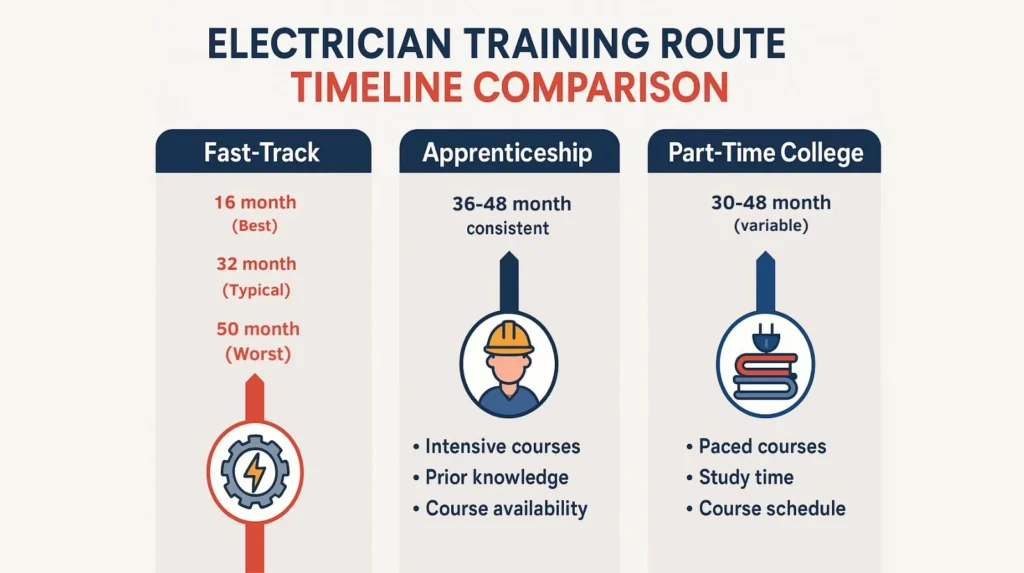
Best-case scenario (everything goes smoothly):
- Classroom qualifications: 4 months
- Finding employment: 2 months
- NVQ portfolio: 12 months
- AM2 prep and assessment: 4 months
- Gold Card application: 2 months
- Total: 24 months (2 years)
Typical scenario (normal delays and challenges):
- Classroom qualifications: 5 months
- Finding employment: 6 months
- NVQ portfolio: 18 months
- AM2 prep and assessment (including one fail/resit): 6 months
- Gold Card application: 2 months
- Total: 37 months (just over 3 years)
Worst-case scenario (significant barriers):
- Classroom qualifications: 6 months
- Finding employment: 12+ months
- NVQ portfolio: 24 months (limited site access, repetitive work)
- AM2 prep and assessment (two attempts): 8 months
- Gold Card application: 2 months
- Total: 52+ months (4+ years)
Thomas Jevons, Head of Training at Elec Training, clarifies:
"From a training perspective, adult learners following the proper route realistically need 2 to 3 years minimum: 3-6 months for Level 2/3 diplomas and 18th Edition, 12-18 months building NVQ portfolio on site, 3 months preparing for and sitting AM2, then applying for Gold Card. Provided you have good employer support, that's achievable. Claims of faster routes are misleading."
Thomas Jevons, Head of Training
Standard Route: Realistic Timeline Breakdown
Now let’s compare with traditional pathways.
Apprenticeship Route (3-4 years)
Timeline: 36-48 months from start to qualified status
What’s included throughout:
- On-the-job training from day one
- Level 2 and Level 3 diplomas (delivered part-time alongside work)
- 18th Edition
- NVQ Level 3 portfolio building continuously
- AM2 or AM2S end-point assessment
- Supervised work experience throughout
Key differences from fast-track:
- You’re earning from day one (starting around £12,000-£18,000/year, increasing annually)
- No employment gap, you’re placed with an employer immediately
- NVQ portfolio builds naturally over 3-4 years
- Everything is structured and coordinated
- Employer is committed to your qualification
Downsides:
- Takes longer overall (though you’re earning throughout)
- Lower initial wages
- Competitive to secure (especially for adults over 25)
- Requires GCSEs in Maths and English for most apprenticeships
Real timeline from forums:
Reddit user:
"I'm 2 years into my apprenticeship at 39 and love it way more than my white collar job. It's hard work but worth it."
Another:
"The Apprenticeship will likely be 3 years of study at a college, one day a week, plus however long it takes you to complete the portfolio."
College Route (Part-Time) + Employment (2.5-4 years)
Timeline: 30-48 months
Stage 1: College Qualifications (1-2 years)
- Level 2 and Level 3 diplomas: 1-2 years part-time (evenings/weekends)
- 18th Edition: 1 week or self-study
- Cost: Often free or heavily subsidised for adults
Stage 2: Finding Employment (1-12 months) Same challenge as fast-track route
Stage 3: NVQ Portfolio (12-18 months) Build portfolio whilst working
Stage 4: AM2 (3-6 months) Prepare and sit assessment
Total: 2.5-4 years depending on employment access
Benefits over fast-track:
- Cheaper (often free college courses)
- Longer classroom learning period (more thorough)
- Can keep current job whilst studying part-time
Downsides:
- Slower classroom phase
- Still face employment gap after college
- Takes longer overall
Reddit user:
"Do a 2365 part time. Level 2 & 3 together will take 4 years and cost a lot of money. I then still need to do a NVQ Level 3 and pass an AM2 test."
Experienced Worker Route (6-12 months)
Who it’s for: Those with 5+ years of verified electrical work experience
Timeline: 6-12 months
What’s involved:
- Evidence portfolio submission (using past work)
- Skills scan
- EWA 2346 portfolio
- AM2E assessment
This is genuinely the fastest legitimate route, but it requires you to already have 5+ years of electrical work. You can’t fake this, as employers and past projects must verify your experience.
What Actually Affects Your Timeline (The Variables That Matter)
Your timeline isn’t just about the route you choose. These factors make the difference between 2 years and 5 years.
Employment Access
Biggest single factor.
If you secure a full-time improver role immediately after classroom training with an employer who supports your NVQ, you’re on the fast track within the fast-track route.
If you spend 6-12 months searching for work, or end up in a mate role with no assessment opportunities, you’re adding years to your timeline.
Reddit user:
"The quickest I seen it was 14 months: 2365-02, 2365-03, and 18th Edition back-to-back, then straight into a job building NVQ and AM2 done quickly. But that's rare."
2. Work Variety
NVQ requires evidence across multiple installation types, testing scenarios, and fault-finding work.
If you’re on varied commercial projects (offices, retail, industrial), you’ll gather evidence faster.
If you’re stuck doing repetitive domestic work (socket changes, consumer unit swaps), your timeline extends significantly.
Forum user:
"Took me 22 months to complete my NVQ. I was on domestic work which is quite repetitive, so it took longer to get evidence of different installation types."
6. AM2 Pass Rate
First-time pass rate is around 60%. If you fail, you’re adding 3-6 months to your timeline for rebooking, additional preparation, and resitting.
Over 85% pass if they use AM2 preparation courses, so investing in prep is worth it.
7. Personal Circumstances
Life happens. Illness, family commitments, financial pressures, relationship breakdowns, and other personal issues can pause or slow your progression.
The 3-year NVQ registration window exists because City & Guilds recognises that life isn’t always straightforward.
3. Employer Support
Employers who understand NVQ requirements, allow assessor visits, give you varied tasks, and support your learning will speed up your timeline.
Employers who see you as cheap labour, don’t understand NVQ, or won’t facilitate assessor access will slow you down or stop your progress entirely.
4. Assessor Availability
NVQ requires regular assessor visits to observe your work and sign off evidence.
If your assessor is reliable, visits every 4-6 weeks, and provides clear feedback, you’ll progress quickly.
If your assessor cancels frequently, is hard to contact, or doesn’t give clear guidance, you’ll waste months.
5. Your Own Work Ethic
This matters more than people admit.
Learners who:
- Show up on time consistently
- Volunteer for varied tasks
- Ask questions and learn actively
- Maintain good relationships
- Keep their portfolio organised
- Don’t need constant supervision
…complete NVQs faster.
Those who:
- Have poor attendance
- Avoid difficult tasks
- Don’t engage with assessors
- Create conflict with employers
- Leave portfolio until the last minute
…take years longer or never finish.
Joshua Jarvis notes:
"Work ethic and attitude often determine timeline success more than course speed. Employers support learners who make their investment worthwhile."
Joshua Jarvis, Placement Manager
6. AM2 Pass Rate
First-time pass rate is around 60%. If you fail, you’re adding 3-6 months to your timeline for rebooking, additional preparation, and resitting.
Over 85% pass if they use AM2 preparation courses, so investing in prep is worth it.
7. Personal Circumstances
Life happens. Illness, family commitments, financial pressures, relationship breakdowns, and other personal issues can pause or slow your progression.
The 3-year NVQ registration window exists because City & Guilds recognises that life isn’t always straightforward.
Real Candidate Timelines (From Forums and Case Studies)
Let’s look at actual timelines people have shared.
Fast Success (14-18 months):
Reddit user:
"Quickest way to get fully qualified with no experience. The quickest I seen it was 14 months: 2365-02, 2365-03, and 18th Edition back-to-back, then straight into a job, built NVQ fast, passed AM2. But that person had no delays and a great employer."
YouTube case study:
"Luke's experience as an adult learner, balancing evening college with work. Took 2 years total from starting Level 2 to getting Gold Card. He had employer support throughout and worked full-time on varied projects."
Typical Timeline (2.5-3 years):
Reddit user:
"It takes 3-5 years to get fully qualified. It really depends on whether your employer has the range of work on for you to be assessed on."
Another:
"I'm 6 years into being an electrician. Joined as an apprentice. The full gamut is Level 2, Level 3, 18th Edition, NVQ3, AM2. Will take about 3-4 years all in."
Forum user:
"My NVQ took 14 months, AM2 took another 4 months to prepare and sit. Total from starting Level 2 to Gold Card was just under 3 years."
Slow Progress (4+ years):
Reddit user:
"If you can afford it, I would recommend doing the NVQ yes. It'll take about 2-3 years with them depending on how easily you manage to access work. But I've seen people take 4-5 years if work is limited."
Forum user:
"Been trying to get my NVQ done for 4 years. Employer doesn't support it properly, assessor is useless, and I'm stuck on repetitive work. Starting to think I'll never finish."
Another:
"Finished Level 2 and 3 in 2020. Still haven't completed my NVQ in 2025. Can't find stable employment that allows me to build evidence properly."
Age-Specific Examples:
Reddit user (39 years old):
"I'm 2 years into my apprenticeship at 39. It's hard work but worth it."
Another (42 years old):
"I'm 42, out of the trade for a while, trying to rebuild confidence. It's taking longer than expected because I'm having to relearn things and find employers willing to take a chance."
Forum user (24 years old):
"I'm 24, did the fast-track route. Took me 2.5 years total: 4 months classroom, 6 months finding work, 16 months NVQ, 4 months AM2."
Common Timeline Myths and Misconceptions
Let’s clear up the misleading claims.
Myth 1: “You can become a qualified electrician in 8-16 weeks”
Reality: You can complete Level 2, Level 3, and 18th Edition classroom qualifications in 8-16 weeks. You cannot become a qualified electrician (with NVQ Level 3, AM2, and Gold Card) in that timeframe.
Marketing that implies full qualification in weeks is misleading.
Myth 2: “Fast-track is always faster than apprenticeships”
Reality: Fast-track is faster for classroom qualifications only. The overall timeline to full qualification is often similar or longer than apprenticeships because:
- Employment gap after classroom training
- Potential delays building NVQ
- No structured employer support
Apprenticeships take 3-4 years but you’re earning and progressing throughout. Fast-track can take 2-4 years with significant unemployment or low-wage periods.
Myth 3: “NVQ Level 3 can be completed in 3 months”
Reality: The minimum official timeline is 6 months with full-time varied work. Typical timeline is 12-18 months. Claims of 3-month NVQs refer to experienced workers with 5+ years already on the tools using past evidence.
For someone new to the trade, 3 months is impossible.
Myth 4: “Once you finish classroom training, you’re nearly qualified”
Reality: Classroom training is roughly 20-30% of the qualification journey. The NVQ portfolio and AM2 are the majority of the work and take the majority of the time.
Forum user:
"People finish their Level 2 and 3 thinking they're 80% done. Then they discover the NVQ takes 18 months and they're nowhere near qualified. It's demoralising."
Myth 5: “Experienced Worker route is a shortcut”
Reality: It’s only faster if you genuinely have 5+ years of verified electrical experience. You can’t fake this. Employers and projects must verify your work history, and the portfolio still requires comprehensive evidence.
If you don’t have the experience, this route isn’t available to you.
Myth 6: “Part-time work will let you complete NVQ just as fast”
Reality: Part-time work (2-3 days/week) typically doubles your NVQ timeline. If full-time work takes 12 months, part-time will take 20-24 months.
You need sufficient hours and task variety to gather evidence. Limited hours = limited evidence = extended timeline.
Timeline Barriers and How to Avoid Them
Here’s what actually stops people from progressing, based on forum complaints and case studies.
Barrier 1: Can’t Find Employment After Classroom Training
How common: Very common for fast-track learners
Impact: Adds 3-12+ months to timeline, sometimes leads to complete abandonment
How to avoid:
- Choose a training provider with active recruitment support (not just job boards)
- Research employment support before enrolling
- Have savings to cover unemployment period
- Be willing to start as a mate on lower wages
- Consider apprenticeships or college routes with built-in employment
At Elec Training, our recruitment team makes over 100 calls per student to secure placements with our contractor network. That level of active support is what prevents this barrier.
Barrier 2: Employer Doesn’t Support NVQ Portfolio Building
How common: Common, especially with small domestic contractors
Impact: Adds 6-24 months to timeline or stops progress entirely
How to avoid:
- Clarify NVQ support during job interviews
- Ask if they’ve supervised NVQ learners before
- Get written confirmation they’ll allow assessor visits
- Choose employers working on varied projects
- If employer won’t support you, change employers early rather than wasting years
Barrier 3: Assessor Issues (Cancellations, Poor Guidance, Delays)
How common: Moderately common
Impact: Adds 3-6 months to timeline
How to avoid:
- Choose providers with multiple assessors (so cancellations can be covered)
- Maintain good communication with assessor
- Keep portfolio organised and up-to-date
- Don’t wait until the last minute to gather evidence
- Raise concerns with training provider if assessor is consistently unavailable
Barrier 4: Limited Work Variety
How common: Very common in domestic work, less common in commercial
Impact: Adds 6-12 months to NVQ timeline
How to avoid:
- Target employers working on varied projects (commercial, industrial, mixed)
- Avoid purely domestic roles unless you’re specifically going domestic installer route
- Ask employers about project types during interviews
- Be willing to travel for better opportunities
Barrier 5: AM2 Failures
How common: 40% fail first time
Impact: Adds 3-6 months per failure
How to avoid:
- Invest in AM2 preparation courses (85%+ pass rate vs 60% without prep)
- Practice safe isolation, testing procedures, and cable terminations thoroughly
- Don’t rush to book AM2 until you’re genuinely ready
- Get feedback from experienced electricians before booking
Barrier 6: Financial Pressure
How common: Very common for adult learners
Impact: Forces people into inappropriate work or causes them to quit
How to avoid:
- Have 6-12 months of savings before starting
- Budget for 2-3 years on lower wages
- Consider part-time routes if you need to keep current income
- Don’t rely on provider’s “guaranteed job” promises without verification
- Use Section 75 protection (credit cards) when paying for training
Which Route Is Actually Faster (And For Whom)?
The answer depends on your circumstances.
Fast-Track is Faster IF:
✅ You have savings to support yourself for 2-3 years on low/no income
✅ You can secure employment immediately after classroom training
✅ You’re in an area with good employment opportunities (London, South-East, major cities)
✅ You’re highly motivated and organised
✅ You choose a provider with genuine employment support
✅ You get lucky with employer and assessor support
Realistic fast-track timeline with everything going well: 2-2.5 years
Apprenticeships Are Better IF:
✅ You can’t afford to be unemployed or on low wages for extended periods
✅ You want structured, coordinated training
✅ You value earning throughout the process
✅ You meet entry requirements (GCSEs, age restrictions less common now)
✅ You can commit to 3-4 years
✅ You want certainty that you’ll complete the full qualification
Realistic apprenticeship timeline: 3-4 years
Part-Time College is Better IF:
✅ You need to keep your current job
✅ You want low-cost classroom training
✅ You’re prepared for a longer overall timeline
✅ You have flexibility in when you secure electrical work
✅ You want a slower, more thorough learning pace
Realistic part-time college timeline: 3-4 years
Experienced Worker Route is Faster IF:
✅ You genuinely have 5+ years of verified electrical experience already
✅ You can evidence past work comprehensively
✅ You’re already working in electrical roles
Realistic EWA timeline: 6-12 months (but only available to experienced workers)
The Timeline Calculator: Work Out Your Realistic Timeline
Use this calculator to estimate your timeline based on your circumstances.
Start with base timeline: 24 months (2 years)
Add time for:
- No immediate employment after classroom training: +6 months
- Part-time work (not full-time): +6 months
- Repetitive work with limited variety: +6 months
- Poor employer support for NVQ: +6-12 months
- Assessor availability issues: +3 months
- Personal circumstances (family, health, finances): +3-6 months per major issue
- AM2 failure (first time): +4 months
- Living in area with limited electrical opportunities: +3-6 months
Subtract time for:
- Immediate full-time placement with varied work: -3 months
- Excellent employer NVQ support: -3 months
- Previous trade experience (not electrical): -2 months
- Strong work ethic and organisation: -2 months
Example Calculation 1 (Best case):
- Base: 24 months
- Immediate full-time placement: -3 months
- Excellent employer support: -3 months
- Strong work ethic: -2 months
- Total: 16 months (but this is rare)
Example Calculation 2 (Typical):
- Base: 24 months
- 3 months finding employment: +3 months
- Part-time work initially: +3 months
- Some assessor delays: +2 months
- Total: 32 months (2 years 8 months)
Example Calculation 3 (Challenging):
- Base: 24 months
- 8 months finding employment: +8 months
- Poor employer NVQ support: +8 months
- Limited work variety: +6 months
- AM2 failure first time: +4 months
- Total: 50 months (over 4 years)
This calculator shows why the “8 weeks to qualified” marketing is absurd, and why honest providers give 2-3 year timelines.
What Employers Actually Care About (Timeline Perspective)
Here’s what matters to employers when you’re applying for work.
They don’t care about:
Whether you did a 4-week or 4-year route for classroom qualifications
Which training provider you used
How fast you completed Level 2/3 diplomas
They do care about:
Whether you have NVQ Level 3 and AM2 (Gold Card)
How much verified site experience you have
Your attitude, reliability, and work ethic
Whether you can work unsupervised safely
Your references from previous employers/supervisors
"From what I've seen in the UK, employers care about whether you have your Gold Card and can demonstrate competence. They don't care if you got there via 3-year apprenticeship or 2-year fast-track. But they won't hire you until you've actually got there."
Reddit user:
"Mate came in with all his certificates from a fast-track course. Boss asked 'Where's your Gold Card?' He said 'I need work to get that.' Boss said 'Come back when you're qualified.' That's the reality."
Forum user:
The timeline that matters to employers is:
"How long until you're independently competent?" Not "How long did your classroom training take?"
The Honest Timeline Comparison Summary
Let’s bring it all together with brutal honesty.
Fast-Track Claims: “8-16 weeks to qualified”
What that actually means: “8-16 weeks of classroom training, after which you’ll still need 18-24+ months of supervised work, NVQ portfolio building, and AM2 to become qualified.”
Realistic total timeline: 2-4 years depending on employment access and support
Best for: Adults with savings, no dependents, ability to handle unemployment risk, and access to good employment opportunities
Risks: Extended unemployment, poor employer support, financial pressure, potential never completing
Apprenticeship Reality: “3-4 years”
What that actually means: “3-4 years from start to qualified, earning throughout, structured progression, coordinated training and work.”
Realistic total timeline: 3-4 years consistently
Best for: People who value certainty, want to earn while learning, need structured support, can commit to longer timeline
Risks: Lower initial wages, harder to access as older adult, longer overall timeline
Part-Time College: “1-2 years college, then work”
What that actually means: “1-2 years evening/weekend classes for classroom qualifications, then 18-24+ months building NVQ whilst working.”
Realistic total timeline: 3-4 years
Best for: People who need to keep current job, want cheap classroom training, can handle extended timeline
Risks: Very long overall timeline, still face employment gap, requires high self-motivation
Experienced Worker: “6-12 months”
What that actually means: “6-12 months to complete portfolio and AM2E if you already have 5+ years of verified electrical experience.”
Realistic total timeline: 6-12 months (but only available to experienced workers)
Best for: People already working in electrical roles who need formal qualifications
Risks: None if you genuinely have the experience; everything if you don’t
Making an Informed Timeline Decision
Based on all the evidence, here’s how to make a realistic decision.
If you’re considering fast-track:
Ask providers for their realistic complete timeline (not just classroom)
Get written evidence of employment support (not vague promises)
Research actual learner outcomes (Trustpilot, forums, Reddit)
Budget for 2-3 years of lower income
Have contingency plans if employment doesn’t materialise
Understand you might not complete if employment isn’t secured
If you’re considering apprenticeships:
Research local apprenticeship opportunities
Prepare for lower wages but certainty of completion
Commit to 3-4 years fully
Understand entry requirements (GCSEs often needed)
Accept longer timeline in exchange for structure and earnings
If you’re considering part-time college:
Research local FE college offerings
Budget for 3-4 years overall timeline
Plan how you’ll secure employment after classroom phase
Consider if you can maintain motivation over extended period
Confirm courses are free/subsidised before enrolling
Questions to ask any provider:
“What’s the realistic timeline from starting with you to holding a Gold Card?”
“How many of your learners secure employment within 3 months of classroom training?”
“What’s your average NVQ completion time?”
“Can you show me evidence of learners who’ve completed the full pathway?”
“What happens if I can’t find employment after classroom training?”
If providers won’t answer these clearly, walk away.
For a detailed timeline breakdown for accelerated electrician training that includes realistic employment support timelines and NVQ progression, our main resource covering all fast-track training realities provides transparent information about what each stage actually involves.
At Elec Training, we’re upfront: our classroom courses take 3-6 months. Your NVQ will take 12-18 months. Your AM2 will take 3-6 months to prepare and sit. Total realistic timeline: 2-3 years minimum with our active recruitment support helping you secure placements.
Call us on 0330 822 5337 to discuss realistic timelines for your circumstances. We’ll explain exactly how long each stage takes, what support we provide for employment, and whether our route fits your timeline expectations. No false promises about “qualified in weeks.” Just honest guidance about what the pathway actually involves and how long it genuinely takes.
References
Official Qualification Requirements:
- City & Guilds – 2365, 2357, 5357 qualification specifications and timelines
- IET (Institution of Engineering and Technology) – Electrician definitions and standards
- JIB (Joint Industry Board) – Qualification requirements and grading
- ECS (Electrotechnical Certification Scheme) – Card requirements and timelines
- National Careers Service (GOV.UK) – Electrician routes and assessment pathways
- Department for Education – Apprenticeship funding rules 2024-2025, minimum durations
- Skills England – Apprenticeship standards and timelines
Assessment Bodies:
- NET (National Electrotechnical Training) – AM2, AM2E, AM2S assessment information
- Ofqual – Qualification regulations and specifications
- TESP (The Electrotechnical Skills Partnership) – EWA guidance and FAQs
Real Candidate Experiences:
- Reddit (r/ukelectricians) – Timeline discussions, adult learner experiences, apprenticeship reports
- ElectriciansForums – NVQ timelines, AM2 booking times, qualification discussions
- Trustpilot – Training provider reviews with timeline information
- YouTube – Real-life case studies and learner journey videos
- TikTok – Electrician training timeline content
Note on Accuracy and Updates
Last reviewed: 10 December 2025. This guide is maintained and updated as qualification requirements, funding rules, and industry timelines change. Timeline information is based on City & Guilds official durations, real candidate experiences from forums (2023-2025), and current assessment body requirements. If you spot inaccuracies or have timeline experiences to share, contact us at charanjit@elec.training.
