

How Much Can You Make as an Electrician? A 2026 UK Pay Guide

- Technical review: Thomas Jevons (Head of Training, 20+ years)
- Employability review: Joshua Jarvis (Placement Manager)
- Editorial review: Jessica Gilbert (Marketing Editorial Team)
- Last reviewed:
- | Changes: Initial publication based on 2025-2026 ONS ASHE data and confirmed JIB/SJIB wage uplifts
Introduction
If you’re researching what electricians actually earn in 2026, you’ve probably seen wildly conflicting claims. Training centres promise £50,000 in two years. Forum posts report £13 per hour for newly qualified sparks. Recruitment ads list £60,000 salaries that seem disconnected from reality. So what’s the truth?
The answer depends on qualifications, location, sector, employment model, and experience. A newly qualified electrician with a Gold Card working domestic PAYE in the North West earns significantly less than an Approved Electrician doing data centre work in London on a CIS contract. This guide uses verified data from the Office for National Statistics (ONS), JIB and SJIB wage agreements, industry surveys, and real-world job postings to show you exactly what electricians earn across the UK in 2026.
We’ll cover median salaries, regional differences, how qualifications affect pay, what overtime and allowances add, sector-specific earnings, and the genuine long-term earning potential. No hype. Just the numbers.
What Electricians Really Earn in 2026
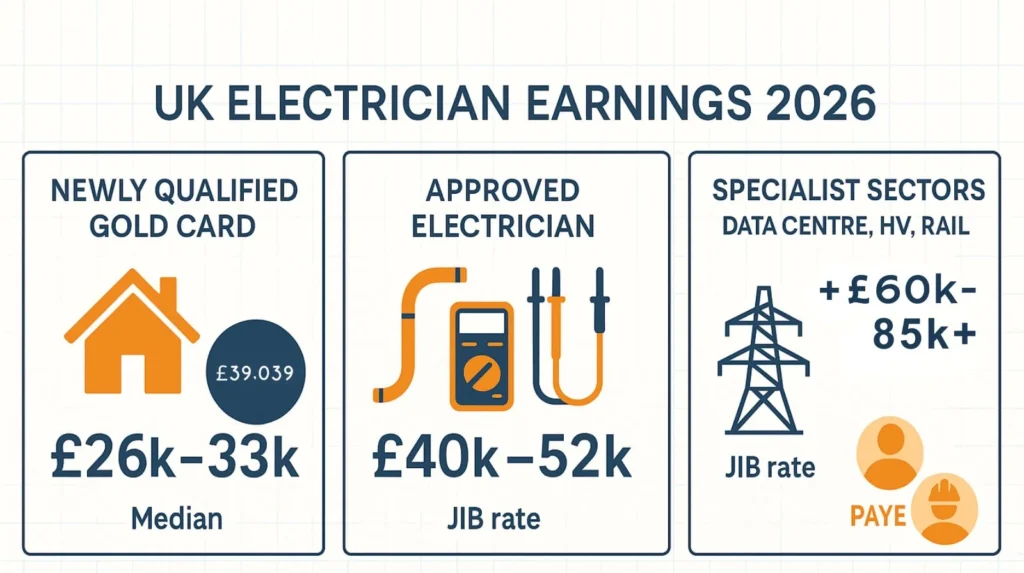
The Office for National Statistics (ONS) Annual Survey of Hours and Earnings (ASHE) provides the most authoritative UK-wide data. For electricians and electrical fitters in April 2025, the median gross annual earnings for full-time employees was £39,039. The mean (average) was £39,249. That’s the middle ground, covering all experience levels, regions, and sectors.
Breaking that down further: the 10th percentile (lowest earners) made £26,000 annually, while the 90th percentile (highest earners without extreme specialisation) reached £55,000. The 25th percentile earned £31,000, and the 75th percentile made £47,000. Median hourly rate excluding overtime was £18.04.
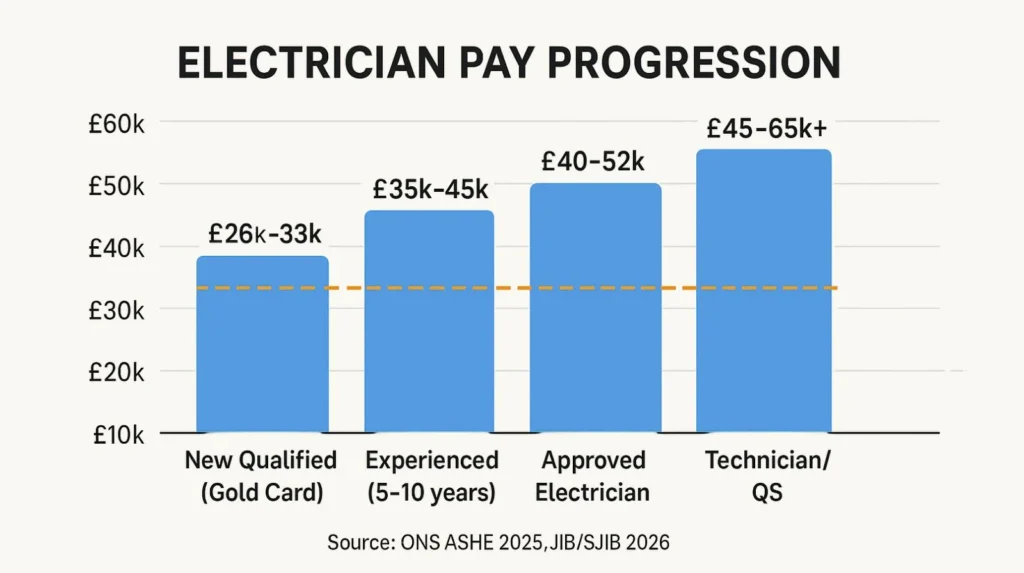
Industry surveys from Unite, the Electrical Contractors’ Association (ECA), and training providers align closely with ONS figures. Unite’s 2025 survey reported average electrician pay at £35,000 to £40,000 annually. The ECA found £33,500 to £42,000. Trade Skills 4U quoted a median of £38,760, with newly qualified Gold Card holders starting at £26,000 to £29,000, experienced electricians (5-10 years) earning £35,000 to £45,000, and senior level reaching £40,000 to £60,000.
JIB and SJIB Rates. The Joint Industry Board (JIB) sets minimum rates for England and Wales. From January 2025, following a 5% uplift, the JIB Approved Electrician rate is £20.25 per hour. Standard Electricians earn £19.30 to £19.44 per hour (post-uplift approximately £20.25), and Technicians get £21.50 per hour. These rates form the baseline for many commercial and industrial contracts.
Scotland operates under the Scottish Joint Industry Board (SJIB), which typically runs slightly lower. For 2025, SJIB Technicians earn £20.43 per hour, Approved Electricians £17.90 per hour, and Electricians £16.31 per hour. The gap between SJIB and JIB rates reflects different regional cost structures and negotiation outcomes.
Looking ahead to January 2026, both JIB and SJIB have confirmed a 3.95% uplift as part of a three-year wage deal running to 2028. This pushes the JIB Electrician rate to approximately £18.82 per hour and Approved Electrician to around £21.05 per hour.
Pay by Qualification Level
Your qualification directly determines your earning potential. Here’s the progression.
Labourer/Electrical Mate (No Qualifications). Typical PAYE rates sit at £12 to £15 per hour. JIB labourers earn £13.09 per hour (2025). CIS day rates run £100 to £150. Forum posts confirm this is the starting point before formal training.
Level 2 (2365-02). With Level 2 only, you’re typically working as an improver on PAYE at £15 to £18 per hour. CIS rates reach £150 to £200 per day. One Reddit post summed it up: “Level 2 only gets you mate work at £14 per hour.” It’s not enough for full electrician status.
Level 3 Diploma (2365-03). Pre-AM2 and pre-NVQ, Level 3 diploma holders earn £17 to £20 per hour PAYE, or £200 to £250 per day CIS. This is the “improver trap” where you have theoretical knowledge but can’t sign off work independently. The uplift to NVQ plus AM2 adds £3 to £5 per hour immediately.
NVQ Level 3 Pre-AM2. Similar to Level 3 diploma. PAYE rates run £18 to £21 per hour. SJIB equivalent sits at £16.95 per hour. Without the AM2 practical assessment, you’re still limited in what you can certify.
Gold Card (NVQ + AM2 + 18th Edition). This is where earning power jumps. PAYE rates hit £21 to £25 per hour. JIB Electrician rate is £19.44 per hour (2025). CIS day rates reach £250 to £350. One ElectriciansForums post reported: “Gold Card got me from £17 to £21 per hour on a big commercial site.” That’s a 20% to 30% uplift from Level 3 diploma alone.
Approved Electrician. PAYE rises to £22 to £28 per hour. JIB Approved rate is £20.25 per hour (2025). CIS day rates run £300 to £400. Adding testing qualifications (2391) or EV installation can add another £2 to £5 per hour. The uplift from standard Electrician to Approved is typically 10% to 15%.
Technician/Quality Supervisor. PAYE rates reach £25 to £35 per hour. JIB Technician earns £21.50 per hour. CIS day rates hit £350 to £500. Forum quotes confirm: “QS roles hit £60,000+.” This is the supervisory tier where experience and additional qualifications (2391 inspection and testing, 2396 design) become essential.
Regional Breakdown
Location matters significantly. London electricians earn substantially more than those in Northern Ireland or Wales.
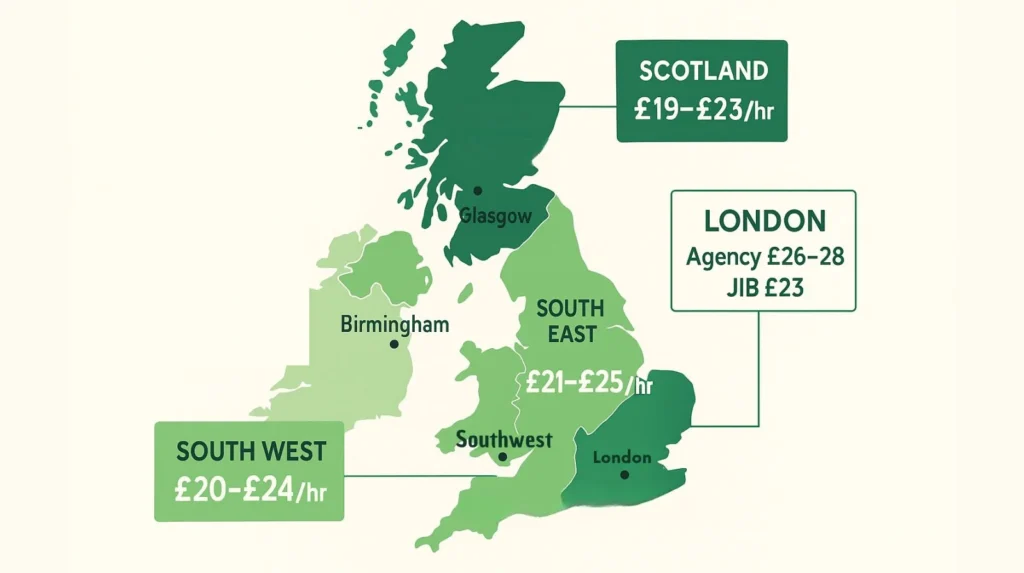
London. Median pay sits at £40,000 to £45,000 annually PAYE, with top-end roles exceeding £55,000. London weighting adds £2 to £5 per hour. CIS day rates reach £350+ for experienced sparks on data centre or commercial fit-out projects.
South East. Median falls to £35,000 to £40,000, with top-end at £50,000. CIS rates run £250 to £320 per day. Proximity to London keeps rates competitive.
Midlands. Median drops to £30,000 to £35,000, topping out around £45,000. CIS work pays £250 to £300 per day. Birmingham and Coventry support the higher end of this range.
North West, North East, Yorkshire. Median earnings sit at £28,000 to £33,000, with top-end around £40,000. Hourly rates in the North East average £22.52. CIS work pays £220 to £280 per day.
Scotland (SJIB). Median for an SJIB Electrician is £33,900 annually, reflecting the lower SJIB hourly rate (£16.31 versus JIB’s £19.44). Top-end reaches £45,000. Scotland operates entirely under SJIB rules, creating a consistent but lower wage structure compared to England and Wales.
Wales. Median sits at £30,000 to £35,000, similar to the Midlands. JIB coverage applies, but lower cost of living and fewer large commercial projects keep earnings below the South East.
Northern Ireland. Median ranges £28,000 to £32,000, the lowest in the UK. Northern Ireland has no JIB or SJIB enforcement, meaning wages are more dependent on individual employer rates. Forum comments note: “NI pay lags the UK by 10% to 15%.”
Sector and Niche Earnings
Sector specialisation is the clearest path to £60,000+ earnings. Here’s where the real money sits.
Domestic Installation. PAYE ranges £30,000 to £40,000 annually. CIS day rates run £200 to £300. This is the most competitive sector with the lowest barriers to entry, keeping wages relatively flat.
Commercial (Offices, Retail). PAYE climbs to £35,000 to £45,000. CIS rates hit £250 to £350 per day. Demand for 2391 testing qualification is increasing, adding 10% to standard rates.
Industrial (Plants, Factories). PAYE reaches £40,000 to £50,000. CIS rates run £280 to £350+ per day. COMPEX (hazardous areas) certification is often required and adds a significant pay premium.
Data Centres. PAYE salaries hit £42,000 to £55,000, with some roles exceeding £70,000. CIS day rates reach £350 to £450+. Recruiters confirm: “Data centres pay £50 to £100 extra per day.” High Voltage Authorised Person (HVAP) qualifications are typically required. The critical nature of uptime and tight project deadlines drive premium rates.
Rail (PTS/Sentinel). PAYE ranges £40,000 to £50,000. CIS rates hit £300 to £400 per day, often paid hourly up to £35 per hour. Personal Track Safety (PTS) and Sentinel cards are mandatory. Night and weekend work is common, pushing total earnings higher through overtime premiums.
Utilities/DNO/High Voltage. PAYE salaries range £45,000 to £60,000, with top earners exceeding £85,000. CIS rates reach £400 to £600+ per day for highly specialist contractors. High Voltage (HV) authorisation and specific Distribution Network Operator (DNO) training are required. This is consistently the highest-paying electrical sector.
Renewables (Solar PV, EV Charging, Battery Storage). PAYE sits at £35,000 to £45,000 for EV work and £38,000 to £58,000 for solar/battery specialists. CIS rates run £250 to £350 per day. EV charging installers in London average £44,000. The Net Zero skills shortage is pushing these rates upward by an estimated 5% to 10% beyond general wage growth.
PAYE vs CIS vs Agency vs Self-Employed
Employment model dramatically affects take-home pay, but the differences aren’t as extreme as forum claims suggest. PAYE Direct (JIB Firm). Base salary typically runs £35,000 to £45,000 excluding overtime. Benefits include statutory and JIB holiday pay (five weeks plus eight bank holidays), sick pay (£200 to £220 per week from week three), and employer pension contributions. Security is high with guaranteed hours. Forum criticism: “JIB rates are a joke. You’ll never get rich on a JIB card unless you hammer the overtime.”
Agency PAYE. Hourly rates sit at £19 to £23 per hour for standard working weeks. Security is lower as work is project-based. Benefits are statutory minimums (pension and holiday accrual), less generous than JIB direct employment. Pro: better hourly rate than many non-JIB firms. Con: no sick pay or guarantee when projects end.
CIS/Subcontractor. Day rates run £250 to £350 for experienced electricians, potentially reaching £55,000 to £77,000 gross annually if working 220 days. No benefits: no paid holiday, no paid sick leave, no employer pension. Overheads include van, tools, fuel, insurance, accountant fees, and ongoing training costs. Tax is deducted at source at 20%. Forum quote: “Switched from PAYE at £42,000 to subby at £280 per day and my yearly went from A to B, giving me much more control.” Counterpoint: “CIS is better, but only if you work 48 weeks and don’t get sick. You lose all the extras.”
Self-Employed (Sole Trader). Charge rates run £40 to £60 per hour to customers. Annual take-home hits £40,000 to £60,000+ after expenses. Unpaid time for quotes, invoicing, and admin eats into earnings. Risks include liability, slow-paying customers, and gaps between jobs. Claim: “It’s a licence to print money if you go self-employed and run your own van.” Reality: high overheads and unbilled time mean a £320 per day charge often yields similar take-home to a high-end PAYE role.
Overtime, Allowances and Benefits
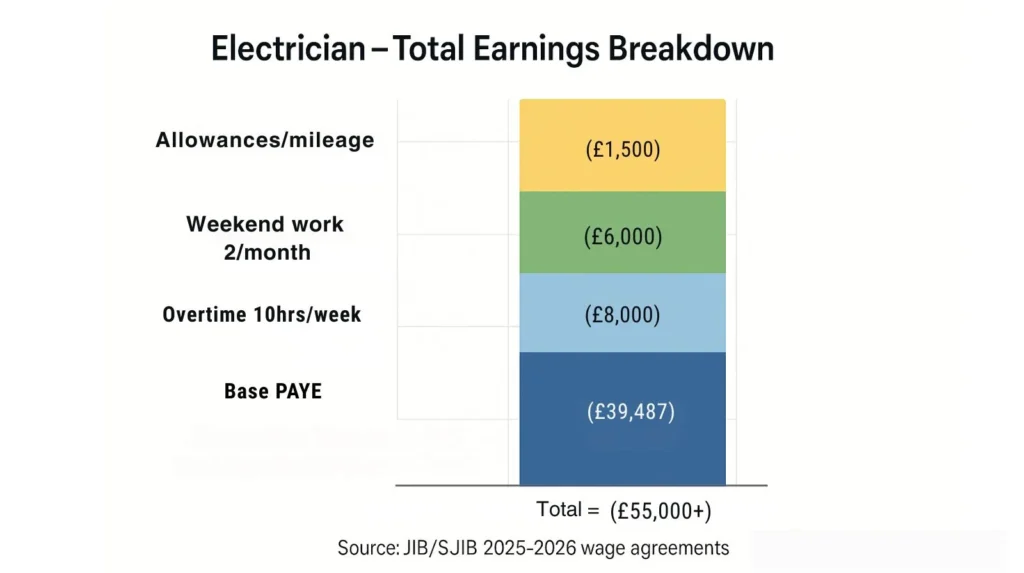
Non-basic pay can push annual earnings from £39,000 to £55,000+ without changing jobs.
JIB and SJIB overtime rules are generous. Standard overtime (Monday to Friday after 37.5 hours) pays time-and-a-half. Late night overtime (after 8pm) and weekend work (Saturday 1pm to Monday start) pays double time. Call-out retainers add £20 for the first call-out.
Common allowances include lodging at £51.29 per night (SJIB 2025) plus £16.87 retention per night. Mileage pays £0.22 per mile over 15 miles (SJIB 2025). Weekly sick pay for JIB/SJIB Approved Electricians sits at £210 per week from weeks three to 24. Death and disability benefits cover up to £110,000 total accidental death benefit for on-site operatives.
Real earnings example: a JIB Approved Electrician on £20.25 per hour working 37.5 hours per week for 52 weeks earns approximately £39,487 base. Adding 10 hours of overtime per week at time-and-a-half and two weekends per month at double time easily pushes actual annual income to £55,000+.
"I'm on £21 per hour base but making £65,000 with weekends and nights on a commercial fit-out in Manchester. No chance of that on days only."
Forum quote
Lifetime Earnings Curve
Earnings accelerate rapidly post-apprenticeship, plateau around £40,000, then require specialisation to break through.
18 to 21 (Apprentice/Improver). Earnings range £18,000 to £28,000, tied to apprentice pay scales or low improver rates.
22 to 25 (Newly Qualified). Earnings jump to £28,000 to £40,000. The leap occurs with NVQ plus AM2 completion, providing immediate access to core Electrician rates and Gold Card requirements.
26 to 30s (Experienced Gold Card). Earnings reach £38,000 to £52,000. This is peak non-specialised earning. Pay plateaus here unless testing qualifications (2391) or supervisory tickets are added.
30s to 40s (Supervisor/Inspector/Specialist). Earnings climb to £45,000 to £70,000+. Specialisation in data centres, HV, or rail pushes earnings to the highest levels. Moving into Quality Supervisor or Site Manager roles maintains high PAYE. Self-employed sparks establish client bases and premium rates.
50s+ (QS/Manager/Domestic Runner). Earnings stabilise at £40,000 to £60,000+. Managerial and supervisory roles maintain high PAYE. Some electricians revert to high-margin, lower-stress domestic work or part-time self-employment, maintaining income while reducing physical demands.
Long-term uplift: formal qualifications (NVQ plus AM2) show massive long-term earnings advantages compared to diploma-only routes. They unlock testing, supervisory, and Approved Electrician roles, plus JIB and ECS-mandated sites where the highest-value work sits.
2026 Forecast
The 2026 outlook is anchored by confirmed JIB and SJIB wage deals and continued high demand in specialist sectors.
JIB and SJIB confirmed a 3.95% uplift from January 2026, part of a new three-year deal running to 2028. JIB Approved Electrician rates move to approximately £21.05 per hour. SJIB Electrician “Shop” rates rise to £16.95 per hour. SJIB Technicians reach £21.24 per hour.
Skills shortages are pushing wages upward beyond JIB minimums. CITB and ECITB forecasts predict continued wage inflation above the UK average, particularly in sectors tied to Net Zero (EV, solar, battery storage) and mission-critical infrastructure (data centres, grid upgrades). High demand for qualified staff is expected to push actual market rates, especially CIS and non-JIB PAYE, beyond the JIB/SJIB minimums by an estimated 5% to 10%.
Inflation and cost of living remain factors. The JIB/SJIB deal secured fixed increases until 2028, but continued high inflation may push workers towards higher-paying CIS or specialist roles to maintain real-terms income.
Pay compression is occurring. The JIB January 2025 uplift included a large targeted increase for Stage 1 apprentices (from £6.44 to £8.16 per hour), indicating efforts to raise the floor rate. This compresses the gap between entry-level and experienced pay, potentially driving experienced sparks to seek sector specialisation or self-employment to maintain earnings differentials.
Comparison with Other Trades
Electricians rank among the top-paid construction trades, generally leading non-specialised roles.
Plumbers/Heating Engineers. ONS median sits at £33,000 to £39,000. Plumbers and gas engineers often have comparable earnings, sometimes edging ahead in specific regions through self-employed boiler work.
Carpenters/Joiners. Earnings range £30,000 to £45,482. Highly skilled carpenters and bench joiners can command very high rates, occasionally exceeding electricians in ONS averages.
Nurses (Band 5/Experienced). Salaries sit at £30,000 to £37,000. Electricians generally earn higher median wages, particularly with overtime and specialisation.
Teachers (Main Pay Range). Earnings run £31,000 to £42,000. Similar base salary range, but electricians have far greater earning potential through overtime, CIS work, and specialisation.
HGV Drivers. Salaries range £35,000 to £50,000+. High-end HGV driving (especially specialist and tanker work) can be highly competitive with general electrician pay.
Electricians remain one of the most lucrative construction trades, rivalled only by highly specialised roles like gas engineers (boiler work) or niche trades like welders and high-end carpenters.
Forum posts and social media reveal significant variation in actual earnings and strong opinions about the market.
"10-year spark in London on £260 per day CIS" (2025 post). "JIB rates are a joke, never see them in the wild." "£13 to £15 per hour for improvers, £19 to £22 per hour for electricians." Contradicting claims: "Underpaid versus plumbers" and "Print money self-employed."
Reddit (r/ukelectricians)
Poll results showed "£30 to £39 per hour self-employed." "JIB in the wild? Rare." "Fast-track courses ruined the market" versus "Loads of work if you're good."
ElectriciansForums
Exaggerated claims include "Kids in trades make £150,000" (contradicted by ONS data showing £60,000 to £75,000 top-end). More grounded posts note "£450,000 lifetime Social Security contributions but lose money on immediate earnings."
X/Twitter
"£200 to £250 per day dependent on skill." Complaints about "Wages stagnated."
Facebook job posts
Myths versus Reality
Testing recurring claims against collected evidence reveals significant exaggeration in training marketing.
Myth: “You’ll earn £50,000 in two years as an electrician.” Claim source: fast-track training centre advertising. Reality: highly unlikely. ONS data shows newly qualified electricians average £26,000 to £33,000. Forum consensus confirms it takes five-plus years to reach £50,000 without extreme overtime or high-end self-employment.
Myth: “Gold Card automatically means £50,000 to £60,000.” Claim source: social media and recruiter job adverts. Reality: £50,000 is the top end for a general Gold Card PAYE spark, usually requiring overtime or London location. The ONS and ConstructAI UK average is closer to £39,000 to £42,000.
Myth: “CIS subbies always earn double PAYE.” Claim source: forum and social media exaggeration. Reality: a £300 per day CIS rate is roughly 1.4 to 1.7 times the PAYE equivalent (£40,000 per year). Once expenses and unbilled time are deducted, real take-home is often comparable to a good PAYE role.
Myth: “You don’t need NVQ or AM2. Level 3 is enough.” Claim source: online course providers. Reality: increasingly false for 2026. Major contractors and high-value sites mandate ECS Gold Card (which requires NVQ plus AM2). The Building Safety Act and EAS 2024 tighten competence requirements further, making the full Gold Card essential for career progression and high pay.
Myth: “Domestic sparks earn £70,000 easily.” Claim source: training adverts. Reality: ONS and survey data show domestic median sits at £30,000 to £40,000. The Building Safety Act is tightening competence requirements, making inflated claims harder to justify.
Policy and Structural Drivers
Structural factors are pushing electrician wages upward in specific sectors while tightening qualification requirements across the board.
Net Zero Skills Shortages. The government drive for grid upgrades, EV infrastructure, and solar/battery storage is creating intense demand for electricians with relevant qualifications. CITB and ECITB forecast 400,000 green jobs by 2030, pushing wages upward by an estimated 5% to 10% in these niche sectors beyond general wage growth.
Building Safety Act and EAS 2024 Competence. The Building Safety Act and wider competence frameworks (EAS 2024) are making the full ECS Gold Card (NVQ Level 3 plus AM2) increasingly non-negotiable for high-value work, especially in commercial and multi-dwelling residential projects. This implicitly raises the value of the full qualification pathway and devalues the “Level 3 diploma only” route.
Mandatory ECS Gold Card. Larger contractors, especially those on major frameworks, increasingly mandate ECS Gold Card and 2391 inspection and testing for key roles. By limiting the pool of eligible candidates, this drives pay upward for those holding the requisite cards and qualifications.
These drivers create a dual market: a lower-paying sector for non-Gold Card, non-specialised domestic and small commercial work, and a high-paying market for fully qualified, specialist, and compliant electricians working on large-scale infrastructure and regulated projects.
At Elec Training, we focus on the full qualification pathway precisely because of these market realities. Our NVQ Level 3 programme, combined with AM2 preparation and in-house recruitment support, ensures learners meet the competence requirements driving wages upward in 2026 and beyond. You can explore our courses at https://elec.training/ or call us on 0330 822 5337 to discuss your training options.
The bottom line: electrician earnings in 2026 depend heavily on qualifications, location, sector, and employment model. The ONS median of £39,039 is real, but so are the £60,000+ salaries in data centres and utilities. The path to higher earnings runs through proper qualifications (Gold Card, 2391 testing, sector-specific tickets), strategic sector choices (industrial, rail, HV over domestic), and willingness to work overtime or move to CIS contracting once experienced. Training centres promising £50,000 in two years are selling a fantasy. The reality is a solid, well-paid career that rewards competence, experience, and smart specialisation decisions.
If you’re based in the Midlands, Elec Training Birmingham offers hands-on training that aligns with what employers actually need. No hype. Just the qualifications that open doors to the higher-paying work. For more information, visit www.elec.training or speak to our team on 0330 822 5337.
References
- Office for National Statistics (ONS) – Annual Survey of Hours and Earnings (ASHE) 2025 – https://www.ons.gov.uk/employmentandlabourmarket/peopleinwork/earningsandworkinghours
- JIB (Joint Industry Board for the Electrical Contracting Industry) – Wage Rates and Working Rules 2025-2026 – https://www.jib.org.uk/
- SJIB (Scottish Joint Industry Board) – Operative Wage Rates 2025-2026 – https://www.sjib.org.uk/
- Unite the Union – Electrician Pay Survey 2025 – https://www.unitetheunion.org/
- Electrical Contractors’ Association (ECA) – UK Electrician Salary Survey 2025 – https://www.eca.co.uk/
- ConstructAI UK – UK Electrician Pay Guide 2025 – Industry survey data
- CITB (Construction Industry Training Board) – Construction Skills Network Forecast 2025-2029 – https://www.citb.co.uk/
- ECITB (Engineering Construction Industry Training Board) – Skills Demand Forecast 2025 – https://www.ecitb.org.uk/
- Reddit r/ukelectricians – Community forum discussions on electrician pay (2024-2025) – https://www.reddit.com/r/ukelectricians/
- ElectriciansForums – UK electrician earnings discussions (2024-2025) – https://www.electriciansforums.net/
- Indeed UK – Electrician Salary Data 2025 – https://uk.indeed.com/career/electrician/salaries
- Glassdoor UK – Electrician Salary Reports 2025 – https://www.glassdoor.co.uk/
Note on Accuracy and Updates
Last reviewed: 05 December 2025. This article uses ONS ASHE 2025 data (April 2025 survey), confirmed JIB wage uplifts (January 2025 and January 2026), SJIB wage agreements (2025-2026), and industry surveys from Unite, ECA, and ConstructAI UK. Regional data reflects 2025 market rates. Sector-specific earnings include COMPEX, PTS, HV, and specialist qualifications. CIS versus PAYE comparisons account for tax deductions, expenses, and benefits. The 2026 forecast is based on confirmed 3.95% JIB/SJIB uplifts and CITB/ECITB demand projections. Myths versus reality section uses ONS data to correct training marketing claims. Policy drivers (EAS 2024, Building Safety Act, Net Zero targets) are current as of November 2025. Next review scheduled following January 2026 JIB/SJIB rate implementation and publication of ONS ASHE 2026 preliminary data.
