

How Much Do Tools, Equipment & a Starter Van Cost for New Electricians?

- Technical review: Thomas Jevons (Head of Training, 20+ years)
- Employability review: Joshua Jarvis (Placement Manager)
- Editorial review: Jessica Gilbert (Marketing Editorial Team)
- Last reviewed:
- Changes: Initial publication
Introduction
Achieving your ECS Gold Card marks a significant milestone in becoming a qualified electrician, but it’s not the financial finish line. Whether you’re newly qualified at 22 after a four-year apprenticeship or completing your NVQ Level 3 and AM2 at 35 as a career changer, the next question is immediate and unavoidable: what does it actually cost to start working?
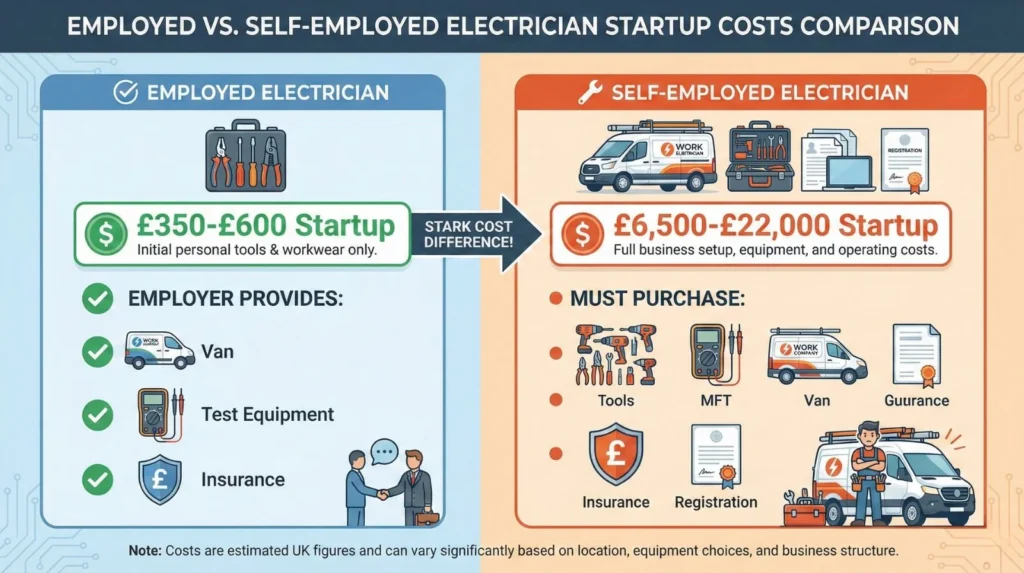
The answer depends entirely on your employment status. An employed electrician joining a contractor as a PAYE worker faces modest startup costs of £350-£600 for basic hand tools and workwear. Your employer provides the van, the expensive test equipment, and covers insurance. You show up with your personal toolkit, collect your wages, and build experience without significant financial burden.
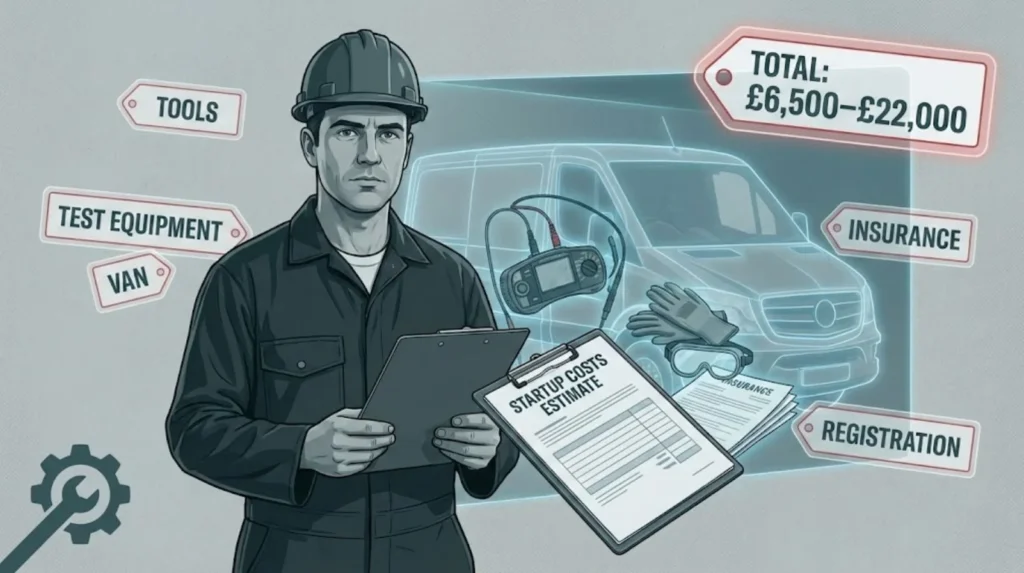
A self-employed electrician faces a dramatically different reality. Before earning your first pound from a customer, you need a comprehensive toolkit (£1,000-£2,500), professional test equipment including a calibrated multifunction tester (£750-£2,000), a roadworthy van (£3,000-£16,000 depending on age and condition), van outfitting and security (£500-£2,000), insurance covering public liability and tools (£1,200-£2,500 annually), Competent Person Scheme registration (£600-£750), and working capital to cover materials whilst waiting for payment from clients (£2,000-£3,000). Total startup costs range from £6,500 for an absolute minimum budget setup to over £22,000 for a professional configuration with a reliable van and quality equipment.
These aren’t theoretical figures or training provider estimates. They’re based on 2025-2026 UK market data from tool suppliers (Screwfix, CEF, Toolstation), van dealers (AutoTrader analysis of Ford Transit Connect and Vauxhall Vivaro pricing), test equipment specialists (Test-Meter, Kewtech, Megger, Fluke), insurance brokers (AXA, Hiscox), and Competent Person Scheme fee schedules (NICEIC, NAPIT). Regional variations are substantial. London and South East setups cost 20-50% more due to ULEZ-compliant vehicle requirements, higher insurance premiums, and elevated fuel costs. Rural North and Midlands setups are more affordable but involve longer travel distances that increase running costs.
Understanding the real cost breakdown before you commit to self-employment prevents the financial shock that forces many newly qualified electricians back into PAYE roles within their first year. This guide examines every component, from VDE-insulated screwdrivers to annual MFT calibration fees, providing minimum, typical, and high-end cost scenarios with realistic break-even timelines based on actual UK day rates and billable utilisation for new starters.
Whether you’re planning your transition from training to professional work, deciding between employed and self-employed pathways, or budgeting for your first van purchase, these are the figures you need to make informed decisions rather than optimistic guesses.
Why These Costs Matter: The Financial Reality of Going Independent
The allure of self-employment in the electrical trade is undeniable. Work your own hours, choose your clients, keep the full £250-£350 daily rate instead of a £32,000-£40,000 PAYE salary. For many newly qualified electricians, the independence and earning potential make self-employment the ultimate goal.
The barrier is capital. Unlike professional services where you can operate from a laptop, electrical work requires physical tools, specialist test equipment, transportation, and comprehensive insurance before you can legally quote for a single job. These aren’t optional luxuries or gradual purchases you make as earnings allow. They’re prerequisites. Without a calibrated multifunction tester, you cannot certify installations. Without public liability insurance, no homeowner or contractor will hire you. Without a van, you cannot transport materials or reach job sites efficiently.
The startup capital requirement creates a natural filter. Many newly qualified electricians intend to go self-employed but spend 1-3 years working PAYE to accumulate the £15,000-£25,000 needed for a proper setup. During this period, they’re earning lower wages than self-employed rates but building experience, industry connections, and financial reserves. Others jump into self-employment with minimal budgets (£6,000-£8,000), accepting higher risk through older vans, basic equipment, and tighter cash flow.
The employment versus self-employment decision isn’t just about personal preference. It’s fundamentally an economic calculation comparing:
PAYE advantages:
Near-zero startup capital (£500-£800 for tools and PPE)
Guaranteed regular income (£32,000-£40,000 annually)
Employer provides van, fuel, major equipment, insurance
Paid holidays, sick leave, pension contributions
No business administration burden (tax returns, invoicing, bookkeeping)
Self-employment advantages:
Higher earning potential (£40,000-£70,000+ annually at full capacity)
Control over work schedule and client selection
Direct relationship with customers (reputation building)
Tax efficiency through business expense deductions
Long-term business asset accumulation (van, tools, client base)
Self-employment disadvantages:
£15,000-£30,000 startup capital requirement
Variable income (gaps between jobs, seasonal slowdowns)
All business costs and risks personally absorbed
No paid leave or sick pay
Administrative burden (VAT if turnover exceeds £85,000, tax returns, insurance renewals)
The break-even timeline matters enormously. A newly self-employed electrician with a £20,000 startup investment working at £250 per day needs approximately 80 billable days to recover initial costs before showing profit. At realistic utilisation rates for new starters (50-60%, accounting for marketing time, quotes that don’t convert, travel, administration), that’s 4-6 months of work. During this period, you’re effectively working to pay off your setup costs whilst covering living expenses from savings or spousal income.
If you hit mechanical problems (van breakdown costing £1,500), tool theft (replacing stolen kit costing £2,000), or an unexpectedly slow first few months (30% utilisation instead of 60%), the break-even point extends to 8-12 months or longer. Many newly qualified electricians underestimate this timeline and face financial pressure that forces them back into PAYE employment before the business becomes profitable.
Regional factors compound the challenge. In London and the South East, you must purchase Euro 6 compliant vans (ULEZ requirement adds £5,000-£8,000 to van costs), pay 30-50% higher insurance premiums, and face elevated fuel costs. However, day rates are correspondingly higher (£300-£400 vs £200-£250 in the North), partially offsetting increased expenses. Rural areas offer lower startup costs but require longer travel distances between jobs, increasing fuel consumption and reducing billable time.
Understanding these financial realities before making the employment decision prevents expensive mistakes. This guide provides the detailed cost breakdown needed for realistic budgeting rather than optimistic assumptions.
Tools and Equipment: What You Actually Need to Start
The foundation of any electrical career is a comprehensive, reliable toolkit. The costs vary dramatically based on quality tier, purchase strategy (new versus used), and work scope (domestic-only versus commercial/industrial).
Hand Tools: The Daily Essentials
Every electrician needs a core set of hand tools for installation, termination, and basic maintenance work. The critical distinction is VDE insulation certification to 1000V, which is mandatory for live electrical work and a legal requirement under health and safety regulations.
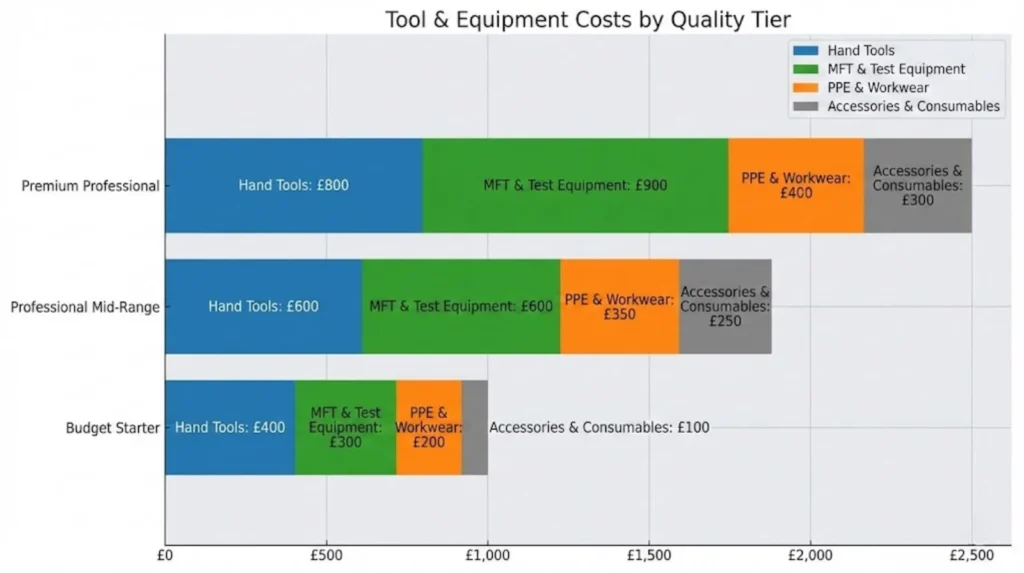
Budget Starter Kit (£150-£250):
Brands: Magnusson (Screwfix own-brand), Draper Expert, Faithfull
Contents: Basic VDE screwdrivers (slotted and Phillips), combination pliers, side cutters, wire strippers, tape measure, spirit level, utility knife
Use case: Suitable for employed electricians where the employer provides specialist tools, or absolute minimum self-employed setup
Limitations: Lower ergonomic quality (hand fatigue during long days), shorter lifespan (replacement needed within 2-3 years), basic VDE certification without premium safety features
Professional Mid-Range Kit (£400-£600):
Brands: Wera, Wiha, CK Tools, Knipex
Contents: Ergonomic VDE screwdrivers with precise tip geometry, automatic wire strippers, premium side cutters with induction-hardened blades, insulated pliers, torque screwdrivers (essential for consumer unit terminations since 18th Edition updates), cable knife, adjustable spanners, Allen keys
Use case: Standard for self-employed domestic and commercial work
Benefits: Significantly better comfort during extended use, longer lifespan (5-10 years with care), precise fit on terminal screws (reduces damage to terminals and screws)
Premium Professional Kit (£650-£1,000+):
Brands: Wiha full professional sets, Wera Kraftform Kompakt, Knipex specialist pliers
Contents: Everything in mid-range plus specialist tools (conduit benders, cable strippers for SWA, precision torque screwdrivers with multiple nm settings, ratcheting screwdrivers)
Use case: Commercial and industrial electricians, those doing significant containment work, quality-focused professionals
Benefits: Lifetime warranty on many tools, maximum precision and durability, comprehensive capability
Consumables and Replacements (Annual Costs): Even quality tools require ongoing investment:
Drill bits and hole saws: £100-£200 annually (wear from masonry drilling)
Cable ties, tape, fixings: £50-£100
Tool replacement (lost or damaged items): £100-£200
Total consumable budget: £250-£500 per year
Used tool market: Buying second-hand from retiring electricians or eBay can save 30-40% on initial outlay (£300-£400 for a professional-quality used kit versus £500-£600 new). Risks include unknown service life remaining, potential damage not visible in photographs, and no warranty. For hand tools where you can inspect condition, used purchases from reputable sellers offer good value.
Test Equipment: Your Professional Credibility
Test equipment represents the single most expensive non-vehicle purchase for self-employed electricians. The multifunction tester (MFT) is essential for installation certification, periodic inspection, and fault diagnosis. Quality and capability distinctions are significant.
Thomas Jevons, our Head of Training with 20+ years of experience, explains the essential features:
"Don't buy an MFT based on brand recognition alone. For newly qualified electricians in 2026, you need proper RCD testing capability including 30mA sensitivity verification, earth fault loop impedance measurement accuracy, and ideally Type B RCD testing if you're doing any EV work. Entry-level testers at £400-£600 often lack these features. Spending £750-£1,000 on a Megger MFT1721 or Fluke 1662 isn't optional luxury, it's buying the capability to test installations correctly."
Thomas Jevons, Head of Training
Entry-Level MFT Options (£400-£600):
Models: Used Fluke 1652, new Kewtech KT63, entry-level Megger models
Capabilities: Basic installation testing (insulation resistance, continuity, earth fault loop impedance), standard RCD testing
Limitations: Often lack B-type RCD testing (needed for EV charge points and some inverters), may not have auto-test sequences (slower testing process), basic data storage (limited test result memory)
Use case: Domestic-only work with minimal EV or renewable installations, tight budget starters
Mid-Range Professional MFTs (£750-£1,000):
Models: Megger MFT1721, Fluke 1662, Kewtech KT65DL
Capabilities: Full test suite including B-type RCD testing, comprehensive data logging, auto-test sequences, reliable earth fault loop impedance measurement, downloadable test results
Benefits: Industry standard reliability, accepted by all CPS schemes, suitable for domestic and commercial work, covers EV charge point testing
Use case: Standard choice for self-employed electricians doing mixed domestic/commercial work
High-End Professional MFTs (£1,200-£2,000):
Models: Fluke 1664 FC, Megger MFT-X1
Capabilities: Everything in mid-range plus cloud connectivity (automatic test result upload), advanced diagnostic features, Bluetooth connectivity to smartphone apps, enhanced accuracy for commercial/industrial requirements
Benefits: Maximum capability for inspection and testing specialists, comprehensive data management, future-proof for emerging standards
Use case: Electricians specialising in inspection and testing (2391 work), those doing significant commercial/industrial installations
Essential Test Equipment Accessories: Beyond the MFT, several items are mandatory:
Voltage indicator and proving unit (£120-£180):
Brands: Martindale, Fluke, Kewtech
Purpose: Safe isolation verification (prove dead, test, prove dead again)
Legal requirement: GS38 compliance for voltage detection
Why essential: Core safety procedure before working on any electrical installation
Lock-off kit (£40-£80):
Contents: Padlocks, lockout hasps, circuit breaker lockouts, “Danger: Electrician at Work” tags
Purpose: Preventing re-energisation whilst working on isolated circuits
Regulatory requirement: Part of safe isolation procedures under BS 7671 and EAWR
Lead and probe sets (£50-£100):
GS38-compliant test leads for MFT
Crocodile clips and probes
Replacement leads (annual, as they wear and fail)
PAT testing equipment (£150-£400, if offering this service):
Portable appliance testing for landlords, commercial clients
Additional revenue stream (£2-£5 per appliance tested)
Kewtech, Seaward, and Megger PAT testers
Total test equipment investment:
Minimum (entry MFT + proving unit + leads): £600-£800
Typical (mid-range MFT + accessories): £1,000-£1,300
Professional (high-end MFT + PAT tester + full accessories): £1,500-£2,500
Annual calibration costs (£90-£120): Multifunction testers require annual calibration certificates to maintain accuracy and satisfy insurance/CPS requirements. Calibration fees from accredited laboratories (UKAS-certified) range from £55-£65 for basic MFT calibration to £90-£120 if including voltage indicators and PAT testers. This is non-negotiable. Operating with uncalibrated equipment invalidates your professional indemnity insurance and creates legal liability if test results are challenged.
PPE and Workwear: Daily Protection
Personal protective equipment and work clothing are ongoing expenses that accumulate significantly over the first year.
Essential PPE and workwear:
Safety boots (£70-£150):
Steel toe cap or composite (lighter weight)
Electrical hazard rated (optional but recommended)
Lifespan: 12-18 months with daily wear
Brands: DeWalt, Scruffs, Site, CAT
Work trousers (£40-£80 per pair):
Reinforced knees, multiple pockets, durable fabric
Brands: Snickers, Dickies, Site
Need 2-3 pairs for rotation (£120-£240 total)
Lifespan: 12-24 months depending on work type
Hi-vis vest or jacket (£15-£50):
Mandatory on construction sites
Need multiple (workshop gets dirty quickly)
Budget £30-£100 for initial supply
Gloves (£20-£50 per year):
Insulated for electrical work
Rigger gloves for heavy lifting
Regular replacement as they wear
Additional PPE (£100-£200):
Hard hat (construction sites): £15-£30
Safety glasses: £10-£20
Knee pads: £20-£40
Dust masks/respirators: £20-£50
First aid kit for van: £30
Fire extinguisher for van: £40
Total initial PPE and workwear costs:
Minimum: £200-£300 (basic boots, trousers, hi-vis)
Typical: £350-£500 (quality boots, multiple trousers, full PPE)
Professional: £500-£800 (premium brands, comprehensive PPE, specialist items)
Annual replacement budget: £200-£400 for worn-out boots, trousers, and damaged PPE.
Your First Van: The Largest Startup Cost
For self-employed electricians, the van represents the single most expensive purchase and the most significant financial risk. Vehicle choice impacts initial capital outlay, running costs, reliability, professional image, and regulatory compliance (ULEZ, Clean Air Zones).
Used Van Options: Balancing Cost and Reliability
The used commercial van market offers dramatic cost savings compared to new vehicles but introduces reliability risks that can devastate cash flow for new businesses.
Budget Used Vans (£3,000-£6,000):
Age: 8-12 years old (2013-2017 models)
Typical vehicles: Ford Transit Connect, Vauxhall Vivaro, Volkswagen Caddy
Mileage: 100,000-150,000+ miles
Condition: High wear, potential mechanical issues imminent
Risks and reality:
MOT failures common (£500-£1,500 in repairs to pass)
Major component failures (clutch £800-£1,200, injectors £600-£1,000, turbo £1,500+)
Downtime costs (lost earnings whilst van in workshop)
Non-ULEZ compliant (cannot work in London or other Clean Air Zones without £12.50 daily charge)
When budget vans make sense:
You have mechanical knowledge and can do basic repairs yourself
You’re working locally (minimising breakdown risk distance from home)
You’re not planning London or urban Clean Air Zone work
You have access to a backup vehicle for emergencies
You budget £1,500-£2,000 for first-year repairs
The “van trap”: Many newly self-employed electricians purchase £3,000-£4,000 vans to preserve capital, then face £2,000-£3,000 in repairs within 12 months plus lost earnings during breakdowns. The apparent savings evaporate into ongoing mechanical problems whilst trying to establish a new business.
Reliable Used Vans (£10,000-£16,000):
Age: 4-6 years old (2019-2021 models)
Typical vehicles: Ford Transit Custom, Vauxhall Vivaro, Volkswagen Transporter, Renault Trafic
Mileage: 40,000-80,000 miles
Condition: Well-maintained, full service history
Benefits:
Euro 6 emissions compliant (ULEZ compatible)
Manufacturer warranty may still be active or available as extended warranty
Lower breakdown risk (modern reliability standards)
Professional appearance supports customer confidence
Several years of dependable service expected
Realistic costs in this range:
£10,000-£12,000: Smaller vans (Transit Connect, Caddy), higher mileage
£13,000-£16,000: Medium vans (Transit Custom SWB, Vivaro), average mileage, good condition
This range represents the optimal balance for most newly self-employed electricians: Significant capital investment (£10,000-£16,000) but dramatically lower mechanical risk and longer service life than budget options.
New Van Purchase and Leasing
New vans eliminate mechanical uncertainty and provide maximum professional image but require substantial capital or ongoing lease commitments.
New Van Purchase (£20,000-£40,000+ VAT):
Small vans (Transit Connect, Combo): £20,000-£27,000 + VAT
Medium vans (Transit Custom, Vito): £26,000-£35,000 + VAT
Large vans (Crafter, Sprinter): £35,000-£50,000 + VAT
Benefits:
Full manufacturer warranty (3-5 years)
Zero breakdown risk initially
Maximum professional appearance
Latest emissions standards
Customisation options (factory-fit ply-lining, rear parking sensors)
Financial reality: Few newly qualified electricians have £25,000-£45,000 available for vehicle purchase. New vans are typically purchased by established businesses with strong cash flow or accessed through financing.
Van Leasing (£250-£550 per month):
Contract hire (most common):
Fixed monthly payment over 2-4 years
Mileage limits (typically 10,000-20,000 miles per year)
Excess mileage charges (10-20p per mile over limit)
Maintenance packages available (additional £50-£100 per month)
Return vehicle at end of contract or start new lease
Lease costs for typical electrician vans:
Small van (Combo, Connect): £250-£350 per month
Medium van (Vivaro, Transit Custom): £350-£500 per month
Initial payment: Typically 3-6 months upfront (£750-£3,000)
Leasing advantages:
Lower initial capital (£1,000-£3,000 vs £15,000-£30,000 purchase)
Predictable monthly costs
Always driving newer, reliable vehicles
VAT claimable on lease payments (if VAT registered)
Leasing disadvantages:
No asset accumulation (you never own the van)
Mileage restrictions problematic for busy businesses
Ongoing commitment (payment continues during slow periods)
Excess wear and tear charges at return (£500-£2,000 common)
When leasing makes sense: Established income stream (minimum 6 months trading), predictable mileage requirements, prefer operational expense to capital outlay.
When leasing doesn’t make sense: New starter with uncertain income, potential for very high mileage, limited capital for upfront payments.
Van Outfitting and Security
An empty van is useless for electrical work. Proper outfitting organises tools, materials, and equipment efficiently whilst security measures protect against the UK’s endemic tool theft problem.
Racking and Storage Solutions:
DIY Plywood Shelving (£150-£300):
Materials from timber merchants or Wickes/B&Q
Simple shelving across wheel arches and sides
Suitable for temporary solutions or extreme budget constraints
Limitations: Lower weight capacity, less professional appearance, difficult to reconfigure
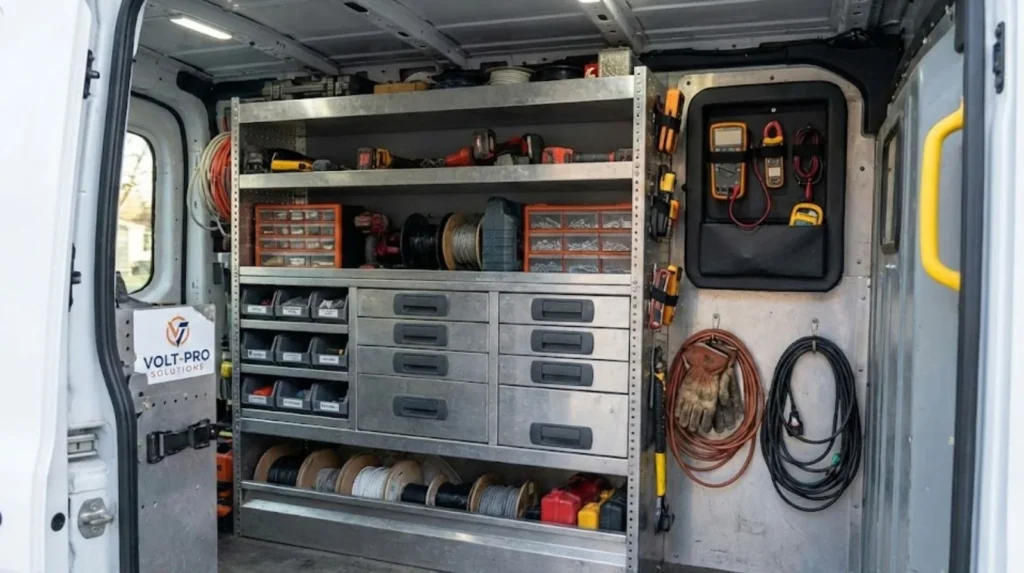
Professional Metal Racking (£800-£2,000):
Brands: Bott, Sortimo, Syncro System
Modular steel racking with adjustable shelves
Drawer units for small parts and fixings
Load ratings for heavy equipment (reels, cable drums)
Professional appearance impresses customers
Longevity: Transfer between vans when upgrading
Typical outfitting costs:
Basic storage bins and boxes: £100-£200
Professional racking system: £800-£1,500
Roof tube (for conduit and long materials): £150-£300
Bulkhead partition (safety and security): £200-£400
Ply-lining (protects van interior): £300-£600
Total budget outfitting: £500-£1,000
Total professional outfitting: £1,500-£2,500
Security Upgrades (Essential for Insurance):
Why security matters: Tool theft from vans is endemic across the UK. Police statistics show thousands of vans broken into daily, with £10 million+ in stolen tools annually. A single theft event can put a self-employed electrician out of business for weeks whilst replacing equipment.
Essential security measures:
Deadlocks or slamlocks (prevent door forcing): £200-£400 installed
Alarm system (motion sensing, alerts to phone): £200-£400
Security marking (Smartwater or forensic marking): £50-£100
Visible deterrents (warning stickers, steering wheel locks): £30-£50
Insurance requirements: Most van insurance policies require minimum security standards (deadlocks, alarms) and have high excesses (£500-£1,000) for tool theft claims. Without proper security, claims may be denied.
Total security investment: £400-£800
Van Signwriting and Branding:
Joshua Jarvis, our Placement Manager, explains the marketing reality:
"First impressions matter enormously in domestic electrical work. A clean, well-maintained van with professional signwriting gets you 30-40% more enquiry conversions than an unmarked, tatty vehicle. Homeowners associate vehicle condition with work quality. Spending £500 on basic signwriting and keeping the van clean isn't vanity, it's marketing that directly affects your ability to win private client work at decent rates."
Joshua Jarvis, Placement Manager
Signwriting options:
Basic vinyl lettering (name, number, email): £150-£250
Partial wrap (sides, rear): £500-£1,000
Full professional wrap: £2,000-£4,000
For new starters: Budget £200-£500 for clean, professional vinyl signwriting including business name, phone number, trade body membership logos (NICEIC, NAPIT), and website if you have one. This modest investment significantly impacts enquiry conversion rates.
Running Costs: The Ongoing Financial Burden
Van ownership costs don’t stop at purchase. Fuel, insurance, tax, maintenance, and depreciation create substantial annual expenses.
Fuel Costs (Annual, Based on 10,000 Miles):
Small van (Transit Connect, Combo): 40-45 MPG = £1,600-£1,900 at £1.50/litre diesel
Medium van (Vivaro, Transit Custom): 35-40 MPG = £1,800-£2,200
Petrol vans: 10-15% higher fuel costs = £2,000-£2,500
Actual mileage for busy self-employed electricians often exceeds 15,000 miles annually, increasing fuel costs to £2,500-£3,500.
Van Insurance (Annual): Insurance is expensive for newly self-employed tradespeople, particularly under age 30 or without significant no-claims bonus.
Typical insurance costs:
New business, age 25-35, clean licence: £1,200-£1,800 per year
Established business, age 35+, full no-claims: £800-£1,200 per year
Under 25 or urban postcode: £2,000-£3,000 per year
Policy requirements:
Commercial van insurance (not private use)
Business use including commuting
Goods in Transit cover (for tools and materials in van)
Public Liability insurance often bundled or required separately
Reducing insurance costs:
Advanced driver certification (10-15% discount)
Telematics/black box (monitor driving, up to 20% discount for safe driving)
Higher excess (reduces premium but increases personal risk)
Van security measures (alarms, trackers) qualify for discounts
Road Tax (VED – Annual):
Light commercial vehicles (under 3.5 tonnes): £335 per year (2025-26 rate)
Euro 6 compliant: Same rate
Electric vans: £0 VED currently (incentive for zero-emission vehicles)
MOT and Servicing (Annual):
Annual MOT test: £55 (commercial vehicle rate)
Service costs: £150-£300 depending on van size and service schedule
Tyres (every 2-3 years): £400-£800 for full set
Brake pads/discs: £200-£400 when needed
Total maintenance budget: £400-£800 per year for well-maintained van
Depreciation (First Year):
New van: £2,500-£3,500 (10-15% first year)
4-6 year used van: £1,500-£2,500 (10-20% depending on mileage)
8-10 year budget van: £500-£1,000 (limited remaining value)
Depreciation is non-cash but represents real loss in vehicle value and affects eventual trade-in or sale proceeds.
Total Annual Van Running Costs:
Fuel: £1,800-£3,500
Insurance: £800-£2,500
Tax: £335
Maintenance/MOT: £400-£800
Depreciation: £1,000-£3,000
Total: £4,335-£10,135 per year
Monthly van costs: £360-£845, a substantial fixed overhead that must be covered regardless of work volume.
Compliance, Insurance and Registration Costs
Legal operation as a self-employed electrician requires multiple certifications, registrations, and insurance policies beyond tools and vehicles.
ECS Gold Card
Your ECS (Electrotechnical Certification Scheme) Gold Card proves qualification status to employers, contractors, and construction sites.
Costs:
Initial application: £47.50-£70 (including health and safety assessment)
Renewal (every 3-5 years): £38.50
Why essential: Construction sites require ECS cards for access. Contractors verify card status before hiring. Many domestic clients request card as proof of qualification.
Competent Person Scheme Registration
Membership in NICEIC, NAPIT, or other CPS schemes allows self-certification of electrical work under Building Regulations Part P, meaning you don’t need to notify local authority building control for every job (saving £100-£300 per notification).
Annual costs:
NICEIC Domestic Installer: £575 per year
NAPIT Domestic Installer: £580 per year
Full Scope schemes: £800-£1,000 per year
Initial assessment: CPS schemes conduct on-site assessment of your work (typically 2 jobs) to verify competence. This occurs after registration but forms part of first year costs.
What CPS membership provides:
Building regulation self-certification (huge convenience and cost saving)
Public-facing directory listing (marketing value)
Technical support helpline
Access to professional development resources
Certificate templates and software
Is CPS membership essential? For domestic work: highly valuable. Without it, every notifiable job (new circuits, consumer unit changes, work in bathrooms) requires building control notification costing £100-£300 per job. After 3-6 notifiable jobs, the scheme has paid for itself. For commercial-only work: less essential, as commercial work has different notification requirements.
Insurance Requirements
Operating without adequate insurance creates catastrophic personal liability risk.
Public Liability Insurance (£2M-£5M cover):
Annual cost: £80-£150 for £2M cover
Annual cost: £150-£250 for £5M cover
What it covers: Injury to third parties, damage to customer property
Why essential: CPS schemes require it, contractors require proof, domestic customers increasingly request it
Professional Indemnity Insurance:
Annual cost: £100-£200
What it covers: Claims arising from professional advice or certification errors (EICR mistakes, incorrect test results, design failures)
Why essential: Required for inspection and testing work (2391), protects against claims that can reach £50,000-£500,000
Tool and Equipment Insurance (Goods in Transit):
Annual cost: £100-£500 depending on value covered
What it covers: Theft from van, accidental damage to tools/test equipment
Policy limits: £5,000-£15,000 typical coverage
Excess: Usually £250-£500 (you pay first portion of any claim)
Total annual insurance costs: £280-£600 for comprehensive self-employed coverage.
Annual Calibration and Certification
MFT calibration:
Cost: £55-£65 per tester
Frequency: Annual (insurance and CPS requirement)
Turnaround: 5-10 working days (loan equipment available from some calibration labs)
PAT tester calibration (if applicable):
Cost: £20-£50
Often bundled with MFT calibration for discounts
Why skipping calibration is catastrophic: If test equipment is uncalibrated and an incident occurs involving an installation you certified, professional indemnity insurance will reject the claim. You become personally liable for damages. Annual calibration is non-negotiable.
BS 7671 Regulations Book
Current edition: BS 7671:2018+A2:2022 (18th Edition Wiring Regulations) Cost: £90-£95 Lifespan: Amendments published periodically; full updates every 5-7 years
Essential reference for all electrical work. Digital versions available (subscription model, £50-£100 annually).
Business Software and Accounting
Job management software: £10-£50 per month Accounting software: £10-£30 per month (Xero, QuickBooks, FreeAgent) Accountant fees: £300-£800 per year for tax return and bookkeeping support
Annual professional costs: £500-£1,500 for software, accounting, and tax compliance.
Total Initial Compliance Costs:
ECS Gold Card: £50-£70
CPS registration: £575-£750
Public Liability insurance: £80-£150
Professional Indemnity: £100-£200
MFT calibration: £55-£65
BS 7671 book: £90-£95
Software/accounting setup: £100-£300
Total: £1,050-£1,630 first year
Ongoing Annual Costs: £1,200-£2,000 for insurance renewals, CPS membership, calibration, software subscriptions, accounting fees.
The Real First-Year Operating Costs: A Comprehensive Model
Understanding total financial commitments requires combining startup capital with ongoing operating expenses and realistic income projections.
Startup Capital Requirements
Scenario: Self-Employed Sole Trader, Reliable Used Van Setup
One-time startup costs:
Tools and hand equipment: £600
Multifunction tester and test accessories: £1,000
PPE and workwear: £400
Used van (4-6 years old, Euro 6): £12,000
Van outfitting and racking: £1,200
Van signwriting: £400
Security upgrades: £500
Initial compliance (ECS, CPS, insurance, calibration): £1,400
Working capital (materials for first few jobs, emergency fund): £2,000
Total Startup Capital: £19,500
Fixed Annual Operating Costs
Year 1 recurring expenses:
Van fuel (12,000 miles): £2,200
Van insurance: £1,500
Van tax: £335
Van maintenance/MOT: £600
Tool replacements and consumables: £400
CPS membership renewal: £575
Insurance renewals (PL + PI): £250
Calibration: £65
Software/accounting: £600
Marketing (Checkatrade, business cards, website): £500
Total Annual Operating Costs: £7,025
Income Projections and Break-Even Analysis
Realistic new starter assumptions:
Billable utilisation: 50-60% of working days (accounting for marketing time, quoting, travel, administration, days between jobs)
Work pattern assumptions:
Year 1: Building client base, slow start, mix of sub-contract and direct work
Average rate: £220 per day (mix of sub-contract at £200-£250 and direct client work at hourly rates)
Billable days Year 1: 140 days (60% of ~230 available working days after holidays)
Gross income Year 1: 140 days x £220 = £30,800
Year 1 Financial Summary:
Gross income: £30,800
Operating costs: £7,025
Startup capital depreciation/amortisation: £2,500 (van depreciation, tool wear)
Net profit before tax: £21,275
However, this doesn’t account for the initial £19,500 startup capital. From a pure cash flow perspective:
Total Year 1 cash outflow: £19,500 (startup) + £7,025 (operating) = £26,525 Total Year 1 cash inflow: £30,800 Cash surplus Year 1: £4,275
Break-even point: With startup costs of £19,500 and average daily rate of £220, break-even occurs after 89 billable days. At 60% utilisation (12-15 billable days per month), this means month 6-7.
Year 2 Projections (After Initial Investment)
Year 2 assumptions:
Client base established, higher utilisation
Billable days: 180 (75% utilisation)
Average rate increase: £240 per day (mixture of established client base at better rates and increased commercial work)
Gross income Year 2: 180 days x £240 = £43,200 Operating costs Year 2: £7,500 (slight increase for inflation, marketing) Van depreciation: £1,500 Net profit before tax Year 2: £34,200
The financial transformation from Year 1 to Year 2 is dramatic: Once startup capital is deployed and you’re no longer recovering initial investment, profit margins improve significantly.
Regional and Specialisation Variations
London and South East adjustments:
Van must be ULEZ compliant: +£5,000 vehicle cost
Insurance: +30-50% (£1,950-£2,250 instead of £1,500)
Fuel: +10-15% due to traffic and higher urban prices
Total startup cost: £24,500-£26,000 instead of £19,500
However, day rates are higher: £300-£400 typical, offsetting increased costs
Rural North and Midlands benefits:
Lower insurance premiums: £900-£1,200 instead of £1,500
ULEZ compliance unnecessary (older vans acceptable): -£5,000 vehicle cost
Total startup cost: £14,500-£16,000 instead of £19,500
Trade-off: Lower day rates (£200-£250 typical) and higher mileage requirements
Specialisation cost impacts:
EV charging installation:
EV-capable MFT required (Type B RCD testing): +£400 on test equipment
Training and certification: +£300-£500
Marketing to differentiate: +£200-£500
Total additional investment: £900-£1,400
Income benefit: £800-£1,200 per EV charge point installation, premium rates
Inspection and testing specialist (2391 qualified):
High-end MFT essential: +£500 upgrade cost
Professional indemnity emphasis (higher limits): +£100-£200 annually
EICR-focused marketing: +£300-£500
Income benefit: £200-£400 per EICR, strong recurring demand from landlords
Minimum, Typical and High-End Startup Scenarios
Breaking down the three realistic cost tiers helps match budget to business model.
Minimum Budget Setup (£6,500-£10,000)
Target audience: Newly qualified electrician with limited savings, willing to accept higher risk, planning primarily sub-contract work initially.
Component breakdown:
Tools: £250 (budget VDE kit, second-hand)
Test equipment: £500 (used basic MFT, voltage indicator, proving unit)
PPE: £200 (essential boots, trousers, hi-vis only)
Van: £3,500 (8-10 year old, high mileage, non-ULEZ)
Van outfitting: £200 (DIY plywood shelving only)
Security: £100 (basic deadlock, no alarm)
Compliance: £900 (ECS card, basic insurance, skip CPS initially)
Working capital: £1,000
Total: £6,650
Risk assessment:
High van breakdown risk (budget £1,500-£2,000 for first-year repairs)
Limited geographic flexibility (cannot work in ULEZ zones)
Tool theft vulnerability (minimal security)
No Part P self-certification (must notify building control at £100-£300 per job)
Cash flow stress (minimal working capital)
When this works: You have mechanical knowledge, local work opportunities, backup vehicle access, and can tolerate financial uncertainty whilst establishing yourself.
When this fails: Van breaks down month 2, requires £1,200 repair, you have no cash reserves and cannot work for two weeks. Business fails before establishing client base.
Typical Professional Setup (£15,000-£22,000)
Target audience: Career changer with savings, professional approach, planning mix of sub-contract and direct domestic work.
Component breakdown:
Tools: £600 (professional VDE kit, new)
Test equipment: £1,200 (mid-range MFT, full accessories, new)
PPE: £400 (comprehensive workwear and PPE)
Van: £12,000 (4-6 year old, Euro 6, reliable condition)
Van outfitting: £1,500 (professional racking, roof tube, ply-lining)
Security: £600 (deadlocks, alarm, marking)
Signwriting: £400 (professional vinyl)
Compliance: £1,400 (ECS, CPS, full insurance, calibration, regulations book)
Working capital: £2,500
Total: £20,600
Risk assessment:
Low van reliability risk (modern, well-maintained vehicle)
Full regulatory compliance (CPS self-certification saves money long-term)
Professional image supports better rates
Adequate working capital for material purchases
Geographic flexibility (ULEZ compatible)
Break-even timeline: 6-8 months at realistic utilisation (60-70%)
This represents optimal balance: Substantial but manageable investment providing reliable foundation for business growth.
High-End Professional Setup (£30,000-£40,000+)
Target audience: Experienced electrician going self-employed with established client base, or career changer with significant capital prioritising quality and capability.
Component breakdown:
Tools: £1,000 (premium VDE sets, specialist tools)
Test equipment: £2,500 (high-end MFT with connectivity, PAT tester, full accessories)
PPE: £700 (premium workwear, comprehensive PPE, spare sets)
Van: £26,000 (new or nearly-new, manufacturer warranty)
Van outfitting: £2,500 (Bott/Sortimo professional racking, full configuration)
Security: £800 (premium alarm, tracker, comprehensive measures)
Signwriting: £1,000 (partial wrap, professional branding)
Compliance: £1,600 (full registration, maximum insurance limits, software)
Working capital: £4,000
Total: £40,100
Benefits:
Zero mechanical risk (new van, full warranty)
Maximum professional image
Comprehensive capability (EV, testing, inspection all covered)
Strong working capital position
Premium positioning supports higher rates
When this makes sense: You have established income stream or significant savings, want to position at premium end of market, cannot afford business interruption from mechanical failures, or are combining with commercial/industrial work requiring comprehensive capability.
Income requirements: Need to achieve £300-£350 daily rates and 70%+ utilisation to justify investment level. Break-even: 8-12 months.
Hidden Costs and Common Financial Pitfalls
Beyond obvious expenses, several factors surprise newly self-employed electricians and strain cash flow.
The Van Trap
The scenario: Purchase £3,000 van to preserve capital for tools and equipment. Month 3: Clutch fails (£900 repair). Month 5: Injector problems (£700 repair). Month 8: MOT failure requiring £600 work to pass. Month 10: Turbo replacement (£1,600).
Total mechanical costs Year 1: £3,800 – more than the van’s purchase price. Add lost earnings during downtime (£500-£1,500 per breakdown depending on repair duration), and the “cheap” van becomes the most expensive option.
The lesson: Budget vans make financial sense only if you have mechanical skills, backup transport, and emergency repair funds. For most new starters, spending £10,000-£12,000 on a reliable van prevents the van trap entirely.
Tool Theft Epidemic
UK statistics: Police record 10,000+ van break-ins monthly. Tool theft costs UK tradespeople £10 million+ annually. Average theft value: £2,000-£5,000 per incident.
Real impact on new starters:
Losing £2,500 in tools month 4 of trading
Insurance excess of £500 means £2,000 out-of-pocket replacement cost
Downtime whilst replacing equipment: 3-5 days (£600-£1,250 lost earnings)
Increased insurance premiums following claim (£200-£400 per year)
Total impact: £3,300-£4,150
Prevention costs vs replacement costs:
Security upgrades (deadlocks, alarm, marking): £600
Preventing one theft pays for security measures twice over
Behavioral measures that cost nothing:
Take tools inside overnight (even with security)
Park in well-lit areas
Don’t advertise contents with signwriting specifying “tools” or “electrician” (use name and number only, not “electrical contractor – fully equipped”)
Payment Delays and Working Capital
The scenario: Win £2,000 job for commercial client. Purchase £600 in materials upfront. Complete work, invoice. Client pays on 60-day terms. You’re out of pocket £600 for two months.
Repeat this across 3-4 concurrent jobs: You need £2,000-£3,000 in working capital tied up in materials waiting for payment. Without this cash buffer, you cannot take on additional work even when opportunities arise.
Solutions:
Require 50% deposit from new domestic clients
Factor payment terms into pricing (commercial work must be more expensive to account for payment delay)
Maintain £2,000-£3,000 working capital specifically for material purchases
Use trade accounts with electrical wholesalers (30-day terms) to bridge gap
Marketing and Client Acquisition Costs
Reality: Winning private client work requires ongoing marketing investment. Word-of-mouth develops slowly. Initial months require active client acquisition.
Typical marketing costs:
Checkatrade/Mybuilder/Trustatrader membership: £600-£1,200 annually
Website and basic SEO: £500-£1,500 initially, then £200-£500 annually
Business cards and printed materials: £100-£200
Van signwriting (already covered above but critical marketing expense)
Facebook/Google Ads (optional): £200-£500 initially to build awareness
Total Year 1 marketing: £1,400-£3,400 depending on strategy.
Break-even on marketing: Winning 10-15 additional jobs at £500-£1,000 average value pays for annual marketing expense. Most newly self-employed electricians underestimate this cost and struggle with client acquisition initially.
VAT Registration Threshold
Once your turnover exceeds £85,000 (12-month rolling basis), you must VAT register. This has implications:
Impact on pricing:
Must charge 20% VAT on top of prices
Can reclaim VAT on purchases
Increases administrative burden (quarterly VAT returns)
Changes how you quote (£60/hour becomes £72/hour inclusive of VAT)
For domestic clients: VAT registration makes you 20% more expensive than non-VAT registered competitors unless you absorb the difference (reducing your actual takings).
Planning for threshold: Many electricians deliberately limit turnover to stay below VAT threshold, or increase prices to compensate once VAT registered.
Fuel Price Volatility
Diesel prices 2024-2025: Ranged from £1.40-£1.60 per litre, a 15% variation. On 12,000 annual miles, this translates to £300-£400 swing in fuel costs.
Petrol prices even more volatile: £1.30-£1.50 per litre range.
Impact: Budget conservatively using higher fuel price estimates (£1.55-£1.60/litre) to avoid cash flow surprises when prices spike.
Market Slowdowns and Seasonality
Construction and electrical work experiences seasonal variation:
December-January: Slow (holidays, weather)
February-March: Steady
April-September: Busy (better weather, school holidays)
October-November: Moderate
For newly self-employed electricians without established client base: December-January can see 40-50% reduction in available work. Budget for 2-3 slower months annually where billable days drop to 8-10 per month instead of 15-18.
Key Misconceptions About Startup Costs
Several dangerous myths persist about the true cost of becoming self-employed.
Misconception 1: “You Only Need a Few Tools to Start”
The myth: £500 in tools and you’re ready to go self-employed.
The reality: £500 covers basic hand tools only. Add £1,000 for test equipment, £10,000+ for van, £1,500 for compliance and insurance, £2,000 for working capital. Minimum viable setup is £15,000, not £500.
Misconception 2: “A £3,000 Van is Fine”
The myth: Save money by buying the cheapest van possible.
The reality: Budget vans almost universally require £1,500-£3,000 in repairs within first year, plus lost earnings during breakdowns. The “saving” versus a £10,000-£12,000 reliable van evaporates into ongoing mechanical problems.
Misconception 3: “You Can Get Premium Day Rates Immediately”
The myth: Self-employed electricians charge £300-£400 per day, so reaching £70,000 annual income is straightforward.
The reality: Newly qualified electricians typically achieve £200-£250 day rates for sub-contract work and £40-£50 hourly for direct clients. Premium rates (£300-£400) come after 2-3 years of building reputation, specialisation, and client base. Initial income expectations of £70,000 need tempering to £30,000-£40,000 Year 1 reality.
Misconception 4: “Insurance is Optional or Can Wait”
The myth: Save money initially by skipping insurance and CPS registration.
The reality: One incident without public liability insurance can bankrupt you. Legal liability for electrical accidents can reach £100,000-£500,000. Personal assets (home, savings) are at risk. CPS membership pays for itself within 3-6 jobs through self-certification savings. These aren’t optional costs, they’re the price of operating legally and safely.
Misconception 5: “Test Equipment is a One-Off Purchase”
The myth: Buy MFT once and you’re covered forever.
The reality: Annual calibration (£90-£120) is mandatory. Equipment eventually fails or becomes obsolete (software updates, new standards). Budget £1,500 for MFT replacement every 7-10 years plus annual calibration fees. Test equipment is an ongoing cost, not one-time expense.
Misconception 6: “Being Self-Employed is Cheaper Than Being Employed”
The myth: No commute, no expensive work clothes, lower taxes through business expenses.
The reality: Self-employment requires £15,000-£30,000 initial capital that employed electricians don’t need. Van, insurance, and compliance costs add £7,000-£10,000 annually. You only come out ahead if your income substantially exceeds employed salary, which takes time to achieve. Year 1, many self-employed electricians earn less than PAYE equivalent after expenses.
Scenario Modelling: Four Realistic Profiles
Examining specific scenarios illustrates how costs, risks, and outcomes vary by approach.
Scenario A: Employed Newly Qualified Electrician
Profile: 23 years old, completed apprenticeship, joining contractor as PAYE electrician
Startup costs:
Hand tools (personal kit): £400
PPE (boots, trousers, hi-vis): £250
ECS Gold Card: £50
Total: £700
Employer provides:
Company van and fuel
Multifunction tester and specialist equipment
Public liability insurance
Tool insurance and replacement
Training and development
Income: £32,000-£36,000 starting salary
Risk level: Minimal. Guaranteed income, minimal financial burden, gaining experience whilst others bear business costs.
When this makes sense: Building experience and savings before potential future self-employment, prioritising financial security, or preferring employment structure.
Scenario B: Self-Employed on Tight Budget
Profile: 28 years old, recently qualified (fast-track route), limited savings (£10,000), must start earning quickly
Startup costs:
Tools: £300 (budget kit, some used)
Test equipment: £550 (used MFT, basic accessories)
PPE: £200
Van: £4,000 (10 year old, high mileage)
Van outfitting: £250 (DIY shelving)
Security: £150 (basic deadlock)
Compliance: £900 (no CPS initially)
Working capital: £1,000
Total: £7,350
Monthly running costs: £500-£600 (fuel, insurance, basic maintenance)
Income target: £200-£220 day rate, 12-15 billable days per month = £2,400-£3,300 monthly
Break-even: Month 4-6 if no major setbacks
Risk factors:
Van breakdown likelihood high (need £2,000 emergency fund)
Tool theft vulnerability
No Part P self-certification (adds cost and limits work scope)
Cash flow extremely tight
Outcome probability: 50-50 success rate. Half navigate tight finances and gradually upgrade equipment/van. Half experience mechanical failure or tool theft that forces return to PAYE employment.
Scenario C: Self-Employed Professional Setup
Profile: 35 years old, career changer, £25,000 in savings, professional approach
Startup costs:
Tools: £650 (professional new kit)
Test equipment: £1,200 (Megger MFT1721, full accessories)
PPE: £450
Van: £13,000 (5 year old Transit Custom, Euro 6)
Van outfitting: £1,800 (Bott racking, roof tube)
Security: £650 (deadlocks, alarm, marking)
Signwriting: £450
Compliance: £1,450 (CPS, full insurance)
Working capital: £2,500
Total: £22,150
Monthly running costs: £700-£850
Income target: £240-£260 day rate, 14-17 billable days per month = £3,360-£4,420 monthly
Break-even: Month 6-8
Risk factors:
Substantial capital deployed (half of savings gone)
Market learning curve (establishing reliable client base takes time)
Cash flow management whilst building business
Outcome probability: 70-80% success rate. Reliable equipment, professional presentation, and adequate working capital provide strong foundation. Most establish sustainable businesses within 12-18 months.
Scenario D: Specialist (EV Charging/Inspection & Testing Focus)
Profile: 40 years old, experienced electrician, targeting premium specialist market
Startup costs:
Tools: £900 (comprehensive professional kit)
Test equipment: £2,200 (Fluke 1664 FC, PAT tester, EV-capable MFT)
PPE: £600 (premium workwear, comprehensive PPE)
Van: £18,000 (3 year old, low mileage, excellent condition)
Van outfitting: £2,200 (premium racking, signwriting emphasising specialty)
Security: £750
Compliance: £1,650 (CPS, enhanced insurance limits)
Specialist training/certification: £800 (EV installation course, advanced testing)
Marketing (specialist positioning): £1,000
Working capital: £3,500
Total: £31,600
Monthly running costs: £900-£1,100
Income target: £300-£350 day rate, 15-18 billable days per month = £4,500-£6,300 monthly
Break-even: Month 8-10
Risk factors:
Highest capital requirement
Specialist market smaller (fewer potential clients)
Premium positioning requires matching service quality
Marketing investment needed to communicate specialisation
Outcome probability: 60-70% success rate among those with genuine experience and professional approach. Specialisation can command premium rates but requires established credibility. Higher startup costs mean longer road to profitability, but ceiling is also higher (£50,000-£70,000 potential annual income).
The Bottom Line on Electrician Startup Costs
Becoming a self-employed electrician in the UK in 2026 requires £6,500-£22,000 in startup capital depending on quality tier, risk tolerance, and work scope. The single largest expense is the van (£3,000-£16,000), followed by comprehensive test equipment (£600-£2,500), tools (£150-£1,000), and compliance costs (£1,000-£1,600).
Employed electricians face minimal personal investment (£500-£800 for tools and PPE) as employers provide vans, major equipment, and insurance. This pathway suits newly qualified electricians building experience, those prioritising financial security, or people without £15,000-£25,000 available capital.
Self-employed electricians must budget for complete setup including working capital for material purchases whilst awaiting payment from clients. Realistic break-even timelines are 6-9 months at typical new starter utilisation rates (50-60% billable days).
Regional variations are substantial. London and South East setups cost 20-50% more due to ULEZ-compliant vehicle requirements, higher insurance, and elevated running costs. However, day rates are correspondingly higher (£300-£400 vs £200-£250 in the North), partially offsetting increased expenses.
The van purchase decision is critical. Budget vans (£3,000-£6,000) create high mechanical risk that can destroy cash flow in the first year. Reliable used vans (£10,000-£16,000, 4-6 years old, Euro 6 compliant) represent optimal balance for most new starters. New vans (£26,000-£40,000) or leasing (£300-£500 monthly) suit established businesses with strong cash flow but are impractical for most newly self-employed electricians.
Hidden costs that catch people out: Annual MFT calibration (£90-£120), tool theft and insurance excesses (£500-£2,000 per incident), payment delays requiring working capital (£2,000-£3,000 tied up in materials), marketing expenses (£1,000-£3,000 Year 1), and first-year van repairs even on seemingly reliable vehicles (£500-£1,500).
At Elec Training, we see both newly qualified electricians and experienced improvers struggling with the self-employment transition, not because they lack technical competence but because they underestimate the capital requirements and cash flow challenges of the first 12 months. Understanding realistic costs before committing prevents expensive mistakes that force return to PAYE employment before the business becomes profitable.
If you’re planning your route from qualification to working as an independent electrician, realistic budgeting based on market data rather than optimistic assumptions is essential. Whether you’re deciding between employed and self-employed pathways, choosing between budget and professional equipment tiers, or timing your transition based on accumulated savings, these cost breakdowns provide the foundation for informed decisions.
call us on 0330 822 5337 to discuss your specific circumstances, whether self-employment makes financial sense for your situation, and what timeline is realistic based on your available capital. We work with 120+ UK contractors who employ newly qualified electricians, providing a PAYE pathway that allows you to build experience and savings before potential future self-employment. No pressure to choose one route over the other, just honest guidance on what each pathway requires financially and practically.
References
- Screwfix Tool Pricing 2025 – Magnusson, Wera, and VDE Tool Kits – https://www.screwfix.com/
- Toolstation Hand Tool and Equipment Pricing 2025 – https://www.toolstation.com/
- CEF (City Electrical Factors) Trade Pricing for Electrical Tools – https://www.cef.co.uk/
- Test-Meter.co.uk – Multifunction Tester Pricing and Specifications (Fluke, Megger, Kewtech 2025) – https://www.test-meter.co.uk/
- Kewtech Corporation – MFT Specifications and Pricing 2025 – https://www.kewtechcorp.com/
- Megger Group Limited – MFT Product Range and Pricing 2025 – https://uk.megger.com/
- Fluke UK – 1662/1664 Series Multifunction Testers – https://www.fluke.com/en-gb
- AutoTrader UK – Used Van Market Analysis Ford Transit Connect/Vauxhall Vivaro 2019-2025 – https://www.autotrader.co.uk/vans
- Parkers Vans – New Commercial Vehicle Pricing 2025 – https://www.parkers.co.uk/vans/
- Bott Ltd – Professional Van Racking Systems Pricing – https://www.bott.co.uk/
- Sortimo UK – Van Storage Solutions and Pricing – https://www.sortimo.co.uk/
- NICEIC – Competent Person Scheme Registration Fees 2025 – https://www.niceic.com/get-registered
- NAPIT – Competent Person Scheme Fees and Assessment Costs 2025 – https://www.napit.org.uk/
- ECS Card Official – Application and Renewal Fees 2025-2026 – https://www.ecscard.org.uk/card-fees/
- AXA Business Insurance – Electrician Public Liability and Van Insurance Quotes 2025 – https://www.axa.co.uk/business-insurance/
- Hiscox Small Business Insurance – Professional Indemnity Quotes for Electricians 2025 – https://www.hiscox.co.uk/
- The Calibration Centre – MFT and Test Equipment Calibration Pricing 2024-2025 – https://www.thecalibrationcentre.co.uk/
- IET (Institution of Engineering and Technology) – BS 7671:2018+A2:2022 Wiring Regulations Pricing – https://www.theiet.org/
- RAC Fuel Watch – UK Petrol and Diesel Price Data 2025 – https://www.rac.co.uk/drive/advice/fuel-watch/
- UK Government Vehicle Tax (VED) Rates 2025-2026 – https://www.gov.uk/vehicle-tax-rate-tables
- Trade Master Mind – Electrical Business Startup Costs UK Analysis 2025 – Referenced for market research data
- Logic4Training – Electrician Day Rates UK Market Data 2025 – Referenced for income projections
Note on Accuracy and Updates
Last reviewed: 13 December 2025. This page is maintained; we correct errors and refresh sources as tool pricing, van market values, insurance premiums, regulatory fees, and fuel costs change. All costs reflect December 2025 UK market pricing from established suppliers and service providers. Van pricing based on AutoTrader market analysis of 2019-2025 models. Test equipment pricing verified against manufacturer RRPs and specialist retailers. Insurance costs reflect 2025-2026 broker quotes for newly self-employed tradespeople. CPS fees and ECS card costs reflect official 2025-2026 published schedules. Next review scheduled following April 2026 to account for new tax year changes, insurance market adjustments, and spring van market pricing.
