

How the 2026 JIB Pay Rise Compares to Inflation, ONS Wages and the Cost of Living

- Technical review: Thomas Jevons (Head of Training, 20+ years)
- Employability review: Joshua Jarvis (Placement Manager)
- Editorial review: Jessica Gilbert (Marketing Editorial Team)
- Last reviewed:
- Changes: Initial publication using confirmed JIB 2026-28 wage agreement, ONS ASHE 2024-2025 data, OBR inflation forecasts November 2025, and cost-of-living component analysis

The Joint Industry Board (JIB) 2026-2028 wage agreement delivers headline increases of 3.95% in 2026, 4.6% in 2027, and 4.85% in 2028 for qualified electricians. Unite the Union described it as a “14% pay rise.” Employers called it “balanced and sustainable.” But neither of these framings tells you what actually matters: whether electrician wages grow faster or slower than the cost of living.
A 14% nominal wage increase means nothing if inflation runs at 15%. A 3% increase matters enormously if inflation is zero. The real question isn’t how large the percentage looks on paper. It’s whether your pay packet buys more at Tesco in 2028 than it does today, whether your rent takes a smaller or larger bite of your wages, whether filling your van with diesel costs proportionally less or more of your hourly rate.
This article strips away the marketing language and provides a data-based breakdown using official sources: Office for National Statistics (ONS) inflation data (CPI and CPIH), ONS earnings surveys (ASHE and AWE), Office for Budget Responsibility (OBR) forecasts, and verified JIB wage rates. We’ll compare the JIB deal directly against UK inflation projections, national wage growth across all sectors, electrician-specific earnings data, and the four cost-of-living categories that hit household budgets hardest (housing, food, energy, transport).
By the end, you’ll know whether the 2026-2028 JIB deal delivers real purchasing power gains, maintains the status quo, or represents a pay cut in disguise. For context on how JIB rates fit into the broader electrician pay landscape, see our comprehensive analysis of JIB pay structures relative to UK inflation and wage trends.
Definitions & Scope: The Foundations of Wage Analysis
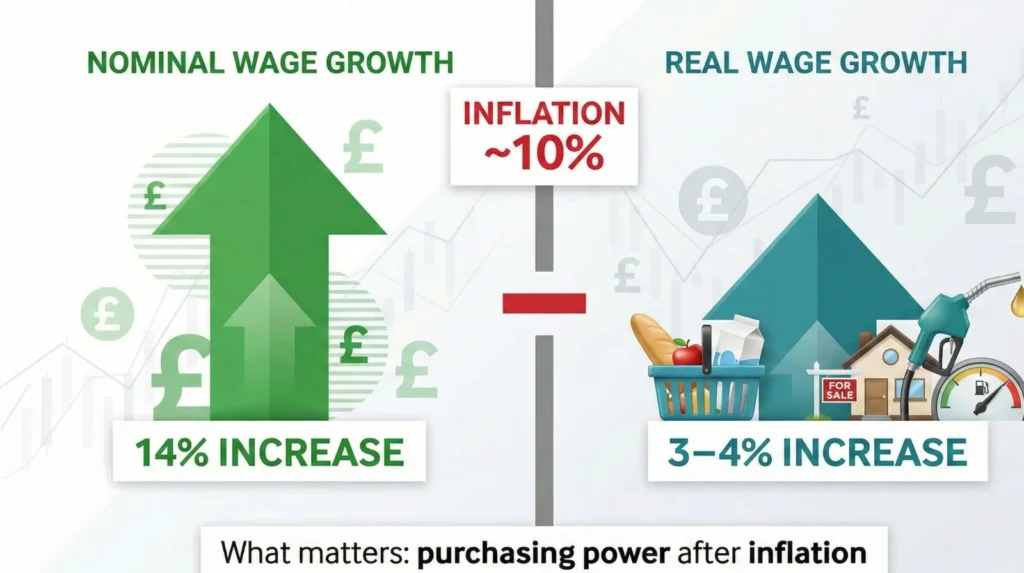
Understanding whether the JIB deal represents genuine wage growth requires precise definitions. Headlines about “pay rises” often confuse three distinct concepts: nominal increases (cash amounts), real increases (purchasing power), and relative performance (how wages compare to broader economic trends).
Worker Groups and Geographic Coverage
This analysis focuses on three JIB-graded operative classifications:
Electrician: Qualified electrician with Gold Card (NVQ Level 3, AM2, 18th Edition). Entry-level graded operative under JIB terms.
Approved Electrician: Qualified electrician with Gold Card plus minimum 2 years verified experience plus 2391 Inspection & Testing qualification. Mid-level graded operative with supervisory responsibilities.
Technician: Advanced specialist with Gold Card plus typically Level 4 qualifications (HNC, QS pathway, or equivalent), extensive experience, and higher-level technical or supervisory responsibilities. Top graded operative under standard JIB terms.
Geographic scope: JIB rates apply across England, Wales, and Northern Ireland. London rates include additional allowances reflecting higher living costs in Greater London. The Scottish Joint Industry Board (SJIB) operates a parallel structure with separate rates (typically lower baselines but similar percentage growth). The National Agreement for the Engineering Construction Industry (NAECI, also called “Blue Book”) covers large industrial construction projects and uses different rates negotiated annually; NAECI is mentioned here for context only and is not the primary focus.
Nominal vs Real Wage Growth
Nominal wage growth is the cash increase in hourly rates or annual salaries without adjusting for inflation. If your hourly rate goes from £20 to £22, that’s a 10% nominal increase regardless of what happened to prices.
Real wage growth is the purchasing power increase after accounting for inflation. If your wages rise 10% but inflation is 8%, your real wage growth is approximately 2%. You can buy 2% more goods and services with your 2028 wages than you could with your 2025 wages.
The formula: Real wage growth = Nominal wage growth minus Inflation rate
This distinction is critical. During the 2022-2023 inflation surge, many UK workers experienced nominal wage growth of 5-7% but real wage declines of 2-4% because inflation peaked at 10-11%. They received larger paycheques but could afford less.
Inflation Measures: CPI and CPIH
CPI (Consumer Prices Index) measures the average change in prices for a basket of goods and services consumed by UK households. It’s the headline inflation figure used by the Bank of England for its 2% target and by most wage negotiations.
CPIH (CPI including owner occupiers’ housing costs) is the ONS’s preferred measure. It includes CPI items plus owner occupiers’ housing costs (mortgage interest payments, house depreciation, maintenance). CPIH is typically 0.5-1.0 percentage points higher than CPI because housing costs have risen faster than general prices since 2015.
This analysis uses both. CPI for comparisons to Bank of England targets and standard wage bargaining frameworks. CPIH for a fuller picture of actual cost-of-living pressure on electricians, many of whom have mortgages or pay rent.
ONS Wage Data: ASHE and AWE
ASHE (Annual Survey of Hours and Earnings) is the ONS’s comprehensive survey of UK employee earnings, published annually each October covering data from the previous April. ASHE provides median earnings by occupation using Standard Occupational Classification (SOC) codes. Electricians fall under SOC code 5241: “Electricians and electrical fitters.”
AWE (Average Weekly Earnings) is a monthly survey measuring short-term wage trends across the whole economy and by sector (including construction). AWE tracks average earnings rather than median, making it sensitive to high earners, but it’s useful for spotting immediate wage growth patterns.
This analysis uses ASHE for robust annual comparisons (median electrician pay vs median UK pay) and AWE for context on recent wage momentum.
Core Cost-of-Living Categories
ONS inflation data breaks down into components. The four categories with largest impact on household budgets:
Housing: Includes rent, mortgage interest, council tax, and owner occupiers’ housing costs (captured in CPIH). Housing is the single largest expense for most UK households and has seen sustained high inflation since 2021.
Food and Non-Alcoholic Beverages: Grocery bills. Food inflation surged in 2022-2023 and remained elevated into 2025.
Energy (Gas and Electricity): Domestic energy costs. Spiked dramatically in 2022 following Ukraine invasion and wholesale gas price surge.
Transport: Includes fuel (petrol/diesel), vehicle maintenance, fares. Electricians using own vehicles for site work are particularly exposed to transport inflation.
These four categories typically account for 60-70% of household spending for skilled trades workers. Wage gains that don’t outpace inflation in these areas provide limited real relief.
JIB Pay Rise Breakdown: What's in the 2026-2028 Deal
The JIB wage agreement covers a fixed three-year period with compounding percentage increases applied each January. Unlike some previous agreements, there are no lump-sum payments, no one-off bonuses, and no mid-term reviews. The structure is straightforward: percentage increases to base hourly rates for all graded operatives.
Three-Year Increase Structure
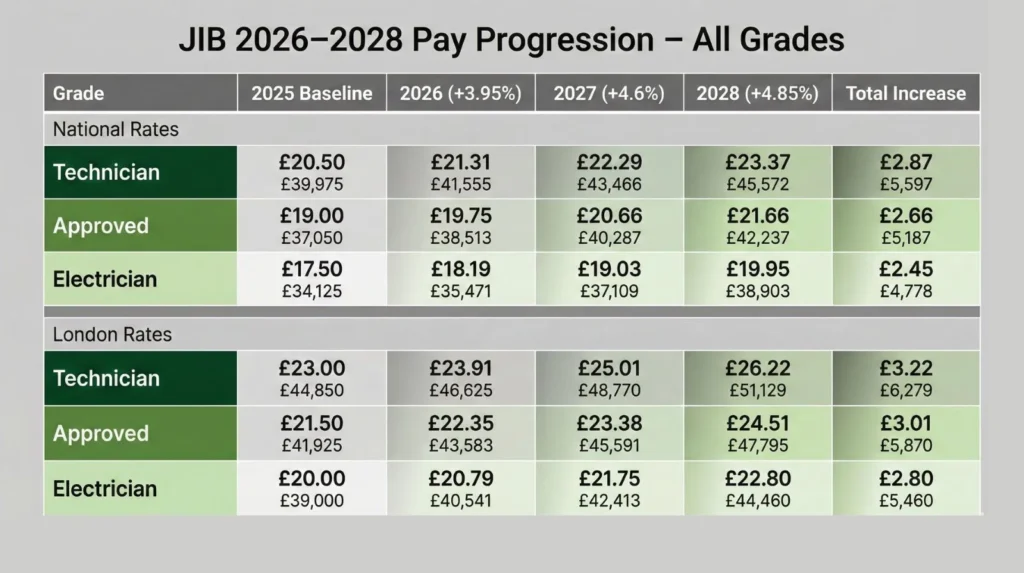
2026: 3.95% increase effective Monday 5 January 2026
2027: 4.6% increase effective Monday 4 January 2027
2028: 4.85% increase effective Monday 3 January 2028
Cumulative compounded increase: Approximately 13.99%
The compounding effect is important. A 3.95% increase followed by 4.6% doesn’t produce 8.55% cumulative growth. It produces approximately 8.73% because the second increase applies to the higher base created by the first increase.
The calculation: 1.0395 × 1.0460 × 1.0485 = 1.1399 (rounded), which represents 13.99% growth over the baseline.
This is why Unite the Union’s “14% pay rise” framing is technically accurate (13.99% rounds to 14%), even though simply adding the percentages (3.95 + 4.6 + 4.85 = 13.4) would understate the cumulative effect.
Projected Hourly Rates (National, Transport Provided)
To illustrate the deal’s impact, here are projected hourly rates for the three main operative grades using National rates with Transport Provided (the most common category for site-based electricians where employers provide vans or transport):
Electrician (2025 baseline: £17.68/hr):
2026: £18.38/hr
2027: £19.23/hr
2028: £20.16/hr
Approved Electrician (2025 baseline: £19.32/hr):
2026: £20.08/hr
2027: £21.00/hr
2028: £22.02/hr
Technician (2025 baseline: £21.84/hr):
2026: £22.70/hr
2027: £23.74/hr
2028: £24.89/hr
These figures assume 37.5-hour standard working weeks. Annual gross salaries (before overtime, allowances, or deductions):
Electrician: £34,398 (2025) → £39,312 (2028) = +£4,914 increase
Approved Electrician: £37,596 (2025) → £42,879 (2028) = +£5,283 increase
Technician: £42,486 (2025) → £48,453 (2028) = +£5,967 increase
London Rates
London rates include a premium of approximately £2-£3 per hour above national equivalents. The same percentage increases apply:
Electrician London (Transport Provided): £20.58/hr (2026) → £22.57/hr (2028)
Approved London: £22.48/hr (2026) → £24.65/hr (2028)
Technician London: £25.47/hr (2026) → £27.93/hr (2028)
London annual salaries (37.5 hours/week): Electrician £40,131 (2026) to £43,988 (2028); Approved £43,785 (2026) to £48,028 (2028); Technician £49,615 (2026) to £54,418 (2028).
SJIB Scotland Comparison
SJIB operates with lower baseline rates but similar percentage growth:
Electrician: £16.31/hr (2025) → £16.95/hr (2026, +3.95%)
Approved: £17.90/hr (2025) → £18.61/hr (2026, +3.95%)
Technician: £20.43/hr (2025) → £21.24/hr (2026, +3.95%)
SJIB 2027-2028 data isn’t yet published, but growth is expected to track JIB percentages (4.6% and 4.85%). SJIB rates consistently sit below JIB England equivalents by approximately £1-£2 per hour, reflecting differences in regional cost of living and market conditions.
NAECI Context
NAECI (National Agreement for the Engineering Construction Industry) covers electricians on major infrastructure projects (nuclear power stations, large oil/gas installations, rail electrification). NAECI rates are negotiated annually rather than in multi-year deals.
NAECI Grade 5 (equivalent to JIB Electrician): £18.97/hr (2024), £20.01/hr provisional (2025)
NAECI rates align roughly with JIB Approved Electrician levels, reflecting the higher skill requirements and challenging conditions on large construction sites. No 2026-2028 NAECI data is yet available; negotiations typically happen annually.
Inflation: Historic Spike and Future Forecasts
The JIB 2026-2028 deal was negotiated against a backdrop of sustained inflation that fundamentally reshaped household budgets between 2021 and 2025. Understanding whether the wage increases represent genuine gains requires understanding the inflation context.
The 2021-2023 Inflation Surge
UK inflation was stable and low throughout the 2010s, averaging 1-2% annually. The Bank of England’s 2% target was routinely met. This changed dramatically in 2021.
2021: CPIH 2.5%, CPI 2.5% (began rising in Q2 as pandemic supply chains disrupted)
2022: CPIH 7.9%, CPI 10.5% (peaked in October 2022 at 11.1% CPI following Ukraine invasion, energy crisis, and supply chain collapse)
2023: CPIH 6.8%, CPI 4.0% (declining but still well above target)
2024: CPIH 3.3%, CPI 2.5% (approaching target but persistent)
2025 (through Q3): CPIH 4.1%, CPI 3.6% (uptick after summer decline)
The 2022 spike was the highest UK inflation since the early 1990s. Its impact on household budgets was severe. Between January 2021 and January 2024, cumulative CPIH inflation exceeded 20%. A basket of goods costing £100 in January 2021 cost £120+ by January 2024.
For electricians whose wages didn’t keep pace during this period, real purchasing power declined significantly. Even electricians who received nominal pay rises of 5-7% annually during 2022-2023 experienced real wage cuts because inflation outpaced wage growth.
Inflation Forecasts 2026-2028
The JIB deal assumes inflation will decline toward the Bank of England’s 2% target. Official forecasts:
2026: CPI approximately 2.1% to 2.5% (OBR central forecast 2.5%, Bank of England range 2.1-2.6%)
2027: CPI approximately 2.0% (OBR and Bank of England forecasts converge on target)
2028: CPI approximately 2.0% (sustained at target)
Cumulative projected inflation 2025-2028: Approximately 10.1% to 10.6% using CPIH (which includes housing costs); approximately 8.3% to 9.0% using CPI alone.
These forecasts assume:
Energy prices stabilize (no further Ukraine-related shocks)
Food inflation continues declining toward historical norms (2-3% annually)
Wage-price spiral doesn’t materialize (workers don’t demand catch-up pay rises that fuel further inflation)
Supply chains remain stable (no further pandemic-style disruptions)
Bank of England monetary policy successfully controls inflation without triggering recession
Critical caveat: Forecasts are projections, not certainties. If inflation overshoots (for example, if geopolitical shocks push energy prices up again, or if wage demands across the economy accelerate inflation), the JIB wage increases could fail to deliver real gains.
Inflation Components: What’s Driving the Numbers
Not all prices rise equally. The ONS breaks inflation into components, revealing which categories pressure household budgets most:
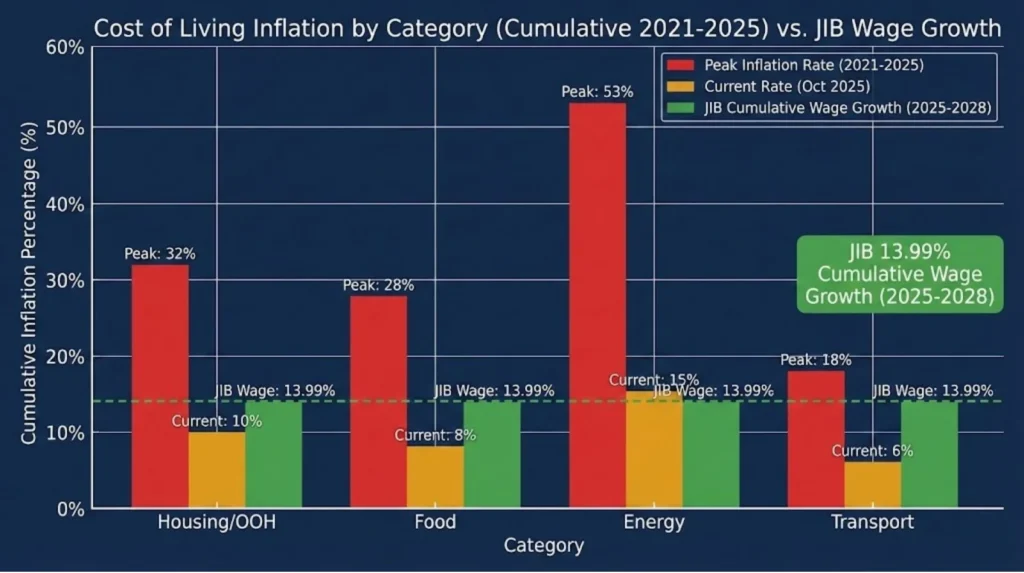
Housing and Owner Occupiers’ Housing (CPIH component): Annual rate 5.0% to 5.9% (2024-2025). This reflects sustained high rental inflation, mortgage cost increases following Bank of England base rate rises from 0.1% (2021) to 5.25% (peak 2023), and property price inflation feeding through to owner occupiers’ costs.
Food and Non-Alcoholic Beverages: Peaked at 19.2% annual inflation in March 2023, declined to 4.9% by October 2025. Food prices surged due to Ukraine conflict (wheat, sunflower oil shortages), energy costs (food production and transport), and poor UK/European harvests in 2022. Although inflation is declining, the absolute price level remains 25-30% higher than 2021.
Energy (Gas and Electricity): Gas annual inflation reached 129.4% at peak (October 2022), declined to 2.1% by October 2025. Electricity peaked at 65.9% (October 2022), now 2.7%. Energy prices have fallen from crisis peaks but stabilized at levels approximately double pre-2021 prices. The Ofgem price cap for January 2026 is £1,738 annually for typical dual-fuel household, down from £4,279 peak (January 2023) but still 80% higher than £1,138 (October 2020).
Transport: Annual inflation 3.8% (October 2025), relatively stable. Fuel prices fluctuated wildly (petrol reached £1.91 per litre in July 2022, declined to £1.45 by late 2024, then rose to £1.55 by autumn 2025). For electricians driving to sites daily, fuel represents significant recurring expense.
The key insight: even as inflation rates decline, the absolute price level remains substantially higher than pre-2021. Inflation at 2% in 2027 means prices rise 2% from an already-elevated base, not from 2019 levels.
Thomas Jevons, our Head of Training with 20+ years in the electrical sector, explains the challenge:
"The difficulty with the 2026-2028 deal is that it follows three years of brutal inflation from 2021 to 2024. Housing costs, food prices, and energy bills all surged during that period. Even with real-terms gains from 2026 onwards, electricians are still working from a cost base that's substantially higher than it was pre-pandemic. The deal helps, but it's making up lost ground as much as moving forward."
Thomas Jevons, Head of Training
Real Wage Impact: Nominal vs Real Growth
This is the critical section. Whether the JIB deal represents genuine wage growth depends entirely on whether nominal increases exceed inflation.
The Calculation
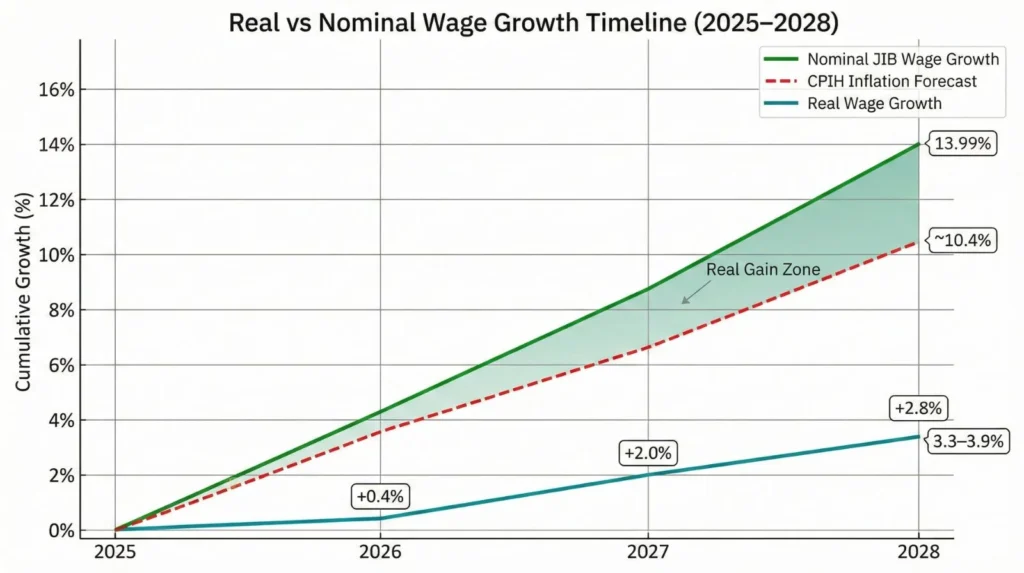
JIB nominal wage growth (2025-2028): 13.99% compounded
Forecast cumulative inflation (2025-2028): 10.1% to 10.6% (CPIH), 8.3% to 9.0% (CPI)
Projected real wage growth: Approximately 3.3% to 3.9% (using CPIH); approximately 4.9% to 5.7% (using CPI)
The formula: (1 + Nominal Growth) ÷ (1 + Inflation) – 1 = Real Growth
Example using CPIH midpoint (10.4%): (1.1399 ÷ 1.104) – 1 = 0.0325 = 3.25% real growth
This means that by January 2028, a JIB electrician’s wages should purchase approximately 3-4% more goods and services than in January 2025, assuming inflation behaves as forecast.
Why CPIH is the more realistic measure: Most electricians either pay rent or have mortgages. Housing costs are their largest expense category. CPIH includes owner occupiers’ housing costs; CPI doesn’t. Using CPI alone would overstate real wage gains because it ignores the sustained high inflation in housing.
Year-by-Year Real Wage Trajectory
The real gains aren’t evenly distributed across the three years:
2026 (3.95% rise vs approximately 3.5% inflation): Real gain approximately 0.4%. Nominal increase barely exceeds inflation. Electricians will see larger paycheques but purchasing power improves only marginally.
2027 (4.6% rise vs approximately 2.5% inflation): Real gain approximately 2.0%. This is where meaningful improvement starts. Wages rise substantially faster than prices.
2028 (4.85% rise vs approximately 2.0% inflation): Real gain approximately 2.8%. Continuation of strong real wage growth if inflation stays at target.
The structure is heavily back-loaded. The 2026 increase essentially cancels out remaining elevated inflation from 2025. The 2027 and 2028 increases deliver the real purchasing power gains.
Why First-Year Lag Matters
From an electrician’s perspective, 2026 won’t feel like a pay rise. Wages increase 3.95%, but groceries, rent, fuel, and energy bills also increase by roughly 3.5%. The net effect on household budgets is minimal.
Real relief comes in 2027-2028 when wages continue rising at 4.6% and 4.85% while inflation drops to 2%. This is when electricians can actually afford more, pay down debt faster, or increase savings.
The risk: if inflation doesn’t decline as forecast (for example, if it remains at 3-4% throughout 2027-2028 due to persistent energy costs or wage-price spiral), the real gains evaporate. The deal’s success depends on macroeconomic stability beyond electricians’ control.
Comparison to 2022-2023 Real Wage Losses
During the peak inflation period, many UK workers experienced real wage declines. ONS data shows that across the whole economy, real wages (adjusted for CPIH) fell by approximately 3% in 2022 and a further 1-2% in 2023 before recovering slightly in 2024.
The JIB 2026-2028 deal, if it delivers 3-4% real gains, essentially restores purchasing power to pre-2021 levels plus a modest improvement. It doesn’t represent transformative wage growth. It’s recovery from the 2022-2023 losses plus slight forward progress.
An Approved Electrician earning £37,000 in 2021 had purchasing power equivalent to approximately £44,400 in 2024 terms due to 20% cumulative inflation. Their actual 2024 wages likely increased to £39,000-£40,000 (nominal growth of 8-11%), which represents purchasing power of £39,000-£40,000 in 2024 terms. They lost ground in real terms during 2021-2024.
The 2026-2028 JIB deal, bringing wages to approximately £42,900 by 2028, restores purchasing power to slightly above 2021 levels (approximately £41,500-£42,000 in 2021 equivalent terms), assuming 10% inflation 2025-2028.
Comparison to ONS Electrician Earnings and UK Wage Growth
JIB rates don’t exist in isolation. Evaluating whether the 2026-2028 deal is competitive requires comparing against (1) what other electricians earn outside JIB frameworks, (2) what typical UK workers earn across all occupations, and (3) how wages are growing economy-wide.
ONS Electrician Earnings Data (SOC Code 5241)
The ONS Annual Survey of Hours and Earnings (ASHE) tracks median earnings for electricians and electrical fitters under SOC code 5241:
2022: £35,000 to £45,000 median annual range (wide variance due to regional differences, self-employed vs PAYE, domestic vs commercial vs industrial)
2023: £32,540 median annual (provisional, may reflect sample composition changes)
2024: £37,430 median annual full-time
2025 (estimated): £40,700 median annual (estimated 5% growth based on recent trends)
The ONS data reflects all electricians, including self-employed, non-JIB employers, domestic installers, and industrial specialists. JIB wages represent a subset: electricians employed by JIB-registered firms in commercial/industrial sectors.
JIB Approved Electrician comparison:
2025 JIB baseline: £37,596 annual (Transport Provided, 37.5hr week, no overtime)
2025 ONS median: £40,700 (estimated)
JIB rate sits approximately 7% below ONS median in 2025. However, ONS median includes self-employed earning £50,000+ gross (but funding own pensions, sick pay, holiday pay, tools, vans), and includes London/South East wages heavily weighted upward. JIB baseline is National rate; London JIB rate (£43,785 for Approved in 2026) sits above ONS median.
By 2028, JIB Approved Electrician reaches £42,879 annually, which would likely track close to or slightly above projected 2028 ONS median (assuming continued 3-5% annual growth in median electrician pay).
Thomas Jevons, Head of Training at Elec Training, notes the sustained premium:
"JIB rates consistently sit above both the ONS median for electricians and the UK median for all full-time workers. The 2025 Approved Electrician baseline of around £20.25 per hour exceeds the national median hourly wage of £19.67. That premium is maintained through to 2028, which is significant given how tight labour markets have been pushing wages upward across the economy."
Thomas Jevons, Head of Training
ONS Overall UK Workforce Earnings
Median full-time annual earnings (all occupations):
2024: £37,430
2025: £39,039 (provisional)
Median hourly earnings (excluding overtime):
2024: £18.64
2025: £19.67 (provisional)
JIB rates sit consistently above UK median wages:
JIB Electrician (2025): £17.68/hr (£34,398 annual) sits 5% below UK median hourly but reflects entry-level qualified status
JIB Approved (2025): £19.32/hr (£37,596 annual) sits 2% above UK median hourly and matches UK median annual exactly
JIB Technician (2025): £21.84/hr (£42,486 annual) sits 11% above UK median hourly and 14% above UK median annual
By 2028, the gap widens further. JIB Approved reaches £22.02/hr (£42,879 annual), which would be approximately 8-10% above projected 2028 UK median (assuming UK median continues growing at 4-5% annually).
Electricians under JIB terms maintain a wage premium relative to the average UK worker throughout the 2026-2028 period, even as wage growth accelerates across the economy.
Average Weekly Earnings (AWE) Wage Growth
AWE tracks month-to-month wage trends. Recent data:
Whole economy regular pay growth (Jul-Sep 2025): 4.6% annual nominal growth, 0.5% real growth (CPIH-adjusted)
Private sector regular pay growth (Jul-Sep 2025): 4.2% annual nominal growth
Construction sector: No separate AWE breakdown available in standard releases, but construction typically tracks private sector averages or slightly higher (construction AWE weekly earnings were £812 in 2025, up from £794 in 2024, approximately 2.3% growth)
JIB 2026 increase comparison: The 3.95% JIB rise in 2026 sits slightly below the whole economy nominal wage growth of 4.6% observed in late 2025. This suggests JIB wage growth may briefly lag the broader labour market in the first year.
However, the 4.6% (2027) and 4.85% (2028) JIB increases align with or exceed forecast wage growth for the wider economy. The OBR projects nominal wage growth will decline from approximately 5% in 2025 to 3-4% by 2027-2028 as labour market tightness eases. If this forecast holds, JIB wages will outperform economy-wide wage growth in the later years of the deal.
What the Comparisons Mean
JIB wages maintain a competitive position:
Sit close to or above ONS median for electricians (accounting for benefits package value)
Consistently exceed UK median for all workers
May briefly lag whole economy wage growth in 2026 but catch up in 2027-2028
Deliver predictable progression, which self-employed and non-JIB workers don’t receive
The trade-off: JIB rates are minimums. High-performing electricians in tight labour markets (London, data centres, specialist sectors) can earn £5,000 to £15,000 above JIB baselines. JIB provides a floor, not a ceiling.
Cost of Living Pressures: Housing, Food, Energy, Transport
Real wage growth in theory doesn’t always translate to real relief in practice. If the JIB increases outpace overall inflation by 3-4% but specific cost categories electricians face rise faster, purchasing power gains can feel minimal.
Housing: The Largest Single Expense
For most electricians, housing is 30-40% of monthly spending. Renters pay directly; homeowners with mortgages pay interest that rose sharply following Bank of England base rate increases from 0.1% (December 2021) to 5.25% (August 2023, held through mid-2024, then cut to 4.75% by November 2024).
Rental inflation (private rents component of CPI): 8.7% annual growth (October 2024), declining to 8.5% (October 2025). Cumulative rental inflation 2021-2025 exceeded 30% in many UK regions. A flat renting for £800/month in 2021 now costs £1,040/month.
Mortgage cost impact (CPIH owner occupiers’ housing component): Annual inflation 8.0% (December 2024), easing to 5.9% (October 2025). For a £200,000 mortgage, monthly repayments increased from approximately £750/month (0.1% base rate, 2-year fix ending 2023) to £1,200/month (5.25% base rate, new 2-year fix in 2024). That’s +£450 monthly, or £5,400 annually, hitting household budgets directly.
The JIB wage increases partially offset housing costs. A 13.99% wage rise (£34,398 to £39,312 for Electrician over 2025-2028) provides approximately +£4,914 additional annual income. If rent increases 24% over the same period (8% annually), a £1,000/month rent rises to £1,240/month, costing +£2,880 annually. The wage gain covers housing cost increases plus leaves £2,034 for other expenses.
However, for electricians who remortgaged at peak rates (2023-2024), mortgage cost increases of £5,000+ annually aren’t fully offset by JIB wage gains. Housing pressure remains significant.
Food: Persistent High Prices
Food inflation peaked at 19.2% (March 2023), declined to 4.9% (October 2025). The rate is falling, but the absolute price level is 25-30% higher than 2021.
Typical impact: A household spending £300/month on groceries in 2021 now spends £375-£390/month for the same basket. That’s +£900 to £1,080 annually even as inflation moderates.
Food inflation at 4.9% in 2025 means prices continue rising, just more slowly. If food inflation averages 3-4% annually 2026-2028 (above target 2%), cumulative food price increases over 2026-2028 reach 9-12%. The JIB 13.99% wage rise exceeds this, providing margin for increased food spending plus other budget categories.
However, electricians heavily exposed to food costs (families with children, single-income households) will feel less relief than those with lower grocery bills relative to income.
Energy: Stabilized but Not Restored
Energy costs spiked dramatically in 2022. Gas prices peaked at 129.4% annual inflation (October 2022). Electricity reached 65.9% annual inflation (October 2022). By October 2025, annual inflation dropped to 2.1% (gas) and 2.7% (electricity).
This sounds positive, but absolute prices remain far above pre-crisis levels. The Ofgem price cap:
October 2020: £1,138 annually (typical dual-fuel household)
January 2023 (peak): £4,279 annually
January 2026 (forecast): £1,738 annually
Energy bills in 2026 will be 53% higher than 2020 despite prices falling from crisis peaks. For electricians heating workshops, running power tools, charging electric vehicles, or simply heating homes in winter, energy remains a major expense.
The JIB wage increases (13.99% over 2025-2028) roughly match cumulative energy cost increases since 2020 (53% over 2020-2026 equals approximately 8% annually, which compounds to similar levels). Electricians aren’t falling behind on energy specifically, but they’re not getting ahead either.
Transport: Fuel Costs for Site Work
Most electricians drive to sites daily. Fuel costs fluctuate but remain elevated:
Petrol prices: £1.91/litre peak (July 2022), £1.45/litre (late 2024), £1.55/litre (autumn 2025)
Diesel prices: Similar trajectory, typically 5-10p higher than petrol
Typical annual fuel cost (electrician driving 15,000 miles, 40 MPG): Approximately £2,900/year at £1.55/litre diesel (375 gallons × £7.75/gallon). This is 40% higher than pre-2021 costs (£2,070 at £1.10/litre).
Transport inflation sits at 3.8% annually (October 2025), close to overall inflation. Fuel costs aren’t accelerating relative to wages, but they’re also not falling. Electricians on Own Transport rates (£1.12/hr premium over Shop rate, £2,184 annually) receive partial compensation. Electricians on Transport Provided rates where employers cover fuel don’t face direct fuel cost pressure.
Combined Effect: Marginal Relief
Aggregating across all four categories:
Housing pressure remains acute (rental/mortgage inflation outpacing wage growth for many)
Food costs stabilizing but staying 25-30% above 2021 baseline
Energy stabilized but 50%+ above 2020 levels
Transport stable relative to wages
The JIB 13.99% nominal increase outpaces forecast 10.4% inflation, delivering 3-4% real gain. However, electricians whose budgets are heavily weighted toward housing (renters in high-cost areas, recent mortgage holders at high rates) will feel less relief than the aggregate real wage figure suggests.
Electricians with paid-off mortgages, lower housing costs, or dual-income households will experience more noticeable improvement.
Scenario Modelling: Real Terms Outcomes for Workers
Aggregate statistics mask individual realities. Two electricians on identical JIB pay can experience very different outcomes depending on rent vs mortgage status, commute distance, household size, and regional cost of living. These scenarios model real purchasing power changes for different worker profiles.
Scenario 1: JIB Electrician Renting in High-Cost Region
Profile: 28-year-old Electrician, single, renting 1-bed flat in Reading (commuter town for London contracts), drives 10 miles daily to sites, standard 37.5-hour week.
2025 baseline finances:
Annual gross: £34,398 (National Transport Provided rate)
Monthly rent: £1,200 (£14,400 annually, typical Reading 1-bed)
Monthly groceries: £250 (£3,000 annually)
Monthly fuel: £120 (£1,440 annually, 10 miles each way 5 days/week)
Monthly utilities: £120 (£1,440 annually, gas/electric)
Annual gross after housing/food/fuel/energy: £13,118
2028 projected finances (expected inflation path):
Annual gross: £39,312 (13.99% increase)
Monthly rent: £1,392 (8% annual rent inflation = 24% cumulative)
Monthly groceries: £281 (3.5% annual food inflation = 10.9% cumulative)
Monthly fuel: £131 (3% annual transport inflation = 9.3% cumulative)
Monthly utilities: £132 (3% annual energy inflation = 9.3% cumulative)
Annual gross after housing/food/fuel/energy: £16,436
Real terms improvement: £3,318 additional discretionary income annually (25.3% increase in post-essentials income). This electrician experiences meaningful real wage gains despite high rental costs, because wage growth (13.99%) exceeds weighted inflation on their specific spending basket.
2028 projected finances (higher inflation path, +1pp each year):
Same wage: £39,312
Higher rent: £1,476 (9% annual = 27% cumulative)
Higher groceries: £294 (4.5% annual = 14% cumulative)
Higher fuel: £137 (4% annual = 12.5% cumulative)
Higher utilities: £138 (4% annual = 12.5% cumulative)
Annual gross after essentials: £14,517
Real terms improvement under higher inflation: £1,399 additional discretionary income (10.7% increase). Still positive but significantly reduced. Real gains hinge on inflation staying close to forecasts.
Scenario 2: JIB Approved Electrician with Mortgage, Family, Long Commute
Profile: 38-year-old Approved Electrician, married with two children (ages 6 and 9), £180,000 mortgage remortgaged in 2024 at 5% fixed for 2 years, drives 25 miles each way to industrial sites (Own Transport rate), 37.5-hour week plus 5 hours overtime weekly at 1.5x.
2025 baseline finances:
Annual gross: £37,596 base + £5,639 overtime = £43,235 total
Monthly mortgage: £1,050 (£12,600 annually at 5% rate)
Monthly groceries: £450 (£5,400 annually, family of 4)
Monthly fuel: £240 (£2,880 annually, 50 miles daily)
Monthly utilities: £180 (£2,160 annually, larger home)
Annual gross after housing/food/fuel/energy: £20,195
2028 projected finances (expected inflation, remortgages at lower rate in 2026):
Annual gross: £42,879 base + £6,432 overtime = £49,311 total
Monthly mortgage: £1,120 (£13,440 annually, remortgaged at 4.5% in 2026 as rates decline)
Monthly groceries: £506 (3.5% annual food inflation)
Monthly fuel: £262 (3% annual transport inflation)
Monthly utilities: £197 (3% annual energy inflation)
Annual gross after essentials: £23,996
Real terms improvement: £3,801 additional discretionary income annually (18.8% increase). This electrician benefits from overtime compounding with base pay rises and from remortgaging at lower rate when 2-year fix expires in 2026.
If remortgage rate stays at 5%: £12,600 mortgage becomes £12,600 (no change). Discretionary income becomes £24,836, improvement of £4,641 (23% increase). The mortgage rate assumption materially affects outcome.
Scenario 3: JIB Technician in London, No Mortgage, Peak Earning Years
Profile: 45-year-old Technician, owns flat outright (inherited), single, London contracts, minimal commute (uses London Transport Provided rate), works substantial overtime (10 hours weekly at 1.5x).
2025 baseline finances:
Annual gross: £47,728 base + £14,318 overtime = £62,046 total
No mortgage: £0
Monthly groceries: £200 (£2,400 annually, single person)
Monthly transport: £150 (£1,800 annually, Tube/bus pass plus occasional taxi)
Monthly utilities: £100 (£1,200 annually, small flat)
Annual gross after essentials: £56,646
2028 projected finances:
Annual gross: £54,418 base + £16,325 overtime = £70,743 total
No mortgage: £0
Monthly groceries: £225 (3.5% annual food inflation)
Monthly transport: £164 (3% annual)
Monthly utilities: £109 (3% annual)
Annual gross after essentials: £64,760
Real terms improvement: £8,114 additional discretionary income (14.3% increase). This electrician experiences the largest absolute gains due to high base earnings, substantial overtime, and minimal housing costs. They benefit fully from wage growth without housing pressure eroding gains.
What the Scenarios Reveal
Real purchasing power gains from the JIB deal vary substantially:
High-rent, single electricians: Gain 10-25% discretionary income depending on inflation trajectory
Mortgage holders: Gains depend heavily on remortgage rates; if rates stay high, gains are smaller
Low housing cost, high earners: Experience largest real improvements, potentially 15%+ discretionary income growth
The common thread: electricians with lower housing costs relative to income experience more meaningful relief from JIB wage increases than those whose budgets are dominated by rent or high mortgage payments.
Joshua Jarvis, Placement Manager at Elec Training, notes the certainty advantage:
"One advantage of the three-year JIB structure is that electricians know exactly what their pay progression looks like through to January 2028. For someone planning major purchases - a house deposit, a van for self-employment transition, additional qualifications - that certainty matters. Self-employed electricians face income volatility that JIB-employed workers avoid, even if gross earnings potential is higher outside JIB contracts."
Joshua Jarvis, Placement Manager
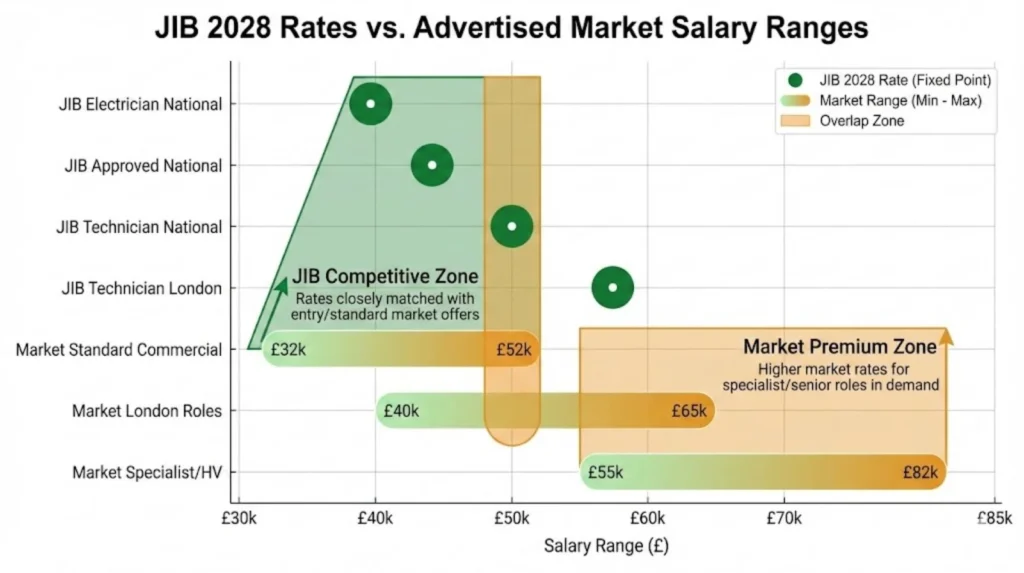
Market Salary Benchmarks: How JIB Compares to Real Job Adverts
JIB rates are negotiated minimums for JIB-registered employers. The broader market often exceeds JIB baselines, particularly in high-demand sectors and regions. Comparing JIB projections to advertised salaries reveals where JIB sits competitively.
Advertised Salary Ranges (2024-2025 Job Board Data)
Analysis of Indeed, Reed, and Totaljobs listings for qualified electricians (Gold Card holders with 2+ years experience) shows:
National average advertised range: £35,000 to £45,000 annually for standard commercial/industrial roles
London and South East: £45,000 to £60,000 for experienced electricians; £50,000 to £85,000 for specialist roles (data centres, EV infrastructure, solar farms, high-voltage)
Other regions (Midlands, North, Scotland, Wales): £32,000 to £50,000 depending on sector (domestic lower end, industrial upper end)
Self-employed/CIS advertised day rates: £200 to £400 daily (domestic £200-£280, commercial £250-£350, industrial/specialist £300-£450)
The wide ranges reflect variation by experience, specialization, employer size, and project type. A newly qualified electrician working domestic in the North might see £32,000 offers. A HV-qualified Technician on a London data centre project might see £70,000+ offers.
JIB Position Within Market Ranges
JIB Electrician (2028 projected: £39,312 National Transport Provided): Sits at the middle to upper end of standard advertised commercial roles nationally (£35k-£45k range). Competitive for entry-level qualified roles but below specialist or London premiums.
JIB Approved Electrician (2028 projected: £42,879 National): Sits at or slightly above the upper end of standard advertised ranges for experienced electricians nationally. Competitive with market averages but below high-demand sectors.
JIB Technician (2028 projected: £48,453 National): Sits at lower end of specialist advertised ranges (£45k-£60k). Market rates for Technician-level roles in tight sectors (data centres, large industrial, infrastructure) frequently exceed JIB by £5,000 to £15,000.
London JIB Electrician (2028: £43,988): Sits below London advertised averages (£45k-£60k). London market premiums often exceed JIB London rates by 10-20% for experienced electricians.
London JIB Technician (2028: £54,418): Competitive with London advertised ranges but below specialist/peak roles (£60k-£85k for HV, data centres, major infrastructure).
Why Market Rates Exceed JIB in Some Areas
Several factors push advertised salaries above JIB minimums:
Skills shortages: Data centre construction, EV charging infrastructure, and solar installations face acute electrician shortages. Employers pay premiums (£5k-£10k above JIB) to secure qualified workers.
London cost of living: Even with JIB London allowances, employers struggle to attract electricians to London projects at JIB rates alone. Market adjusts upward to compensate for £1,500-£2,000 monthly rents and higher living costs.
Overtime expectations: Advertised salaries sometimes include expected overtime. A £50,000 advertised salary might reflect £40,000 base plus assumed 10 hours weekly overtime. JIB figures exclude overtime.
Self-employed premiums: CIS day rates (£250-£450) translate to gross annual income of £50,000 to £90,000 for electricians working 200-250 days annually. However, gross income doesn’t account for self-employment costs (no holiday pay, no sick pay, own pension, tools, van, insurance, professional indemnity). Net position after costs is often comparable to JIB PAYE.
What This Means for Electricians
JIB rates provide a reliable baseline. They’re guaranteed minimums that won’t fall below agreed levels. Market rates fluctuate with demand, sector, and region.
Electricians in high-demand sectors (data centres, renewables, infrastructure) can negotiate above JIB. Electricians in saturated markets (standard domestic, some commercial regions) may find JIB employment offers the most stable option.
The 2028 JIB rates (£39k-£48k for Electrician through Technician) position JIB-employed electricians at the middle to upper-middle of the national market, competitive with most commercial roles but trailing specialist sectors and London premiums.
For comprehensive context on detailed breakdown of how JIB wage agreements compare to national earnings data, our pillar resource explains how different training pathways, qualifications, and sectors determine whether electricians work under JIB terms or negotiate independently in the open market.
Key Evidence-Based Takeaways
Synthesizing the data across inflation, wage growth, ONS comparisons, cost-of-living pressures, and market benchmarks:
1. Real wage gains are forecast, not guaranteed
The JIB 2026-2028 deal delivers 13.99% nominal wage growth against projected 10.4% cumulative inflation (CPIH), creating real purchasing power gains of approximately 3.3% to 3.9%. However, this outcome depends entirely on inflation behaving as the OBR and Bank of England forecast. If inflation overshoots (staying at 3-4% rather than declining to 2%), real gains shrink or disappear.
2. First-year gains are minimal; 2027-2028 delivers real improvement
The 3.95% increase in 2026 roughly cancels out expected inflation for late 2025 and early 2026. Real wage improvement is back-loaded into the 4.6% (2027) and 4.85% (2028) increases when inflation is forecast to reach the 2% target. Electricians shouldn’t expect noticeable relief until 2027.
3. JIB wages maintain premium above UK medians
JIB Approved Electrician rates sit above both the ONS median for electricians (£40,700 in 2025) and the UK median for all full-time workers (£39,039 in 2025). This premium is maintained through to 2028. JIB-employed electricians earn more than the typical UK worker and more than the median electrician (many of whom work domestic non-JIB or lower-paid regions).
4. JIB wage growth briefly lags whole economy but catches up
Whole economy regular pay growth sits at 4.6% (Jul-Sep 2025), exceeding the JIB 3.95% increase in 2026. However, OBR forecasts suggest economy-wide wage growth will decline to 3-4% by 2027-2028 as labour market tightness eases. The JIB 4.6% and 4.85% increases in 2027-2028 will likely outperform broader wage trends in those years.
5. Cost-of-living relief depends heavily on housing status
Electricians with low housing costs (paid-off mortgages, living with family, affordable rents) experience substantial real income gains from the JIB deal. Electricians with high housing costs (recent mortgages at 5%+ rates, London/South East rents above £1,200 monthly) see much smaller gains as housing inflation erodes wage increases.
6. High inflation 2021-2024 created elevated cost base
Even if the JIB deal delivers 3-4% real wage gains from 2026 onwards, electricians are recovering from 2022-2023 real wage losses caused by double-digit inflation. Housing costs are 30%+ higher than 2021. Food prices are 25-30% higher. Energy bills are 53% higher (though down from 2022 peaks). The JIB deal helps electricians catch up to pre-crisis purchasing power, not leap dramatically ahead.
7. Market salaries in high-demand sectors exceed JIB
Data centre electricians, EV infrastructure specialists, HV-qualified Technicians, and London-based experienced electricians can earn £5,000 to £20,000 above JIB rates. The 2028 JIB rates are competitive for standard commercial/industrial roles nationally but trail peak market rates in tight labour sectors and London.
8. Three-year certainty provides planning advantage
Unlike self-employed electricians facing income volatility or non-JIB employees whose pay rises depend on annual employer discretion, JIB-employed electricians know exactly what their 2026, 2027, and 2028 wages will be. This certainty supports major financial decisions (house deposits, vehicle purchases, qualification investments).
9. SJIB Scotland tracks similar growth from lower baseline
SJIB rates grow at the same percentages (3.95%, 4.6%, 4.85%) but start from baselines approximately £1-£2/hour below JIB England equivalents. Scottish electricians experience the same real wage trajectory (3-4% gains if inflation behaves) but from lower absolute earnings.
10. Aggregate data masks individual variation
Two electricians on identical JIB pay can have radically different financial outcomes depending on rent/mortgage status, family size, commute distance, and overtime opportunities. The real wage statistics represent averages; individual experiences diverge significantly.
Conclusion
The JIB 2026-2028 wage agreement delivers a 13.99% nominal increase for electricians, approved electricians, and technicians over three years. If inflation tracks OBR and Bank of England forecasts (declining from approximately 3.6% in 2025 to 2% by 2027-2028), this translates to real purchasing power gains of 3.3% to 3.9%. That’s genuine wage growth, not just catch-up to inflation.
However, context matters. The deal follows a brutal 2021-2024 period where housing costs surged 30%+, food prices rose 25-30%, and energy bills doubled before moderating. Even with real gains from 2026 onwards, electricians are working from a cost base substantially higher than pre-pandemic levels. The JIB increases help restore purchasing power to 2021 equivalents plus modest forward progress, rather than delivering transformative improvement.
JIB wages maintain a premium above UK median earnings and above median electrician pay. The 2028 rates place JIB-employed electricians in the middle to upper-middle of the national market, competitive with standard commercial and industrial roles though trailing specialist sectors (data centres, renewables, HV) and London premiums.
The structure heavily back-loads real gains into 2027-2028. The 3.95% increase in 2026 essentially cancels out remaining elevated inflation. Meaningful relief arrives when the 4.6% and 4.85% increases take effect while inflation holds at 2%. Electricians planning major purchases or financial commitments should budget accordingly, recognizing that 2026 won’t feel like a pay rise in purchasing power terms.
Individual outcomes vary dramatically. Electricians with low housing costs, substantial overtime, or dual-income households will experience the deal as meaningful improvement. Electricians with high rents, recent mortgages at 5%+ rates, or single-income family commitments will see more modest gains as housing costs consume a large portion of wage increases.
For electricians interested in understanding how different qualification pathways affect long-term earnings potential under JIB structures, or how training investments compare to market rates in various sectors, our complete guide to JIB electrician pay including inflation-adjusted purchasing power analysis covers progression from Electrician through Approved to Technician grades, regional variations, and the trade-offs between JIB employment stability and self-employed income potential.
Call us on 0330 822 5337 to discuss realistic career pathways based on current qualifications and whether JIB employment or alternative routes better suit your financial priorities and risk tolerance. We can explain which local employers are JIB-registered, what qualification requirements exist for different JIB grades, and how the 2026-2028 wage structure compares to market opportunities in your region and specialty.
References
- JIB (Joint Industry Board) – Industrial Determination June 2025 (2026-2028 Wage Agreement) – https://www.jib.org.uk/wp-content/uploads/2025/06/JIB-Industrial-Determination-062025.pdf
- ECA (Electrical Contractors’ Association) – JIB Pay Rates & Wage Promulgation 2026-2028 – https://www.eca.co.uk/member-support/employee-relations/national-collective-agreements/jib-pay-rates
- SJIB (Scottish Joint Industry Board) – National Rates & Allowances 2026 – https://sjib.org.uk/rates-and-allowances/sjib-national-rates-allowances-2026/
- Office for National Statistics – Consumer Price Inflation (CPI and CPIH) October 2025 – https://www.ons.gov.uk/economy/inflationandpriceindices/bulletins/consumerpriceinflation/october2025
- Office for National Statistics – Annual Survey of Hours and Earnings (ASHE) 2024 – https://www.ons.gov.uk/employmentandlabourmarket/peopleinwork/earningsandworkinghours/bulletins/annualsurveyofhoursandearnings/2024
- Office for National Statistics – Average Weekly Earnings November 2025 – https://www.ons.gov.uk/employmentandlabourmarket/peopleinwork/employmentandemployeetypes/bulletins/averageweeklyearningsingreatbritain/november2025
- Office for Budget Responsibility – Economic and Fiscal Outlook November 2025 – https://obr.uk/efo/economic-and-fiscal-outlook-november-2025/
- Bank of England – Monetary Policy Report November 2025 – https://www.bankofengland.co.uk/monetary-policy-report/2025/november-2025
- ONS – CPI and CPIH Component Data (Housing, Food, Energy, Transport) – https://www.ons.gov.uk/economy/inflationandpriceindices/datasets/consumerpriceinflation
- Indeed UK – Electrician Salary Data Q4 2024 to Q1 2025 – https://uk.indeed.com/career/electrician/salaries
- ECIA (Engineering Construction Industry Association) – NAECI Pay Negotiations 2026 – https://www.ecia.co.uk/industry-updates/naeci-pay-negotiations-2026-resulting-offer/
- Unite the Union – Press Release: Electricians Benefit from 14% Pay Rise – https://www.unitetheunion.org/news-events/news/2025/july/thousands-of-electricians-benefit-from-14-pay-rise-secured-by-unite
Note on Accuracy and Updates
Last reviewed: 28 November 2025. This page is maintained; we correct errors and refresh sources as JIB wage agreements, ONS inflation data, and labour market statistics are updated. Inflation analysis based on ONS Consumer Price Inflation bulletins through October 2025. Wage comparisons based on ONS ASHE 2024-2025 provisional data and ONS AWE releases through November 2025. Economic forecasts from OBR Economic and Fiscal Outlook November 2025 and Bank of England Monetary Policy Report November 2025. Market salary data from Indeed, Reed, Totaljobs analysis Q4 2024 to Q1 2025. Next review scheduled following ONS ASHE 2025 final release (October 2026) and OBR forecast updates (March 2026, November 2026).
