
How to Avoid Scam Training Providers in the UK Adult Training Sector

- Technical review: Thomas Jevons (Head of Training, 20+ years)
- Employability review: Joshua Jarvis (Placement Manager)
- Editorial review: Jessica Gilbert (Marketing Editorial Team)
- Last reviewed:
- Changes: Initial publication
Why This Guide Exists (And Why You Need to Read It)
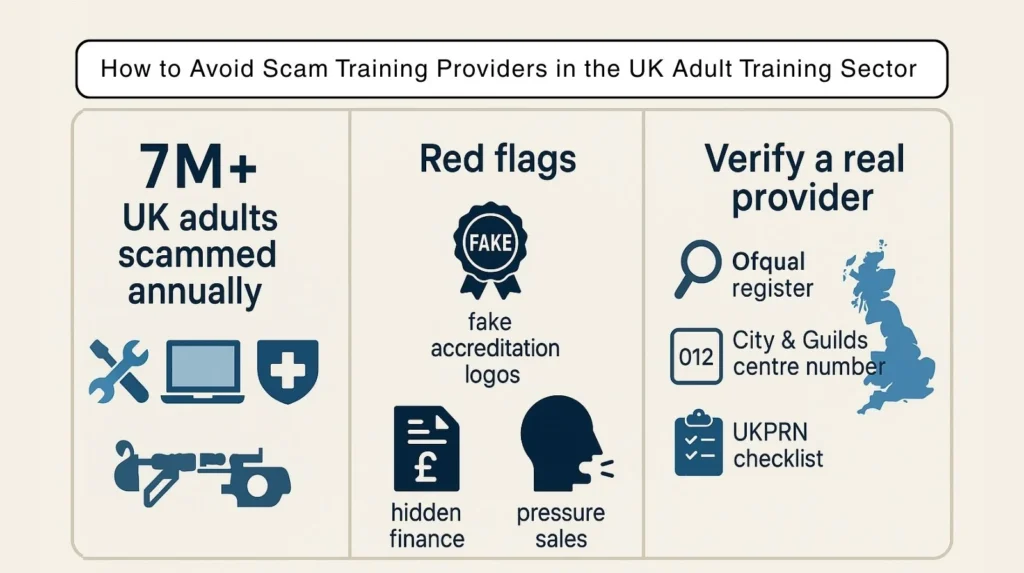
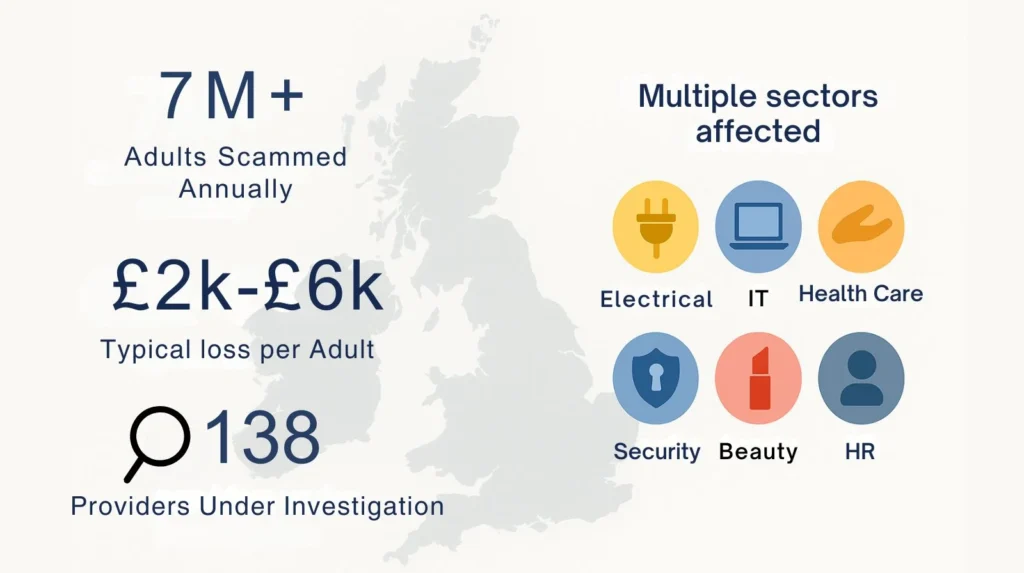
Over 7 million UK adults were hit by scams in the past year, according to Citizens Advice. That’s not just online fraud or phishing emails. A significant portion involves training providers operating across the adult education sector: electrical courses, IT bootcamps, care qualifications, security training, beauty therapy, HR certifications, and more.
Some providers operate legally but misleadingly. Others are outright scams that disappear with your money. Many sit in the uncomfortable middle, taking thousands of pounds for courses that deliver worthless certificates, no employment support, and leave you worse off than when you started.
The UK adult training sector has serious problems with mis-selling, fake qualifications, aggressive finance tactics, and providers who collapse after taking deposits. Trading Standards officers have reported firms conning people out of their learning account credits. The BBC, Guardian, and FE Week have documented multiple cases of collapsed providers, fake apprenticeships, and learners losing £3,000 to £6,000 on courses that led nowhere.
This isn’t about legitimate colleges or properly accredited training centres. This is about the dodgy end of the market where vulnerable adults looking to retrain get exploited.
This guide explains how to spot scam training providers, what your legal rights are, how to verify accreditations, what red flags to watch for, and where to report problems. It’s based on UK consumer protection law, regulatory warnings, real case studies, and patterns identified across forums, complaint sites, and official investigations.
Whether you’re considering a detailed guide to choosing legitimate fast-track training in electrical work, an IT course, care qualification, or any other adult training, this guide will help you avoid the scams.
The Scale of the Problem in UK Adult Training
Let’s establish how widespread this issue actually is, using official data and documented cases.
Citizens Advice figures:
- Over 7 million UK adults hit by scams in the past year
- 20% significantly affected by financial loss
- 9 million people affected by financial scams overall
- Over 11,000 complaints about offline scams (phone, post, door-to-door) in one year alone
Training-specific issues documented:
- Tens of millions of pounds potentially defrauded from adult education schemes, according to the National Audit Office
- 138 training providers being investigated for allegations of fraud, cash-for-diplomas schemes, fake degrees, and fabricated assessments (per social media reports citing regulatory investigations)
- Trading Standards cases involving firms that conned people into giving away learning account numbers and cashing the credits
- Multiple apprenticeship training providers facing bans over missing millions in government funding
Sectors affected:
- Electrical and construction trades
- IT and web development
- Care work (NVQ Level 2/3)
- Security (SIA, CSCS)
- Beauty therapy
- HR and business admin
- Plumbing and heating
- Medical billing and admin
- Pharmacy technician training
- Forest Schools and outdoor education
The problem isn’t confined to one industry. It’s systemic across adult training, particularly in courses aimed at career-changers, people made redundant, or those seeking fast qualification routes.
Common financial losses:
- £2,000 to £6,000 per course
- High-interest loans stacked on top of course fees
- Hidden costs not disclosed upfront
- Finance agreements with rates of 15% to 30% APR
- Learners unable to get refunds after discovering mis-selling
One Reddit user described being scammed by a company called *******UK:
"They sold me an electrician course and arranged for me to take out a loan. I later discovered it was a scam."
Another lost £750 in a single day to a training scam. Forum posts repeatedly mention providers like ******Ltd, described as
"part of a network of companies designed to profit from mis-sold loans and overpriced training."
This isn’t rare. It’s a widespread, well-documented problem affecting thousands of learners annually.
Your Legal Rights Under UK Consumer Protection Law
Before we get into scam tactics, let’s establish what protections you have. UK law provides significant consumer rights for training courses, but many learners don’t know they exist.
Consumer Rights Act 2015
The UK Government recognises students as consumers. The Consumer Rights Act 2015 consolidates consumer protection laws and applies to training courses purchased from providers.
Key protections:
- Services must be provided with reasonable care and skill
- Contracts must be transparent, legible, and written in plain, intelligible language
- Service providers must deliver what they promise
- You have rights if the service is not performed properly
This applies to vocational training, adult education courses, and professional qualifications purchased from providers.
Consumer Protection from Unfair Trading Regulations 2008 (CPRs)
These regulations prohibit:
- Misleading actions (false or deceptive advertising, misleading claims about qualifications)
- Misleading omissions (hiding costs, not disclosing that NVQ or work experience is required separately)
- Aggressive commercial practices (high-pressure sales, intimidation, harassment)
- Unfair commercial practices at any stage of interaction with prospective students
Traders cannot include false or deceptive messages. They’re prohibited from engaging in misleading actions and omissions. Breaches can result in criminal prosecution.
Consumer Contracts Regulations 2013 (14-Day Cooling-Off Period)
For distance sales (online courses) and off-premises contracts, you have a minimum 14-day cooling-off period to cancel without reason.
Key points:
- Period starts the day after you enter into the contract for services
One learner on Reddit said:
"I recently purchased a 12-week educational course online to be attended in person starting at the end of July. Can I cancel?"
Under UK Consumer Contracts Regulations, you have the right to cancel within 14 days.
Section 75 Protection (Credit Card Purchases Over £100)
This is huge and many people don’t know about it. If you paid any part of a course fee (even just the deposit) by credit card, and the total cost is between £100 and £30,000, you have protection under Section 75 of the Consumer Credit Act 1974.
What it covers:
- Breach of contract by the training provider
- Misrepresentation
- Provider goes bust before delivering the course
- Course not as described
You can claim directly from your credit card company, and they’re jointly liable with the provider. Even if you only paid a £100 deposit on a £5,000 course, the entire purchase sum is covered.
Chargeback Protection (Debit Card Purchases)
If you paid by debit card, you can request a chargeback through your bank for:
- Goods/services not received
- Goods/services not as described
- Provider went bust
Chargeback isn’t a legal right like Section 75, but most UK banks offer it as a scheme protection.
Reddit users frequently advise:
"If you used a credit card, request Section 75. You can try a chargeback for debit. I absolutely hate 'IT training' companies."
Financial Ombudsman Service (FOS)
If your credit card company or bank refuses a Section 75 or chargeback claim, you can escalate to the Financial Ombudsman Service. The FOS has dealt with cases where people were mis-sold training courses linked to finance agreements.
Important: The FOS has been criticised for inconsistency and for allegedly overstating the number of cases it upholds. University researchers accused it of this. One commentator wrote:
"The reality is this: the FOS has become a failing gatekeeper rather than a champion of consumer justice."
However, it remains your escalation route for finance disputes.
Competition and Markets Authority (CMA) Guidance
The CMA provides guidance on consumer rights for students and training purchasers. The guidance sets out minimum legal requirements for compliance with consumer law.
Common Scam Tactics Used by Dodgy Training Providers
Let’s break down the specific tactics scam providers use, based on documented cases, forum complaints, and Trading Standards warnings.
High-Pressure Sales and Aggressive Marketing
What it looks like:
- Cold-calling and relentless follow-ups
- “Limited spaces available, must decide today”
- “Special discount expires in 24 hours”
- Pressure to sign finance agreements on the spot
- Refusing to let you leave without signing
- Making you feel stupid for wanting time to think
One learner on Money Saving Expert wrote:
"I went online and found ****** training. Now my wife is so angry at me. The web page says you pay after the training, but I had to pay a deposit."
UK law prohibits aggressive sales tactics. If you feel pressured, intimidated, or harassed into signing, that’s a breach of the Consumer Protection from Unfair Trading Regulations.
Red flags:
- Won’t give you written information to take away
- Insists you sign immediately
- Uses emotional manipulation (“Don’t you want to provide for your family?”)
- Creates false urgency
Fake Job Guarantees
Common claims:
- “Guaranteed interviews with top companies”
- “100% employment rate”
- “Earn £50k+ within months”
- “We have thousands of employers waiting to hire you”
Joshua Jarvis, Placement Manager at Elec Training, explains:
"Lack of transparency is the biggest red flag we see. Legitimate providers show you their facilities, introduce you to tutors, explain exactly what qualifications you'll receive, and clarify what you'll still need afterwards. If everything is vague or rushed, or if they won't answer specific questions, that's when you need to be concerned."
Joshua Jarvis, Placement Manager
What legitimate providers can offer:
- Active placement support
- Contractor network introductions
- CV and interview guidance
- Help securing improver or entry-level roles
“Fully Qualified Fast” Mis-Selling
Common in sectors:
- Electrical: “Qualified electrician in 4-16 weeks”
- IT: “Full-stack developer in 12 weeks”
- Care: “NVQ Level 3 in weeks”
- Security: “SIA licence fast-track”
The problem: These claims conflate classroom qualifications with full competence. A Level 3 diploma isn’t the same as an NVQ Level 3 requiring on-site evidence. An online coding bootcamp doesn’t replace a degree or years of experience.
One Reddit user said of an IT course:
"I've seen a few courses like this, where you pay £1,800-£2,000 for a crash course in Web Development with a promise you'll be given a job. Anyone that goes on these courses and thinks they can walk out earning £50k a year are delusional."
Reality: Most “fast-track” courses provide foundational knowledge only. You’ll still need work experience, additional qualifications, or assessments to be properly qualified.
Fake Accreditations and Misuse of Logos
Common tactics:
- Using Ofqual, City & Guilds, or awarding body logos without authorisation
- Claiming “City & Guilds approved” when only delivering unregulated CPD courses
- Inventing fake accreditation bodies
- Claiming courses are “government-recognised” when they’re not on the Ofqual register
- “CPD UK Certified” or “Lead Auditor” certificates with no legal standing
From LinkedIn:
"From fake 'Lead Auditor' certificates to 'CPD UK Certified' courses with no legal standing, scams are rampant, especially targeting newcomers."
How to verify:
- Check the Ofqual Register of Regulated Qualifications
- Verify City & Guilds centre numbers on their official website
- Look up UKPRN (UK Provider Reference Number) on the UK Register of Learning Providers
- Contact the awarding body directly to confirm the provider is authorised
Thomas Jevons, Head of Training at Elec Training, clarifies:
"In practice, legitimate training centres are transparent about their City & Guilds centre number, Ofqual-regulated qualifications, and assessment processes. If a provider is vague about accreditation or uses phrases like 'industry-recognised' without specifics, that's a warning sign. Proper qualifications are listed on the Ofqual register."
Thomas Jevons, Head of Training
Fake Reviews and SEO Manipulation
Tactics identified:
- Paying for fake 5-star Trustpilot reviews
- Manipulating Google star ratings
- Creating fake comparison sites that rank their own courses #1
- Affiliate marketing schemes where “Top 10” lists are paid placements
- Hiding negative reviews or burying complaints
The CMA secured changes from Google to tackle fake reviews in January 2025. Google agreed to remove fake reviews and sanction UK businesses manipulating star ratings. Up to 35% of online reviews could be fake across major platforms, causing between £50 million and £312 million in consumer harm.
How to spot it:
- Check review dates (sudden spike of 5-star reviews in a short period is suspicious)
- Read negative reviews carefully (real complaints are detailed and specific)
- Search “[provider name] scam” or “[provider name] complaint” on Reddit, Money Saving Expert forums, and Forums
- Look for patterns (multiple complaints about the same issue)
Finance Traps and Loan Mis-Selling
Common problems:
- High-interest loans (15%-30% APR) not clearly explained
- Loan stacking (taking out multiple loans, each to pay the previous one)
- Fixed-sum loan agreements that are difficult to cancel
- Being told “everyone finances training this way”
- Not explaining total repayment amounts
- Pushing finance before showing you the training centre or course content
One Reddit user reported:
"I recently discovered I've been scammed by a company. They sold me a course and arranged for me to take out a loan."
A Money Saving Expert forum user wrote:
"The training provider is now refusing to issue a refund of around £3,000, stating 'failure to attend this next course will result in forfeiture of fees paid.'"
FCA regulation: Training finance should be regulated, but gaps exist. Buy Now Pay Later (BNPL) schemes will be regulated by the FCA from July 2026, which may affect course finance arrangements.
Your rights:
- Providers must explain finance terms clearly
- You have cooling-off rights
- Section 75 protection applies if you used a credit card for any part of the payment
Ghost Training Centres and Online-Only Scams
What happens:
- “Training centre” is just a PO box or serviced office
- No physical facilities
- All learning is meant to be online, but materials are incomplete or don’t exist
- Provider disappears after taking deposits
- Centres close and reopen under new names
One Trustpilot reviewer said of a training company:
"This company is a pure scam! They collect your money and disappear into thin air, they won't issue any certificate, they make sure you just get stuck."
Another wrote:
"This scammers has changed their name to ***** Academy and many are still experiencing their evils."
ElectriciansForums users repeatedly warn:
"Avoid training 'company' scams. Always go view the training centre before booking any electrical courses."
Protection:
- Always visit the training centre in person before enrolling
- Verify the physical address on Google Maps and check if it matches the provider’s claims
- Ask to see the facilities and meet tutors
- If they refuse to let you visit, walk away
Pyramid-Scheme Style Coaching and "Opportunities"
Seen in:
- MLM-style training programmes
- “Become a coach/facilitator” schemes
- “Buy our course, then sell it to others” models
- High-ticket sales training scams
Social media is full of these. One commentator wrote:
"Sales training is the biggest scam in high-ticket sales. I see it over and over again. New reps spending thousands on courses to 'master objection handling.'"
Mumsnet threads discuss “coaching pyramid schemes” where people pay thousands to train as facilitators, only to discover they’re in a cult-like structure.
Warning signs:
- Focus on recruiting others rather than actual learning
- Promises of passive income from referrals
- “Investment” language instead of training language
- Requirement to buy more courses to progress
Fake Apprenticeships and Government Scheme Abuse
Documented issues:
- Providers claiming to offer apprenticeships but delivering short courses instead
- Fake apprenticeship certificates
- Drawing down government funding for students who don’t exist
- Making fake student entries to claim funding
- Selling fake certificates
GOV.UK announced:
"Bogus training courses come under fire. Dodgy training providers who promise fake apprenticeships face prosecution under new government reforms."
One Reddit user asked:
"Is this a scam? An apprenticeship is a government scheme and 100% needs to have a training provider. This sounds totally disorganised."
How to verify:
- Check the Register of Apprenticeship Training Providers on GOV.UK
- Confirm the provider has a UKPRN
- Verify that the apprenticeship is listed on the official apprenticeship service
- Real apprenticeships involve employment and a training provider, not just classroom learning
Exam and Qualification Fraud
Ofqual warnings: Ofqual (the qualifications regulator) has strengthened measures to find and tackle qualification fraud, including:
- Fake certificates
- Delivering fast-track training and helping learners cheat during tests
- Certificate fraud in security, construction, and other industries
The head of an exam board warned that undetected qualifications fraud in the security industry is becoming “a risk to public safety.”
Consequences for learners:
- Fake qualifications can lead to criminal charges
- You won’t be able to work in regulated industries
- Employers will discover the fraud during background checks
- You’ve wasted money on worthless certificates
How to avoid:
- Only use Ofqual-registered awarding organisations
- Verify certificates with the issuing body
- Don’t pay for “fast-track” qualifications that skip assessments
- Report suspected fraud to Ofqual
Sector-Specific Scams
Security (SIA, CSCS):
- Fake CSCS Green Card providers increasing, especially on marketplaces
- Only CITB-approved Safe2Site training is valid for CSCS
- Fake SIA licence training
- Websites selling fake security qualifications
COSAC warned:
"Fake CSCS Green Card providers are increasing. We've released a guide on how to avoid scams and why only CITB-approved Safe2Site training is valid."
IT and Web Development:
- £1,800-£2,000 crash courses promising full-stack developer status
- “Guaranteed job” claims with no real employer connections
- Courses teaching outdated tech stacks
- Online bootcamps with no tutor support
Care Work:
- NVQ Level 2/3 courses claiming to qualify you for care roles without work placement
- Fake certificates for safeguarding, first aid, or medication administration
- Providers not registered with awarding bodies
Beauty Therapy:
- Courses claiming professional insurance recognition without proper qualifications
- CPD certificates passed off as professional qualifications
- No hands-on practice or assessment
Forest Schools and Outdoor Education:
- One Money Saving Expert user complained about a Forest Schools Level 3 course provider refusing refunds despite poor delivery
Real UK Case Studies and Documented Incidents
Let’s look at specific cases to understand how these scams actually play out.
Case 1: BBC Investigation into CSCS Card Fraud
The BBC reported that construction workers across the UK are required to hold CSCS cards to prove competence. Scammers have created fake card schemes, and the genuine scheme’s administrators insist fraud is being tackled robustly, but concerns remain about scale.
Case 2: £3.5 Million Missing in Apprenticeship Fraud
FE Week reported an apprenticeship training provider director facing a six-year ban over £3.5 million in missing funds. He failed to keep company accounts and record company grants. When the business liquidated in 2020, the Insolvency Service found £3.5 million missing, with over £2.5 million owed to the Education and Skills Funding Agency (ESFA).
Case 3: NAO Report on Adult Education Scheme Fraud
The BBC reported that tens of millions of pounds of taxpayers’ money may have been defrauded from an adult education scheme, according to a National Audit Office spending watchdog report.
Case 4: Trading Standards Cases on Learning Account Credit Theft
The Guardian reported that Trading Standards officers found firms had conned people into giving away their learning account numbers and cashed the credit. Some learners lost thousands intended for genuine education.
Case 5: Provider Collapses Leaving Learners Stranded
Multiple reports (FE Week, Facebook, local news) document training providers going bust after governments and mayoral authorities terminated adult education contracts, leaving learners without refunds or completed qualifications.
One provider, Quest, sued the government for breach of contract after their apprenticeship contracts were terminated.
Case 6: ***Training Course Scam
A Reddit user wrote:
"I recently discovered I've been scammed by a company called ***Training. They sold me an electrician course and arranged for me to take out a loan."
Case 8: ******* Legal Case
FE Week reported that ******** a provider, sued the Department for Education for £5.8 million in non-payments following termination of its contracts, claiming alleged fraud was involved in government processes.
Case 9: Trustpilot Warnings
Multiple providers have extensive negative Trustpilot reviews:
- “AVOID AT ALL COSTS. The title isn’t an exaggeration. I was young so thought it would be a good idea to train to be an electrician. But my life goals changed, and they refused any refund.”
- “*** has helped me to legally navigate through a semi-scam in the form of Trades Courses.”
- “Awful company, take you for every penny possible and give the bare minimum help. I implore anyone thinking about starting a course here to avoid them!”
- “Glad I got out of this scam before the cooling-off period was up! Can’t learn a trade reading a book, especially one with spelling errors.”
Case 10: Money Saving Expert Forum Complaints
A user wrote:
"My issue is with a training provider of ***** Schools. I completed a Level 3 course last September. The provider has no refund policy, and my only choice is to carry on or forfeit the money."
Another:
"The training provider is now refusing to issue a refund of around £3,000, stating 'failure to attend this next course will result in forfeiture of fees paid.'"
Case 11: Electricians Forums Warnings
Electricians Forums users repeatedly post:
"Avoid training 'company' scams. Always go view the training centre before booking any electrical courses."
One user wrote:
I think I'll stick to Elec Training as I've met both my tutors face-to-face on registration, which gives me peace of mind."
Another:
"The promised 'virtual learning' is nowhere to be seen, and I am now paying £180.00 per month with no choice but to continue suffering in silence."

How to Verify Training Provider Accreditations and Qualifications
This is where you separate legitimate providers from scams. Verification is straightforward if you know where to look.
Step 1: Check the Ofqual Register of Regulated Qualifications
What it is: The official UK register of qualifications recognised by regulators in England and Northern Ireland.
How to use it:
- Go to https://register.ofqual.gov.uk/
- Search for the specific qualification (e.g., “Level 3 Diploma in Electrical Installations”)
- Confirm it appears on the register
- Check which awarding organisations are approved to deliver it
What it tells you: Whether the qualification is officially recognised, or just a made-up certificate with no standing.
Red flag: Provider claims their qualification is “equivalent to” or “better than” an Ofqual-regulated one, but it doesn’t appear on the register.
Step 2: Verify the UK Provider Reference Number (UKPRN)
What it is: Every legitimate training provider in the UK should have a UKPRN, issued by the UK Register of Learning Providers (UKRLP).
How to check:
- Ask the provider for their UKPRN
- Go to https://www.ukrlp.co.uk/
- Search for the provider by name or number
- Confirm the details match
Red flag: Provider can’t or won’t give you their UKPRN, or it doesn’t exist on the register.
Step 3: Check City & Guilds Centre Numbers
For electrical and construction training, City & Guilds is the main awarding body in the UK.
How to verify:
- Ask the provider for their City & Guilds centre number
- Go to City & Guilds website and use their centre finder
- Confirm the provider is listed as an approved centre
At Elec Training, our City & Guilds Centre Number is 012036, and you can verify this directly with City & Guilds.
Red flag: Provider uses City & Guilds logos but can’t provide a centre number, or the number doesn’t match.
Step 4: Verify Apprenticeship Training Provider Status
If the provider claims to offer apprenticeships:
How to check:
- Go to https://www.gov.uk/government/publications/register-of-apprenticeship-training-providers
- Search for the provider
- Confirm they’re on the official register
Red flag: Claims to offer apprenticeships but doesn’t appear on the register.
Step 5: Check Awarding Body Membership
For sector-specific qualifications, verify the provider is recognised by the relevant bodies:
Security:
- SIA (Security Industry Authority) approved training centres
- CSCS card providers (must be CITB-approved)
Care:
- Skills for Care approved providers
- CQC-recognised training
IT:
- BCS, CompTIA, Microsoft, or other vendor-specific approval
Beauty:
- VTCT, CIBTAC, or ITEC approved centres
Don’t just trust logos on websites. Contact the awarding body directly to confirm.
Step 6: Verify Physical Location
What to do:
- Visit the training centre in person before enrolling
- Verify the address on Google Maps
- Check if it’s a real training facility or just a PO box/serviced office
- Ask to see classrooms, equipment, and meet tutors
Red flags:
- Won’t let you visit
- No physical address listed
- “Training centre” is just a residential address
- Facilities don’t match website photos
Step 7: Check Financial Conduct Authority (FCA) Status
If the provider offers finance arrangements directly (not through a third-party lender):
How to check:
- Go to https://register.fca.org.uk/
- Search for the provider’s name
- Confirm they’re authorised to provide credit
Red flag: Offering finance but not FCA-authorised (illegal).
Official UK Verification Resources and Reporting Channels
If you suspect a scam or want to verify a provider, use these official resources.
Verification Resources
Ofqual Register of Regulated Qualifications Website: https://register.ofqual.gov.uk/ Purpose: Verify if a qualification is officially recognised
UK Register of Learning Providers (UKRLP) Website: https://www.ukrlp.co.uk/ Purpose: Check provider UKPRN and basic details
Register of Apprenticeship Training Providers Website: https://www.gov.uk/guidance/register-of-apprenticeship-training-providers Purpose: Verify apprenticeship provider status
City & Guilds Centre Search Website: https://www.cityandguilds.com/ Purpose: Verify approved centres by centre number
FCA Register Website: https://register.fca.org.uk/ Purpose: Check if provider is authorised to offer credit/finance
Companies House Website: https://www.gov.uk/government/organisations/companies-house Purpose: Check company registration, directors, and financial filings
Reporting Channels
Action Fraud (England, Wales, Northern Ireland) Website: https://www.actionfraud.police.uk/ Phone: 0300 123 2040 Purpose: Report fraud and cyber crime
Police Scotland (Scotland) Website: https://www.scotland.police.uk/ Purpose: Report fraud in Scotland
Citizens Advice Consumer Service Website: https://www.citizensadvice.org.uk/consumer/ Phone: 0808 223 1133 Purpose: Report scams and get advice
Trading Standards Find your local Trading Standards via GOV.UK Purpose: Report unfair trading, mis-selling, and consumer rights breaches
Ofqual Website: https://www.gov.uk/government/organisations/ofqual Purpose: Report concerns about awarding organisations or qualification fraud
Financial Ombudsman Service Website: https://www.financial-ombudsman.org.uk/ Phone: 0800 023 4567 Purpose: Escalate disputes about finance mis-selling after complaining to provider/lender
Advertising Standards Authority (ASA) Website: https://www.asa.org.uk/ Purpose: Report misleading advertising
Competition and Markets Authority (CMA) Website: https://www.gov.uk/government/organisations/competition-and-markets-authority Purpose: Report anti-competitive practices or widespread consumer harm
Red Flags Checklist: When to Walk Away Immediately
Use this checklist when researching any UK training provider. If you spot multiple red flags, don’t enrol.
Marketing and Claims Red Flags
❌ “Fully qualified in [short timeframe]” without clarifying what “qualified” means
❌ Specific salary promises (e.g., “Earn £50k+ within months”)
❌ Claims about qualifications that don’t appear on Ofqual register
❌ Misuse of official logos (Ofqual, City & Guilds, awarding bodies) without authorisation
Accreditation Red Flags
❌ Can’t or won’t provide City & Guilds centre number or UKPRN
❌ Claims “industry-recognised” without specifics
❌ Vague about which awarding body provides the qualification
❌ Uses made-up accreditation bodies
❌ Claims qualifications are “equivalent to” regulated ones without proof
Financial Red Flags
❌ Pushes finance agreements before showing facilities or course content
❌ Won’t explain total repayment costs clearly
❌ High-interest rates (15%-30% APR) presented as normal
❌ Requires immediate deposit to “secure your place”
❌ No clear refund policy
❌ Hidden costs revealed only after signing
Operational Red Flags
❌ No physical address or won’t let you visit
❌ Can’t meet tutors before enrolling
❌ Facilities don’t match website photos
❌ Provider recently changed names
❌ Company is less than 1 year old with no track record
❌ Directors have history of dissolved training companies
Communication Red Flags
❌ High-pressure sales tactics
❌ Won’t answer specific questions about qualifications
❌ Vague about what you’ll actually receive on completion
❌ Doesn’t clarify what additional steps you’ll need (NVQ, work experience, AM2, etc.)
❌ Promises outcomes that sound too good to be true
❌ Refuses to put promises in writing
Review Red Flags
❌ Only 5-star reviews with generic praise
❌ Sudden spike of positive reviews in short period
❌ Negative reviews mention same issues repeatedly (refunds, mis-selling, poor delivery)
❌ Provider has multiple names/brands with separate negative review histories
❌ Can’t find any genuine student testimonials with employment outcomes
If you see 3+ red flags, walk away. If you see 5+ red flags, it’s almost certainly a scam.
What Legitimate Training Providers Look Like
To help you calibrate, here’s what proper providers do differently.
Transparency About Qualifications
Legitimate providers:
- Give you exact qualification titles (e.g., “City & Guilds 2365 Level 3 Diploma in Electrical Installations”)
- Explain what’s Ofqual-regulated and what isn’t
- Clarify what you’ll still need after the course (NVQ, work experience, AM2, etc.)
- Show you the qualification on the Ofqual register
- Provide City & Guilds centre number and UKPRN upfront
Example from Elec Training’s fast-track course overview: We’re transparent that our classroom courses (Level 2/3 diplomas, 18th Edition) are foundations. We explain clearly that learners will still need NVQ Level 3, AM2, and site experience to become fully qualified electricians. We don’t promise shortcuts that don’t exist.
Honest Employment Support
Legitimate providers:
- Explain that employment depends on your performance and market conditions
- Show evidence of learners in actual employment with pay rates
- Have relationships with contractors and employers
- Clarify the difference between placements and permanent jobs
What they don’t do:
- Make specific salary claims
- Imply you’ll be qualified to work independently immediately
Clear Costs and Finance
Legitimate providers:
- Break down all costs upfront (course fees, exam fees, PPE, additional qualifications)
- Explain finance options without pressure
- Give you time to consider and compare
- Honour 14-day cooling-off periods
- Have clear refund policies in writing
Physical Facilities and Accessibility
Legitimate providers:
- Welcome you to visit before enrolling
- Show you training bays, equipment, and facilities
- Introduce you to tutors and assessors
- Have a verifiable physical location
- Match their marketing to reality
Proper Complaints Procedures
Legitimate providers:
- Have published complaints procedures
- Respond to issues promptly
- Provide clear escalation routes
- Don’t hide behind “no refund” policies when mis-selling has occurred
What to Do If You've Been Scammed
If you’ve already enrolled with a dodgy provider, here’s your action plan.
Step 1: Gather Evidence
Collect:
- All emails, texts, and correspondence
- Marketing materials and website screenshots (archive them in case the site disappears)
- Contract or terms and conditions
- Payment receipts
- Finance agreement documents
- Any recordings of sales calls (if you have them)
- Proof of what was promised vs what was delivered
Step 2: Complain to the Provider
Follow their published complaints procedure:
- Put your complaint in writing (email and recorded delivery letter)
- State clearly what you were promised and what actually happened
- Cite specific breaches (misrepresentation, Consumer Rights Act, CPRs)
- Request a full refund with a deadline (14 days is reasonable)
- Keep copies of everything
Step 3: Use Section 75 or Chargeback
If you paid by credit or debit card:
- Contact your card provider immediately
- Request Section 75 protection (credit card) or chargeback (debit card)
- Provide all evidence
- Explain the breach of contract or misrepresentation
The card company must investigate and respond within specified timeframes.
Step 4: Report to Authorities
Report to:
- Action Fraud (or Police Scotland) for fraud
- Citizens Advice Consumer Service for mis-selling and unfair trading
- Trading Standards (via Citizens Advice referral)
- Ofqual if qualification fraud is involved
- ASA if misleading advertising is ongoing
Step 5: Escalate if Needed
If the provider or card company refuses to resolve:
- Financial Ombudsman Service for finance disputes
- Small claims court for breach of contract (for claims under £10,000)
- Legal advice for larger claims
Step 6: Warn Others
- Post detailed reviews on Trustpilot, Google Reviews
- Share your experience on Reddit, Money Saving Expert forums, ElectriciansForums (if trade-related)
- Report to consumer protection groups
Important: Don’t let embarrassment stop you from reporting. Scammers rely on people staying silent. Your report might prevent others from being scammed and helps authorities build cases.
Sector-Specific Guidance: What to Watch For
Different industries have specific scam patterns. Here’s what to watch for by sector.
Electrical and Construction Trades
Common scams:
- Fast-track courses claiming full electrician qualification in weeks
- Fake CSCS cards
- Providers not registered with City & Guilds
- Courses excluding NVQ and AM2 without clarifying this upfront
What to verify:
- City & Guilds centre number
- Clear explanation that NVQ Level 3 and AM2 are separate requirements
- Actual employment support (not just job board access)
Legitimate example: At Elec Training (Centre Number: 012036), we explain upfront that our classroom courses are foundations requiring subsequent NVQ Level 3 portfolio building and AM2. Our in-house recruitment team actively contacts contractors to secure placements where learners can build portfolios.
IT and Web Development
Common scams:
- £2,000+ bootcamps promising full-stack developer status in 12 weeks
- “Guaranteed job” claims with no real employer partnerships
- Outdated tech stacks
- No actual tutor support despite marketing claims
What to verify:
- Employer partnerships (ask for names of companies that have hired graduates)
- Curriculum relevance (check if tech stack is current)
- Real tutor access (not just recorded videos)
Warning: Reddit users repeatedly say:
"Absolutely not. Don't go for online fast-track courses. Do your research."
Care Work (NVQ Level 2/3)
Common scams:
- Courses claiming to qualify you without work placements
- Fake certificates for safeguarding, first aid, medication administration
- Providers not registered with awarding bodies
What to verify:
- Work placement is included and confirmed with actual care home
- Awarding body is legitimate (Skills for Care, City & Guilds, Pearson)
- Check provider on CQC if they claim to offer care-related qualifications
Security (SIA, CSCS)
Common scams:
- Fake SIA licence training
- CSCS card providers not CITB-approved
- Online-only courses for qualifications requiring in-person assessment
What to verify:
- SIA-approved contractor status
- CITB approval for CSCS courses
- Physical training location for door supervisor, CCTV, security guard courses
Warning from COSAC:
"Fake CSCS Green Card providers are increasing, especially on marketplaces. Only CITB-approved Safe2Site training is valid."
Beauty Therapy and Aesthetics
Common scams:
- CPD certificates passed off as professional qualifications
- No hands-on practice or assessment
- Claims of insurance recognition without proper qualifications
What to verify:
- Awarding body (VTCT, CIBTAC, ITEC)
- Insurance provider will recognise the qualification
- Includes practical assessments, not just online theory
HR and Business Administration
Common scams:
- Fake CIPD accreditation claims
- Unregulated diplomas marketed as professional qualifications
- Distance learning with no tutor support
What to verify:
- CIPD centre approval (if CIPD qualification)
- Ofqual registration for business admin qualifications
- Real tutor access
One Money Saving Expert user wrote:
"Hi, I could use some advice regarding an HR course I applied for. I saw on the CIPD website that there was a training provider near to where I work. Now I'm concerned it's not legitimate."
Final Advice: How to Protect Yourself
After reviewing hundreds of cases, complaints, and regulatory warnings, here’s the distilled advice.
Before enrolling in any course:
- Visit in person. Never enrol without seeing facilities and meeting tutors.
- Verify everything. Check Ofqual register, UKPRN, awarding body approval, Companies House. Don’t trust websites alone.
- Get it in writing. Any promise about employment, qualifications, or outcomes must be in the contract. If they won’t put it in writing, it’s not real.
- Take your time. Legitimate providers give you time to decide. Scammers create false urgency.
- Check reviews properly. Look beyond the provider’s website. Search Reddit, Money Saving Expert, Trustpilot, sector-specific forums. Read negative reviews carefully.
- Understand finance. Know total repayment costs, interest rates, and your cancellation rights before signing anything.
- Ask specific questions:
- What exact qualification will I receive (full title)?
- Is it on the Ofqual register?
- What’s your City & Guilds centre number / UKPRN?
- What will I still need after completing this course?
- Can you show me evidence of students in employment with pay rates?
- What’s your physical address? Can I visit
- What’s your refund policy in writing?
- What exact qualification will I receive (full title)?
- Trust your instincts. If it feels wrong, pressured, or too good to be true, walk away. There are legitimate providers. You don’t need to settle for dodgy ones.
- Use credit cards. Pay deposits with a credit card (not debit) to get Section 75 protection. This is your safety net.
- Report scams. If you spot one, report it. You’ll protect others and help authorities build cases.
Remember: The UK adult training sector has thousands of legitimate, accredited, properly regulated providers. You don’t need to take risks with dodgy ones. Do your research, verify everything, and don’t let anyone pressure you into decisions you’re not comfortable with.
If you want an honest breakdown of what fast-track courses actually deliver in electrical training, with transparent information about costs, timelines, qualifications, and realistic employment pathways, that’s what we provide at Elec Training. Just honest guidance about what training actually leads to, and active support from our in-house recruitment team.
Call us on 0330 822 5337 to discuss any training pathway with someone who’ll give you straight answers about qualifications, costs, timelines, and what you’ll genuinely need to become employable. We’ll tell you if our courses fit your situation, and we’ll be honest if they don’t. That’s how legitimate providers should operate.
References
UK Consumer Protection Law:
- Consumer Rights Act 2015
- Consumer Protection from Unfair Trading Regulations 2008
- Misrepresentation Act 1967
- Consumer Contracts Regulations 2013
- Consumer Credit Act 1974 (Section 75)
Regulatory Bodies:
- Ofqual – Register of Regulated Qualifications
- UK Register of Learning Providers (UKRLP)
- Competition and Markets Authority (CMA)
- Financial Conduct Authority (FCA)
- Advertising Standards Authority (ASA)
- Office for Students
Reporting and Support:
- Action Fraud – https://www.actionfraud.police.uk/
- Citizens Advice Consumer Service – 0808 223 1133
- Financial Ombudsman Service – https://www.financial-ombudsman.org.uk/
- Trading Standards via Citizens Advice
Research Sources:
- BBC investigations (CSCS fraud, training scams)
- The Guardian – training provider collapses, adult education fraud
- FE Week – provider investigations, regulatory actions
- National Audit Office – adult education fraud reports
- Citizens Advice – scam statistics and consumer protection
- Reddit (r/ukelectricians, r/uktrades, r/AskUK, r/LegalAdviceUK)
- Money Saving Expert forums – consumer complaints
- ElectriciansForums – industry warnings
- Trustpilot – training provider reviews
- Social media (X/Twitter, Facebook, Mumsnet) – whistleblowing and warnings
- Ofqual enforcement actions
- City & Guilds malpractice warnings
- Companies House records
- Financial Ombudsman Service case studies
- ASA rulings on training provider advertising
- GOV.UK guidance on apprenticeships, qualifications, and consumer rights
Note on Accuracy and Updates
Last reviewed: 09 December 2025. This guide is maintained and updated as new scams emerge, regulations change, and enforcement actions are taken. If you spot inaccuracies or want to report a scam not covered here, contact us at [email protected].
