

How to Become an EV Charge Point Installer (UK 2025-2026 Regulatory Update)

- Technical review: Thomas Jevons (Head of Training, 20+ years)
- Employability review: Joshua Jarvis (Placement Manager)
- Editorial review: Jessica Gilbert (Marketing Editorial Team)
- Last reviewed:
- Changes: New comprehensive article addressing EV charge point installer qualification pathway, EAS 2024 regulatory transition ending Qualified Supervisor model by October 2026 requiring individual Level 3 EV competence for every installer, foundation requirement of qualified electrician status (NVQ Level 3, AM2, 18th Edition) before EV specialization, BS 7671 Section 722 technical requirements including PME earthing assessment, RCD type specifications, dedicated circuit mandate, DNO notification obligations, surge protection device implementation, load management commissioning, employer market expectations showing 90%+ roles require ECS Gold Card plus EV training not diploma-only credentials, OZEV authorization pathway via Competent Person Scheme membership, multi-skilled Electrician Plus market trend combining EV with solar PV and battery storage, physical installation work realities including trenching and groundworks, realistic timelines (3-4 years complete beginner to qualified electrician then 2-5 days EV specialization), pathway comparison for existing electricians versus career changers, common marketing myths corrected regarding fast-track EV-only routes, and positioning Elec Training's guaranteed placement support as foundation for securing electrical employment enabling subsequent EV specialization progression
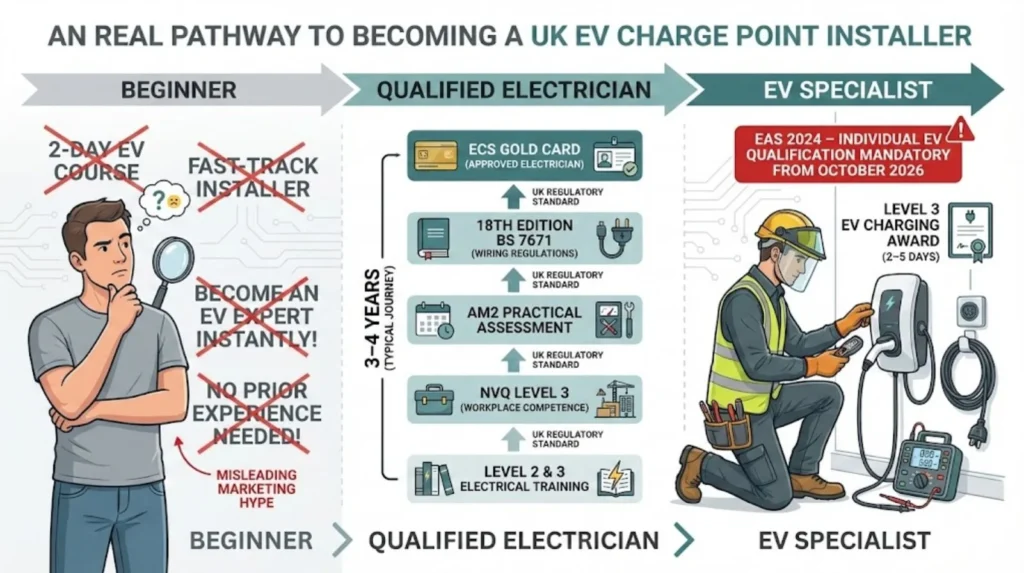
You cannot legally or safely become an Electric Vehicle (EV) charge point installer without first qualifying as an electrician. There is no shortcut “EV-only installer” pathway in the UK.
EV charging equipment connects to 230V single-phase or 400V three-phase electrical supplies requiring circuit design, protective device selection, earthing system verification, safe isolation procedures, and comprehensive testing protocols identical to any electrical installation. The physical charger unit represents the final component of a complete electrical circuit subject to BS 7671 Wiring Regulations, Building Regulations Part P notification requirements, and Distribution Network Operator (DNO) approval processes.
Training providers marketing “2-day EV installer courses” or “fast-track EV qualification” programs target existing qualified electricians adding specialization, not complete beginners entering the trade. Marketing materials often omit this prerequisite, creating misconception that EV installation represents standalone entry-level career accessible within days or weeks. It does not.
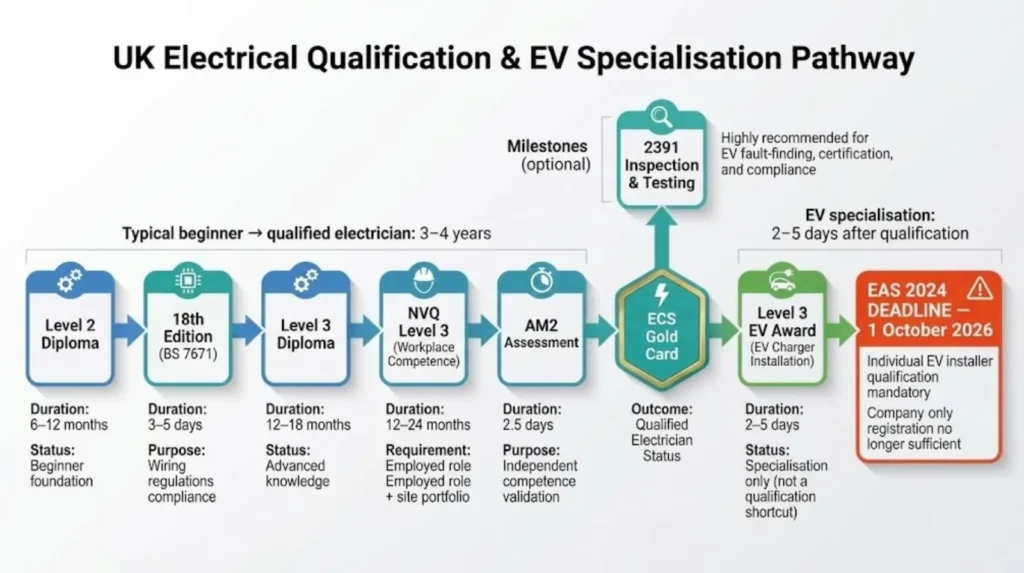
The regulated qualification pathway requires: NVQ Level 3 Diploma in Installing Electrotechnical Systems and Equipment (workplace competence qualification typically 12 to 24 months portfolio development), AM2/AM2E practical assessment (final competence gatekeeper, 2.5 consecutive days), 18th Edition Wiring Regulations BS 7671:2018+A2:2022 (current regulatory knowledge), then Level 3 Award in Requirements for Installation of EV Charging Equipment (EV-specific specialization, 2 to 5 days for qualified electricians).
For complete beginners, this represents 3 to 4 years minimum timeline becoming qualified electrician first, then 2 to 5 days adding EV specialization. Understanding how to become an electrician in the uk provides essential foundation context before pursuing EV installation career.
Additionally, critical regulatory deadline approaching: From October 1, 2026, the Electrotechnical Assessment Specification (EAS 2024) mandates every individual physically installing EV charge points must hold their own Level 3 EV qualification. The previous “Qualified Supervisor” model (where one qualified person signs off work performed by less-qualified staff) ends for EV installations. This regulatory shift toward individual accountability affects both new entrants and existing electricians currently performing EV work under supervisor sign-off.
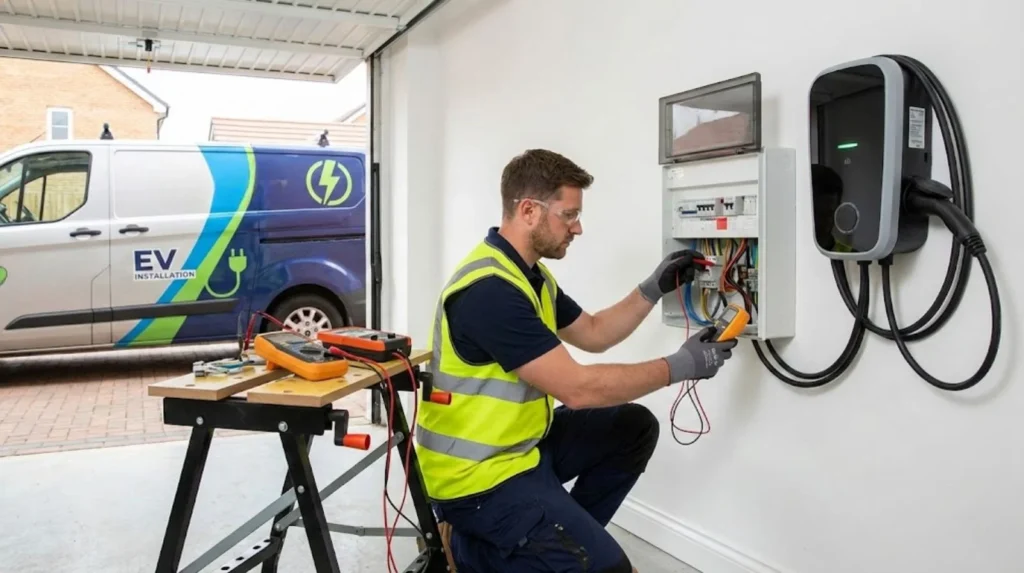
The October 2026 Regulatory Deadline (EAS 2024 Transition)
Electrotechnical Assessment Specification 2024 introduces fundamental change to EV installer competence requirements, with transition period ending October 1, 2026.
Previous Model (Pre-October 2026):
Electrical contracting companies could employ one “Qualified Supervisor” holding Level 3 EV qualification who signs off installations performed by less-qualified electricians or trainees. Supervisor’s competence covered company’s EV installation work even if individuals performing physical installation lacked EV-specific training. This model mirrored broader electrical industry practice where experienced electricians supervise apprentices and improvers.
New Model (From October 2026):
Every individual physically installing EV charge points must hold their own Level 3 Award in Requirements for Installation of EV Charging Equipment (e.g., City & Guilds 2921 series, EAL equivalent). Company cannot rely on supervisor’s qualification to cover unqualified installers’ work anymore. Individual accountability replaces company-wide certification.
Who This Affects:
Electricians currently performing EV installations under supervisor sign-off: You have until October 1, 2026 to obtain your own Level 3 EV Award or cease EV installation work. Supervisor cannot legally sign off your installations after deadline if you lack individual EV qualification.
Electrical contractors employing multiple installers: All staff performing EV work must complete Level 3 EV training before October 2026. Budget accordingly for multiple course fees, time off for training, assessment scheduling. Cannot continue current model of one qualified supervisor covering entire team.
Training providers and awarding bodies: Expect significant demand surge approaching October 2026 deadline as electricians rush to obtain mandatory EV qualifications. Course availability and assessment centre capacity may constrain last-minute qualification attempts.
New entrants to electrical trade: EV installation represents specialization requiring both foundational electrical qualifications AND EV-specific training from outset. The transition merely formalizes individual competence requirement already implied by BS 7671 Section 722 complexity.
Enforcement Uncertainty:
EAS 2024 sets regulatory framework but enforcement mechanisms remain unclear for sole traders and small contractors not registered with Competent Person Schemes (NICEIC, NAPIT, etc.). Large CPS-registered companies face stringent compliance audits. Sole traders performing occasional domestic EV installations may face less immediate enforcement pressure, though operating without proper qualifications risks insurance invalidation, prosecution under Building Regulations, and civil liability for faulty installations causing fire or injury.
Regardless of enforcement variability, the regulatory direction is unambiguous: individual EV installer competence becoming mandatory, ending reliance on supervisor qualifications covering less-trained staff.
Core Electrical Qualifications Required (The Foundation)
EV specialization builds on complete electrical qualification foundation. No component is optional or substitutable.
NVQ Level 3 Diploma in Installing Electrotechnical Systems and Equipment
What it is: Workplace competence qualification proving practical electrical installation ability through portfolio evidence gathered over 12 to 24 months on actual electrical work sites under qualified supervision. Awarding bodies include City & Guilds (2357), EAL, SQA (Scotland).
What it covers: Circuit design and installation, containment systems (conduit, trunking, cable tray), wiring techniques, protective devices (MCBs, RCDs, RCBOs), earthing and bonding, three-phase systems, motor control circuits, inspection and testing procedures, certification and documentation, safe isolation practices, fault diagnosis.
Why mandatory for EV: Portfolio must demonstrate competence in circuits, protective devices, earthing systems, and testing procedures required for EV installations. Without NVQ Level 3 foundation, you lack baseline electrical knowledge to interpret BS 7671 Section 722 EV-specific requirements safely. EV charge point represents electrical load requiring dedicated circuit from consumer unit, appropriate protective devices, earth fault protection, and verification testing – all standard NVQ competencies applied to EV context.
Assessment: Ongoing portfolio development with quarterly assessor site visits observing installations, reviewing photographic evidence, verifying witness testimonies from qualified supervisors. Cannot be completed classroom-only or via evening courses. Requires electrical employment or guaranteed work placement for site access.
Typical duration: 12 to 24 months with consistent electrical employment providing diverse installation types for portfolio breadth.
AM2/AM2E Practical Assessment
What it is: Final competence gatekeeper assessment conducted at approved centres over 2.5 consecutive days (approximately 16.5 hours total assessment time). Currently administered by NET (National Electrotechnical Training).
What it covers: Timed practical installation tasks including containment installation, cable selection and termination, circuit protection, earthing arrangements, inspection and testing, certification completion, fault-finding under examination conditions.
Why mandatory for EV: Proves ability to perform electrical installations independently to required standard within commercial time constraints. EV installation employers expect AM2-qualified electricians capable of working without constant supervision, completing installations efficiently, and producing compliant test certificates – all verified through AM2 assessment.
Assessment: Practical tasks assessed by external examiner. Pass/fail determination based on installation quality, testing accuracy, documentation completeness, safe working practices, time management. Failure rate approximately 25 to 30% nationally, requiring resit fees and rescheduling.
Scheduling: Must book 3 to 6 months advance. Weekday-only assessment (typically Monday to Wednesday) requiring annual leave from employment. Limited UK assessment centre locations requiring travel and potentially accommodation.
18th Edition Wiring Regulations (BS 7671:2018+A2:2022)
What it is: Current UK electrical installation standards knowledge qualification. Amendment 2 (A2:2022) represents latest update including surge protection device requirements, RCD provisions, and EV-relevant regulations.
What it covers: Electrical safety principles, protective measures against electric shock and fire, special location requirements (including Section 722 EV charging installations), earthing systems (TN-S, TN-C-S/PME, TT), protective device selection and coordination, cable sizing and current-carrying capacity, inspection and testing requirements, certification procedures.
Why mandatory for EV: Section 722 specifically addresses EV charging equipment installation requirements. Without current 18th Edition knowledge, electrician cannot interpret PME earthing considerations, RCD type requirements, dedicated circuit obligations, or DNO notification processes governing EV installations. Regulation updates occur periodically (approximately every 3 to 4 years) requiring refresher training maintaining currency.
Assessment: Multiple-choice examination (typically 60 questions, 2 hours, 60% pass mark). Open-book format allowing access to BS 7671 regulations book during exam, testing ability to locate and interpret regulations rather than rote memorization.
Duration: 3 to 5 days intensive course or 5 to 8 evening sessions. Some electricians self-study using BS 7671 book (cost approximately £90 to £120) and online resources, then book exam separately.
Optional but Highly Recommended: 2391 Inspection and Testing
What it is: Advanced qualification in inspection, testing, and certification of electrical installations (City & Guilds 2391 or equivalent).
Why valuable for EV: EV charge point commissioning requires comprehensive initial verification including circuit impedance measurements, continuity testing, insulation resistance testing, polarity verification, RCD trip testing, earth electrode resistance measurement (TT systems), functional testing of EVSE communication protocols. Electricians holding 2391 already perform these procedures competently. Those without 2391 may struggle with testing complexity beyond basic installation work, particularly earth fault loop impedance calculations and RCD type verification critical for EV safety.
Employer preference: Job advertisements frequently list 2391 as “essential” or “highly desirable” for EV installer roles because testing competence separates installation-capable electricians from those requiring supervision during commissioning phase.
For comprehensive breakdown of electrical qualification requirements and progression pathways, see the UK electrician qualification pathway covering NVQ Level 3, 18th Edition, and AM2 requirements including realistic timelines and employment contexts.
EV-Specific Training (Level 3 Award)
Once qualified as electrician (holding NVQ Level 3, AM2, 18th Edition), EV specialization training typically requires 2 to 5 days intensive course.
Regulated Qualifications:
City & Guilds 2921 series: Most common EV qualification pathway. Includes 2921-31 (Requirements for Installation), 2921-34 (Design, Installation, and Commissioning). Ofqual-regulated Level 3 Awards.
EAL equivalent: Alternative awarding body offering comparable Level 3 EV installation qualifications with similar learning outcomes and assessment methods.
Course Content Coverage:
BS 7671 Section 722 requirements: EV-specific regulations including dedicated circuit mandate, protective device specifications, earthing system considerations, RCD type selection, surge protection provisions, DNO notification obligations.
IET Code of Practice for Electric Vehicle Charging Equipment Installation (5th Edition): Industry best-practice guidance supplementing BS 7671 regulations with detailed technical recommendations for domestic, commercial, and public EV installations.
Earthing system assessment: PME (Protective Multiple Earthing / TN-C-S) considerations for EV installations, TT system requirements, earth electrode testing, equipotential bonding verification.
RCD selection and testing: Why Type A RCDs insufficient for EV chargers producing DC fault currents, Type B RCD requirements, Type A with 6mA DC detection alternative, testing procedures confirming correct operation.
DNO notification processes: When and how to notify Distribution Network Operator of EV installation preventing local transformer overload, understanding DNO approval requirements for higher-rated chargers (above 7.4kW single-phase or any three-phase installations).
Load management systems: Commissioning multiple charge point installations with dynamic load balancing, understanding communication protocols (OCPP – Open Charge Point Protocol), configuring maximum demand limitations preventing circuit overload.
Smart charging regulations: Electric Vehicles (Smart Charge Points) Regulations 2021 compliance ensuring chargers provide grid stability features, cybersecurity requirements, consumer access to charging data.
Assessment Methods:
Practical observation: Installing and commissioning EV charge point on test rig or simulated installation demonstrating circuit connection, protective device selection, earthing verification, testing procedures, functional commissioning.
Written examination: Closed-book or open-book multiple-choice test (typically 40 to 50 questions, 90 to 120 minutes) covering Section 722 regulations, IET Code requirements, earthing systems, DNO processes, safety procedures.
Portfolio submission: Some awarding bodies require photographic evidence or installation documentation from workplace EV installations demonstrating real-world competence beyond simulated assessment.
Course Duration and Cost:
Duration: 2 to 5 days intensive delivery for qualified electricians. Some providers offer 2-day condensed courses covering core requirements. 5-day courses provide more comprehensive coverage including advanced topics (three-phase installations, commercial load management, multiple charge point arrays).
Cost: £400 to £900 depending on course duration, provider, location, and whether practical assessment included or scheduled separately. Additional costs may include £50 to £100 examination/assessment fees, £90 to £120 IET Code of Practice book if not provided.
Entry Requirements:
Legitimate EV training providers require proof of electrical qualifications: NVQ Level 3 or equivalent, current 18th Edition certificate, evidence of qualified electrician status (ECS Gold Card typically accepted). Providers accepting students without electrical qualifications deliver inadequate training creating dangerous incompetent installers or misrepresent course as complete qualification pathway rather than specialization addition.
Thomas Jevons, our Head of Training, explains BS 7671 Section 722 technical complexity:
"Section 722 of BS 7671 imposes specific requirements for EV charging installations beyond standard socket circuit regulations. PME earthing arrangements require careful assessment. TT earthing systems need special consideration for fault protection. RCD types matter: Type A RCDs insufficient for EV chargers producing DC fault currents, requiring Type B or Type A with 6mA DC detection. Dedicated circuits mandatory, cannot spur from existing socket circuits. DNO notification compulsory for every installation to prevent local transformer overload. Surge Protection Devices increasingly required. Load management systems for multiple charge points need commissioning verification. These aren't suggestions. They're regulatory requirements electricians must understand before attempting EV installations."
Thomas Jevons, Head of Training
OZEV Authorization and Competent Person Scheme Membership
Installing EV charge points does not automatically grant access to government grant schemes. OZEV (Office for Zero Emission Vehicles) authorization requires additional registration and compliance verification.
What OZEV Authorization Enables
Grant access: OZEV-authorized installers can claim government grants on behalf of customers for:
EV chargepoint grant for flat owners, renters, and landlords: Covering 75% of installation costs up to £350 (as of 2024/25, subject to change) for people without off-street parking or living in flats requiring more complex installations.
Workplace Charging Scheme: Supporting businesses and charities installing charge points at workplaces (funding levels vary, check current OZEV guidance for rates).
On-street Residential Chargepoint Scheme: Local authority-led program OZEV-authorized installers may participate in delivering.
Market advantage: Customers aware of grant availability preferentially contact OZEV-authorized installers. Non-authorized installers lose potential customers requiring grant support for installation affordability.
OZEV Authorization Requirements
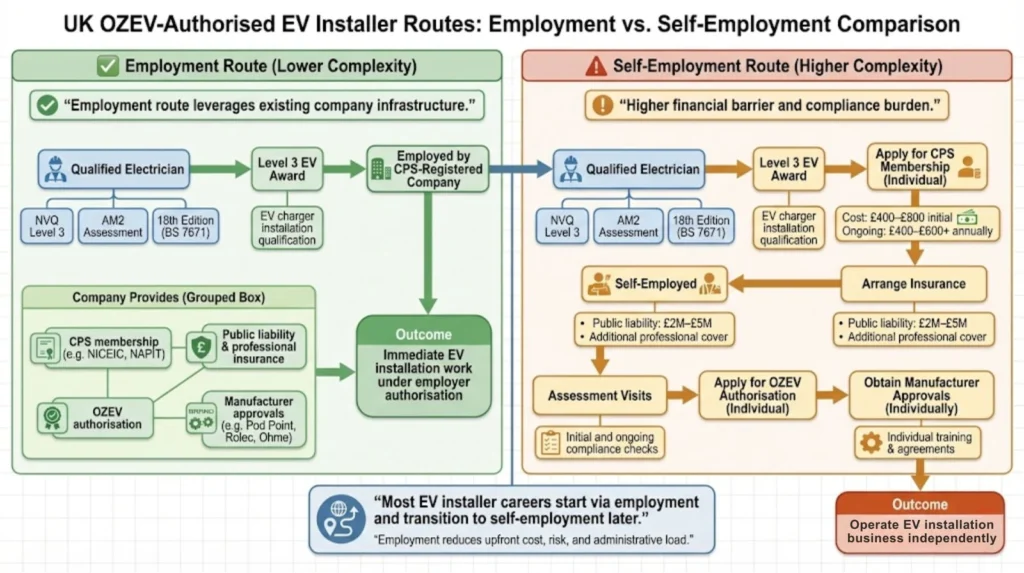
Competent Person Scheme membership: Installer must work for company registered with CPS like NICEIC, NAPIT, ELECSA, or ECA (Electrical Contractors’ Association). Individual electricians cannot obtain OZEV authorization independently – must be employed by or operate as CPS-registered company.
Appropriate insurance: Public liability insurance (minimum £2 million, some schemes require £5 million), professional indemnity insurance, employer’s liability insurance (if employing staff).
Manufacturer approval: OZEV authorization often requires installer approval from specific EV charger manufacturers (e.g., Pod Point, Ohme, Wallbox, Tesla, Hypervolt). Manufacturers provide product-specific installation training (typically 1-day courses or online modules) and assess installer competence before granting approval. This ensures warranty compliance and correct product commissioning.
Quality assurance: CPS membership requires ongoing compliance monitoring, periodic audits of installations, customer complaint resolution processes, adherence to scheme technical standards.
CPS Membership Pathways
Employment route: Easier pathway for individual electricians. Gain employment with CPS-registered electrical contractor already holding NICEIC/NAPIT membership and OZEV authorization. Company’s existing infrastructure covers individual installer enabling immediate EV work access under company registration.
Self-employment route: More complex. Self-employed electricians must:
Apply for CPS membership independently (application fees typically £400 to £800, annual membership fees £400 to £600+ depending on scheme)
Provide evidence of electrical qualifications (NVQ Level 3, AM2, 18th Edition, EV Award)
Undergo initial assessment visits with sample installations inspected
Maintain appropriate insurance levels
Apply for OZEV authorization separately after CPS approval
Obtain manufacturer approvals individually
Financial barrier: CPS membership and insurance costs create higher entry threshold for self-employed electricians compared to employed route where company covers membership and insurance overheads.
Why This Matters:
Electricians wanting EV installation careers often need employers already CPS-registered with OZEV authorization rather than immediate self-employment. This creates employment dependency initially, though experienced EV installers may transition to self-employment once established customer base and financial capacity support CPS membership costs.
Employer Expectations and Market Realities
Job advertisement analysis reveals significant gap between minimum regulatory requirements and actual employer hiring criteria for EV installer roles.
The Gold Card Standard:
Joshua Jarvis, our Placement Manager, explains employer expectations:
"Analysis of UK job advertisements for EV charge point installers shows 90% plus require ECS Gold Card as minimum entry credential. Employers aren't asking for 'electrical qualification' vaguely. They specify Gold Card electrician with EV training completed. This signals employer expectation of: NVQ Level 3 competence proven through workplace assessment, AM2 practical examination pass, 18th Edition current, plus Level 3 EV Award from recognized awarding body. Candidates holding Level 2 or Level 3 diplomas without NVQ competence and Gold Card don't meet threshold even if they've completed EV course. Market reality: EV installer roles accessible primarily to existing qualified electricians adding specialization, not entry-level positions for electrical beginners."
Joshua Jarvis, Placement Manager
What ECS Gold Card Represents:
Qualification proof: NVQ Level 3 completion, AM2 pass, current 18th Edition certificate verified by ECS before card issuance.
Workplace competence: Portfolio evidence from actual electrical installations proving ability beyond classroom theory.
Industry recognition: Construction sites, commercial clients, insurance providers recognize Gold Card as qualified electrician credential enabling unsupervised electrical work.
Professional status: Separates qualified electricians from trainees, apprentices, or diploma-only candidates lacking workplace competence verification.
Market Positioning:
Employers hiring for “EV Installer” or “EV Charge Point Engineer” roles overwhelmingly specify:
Essential requirements: ECS Gold Card (or equivalent qualified electrician status), 18th Edition current (Amendment 2), full UK driving license (field-based role requirement), Level 3 EV Award (City & Guilds 2921 or equivalent).
Highly desirable: 2391 Inspection and Testing qualification, previous EV installation experience (1+ years typically), manufacturer approvals (Pod Point, Ohme, etc.), commercial electrical experience (not just domestic), CPS membership (if self-employed applicants considered).
Salary ranges: Qualified EV installers with 1 to 3 years experience typically command £30,000 to £40,000 annually (PAYE employment, may include company van, tools, phone). Experienced installers (3+ years) with multi-skilled capabilities (EV plus solar or battery storage) achieve £40,000 to £50,000+. Self-employed day rates vary widely by region and client type (£200 to £400 per day achievable with established customer base).
The “Electrician Plus” Market Trend:
Employers increasingly prefer multi-skilled installers combining EV expertise with complementary low-carbon technologies:
EV + Solar PV: Domestic retrofit projects often bundle EV charger with solar panel installation enabling cheaper vehicle charging from self-generated electricity. Installer offering both services captures complete project rather than subcontracting solar portion.
EV + Battery Storage: Commercial installations combining EV infrastructure with battery storage for load management and grid services. Understanding both technologies creates competitive advantage.
EV + Heat Pumps: Whole-home electrification projects replacing gas boilers with heat pumps and adding EV charging. Multi-skilled installer provides single-contractor solution reducing project coordination complexity.
Market advantage: Single-technology EV-only installers face limitation because customers increasingly seek integrated solutions. Multi-skilled “Electrician Plus” profile commands premium rates and broader employment opportunities.
Employment Types:
PAYE positions: Electrical contractors specializing in EV installations, renewable energy companies offering EV alongside solar/battery services, facilities management firms serving commercial property portfolios, automotive dealerships providing installation services for EV vehicle sales, charge point network operators (CPOs) employing installation teams for public charging infrastructure.
Contract/self-employed: Domestic installers serving residential market via platforms (Checkatrade, TrustATrader, etc.), subcontractors to larger electrical firms requiring overflow capacity, specialists serving niche markets (commercial fleet charging, destination charging for hospitality sector).
Reality Check for Career Changers:
Entry-level “EV Installer” positions for candidates without qualified electrician status essentially non-existent. Job advertisements labeled “EV Installer – No Experience Necessary” typically mean electrical qualification required but EV installation experience not required, or misrepresent apprentice/trainee roles as installer positions. Career changers from non-electrical backgrounds must complete 3 to 4 year electrician qualification pathway before accessing EV installer employment market.
Physical Installation Work Realities
EV charge point installation involves substantial physical labor often underestimated by electricians expecting purely technical electrical work.
Domestic Installation Typical Scope:
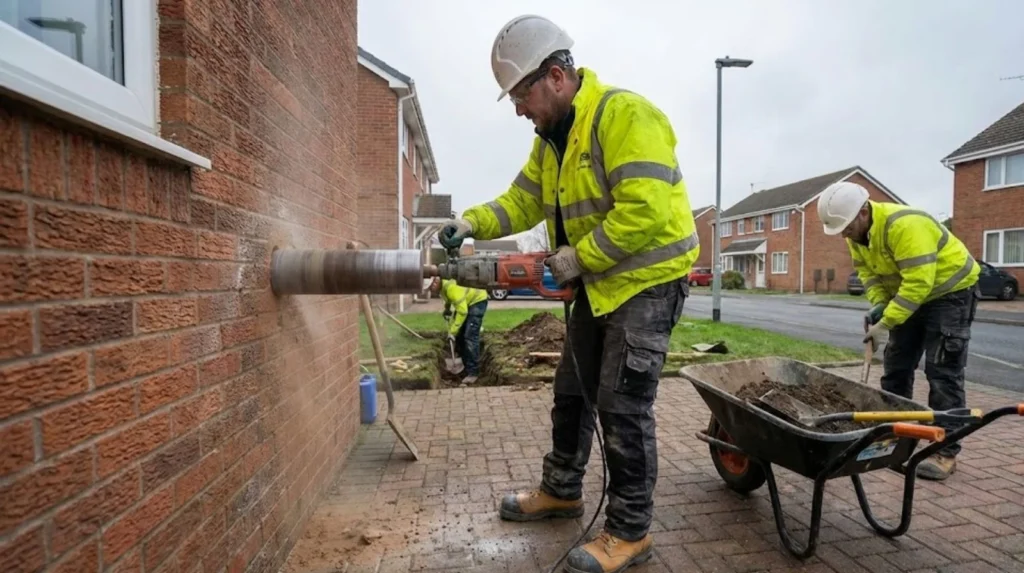
Cable runs: Trenching from consumer unit location (typically inside garage, utility room, or under stairs) to external parking area where charger mounted. Trench depths 300mm to 450mm for armored cable protection, lengths commonly 10 to 30 meters depending on property layout. Manual digging or hired mini-digger (additional cost).
Wall penetration: Drilling through brick/block walls for cable entry and exit points. Core drilling 40mm to 50mm diameter holes through solid walls, sometimes double-skinned cavity walls requiring longer drill bits and specialized equipment.
Charger mounting: Installing post-mounted chargers requires concrete base foundation (typically 600mm x 600mm x 600mm minimum) with ground anchor bolts set in concrete. Wall-mounted chargers need secure fixing to brick or blockwork (not hollow walls) supporting 5kg to 15kg equipment weight plus cable strain.
Surface reinstatement: After trenching, reinstate surfaces (grass re-turfing, paving slab replacement, tarmac/concrete repair) to customer satisfaction. Poor reinstatement creates customer complaints and reputation damage.
Containment installation: External-grade conduit or trunking for exposed cable runs where trenching impractical (e.g., commercial car parks with existing surface that cannot be excavated).
Commercial Installation Scaling:
Multiple charge points: Commercial installations often include 4 to 20+ charge points in array formation requiring extensive containment systems, substantial cable pulling through ducts, load management system commissioning coordinating multiple units.
Three-phase supplies: Many commercial EV installations use 400V three-phase supplies for higher charging rates (22kW per charger typical) requiring heavier cables, larger protective devices, more complex testing procedures.
Height work: Installing chargers in multi-story car parks, external building facades, or canopy-mounted positions requires working at height with appropriate access equipment (scaffolding, mobile elevated work platforms, ladders with safety systems).
Coordination: Commercial projects involve multiple stakeholders (building owners, facility managers, DNO, planning authorities, accessibility compliance, building control). Installation scheduling works around building operations minimizing disruption.
Physical Demands Summary:
Manual labor: Digging, lifting, carrying equipment and materials, prolonged outdoor work in various weather conditions.
Physical capacity: Role suits physically capable individuals comfortable with construction-style work, not suitable for electricians with physical limitations, back problems, or preferring predominantly indoor work.
Age considerations: Older electricians (50+) transitioning to EV installation may find physical demands challenging compared to lighter domestic electrical work (socket replacements, consumer unit upgrades, testing inspections).
Team composition: Larger installations often deploy two-person teams dividing physical labor (one person trenching while other prepares electrical connections) improving efficiency and reducing individual physical strain.
Complete Pathway Comparison: Beginner vs Existing Electrician
Timeline and requirements differ drastically depending on starting point.
Complete Beginner (No Electrical Background)
Starting point: Career changer from non-electrical employment, school leaver, or adult seeking trade entry.
Phase 1 – Electrical Foundation (Years 1-4):
Apprenticeship route (recommended): Electrotechnical Apprenticeship (Installation and Maintenance Electrician Standard ST0152) combining:
Level 2 Diploma in Electrical Installations (classroom theory, 6 to 12 months)
Level 3 Diploma in Electrical Installations (advanced theory, 12 to 18 months)
NVQ Level 3 in Installing Electrotechnical Systems (workplace competence, 12 to 24 months portfolio development)
18th Edition Wiring Regulations
AM2/AM2E End-Point Assessment
Total duration: 3.5 to 4 years, wages start £15,000 to £18,000 (year 1) progressing to £22,000 to £28,000 (year 4)
Adult learner route (higher risk): Level 2 and Level 3 electrical installation diplomas via evening classes or intensive courses, then secure mate/improver employment for NVQ workplace evidence, complete 18th Edition and AM2. Total investment £6,000 to £12,000 self-funded, timeline 3 to 5 years including securing electrical employment for NVQ access. (See Article 19 on part-time training challenges and diploma-completion trap risks).
Phase 2 – EV Specialization (Days 1-5):
Once holding NVQ Level 3, AM2 pass, 18th Edition current, and ECS Gold Card:
Enroll in Level 3 Award in EV Charging Installation (City & Guilds 2921 or equivalent)
Complete 2 to 5 day course including practical assessment and examination
Cost: £400 to £900
Obtain manufacturer approvals (Pod Point, Ohme, etc.) via 1-day product training courses or online modules
Phase 3 – Employment/Authorization:
Apply for EV installer positions with CPS-registered companies holding OZEV authorization
Or if self-employed: Apply for CPS membership (£400 to £800 initial + ongoing annual fees), obtain appropriate insurance, apply for OZEV authorization
Total timeline beginner to employable EV installer: 3.5 to 4+ years
Critical barrier: Securing electrical employment for NVQ portfolio evidence. Without workplace access, pathway stalls regardless of diploma completion. Elec Training’s guaranteed work placement through 120+ contractor partnerships specifically addresses this barrier enabling NVQ progression rather than diploma-completion trap outcome.
Existing Qualified Electrician (Transitioning to EV)
Starting point: Holds NVQ Level 3, AM2 pass, 18th Edition current, ECS Gold Card, working as qualified electrician (1+ years experience).
Phase 1 – EV Specialization (Days 1-5):
Verify 18th Edition currency (Amendment 2 – A2:2022). If holding older amendment, complete update course (1 day or online)
Enroll in Level 3 EV Award (2 to 5 days, cost £400 to £900)
Complete practical assessment and examination
Obtain IET Code of Practice (5th Edition) book if not provided
Phase 2 – Manufacturer Approvals:
Complete manufacturer-specific training for preferred charger brands (typically 1-day courses or online modules)
Costs vary: some manufacturers offer free online training, others charge £100 to £300 per product approval
Phase 3 – Employment/Authorization:
If employed: Discuss EV work addition with current employer. If employer CPS-registered with OZEV authorization, transition immediate. If employer not currently EV-focused, may need employer change to access EV installation market.
If self-employed: Apply for CPS membership if not already member (many self-employed electricians already NICEIC/NAPIT registered, adding OZEV authorization to existing membership simpler than new application). Apply OZEV authorization. Obtain manufacturer approvals. Market EV services to existing customer base.
Total timeline qualified electrician to EV installer: 2 to 10 days training plus administrative processes (CPS/OZEV applications potentially 1 to 3 months processing).
Advantage: Existing electrical employment and qualifications remove foundation barriers. EV specialization represents straightforward addition to existing skillset rather than multi-year career change.
Common Myths About EV Installer Careers
Correcting frequent misconceptions perpetuated by training provider marketing and industry misunderstanding.
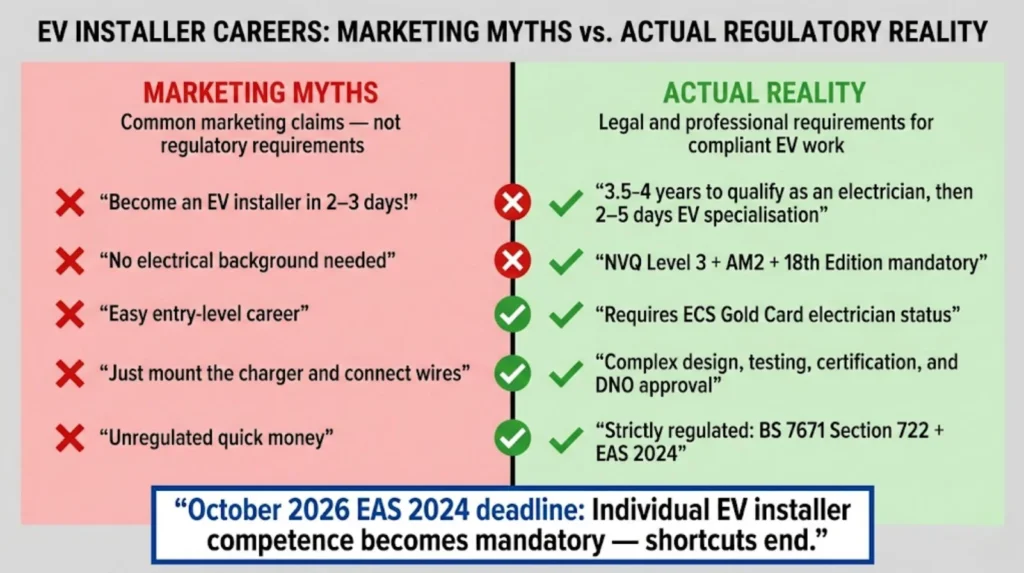
Myth: “You can become EV installer in 2-3 days from scratch”
Reality: 2 to 3 day EV courses target existing qualified electricians adding specialization, not complete beginners. Legitimate providers require proof of NVQ Level 3, 18th Edition, qualified electrician status before enrollment. Total pathway for beginners: 3.5 to 4 years becoming electrician first, then 2 to 5 days EV training.
Verdict: Completely false for beginners. True only for existing qualified electricians.
Myth: “EV installation is unregulated wild west”
Reality: Strictly regulated under BS 7671 Section 722, Building Regulations Part P notification requirements, DNO approval obligations, Electric Vehicles (Smart Charge Points) Regulations 2021. CPS membership required for self-certification. OZEV authorization for grant access. From October 2026, EAS 2024 mandates individual Level 3 EV competence for every installer.
Verdict: Completely false. One of most regulated electrical installation types.
Myth: “Any electrician can install EV chargers without additional training”
Reality: Technically competent electricians can perform physical installation work interpreting BS 7671 Section 722 requirements. However, from October 2026, EAS 2024 requires Level 3 EV Award for legal compliance. Additionally, employer market demands EV-specific training – 90%+ job advertisements require Level 3 EV qualification not just electrical competence alone.
Verdict: Partially true pre-October 2026 (though market demands training), completely false post-October 2026.
Myth: “Manufacturer training substitutes for regulated qualification”
Reality: Manufacturer courses (Pod Point, Ohme, Wallbox, Tesla) provide product-specific installation and commissioning guidance ensuring warranty compliance. These are 1-day or online modules, NOT Ofqual-regulated Level 3 qualifications. Cannot substitute for City & Guilds 2921 or EAL equivalent. Manufacturer training supplements regulated qualification, doesn’t replace it.
Verdict: False. Manufacturer training necessary for product approvals but insufficient for regulatory compliance.
Myth: “EV installer is entry-level electrical career”
Reality: Market analysis shows 90%+ employers require ECS Gold Card (qualified electrician status) plus EV training. Entry-level positions essentially non-existent. EV installation represents specialization for existing electricians, not entry route into electrical trades.
Verdict: Completely false. Requires qualified electrician foundation first.
Myth: “You don’t need to notify DNO for domestic chargers”
Reality: DNO (Distribution Network Operator) notification compulsory for every EV installation regardless of size, domestic or commercial context. Failure to notify risks local transformer overload, grid instability, prosecution under Electricity Safety, Quality and Continuity Regulations 2002. DNO approval sometimes refused requiring upgraded local infrastructure before installation proceeds.
Verdict: Completely false. DNO notification mandatory universally.
Myth: “Self-study online course sufficient for EV qualification”
Reality: Regulated Level 3 EV Awards require practical assessment (installing charger on test rig or real installation) observed by qualified assessor, plus written examination. Cannot be completed purely online or self-study. Practical competence demonstration mandatory.
Verdict: False. Practical assessment required, not just online learning.
Myth: “Apprentices cannot install EV chargers”
Reality: Apprentices CAN install EV chargers under direct close supervision of qualified electrician holding Level 3 EV qualification. However, from October 2026, EAS 2024 individual competence requirement means apprentices must complete their own Level 3 EV Award before independent EV work, cannot rely indefinitely on supervisor sign-off.
Verdict: Partially true. Can install under supervision but cannot sign off independently without qualification.
Myth: “EV installation just involves mounting charger and connecting three wires”
Reality: Requires: dedicated circuit from consumer unit (potentially 10A to 40A MCB depending on charger rating), appropriate cable sizing for voltage drop and current-carrying capacity, correct RCD type selection (Type B or Type A with DC detection), earthing system assessment (PME vs TT), initial verification testing (continuity, insulation resistance, earth fault loop impedance, RCD trip times), DNO notification processing, charger commissioning and functional testing, installation certification, customer handover and instruction. Physical work includes trenching, wall penetration, surface reinstatement. Multi-day installation common for complex domestic jobs, multi-week for commercial projects.
Verdict: Completely false. Complex electrical and physical installation process.
Myth: “OZEV authorization and TrustMark are the same thing”
Reality: OZEV (Office for Zero Emission Vehicles) is government department authorizing installers to access grant schemes. TrustMark is government-endorsed quality scheme for trades including electrical work. OZEV requires CPS membership (NICEIC/NAPIT) which provides route to TrustMark registration, but they’re separate entities with different purposes. TrustMark provides consumer protection framework; OZEV provides grant administration.
Verdict: False. Related but distinct schemes.
Myth: “You can use 3-pin plug for daily EV charging professionally”
Reality: 3-pin plug charging (Mode 1 or Mode 2 using portable EVSE) discouraged for long-term regular use due to fire risk from sustained high current draw (10A to 13A for extended periods stressing domestic socket circuits designed for intermittent loads). BS 7671 Section 722 effectively mandates dedicated EV charging circuit with appropriate protection for permanent installations. 3-pin occasional emergency charging acceptable; daily habitual charging requires proper EV charge point installation.
Verdict: False for professional installations. Emergency use only acceptable.
Myth: “EV work is easy money for electricians”
Reality: Physical demands (trenching, drilling, groundworks), complex earthing assessments, RCD type specifications, DNO coordination, customer expectation management (installation timescales, grant processing delays, DNO approval uncertainties), competitive market with established installers, CPS membership costs, manufacturer approval requirements, OZEV administrative burden. Profitable for efficient experienced installers with established workflows; challenging for newcomers underestimating complexity.
Verdict: Partially false. Can be lucrative but requires competence, efficiency, business infrastructure.
Building Your EV Installer Career
EV charge point installation represents viable specialization for qualified electricians and achievable long-term career goal for beginners willing to commit to complete electrical qualification pathway first.
For Complete Beginners:
Critical understanding: Cannot shortcut to EV-only installer role. Must qualify as electrician first through 3 to 4 year pathway (apprenticeship recommended, adult learner route higher risk due to workplace access barriers).
Strategic approach:
Step 1: Research electrical apprenticeship opportunities in your region. Apprenticeships provide wages throughout training (£15,000 to £28,000 progressing over 4 years), employer-funded qualifications (zero tuition costs), guaranteed workplace access for NVQ portfolio development, and qualified electrician status upon completion.
Step 2: If apprenticeship unavailable (age restrictions, regional scarcity), consider adult learner route via Level 2/3 diplomas ONLY if realistic plan exists for securing electrical employment enabling NVQ progression. Elec Training’s guaranteed work placement through 120+ contractor partnerships specifically solves workplace access barrier causing diploma-completion trap for self-funded adult learners.
Step 3: During electrical qualification years, research EV market developments, follow industry news (OZEV policy changes, charger technology advances, regulatory updates), understand which electrical contractors in your region perform EV work identifying potential future employers.
Step 4: Upon achieving qualified electrician status (NVQ Level 3, AM2 pass, 18th Edition current, ECS Gold Card), immediately pursue Level 3 EV Award (2 to 5 days, £400 to £900). Don’t delay – October 2026 EAS deadline approaching, course demand increasing.
Step 5: Target employment with CPS-registered electrical contractors already performing EV installations and holding OZEV authorization. This provides immediate EV work access under company infrastructure without individual CPS membership costs.
Timeline expectation: 3.5 to 4.5 years from complete beginner to actively installing EV charge points as qualified electrician with EV specialization.
For Existing Qualified Electricians:
Opportunity assessment: EV installation represents natural specialization if you already hold NVQ Level 3, AM2, current 18th Edition. Adding EV capability opens new market sectors (domestic retrofit, commercial fleet charging, renewable energy integration).
Quick-start pathway:
Immediate action: Enroll in Level 3 EV Award course (City & Guilds 2921 or EAL equivalent). 2 to 5 day course completion achievable within weeks. Verify 18th Edition currency (Amendment 2 required – update if holding older amendment).
Manufacturer approvals: Complete product-specific training for major charger brands (Pod Point, Ohme, Wallbox prioritize as most common UK residential market). 1-day courses or online modules typically.
Employment route: If currently employed, discuss EV work addition with employer. If employer interested, they may fund training and add EV services to business offering. If employer not EV-focused, consider employer change to electrical contractor already performing EV installations.
Self-employment route: If already self-employed electrician, verify CPS membership current (NICEIC/NAPIT). Apply for OZEV authorization. Market EV services to existing customer base emphasizing renewable energy integration, home charging convenience, grant access support.
Market positioning: Consider multi-skilled “Electrician Plus” development. Combine EV training with Solar PV installation qualification, battery storage understanding, heat pump awareness. Integrated low-carbon technology offering commands premium rates and captures whole-home electrification projects.
Timeline expectation: 2 to 10 days training plus administrative processing (1 to 3 months CPS/OZEV applications) from qualified electrician to actively marketing EV services.
The Elec Training Difference:
Whether complete beginner or existing electrician, workplace access determines EV career viability. Beginners need electrical employment for NVQ progression. Experienced electricians benefit from CPS-registered employer providing OZEV authorization infrastructure.
Elec Training’s guaranteed work placement support addresses both scenarios:
For beginners: 120+ contractor partnerships enable electrical employment securing NVQ workplace access, preventing diploma-completion trap that stalls self-funded adult learners.
For progressors: Connections include CPS-registered companies performing EV work, solar installations, renewable energy projects – employers actively seeking qualified electricians with EV training or willingness to add EV specialization.
In-house recruitment team making 100+ employer contact calls per learner increases probability of securing placement with employers offering EV career pathway rather than generic electrical work alone.
Call 0330 822 5337 to discuss EV installer career planning specific to your circumstances. We’ll provide honest assessment of: realistic timeline from your current position to EV installer status, foundation electrical qualification requirements if beginner, guaranteed placement support availability for NVQ workplace access, existing electrician EV specialization pathways, employer connections for CPS-registered companies performing EV work, market realities about EV installer employment versus self-employment initially, multi-skilled Electrician Plus development combining EV with solar or battery storage. No overselling “2-day EV installer” shortcuts. No dismissing 3 to 4 year electrician foundation reality. Just evidence-based guidance helping you build legitimate EV installer career through proper qualification pathway and strategic workplace access timing.
References
- GOV.UK – OZEV Guidance for Authorised Installers – https://www.gov.uk/guidance/residential-and-commercial-chargepoints-become-an-authorised-installer
- IET (Institution of Engineering and Technology) – Electrotechnical Assessment Specification (EAS) 2024 – https://electrical.theiet.org/bs-7671-18th-edition-wiring-regulations/building-regulations/electrotechnical-assessment-specification/
- IET – BS 7671:2018+A2:2022 Wiring Regulations (18th Edition) – https://www.theiet.org/
- IET – Code of Practice for Electric Vehicle Charging Equipment Installation (5th Edition) – https://shop.theiet.org/code-of-practice-for-electric-vehicle-charging-equipment-installation-5th-edition
- IET – BS 7671 Electric Vehicle Charging Installations FAQs – https://electrical.theiet.org/bs-7671-18th-edition-wiring-regulations/faqs/electric-vehicle-charging-installations-faqs/
- Ofqual Register – Regulated Qualifications Search – https://register.ofqual.gov.uk/
- City & Guilds – 2921 Electric Vehicle Charging Qualification Series – https://www.cityandguilds.com/qualifications-and-apprenticeships/building-services-industry/electrical-installation/2921-electric-vehicle-charging
- EAL – Level 3 Award in Requirements for the Installation of EV Charging Equipment – https://www.eal.org.uk/
- ECS (Electrotechnical Certification Scheme) – Card Types and Requirements – https://www.ecscard.org.uk/card-types/Electrotechnical/Installation-Electrician
- NICEIC – EV Charging Installation Guidance – https://www.niceic.com/
- NAPIT – Guide to Qualifications Requirements (Electrical) – https://www.napit.org.uk/downloads/QualificationGuide/napit-guide-to-qualifications-requirements-electrical.pdf
- NET (National Electrotechnical Training) – AM2/AM2E Assessment – https://www.netservices.org.uk/
- TESP (The Electrotechnical Skills Partnership) – Electrician Plus Standards – https://www.the-esp.org.uk/
- Institute of Apprenticeships – Installation and Maintenance Electrician Standard ST0152 – https://www.instituteforapprenticeships.org/
- Indeed UK – EV Charging Installation Jobs – https://uk.indeed.com/q-ev-charging-installation-jobs.html
- Reed – EV Installer Job Market Analysis – https://www.reed.co.uk/
- Elec Training – How to Become an Electrician in the UK – https://elec.training/news/how-to-become-an-electrician-in-the-uk-2026/
- Elec Training – Courses Overview – https://elec.training/courses/
Note on Accuracy and Updates
Last reviewed: 3 January 2026. This page is maintained; we correct errors and refresh sources as qualification specifications, regulatory frameworks, government schemes, and market conditions change. EAS 2024 October 1, 2026 deadline for individual Level 3 EV competence represents current regulatory framework subject to government review or extension though no indication of delay currently exists. OZEV grant schemes (rates, eligibility, application processes) change periodically based on government budget allocations and policy priorities; verify current grant availability and rates via GOV.UK before advising customers. BS 7671 Section 722 requirements reflect 18th Edition Amendment 2 (A2:2022) standards current as of publication; future amendments may introduce additional requirements particularly regarding surge protection devices, RCD specifications, or smart charging integration. Employer market expectations (90%+ requiring Gold Card) based on job advertisement analysis December 2024 to December 2025 across Indeed, Reed, Totaljobs platforms; regional variations exist with London and South East showing higher demand than some rural areas. Course costs (Level 3 EV Award £400-£900, CPS membership £400-£800 initial, manufacturer training £100-£300) represent 2024/25 market rates subject to inflation and provider variation. Salary ranges (£30,000-£50,000+ qualified EV installers) reflect current market conditions varying substantially by region, employer type, experience level, and multi-skilled capability. Physical installation work realities (trenching distances, concrete base specifications, wall penetration requirements) represent typical domestic installations; commercial projects scale significantly larger. Multi-skilled Electrician Plus market trend (EV combined with solar PV, battery storage, heat pumps) reflects current low-carbon technology integration observed in retrofit market; future market evolution may prioritize different technology combinations. Next review scheduled following: EAS 2024 enforcement implementation (post-October 2026), significant OZEV scheme reforms, BS 7671 amendment publications, or substantial qualification framework changes affecting EV installer pathways.
