

How to Understand an EICR: A Practical Guide for Homeowners and Landlords

- Technical review: Thomas Jevons (Head of Training, 20+ years)
- Employability review: Joshua Jarvis (Placement Manager)
- Editorial review: Jessica Gilbert (Marketing Editorial Team)
- Last reviewed:
- Changes: Updated landlord compliance timelines, Northern Ireland requirements, 2026 enforcement data, qualified electrician requirements
An Electrical Installation Condition Report, or EICR for short, sounds straightforward enough. You hire an electrician, they test your wiring, you get a report. Simple.
Except it’s not.
Because the EICR industry in the UK is littered with cowboys charging £80 for inspections that take 45 minutes, landlords panicking over C3 codes they don’t need to fix, and homeowners being told their perfectly safe 1990s consumer unit is “dangerous” and needs replacing immediately for £800.
Here’s the thing about EICRs. When they’re done properly by qualified electricians, they’re useful safety documents that identify genuine hazards. When they’re done badly, they’re either useless pieces of paper or expensive sales tools designed to extract money for unnecessary work.
This guide covers what an EICR actually is, who legally needs one, how to read the codes without panicking, what landlords must do within 28 days of an unsatisfactory report, and how to spot the warning signs of a poor-quality inspection before you waste your money.
Let’s get into it.
What an EICR Actually Is (and What It Definitely Is Not)
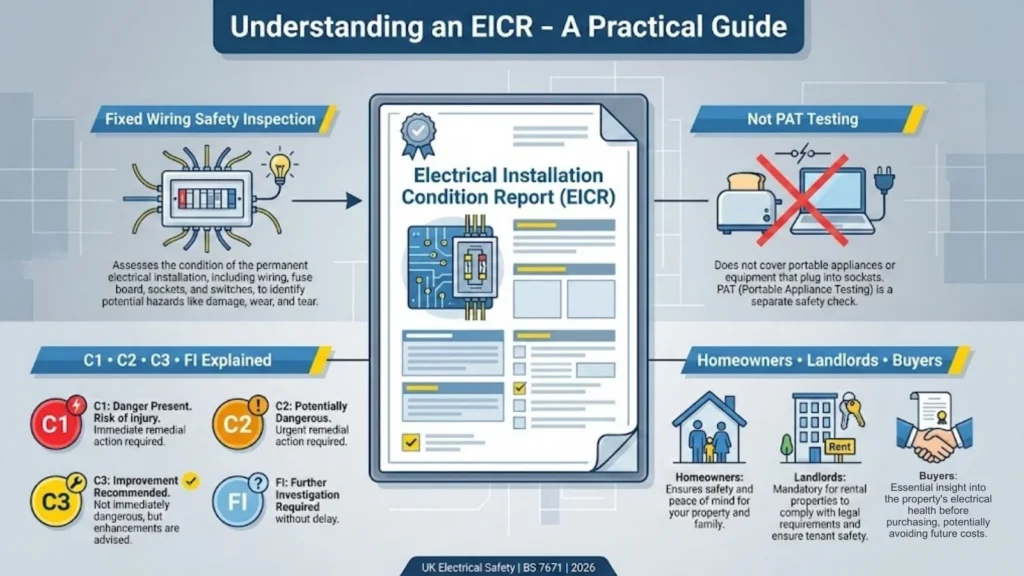
An Electrical Installation Condition Report is a formal assessment of the fixed electrical installation in a property. Fixed means the stuff that’s wired into the building, the things you can’t unplug and move around. Consumer units (fuse boxes), wiring hidden in walls and ceilings, light fittings, socket outlets, permanently connected equipment like electric showers or immersion heaters. That’s what an EICR covers.
It does not cover portable appliances. Your kettle, your laptop, your microwave. Those fall under Portable Appliance Testing (PAT), which is a completely different thing. Don’t let anyone tell you an EICR includes PAT testing, it doesn’t.
The EICR identifies defects, damage, deterioration, and anything that doesn’t comply with BS 7671, the current edition of the IET Wiring Regulations. The inspector tests the installation, records the results, codes any observations (problems they’ve found), and issues a final verdict: Satisfactory or Unsatisfactory.
That verdict matters legally if you’re a landlord. It matters for insurance claims if you’re a homeowner. And it matters if you’re buying a house and the seller’s conveyancing solicitor asks for proof the electrics are safe.
Here’s what an EICR is not. It’s not a guarantee your installation will stay safe forever. It’s not an MOT-style pass/fail with a rigid list of criteria. And it’s definitely not a vehicle for electricians to invent problems so they can sell you expensive remedial work (though some try).
The report reflects the condition of the installation at the time of inspection. That’s it. A Satisfactory report means no immediate dangers were found, though there might still be recommendations for improvements. An Unsatisfactory report means there are issues that need fixing to ensure safety, coded as C1, C2, or FI (more on codes in a minute).
Understanding what an EICR can and can’t tell you is the first step to not getting ripped off.
Who Legally Needs an EICR in the UK (It Depends Where You Are)
The legal requirements for EICRs vary across England, Scotland, Wales, and Northern Ireland. If you’re a landlord, you need to know the rules for your specific nation because local authorities can and do enforce them.
England: The Electrical Safety Standards in the Private Rented Sector (England) Regulations 2020 require private landlords to obtain an EICR for all residential tenancies, new and existing. The inspection must be carried out at least every five years by a qualified and competent person. Social housing landlords came under the same requirements in 2025.
Scotland: Landlords have been required to provide an EICR to tenants since 2015 under the Housing (Scotland) Act 2006. The five-year inspection cycle applies, with enforcement by local authorities.
Wales: The Renting Homes (Wales) Act 2016 mandates electrical safety inspections every five years for all private rented properties. Social landlords follow similar requirements under the Welsh Housing Quality Standard.
Northern Ireland: As of 1 April 2025, the Private Tenancies Act (Northern Ireland) 2022 requires all private landlords to obtain an EICR every five years. This brought Northern Ireland in line with the rest of the UK after years of less prescriptive rules.
If you’re a landlord and you don’t comply, local authorities can issue fines up to £30,000, serve improvement notices, or take other enforcement action. Tenants increasingly know their rights and report non-compliance, so ignoring the requirement isn’t an option.
Businesses and employers across the UK must maintain electrical safety under the Electricity at Work Regulations 1989. This doesn’t explicitly mandate EICRs, but periodic inspections are the standard method for demonstrating compliance with the duty to keep electrical systems safe. The Health and Safety Executive (HSE) can prosecute employers if unsafe electrical installations cause injury or death.
Homeowners, people who own and occupy their own property, are not legally required to have an EICR. That said, it’s strongly recommended every 10 years by Electrical Safety First and the IET, especially before selling, after major renovations, or when buying a house where the electrical installation history is unknown. Mortgage lenders and insurance companies sometimes ask for one, particularly for older properties. If you’re planning to become an electrician yourself, understanding the complete qualification pathway and what employers actually expect helps you see why proper inspection qualifications matter so much.
To be clear: if you’re a landlord in any part of the UK, you need an EICR every five years. No exceptions, no excuses.
How Often EICRs Are Required (and Why the Interval Matters)
The standard interval for an EICR in rented properties is five years. That’s set out in regulations for England, Wales, Scotland, and Northern Ireland. Five years from the date of the last inspection, you need a new one.
The inspector might recommend a shorter interval based on what they find. If the installation is very old, heavily used, shows signs of wear, or has evidence of DIY alterations that weren’t done properly, they might say “re-inspect in one year” or “re-inspect in three years.” That recommendation is based on the condition of the installation and the level of risk.
After major electrical work like a full rewire or a new consumer unit, you’ll get an Electrical Installation Certificate (EIC) instead of an EICR. That certificate confirms the new work meets current standards. The five-year EICR clock then resets from the date of that certificate.
Here’s why the interval matters. Electrical installations deteriorate over time. Cable insulation degrades, connections loosen, moisture gets into junction boxes, people make unauthorised modifications. A five-year cycle catches these issues before they become dangerous. Extending the interval to save money increases the risk that faults go undetected until someone gets hurt or a fire starts.
Commercial premises, industrial sites, and properties with high electrical loads might need more frequent inspections under HSE guidance. The Electricity at Work Regulations 1989 don’t specify intervals, they just say systems must be maintained. But risk assessments typically conclude that annual or biannual inspections are appropriate for high-risk environments.
Always follow the inspector’s recommendation for the next inspection date. It’s not arbitrary, it’s based on what they’ve seen in your installation.
What Actually Happens During an EICR Inspection (and How Long It Takes)
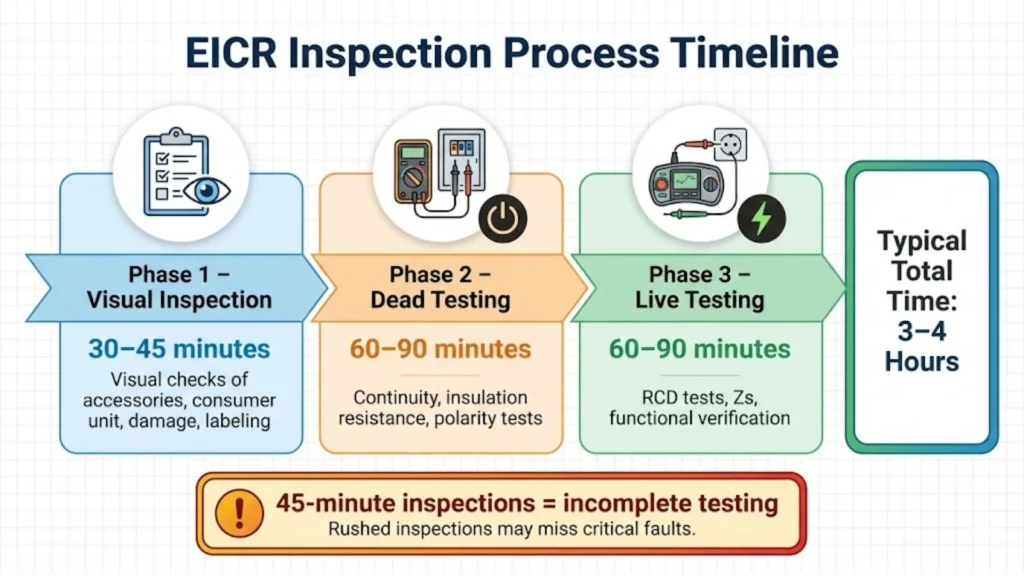
A thorough EICR for a typical three-bedroom house takes 3-4 hours. Anyone claiming they can do it in 45 minutes is lying or cutting corners. Here’s why.
The inspection starts with a visual check. The electrician looks for obvious defects like damaged cables, scorch marks around sockets, overheating signs, inadequate labelling on the consumer unit, and whether the installation generally looks safe. This takes 30-45 minutes depending on property size and access.
Next is dead testing. The power gets isolated (switched off at the consumer unit), and the electrician uses calibrated test equipment to check continuity, insulation resistance, and earthing. Continuity testing confirms that protective conductors (earth wires) are properly connected throughout the installation. Insulation resistance testing checks that cables aren’t leaking electricity where they shouldn’t. This phase takes 60-90 minutes because every circuit needs testing.
Then comes live testing. The power is restored, and the electrician tests polarity (checking that live and neutral are connected the right way round), earth fault loop impedance (measuring how quickly a fault would trip the protective device), and RCD functionality (testing that safety switches trip within the required milliseconds). This takes another 60-90 minutes.
Throughout the process, the electrician records test results on the Schedule of Test Results, which forms part of the final report. They’re checking that measured values fall within acceptable limits set out in BS 7671 and GN3 (Guidance Note 3: Inspection and Testing).
Calibrated test equipment is non-negotiable. Professional electricians must have their instruments calibrated annually to ensure accuracy. A report produced with uncalibrated or faulty equipment could be challenged in court if an incident occurs.
If an EICR only takes 45 minutes, the electrician either hasn’t done the testing properly or they’ve just eyeballed the consumer unit and filled in the paperwork. That’s not an inspection, that’s a waste of your money. And if something dangerous gets missed, you’re liable as the landlord or property owner.
EICR Codes Explained Without the Panic
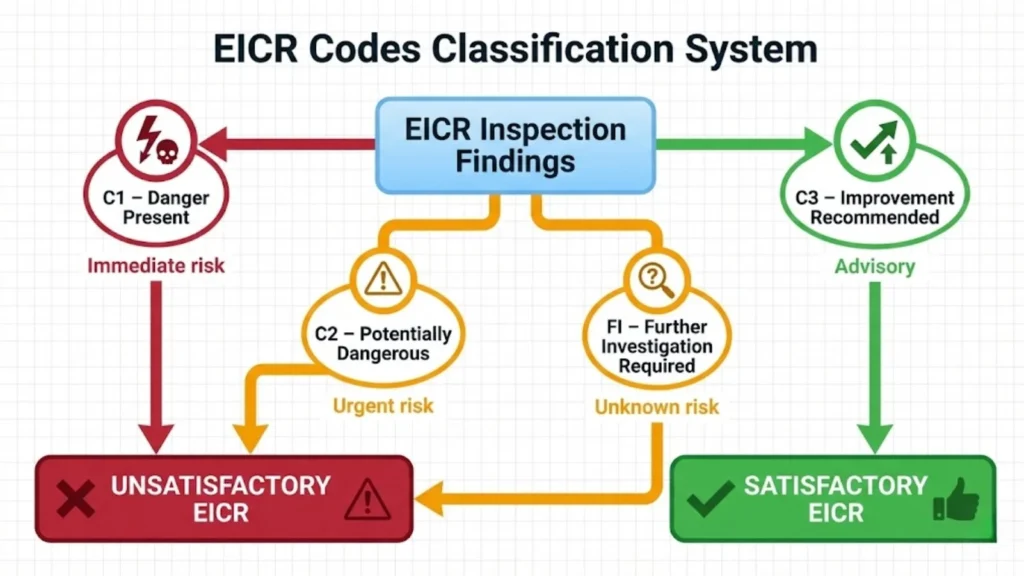
When the electrician completes the inspection, they code any observations (problems they’ve found) using a classification system. Understanding these codes is essential for knowing what actually needs fixing and what’s just advisory.
C1 – Danger Present: This means there’s an immediate risk of injury. Exposed live parts, severely damaged cables, missing earth connections on Class I equipment. C1 codes require urgent remedial action, usually within hours or days. They’re rare in domestic properties unless something catastrophically wrong has happened. A C1 code makes the report Unsatisfactory.
C2 – Potentially Dangerous: This means the defect poses a potential danger that requires prompt remedial work. Common examples include inadequate earthing and bonding, missing RCD protection on socket circuits, or degraded cable insulation. C2 doesn’t mean “dangerous right now,” it means “dangerous if circumstances change or the fault worsens.” Landlords in England and Wales must fix C2 codes within 28 days. A C2 code makes the report Unsatisfactory.
FI – Further Investigation Required: This means the inspector found something they couldn’t fully assess without additional work. Examples include buried cables they can’t trace, concealed junction boxes they can’t access, or equipment they can’t test without dismantling. FI codes need addressing because the inspector can’t confirm safety. An FI code makes the report Unsatisfactory.
C3 – Improvement Recommended: This is advisory. The installation doesn’t meet current best practice or modern standards, but it’s not dangerous. Common C3 observations include old-style consumer units that still work fine, lack of surge protection, or circuits that would benefit from additional RCD protection but aren’t legally required to have it. C3 codes do not make the report Unsatisfactory. Landlords are not legally required to fix them, though doing so improves safety.
Here’s where people panic unnecessarily. A report with C3 codes only is still Satisfactory. You don’t have to fix C3 observations to comply with landlord regulations. Some electricians deliberately over-code C3 issues as C2 to force remedial work. That’s unethical and potentially fraudulent.
To be clear: C1, C2, or FI = Unsatisfactory report, work required. C3 only = Satisfactory report, improvements recommended but not mandatory.
Common Causes of C2 and C3 Observations (What Inspectors Actually Find)
Most C2 and C3 codes in domestic EICRs fall into a few common categories. Knowing what to expect helps you judge whether the observations are reasonable.
Missing RCD Protection (C2 or C3): Modern standards in BS 7671 require RCD protection for socket circuits that could reasonably be used to supply portable equipment outdoors. If your installation was wired before RCDs became mandatory and doesn’t have them, that’s often coded C2. Older properties without RCD protection typically need consumer unit upgrades to bring circuits up to current standards. This is one of the most common C2 observations, and it’s legitimate.
Earthing and Bonding Issues (C2): The main earthing connection and supplementary bonding to metal pipes (gas, water, oil) are critical safety features. If the main earth is missing, undersized, or poorly connected, or if gas and water pipes aren’t bonded to the earth bar, that’s typically coded C2. These aren’t cosmetic issues, they’re fundamental to the safety system working correctly if a fault occurs.
Older Consumer Units Without Modern Protection (C3): Having an old rewirable fuse box isn’t automatically dangerous. If it’s in good condition, the fuses are the correct ratings, and the circuits are safe, it typically gets C3 for improvement recommended. The observation might note that modern consumer units with RCBOs offer better protection, but that doesn’t make the old one dangerous. This is where over-coding happens, electricians claiming an old fuse box is C2 when it should be C3.
DIY Alterations That Don’t Comply with BS 7671 (C2 or C3): Unauthorised electrical work is common in older properties. Junction boxes hidden in lofts without proper access, cables buried without mechanical protection, socket circuits extended incorrectly. Depending on severity, these get coded C2 (if they pose a credible danger) or C3 (if they’re non-compliant but not immediately dangerous).
Degraded Cable Insulation (C2): Cables deteriorate over time, especially in hot environments like airing cupboards or near boilers. If insulation is cracked, brittle, or perished, that’s typically C2 because exposed conductors could cause shocks or fires.
The key question with any observation is: does this pose a credible danger, or is the electrician over-coding to create work? If you’re unsure, get a second opinion from an electrician registered with a different Competent Person Scheme.
What Landlords Must Do After an Unsatisfactory EICR (The 28-Day Clock)
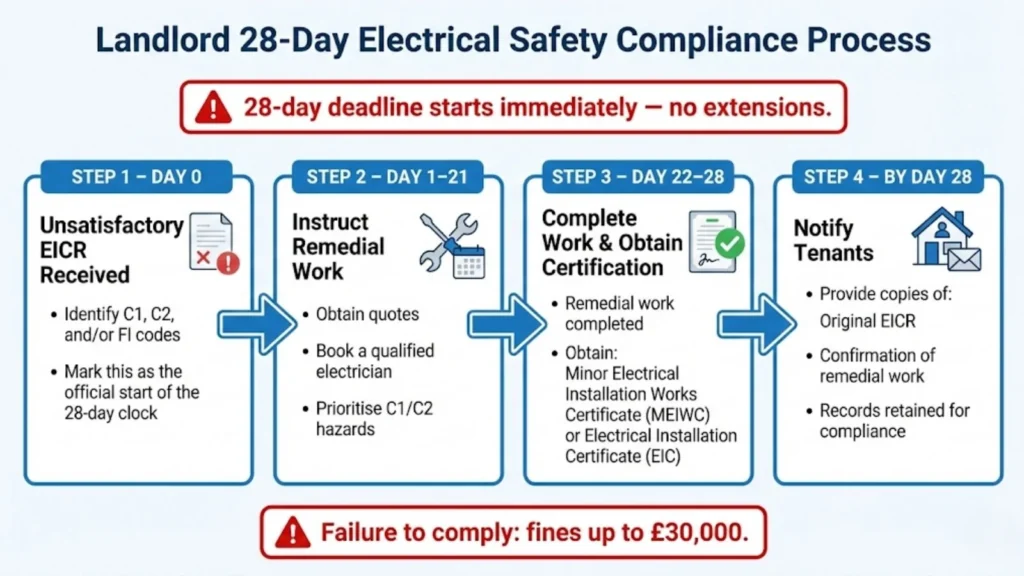
If your EICR comes back Unsatisfactory (C1, C2, or FI codes present), the clock starts immediately. In England and Wales, you have 28 days to complete remedial works and obtain written confirmation from a qualified electrician that the faults have been fixed.
Here’s the process:
Step 1: Identify all C1, C2, and FI observations in the report. These are the ones you must fix. C3 observations are advisory, you don’t have to touch them.
Step 2: Instruct a qualified electrician to carry out the remedial work. This can be the same electrician who did the inspection or a different one. Get quotes if necessary, but don’t delay beyond the 28-day limit.
Step 3: Once the work is complete, the electrician must provide written confirmation that the installation now meets BS 7671 standards. This is usually a Minor Works Certificate for small jobs or an Electrical Installation Certificate for larger work.
Step 4: Provide a copy of the original unsatisfactory EICR and the written confirmation of remedial work to your tenants within 28 days of the inspection date. If you’ve got a letting agent, they should handle this, but you’re ultimately responsible.
Step 5: Keep records. Local authorities can request proof of compliance at any time. If you can’t produce the EICR, the remedial certificates, and evidence you’ve notified tenants, you’re in breach of the regulations.
If you don’t comply, local authorities in England can issue civil penalties up to £30,000, serve Improvement Notices, or take other enforcement action. Similar processes apply in Scotland, Wales, and Northern Ireland under their respective regulations. Enforcement is real. Councils receive complaints from tenants, conduct spot checks, and prosecute landlords who ignore unsafe electrical installations.
Here’s the practical problem landlords face: getting an electrician to do remedial work within 28 days. If the electrician who did your inspection is booked out for three weeks, or if you need Building Control notification for a consumer unit replacement, that eats into your compliance window. Plan ahead. Don’t wait until day 27 to start ringing around for quotes.
The 28-day rule exists because C1 and C2 codes represent genuine hazards. Dragging your feet puts tenants at risk and exposes you to legal consequences.
Typical EICR Costs and What Affects Pricing (Why Cheap Is Expensive)
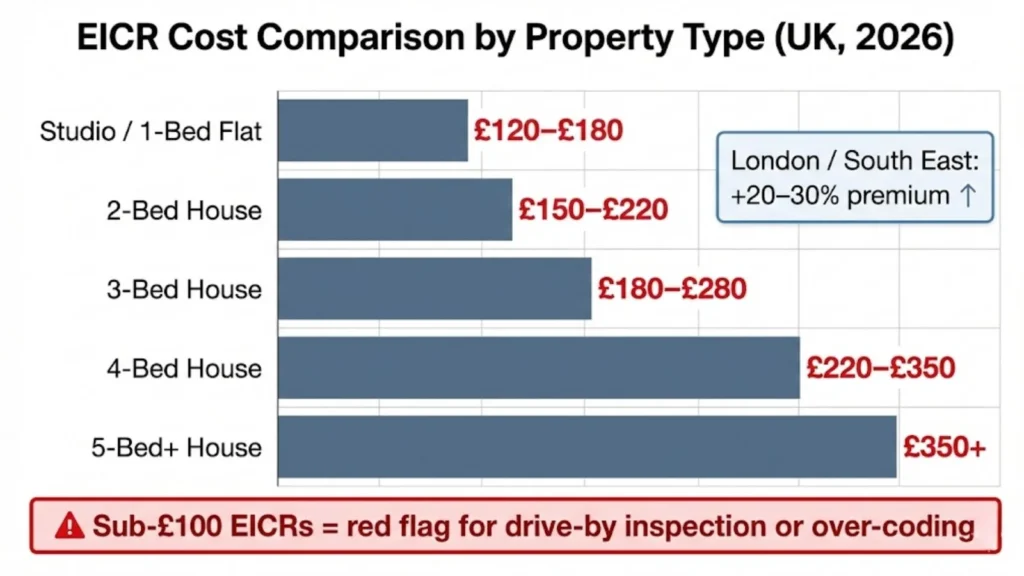
CR costs in the UK vary by region, property size, number of circuits, and access difficulties. Here’s what you should expect to pay in 2026:
Studio or 1-bed flat: £120-£180
2-bed house: £150-£220
3-bed house: £180-£280
4-bed house: £220-£350
5-bed house or larger: £350+
London and the South East typically sit 20-30% higher than these national averages. Birmingham, Manchester, and other major cities fall somewhere in the middle. Rural areas with limited electrician availability can also command higher prices.
Several factors affect pricing beyond property size. Number of circuits matters because each one needs individual testing. A house with 12 circuits takes longer to test than one with 6. Access difficulties (tight lofts, locked cupboards, tenants who aren’t home) add time. Properties with older installations or complex wiring take longer to assess.
Joshua Jarvis, Placement Manager at Elec Training, sees the consequences of cheap EICRs regularly:
"We see landlords going for £80 EICRs to save money, then getting stung with a report that's either useless or deliberately over-coded to create remedial work. A proper inspection costs £150-£250 depending on property size. Anything significantly cheaper means you're either getting a drive-by inspection or you're about to be upsold on unnecessary upgrades."
Joshua Jarvis, Placement Manager
Here’s why £80 EICRs are a false economy. A proper inspection takes 3-4 hours of an electrician’s time. Add in travel, calibrated test equipment, professional indemnity insurance, and the administrative cost of producing the report, and the break-even point for a legitimate business is around £120-£150 minimum. If someone’s charging £80, they’re either not doing the work properly or they’re planning to “find” expensive faults to make up the difference.
The drive-by inspection scenario: the electrician spends 30 minutes eyeballing the consumer unit, fills in a generic report template, and leaves. You get a Satisfactory result with minimal testing. If something dangerous is missed and someone gets hurt, your insurance won’t cover you because the EICR isn’t worth the paper it’s printed on.
The over-coding scenario: the electrician charges £80, does a cursory inspection, then codes everything as C2 (including things that should be C3), and quotes £800 for remedial work. You’ve saved £70 on the inspection and spent an extra £400 on unnecessary upgrades.
Pay for a proper EICR from a qualified electrician registered with NICEIC, NAPIT, ELECSA, or another Competent Person Scheme. It costs more upfront, but it’s accurate, defensible, and doesn’t create problems down the line.
How to Spot a Poor-Quality or Misleading EICR (Red Flags That Matter)
Not all EICRs are created equal. Some are professional engineering assessments. Others are sales documents designed to extract money for unnecessary work. Here’s how to tell the difference.
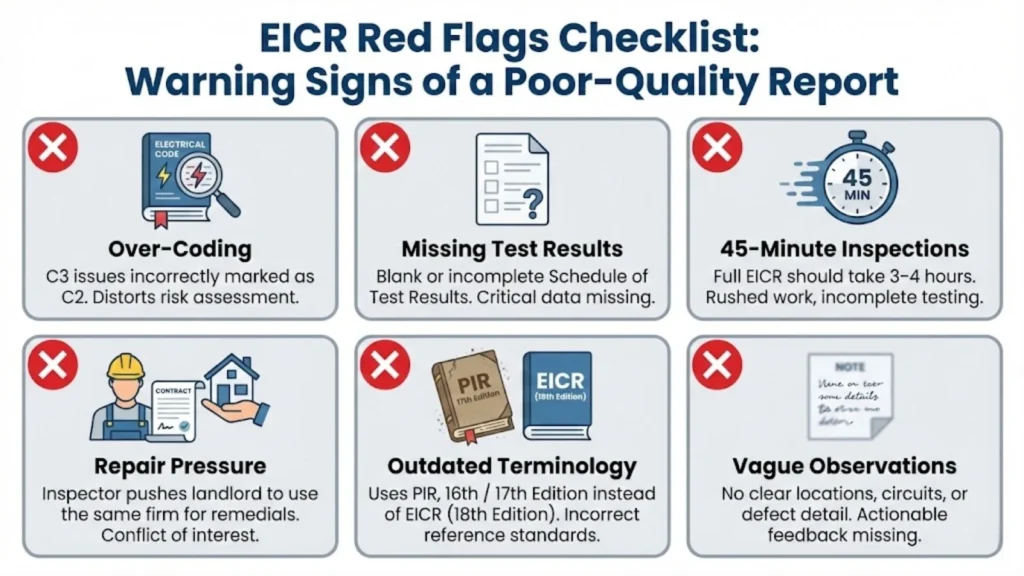
Red Flag 1: Over-Coding Minor Issues as C2
If the report codes things like missing circuit labels, lack of surge protection, or an old-style consumer unit as C2 (potentially dangerous), that’s over-coding. These should be C3 (improvement recommended) unless there’s a specific safety concern. Check the observations against Electrical Safety First’s Best Practice Guide 4, which provides coding guidance. If the electrician’s coding seems aggressive, get a second opinion.
Red Flag 2: Missing or Incomplete Test Results
A professional EICR must include a Schedule of Test Results with measured values for insulation resistance, earth fault loop impedance, continuity, and RCD trip times. If these columns are blank, filled with “N/A” without explanation, or missing entirely, the testing wasn’t done. Don’t accept the report, don’t pay for it, and don’t use that electrician again.
Red Flag 3: Unrealistically Short Inspection Times
If the electrician arrives at 2pm and leaves at 2:45pm claiming they’ve completed a full EICR on a three-bedroom house, they haven’t. Challenge them. Ask to see the test results. A proper inspection takes hours, not minutes.
Red Flag 4: Pressure to Use the Same Firm for Remedial Work
It’s fine for the electrician who did the inspection to quote for remedial work, but they shouldn’t pressure you into using them. If they refuse to explain the observations, won’t provide copies of the report until you agree to hire them for repairs, or claim you “must” use them because they know the property, that’s a red flag. You can instruct any qualified electrician to do remedial work.
Red Flag 5: Outdated Terminology or References
If the report is titled “Periodic Inspection Report” (PIR) instead of EICR, or if it references the 16th or 17th Edition of BS 7671 instead of the 18th Edition, the electrician is using obsolete forms and may not be current with 2026 standards. The 18th Edition (BS 7671:2018) has been mandatory since July 2018, with Amendment 2 from March 2022. There’s no excuse for outdated paperwork.
Red Flag 6: Generic Observations Without Specific Locations
Professional reports specify exactly where problems are located. “Socket outlet in bedroom 2 lacks RCD protection” is specific. “Some sockets lack RCD protection” is vague. If the report doesn’t tell you which circuits, which rooms, or which equipment has problems, the inspector hasn’t done the job properly.
If you spot these red flags, don’t rely on the EICR. Challenge the electrician, refuse payment if the work wasn’t done, and report them to their Competent Person Scheme if they’re registered. If they’re not registered, report them to Trading Standards.
What Qualifications an Electrician Must Have to Conduct EICRs Legally
Not every electrician is qualified to carry out EICRs. The qualification requirements are specific, and if the person inspecting your property doesn’t meet them, the report may not be legally valid.
Thomas Jevons, Head of Training at Elec Training with 20+ years of experience, explains what’s required:
"To conduct an EICR legally, you need NVQ Level 3, 18th Edition certification, and the C&G 2391 Inspection and Testing qualification. That 2391 isn't just a box-ticking exercise, it teaches you how to interpret test results, apply engineering judgement, and code observations correctly. Without it, you're guessing."
Thomas Jevons, Head of Training
Here’s the breakdown of required qualifications:
NVQ Level 3 in Electrotechnical Services (or equivalent): This demonstrates competence in electrical installation work. It’s the foundation qualification for working as an electrician. Anyone conducting EICRs must hold this or an equivalent Level 3 qualification recognised by the industry.
BS 7671 18th Edition Wiring Regulations: The inspector must be current with the 18th Edition (BS 7671:2018), including Amendment 2 (March 2022) and any subsequent amendments. This is the standard they’re inspecting against. Without it, they can’t properly assess compliance. The C&G 2382 course covers this.
City & Guilds 2391 Inspection and Testing Qualification (or equivalent): This is the specialist qualification for inspection and testing work. It covers test procedures, interpretation of results, application of codes, and completion of EICR documentation. Equivalent qualifications include C&G 2394/2395. Without this qualification, an electrician can install circuits but can’t legally inspect and report on installations.
Registration with a Competent Person Scheme: Membership of NICEIC, NAPIT, ELECSA, or another scheme recognised by government provides an additional layer of accountability. These bodies audit members’ work, offer complaints procedures, and can remove registration if standards aren’t met. While not legally mandatory for conducting EICRs, it’s industry best practice and provides consumer protection.
Professional Indemnity Insurance: The electrician must hold insurance specifically covering the production of reports. If they get the coding wrong or miss a dangerous fault, you need to be able to claim compensation. Always verify insurance is current before instructing work.
Before you hire an electrician for an EICR, ask for evidence of their qualifications. Check they’re registered with a Competent Person Scheme. Verify their insurance. If they can’t or won’t provide this information, don’t use them. For those considering electrical careers themselves, understanding the complete inspection and testing qualification pathway shows exactly what’s involved in becoming properly qualified to conduct EICRs.
The qualification requirements exist for good reason. Inspection and testing is a specialised skill that requires training beyond basic installation work. An electrician who can wire a socket circuit competently might not have the knowledge to interpret earth fault loop impedance readings or apply coding correctly. That’s why the 2391 qualification exists.
Real-World EICR Scenarios (What Actually Happens)
Understanding theory is one thing. Knowing how EICRs play out in practice is another. Here are common scenarios landlords and homeowners face:
Scenario 1: Buying a House with an Unsatisfactory EICR
You’re buying a house. The survey reveals the electrics haven’t been tested in 15 years. Your solicitor requests an EICR. The seller commissions one, and it comes back Unsatisfactory with multiple C2 codes for missing RCD protection, inadequate earthing, and degraded cable insulation. What happens?
You’ve got three options. Negotiate a price reduction to cover the cost of remedial work (typically £800-£2,000 depending on extent). Insist the seller fixes the issues before completion and provides certificates. Walk away from the purchase if the electrical problems are too severe or expensive.
Most buyers negotiate a price reduction because it gives them control over choosing the electrician and ensuring work is done properly. If you let the seller arrange remedial work, they might use the cheapest option available, which doesn’t always mean the best quality.
Scenario 2: Tenant Disputes Over C3 Observations
You’re a landlord. Your EICR comes back Satisfactory with several C3 codes recommending a consumer unit upgrade and additional RCD protection. The tenant reads the report, panics, and demands you fix everything immediately. They threaten to report you to the council for unsafe electrics.
Legally, you don’t have to fix C3 observations. The report is Satisfactory, which means it meets the regulatory requirement. However, explaining this to tenants requires tact. Provide them with information about what C3 codes mean, reassure them the installation is safe, and consider whether making some improvements (like adding RCD protection to high-risk circuits) would be worthwhile for tenant relations.
If the tenant persists in claiming the property is unsafe despite a Satisfactory report, document everything. Keep copies of the EICR, your explanations to the tenant, and any correspondence. If they do report you to the council, you can demonstrate compliance.
Scenario 3: Landlord Compliance Timelines and Emergency Remedials
You’re a landlord with multiple properties. One of your EICRs reveals C2 codes for inadequate bonding and a failed RCD. You contact the electrician who did the inspection, but they’re booked out for three weeks. You ring five other electricians, and the earliest anyone can attend is 22 days from now. You’ve got 28 days to complete the work and notify tenants.
This is why forward planning matters. If you’ve got multiple properties, schedule EICRs well before the five-year deadline so you’ve got time to manage any remedial work without the pressure of compliance deadlines. If you’re already against the clock, explain the situation to the electrician, ask if they can prioritise urgent safety work (like fixing the bonding issue), and provide evidence to the local authority that you’re actively addressing the problems if they enquire.
The 28-day rule doesn’t have exceptions for electrician availability, so managing the timeline is your responsibility.
Scenario 4: DIY Electrical Work Discovered During EICR
You’re selling your house. The EICR reveals multiple instances of DIY electrical work that doesn’t comply with Building Regulations or BS 7671. Junction boxes hidden in inaccessible locations, socket circuits extended without proper cable sizing, a shower circuit installed without notification to Building Control. The inspector codes these as C2 because they pose potential dangers.
Unauthorised electrical work is a problem because it wasn’t inspected at the time, and there’s no documentation proving it meets standards. Even if it looks like it works, it might not be safe. You’ll need to commission remedial work to bring the installation into compliance, which typically means removing hidden junction boxes, re-running cables with proper protection, and potentially notifying Building Control retrospectively.
This scenario is common in older properties where multiple owners have made modifications over decades. It’s also one of the reasons why buying a house with a recent satisfactory EICR gives you peace of mind.
Scenario 5: Insurance Claims Requiring EICR Evidence
Your house suffers an electrical fire. The insurance assessor investigates and asks for evidence the electrical installation was maintained properly. You haven’t had an EICR done in 20 years. The insurer argues that failure to maintain the installation contributed to the fire and declines the claim.
Insurance policies typically require reasonable steps to maintain safety. While they don’t explicitly mandate EICRs for homeowners, demonstrating you’ve had periodic inspections strengthens your position if something goes wrong. If you’re a landlord and you haven’t complied with EICR requirements, expect your insurance to be invalidated for electrical-related claims.
These scenarios show why EICRs matter beyond regulatory compliance. They’re evidence of due diligence, protection against disputes, and documentation that helps with property transactions.
What Actually Matters in an EICR (Focus on Safety, Not Sales)
Strip away the jargon, the coding system, and the regulatory requirements, and here’s what actually matters about EICRs.
C1 and C2 codes represent genuine hazards. If your report lists them, get them fixed. These aren’t optional, they’re safety issues that could cause shocks, fires, or fatalities if circumstances change or faults worsen.
C3 codes are recommendations for improvement. Consider them, budget for them if you can, but don’t panic if you can’t afford to address them immediately. They don’t make the installation unsafe for continued use.
Hire qualified electricians who hold NVQ Level 3, 18th Edition, and the 2391 Inspection and Testing qualification. Check they’re registered with a Competent Person Scheme. Verify their insurance. Don’t cut corners on price because cheap EICRs either miss problems or invent them.
If you’re a landlord, stay on top of the five-year cycle. Schedule EICRs with enough time to manage remedial work without the pressure of compliance deadlines. Keep records, notify tenants, and treat electrical safety as the ongoing responsibility it is, not a one-time box-ticking exercise.
If you’re a homeowner, get an EICR every 10 years, before major renovations, or when buying a property with unknown electrical history. It’s not legally required, but it’s sensible risk management.
And if you’re considering a career in electrical work and want to understand the complete pathway from training through to conducting EICRs professionally, exploring the full range of electrical qualifications shows what’s involved in becoming the kind of electrician people can trust with safety-critical inspections.
An EICR is a safety document, not a sales tool. Treat it that way, and you’ll avoid the cowboys, the over-coding, and the unnecessary panic that makes the industry frustrating for everyone involved.
References
- BS 7671:2018+A2:2022 (IET Wiring Regulations) – https://www.theiet.org/
- IET Guidance Note 3: Inspection & Testing – https://electrical.theiet.org/
- Housing (Scotland) Act 2006 – https://www.gov.scot/
- Renting Homes (Wales) Act 2016 – https://www.gov.wales/
- Private Tenancies Act (Northern Ireland) 2022 – https://www.nidirect.gov.uk/
- Electricity at Work Regulations 1989 – https://www.hse.gov.uk/electricity/
- Electrical Safety First Best Practice Guide 4 – https://www.electricalsafetyfirst.org.uk/
- GOV.UK: Electrical safety standards for landlords – https://www.gov.uk/government/publications/electrical-safety-standards-in-the-private-rented-sector-guidance-for-landlords-tenants-and-local-authorities
- NICEIC – https://www.niceic.com/
- NAPIT – https://www.napit.org.uk/
Note on Accuracy and Updates
Last reviewed: 15 January 2026. This page is maintained regularly. We correct errors, update regulatory references, and refresh enforcement data as standards and legislation change. EICR requirements and compliance procedures may vary by UK nation, always verify current regulations with local authorities or legal advisors.
FAQs
What is an EICR, and what does it actually cover in a property (and what doesn’t it cover)?
An Electrical Installation Condition Report, or EICR, is a detailed inspection and testing of the fixed electrical wiring in a property to assess its safety and condition. It covers elements such as circuits, sockets, switches, consumer units, earthing, and bonding, checking for defects, deterioration, or non-compliance with BS 7671 standards, which demonstrate adherence to the Electricity at Work Regulations.
The report does not include portable appliances, which require separate Portable Appliance Testing, nor does it cover temporary installations or appliances plugged into sockets.
What to do next:
If you suspect issues, contact a qualified electrician to arrange an EICR.
What does “Satisfactory” vs “Unsatisfactory” mean on an EICR, and is it the same as pass or fail?
A satisfactory EICR means the electrical installation is safe for continued use, with no immediate dangers identified, though it may include recommendations for improvements. An unsatisfactory result indicates defects that pose risks and require remedial work to make the installation safe.
While often likened to pass or fail, these terms are not official. The focus is on safety levels, where C1, C2, or FI codes result in an unsatisfactory outcome, but a report containing only C3 observations can still be satisfactory.
What to do next:
Review any codes in your report and consult a qualified electrician for advice on necessary actions.
Who legally needs an EICR in the UK, and how do the rules differ across England, Wales, Scotland, and Northern Ireland?
In England and Wales, landlords of private rented properties must have an EICR every five years or at tenancy change, ensuring the installation is safe. Copies must be provided to tenants and local authorities on request. Homeowners and businesses have no legal requirement but are advised to consider one for safety.
In Scotland, landlords must obtain an EICR every five years under the Housing (Scotland) Act, with similar provision rules. Northern Ireland has no specific EICR mandate for landlords, but general safety duties apply under health and safety law, so local authority guidance should be checked.
What to do next:
Confirm your obligations based on location by checking government guidance or speaking to a qualified electrician.
How often should an EICR be carried out for landlords, homeowners, and businesses, and when should the interval be shorter than five years?
For landlords in England, Wales, and Scotland, an EICR is generally required every five years, or sooner if recommended in the previous report. Homeowners and businesses are advised to follow a five-year interval as good practice, in line with BS 7671 guidance.
Shorter intervals, such as one to three years, may be appropriate for older installations, properties with heavy use, frequent tenant turnover, or where damage, alterations, or environmental factors like flooding have occurred.
What to do next:
Check the recommended re-inspection date on your last EICR and book the next inspection in good time.
What happens during an EICR?
During an EICR, a qualified electrician visually inspects the electrical installation for obvious defects, then carries out tests on circuits, earthing, and protective devices using specialist equipment. Power isolation is often required for safety. All findings, measurements, and observations are recorded in the report and coded where issues are identified.
For a typical three-bedroom house, the process usually takes around three to four hours, depending on size and accessibility. The inspection focuses on fixed wiring and does not involve dismantling fittings unless necessary.
What to do next:
Ensure clear access to electrical points and inform occupants about temporary power interruptions.
What do the codes C1, C2, C3, and FI mean on an EICR?
C1 indicates danger present and requires immediate action to remove the risk of injury. C2 means potentially dangerous and calls for urgent remedial work to prevent hazards.
FI stands for further investigation required, meaning the inspector could not fully assess a potential issue without additional work. C3 means improvement recommended to meet current standards, but it is not mandatory.
These codes are based on Electrical Safety First Best Practice Guide 4 and are designed to prioritise safety.
What to do next:
If your report includes C1, C2, or FI, arrange remedial work promptly with a qualified electrician.
How long does a proper EICR take for a typical three-bed house?
A thorough EICR for a typical three-bed house generally takes three to four hours. This allows time for visual inspection, testing of multiple circuits, and accurate recording of results.
Factors such as the age of the installation, number of circuits, or complexity can extend the time required. Inspections claimed to take 45 minutes or less may indicate that key tests have been skipped.
What to do next:
Ask the electrician in advance how long the inspection is expected to take to ensure it is carried out properly.
What should I do if my EICR is unsatisfactory?
An unsatisfactory EICR means C1, C2, or FI observations are present and remedial work is required to make the installation safe. Obtain quotes for the necessary repairs and ensure all listed defects are addressed.
For landlords in England and Wales, remedial work must be completed within 28 days, with written confirmation provided to tenants and local authorities if requested. Scotland has similar requirements, while Northern Ireland landlords should check local guidance.
What to do next:
Instruct a qualified electrician to complete and certify the remedial work, and retain all documentation.
How much does an EICR cost in 2026?
In 2026, EICR costs typically range from £150 to £300 for a one- to two-bed property, £200 to £400 for a three-bed house, and £300 to £600 for larger homes. Prices vary depending on location, property complexity, and the number of circuits.
Urban areas such as London are usually more expensive, while rural locations may be cheaper. Accessibility and the condition of the installation also affect pricing.
What to do next:
Request quotes from several qualified electricians and confirm that the price includes a full report with a schedule of test results.
How can I spot a poor-quality EICR, and what qualifications should the electrician have?
Warning signs of a poor-quality EICR include missing schedules of test results, vague observations, very short inspection times, over-coding minor issues, pressure to buy unnecessary remedial work, or use of outdated terminology such as PIR instead of EICR.
A competent electrician should hold NVQ Level 3 or equivalent, current 18th Edition certification, and inspection and testing qualifications such as City & Guilds 2391 or 2394/2395. Registration with schemes like NICEIC or NAPIT provides additional reassurance.
What to do next:
Verify the electrician’s qualifications and scheme registration online before booking the inspection.
