

How Training Affects Electrician Pay (Level 2 → Gold Card Earnings)

- Technical review: Thomas Jevons (Head of Training, 20+ years)
- Employability review: Joshua Jarvis (Placement Manager)
- Editorial review: Jessica Gilbert (Marketing Editorial Team)
- Last reviewed:
- Changes: Initial publication using JIB 2025 rates, ECS competence requirements, C&G qualification pathways, and employer wage data from ONS ASHE 2024
Introduction
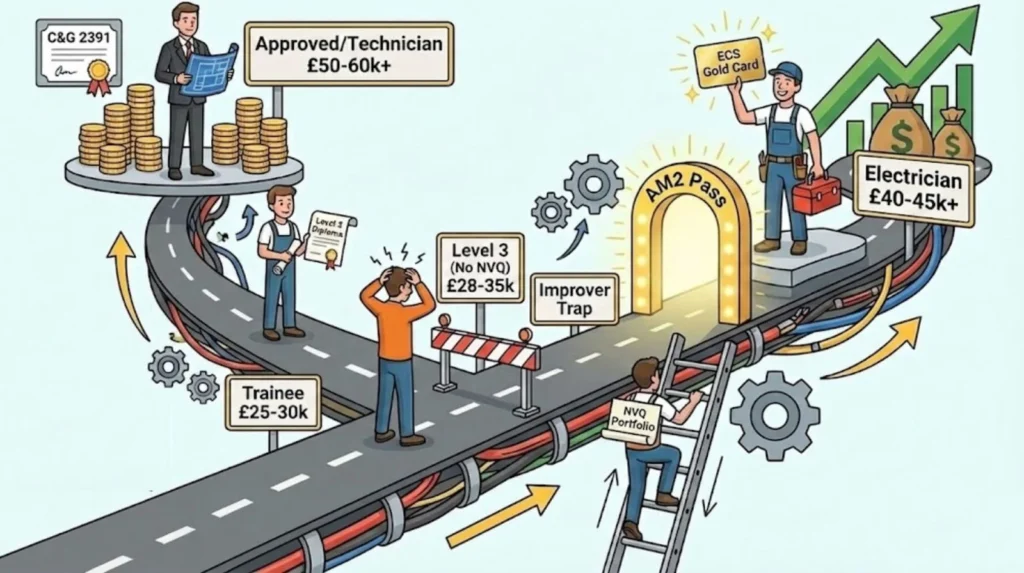
Ask ten people what a “qualified electrician” means and you’ll get ten different answers. An employer wants an NVQ Level 3 and AM2 certificate. A training provider selling fast-track courses might claim a Level 3 Diploma is enough. A homeowner hiring someone off Facebook probably has no idea what qualifications exist. The confusion costs people thousands in training fees and years in suppressed wages.
The brutal reality is this: your training qualifications directly determine your earnings, but not in the way most training adverts suggest. A Level 3 Diploma without an NVQ keeps you stuck at Improver wages (£28,000 to £34,000 annually) regardless of how many classroom hours you’ve completed. The AM2 endpoint assessment unlocks a £6,000 to £10,000 annual pay jump overnight. And post-Gold Card certifications like 2391 Inspection & Testing can add £50 to £100 per day to CIS rates, but only if you have the foundation qualifications first.
This article breaks down the UK electrical training ladder rung by rung, from Labourer through to Approved Electrician and beyond, using JIB 2025 wage rates, ONS Annual Survey of Hours and Earnings (ASHE) 2024 data, job board analysis from Indeed and Reed, contractor forum discussions, and ECS competence requirements. We’ll show exactly which qualifications trigger pay increases, which ones are mandatory but add nothing to your wage, and where adult learners commonly get stuck losing years of potential earnings.
The detailed breakdown of JIB wage progression from training through to Gold Card status covers the 2026-28 pay deal and regional variations, but this article focuses specifically on how each training qualification affects your earning potential at every stage of the pathway.
The Full UK Training & Qualification Ladder
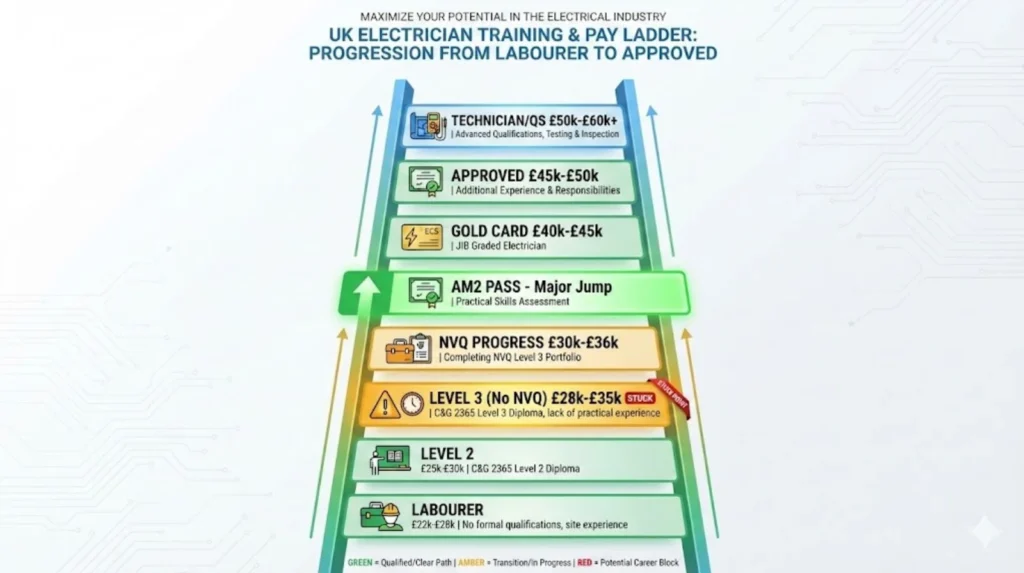
Understanding the UK electrical training pathway requires knowing what each qualification actually certifies, what it doesn’t allow you to do, and where people commonly get stuck. The ladder runs from entry-level labouring through to senior grades, with multiple potential bottlenecks.
Labourer / Electrical Mate (Green CSCS/ECS Card)
What it certifies: Nothing electrical. This is an entry-level support role requiring only a Health, Safety & Environmental (HS&E) assessment and sometimes a basic health and safety qualification like C&G 6072.
JIB definition: “A person who is engaged in general labouring duties.” You’re fetching materials, running cables under supervision, and assisting qualified electricians. You cannot perform electrical work independently.
ECS card: Electrical Labourer Card (green). Site access only, no technical competence assumed.
Employer perception: Training ground for apprenticeships or adult learners waiting to start formal qualifications. Not employable as an electrician.
Common misconception: Some people assume site experience as a Mate counts toward NVQ portfolios. It doesn’t unless you’re formally enrolled on an NVQ programme with an assessor.
Why people get stuck here: Waiting for apprenticeship starts, unable to afford Level 2/3 courses, or working cash-in-hand without progressing to formal training.
Level 2 Diploma (C&G 2365-02, EAL Equivalent)
What it certifies: Fundamental knowledge of electrical principles, wiring systems, and installation theory. This is classroom-based learning covering Ohm’s Law, circuit types, cable sizing, and basic installation methods.
City & Guilds definition: “Provides the knowledge for electrical installations in buildings and structures.” Certifies knowledge only, not performance or competence.
What it does NOT allow: Unsupervised electrical work. No design responsibility. No legal right to sign off installations. You’re still a Trainee.
ECS/JIB mapping: Electrical Trainee Card (white) or Improver grade if on a registered apprenticeship pathway. Many adult learners struggle to get the white card without employer sponsorship.
Employer perception: First step only. Employers see this as proof you understand basic theory but have zero hands-on competence. Job adverts rarely accept Level 2 alone for anything beyond Mate roles.
Common misconception: “Level 2 makes me an electrician.” Reality: you’re still a Mate with slightly better theoretical knowledge. The pay bump from Labourer to Level 2 is minimal (around £1 to £2 per hour).
Duration: Full-time college takes 1 year for 16 to 18-year-olds. Adult fast-track courses compress this to weeks or months, but employers heavily discount the value of rapid theory-only qualifications.
Level 3 Diploma (C&G 2365-03, C&G 8202, EAL Level 3)
What it certifies: Advanced knowledge including circuit design, inspection theory, testing calculations, and BS 7671 Wiring Regulations. Still classroom-based theory.
City & Guilds definition: “Advanced technical certificate in electrical installation.” Covers three-phase systems, protective devices, fault diagnosis theory, and inspection principles.
What it does NOT allow: Independent electrical work. No Gold Card eligibility. No legal competence recognition by ECS or JIB. You are officially an “Improver” or “Trainee Electrician,” not a qualified electrician.
ECS/JIB mapping: Electrical Improver Card (white) if you can prove you’re on a pathway to NVQ. Many adult learners with just Level 3 cannot get any ECS card because they’re not enrolled in NVQ programmes.
This is the “Improver Trap”: Thousands of adult learners stop at Level 3 because training providers sell it as a complete package. They then discover:
- Employers won’t pay Electrician rates without the NVQ
- Commercial sites won’t grant access without a Gold Card
- They’re permanently stuck at £28,000 to £35,000 wages
- Building an NVQ portfolio requires employer sponsorship they can’t get
Employer perception: “Paper qualified but not competent.” Forum discussions and employer surveys consistently show distrust of Level 3-only candidates, especially from fast-track providers. Employers see these qualifications as proof you sat in a classroom, not that you can wire a consumer unit safely.
Common misconception: “I’ve completed Level 3, so I’m a qualified electrician.” This is actively false according to JIB, ECS, and IET definitions. You are a Trainee.
Real forum quote (paraphrased):
"I spent £7,000 on a training centre package. Got my Level 3. Rang 50 firms. Nobody cares. I'm working as a mate for £14/hr trying to get my portfolio signed off."
Duration: Full-time college takes 1 year. Adult fast-track courses compress to 8 to 16 weeks. Employer value of fast-track Level 3 qualifications is significantly lower than college or apprenticeship routes.
NVQ Level 3 (C&G 2357, C&G 5357, C&G 2346 EWA)
What it certifies: Competence. This is performance-based assessment proving you can actually do electrical work safely in real-world environments.
City & Guilds definition: “NVQ Diploma in Installing Electrotechnical Systems and Equipment.” Requires a portfolio/logbook demonstrating competence across multiple units covering installation, testing, inspection, fault-finding, and safe working practices.
Three routes to NVQ:
- 5357 Apprenticeship: Integrated knowledge and competence pathway over 3 to 4 years. This is the gold standard route.
- 2357 NVQ: For those with Level 2/3 diplomas who secure employment and build portfolios with assessor support. Takes 18 to 36 months depending on site opportunities.
- 2346 Experienced Worker Assessment (EWA): For electricians with 3+ years of documented site experience but no formal NVQ. Requires extensive evidence gathering and witness testimonies.
Portfolio requirements: Photographic evidence of installations you’ve worked on, witness testimonies from supervisors, diary sheets logging hours against specific unit outcomes, and assessor observations of your on-site work. This typically requires 400+ logged hours across multiple installation types.
What it does NOT allow: You still can’t work unsupervised or get a Gold Card until you pass AM2. The NVQ makes you eligible for AM2, but doesn’t itself confer fully qualified status.
ECS/JIB mapping: With NVQ in progress or completed, you can apply for the Gold Card once AM2 is passed. The NVQ is the gatekeeper to the AM2 assessment.
Employer perception: This is where employers start taking you seriously. An NVQ in progress signals you’re on a legitimate pathway to competence. Completed NVQ holders awaiting AM2 slots typically earn £35,000 to £40,000 PAYE.
The portfolio bottleneck: This is where many adult learners hit a second wall. You need employer sponsorship to build the portfolio, but employers want qualified electricians, not Improvers. It’s a catch-22 that can take years to resolve without good placement support.
Duration: 18 months to 3 years depending on site opportunities and assessor availability. Fast-track training providers cannot compress this because it requires real site work hours.
AM2 / AM2S / AM2E (Endpoint Assessment)
What it certifies: Practical competence under exam conditions. This is a 2.5-day independent assessment at a NET (National Electrotechnical Training) centre where you must wire a circuit to BS 7671 standards, test it correctly, and complete paperwork within strict time limits.
NET definition: “Achievement Measurement of Competence; practical assessment of installation skills.”
Assessment content: Install and test a complete electrical circuit including consumer unit connections, protective devices, cable terminations, earthing and bonding, and testing with certification. You’re marked on technical accuracy, safe working practices, and time management.
Pass rate: Approximately 75% to 80% first attempt. Common failure points include incorrect testing procedures, poor cable terminations, and BS 7671 regulation errors.
What it unlocks: Eligibility for the ECS Gold Card. Without AM2, you cannot apply for a Gold Card regardless of your other qualifications or site experience.
Cost: Approximately £800 to £1,200 depending on location and whether it’s AM2, AM2S (Scotland), or AM2E (experienced worker route).
Thomas Jevons, our Head of Training with 20+ years on the tools, explains:
The AM2 assessment is the industry's firewall for competence. You can have all the classroom qualifications in the world, but without that practical endpoint assessment demonstrating you can wire a circuit safely under timed conditions, you're not getting a Gold Card. That's why the pay jump at this stage is so significant - it's proof you can actually do the work."
Thomas Jevons, Head of Training
Employer perception: The AM2 certificate is what employers actually look for. Job adverts for “Electrician” roles almost always state “AM2 essential” or “Gold Card required,” which amounts to the same thing.
Common misconception: “I don’t need AM2 because I’ve got 10 years’ experience.” Commercial and industrial sites are card-controlled. No Gold Card means no entry through the turnstile, regardless of experience.
ECS Gold Card (Installation Electrician / Maintenance Electrician)
What it certifies: Full competence. You are now a “Competent Person” under Part P Building Regulations and can work unsupervised.
ECS definition: “For Level 3 NVQ skilled individuals working unsupervised.” The card requires NVQ Level 3, AM2 pass, current BS 7671 (18th Edition), and HS&E test.
Card colour: Gold. This is the visual proof you’re fully qualified. Site managers, insurance companies, and building control officers recognise this card as the minimum standard for electrical work.
What it allows: Independent electrical work, signing off your own installations (with appropriate scheme registration like NICEIC or NAPIT), design responsibility within competence limits, and access to commercial and industrial sites.
JIB grading: Maps to “Electrician” grade, which is the baseline for full JIB rates (£19.30 to £20.25 per hour in 2025 depending on transport provision).
Employer perception: This is the minimum credential employers accept for “Electrician” job titles. Anything less is Mate, Improver, or Trainee.
Renewal: Every 5 years. Requires proof of continued BS 7671 updates and ongoing site work.
Beyond Gold Card: Approved Electrician, Technician, QS
Approved Electrician (JIB grade): Requires Gold Card plus 2 years of post-qualification verified experience plus Inspection & Testing qualification (C&G 2391 or 2394/5). This triggers higher JIB hourly rates (£20.25 to £22+ in 2025) and opens up supervisory and EICR-focused roles.
Technician/Qualified Supervisor (QS): Requires additional portfolio evidence, often Level 4 qualifications or specialized training, and supervisory responsibilities. PAYE salaries range from £48,000 to £60,000+ depending on sector.
Senior roles: Project management, electrical design (2396), HV authorised persons, or sector-specific senior positions (rail, data centres, utilities). These typically require 5 to 10 years post-Gold Card experience and continuous professional development.

Pay Benchmarks by Training Stage
The numbers tell the real story. Here’s exactly what electricians earn at each qualification level, broken down by employment type.
Labourer / Electrical Mate
JIB hourly rate: £12.59 (national 2025)
PAYE annual salary: £22,000 to £28,000 depending on region and overtime availability
CIS/self-employed day rate: £100 to £130 (London £130 to £150)
Regional variations: North and Midlands sit at lower end (£22,000 to £25,000 PAYE), South and London at upper end (£26,000 to £28,000)
Overtime potential: Minimal. Labourers rarely get significant overtime on commercial sites.
Sources: JIB wage tables 2025, Indeed salary data November 2024 (£22,000 to £25,000 average for “Electrical Labourer”), Reed listings showing £24,000 median.
Level 2 Diploma Only (No Level 3)
JIB hourly rate: £12.42 to £14.00 (Trainee Stage 1 to Stage 2 depending on apprenticeship year)
PAYE annual salary: £25,000 to £30,000
CIS/self-employed day rate: £120 to £160 (rarely offered CIS work without Level 3 minimum)
Pay jump from Labourer: Minimal. Around £1 to £2 per hour or £2,000 to £3,000 annually. Employers view Level 2 as a stepping stone, not a destination.
Regional variations: London adds approximately 10% (£27,000 to £32,000 PAYE).
Sources: ElectriciansForums threads discussing Improver rates, Glassdoor averaging £28,000 for “Electrical Trainee.”
Level 3 Diploma (No NVQ) – The Improver Trap
JIB hourly rate: £14.50 to £16.50 (Trainee Stage 2/3 or Improver grade)
PAYE annual salary: £28,000 to £35,000
CIS/self-employed day rate: £150 to £200 (some agencies offer £180 to £220 for experienced Improvers)
Pay jump from Level 2: Moderate. Around £3,000 to £5,000 annually, but this is where many people plateau for years.
Regional variations: North £28,000 to £32,000, Midlands £30,000 to £34,000, South £32,000 to £36,000, London £35,000 to £40,000.
Why this is a trap: Employers cap your wages here because you lack competence certification. Job adverts listing “Electrician – £40,000” require NVQ + AM2. You’re excluded from those roles despite having advanced theoretical knowledge.
Forum reality check (paraphrased): “Level 3 without NVQ = permanent Improver. I’ve been stuck at £32k for 3 years because I can’t get the portfolio signed off.”
Sources: ONS ASHE 2024 (£32,000 median for “Electrical Improver”), Reed listings showing £30,000 to £34,000 range for Level 3 holders.
NVQ in Progress (Portfolio Underway, Not Yet Signed Off)
JIB hourly rate: £15 to £17 (still Improver grade until AM2)
PAYE annual salary: £30,000 to £36,000
CIS/self-employed day rate: £160 to £210
Pay jump from Level 3 only: Minimal until completion. The portfolio work itself doesn’t unlock pay increases; only the AM2 pass does.
Why wages remain suppressed: Employers know you’re not yet Gold Card eligible. You’re valuable because you’re progressing, but not valuable enough to pay Electrician rates.
Sources: Reddit r/ukelectricians discussions showing £15/hr as typical NVQ student rate.
NVQ Completed, Pre-AM2
JIB hourly rate: £16 to £18 (some employers begin paying closer to Electrician rates once NVQ is verified)
PAYE annual salary: £35,000 to £40,000
CIS/self-employed day rate: £180 to £220
Pay jump from in-progress NVQ: Small. Around £2 to £3 per hour or £4,000 to £5,000 annually. The real jump comes after AM2.
Employer behaviour: Some employers hold back pay increases until you physically present the AM2 certificate and Gold Card. Others recognise NVQ completion as proof you’re on track and bump wages slightly.
Sources: ECA employer survey showing £35,000 average for NVQ-completed pre-AM2 candidates.
Post-AM2 – ECS Gold Card (Installation / Maintenance Electrician)
JIB hourly rate: £19.30 to £20.25 (2025 rates, depending on whether employer provides transport)
PAYE annual salary: £40,000 to £45,000 (national average), £45,000 to £52,000 (London)
CIS/self-employed day rate: £220 to £280 (national), £280 to £350 (London)
Pay jump from NVQ-completed pre-AM2: Significant. This is the single biggest earnings jump in the entire pathway. From approximately £35,000 to £42,000 PAYE, or from £180/day to £250/day CIS.
Why the jump is so large: This is where employers legally recognise you as a “Competent Person.” JIB union rules prohibit paying full Electrician rates to non-Gold Card holders. Commercial sites require the card for access. Insurance and building control require it for sign-offs.
Regional variations:
- North: £38,000 to £42,000 PAYE, £220 to £260/day CIS
- Midlands: £40,000 to £44,000 PAYE, £240 to £280/day CIS
- South: £42,000 to £46,000 PAYE, £260 to £300/day CIS
- London: £45,000 to £52,000 PAYE, £300 to £350/day CIS
Sector variations:
- Domestic: £38,000 to £42,000 PAYE, £220 to £280/day CIS
- Commercial: £40,000 to £45,000 PAYE, £240 to £300/day CIS
- Industrial: £42,000 to £50,000 PAYE (with shift premiums), £280 to £400/day CIS
Sources: JIB wage tables January 2025 (£19.30 baseline), ONS ASHE 2024 (£39,000 mean for “Electrician”), Indeed job adverts averaging £42,000 for Gold Card roles, Glassdoor showing £44,000 median.
Forum confirmation (paraphrased):
"Got my Gold Card last month. Wage jumped from £35k to £42k. Same firm, same job, just the card changed everything."
Approved Electrician / Technician / QS
JIB hourly rate: £20.25 to £22+ (Approved grade), up to £25+ for Qualified Supervisor roles
PAYE annual salary: £45,000 to £60,000+ depending on sector and seniority
CIS/self-employed day rate: £250 to £350 (Approved), £300 to £450 (specialist Technician/QS roles)
Pay jump from standard Gold Card: Moderate to significant depending on route. Approved status adds approximately £3,000 to £5,000 annually. Technician/QS roles add £8,000 to £15,000.
What triggers this level: Gold Card + 2 years verified post-qualification experience + 2391 Inspection & Testing (for Approved). Technician and QS roles require additional portfolio evidence, supervisory responsibilities, and often Level 4 qualifications.
Sources: CITB Construction Skills Network report showing £45,000+ for Approved grades, Reed averaging £50,000 for “Approved Electrician,” ECA survey data.
Progression Rules: What Actually Triggers Pay Rises
Understanding the formal pathway is one thing. Understanding how employers actually behave is another. Here’s both.
Level 2 → Level 3: The Minor Bump
Formal JIB rule: Completing C&G 2365 Level 2 moves a worker from “Labourer” to “Adult Trainee Stage 2” if on a registered pathway.
Pay impact: Minimal. Around £1.20 per hour or £2,500 annually. Employers rarely give significant raises for classroom-only progress because you’re still not competent to work independently.
Real-world employer behaviour: Many employers view Level 2 as “still a Mate with some theory.” Unless you’re on an apprenticeship with locked-in progression, don’t expect automatic pay increases just for completing Level 2.
Level 3 Diploma → NVQ Enrolment: The Improver Band
Formal rule: Once enrolled on an NVQ (C&G 2357/5357) and working on site with assessor support, the worker moves to “Improver” status.
Pay impact: Moderate. Around £14 to £15 per hour PAYE. The worker is now useful on site but legally requires supervision for all electrical work.
Real-world employer behaviour: This is where adult learners often get stuck because NVQ enrolment requires employer sponsorship. You can’t build the portfolio without site access, and employers are reluctant to sponsor someone without existing competence. It’s a catch-22 that requires either apprenticeship entry or exceptional placement support.
NVQ Portfolio Completion → AM2 Eligibility: The Gatekeeper
Formal rule: JIB Handbook and NET assessment requirements state you cannot book AM2 until your NVQ portfolio is “green-lighted” (fully signed off) by an assessor.
Pay impact: None until AM2 is actually passed. Some employers bump wages slightly (£1 to £2/hr) when portfolio is completed because it proves you’re weeks away from Gold Card status, but this isn’t universal.
Real-world employer behaviour: Many employers withhold the “Electrician” title and associated pay until the physical Gold Card is in hand, not just when the NVQ is completed.
Passing AM2 → Gold Card: The Major Jump
Formal rule: This is the hardest pay boundary to cross. JIB employers cannot pay full Electrician rates (£19.30+/hr in 2025) under union rules until you hold the Gold Card. Commercial sites cannot grant card-controlled access without it.
Pay impact: Immediate jump of approximately £4,000 to £6,000 annually PAYE, or £40 to £60 per day CIS. This is the qualification that changes your career.
Real-world employer behaviour: Some firms give the pay rise the day the AM2 certificate arrives. Others wait until the physical ECS card is issued (which can take 2 to 3 weeks). A small minority try to delay or suppress the increase, which typically results in the electrician immediately finding a new employer who will pay properly.
Forum quote (paraphrased):
"Passed AM2 on Friday. Boss congratulated me but said my pay wouldn't change until the card arrived. I handed in my notice Monday. New firm paying me £42k starting next month."
The “2-Year Rule” (Electrician → Approved)
Formal rule: JIB Handbook Section 4 states you cannot be graded “Approved Electrician” straight after qualifying. You need 2 years of verified post-Gold Card experience plus Inspection & Testing qualification (C&G 2391).
Pay impact: This triggers the £20.25/hr rate (approximately £3,000 to £4,000 annual rise from baseline Electrician rate). For CIS workers, it adds £30 to £50 per day.
Real-world employer behaviour: Strictly enforced by JIB-registered employers. Non-JIB employers may promote to “Senior Electrician” earlier but rarely match the JIB Approved rate without the 2391 qualification.
Unsupervised Work: The Gold Card Requirement
Formal rule: ECS, Part P Building Regulations, and employer insurance requirements all specify that unsupervised electrical work requires competence certification (NVQ + AM2 minimum).
Reality: Domestic self-employed work allows more flexibility because homeowners don’t check qualifications. However, building control, competent person scheme registration (NICEIC, NAPIT), and insurance policies increasingly demand formal credentials. Commercial and industrial sites are absolutely card-controlled – no Gold Card means no entry.
Common contradiction: Job adverts occasionally list “Level 3 required for Electrician roles” without mentioning NVQ or Gold Card. These adverts are either poorly written, looking for Improvers but mislabeling the role, or from employers who don’t understand qualification requirements. Legitimate Electrician roles require Gold Card.
Time-Served vs Formally Qualified
The argument: Some electricians with 10+ years’ experience but no formal NVQ or Gold Card argue they’re more competent than recently qualified electricians.
Employer position: Increasingly irrelevant. Building Safety Act post-Grenfell tightened competence definitions. “Grandfather rights” (getting cards based on experience only) have been largely abolished. EAS Qualifications Guide 2024 rigorously defines “Qualified Supervisor” requirements.
Reality: Time-served electricians without formal qualifications are being forced to either complete the NVQ via Experienced Worker Assessment route (C&G 2346) or accept permanent Improver wages and site access restrictions.
Add-On Qualifications and Their Pay Impact
Not all post-Gold Card training has equal value. Some certifications unlock significant earnings increases. Others are mandatory but add nothing to your wage.
BS 7671 18th Edition (Wiring Regulations)
What it is: Certification that you understand current BS 7671:2018+A2:2022 Wiring Regulations.
Pay impact: Zero additional pay. This is 100% mandatory for all electrical work. You cannot get a Gold Card without it. You cannot work legally without it.
Why it matters: It prevents pay loss rather than adding value. Without current BS 7671, your existing qualifications become invalid and you lose employment eligibility.
Renewal: Required every 3 to 5 years as regulations update (19th Edition expected 2026/2027).
Employer view: Baseline requirement. Not listing this on your CV is like not listing “has driving licence” for a delivery driver role.
C&G 2391-52 (Inspection, Testing & Certification)
What it is: Practical and theoretical training in periodic inspection (EICR), testing procedures, fault diagnosis, and certification requirements.
Pay impact: High. Single highest-value add-on qualification. Adds £3 to £5 per hour to PAYE rates, or £50 to £100 per day to CIS rates.
Why it matters: Essential for “Approved Electrician” JIB grading. Opens up EICR-focused roles (landlord compliance, estate management, local authority testing contracts). Allows you to sign off inspection certificates, which commands premium rates.
Market demand: Extremely high. EICR requirements for rental properties create massive demand for qualified inspectors. Some electricians focus entirely on testing and earn £45,000 to £55,000 PAYE or £280 to £350 per day CIS purely from inspection work.
Employer view: Baseline requirement for any senior electrician role. Many job adverts for “Electrician £45k+” list 2391 as essential, not desirable.
Forum confirmation (paraphrased): “Got my 2391 in March. Boss bumped me from £18/hr to £23/hr immediately because he could now send me out for EICRs alone.”
EV Charging Installation (C&G 2919, C&G 2921)
What it is: Training in electric vehicle charging point installation covering regulations, DNO notifications, and installation methods.
Pay impact: Volatile but potentially high. Can add £50 to £100 per day for self-employed installers working on piece rates (paid per charger installed). PAYE uplift is moderate (£1,000 to £2,000 annually) for firms specializing in EV work.
Why it matters: Government push toward EV adoption creates high demand. Domestic EV charger installations are lucrative for self-employed electricians, with typical job values of £800 to £1,200 taking 3 to 5 hours.
Market reality: Demand is regional and cyclical. Urban areas with high EV adoption see consistent work. Rural areas have sporadic demand. The market is becoming saturated with EV-trained electricians, potentially reducing premium rates over next few years.
Employer view: Desirable for firms in renewables or domestic installation. Not essential for commercial or industrial electricians.
Solar PV Installation (C&G 2399, BPEC Certification)
What it is: Training in solar panel electrical connections, inverter installation, battery storage integration, and MCS (Microgeneration Certification Scheme) compliance.
Pay impact: Significant for CIS/subcontractors. Solar electricians on CIS often command £250 to £350 per day due to current demand and skills shortage. PAYE uplift is moderate (£3,000 to £5,000 annually).
Why it matters: Government net-zero targets and energy bill increases drive solar adoption. MCS certification (which requires appropriate electrical qualifications) is mandatory for installations to qualify for government schemes and export tariffs.
Market reality: Seasonal work (peaks in spring/summer, drops in winter). Domestic installations dominate, with commercial solar growing. Battery storage additions create higher-value jobs.
Employer view: Essential for renewables-focused firms. Becoming increasingly common as a baseline expectation rather than specialist skill.
Battery Storage Systems
What it is: Training in domestic and commercial battery storage installation, often combined with solar PV.
Pay impact: Similar to solar PV. Adds £3 to £5 per hour or £40 to £60 per day CIS.
Why it matters: Energy storage is growing rapidly as solar adoption increases. Battery installations are more complex and higher-value than solar-only jobs.
Employer view: Specialist but growing in demand. Combined solar + battery certification makes you significantly more valuable than solar-only or battery-only trained electricians.
C&G 2396 (Design, Erection & Verification)
What it is: Training in electrical installation design, calculations for load requirements, cable sizing, protective device selection, and installation verification.
Pay impact: Adds approximately £5 per hour for design-focused roles. Opens up “Electrical Designer” and “Design Engineer” positions paying £45,000 to £55,000 PAYE.
Why it matters: Larger commercial and industrial projects require formal electrical design. This qualification allows you to produce design drawings and calculations that building control and clients will accept.
Employer view: Specialist requirement. Essential for senior roles in M&E contractors or design consultancies. Not needed for standard installation electricians.
Supervisor / Qualified Supervisor (QS) Training
What it is: Additional portfolio evidence, often combined with site supervision courses (SMSTS, SSSTS) and IOSH qualifications, proving supervisory competence.
Pay impact: Significant. Adds approximately £8,000 to £15,000 annually moving from standard Electrician to Supervisor/QS roles.
Why it matters: Commercial and industrial sites require Qualified Supervisors to oversee work, sign off installations, and manage teams. EAS 2024 competence requirements mandate QS roles have specific qualifications and experience.
Employer view: Essential for progression beyond standard electrician roles. Most contractors have clear pathways: Electrician → Approved → Technician → QS → Project Manager.
Joshua Jarvis, our Placement Manager, notes:
"Electricians with additional certifications like EV installation or solar PV see immediate CIS day rate increases - often £50 to £100 per day extra. But that premium only applies once you have the Gold Card foundation. Specialist training without core competence certifications doesn't open doors; it just provides options once you're already through the door."
Joshua Jarvis, Placement Manager

PAYE vs Agency vs CIS vs Self-Employed: Training Leverage Effect
Identical qualifications yield dramatically different earnings depending on employment model. Understanding this helps you decide which route maximizes returns on your training investment.
Gold Card Electrician Comparison
PAYE (Direct Employment):
- Annual salary: £40,000 to £45,000
- Includes: 28 days paid holiday, pension contributions, sick pay, van/tools often provided
- Job security: Protected by employment law
- Progression: Clear pathways to Approved/Technician within same company
- Training leverage: Low. Extra qualifications like solar or EV typically add £1,000 to £2,000 annually in small bonuses or incremental raises.
Agency (PAYE via Umbrella):
- Hourly rate: £24 to £26 per hour
- Annual equivalent: £48,000 to £52,000 (assuming full year of work)
- “Rolled up” holiday pay: Higher hourly rate but no actual paid holidays
- Job security: None. Week-to-week contracts common.
- Progression: Flat. You’re typically stuck at same rate unless you switch agencies.
- Training leverage: Low to moderate. Extra qualifications might get you £1 to £2/hr increase.
CIS (Construction Industry Scheme, via Agency or Direct Subcontracting):
- Day rate: £220 to £280 (national), £280 to £350 (London)
- Annual equivalent: £55,000 to £70,000 gross (assuming 250 working days)
- Tax: 20% deducted at source by contractor
- No holiday pay, no sick pay, no pension (you fund these yourself)
- Own van, tools, insurance, professional indemnity all your responsibility
- Job security: None. Entirely dependent on contracts.
- Progression: Rate-based. Negotiate higher day rates for specialist skills.
- Training leverage: High. Extra qualifications like testing, solar, or EV can add £50 to £100 per day immediately. This is where post-Gold Card training shows fastest returns.
Self-Employed (Direct to Client):
- Price work: £300 to £500+ per day depending on job type and client
- Turnover: £70,000 to £100,000+ possible
- High admin burden: Quoting, invoicing, chasing payments, marketing
- Own all equipment, insurance, professional indemnity, public liability
- Job security: Entirely self-generated. No work means no income.
- Progression: Business growth. Build reputation, employ others, scale.
- Training leverage: Highest. Specialist qualifications allow premium pricing. Solar + battery electricians charge £400 to £600 per day. Testing specialists invoice £80 to £120 per hour.
Approved Electrician / Technician Comparison
PAYE: £45,000 to £50,000 (Approved), £50,000 to £60,000 (Technician)
Agency PAYE: £48,000 to £55,000 equivalent
CIS: £250 to £300 per day (Approved), £300 to £400 (specialist Technician roles)
Self-Employed: £350 to £500+ per day depending on specialist skills
The “Training Leverage” Effect Explained
Why does the same qualification (e.g., 2391 Testing) add £2,000 annually to PAYE wages but £50 to £100 per day to CIS rates?
PAYE employers budget in annual increments and negotiate salaries based on role definitions. Adding a qualification might move you from “Electrician” to “Approved Electrician” grade, which has a defined pay band. The increase is structured and predictable but limited.
CIS contractors and self-employed electricians price work by the job or day. If a 2391 qualification allows you to complete EICRs that command £250 to £350 per property, clients pay the job rate, not an hourly salary. The leverage is immediate and market-driven.
Example: An electrician earning £40,000 PAYE who completes 2391 might get bumped to £43,000 (7.5% increase). The same electrician moving to CIS work can immediately charge £280 per day for testing contracts instead of £220 for installation work (27% increase).
Forum quote (paraphrased):
"I was on £40k PAYE. Did my 2391 and asked for a raise. Boss offered £42k. Went CIS instead. Now doing EICRs at £300/day. Best decision I made."
Training Quality, Fast-Track Routes & Employer Distrust
Not all training is valued equally by employers. Understanding the “paper spark” stigma helps avoid wasting money on qualifications that won’t deliver earnings.
The “Paper Spark” Problem
Employer attitude: Widespread distrust of adult learners who complete Level 2 and Level 3 in compressed timeframes (5 to 16 weeks) without NVQ portfolios or AM2 assessment.
Key complaint from contractors: Candidates arrive with C&G 2365 certificates but cannot fish cables, terminate consumer units safely, or follow BS 7671 without constant supervision. They have theoretical knowledge but zero practical competence.
Forum consensus quote (paraphrased):
"A Level 3 Diploma without an NVQ is just a very expensive piece of paper. You are still a Mate who can recite Ohm's Law."
Wage Penalty for Fast-Track Graduates
Reality: Fast-track Level 3 graduates are routinely offered Mate or Labourer wages (£12 to £14 per hour, £25,000 to £30,000 annually) despite holding Level 3 qualifications that supposedly certify “advanced electrical knowledge.”
Why: Employers know these candidates cannot work independently. The Level 3 classroom hours don’t translate to on-site productivity. They require the same supervision as someone with no qualifications, so employers pay accordingly.
Timeline to recover: Most fast-track graduates spend 1 to 2 years at suppressed wages while building NVQ portfolios. This negates the “fast” aspect of their training. A 4-year apprentice reaches Gold Card status in similar timeframe but with employer-funded training and progressive wage increases throughout.
ECS Card Access Restrictions
Policy change: The ECS removed easy “Trainee Card” access routes in 2021. Candidates now need to prove they’re on a specific registered qualification pathway (JIB-registered training plan, apprenticeship, or sponsored NVQ route) to get a white Trainee card.
Impact: Adult learners who complete fast-track Level 3 courses cannot get ECS cards without employer sponsorship for NVQ enrolment. No card means no site access. No site access means no portfolio building. Catch-22.
Official Industry Stance
Building Safety Act (Post-Grenfell): Massive tightening of “Competence” definitions in electrical work. Training providers must now clearly distinguish between knowledge certification (diplomas) and competence certification (NVQ + AM2).
EAS Qualifications Guide 2024: The IET/EAS rigorously defines what “Qualified Electrician” means. Level 3 Diploma alone does not meet this definition. NVQ Level 3 + AM2 is the minimum.
Training Provider Marketing vs Reality
Common marketing claims:
- “Become a qualified electrician in 5 weeks”
- “Fast-track to £40,000 salary”
- “Guaranteed work placement”
Reality:
- 5 weeks gets you Level 3 Diploma, not qualified status (that requires NVQ + AM2, taking 2+ years)
- £40,000 salary requires Gold Card, not Level 3 alone
- “Guaranteed work” usually means “employment support,” not actual job offers
Consumer warnings: Multiple forums (ElectriciansForums, Reddit r/ukelectricians) warn against training providers who overstate earnings potential or understate time-to-qualification.
What Employers Actually Want
Baseline: Gold Card. Everything else is filtered out immediately for “Electrician” roles.
Preferred: Apprenticeship-trained or college-based routes with full site portfolio evidence, not fast-track compressed courses.
Red flags for employers:
- Level 3 achieved in under 6 months
- No site experience listed on CV
- Large gap between Level 3 completion and current date (suggests inability to find work)
- Multiple short-term Mate/Improver roles (suggests competence issues)
Lifetime Earnings Curve: How Training Affects Long-Term Wealth
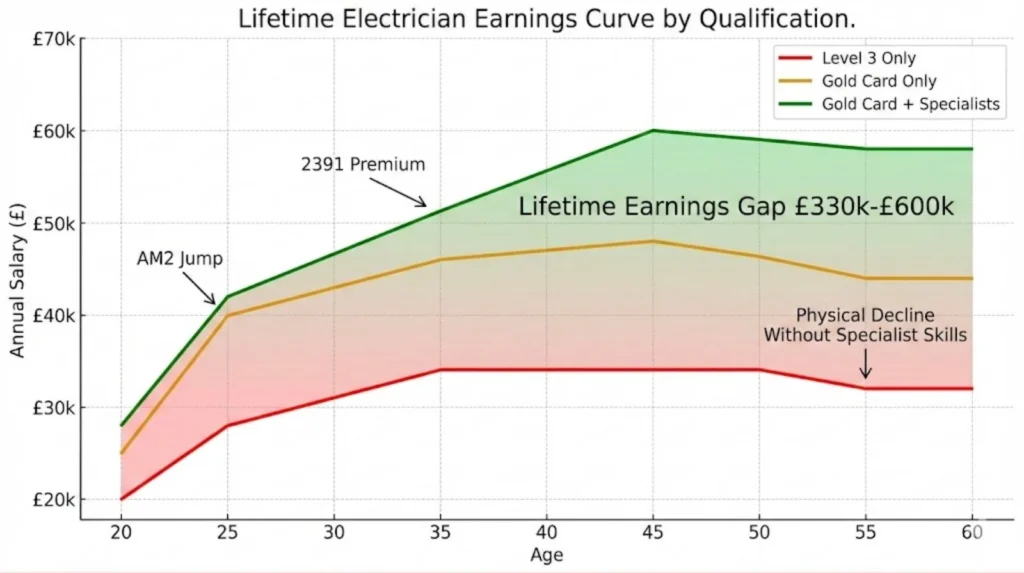
Where you end up at 50 depends entirely on which qualifications you completed at 25.
Age 18-21 (Apprentice / Early Training)
Typical earnings: £8,000 to £18,000 annually depending on apprenticeship year
Qualification pathway: Level 2 → Level 3 → NVQ enrolment
Financial reality: Low earnings but employer-funded training. No tuition debts. Progressive wage increases built into apprenticeship frameworks.
Age 21-24 (Improver / Mate / NVQ Completion)
Typical earnings: £24,000 to £30,000 annually
Qualification pathway: NVQ portfolio building → AM2 preparation
Critical decision point: Adult learners who stop at Level 3 without completing NVQ get stuck in this earnings band indefinitely. Apprentices and committed learners progress to Gold Card by age 23 to 25.
Age 25-35 (Gold Card Peak Earning Years)
Typical earnings: £38,000 to £45,000 PAYE, £50,000 to £65,000 CIS/self-employed
Qualification pathway: Gold Card → Add-on training (2391, EV, Solar) → Approved status
Earnings curve: Sharp rise once Gold Card is achieved. This is where training investment pays off most dramatically. Electricians with Gold Card + 2391 at age 30 often out-earn peers by £10,000 to £15,000 annually.
Physical capacity: Peak years for demanding installation work (commercial fit-out, industrial shutdowns). High overtime availability adds £5,000 to £12,000 annually on top of base wages.
Age 35-50 (Plateau vs Specialist Divergence)
Standard installation electricians: Plateau at approximately £42,000 to £48,000 PAYE. Physical toll of daily installation work becomes more challenging. Overtime reduces.
Specialists (Technician/QS/Testing/Industrial): Continue rising to £55,000 to £70,000+ PAYE or £300 to £450 per day CIS. These roles leverage knowledge and experience over physical speed.
The qualification ceiling becomes the earnings ceiling: Electricians who never completed 2391 or progressed beyond Gold Card find themselves competing with younger, fitter electricians for installation work. Those who invested in specialist qualifications move into higher-value, less physical roles.
Age 50+ (Transition to Inspection / Management)
Physical reality: Crawling through lofts, pulling cables, and standing on ladders 8 hours daily becomes unsustainable for most electricians by their 50s.
Qualification-dependent options:
- With 2391 / QS credentials: Move entirely to inspection, testing, and supervision roles. Earnings maintain £50,000 to £60,000+ levels. Physical demands drop significantly.
- Without specialist qualifications: Forced to continue demanding installation work at reduced hours, or exit the trade entirely. Earnings decline.
Why electricians peak later than other trades: ONS data shows electrician earnings peak in the 45-49 age bracket, later than general construction trades (which peak at 35-39). This is because electrical work increasingly rewards knowledge and experience over pure physical capability as careers progress.
Lifetime Earnings Comparison
Scenario A: Stopped at Level 3, No NVQ
- Age 25: £30,000
- Age 35: £34,000
(minimal progression, permanent Improver) - Age 45: £36,000 (wage stagnation)
- Age 55: £32,000 (reduced hours due to physical limitations)
- Lifetime earnings (age 25-55): Approximately £1,020,000
Scenario B: Completed NVQ + AM2, Gold Card Only
- Age 25: £40,000
- Age 35: £45,000
- Age 45: £48,000 (plateau without specialist skills)
- Age 55: £44,000 (reduced hours)
- Lifetime earnings (age 25-55): Approximately £1,350,000 (+£330,000 vs Scenario A)
Scenario C: Gold Card + 2391 + Specialist Training
- Age 25: £42,000
- Age 35: £52,000 (Approved + specialist roles)
- Age 45: £60,000 (Technician / QS / Testing focus)
- Age 55: £58,000 (inspection-focused, sustainable hours)
- Lifetime earnings (age 25-55): Approximately £1,620,000 (+£600,000 vs Scenario A)
CITB research confirms: NVQ completers earn approximately 20% more over their lifetime compared to Level 3-only holders. The qualification investment (£8,000 to £12,000) pays back within 18 to 24 months and continues compounding for 30+ years.
Sector & Niche Differences: Where Training Pays Most
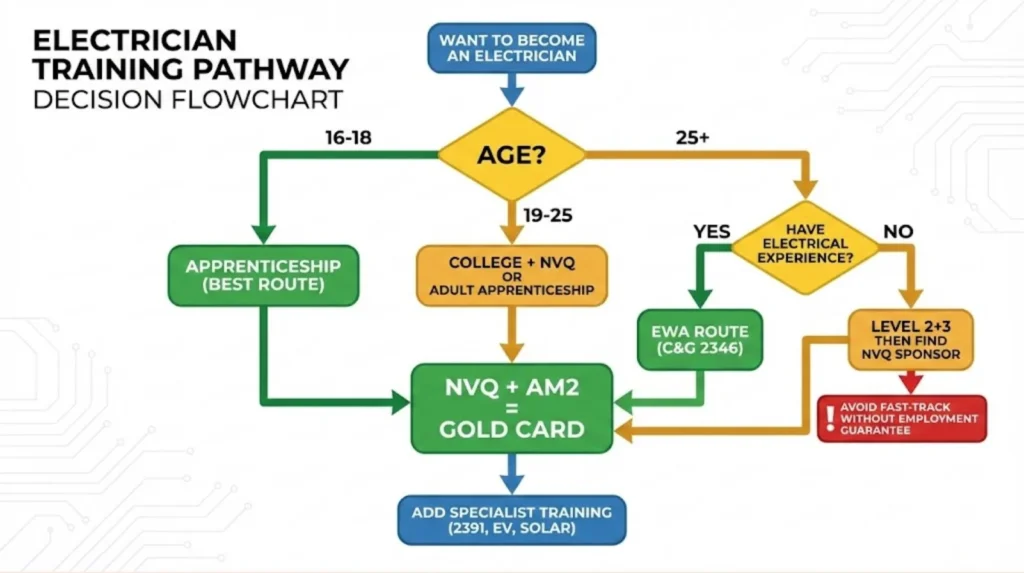
Different sectors reward qualifications differently. Understanding which niches value training most helps you target specialist certifications strategically.
Domestic Installation
Typical qualifications: Gold Card minimum, 18th Edition, often 2391 for EICR work
Specialist additions: EV charging (C&G 2919), Solar PV (C&G 2399), Battery storage
Pay range: £35,000 to £45,000 PAYE, £220 to £300 per day CIS (national), £280 to £350 (London)
Training value: Moderate. Basic Gold Card gets you entry. Specialist green energy certifications add £40 to £80 per day for self-employed work but minimal uplift for PAYE domestic roles.
Career trajectory: Flat unless you build a business. Experienced domestic electricians earn similar amounts at age 35 and age 50 unless they transition to business ownership or move into commercial work.
Commercial (Office / Retail / Fit-Out)
Typical qualifications: Gold Card, 18th Edition, often 2391 for larger contractors
Specialist additions: Emergency lighting, fire alarm (BS 5839), access control systems
Pay range: £40,000 to £50,000 PAYE, £240 to £320 per day CIS
Training value: Moderate to high. Standard JIB rates apply. 2391 qualification often required for senior roles in M&E contractors. Specialist systems training (fire alarms, access control) can add £3,000 to £5,000 annually PAYE.
Career trajectory: Clear progression routes. Electrician → Approved → Technician → QS → Project Manager. Training is rewarded with defined pay grades.
Industrial (Factories / Manufacturing / Plants)
Typical qualifications: Gold Card, 18th Edition, 2391 Testing essential
Specialist additions: COMPEX (explosive atmospheres), HV authorised person, 3-phase expertise, PLC understanding, SCADA systems knowledge
Pay range: £45,000 to £60,000 PAYE (with shift allowances), £280 to £450 per day CIS
Training value: High. Industrial work rewards specialist qualifications more than any other sector. COMPEX adds £4,000 to £6,000 annually. HV authorisation adds £8,000 to £12,000. Shutdown overtime can add £10,000+ annually.
Career trajectory: Steep progression for those with specialist training. Industrial Technicians and QS roles routinely earn £60,000 to £75,000 PAYE.
Why industrial rewards training most: Complex systems, safety-critical environments, and 24/7 operations mean employers pay premium wages for proven competence. Industrial sites cannot tolerate incompetence, so qualifications are strictly enforced and financially rewarded.
Data Centres
Typical qualifications: Gold Card, 18th Edition, 2391, often security clearance (SC level)
Specialist additions: HV switching, UPS systems, generator maintenance, structured cabling
Pay range: £50,000 to £70,000+ PAYE, £350 to £600 per day CIS for commissioning and specialist roles
Training value: Highest. Data centre electrical work is the highest-paid standard electrical work in the UK. Commissioning engineers with right qualifications and security clearance command £450 to £600 per day CIS consistently.
Barriers to entry: Requires 3+ years’ experience in data centre environments, security clearance (which can take 6 to 12 months to obtain), and specialist qualifications beyond Gold Card.
Career trajectory: Rapid progression for those who break in. Data centre electricians at age 30 often earn more than commercial QS roles at age 50.
Rail / Utilities / Infrastructure
Typical qualifications: Gold Card, 18th Edition, 2391
Specialist additions: PTS (Personal Track Safety for rail), Sentinel (for certain infrastructure work), DNO authorisation (for utilities), HV switching
Pay range: £45,000 to £65,000 PAYE, £300 to £450 per day CIS
Training value: High. Specialist cards and authorisations are strict barriers to entry but unlock consistent high-paying work. Rail electricians with PTS and HV authorisation routinely earn £55,000 to £65,000 PAYE.
Career trajectory: Stable with good pension contributions (especially utilities and rail operators). Less dramatic earnings peaks than data centres but better long-term security.
Renewables (Solar / Wind / Battery Storage)
Typical qualifications: Gold Card, 18th Edition, often 2391
Specialist additions: Solar PV (C&G 2399), MCS registration, battery storage, EV charging (C&G 2919), wind turbine electrical systems
Pay range: £40,000 to £55,000 PAYE, £280 to £400 per day CIS (solar/battery specialists)
Training value: High for self-employed, moderate for PAYE. Solar and battery specialists working CIS can command £350 to £400 per day during peak demand periods. PAYE roles in renewables firms offer £42,000 to £50,000.
Market volatility: Government policy heavily influences demand. Subsidy changes can create boom-bust cycles. Currently high demand (2024-2025), but this may stabilize as market matures.
Career trajectory: Growing sector. Electricians who established themselves in renewables 5 to 10 years ago are now running successful businesses earning £80,000 to £120,000+ annually.
Testing & Inspection (EICR Focus)
Typical qualifications: Gold Card, 18th Edition, 2391 essential
Specialist additions: Thermal imaging, PAT testing, emergency lighting testing
Pay range: £42,000 to £52,000 PAYE, £250 to £350 per day CIS (testing-only work)
Training value: High. The 2391 qualification is the gatekeeper. Testing specialists can build careers focused entirely on inspection with minimal physical installation work.
Career trajectory: Sustainable long-term. Testing work is less physically demanding than installation, making it ideal for electricians aged 45+. Earnings remain stable throughout career.
Market demand: Extremely high due to landlord EICR compliance requirements. Testing electricians report consistent year-round work with minimal seasonal variation.
Myths & Misunderstandings to Debunk
The electrical training market is full of misleading information. Here’s what’s actually true.
Myth: “Level 3 Diploma makes you a qualified electrician.”
Reality: False. According to JIB, ECS, and IET definitions, you are a Trainee or Improver. You need NVQ Level 3 + AM2 for qualified status. Job adverts requiring “qualified electrician” mean Gold Card holders, not Level 3 Diploma holders.
Myth: “You don’t need an NVQ or AM2 if you have enough experience.”
Reality: Partially true for domestic self-employed work, but false for commercial and industrial employment. Card-controlled sites require ECS Gold Cards for access. Insurance companies require competence certification. Building Safety Act post-Grenfell tightened competence definitions, making experience-only routes increasingly difficult.
Myth: “Gold Card guarantees £50,000+ earnings.”
Reality: False. National average for Gold Card electricians is £40,000 to £45,000 PAYE. London and specialist sectors (data centres, industrial) push this higher, but standard domestic or commercial electricians earn closer to £38,000 to £44,000 depending on region.
Myth: “2391 Testing qualification doubles your wage.”
Reality: Exaggerated. It adds £3 to £5 per hour PAYE (£6,000 to £10,000 annually) or £50 to £100 per day CIS. Significant, but not double. The “doubles wage” claim comes from electricians who moved from installation work at £220/day to specialist testing work at £300/day, which is a 36% increase, not 100%.
Myth: “Fast-track courses are equivalent to apprenticeships.”
Reality: False. Fast-track courses deliver Level 2 and Level 3 Diplomas (knowledge only). Apprenticeships deliver integrated knowledge + competence (NVQ) over 3 to 4 years with employer support throughout. Employers heavily prefer apprenticeship-trained electricians and pay accordingly.
Myth: “You can’t get a Gold Card through adult training routes.”
Reality: False. The Experienced Worker Assessment route (C&G 2346) and standard NVQ 2357 pathway are both open to adult learners. It’s harder than apprenticeships because you need employer sponsorship for portfolio building, but thousands of career-changers complete it successfully every year.
Myth: “Once you’ve passed AM2, you don’t need any more training.”
Reality: False. BS 7671 updates every 3 to 5 years require re-certification (18th Edition now, 19th Edition expected 2026/2027). Industry changes (EV, solar, battery storage, smart homes) require ongoing CPD. Employers increasingly expect continuous learning.
Myth: “All electrician training courses lead to the same outcome.”
Reality: False. Courses vary dramatically in quality, content, and employer recognition. Fast-track providers compress Level 2/3 into weeks. Colleges and apprenticeship programmes spread the same content over years with hands-on practice. The certificate might look similar, but employer perception and your actual competence differ enormously.
What This Means for Your Training Decisions
Understanding how training affects pay helps you avoid expensive mistakes and plan strategically.
If you’re considering fast-track courses: Ask yourself whether you have a guaranteed employer who will sponsor your NVQ portfolio after Level 3. If not, you risk spending £5,000 to £8,000 on qualifications that get you stuck at Improver wages (£28,000 to £34,000) for years. Apprenticeships or college routes with built-in work placement are safer pathways.
If you’re currently stuck at Level 3 without NVQ: Your priority is finding an employer who will sponsor portfolio building or paying for Experienced Worker Assessment. Every year you delay costs approximately £6,000 in lost earnings (the difference between Improver and Gold Card wages).
If you have your Gold Card: The highest-return investment is 2391 Inspection & Testing. This single qualification unlocks £6,000 to £10,000 additional annual earnings and creates sustainable career options for age 45+.
If you’re choosing between PAYE and CIS: Specialist qualifications (EV, solar, testing) deliver 3x to 5x higher returns in CIS than PAYE. If you plan to invest in post-Gold Card training, CIS or self-employment maximizes financial returns.
If you’re planning long-term: The electricians earning £60,000+ at age 45 all invested in specialist training beyond Gold Card. Those who stopped at basic qualification plateau at £42,000 to £48,000 and face physical limitations by their 50s.
For the comprehensive guide to how JIB grading and qualifications determine electrician pay, we’ve covered the 2026-28 wage deal and regional variations, but qualification progression is what determines your personal ceiling within those structures.
Call us on 0330 822 5337 to discuss realistic training pathways based on your current situation. We’ll explain exactly which qualifications you need, how long each takes, and what our in-house recruitment team sees in terms of actual job opportunities for different qualification levels. No hype about “qualified in 5 weeks.” No unrealistic £50,000 first-year earnings claims. Just honest guidance about training routes that actually lead to employment, and what that employment realistically pays at each stage.
For a complete picture of how the JIB deal affects different qualification levels, see our complete analysis of the 2026-28 JIB deal and its impact on training pathway earnings.
References
- JIB (Joint Industry Board) – Wage Rates 2025 & Grading Handbook – https://www.jib.org.uk/wage-rates/
- City & Guilds – Qualification Specifications (2365, 2357, 5357, 2346, 2391) – https://www.cityandguilds.com/qualifications-and-apprenticeships/
- NET (National Electrotechnical Training) – AM2 Assessment Criteria & Pass Rates – https://www.neteltc.co.uk/
- IET (Institution of Engineering and Technology) – BS 7671:2018+A2:2022 Wiring Regulations – https://electrical.theiet.org/bs-7671/
- EAS (Electrotechnical Assessment Specification) 2024 Update – Competence Requirements for Qualified Supervisor Roles – https://www.jib.org.uk/eas/
- CITB (Construction Industry Training Board) – Construction Skills Network Report 2024-2028, Electrical Workforce Analysis – https://www.citb.co.uk/about-citb/construction-industry-research-reports/
- Indeed UK – Electrician Salary Data (November 2024 to January 2025) – https://uk.indeed.com/career/electrician/salaries
- Reed UK – Electrician Job Market Analysis & Salary Benchmarks 2025 – https://www.reed.co.uk/average-salary/average-electrician-salary
- Glassdoor UK – Electrician, Approved Electrician, Technician Salary Reports – https://www.glassdoor.co.uk/Salaries/electrician-salary-SRCH_KO0,11.htm
- Reddit r/ukelectricians – Community Discussions on Training Routes, Pay Progression, and Employer Experiences (2023-2025) – https://www.reddit.com/r/ukelectricians/
- ElectriciansForums.net – Pay Discussions, Training Route Debates, Employer Feedback (2023-2025) – https://www.electriciansforums.net/
- Building Safety Act 2022 – Competence Requirements Post-Grenfell – https://www.gov.uk/government/collections/building-safety-bill
- Department for Education – Apprenticeship Funding and Standards (Electrotechnical) – https://www.gov.uk/government/publications/apprenticeship-funding
Note on Accuracy and Updates
Last reviewed: 27 November 2025. This page is maintained; we correct errors and refresh sources as JIB wage rates, qualification pathways, employer requirements, and training regulations change. Pay data based on JIB 2025 rates, ONS ASHE 2024 provisional release, and job market analysis Q4 2024 to Q1 2025. Qualification requirements based on ECS competence criteria November 2025, City & Guilds specifications, and EAS 2024 update. Next review scheduled following JIB 2026 wage agreement implementation (January 2026) and ECS card requirement updates.
