

Is Domestic-Only Electrical Work Enough? Pros, Cons & Long-Term Earnings

- Technical review: Thomas Jevons (Head of Training, 20+ years)
- Employability review: Joshua Jarvis (Placement Manager)
- Editorial review: Jessica Gilbert (Marketing Editorial Team)
- Last reviewed:
- Changes: Updated EAS 2024-2026 compliance requirements and JIB 2025 wage data
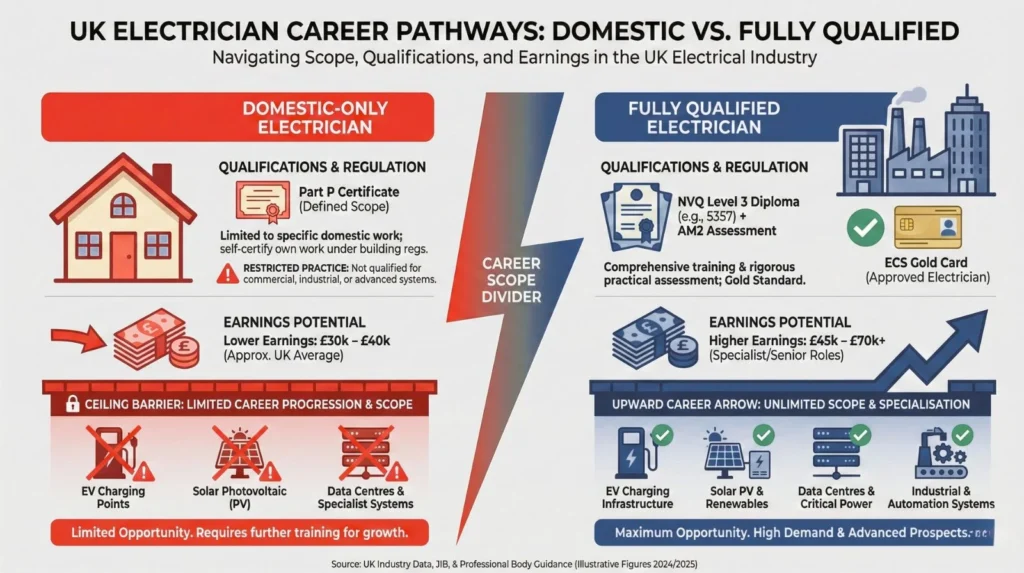
The UK electrical industry operates on a two-tier system that most new entrants don’t fully understand until they’ve already committed to a route. On one side sits domestic-only electrical work, accessible through short courses and Part P registration schemes, allowing quick entry into residential rewires, consumer unit changes, and landlord certificates. On the other sits full-scope commercial and industrial work requiring NVQ Level 3, AM2 assessment, and ECS Gold Card status.
The choice between these paths shapes your earning potential, job security, and career mobility for decades. Domestic-only routes promise faster entry and independence but create qualification ceilings that limit access to higher-paid sectors. Full-scope routes require longer training but unlock every electrical job in the UK economy, from £200 daily domestic work to £450 daily industrial commissioning roles.
Understanding structured electrical training routes means recognising how this decision affects you in 2030, not just 2026. This article breaks down what domestic-only actually means legally, what it pays compared to commercial and industrial work, and why regulatory changes coming in October 2026 are forcing many domestic electricians to reconsider their qualification status.
What Domestic-Only Actually Means (Legal & Scheme Reality)
First, clarity: “domestic-only electrician” isn’t a formal qualification category in UK law. It’s a label used by Competent Person Schemes like NICEIC, NAPIT, and ELECSA to describe operatives registered for self-certification under Part P of Building Regulations in England and Wales.
Domestic-only work covers electrical installations in dwellings: full or partial house rewires, kitchen and bathroom extensions, consumer unit replacements, EV home charger installations, and Electrical Installation Condition Reports for landlords. The scope legally ends at the boundary of residential properties. Commercial premises like shops, offices, or industrial sites require different competence demonstrations.
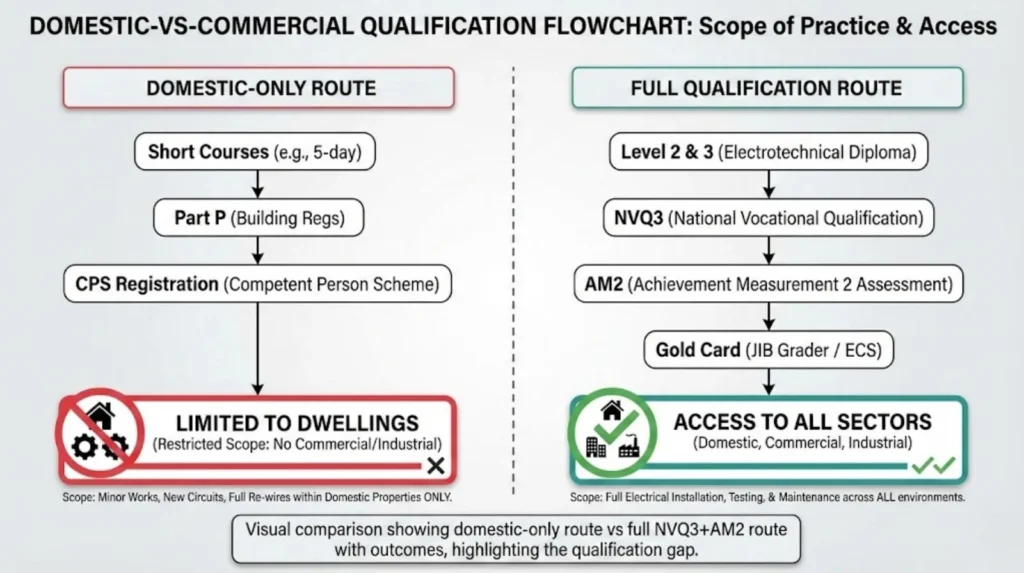
The qualification gap matters. Domestic Installer registration typically requires 18th Edition BS 7671, basic inspection and testing knowledge (often City & Guilds 2391), and membership in a Competent Person Scheme. Crucially, this route often bypasses NVQ Level 3 and the AM2 end-point assessment that demonstrate broader competence.
Commercial electrical work includes offices, schools, hospitals, retail units, and local authority buildings. Typical tasks involve lighting systems, low-voltage distribution, containment (steel conduit, cable tray, trunking), fire alarm installations, and commercial EV charging infrastructure. Industry expectation is NVQ Level 3 in Electrotechnical Installation, AM2 assessment, and ECS Gold Card (Installation Electrician grade).
Industrial electrical work operates in factories, process plants, utilities, data centres, and infrastructure projects. Work includes industrial controls, automation systems, motor drives, high-voltage exposure, and substation maintenance. Qualifications mirror commercial requirements but often need additional endorsements for HV authorization or CompEx (hazardous areas).
The key distinction: a “fully qualified electrician” in UK industry terms means someone holding NVQ Level 3 plus AM2 plus ECS Gold Card. This credential enables work across all three sectors. Domestic-only routes interact with this standard but remain restricted. You cannot obtain an ECS Installation Electrician Gold Card through domestic-only experience without additional evidence from commercial or industrial sites.
BS 7671 (18th Edition Wiring Regulations) and the Electricity at Work Regulations 1989 apply universally regardless of sector. However, the Electrotechnical Assessment Specification (EAS) 2024 emphasizes demonstrated competence across multiple installation types. Domestic-only work, whilst entirely legal and valuable, doesn’t satisfy the breadth requirements that define “qualified electrician” in JIB grading structures or ECS card criteria.
Pay & Earnings Comparison (What Each Route Actually Delivers)
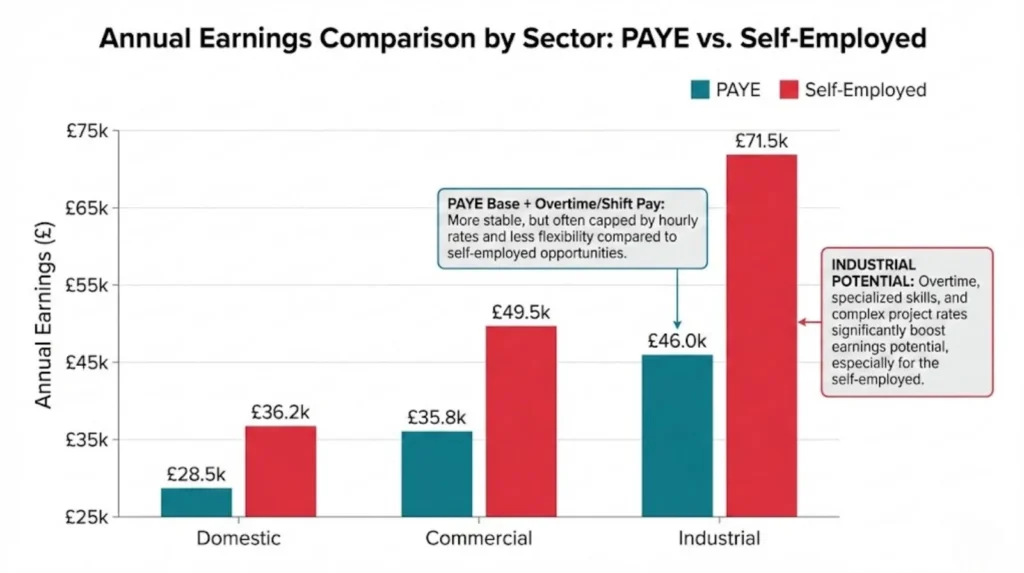
The earnings difference between domestic-only and full-scope electricians shows most clearly when you separate PAYE employment from self-employment and account for regional variations.
PAYE Employment Earnings
Domestic-only electricians employed by house builders, social housing contractors, or electrical firms specializing in residential work typically earn £30,000-£40,000 annually across most of the UK. London and South East positions push this to £35,000-£45,000. These roles often include company vans and fuel cards, and some offer bonuses for high-volume EICR completion.
Commercial electricians in PAYE positions average £35,000-£50,000 nationally, rising to £40,000-£55,000 in London and South East regions. The base salary reflects higher complexity work, and most positions operate on 37.5-hour standard weeks with overtime paid at time-and-a-half or double time.
Industrial electricians employed in factories, utilities, or process plants earn £36,000-£47,000 base salaries, reaching £42,000-£52,000 in higher-cost regions. The critical difference is overtime availability. Industrial environments often run 24-hour operations with shift premiums, weekend rates, and callout payments pushing total annual earnings past £60,000-£70,000 for willing workers.
The 2025 JIB (Joint Industry Board) minimum rates effective January 6, 2025, set wage floors for commercial and industrial work in England, Wales, and Northern Ireland:
Electrician (base grade): £16.31/hour (£33,925 annually)
Approved Electrician: £17.90/hour (£37,232 annually)
Technician: £20.43/hour (£42,494 annually)
London rates add 12-15% to these figures. Scotland follows SJIB rates with slight variations. Critically, domestic-only work has no equivalent wage protection mechanism. Earnings depend entirely on market rates and business negotiation.
Self-Employed & CIS Day Rates
Self-employment amplifies earning differences. Domestic-only electricians working as sole traders report day rates of £200-£350, though this varies dramatically based on work type, client base, and regional competition. High-volume EICR work for landlords might yield £150-£200 daily, whilst complex rewires in high-end properties reach £300-£350. The challenge is consistency and business development skills.
Commercial and industrial self-employed electricians or CIS subcontractors working through agencies typically command £250-£400 daily (£23-£28/hour), with specialists in commissioning, BMS (building management systems), or data centres reaching £350-£450 daily. These rates often include site allowances and accommodation provisions for projects requiring travel.
| Category | PAYE Annual (UK Average) | PAYE Annual (London/SE) | Self-Employed Day Rate | Key Earnings Factors |
| Domestic-Only | £30,000-£40,000 | £35,000-£45,000 | £200-£350 | Highly variable, depends on business skills and market saturation |
| Commercial | £35,000-£50,000 | £40,000-£55,000 | £250-£400 | JIB minimums protect floor, overtime adds 15-25% |
| Industrial | £36,000-£47,000 | £42,000-£52,000 | £300-£450 | Shift premiums and callouts push total past £60k-£70k |
The pattern is consistent: domestic-only work establishes a lower earnings floor and a lower ceiling. Commercial and industrial pathways provide higher base salaries, structured pay progression through JIB grades, and substantially higher earning potential through overtime and specialist work.
Joshua Jarvis, Placement Manager:
"The domestic electricians in our network who report the highest earnings are almost always the ones who hold full Gold Card qualifications but choose to focus on residential work. They're billing £300-£400 daily for high-end installations because they can handle everything including commercial-grade systems in large homes. Domestic-only operatives compete in a saturated market where customers shop purely on price. The qualification difference directly impacts your negotiating position."
Joshua Jarvis, Placement Manager
Long-Term Job Security & Market Resilience
Job security separates along two fault lines: cyclical vulnerability and access to growth sectors.
Domestic-only electrical work ties directly to housing market conditions and consumer spending confidence. During the 2020-2022 housing slowdown, domestic contractors reported 5-10% job reductions according to IBISWorld industry analysis. Homeowners defer non-essential work like garden lighting, whole-house rewires, or high-end automation when mortgage rates rise or property values stagnate. Landlords continue EICRs due to legal requirements, but price pressure intensifies as competition increases.
Commercial and industrial work demonstrates greater resilience. Institutional clients including government bodies, schools, hospitals, and utilities operate on multi-year capital budgets less sensitive to short-term economic shifts. Infrastructure projects like National Grid upgrades, data centre construction, and renewable energy installations proceed regardless of housing market conditions.
Joshua Jarvis, Placement Manager:
"During the 2020-2022 period when the housing market slowed, we had domestic-only electricians contacting us desperately trying to pivot into commercial work because residential jobs dried up. The problem was they couldn't access commercial sites without Gold Cards, and they couldn't get Gold Cards without commercial evidence. They were stuck. The electricians with full qualifications just shifted focus and kept working. That's the security difference."
Joshua Jarvis, Placement Manager
The CITB Construction Skills Network forecasts requiring 47,860 additional construction workers annually through 2029, with electricians designated a priority occupation. However, growth rates differ by sector. Commercial and industrial electrical roles are projected to grow 15-20% through 2030 compared to 10% for domestic work.
The green economy factor amplifies this gap. Government net-zero commitments create substantial demand for electrical work in:
Large-scale EV charging infrastructure (motorway services, fleet depots, commercial car parks)
Industrial solar PV installations and battery storage systems
Data centres supporting AI and cloud computing expansion (M4 corridor, London Docklands)
Heat pump installations in commercial buildings and social housing
Grid infrastructure upgrades for renewable energy integration
Most of these opportunities sit in commercial or industrial categories. Domestic EV chargers and residential solar panels create work for domestic electricians, but the volume and value concentrates in larger-scale non-domestic projects.
Department for Energy Security and Net Zero projections estimate 400,000 green jobs by 2030, including substantial electrical roles. Evidence suggests commercial and industrial electricians with appropriate endorsements (EV, renewables, BMS) position themselves for the highest-value opportunities in this transition.
The Gold Card Trap (Why Domestic-Only Limits Mobility)
Here’s the professional ceiling that catches domestic electricians unexpectedly: most commercial and industrial employers require ECS Gold Card status before offering employment or site access. The card functions as an industry passport proving competence.
To obtain an ECS Installation Electrician Gold Card, you must hold NVQ Level 3 in Electrotechnical Installation plus successful AM2 assessment. The NVQ portfolio requires photographic and assessor-observed evidence across multiple competence units including:
Containment systems (steel conduit, PVC/steel trunking, cable tray, basket tray)
Three-phase installations and distribution
Large distribution board modifications
Commercial testing procedures
Site-based installation work under supervision
The evidence gap creates the trap. Domestic-only experience covers twin-and-earth cable installations, consumer units, socket circuits, lighting circuits, and single-phase work. These provide evidence for some NVQ units but not others. You cannot photograph containment work you’ve never done. You cannot demonstrate three-phase competence from houses with single-phase supplies.
When domestic electricians attempt to transition into commercial work, they hit this barrier immediately. Recruitment agencies and contractors check ECS cards first. Without Gold Card status, applications don’t proceed regardless of years of domestic experience. Employers don’t have time to individually assess competence when the card system provides standardized verification.
The Experienced Worker Assessment (EWA) route (City & Guilds 2346/2347) offers a bridge for electricians with 3-5+ years of trade experience but lacking formal qualifications. The process costs £1,750-£2,200 including portfolio assessment and AM2E examination, plus potential gap training costs of £400-£800 for 18th Edition or Inspection & Testing if needed.
However, EWA still requires commercial evidence. If your entire career involves domestic houses, you must actively seek commercial work to gather the necessary portfolio content. This creates a Catch-22: you need commercial employment to get commercial evidence, but you need commercial evidence to get commercial employment.
The alternative is enrolling in full NVQ Level 3 programmes with guaranteed placement support to gather commercial site evidence whilst training. This extends the qualification timeline but eliminates the gap that traps purely domestic operatives.
Regulatory Changes Reshaping Domestic Work (EAS 2024-2026)
The electrical industry’s regulatory framework is tightening significantly, with implications for domestic-only pathways.
The Electrotechnical Assessment Specification (EAS) updated in late 2024 raises competence requirements across all sectors. The most significant change affects Qualified Supervisors (QS) in any firm, including domestic-only businesses registered with NICEIC, NAPIT, or ELECSA.
Thomas Jevons, Head of Training:
"EAS 2024 raised the bar significantly for Qualified Supervisors. By October 2026, anyone supervising inspection and testing work needs formal Level 3 qualifications, even in domestic-only businesses. The days of running a domestic installation company on Part P courses alone are ending. You'll need proper NVQ credentials or you'll lose your ability to certify work through NICEIC or NAPIT."
Thomas Jevons, Head of Training
By October 2026, Qualified Supervisors responsible for technical standards in electrical firms must hold specific Level 3 Inspection & Testing qualifications. Previous arrangements allowing QS status through experience alone or basic Part P courses are ending. This forces many domestic-only businesses to either upskill their supervisory staff to full NVQ Level 3 standards or lose Competent Person Scheme membership.
Without CPS membership, domestic electricians cannot self-certify notifiable work under Part P. Every consumer unit change, new circuit, or alteration to special locations requires Building Control notification at £200-£400 per job, destroying project profitability. The economic pressure to gain proper qualifications becomes unavoidable.
This regulatory tightening closes what was previously a “low-qualification” entry point into domestic electrical work. The industry is converging toward a single standard: NVQ Level 3 competence regardless of sector focus.
What UK Electricians Actually Say (Forum Evidence)
What UK Electricians Actually Say (Forum Evidence)
Real-world experiences from UK electrician forums reveal consistent patterns about domestic-only versus commercial/industrial work.
Flexibility and independence dominate domestic-only advantages. Multiple electricians praise setting their own schedules, working locally without commuting, and avoiding corporate bureaucracy. One Reddit r/ukelectricians contributor noted:
"I've been domestic-only for 5 years, love the local jobs and setting my own hours, but pay tops out at £40k self-employed; commercial guys I know make £50k+ with overtime."
Customer stress and payment issues appear repeatedly as domestic-only frustrations. Several forum members describe exhausting interactions with homeowners who watch work constantly, change specifications mid-project, or delay payments. One electrician summarized:
"Regret staying domestic; weekends dealing with picky homeowners, no real progression. Switched to commercial sites last year, pay up 25%, more stable contracts."
The earnings ceiling confirms statistical data. Numerous posts report domestic-only electricians reaching £35,000-£45,000 and struggling to progress further without transitioning sectors or developing high-value niches like smart home automation or high-end audio-visual integration.
Security motivates sector transitions. Multiple electricians who switched from domestic to commercial or industrial cite job stability as the primary driver. One noted:
"From domestic to industrial maintenance: better job security, JIB rates add bonuses, but longer hours and travel. Worth it for £45k vs £35k."
Another highlighted resilience:
"Domestic is fine if you're self-employed—EV chargers pay well (£300-£500/job), less bureaucracy than industrial. But housing market dips hit hard in 2022."
Commercial work receives mixed reviews. Several electricians describe commercial sites as repetitive, spending weeks or months on identical tasks like LED panel installations or conduit runs. Some prefer domestic work specifically for variety and problem-solving challenges. One stated:
"Commercial is just bashing conduit and tray for weeks. You become an installer, not an electrician. In domestic, you have to think; fault finding in an old house is a real skill."
Qualification barriers feature prominently. Multiple threads discuss domestic electricians unable to access commercial opportunities without Gold Cards, confirming the mobility ceiling. One summarized:
"Domestic-only is oversaturated; everyone with a short course competes on price. Commercial needs proper quals but opens doors to data centres."
Domestic-Only: Pros, Cons & Trade-Offs
Advantages of Domestic-Only Focus
Faster qualification entry. Short courses covering Part P, 18th Edition, and basic inspection/testing allow market entry within 6-12 months compared to 3-4 year apprenticeships. Initial costs remain lower for tools and equipment since domestic work typically requires smaller tool kits and no commercial-grade test equipment initially.
Flexibility and autonomy. Self-employed domestic electricians control their schedules, choose clients, and operate locally without commuting to distant sites. This appeals particularly to people with family commitments or those valuing work-life balance over maximum earnings.
Niche specialization opportunities. High-volume EICR work for landlords, EV home charger installations, smart home integration, and residential solar PV additions create profitable niches. Electricians who develop strong reputations in upmarket residential areas can command premium rates of £300-£400 daily.
Lower business overhead. Small vans suffice for domestic work, tool requirements stay manageable, and marketing focuses on local areas through word-of-mouth, Google Business listings, and platforms like Checkatrade rather than expensive commercial tendering.
Disadvantages of Domestic-Only Routes
Clear earnings ceiling. Statistical evidence consistently shows domestic-only electricians topping out at £35,000-£40,000 PAYE or £40,000-£50,000 self-employed. Commercial and industrial pathways offer 15-25% higher ceilings with overtime and specialist roles pushing past £60,000-£70,000.
Market saturation and price pressure. The proliferation of short-course training creates intense competition in domestic markets. Customers shop primarily on price for straightforward jobs like consumer unit changes or additional sockets, driving margins down.
No structured progression. Unlike JIB routes offering defined grades (Electrician → Approved Electrician → Technician) with corresponding pay increases, domestic-only work provides no career ladder. You start as an improver, become a domestic installer, and remain there unless you transition sectors or build a business empire.
Cyclical vulnerability. Housing market downturns, consumer confidence collapses, and interest rate rises directly reduce domestic electrical spending. Commercial and industrial work tied to infrastructure and institutional budgets shows greater recession resilience.
Limited access to green economy. Large-scale EV infrastructure, industrial solar farms, grid-tied battery storage, and commercial heat pump installations concentrate in commercial/industrial sectors. Domestic electricians access residential versions of these technologies but miss the highest-value opportunities.
EAS 2026 compliance pressure. Regulatory changes forcing NVQ Level 3 standards for Qualified Supervisors mean domestic-only routes no longer avoid formal qualification requirements. The path previously offering “quick entry without full apprenticeship” is narrowing.
Commercial & Industrial Advantages
Higher earning floors and ceilings. JIB minimum rates protect against market undercutting, and overtime provisions create earning potential 20-40% above base salaries. Industrial shift work, callouts, and specialist endorsements push total compensation substantially higher than domestic-only maximums.
Structured career progression. Clear pathways exist from Electrician to Approved Electrician, Technician, Qualified Supervisor, and into specialized roles like BMS engineer, commissioning specialist, or HV-authorized personnel. Each step brings meaningful pay increases.
Industry demand and long-term security. Data centres, renewable energy infrastructure, industrial automation, and utilities modernization create sustained demand for commercial/industrial electricians. Government net-zero commitments guarantee decades of work in these sectors.
Professional development opportunities. Access to advanced training in building management systems, industrial controls, HV switching, and automation technologies unavailable in purely domestic contexts.
Commercial & Industrial Disadvantages
Longer commutes and travel requirements. Major projects concentrate in cities, industrial estates, and specific regions. Electricians often travel 1-2 hours each way or work away from home for extended periods.
Less autonomy. Working for contractors or directly employed by facilities means following instructions, adhering to site rules, and operating within corporate hierarchies rather than calling your own shots.
Repetitive tasks on large projects. Commercial sites often involve weeks or months performing identical work (installing hundreds of LED panels, running kilometers of containment) rather than the variety domestic work offers.
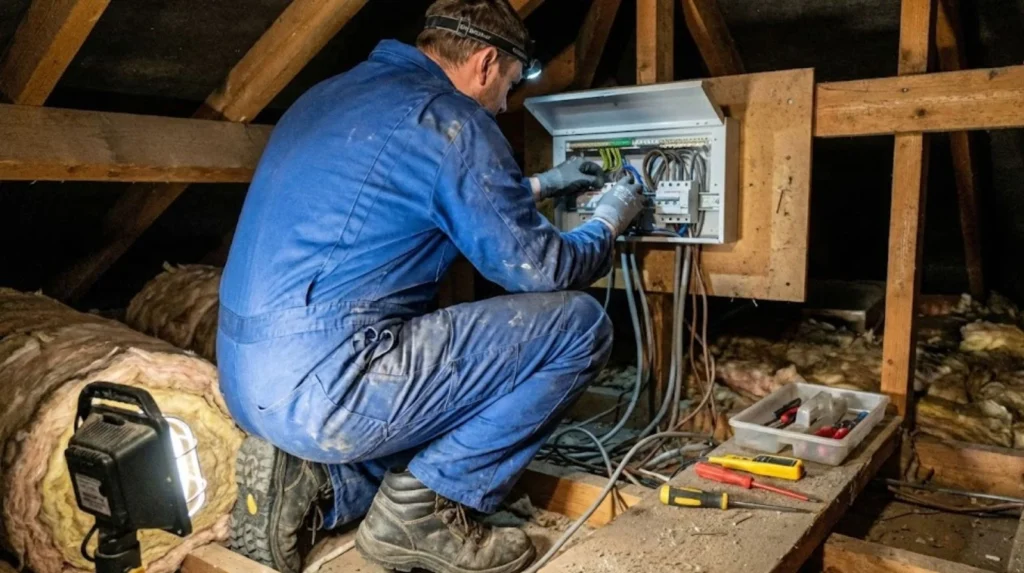
Site conditions. Whilst commercial sites generally provide better access equipment and welfare facilities than crawling through domestic lofts, they can involve working in difficult industrial environments, extreme temperatures, or hazardous areas.
Myths vs Reality About Domestic-Only Work
Myth: Domestic-only electricians earn as much as commercial/industrial electricians.
Reality: Possible in short bursts or through specialized niches, but consistently false. Statistical evidence shows 10-20% earnings gaps favoring commercial and industrial work, with the gap widening when comparing total compensation including overtime, shift premiums, and benefits. Self-employed domestic electricians can match commercial earnings if they develop premium client bases and high-value specializations, but this represents exceptional performance rather than typical outcomes.
Myth: You don’t need NVQ Level 3 or AM2 if you only do domestic work.
Reality: True historically, but increasingly misleading. EAS 2024 revisions requiring Level 3 qualifications for Qualified Supervisors by October 2026 force domestic-only businesses toward full NVQ standards. Additionally, lacking Gold Card status prevents sector mobility if domestic markets contract. The “shortcut” domestic route is disappearing as regulation tightens.
Myth: Domestic electrical work is easier and safer than commercial or industrial.
Reality: Partially true regarding high-voltage exposure and major industrial hazards, but misleading overall. Domestic work involves physical challenges commercial electricians rarely face: crawling through lofts in extreme temperatures, lifting floorboards, working in confined spaces, and dealing with deteriorated wiring in century-old properties. The safety profile differs but doesn’t objectively favor domestic work. Commercial sites have stricter health and safety enforcement through CDM regulations and site management, potentially creating safer working conditions despite higher-voltage systems.
Myth: There’s no career ceiling if you’re self-employed in domestic work.
Reality: False. Business growth hits natural limits based on how much work one person can complete, regional market size, and price competition. Without employees, revenue caps at daily rates multiplied by working days. With employees, you’ve transitioned into business management rather than electrical work. Furthermore, without full qualifications, you cannot bid on social housing contracts, commercial work, or supervisory roles. The ceiling exists even in self-employment.
The Hybrid Model (Best of Both Worlds)
Evidence increasingly points toward a “hybrid” approach as the optimal strategy: obtain full NVQ Level 3, AM2, and ECS Gold Card qualifications enabling work across all sectors, then operate a business focusing on whichever mix of domestic, commercial, and industrial work best suits your preferences and local opportunities.
This model provides maximum flexibility. During housing market slowdowns, shift toward commercial maintenance contracts or industrial work. When residential markets boom and homeowner confidence runs high, capitalize on high-margin domestic projects. The qualification credential opens every door; you choose which ones to walk through based on economic conditions and personal priorities.
Electricians holding full qualifications but operating primarily in domestic markets report the highest earnings within the residential sector. Their credentials allow them to quote confidently on complex installations, handle commercial-grade systems in large homes, and avoid race-to-bottom pricing competition with under-qualified operators. Customers recognize Gold Card status as quality assurance, justifying premium rates.
The strategic question isn’t “domestic vs commercial/industrial” but rather “restricted competence vs full competence.” Restricting yourself to domestic-only work through short-course qualifications creates professional ceilings you may not notice until external circumstances force career changes. Building full competence through structured NVQ pathways takes longer initially but eliminates those ceilings permanently.
What the Next 5 Years Look Like (2026-2030 Outlook)
Multiple industry trends converge to favor full-scope qualifications over domestic-only routes through 2030.
Renewable energy and net-zero transition will dominate electrical sector growth. Government commitments to decarbonize electricity by 2030, install 600,000 heat pumps annually by 2028, and expand EV charging infrastructure create enormous demand. Most of this work sits in commercial and industrial categories: grid-scale battery storage, commercial solar arrays, fleet charging depots, industrial heat pump installations, and utility infrastructure upgrades.
Data centre expansion driven by AI computing and cloud services is creating sustained demand for commercial and industrial electricians. Major developments in the M4 corridor (Slough, Reading) and London Docklands require specialists in uninterruptible power supplies, cooling systems, BMS integration, and precision electrical distribution. These projects pay premium rates and offer multi-year job security.
Domestic work is evolving toward energy integration. Simple rewires are declining as housing stock modernizes. Growth areas include whole-house energy systems integrating solar PV, battery storage, EV chargers, and smart home controls. Domestic electricians succeeding in 2030 will need technical knowledge approaching commercial complexity: CT-clamp monitoring, demand-side response, and networked device configuration. The gap between “domestic-only” and “commercial-grade skills” is narrowing.
Skills shortages favor qualified electricians. The CITB projects needing 47,860 additional construction workers annually, with electricians prioritized. However, regulatory tightening (EAS 2026) reduces the influx of under-qualified entrants. Electricians holding full NVQ Level 3 credentials position themselves in a seller’s market where employers compete for qualified staff rather than electricians competing for jobs.
Scotland’s devolved approach to skills and apprenticeships creates regional variations, but the fundamental pattern holds: commercial and industrial electrical work aligned with infrastructure investment and net-zero goals offers the strongest long-term security.
The trajectory favors electricians with full qualifications choosing their sector focus strategically rather than electricians trapped in limited sectors by qualification ceilings.
Progression Pathways Matter More Than Starting Points
Whether you begin in domestic work or jump straight into commercial/industrial training matters less than where your qualifications allow you to go long-term. The electrical industry values demonstrated competence through NVQ portfolios, AM2 assessment, and ECS card status above how you arrived at those credentials.
Domestic-only routes work for people prioritizing immediate income, complete independence, and willingness to accept earnings ceilings around £40,000-£45,000. They succeed particularly well for electricians developing specialized niches in high-value residential markets or geographical areas with limited commercial/industrial opportunities.
Full-scope qualification routes through NVQ Level 3 and AM2 deliver higher lifetime earnings, better recession resilience, clearer career progression, and access to the fastest-growing sectors in the UK electrical industry. The 18-24 month timeline through Elec Training’s comprehensive course options including NVQ support, AM2 preparation, and placement guarantees through our in-house recruitment team creates the credential foundation for a 40-year career.
The regulatory environment is tightening. EAS 2026 requirements eliminate previous shortcuts into domestic work without proper qualifications. The market increasingly recognizes Gold Card status as the industry standard regardless of sector. Starting domestic-only made sense when Part P first introduced self-certification in 2005. Twenty years later, the pathway closing rather than expanding.
If you’re considering electrical training or currently working domestic-only and evaluating whether to upskill, understand that the decision affects your 2035 earnings and opportunities as much as your 2026 position. The UK electrical industry is growing, demand is strong, and qualified electricians command respect and excellent compensation. The question is whether you want credentials that open every opportunity or credentials that restrict you to one sector with no escape route when circumstances change.
For guidance on UK-based electrician qualification programmes that deliver full NVQ Level 3, AM2, and Gold Card credentials whilst supporting you through work placements that gather the commercial evidence portfolio you need, call us on 0330 822 5337. We’ll explain exactly what full qualification requires, how long it realistically takes, what you’ll earn at each stage, and how our placement team eliminates the evidence gap that traps domestic-only electricians trying to transition. No hype. No unrealistic promises. Just practical guidance from people who understand the difference between credentials that look good on paper and credentials that actually open doors when you need them to.
References
- Joint Industry Board (JIB) – Wage rates and industrial determinations 2025-2026: https://www.jib.org.uk
- Electrotechnical Certification Scheme (ECS) – Card types and qualification requirements: https://www.ecscard.org.uk
- CITB Construction Skills Network – Industry outlook and demand forecasts 2025-2029: https://www.citb.co.uk
- Department for Energy Security and Net Zero (DESNZ) – Clean energy jobs and green skills: https://www.gov.uk/desnz
- Office for National Statistics (ONS) – Construction and electrical industry wage data: https://www.ons.gov.uk
- Glassdoor – Industrial electrician salary data UK 2025: https://www.glassdoor.com
- Indeed UK – Electrician salary surveys 2025 (commercial and general): https://uk.indeed.com
- Reed – Industrial electrician average salary 2025: https://www.reed.co.uk
- IBISWorld – UK electrician industry analysis and cyclical trends: https://www.ibisworld.com
- Elec Training – NICEIC Qualified Supervisor requirements and EAS updates: https://elec.training/news/
- Checkatrade – Self-employed electrician income data 2025: https://www.checkatrade.com
- Reddit r/ukelectricians and r/electricians – Practitioner experiences and sector comparisons 2023-2025: https://www.reddit.com
Note on Accuracy and Updates
Last reviewed: 15 December 2025. This page reflects current EAS 2024-2026 requirements, JIB wage agreements effective January 2025, and ECS card criteria. We monitor regulatory changes and update content as industry standards evolve. Regional wage data represents 2025 market conditions and varies by employer and location.
